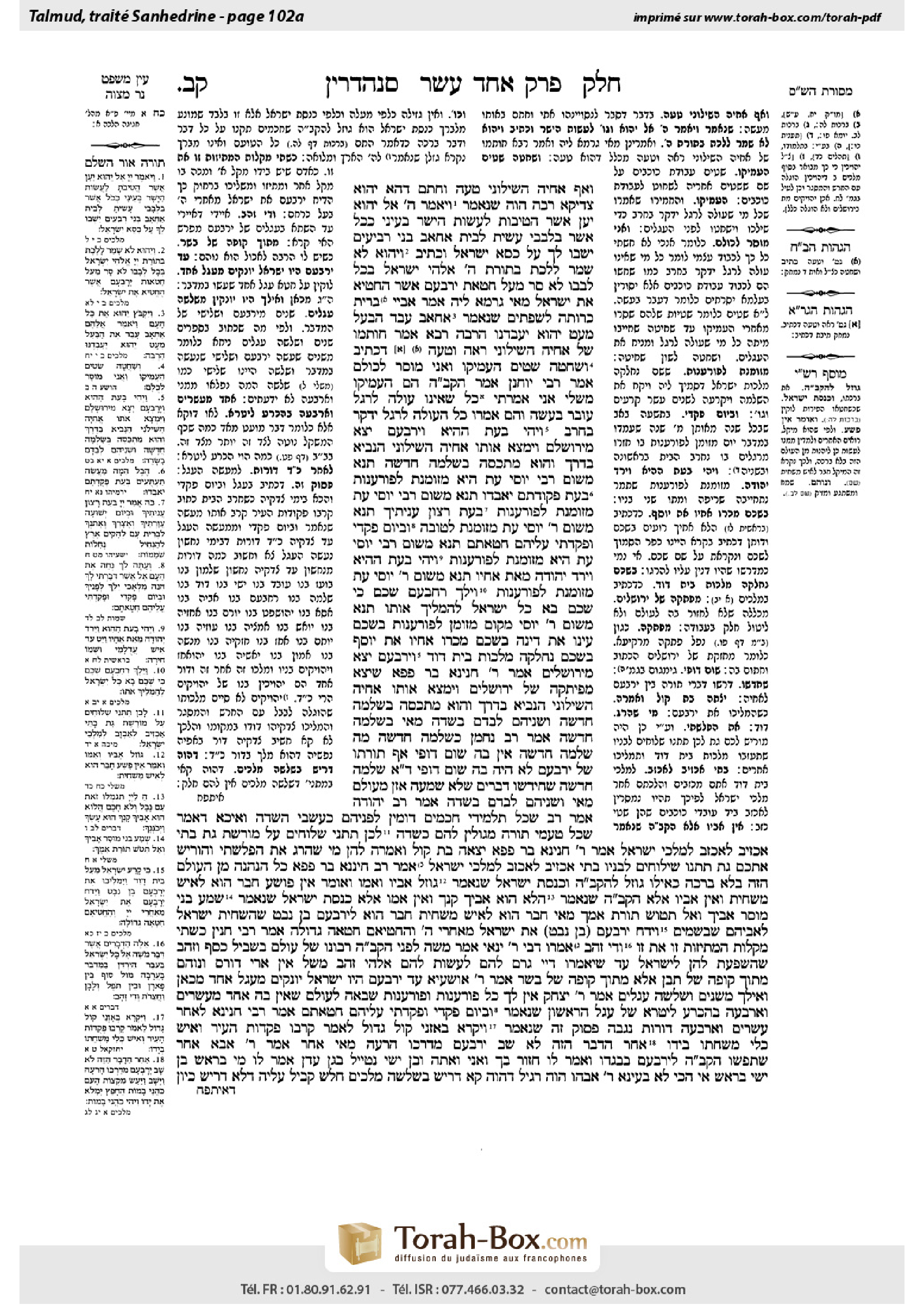
Sanhedrin 102a: Talmud study for Daf Yomi
Daf Yomi is the daily study of one Talmud folio. Explore 37 tractates with scans, Hebrew text, Sefaria English and AI-generated French translations where annotated.
Passage selection and English or AI-generated French translation are available where the scan has annotations. Daf Study is independent of Torah-Box and Sefaria.
Browse Sanhedrin · סנהדרין · All tractatesSanhedrin 102a text and translations
This page of Sanhedrin includes the Aramaic text, an English translation and an AI-generated French translation, alongside the scan above.
סנהדרין ק״ב א · Aramaic and Hebrew text
וְאַף אֲחִיָּה הַשִּׁילוֹנִי טָעָה וְחָתַם, דְּהָא יֵהוּא צַדִּיקָא רַבָּה הֲוָה, שֶׁנֶּאֱמַר: ״וַיֹּאמֶר ה׳ אֶל יֵהוּא יַעַן אֲשֶׁר הֱטִיבֹתָ לַעֲשׂוֹת הַיָּשָׁר בְּעֵינַי כְּכֹל אֲשֶׁר בִּלְבָבִי עָשִׂיתָ לְבֵית אַחְאָב בְּנֵי רְבִעִים יֵשְׁבוּ לְךָ עַל כִּסֵּא יִשְׂרָאֵל״, וּכְתִיב: ״וְיֵהוּא לֹא שָׁמַר לָלֶכֶת בְּתוֹרַת ה׳ אֱלֹהֵי יִשְׂרָאֵל בְּכׇל לְבָבוֹ לֹא סָר מֵעַל חַטֹּאות יָרׇבְעָם אֲשֶׁר הֶחֱטִיא אֶת יִשְׂרָאֵל״.
מַאי גְּרַמָא לֵיהּ? אָמַר אַבָּיֵי: בְּרִית כְּרוּתָה לַשְּׂפָתַיִם, שֶׁנֶּאֱמַר ״אַחְאָב עָבַד אֶת הַבַּעַל מְעָט יֵהוּא יַעַבְדֶנּוּ הַרְבֵּה״. רָבָא אָמַר: חוֹתָמוֹ שֶׁל אֲחִיָּה הַשִּׁילוֹנִי רָאָה, וְטָעָה.
דִּכְתִיב: ״וְשַׁחֲטָה שֵׂטִים הֶעְמִיקוּ וַאֲנִי מוּסָר לְכֻלָּם״. אָמַר רַבִּי יוֹחָנָן: אָמַר הַקָּדוֹשׁ בָּרוּךְ הוּא, הֵם הַעֲמִיקוּ מִשֶּׁלִּי. אֲנִי אָמַרְתִּי: כֹּל שֶׁאֵינוֹ עוֹלֶה לָרֶגֶל עוֹבֵר בַּעֲשֵׂה, וְהֵם אָמְרוּ: כׇּל הָעוֹלֶה לָרֶגֶל יִדָּקֵר בַּחֶרֶב.
״וַיְהִי בָּעֵת הַהִיא וְיָרׇבְעָם יָצָא מִירוּשָׁלִָים וַיִּמְצָא אֹתוֹ אֲחִיָּה הַשִּׁילוֹנִי הַנָּבִיא בַּדֶּרֶךְ וְהוּא מִתְכַּסֶּה בְּשַׂלְמָה חֲדָשָׁה״. תָּנָא מִשּׁוּם רַבִּי יוֹסֵי: עֵת הִיא מְזוּמֶּנֶת לְפוּרְעָנוּת.
״בְּעֵת פְּקֻדָּתָם יֹאבֵדוּ״, תָּנָא מִשּׁוּם רַבִּי יוֹסֵי: עֵת מְזוּמֶּנֶת לְפוּרְעָנוּת. ״בְּעֵת רָצוֹן עֲנִיתִיךָ״, תָּנָא מִשּׁוּם רַבִּי יוֹסֵי: עֵת מְזוּמֶּנֶת לְטוֹבָה. ״וּבְיוֹם פׇּקְדִי וּפָקַדְתִּי עֲלֵהֶם חַטָּאתָם״, תָּנָא מִשּׁוּם רַבִּי יוֹסֵי: עֵת הִיא מְזוּמֶּנֶת לְפוּרְעָנוּת. ״וַיְהִי בָּעֵת הַהִיא וַיֵּרֶד יְהוּדָה מֵאֵת אֶחָיו״, תָּנָא מִשּׁוּם רַבִּי יוֹסֵי: עֵת מְזוּמֶּנֶת לְפוּרְעָנוּת.
״וַיֵּלֶךְ רְחַבְעָם שְׁכֶם כִּי שְׁכֶם בָּא כׇל יִשְׂרָאֵל לְהַמְלִיךְ אֹתוֹ״. תָּנָא מִשּׁוּם רַבִּי יוֹסֵי: מָקוֹם מְזוּמָּן לְפוּרְעָנוּת. בִּשְׁכֶם עִינּוּ אֶת דִּינָה, בִּשְׁכֶם מָכְרוּ אֶחָיו אֶת יוֹסֵף, בִּשְׁכֶם נֶחְלְקָה מַלְכוּת בֵּית דָּוִד.
״וְיָרׇבְעָם יָצָא מִירוּשָׁלָיִם״, אָמַר רַבִּי חֲנִינָא בַּר פָּפָּא: שֶׁיָּצָא מִפִּיתְקָהּ שֶׁל יְרוּשָׁלַיִם.
״וַיִּמְצָא אֹתוֹ אֲחִיָּה הַשִּׁילוֹנִי הַנָּבִיא בַּדֶּרֶךְ וְהוּא מִתְכַּסֶּה בְּשַׂלְמָה חֲדָשָׁה וּשְׁנֵיהֶם לְבַדָּם בַּשָּׂדֶה״. מַאי ״בְּשַׂלְמָה חֲדָשָׁה״? אָמַר רַב נַחְמָן: כְּשַׂלְמָה חֲדָשָׁה. מָה שַׂלְמָה חֲדָשָׁה אֵין בָּהּ שׁוּם דּוֹפִי – אַף תּוֹרָתוֹ שֶׁל יָרׇבְעָם לֹא הָיָה בָּהּ שׁוּם דּוֹפִי. דָּבָר אַחֵר: ״שַׂלְמָה חֲדָשָׁה״ – שֶׁחִידְּשׁוּ דְּבָרִים שֶׁלֹּא שָׁמְעָה אֹזֶן מֵעוֹלָם.
מַאי ״וּשְׁנֵיהֶם לְבַדָּם בַּשָּׂדֶה״? אָמַר רַב יְהוּדָה אָמַר רַב: שֶׁכׇּל תַּלְמִידֵי חֲכָמִים דּוֹמִין לִפְנֵיהֶם כְּעִשְׂבֵי הַשָּׂדֶה. וְאִיכָּא דְּאָמַר: שֶׁכׇּל טַעֲמֵי תּוֹרָה מְגוּלִּין לָהֶם כַּשָּׂדֶה.
״לָכֵן תִּתְּנִי שִׁלּוּחִים עַל מוֹרֶשֶׁת גַּת בָּתֵּי אַכְזִיב לְאַכְזָב לְמַלְכֵי יִשְׂרָאֵל״. אָמַר רַבִּי חֲנִינָא בַּר פָּפָּא: יָצְאָה בַּת קוֹל וְאָמְרָה לָהֶן, מִי שֶׁהָרַג אֶת הַפְּלִשְׁתִּי וְהוֹרִישׁ אֶתְכֶם גַּת, תִּתְּנוּ שִׁילּוּחִים לְבָנָיו? ״בָּתֵּי אַכְזִיב לְאַכְזָב לְמַלְכֵי יִשְׂרָאֵל״.
אָמַר רַבִּי חֲנִינָא בַּר פָּפָּא: כׇּל הַנֶּהֱנֶה מִן הָעוֹלָם הַזֶּה בְּלֹא בְּרָכָה, כְּאִילּוּ גּוֹזֵל לְהַקָּדוֹשׁ בָּרוּךְ הוּא וּכְנֶסֶת יִשְׂרָאֵל, שֶׁנֶּאֱמַר: ״גּוֹזֵל אָבִיו וְאִמּוֹ וְאֹמֵר אֵין פָּשַׁע חָבֵר הוּא לְאִישׁ מַשְׁחִית״. וְאֵין אָבִיו אֶלָּא הַקָּדוֹשׁ בָּרוּךְ הוּא, שֶׁנֶּאֱמַר: ״הֲלֹא הוּא אָבִיךָ קָּנֶךָ״. וְאֵין אִמּוֹ אֶלָּא כְּנֶסֶת יִשְׂרָאֵל, שֶׁנֶּאֱמַר: ״שְׁמַע בְּנִי מוּסַר אָבִיךָ וְאַל תִּטֹּשׁ תּוֹרַת אִמֶּךָ״.
מַאי ״חָבֵר הוּא לְאִישׁ מַשְׁחִית״? חָבֵר הוּא לְיָרׇבְעָם בֶּן נְבָט, שֶׁהִשְׁחִית יִשְׂרָאֵל לַאֲבִיהֶם שֶׁבַּשָּׁמַיִם.
״וְיַדַּח יָרׇבְעָם (בֶּן נְבָט) אֶת יִשְׂרָאֵל מֵאַחֲרֵי ה׳ וְהֶחֱטִיאָם חֲטָאָה גְדוֹלָה״. אָמַר רַבִּי חָנִין: ״כִּשְׁתֵּי מַקְלוֹת הַמַּתִּיזוֹת זוֹ אֶת זוֹ״.
״וְדִי זָהָב״. אָמְרוּ דְּבֵי רַבִּי יַנַּאי, אָמַר מֹשֶׁה לִפְנֵי הַקָּדוֹשׁ בָּרוּךְ הוּא, רִבּוֹנוֹ שֶׁל עוֹלָם, בִּשְׁבִיל כֶּסֶף וְזָהָב שֶׁהִשְׁפַּעְתָּ לָהֶן לְיִשְׂרָאֵל עַד שֶׁיֹּאמְרוּ ׳דַּיי׳, גָּרַם לָהֶם לַעֲשׂוֹת לָהֶם אֱלֹהֵי זָהָב. מָשָׁל: אֵין אֲרִי דּוֹרֵס וְנוֹהֵם מִתּוֹךְ קוּפָּה שֶׁל תֶּבֶן, אֶלָּא מִתּוֹךְ קוּפָּה שֶׁל בָּשָׂר.
אָמַר רַבִּי אוֹשַׁעְיָא: עַד יָרׇבְעָם הָיוּ יִשְׂרָאֵל יוֹנְקִים מֵעֵגֶל אֶחָד, מִכָּאן וְאֵילָךְ מִשְּׁנַיִם וּשְׁלֹשָׁה עֲגָלִים. אָמַר רַבִּי יִצְחָק: אֵין לָךְ כׇּל פּוּרְעָנוּת וּפוּרְעָנוּת שֶׁבָּאָה לְעוֹלָם שֶׁאֵין בָּהּ אֶחָד מֵעֶשְׂרִים וְאַרְבָּעָה בְּהֶכְרֵעַ לִיטְרָא שֶׁל עֵגֶל הָרִאשׁוֹן, שֶׁנֶּאֱמַר: ״וּבְיוֹם פׇּקְדִי וּפָקַדְתִּי עֲלֵהֶם חַטֹּאתָם״.
אָמַר רַבִּי חֲנִינָא: לְאַחַר עֶשְׂרִים וְאַרְבָּעָה דּוֹרוֹת נִגְבָּה פָּסוּק זֶה, שֶׁנֶּאֱמַר: ״וַיִּקְרָא בְאׇזְנַי קוֹל גָּדוֹל לֵאמֹר קָרְבוּ פְּקֻדּוֹת הָעִיר וְאִישׁ כְּלִי מַשְׁחֵתוֹ בְּיָדוֹ״.
״אַחַר הַדָּבָר הַזֶּה לֹא שָׁב יָרׇבְעָם מִדַּרְכּוֹ הָרָעָה״. מַאי ״אַחַר״? אָמַר רַבִּי אַבָּא: אַחַר שֶׁתְּפָשׂוֹ הַקָּדוֹשׁ בָּרוּךְ הוּא לְיָרׇבְעָם בְּבִגְדוֹ, וְאָמַר לוֹ: חֲזוֹר בְּךָ, וַאֲנִי וְאַתָּה וּבֶן יִשַׁי נְטַיֵּיל בְּגַן עֵדֶן. אָמַר לוֹ: מִי בָּרֹאשׁ? בֶּן יִשַׁי בָּרֹאשׁ. אִי הָכִי, לָא בָּעֵינָא.
רַבִּי אֲבָהוּ הֲוָה רְגִיל דַּהֲוָה קָא דָרֵישׁ בִּשְׁלֹשָׁה מְלָכִים. חֲלַשׁ, קַבֵּיל עֲלֵיהּ דְּלָא דָּרֵישׁ. כֵּיוָן
Sanhedrin 102a · English translation
And even Ahijah the Shilonite erred in this matter and signed that he would accept all of Jeroboam’s pronouncements. And generations later this caused Jehu to sin. The Gemara explains: As Jehu was an extremely righteous person. As it is stated: “And the Lord said to Jehu: Because you have done well, to perform what is right in My eyes, and have done to the house of Ahab according to all that was in My heart, your children of the fourth generation shall sit on the throne of Israel” (II Kings 10:30). And it is written: “But Jehu took no care to walk in the Torah of the Lord, God of Israel, with all his heart; he departed not from the sins of Jeroboam, who made Israel sin” (II Kings 10:31).
What caused Jehu to do so? Abaye says: A covenant is made with the lips, as it is stated that Jehu said cunningly in an attempt to entrap the priests of the Baal: “Ahab worshipped Baal a little, but Jehu shall serve him much” (II Kings 10:18). Although it was not his intention, once the statement escaped his lips he began following the path to its fulfillment. Rava says: He saw the seal of Ahijah the Shilonite on the coronation document of Jeroboam and he erred and believed that it was permitted to act as Jeroboam did.
The Gemara continues its discussion of Jeroboam. With regard to that which is written: “And the apostates are deep in slaughter and I am rejected by them all” (Hosea 5:2), Rabbi Yoḥanan says that the Holy One, Blessed be He, says: They issued decrees that are more profound and more extreme than my own. I said: Anyone who does not ascend to Jerusalem for the pilgrimage Festival violates a positive mitzva, and they said: Anyone who ascends to Jerusalem for the pilgrimage Festival will be stabbed with the sword. In that way, Jeroboam successfully prevented the residents of the kingdom of Israel from ascending to Jerusalem.
The verse states: “And it came to pass at that time, and Jeroboam left Jerusalem, and the prophet Ahijah the Shilonite found him on the way, and he was clad in a new garment, and the two were alone in the field” (I Kings 11:29). It was taught in the name of Rabbi Yosei: The phrase “at that time” indicates that it is a time ordained for calamity.
The verse states: “At the time of their punishment, they shall perish” (Jeremiah 51:18). It was taught in the name of Rabbi Yosei: The phrase “at the time” indicates that it is a time ordained for calamity. The verse states: “In an acceptable time have I answered you” (Isaiah 49:8). It was taught in the name of Rabbi Yosei: The phrase “in an acceptable time” indicates that it is a time ordained for good. The verse states: “On the day when I punish, I will punish their sin upon them” (Exodus 32:34). It was taught in the name of Rabbi Yosei: The phrase “on the day when I punish” indicates that it is a time ordained for calamity. The verse states: “And it came to pass at that time, and Judah descended from his brothers” (Genesis 38:1). It was taught in the name of Rabbi Yosei: The phrase “at that time” indicates that it is a time ordained for calamity.
The verse states: “And Rehoboam went to Shechem; for all Israel came to Shechem, to make him king” (I Kings 12:1). It was taught in the name of Rabbi Yosei: Shechem is a place ordained for calamity. In Shechem, they tormented and raped Dinah, in the outskirts of Shechem the brothers sold Joseph, in Shechem the kingdom of the house of David was divided.
With regard to the verse which states: “And Jeroboam left Jerusalem” (I Kings 11:29), Rabbi Ḥanina bar Pappa says: It means that he left the destiny of Jerusalem, meaning he removed himself from the category of the residents of Jerusalem, never to return.
The verse states: “And the prophet Ahijah the Shilonite found him on the way, and he was clad in a new [ḥadasha] garment, and the two were alone in the field.” What is taught by the phrase “in a new garment”? Rav Naḥman says: It was like a new garment; just as a new garment has no imperfection, so too, the Torah studies of Jeroboam at that time had no imperfection. Alternatively, “a new garment” teaches that they introduced [sheḥideshu] matters that no ear had ever heard.
What is taught by the phrase “and the two were alone in the field”? Rav Yehuda says that Rav says: It teaches that all the Torah scholars of that generation seemed, relative to them, like grass of the field, as they were wiser than all of them. And there are those who say: It teaches that all the rationales of the Torah were revealed to them like a field that is exposed for all to see.
The verse states: “Therefore shall you give parting gifts to Moresheth Gath; the houses of Achzib are a deceitful thing for the kings of Israel” (Micah 1:14). Rabbi Ḥanina bar Pappa says: When they crowned Jeroboam, a Divine Voice emerged and said to the subjects of the kingdom of Israel: He who killed the Philistine and bequeathed the city of Gath to you, i.e., King David, will you give parting gifts to his sons and revolt against them? Ultimately, the houses of Achzib are a deceitful thing for the kings of Israel, as the kings of Israel will also be forsaken by their subjects.
Rabbi Ḥanina bar Pappa says: With regard to anyone who derives benefit from this world without reciting a blessing, it is as though he stole from the Holy One, Blessed be He, and the congregation of Israel, as it is stated: “Whoever robs his father and his mother and says: It is no transgression, he is the companion of a corrupter” (Proverbs 28:24). And the term “his father” is referring to none other than the Holy One, Blessed be He, as it is stated: “Is He not your Father Who created you, Who made you and established you?” (Deuteronomy 32:6). And the term “his mother” is referring to none other than the congregation of Israel, as it is stated: “Hear, my son, the discipline of your father, and do not forsake the Torah of your mother” (Proverbs 1:8). The mention of the Torah as emanating from the mother indicates that the mother represents the congregation of Israel, and the Torah of the mother is the tradition of the Jewish people.
What is the meaning of the phrase “He is the companion of a corrupter”? It means that he is a companion of Jeroboam, son of Nebat, who corrupted the people of Israel before their Father in Heaven by sinning and by causing others to sin.
With regard to the verse: “And Jeroboam drove Israel from following the Lord, and caused them to sin a great sin” (II Kings 17:21), Rabbi Ḥanin says: This is like two sticks that when they collide cause each other to carom, as due to the strife, Jeroboam caused the subjects of the kingdom of Israel to grow distant from God.
§ Apropos the calves of Jeroboam, the Gemara discusses the Golden Calf discussed in the Torah. The verse states: “And Di Zahav” (Deuteronomy 1:1). The school of Rabbi Yannai said: Moses said before the Holy One, Blessed be He: Master of the Universe, because of the gold and silver that You lavished upon the Jewish people during the exodus from Egypt until they said enough [dai], this wealth caused the Jewish people to fashion for themselves gods of gold. The combination of wealth and leisure left them open to a transgression of that sort. There is a parable for this: A lion does not maul and roar over a basket of straw from which he derives no pleasure; rather, he mauls and roars over a basket of meat, as he roars only when satiated. In other words, the guilt is not exclusively theirs.
Rabbi Oshaya says: Until Jeroboam, Israel was suckling, i.e., suffering the consequences, from worshipping one calf that they fashioned in the wilderness. From that point forward, they were suckling from two and three calves, as Jeroboam added the calves in Bethel and Dan. Rabbi Yitzḥak says: You have no punishment that comes to the world in which there is not one twenty-fourth of the surplus of a litra of the first calf. When weighing a substance, there would often be a disparity of up to one twenty-fourth of its weight. The point is that a minuscule portion of the sin of the Golden Calf is added to every punishment imposed upon the Jewish people, as it is stated: “On the day when I punish, I will punish their sin upon them” (Exodus 32:34), indicating that atonement for that sin is incomplete, and the Jewish people will continue to suffer for it.
Rabbi Ḥanina says: After twenty-four generations elapsed from the sin of the Golden Calf, the debt referred to in this verse was collected, as it is stated: “And he cried in my ears with a loud voice, saying: Those who have charge over the city draw near, every man with his deadly weapon in his hand” (Ezekiel 9:1). This prophecy occurred twenty-four generations after the sin of the Golden Calf.
The verse states: “And after this matter, Jeroboam returned not from his evil way” (I Kings 13:33). To what event is the verse alluding, when it states: “After this matter”? Rabbi Abba says: It is after the Holy One, Blessed be He, grabbed Jeroboam by his garment, i.e., he sent prophets and implored him, and said to him: Repent, and you and I and the son of Yishai will stroll together in the Garden of Eden. Jeroboam said to Him: Who will walk in the lead? God said to Jeroboam: The son of Yishai will walk in the lead. Jeroboam said: If so, I do not wish to repent.
§ The Gemara relates: Rabbi Abbahu was accustomed to lecture at great length about the three kings enumerated in the mishna, who have no share in the World-to-Come. He fell ill, and he undertook that he would not lecture about those kings. Once
Sanhedrin 102a · Traduction française (IA)
Même Ahijah le Shilonite se trompa à ce sujet et signa un engagement à accepter toutes les décisions de Jéroboam. Des générations plus tard, cela conduisit Jéhu à pécher. La Guemara explique : Jéhu était un homme extrêmement juste, comme il est dit : « Le Seigneur dit à Jéhu : Parce que tu as bien agi, en faisant ce qui est droit à mes yeux, et que tu as traité la maison d’Achab selon tout ce qui était dans mon cœur, tes fils de la quatrième génération siégeront sur le trône d’Israël » (II Rois 10,30). Et il est écrit : « Mais Jéhu ne prit pas garde à marcher de tout son cœur selon la Torah du Seigneur, Dieu d’Israël ; il ne se détourna pas des péchés de Jéroboam, qui avait fait pécher Israël » (II Rois 10,31).
Qu’est-ce qui poussa Jéhu à agir ainsi ? Abayé dit : Une alliance est conclue par les paroles prononcées, comme il est dit que Jéhu déclara astucieusement, dans le but de piéger les prêtres de Baal : « Achab a servi Baal un peu, mais Jéhu le servira beaucoup » (II Rois 10,18). Bien que telle ne fût pas son intention, une fois ces paroles prononcées, il commença à suivre la voie qui menait à leur réalisation. Rava dit : Il vit le sceau d’Ahijah le Shilonite sur le document de couronnement de Jéroboam ; il se trompa et crut qu’il était permis d’agir comme Jéroboam.
La Guemara poursuit son examen de Jéroboam. À propos de ce qui est écrit : « Les apostats s’enfoncent profondément dans le massacre, mais je les réprouve tous » (Osée 5,2), Rabbi Yoḥanan dit que le Saint, béni soit-Il, déclare : Ils ont pris des décrets plus profonds et plus extrêmes que les miens. J’ai dit : Quiconque ne monte pas à Jérusalem pour la fête de pèlerinage transgresse une mitsva positive ; eux ont dit : Quiconque montera à Jérusalem pour la fête de pèlerinage sera transpercé par l’épée. Ainsi, Jéroboam réussit à empêcher les habitants du royaume d’Israël de monter à Jérusalem.
Le verset dit : « À cette époque, Jéroboam sortit de Jérusalem ; le prophète Ahijah le Shilonite le rencontra sur le chemin. Il était vêtu d’un vêtement neuf, et tous deux étaient seuls dans la campagne » (I Rois 11,29). Il a été enseigné au nom de Rabbi Yossei : L’expression « à cette époque » indique qu’il s’agissait d’une époque prédestinée au malheur.
Le verset dit : « Au moment de leur châtiment, ils périront » (Jérémie 51,18). Il a été enseigné au nom de Rabbi Yossei : L’expression « au moment » indique qu’il s’agissait d’une époque prédestinée au malheur. Le verset dit : « En un temps favorable, je t’ai répondu » (Isaïe 49,8). Il a été enseigné au nom de Rabbi Yossei : L’expression « en un temps favorable » indique qu’il s’agissait d’une époque prédestinée au bien. Le verset dit : « Le jour où je sévirai, je leur demanderai compte de leur péché » (Exode 32,34). Il a été enseigné au nom de Rabbi Yossei : L’expression « le jour où je sévirai » indique qu’il s’agissait d’une époque prédestinée au malheur. Le verset dit : « À cette époque, Juda s’éloigna de ses frères » (Genèse 38,1). Il a été enseigné au nom de Rabbi Yossei : L’expression « à cette époque » indique qu’il s’agissait d’une époque prédestinée au malheur.
Le verset dit : « Roboam se rendit à Sichem, car tout Israël était venu à Sichem pour le proclamer roi » (I Rois 12,1). Il a été enseigné au nom de Rabbi Yossei : Sichem est un lieu prédestiné au malheur. À Sichem, Dina fut tourmentée et violée ; dans les environs de Sichem, les frères vendirent Joseph ; à Sichem, le royaume de la maison de David fut divisé.
À propos du verset qui dit : « Jéroboam sortit de Jérusalem » (I Rois 11,29), Rabbi Ḥanina bar Pappa dit : Cela signifie qu’il quitta le destin de Jérusalem, c’est-à-dire qu’il se retira de la catégorie des habitants de Jérusalem, sans jamais y revenir.
Le verset dit : « Le prophète Ahijah le Shilonite le rencontra sur le chemin ; il était vêtu d’un vêtement neuf [ḥadasha], et tous deux étaient seuls dans la campagne. » Que nous enseigne l’expression « d’un vêtement neuf » ? Rav Naḥman dit : Il était comme un vêtement neuf : de même qu’un vêtement neuf ne présente aucun défaut, de même, à cette époque, l’étude de la Torah de Jéroboam ne présentait aucun défaut. Autre explication : « un vêtement neuf » enseigne qu’ils introduisirent [sheḥideshu] des enseignements que nulle oreille n’avait jamais entendus.
Que nous enseigne l’expression « et tous deux étaient seuls dans la campagne » ? Rav Yehouda dit au nom de Rav : Elle enseigne que tous les sages de la Torah de cette génération leur semblaient, en comparaison, comme l’herbe des champs, car ils étaient plus sages qu’eux tous. D’autres disent qu’elle enseigne que toutes les explications de la Torah leur étaient dévoilées comme un champ exposé aux regards de tous.
Le verset dit : « C’est pourquoi tu donneras des présents d’adieu à Morésheth-Gath ; les maisons d’Akzib seront une tromperie pour les rois d’Israël » (Michée 1,14). Rabbi Ḥanina bar Pappa dit : Lorsqu’ils couronnèrent Jéroboam, une Voix céleste se fit entendre et dit aux sujets du royaume d’Israël : Celui qui a tué le Philistin et vous a donné en héritage la ville de Gath, c’est-à-dire le roi David, allez-vous donner des présents d’adieu à ses fils et vous révolter contre eux ? En fin de compte, les maisons d’Akzib seront une tromperie pour les rois d’Israël, car les rois d’Israël seront eux aussi abandonnés par leurs sujets.
Rabbi Ḥanina bar Pappa dit : Quiconque tire profit de ce monde sans réciter de bénédiction, c’est comme s’il avait volé le Saint, béni soit-Il, et la communauté d’Israël, comme il est dit : « Celui qui dépouille son père et sa mère et dit : “Ce n’est pas une faute”, est le compagnon d’un corrupteur » (Proverbes 28,24). Le terme « son père » ne désigne nul autre que le Saint, béni soit-Il, comme il est dit : « N’est-Il pas ton Père, qui t’a créé, qui t’a fait et t’a affermi ? » (Deutéronome 32,6). Et le terme « sa mère » ne désigne nul autre que la communauté d’Israël, comme il est dit : « Écoute, mon fils, l’instruction de ton père, et n’abandonne pas la Torah de ta mère » (Proverbes 1,8). La mention de la Torah comme venant de la mère indique que la mère représente la communauté d’Israël, et que la Torah de la mère est la tradition du peuple juif.
Que signifie l’expression « il est le compagnon d’un corrupteur » ? Elle signifie qu’il est le compagnon de Jéroboam, fils de Nebat, qui corrompit le peuple d’Israël devant son Père céleste en péchant et en poussant les autres à pécher.
À propos du verset : « Jéroboam éloigna Israël du Seigneur et le fit commettre un grand péché » (II Rois 17,21), Rabbi Ḥanin dit : C’est comme deux bâtons qui, lorsqu’ils se heurtent, se repoussent l’un l’autre ; de même, en raison du conflit, Jéroboam éloigna de Dieu les sujets du royaume d’Israël.
§ À propos des veaux de Jéroboam, la Guemara aborde le Veau d’or dont parle la Torah. Le verset dit : « Et Di Zahav » (Deutéronome 1,1). Les sages de l’école de Rabbi Yannai ont dit : Moïse dit devant le Saint, béni soit-Il : Maître de l’Univers, c’est à cause de l’or et de l’argent dont Tu as comblé le peuple juif lors de la sortie d’Égypte, jusqu’à ce qu’il dise « assez » [dai], que cette richesse a poussé le peuple juif à se fabriquer des dieux d’or. L’association de la richesse et des loisirs l’a rendu vulnérable à une transgression de cette sorte. Voici une parabole : un lion ne déchiquette pas et ne rugit pas au-dessus d’un panier de paille, dont il ne tire aucun plaisir ; il déchiquette et rugit plutôt au-dessus d’un panier de viande, car il ne rugit que lorsqu’il est rassasié. Autrement dit, leur culpabilité ne leur incombe pas exclusivement.
Rabbi Oshaya dit : Jusqu’à Jéroboam, Israël subissait encore les conséquences du culte d’un seul veau, celui qu’ils avaient fabriqué dans le désert. À partir de ce moment, ils subirent les conséquences du culte de deux et de trois veaux, car Jéroboam avait ajouté les veaux de Béthel et de Dan. Rabbi Yitzḥak dit : Il n’est aucun châtiment qui survienne dans le monde sans qu’il comporte un vingt-quatrième du surplus d’une litra provenant du premier veau. Lorsqu’on pesait une substance, il y avait souvent un écart pouvant aller jusqu’à un vingt-quatrième de son poids. Cela signifie qu’une infime part du péché du Veau d’or s’ajoute à chaque châtiment infligé au peuple juif, comme il est dit : « Le jour où je sévirai, je leur demanderai compte de leur péché » (Exode 32,34), ce qui indique que l’expiation de ce péché est incomplète et que le peuple juif continuera d’en subir les conséquences.
Rabbi Ḥanina dit : Vingt-quatre générations après le péché du Veau d’or, la dette évoquée dans ce verset fut recouvrée, comme il est dit : « Il cria à mes oreilles d’une voix forte : Approchez, vous qui avez la charge de la ville, chacun avec son arme meurtrière à la main » (Ézéchiel 9,1). Cette prophétie eut lieu vingt-quatre générations après le péché du Veau d’or.
Le verset dit : « Après cet événement, Jéroboam ne se détourna pas de sa mauvaise voie » (I Rois 13,33). À quel événement le verset fait-il allusion en disant « après cet événement » ? Rabbi Abba dit : Cela se passa après que le Saint, béni soit-Il, eut saisi Jéroboam par son vêtement — c’est-à-dire qu’Il lui envoya des prophètes et le supplia — et lui eut dit : « Repens-toi, et toi, moi et le fils d’Ishaï nous promènerons ensemble dans le jardin d’Éden. » Jéroboam lui dit : « Qui marchera en tête ? » Dieu répondit à Jéroboam : « Le fils d’Ishaï marchera en tête. » Jéroboam dit : « Dans ce cas, je ne veux pas me repentir. »
§ La Guemara rapporte : Rabbi Abbahou avait coutume de donner de longs enseignements sur les trois rois énumérés dans la Michna, qui n’ont aucune part au monde futur. Il tomba malade et s’engagea à ne plus enseigner à leur sujet. Une fois
Traduction française générée par IA à partir de l’édition anglaise de Sefaria. Vérifie toujours un passage avec le texte source.
Text from Sefaria: William Davidson Edition - Vocalized Aramaic (CC BY NC); William Davidson Edition - English (CC BY NC).