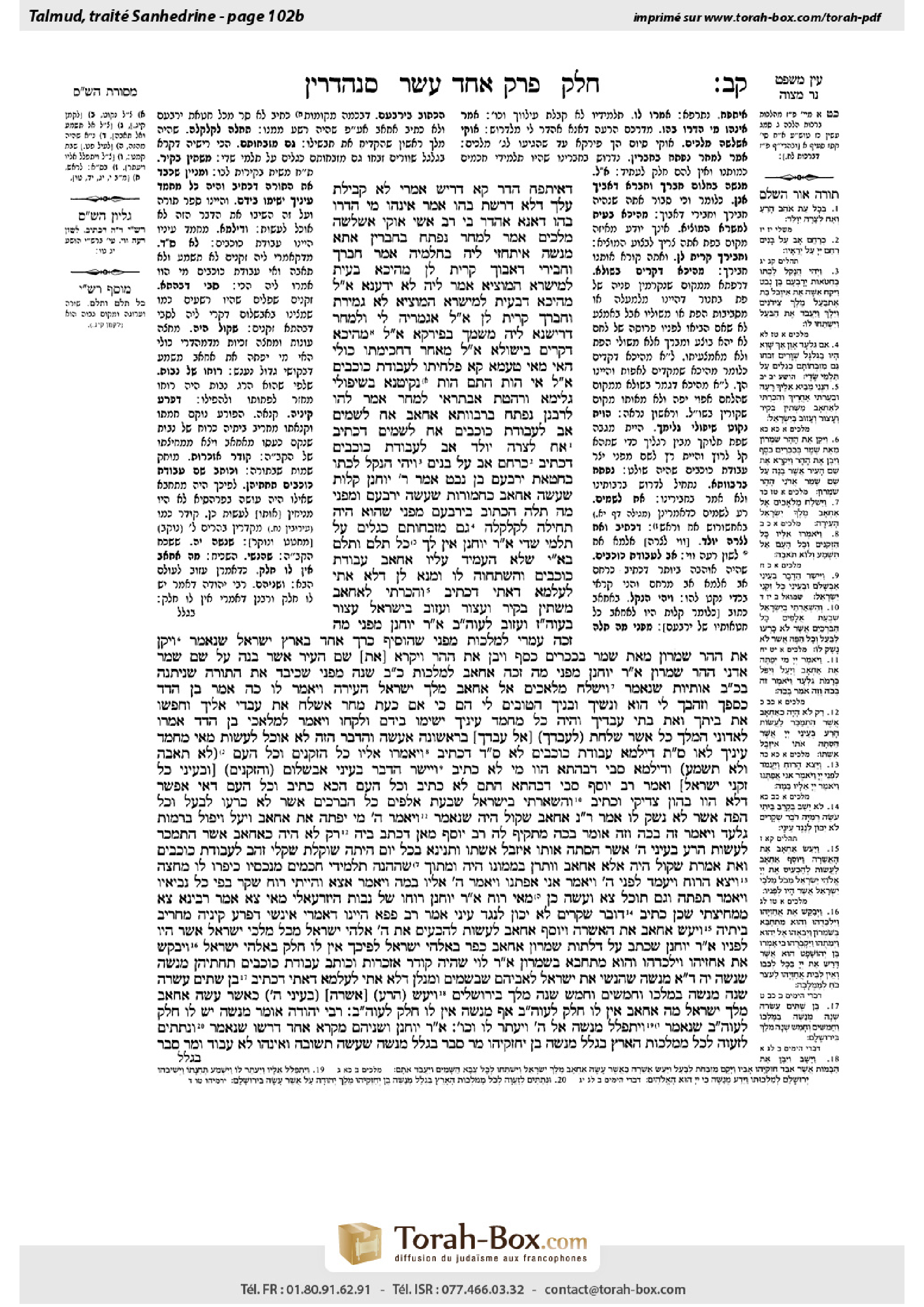
Sanhedrin 102b: Talmud study for Daf Yomi
Daf Yomi is the daily study of one Talmud folio. Explore 37 tractates with scans, Hebrew text, Sefaria English and AI-generated French translations where annotated.
Passage selection and English or AI-generated French translation are available where the scan has annotations. Daf Study is independent of Torah-Box and Sefaria.
Browse Sanhedrin · סנהדרין · All tractatesSanhedrin 102b text and translations
This page of Sanhedrin includes the Aramaic text, an English translation and an AI-generated French translation, alongside the scan above.
סנהדרין ק״ב ב · Aramaic and Hebrew text
דְּאִתְּפַח, הֲדַר קָא דָרֵישׁ. אָמְרִי: לָא קַבֵּילְתְּ עֲלָךְ דְּלָא דָּרְשַׁתְּ בְּהוּ? אָמַר: אִינְהוּ מִי הֲדַרוּ בְּהוּ, דַּאֲנָא אֶהְדַּר בִּי?
רַב אָשֵׁי אוֹקֵי אַשְּׁלֹשָׁה מְלָכִים. אֲמַר: לִמְחַר נִפְתַּח בְּחַבְרִין. אֲתָא מְנַשֶּׁה, אִיתְחֲזִי לֵיהּ בְּחֶלְמֵיהּ. אָמַר: חֲבֵרָךְ וַחֲבֵירֵי דַּאֲבוּךְ קָרֵית לַן?
מֵהֵיכָא בָּעֵית לְמִישְׁרֵא הַמּוֹצִיא? אֲמַר לֵיהּ: לָא יָדַעְנָא. אֲמַר לֵיהּ: מֵהֵיכָא דְּבָעֵית לְמִישְׁרֵא הַמּוֹצִיא לָא גְּמִירַתְּ, וַחֲבֵרָךְ קָרֵית לַן? אֲמַר לֵיהּ: אַגְמְרֵיהּ לִי, וְלִמְחַר דָּרֵישְׁנָא לֵיהּ מִשְּׁמָךְ בְּפִירְקָא. אֲמַר לֵיהּ: מֵהֵיכָא דְּקָרֵים בִּישּׁוּלָא.
אֲמַר לֵיהּ: מֵאַחַר דְּחַכִּימַתְּ כּוּלֵּי הַאי, מַאי טַעְמָא קָא פָּלְחִיתוּ לַעֲבוֹדָה זָרָה? אֲמַר לֵיהּ: אִי הֲוֵת הָתָם, הֲוֵת נָקֵיטַתְּ בְּשִׁיפּוּלֵי גְּלִימָא וְרָהֲטַתְּ אַבַּתְרַאי. לִמְחַר אֲמַר לְהוּ לְרַבָּנַן: נִפְתָּח בְּרַבְּווֹתָא.
אַחְאָב: אָח לַשָּׁמַיִם, אָב לַעֲבוֹדָה זָרָה. אָח לַשָּׁמַיִם, דִּכְתִיב: ״אָח לְצָרָה יִוָּלֵד״. אָב לַעֲבוֹדָה זָרָה, דִּכְתִיב: ״כְּרַחֵם אָב עַל בָּנִים״.
״וַיְהִי הֲנָקֵל לֶכְתּוֹ בְּחַטֹּאות יָרׇבְעָם בֶּן נְבָט״. אָמַר רַבִּי יוֹחָנָן: קַלּוֹת שֶׁעָשָׂה אַחְאָב – כַּחֲמוּרוֹת שֶׁעָשָׂה יָרׇבְעָם. וּמִפְּנֵי מָה תָּלָה הַכָּתוּב בְּיָרׇבְעָם? מִפְּנֵי שֶׁהוּא הָיָה תְּחִילָּה לַקַּלְקָלָה. ״גַּם מִזְבְּחוֹתָם כְּגַלִּים עַל תַּלְמֵי שָׂדָי״. אָמַר רַבִּי יוֹחָנָן: אֵין לָךְ כׇּל תֶּלֶם וָתֶלֶם בְּאֶרֶץ יִשְׂרָאֵל שֶׁלֹּא הֶעֱמִיד עָלָיו אַחְאָב עֲבוֹדָה זָרָה וְהִשְׁתַּחֲוָה לָהּ.
וּמְנָא לַן דְּלָא אָתֵי לְעָלְמָא דְּאָתֵי? דִּכְתִיב: ״וְהִכְרַתִּי לְאַחְאָב מַשְׁתִּין בְּקִיר וְעָצוּר וְעָזוּב בְּיִשְׂרָאֵל״. ״עָצוּר״ – בָּעוֹלָם הַזֶּה, ״וְעָזוּב״ – לָעוֹלָם הַבָּא.
אָמַר רַבִּי יוֹחָנָן: מִפְּנֵי מָה זָכָה עׇמְרִי לַמַּלְכוּת? מִפְּנֵי שֶׁהוֹסִיף כְּרַךְ אֶחָד בְּאֶרֶץ יִשְׂרָאֵל, שֶׁנֶּאֱמַר: ״וַיִּקֶן אֶת הָהָר שֹׁמְרוֹן מֵאֶת שֶׁמֶר בְּכִכְּרַיִם כָּסֶף וַיִּבֶן אֶת הָהָר וַיִּקְרָא [אֶת] שֵׁם הָעִיר אֲשֶׁר בָּנָה עַל שֶׁם שֶׁמֶר אֲדֹנֵי הָהָר שֹׁמְרוֹן״.
אָמַר רַבִּי יוֹחָנָן: מִפְּנֵי מָה זָכָה אַחְאָב לַמַּלְכוּת עֶשְׂרִים וּשְׁתַּיִם שָׁנָה?
מִפְּנֵי שֶׁכִּיבֵּד אֶת הַתּוֹרָה, שֶׁנִּיתְּנָה בְּעֶשְׂרִים וּשְׁתַּיִם אוֹתִיּוֹת, שֶׁנֶּאֱמַר: ״וַיִּשְׁלַח מַלְאָכִים אֶל אַחְאָב מֶלֶךְ יִשְׂרָאֵל הָעִירָה. וַיֹּאמֶר לוֹ כֹּה אָמַר בֶּן הֲדַד כַּסְפְּךָ וּזְהָבְךָ לִי הוּא וְנָשֶׁיךָ וּבָנֶיךָ הַטּוֹבִים לִי הֵם״. ״כִּי אִם כָּעֵת מָחָר אֶשְׁלַח אֶת עֲבָדַי אֵלֶיךָ וְחִפְּשׂוּ אֶת בֵּיתְךָ וְאֵת בָּתֵּי עֲבָדֶיךָ וְהָיָה כׇּל מַחְמַד עֵינֶיךָ יָשִׂימוּ בְיָדָם וְלָקָחוּ״. ״וַיֹּאמֶר לְמַלְאֲכֵי בֶן הֲדַד אִמְרוּ לַאדֹנִי הַמֶּלֶךְ כֹּל אֲשֶׁר שָׁלַחְתָּ אֶל עַבְדְּךָ בָרִאשׁוֹנָה אֶעֱשֶׂה וְהַדָּבָר הַזֶּה לֹא אוּכַל לַעֲשׂוֹת״.
מַאי ״מַחְמַד עֵינֶיךָ״? לָאו סֵפֶר תּוֹרָה?
דִּילְמָא עֲבוֹדָה זָרָה? לָא סָלְקָא דַּעְתָּךְ, דִּכְתִיב: ״וַיֹּאמְרוּ אֵלָיו כׇּל הַזְּקֵנִים וְכׇל הָעָם לֹא תֹאבֶה וְלֹא תִשְׁמַע״. וְדִילְמָא סָבֵי דְּבַהֲתָא הֲווֹ? מִי לָא כְּתִיב: ״וַיִּישַׁר הַדָּבָר בְּעֵינֵי אַבְשָׁלֹם וּבְעֵינֵי כׇּל זִקְנֵי יִשְׂרָאֵל״? וְאָמַר רַב יוֹסֵף: סָבֵי דְּבַהֲתָא.
הָתָם לָא כְּתִיב ״וְכׇל הָעָם״, הָכָא כְּתִיב ״וְכׇל הָעָם״, דְּאִי אֶפְשָׁר דְּלָא הֲווֹ בְּהוֹן צַדִּיקֵי. וּכְתִיב: ״וְהִשְׁאַרְתִּי בְיִשְׂרָאֵל שִׁבְעַת אֲלָפִים כׇּל הַבִּרְכַּיִם אֲשֶׁר לֹא כָרְעוּ לַבַּעַל וְכׇל הַפֶּה אֲשֶׁר לֹא נָשַׁק לוֹ״.
אָמַר רַב נַחְמָן: אַחְאָב שָׁקוּל הָיָה, שֶׁנֶּאֱמַר: ״וַיֹּאמֶר ה׳ מִי יְפַתֶּה אֶת אַחְאָב וְיַעַל וְיִפֹּל בְּרָמֹת גִּלְעָד וַיֹּאמֶר זֶה בְּכֹה וְזֶה אֹמֵר בְּכֹה״. מַתְקֵיף לַהּ רַבִּי יוֹסֵף: מַאן דִּכְתִיב בֵּיהּ ״רַק לֹא הָיָה כְאַחְאָב אֲשֶׁר הִתְמַכֵּר לַעֲשׂוֹת הָרַע בְּעֵינֵי ה׳ אֲשֶׁר הֵסַתָּה אֹתוֹ אִיזֶבֶל אִשְׁתּוֹ״, וּתְנֵינָא: בְּכׇל יוֹם הָיְתָה שׁוֹקֶלֶת שִׁקְלֵי זָהָב לַעֲבוֹדָה זָרָה, וְאַתְּ אָמְרַתְּ שָׁקוּל הָיָה?! אֶלָּא, אַחְאָב וַותְּרָן בְּמָמוֹנוֹ הָיָה, וּמִתּוֹךְ שֶׁהֶהֱנָה תַּלְמִידֵי חֲכָמִים מִנְּכָסָיו כִּיפְּרוּ לוֹ מֶחֱצָה.
״וַיֵּצֵא הָרוּחַ וַיַּעֲמֹד לִפְנֵי ה׳ וַיֹּאמֶר אֲנִי אֲפַתֶּנּוּ וַיֹּאמֶר ה׳ אֵלָיו בַּמָּה. וַיֹּאמֶר אֵצֵא וְהָיִיתִי רוּחַ שֶׁקֶר בְּפִי כׇּל נְבִיאָיו וַיֹּאמֶר תְּפַתֶּה וְגַם תּוּכָל צֵא וַעֲשֵׂה כֵן״. מַאי רוּחַ? אָמַר רַבִּי יוֹחָנָן: רוּחוֹ שֶׁל נָבוֹת הַיִּזְרְעֵאלִי.
מַאי ״צֵא״? אָמַר רָבִינָא: ״צֵא מִמְּחִיצָתִי״, שֶׁכֵּן כְּתִיב: ״דֹּבֵר שְׁקָרִים לֹא יִכּוֹן לְנֶגֶד עֵינָי״. אָמַר רַב פָּפָּא: הַיְינוּ דְּאָמְרִי אִינָשֵׁי: דְּפָרַע קִינֵּיהּ מַחְרֵיב בֵּיתֵיהּ.
״וַיַּעַשׂ אַחְאָב אֶת הָאֲשֵׁרָה וַיּוֹסֶף אַחְאָב לַעֲשׂוֹת לְהַכְעִיס אֶת ה׳ אֱלֹהֵי יִשְׂרָאֵל מִכֹּל מַלְכֵי יִשְׂרָאֵל אֲשֶׁר הָיוּ לְפָנָיו״. אָמַר רַבִּי יוֹחָנָן: שֶׁכָּתַב עַל דַּלְתוֹת שֹׁמְרוֹן אַחְאָב כָּפַר בֵּאלֹהֵי יִשְׂרָאֵל, לְפִיכָךְ אֵין לוֹ חֵלֶק בֵּאלֹהֵי יִשְׂרָאֵל.
״וַיְבַקֵּשׁ אֶת אֲחַזְיָהוּ וַיִּלְכְּדֻהוּ וְהוּא מִתְחַבֵּא בְשֹׁמְרוֹן״. אָמַר רַבִּי לֵוִי: שֶׁהָיָה קוֹדֵר אַזְכָּרוֹת, וְכוֹתֵב עֲבוֹדָה זָרָה תַּחְתֵּיהֶן.
מְנַשֶּׁה – שֶׁנָּשָׁה יָהּ. דָּבָר אַחֵר: מְנַשֶּׁה – שֶׁהִנְשִׁי אֶת יִשְׂרָאֵל לַאֲבִיהֶם שֶׁבַּשָּׁמַיִם. וּמְנָלַן דְּלָא אָתֵי לְעָלְמָא דְּאָתֵי? דִּכְתִיב: ״בֶּן שְׁתֵּים עֶשְׂרֵה שָׁנָה מְנַשֶּׁה בְמׇלְכוֹ וַחֲמִשִּׁים וְחָמֵשׁ שָׁנָה מָלַךְ בִּירוּשָׁלִָים וַיַּעַשׂ אֲשֵׁרָה כַּאֲשֶׁר עָשָׂה אַחְאָב מֶלֶךְ יִשְׂרָאֵל״. מָה אַחְאָב אֵין לוֹ חֵלֶק לָעוֹלָם הַבָּא, אַף מְנַשֶּׁה אֵין לוֹ חֵלֶק לָעוֹלָם הַבָּא.
רַבִּי יְהוּדָה אוֹמֵר: מְנַשֶּׁה יֵשׁ לוֹ חֵלֶק לָעוֹלָם הַבָּא, שֶׁנֶּאֱמַר: ״וַיִּתְפַּלֵּל מְנַשֶּׁה אֶל ה׳ וַיֵּעָתֶר לוֹ וְגוֹ׳״. אָמַר רַבִּי יוֹחָנָן: וּשְׁנֵיהֶם מִקְרָא אֶחָד דָּרְשׁוּ, שֶׁנֶּאֱמַר: ״וּנְתַתִּים לְזַעֲוָה לְכֹל מַמְלְכוֹת הָאָרֶץ בִּגְלַל מְנַשֶּׁה בֶן יְחִזְקִיָּהוּ״. מָר סָבַר: בִּגְלַל מְנַשֶּׁה שֶׁעָשָׂה תְּשׁוּבָה וְאִינְהוּ לָא עֲבוּד, וּמָר סָבַר:
Sanhedrin 102b · English translation
he recovered, he then lectured on that topic. His students said to him: Did you not undertake that you will not lecture about them? Rabbi Abbahu said: Did they repent, that I will reconsider and refrain from condemning them?
One day Rav Ashi ended his lecture just before reaching the matter of the three kings. He said to his students: Tomorrow we will begin the lecture with our colleagues the three kings, who, although they were sinners, were Torah scholars like us. Manasseh, king of Judea, came and appeared to him in his dream. Manasseh said to him angrily: You called us your colleague and the colleagues of your father? How dare you characterize yourself as our equal?
Manasseh said to him: I will ask you, from where are you required to begin cutting a loaf of bread when reciting the blessing: Who brings forth bread from the earth? Rav Ashi said to him: I do not know. Manasseh said to him: Even this, from where you are required to begin cutting a loaf of bread when reciting the blessing: Who brings forth bread from the earth, you did not learn, and yet you call us your colleague? Rav Ashi said to Manasseh: Teach me this halakha and tomorrow I will lecture and cite it in your name during my public lecture delivered on the Festival. Manasseh said to him: One cuts the loaf from where it crusts as a result of baking.
Rav Ashi said to him: Since you were so wise, what is the reason you engaged in idol worship? Manasseh said to him: Had you been there at that time, you would have taken and lifted the hem of your cloak and run after me due to the fierce desire to engage in idol worship and due to the fact that it was a common faith. The next day Rav Ashi said to the Sages as a prelude to his lecture: We will begin with the treatment of our teachers, those kings who were greater than us in Torah knowledge but whose sins caused them to lose their share in the World-to-Come.
§ The Gemara proceeds to discuss the second king enumerated in the mishna, Ahab. Ahab [Aḥav], although he was a brother [aḥ] to Heaven, he was a father [av] for idol worship. He was a brother to Heaven, as it is written: “And a brother is born for adversity” (Proverbs 17:17), and in desperate times, he turned to Heaven. He was a father for idolatry. This is the highest level of attachment, as it is written: “As a father has compassion for his children” (Psalms 103:13).
With regard to Ahab, it is written: “And it came to pass, the most minor of his transgressions was his walking in the sins of Jeroboam, son of Nebat” (I Kings 16:31). Rabbi Yoḥanan says: The minor sins that Ahab performed were on par with the major sins that Jeroboam performed, as the transgressions committed by Ahab were much more serious than those committed by Jeroboam. And for what reason did the verse attribute the sins of all the kings of Israel to Jeroboam, even though the sins of Ahab were more substantial? It is due to the fact that he was first to engage in iniquity. With regard to the verse: “Their altars shall also be like droppings in the furrows of the field” (Hosea 12:12), Rabbi Yoḥanan says: You do not have even one furrow in Eretz Yisrael upon which Ahab did not place an object of idol worship and bow to it.
The Gemara asks: And from where do we derive that Ahab does not enter into the World-to-Come? The Gemara answers: It is derived as it is written: “And I will excise from Ahab every man, and him that is shut up and him that is abandoned in Israel” (I Kings 21:21). “Him that is shut up” indicates he will be excised in this world, while “and him that is abandoned” indicates he will be excised in the World-to-Come.
Rabbi Yoḥanan says: For what virtue was Omri, king of Israel, who was Ahab’s father, privileged to ascend to the monarchy? It is due to the fact that he added one city in Eretz Yisrael, as it is stated: “And he bought the hill of Samaria from Shemer for two talents of silver, and built on the hill, and called the name of the city that he built after Shemer, the owner of the hill, Samaria” (I Kings 16:24).
Rabbi Yoḥanan says: For what virtue was Ahab privileged to ascend to the monarchy and rule for twenty-two years?
It is due to the fact that he respected the Torah, which was given with twenty-two letters, as it is stated: “And he sent messengers to Ahab, king of Israel, into the city, and said to him: So says Ben-Hadad: Your silver and your gold are mine; your wives and also your good children, are mine. And the king of Israel answered and said: It is according to your saying, my lord, O king: I am yours, and all that I have. And the messengers came again, and said: So speaks Ben-Hadad, saying: I sent to you, saying: You shall deliver me your silver, and your gold, and your wives, and your children. Yet I will send my servants to you tomorrow about this time, and they shall search your house, and the houses of your servants, and it shall be, that they shall put in their hand all the delight of your eyes and take it…And he said to the messengers of Ben-Hadad, tell my lord the king: All that you did send for to your servant at the first I will do; but this thing I may not do” (I Kings 20:2-6, 9).
The Gemara asks: What is “the delight of your eyes” that Ahab refused to give Ben-Hadad after agreeing to give him his wives and his gold? Is it not a Torah scroll? Ahab treated the Torah with deference.
The Gemara suggests: Perhaps the delight of his eyes was an object of idol worship. The Gemara answers: That could not enter your mind, as it is written that Ahab consulted the Sages with regard to this matter: “And all the elders and all the people said to him: Do not consent and heed not” (I Kings 20:8). The elders in this verse are presumably the Sages. The Gemara continues: But perhaps they were wicked elders, who worshipped idols. Isn’t it written: “And the saying pleased Absalom well and all the elders of Israel” (II Samuel 17:4), and Rav Yosef says: The elders of Israel mentioned in that verse were wicked elders. Perhaps the elders of Israel with whom Ahab consulted were also wicked.
The Gemara rejects this: There, with regard to Absalom it is not written: “And all the people,” whereas here, with regard to Ahab, it is written: “And all the people.” As it is impossible that there were not among them righteous people, if the righteous people agreed, apparently, “the delight of your eyes” was sacred. And it is written: “And I will leave seven thousand in Israel; all the knees that have not bent to the Baal, and every mouth that has not kissed it” (I Kings 19:18), indicating that there were righteous people among them.
Rav Naḥman says: Ahab was balanced in terms of the mitzvot and transgressions that he performed, as it is stated: “And the Lord said, who shall entice Ahab that he may ascend and fall at Ramoth Gilead? And this one said in this manner, and that one said in that manner” (I Kings 22:20), indicating that it is unclear whether or not he was a full-fledged transgressor. Rav Yosef objects to this statement: This is the person about whom the prophet wrote: “But there was none like Ahab who devoted himself to do evil in the eyes of the Lord, whom Jezebel his wife had incited” (I Kings 21:25). And we learn in a baraita: Every day she would weigh gold shekels equal to Ahab’s weight for idol worship. And you say he was balanced? Rather, Ahab was generous with his money and did not scrimp, and since he also benefited Torah scholars with his property, the heavenly court expiated half his sins for him. The result was a balance between mitzvot and transgressions.
With regard to God’s search for a volunteer to entice Ahab, it is written: “And there came forth a spirit, and stood before the Lord, and said: I will entice him. And the Lord said to him: With what? And he said: I will go out, and I will be a lying spirit in the mouth of all his prophets. And He said: You shall entice him, and also prevail; go out, and do so” (I Kings 22:21–22). The Gemara asks: What spirit was that? Rabbi Yoḥanan says: It was the spirit of Naboth the Jezreelite, who sought to take revenge against Ahab.
The Gemara asks: What is the meaning of the term “go out” that God instructed the spirit? Ravina says that it means: Go out from within my partition and do not return, as so it is written: “He that speaks falsehoods shall not be established before My eyes” (Psalms 101:7). The spirit that volunteered to lie may no longer be before God. Rav Pappa says that this is in accordance with the adage that people say: One who avenges due to his zealotry destroys his own house. The spirit of Naboth that sought revenge was expelled from before God.
With regard to the verse: “And Ahab made the ashera; and Ahab did more to provoke the Lord, God of Israel, to anger than all the kings of Israel that were before him” (I Kings 16:33), Rabbi Yoḥanan says: It means that he wrote on the doors of Samaria: Ahab denies the existence of the God of Israel, therefore he has no share in the God of Israel.
With regard to the verse: “And he sought Ahaziah, and they apprehended him, for he was hiding in Samaria” (II Chronicles 22:9), Rabbi Levi says: What would he do in hiding? He would excise mentions of God’s name in Torah scrolls and write the name of an object of idol worship in their stead.
The Gemara proceeds to discuss the third king enumerated in the mishna. He was called Manasseh [Menashe] because he forgot God [nasha yah]. Alternatively, he was called Manasseh since he caused the kingdom of Israel to forget [hinshi] their Father Who is in Heaven. And from where do we derive that Manasseh does not enter into the World-to-Come? The Gemara answers: It is derived as it is written: “Manasseh was twelve years old when he began to reign, and he reigned fifty-five years in Jerusalem…And he did that which was evil in the sight of the Lord…And he made an ashera, as did Ahab king of Israel” (II Kings 21:1–3). Just as Ahab has no share in the World-to-Come, so too, Manasseh has no share in the World-to-Come.
§ The mishna teaches that Rabbi Yehuda says: Manasseh has a share in the World-to-Come, as it is stated: “And he prayed to him and He was entreated of him, and heard his supplication and brought him back to Jerusalem unto his kingdom” (II Chronicles 33:13). Rabbi Yoḥanan says: And both of them, Rabbi Yehuda and the Rabbis, who disagree with regard to whether Manasseh has a share in the World-to-Come, interpreted one and the same verse, as it is stated: “And I will make them into a horror for all the kingdoms of the earth, on account of Manasseh, son of Hezekiah” (Jeremiah 15:4). One Sage, Rabbi Yehuda, holds that “on account of Manasseh” means that the Jewish people will be judged harshly, as ultimately, one as wicked as Manasseh repented, and they did not do so. And one Sage, the Rabbis, holds that
Sanhedrin 102b · Traduction française (IA)
Quand il se rétablit, il donna alors un enseignement sur ce sujet. Ses élèves lui dirent : « N’avais-tu pas pris l’engagement de ne pas enseigner à leur sujet ? » Rabbi Abbahou répondit : « Se sont-ils repentis, pour que je revienne sur ma décision et m’abstienne de les condamner ? »
Un jour, Rav Ashi termina son enseignement juste avant d’aborder la question des trois rois. Il dit à ses élèves : « Demain, nous commencerons notre enseignement par nos collègues, les trois rois, qui, bien qu’ils aient péché, étaient des érudits en Torah comme nous. » Menaché, roi de Judée, vint lui apparaître en rêve. Menaché lui dit avec colère : « Tu nous as appelés tes collègues et les collègues de ton père ? Comment oses-tu te considérer comme notre égal ? »
Menaché lui dit : « Je vais te poser une question : à quel endroit faut-il commencer à couper une miche de pain lorsqu’on récite la bénédiction : “Qui fait sortir le pain de la terre” ? » Rav Ashi répondit : « Je ne sais pas. » Menaché lui dit : « Même cela, à quel endroit faut-il commencer à couper une miche de pain lorsqu’on récite la bénédiction : “Qui fait sortir le pain de la terre”, tu ne l’as pas appris, et pourtant tu nous appelles tes collègues ? » Rav Ashi dit à Menaché : « Enseigne-moi cette halakha, et demain, pendant mon enseignement public à l’occasion de la fête, je la citerai en ton nom. » Menaché lui dit : « On coupe la miche là où la croûte s’est formée à la cuisson. »
Rav Ashi lui dit : « Puisque tu étais si sage, pourquoi t’es-tu livré au culte des idoles ? » Menaché lui répondit : « Si tu avais vécu à cette époque, tu aurais relevé le pan de ton manteau et couru après moi, tant le désir de pratiquer le culte des idoles était ardent et tant cette croyance était répandue. » Le lendemain, Rav Ashi dit aux Sages, en guise d’introduction à son enseignement : « Nous commencerons par évoquer nos maîtres, ces rois qui nous surpassaient dans la connaissance de la Torah, mais dont les péchés leur ont fait perdre leur part dans le Monde futur. »
§ La Guemara poursuit en examinant le deuxième roi énuméré dans la Michna, Ahab. Ahab [Aḥav], bien qu’il fût un frère [aḥ] pour le Ciel, était un père [av] pour le culte des idoles. Il était un frère pour le Ciel, comme il est écrit : « Un frère est né pour les jours d’adversité » (Proverbes 17, 17) : dans les moments de détresse, il se tournait vers le Ciel. Il était un père pour le culte des idoles, car il y était profondément attaché, comme il est écrit : « Comme un père a compassion de ses enfants » (Psaumes 103, 13).
Au sujet d’Ahab, il est écrit : « Et il arriva que la moindre de ses transgressions fut de suivre les péchés de Jéroboam, fils de Nebat » (I Rois 16, 31). Rabbi Yoḥanan dit : Les péchés mineurs commis par Ahab équivalaient aux péchés majeurs commis par Jéroboam, car les transgressions d’Ahab étaient bien plus graves que celles de Jéroboam. Pourquoi le verset attribue-t-il les péchés de tous les rois d’Israël à Jéroboam, alors que ceux d’Ahab étaient plus graves ? Parce que Jéroboam fut le premier à commettre l’iniquité. À propos du verset : « Leurs autels seront aussi comme des tas de pierres dans les sillons des champs » (Osée 12, 12), Rabbi Yoḥanan dit : Il n’y a pas un seul sillon en terre d’Israël sur lequel Ahab n’ait placé un objet idolâtre et ne se soit prosterné devant lui.
La Guemara demande : D’où déduit-on qu’Ahab n’entre pas dans le Monde futur ? La Guemara répond : On le déduit de ce qui est écrit : « Je retrancherai d’Ahab tout mâle, celui qui est enfermé et celui qui est abandonné en Israël » (I Rois 21, 21). « Celui qui est enfermé » indique qu’il sera retranché dans ce monde, tandis que « celui qui est abandonné » indique qu’il sera retranché dans le Monde futur.
Rabbi Yoḥanan dit : Grâce à quelle vertu Omri, roi d’Israël et père d’Ahab, eut-il le mérite d’accéder à la royauté ? Parce qu’il ajouta une ville en terre d’Israël, comme il est écrit : « Il acheta la colline de Samarie à Shemer pour deux talents d’argent, bâtit sur la colline et appela Samarie la ville qu’il avait bâtie, du nom de Shemer, propriétaire de la colline » (I Rois 16, 24).
Rabbi Yoḥanan dit : Grâce à quelle vertu Ahab eut-il le mérite d’accéder à la royauté et de régner pendant vingt-deux ans ?
Parce qu’il respectait la Torah, qui fut donnée avec vingt-deux lettres, comme il est écrit : « Il envoya des messagers à Ahab, roi d’Israël, dans la ville, et lui dit : “Ainsi parle Ben-Hadad : Ton argent et ton or sont à moi ; tes femmes et tes beaux enfants aussi sont à moi.” Le roi d’Israël répondit : “Comme tu le dis, mon seigneur le roi : je suis à toi, ainsi que tout ce que je possède.” Les messagers revinrent et dirent : “Ainsi parle Ben-Hadad : Je t’ai fait dire : Tu me livreras ton argent, ton or, tes femmes et tes enfants. Pourtant, demain, à cette heure-ci, j’enverrai mes serviteurs chez toi ; ils fouilleront ta maison et celles de tes serviteurs, et prendront tout ce qui fait le délice de tes yeux…” Il dit aux messagers de Ben-Hadad : “Dites à mon seigneur le roi : Tout ce que tu as d’abord demandé à ton serviteur, je le ferai ; mais cette chose-ci, je ne peux pas la faire” » (I Rois 20, 2-6, 9).
La Guemara demande : Qu’était « le délice de tes yeux » qu’Ahab refusa de céder à Ben-Hadad, après avoir accepté de lui donner ses femmes et son or ? N’était-ce pas un rouleau de Torah ? Ahab traitait la Torah avec déférence.
La Guemara suggère : Peut-être le délice de ses yeux était-il un objet idolâtre. La Guemara répond : Cette possibilité ne saurait venir à l’esprit, car il est écrit qu’Ahab consulta les Sages à ce sujet : « Tous les anciens et tout le peuple lui dirent : N’y consente pas et n’écoute pas » (I Rois 20, 8). Les anciens mentionnés dans ce verset sont sans doute les Sages. La Guemara poursuit : Mais peut-être s’agissait-il d’anciens méchants qui pratiquaient le culte des idoles. N’est-il pas écrit : « Cette parole plut à Absalom et à tous les anciens d’Israël » (II Samuel 17, 4), et Rav Yosef dit : Les anciens d’Israël mentionnés dans ce verset étaient des anciens méchants. Peut-être les anciens d’Israël qu’Ahab consulta étaient-ils eux aussi méchants.
La Guemara rejette cette hypothèse : Dans le cas d’Absalom, il n’est pas écrit « et tout le peuple », tandis que dans celui d’Ahab, il est écrit « et tout le peuple ». Or, il est impossible qu’il n’y ait pas eu parmi eux des gens justes ; si les gens justes furent d’accord, il apparaît que « le délice de tes yeux » était sacré. Il est également écrit : « Je laisserai sept mille hommes en Israël, tous ceux qui n’ont pas fléchi le genou devant Baal et dont la bouche ne l’a pas embrassé » (I Rois 19, 18), ce qui indique qu’il y avait des gens justes parmi eux.
Rav Naḥman dit : Ahab avait un bilan équilibré entre les mitsvot et les transgressions qu’il avait accomplies, comme il est écrit : « Le Seigneur dit : Qui séduira Ahab pour qu’il monte et tombe à Ramot-Galaad ? Celui-ci parla ainsi, et celui-là parla ainsi » (I Rois 22, 20), ce qui indique qu’on ne sait pas s’il était ou non un transgresseur invétéré. Rav Yosef objecte : C’est de cet homme que le prophète a écrit : « Il n’y eut personne comme Ahab qui se soit vendu pour faire ce qui est mal aux yeux du Seigneur, car Jézabel, sa femme, l’incitait » (I Rois 21, 25). Et nous apprenons dans une baraïta : Chaque jour, elle pesait des sicles d’or équivalant au poids d’Ahab, pour le culte des idoles. Et tu dis que son bilan était équilibré ? En réalité, Ahab était généreux avec son argent et ne lésinait pas ; comme il faisait également bénéficier les érudits en Torah de ses biens, la cour céleste expia pour lui la moitié de ses péchés. Il en résultait un équilibre entre ses mitsvot et ses transgressions.
À propos de la recherche par Dieu d’un volontaire pour séduire Ahab, il est écrit : « Un esprit s’avança, se tint devant le Seigneur et dit : “Je le séduirai.” Le Seigneur lui dit : “Comment ?” Il répondit : “Je sortirai et serai un esprit de mensonge dans la bouche de tous ses prophètes.” Il dit : “Tu le séduiras et tu réussiras aussi ; sors et fais-le” » (I Rois 22, 21-22). La Guemara demande : Quel était cet esprit ? Rabbi Yoḥanan dit : C’était l’esprit de Naboth de Jezréel, qui cherchait à se venger d’Ahab.
La Guemara demande : Que signifie l’expression « sors », par laquelle Dieu ordonna à l’esprit de sortir ? Ravina dit qu’elle signifie : « Sors de derrière ma cloison et ne reviens pas », car il est également écrit : « Celui qui profère des mensonges ne se tiendra pas devant Mes yeux » (Psaumes 101, 7). L’esprit qui s’était porté volontaire pour mentir ne pouvait plus se tenir devant Dieu. Rav Pappa dit que cela correspond au proverbe : « Celui qui se venge par zèle détruit sa propre maison. » L’esprit de Naboth, qui cherchait à se venger, fut chassé de devant Dieu.
À propos du verset : « Ahab fit aussi une ashera ; Ahab fit davantage pour irriter le Seigneur, Dieu d’Israël, que tous les rois d’Israël qui l’avaient précédé » (I Rois 16, 33), Rabbi Yoḥanan dit que cela signifie qu’il fit inscrire sur les portes de Samarie : « Ahab nie l’existence du Dieu d’Israël ; il n’a donc aucune part dans le Dieu d’Israël. »
À propos du verset : « Il chercha Aḥazia, et on le captura, car il se cachait à Samarie » (II Chroniques 22, 9), Rabbi Levi dit : « Que faisait-il là, caché ? » Il effaçait les mentions du nom de Dieu dans les rouleaux de Torah et les remplaçait par le nom d’un objet idolâtre.
La Guemara poursuit en examinant le troisième roi énuméré dans la Michna. Il fut appelé Menaché [Menashe] parce qu’il oublia Dieu [nasha yah]. Autre explication : il fut appelé Menaché parce qu’il fit oublier [hinshi] au royaume d’Israël son Père qui est dans les Cieux. D’où déduit-on que Menaché n’entre pas dans le Monde futur ? La Guemara répond : On le déduit de ce qui est écrit : « Menaché avait douze ans lorsqu’il devint roi, et il régna cinquante-cinq ans à Jérusalem… Il fit ce qui est mal aux yeux du Seigneur… Il fit une ashera, comme l’avait fait Ahab, roi d’Israël » (II Rois 21, 1-3). De même qu’Ahab n’a pas de part dans le Monde futur, Menaché n’a pas non plus de part dans le Monde futur.
§ La Michna enseigne que Rabbi Yehuda dit : Menaché a une part dans le Monde futur, comme il est écrit : « Il le pria ; Dieu se laissa fléchir, entendit sa supplication et le ramena à Jérusalem, dans son royaume » (II Chroniques 33, 13). Rabbi Yoḥanan dit : Rabbi Yehuda et les Rabbins, qui sont en désaccord sur la question de savoir si Menaché a une part dans le Monde futur, ont tous deux interprété un seul et même verset, comme il est écrit : « Je les livrerai à l’effroi de tous les royaumes de la terre, à cause de Menaché, fils de Hizqiya » (Jérémie 15, 4). Rabbi Yehuda, l’un des Sages, estime que « à cause de Menaché » signifie que le peuple juif sera jugé sévèrement, puisque, finalement, un homme aussi méchant que Menaché s’est repenti, contrairement à eux. Les Rabbins, l’autre opinion, estiment que
Traduction française générée par IA à partir de l’édition anglaise de Sefaria. Vérifie toujours un passage avec le texte source.
Text from Sefaria: William Davidson Edition - Vocalized Aramaic (CC BY NC); William Davidson Edition - English (CC BY NC).