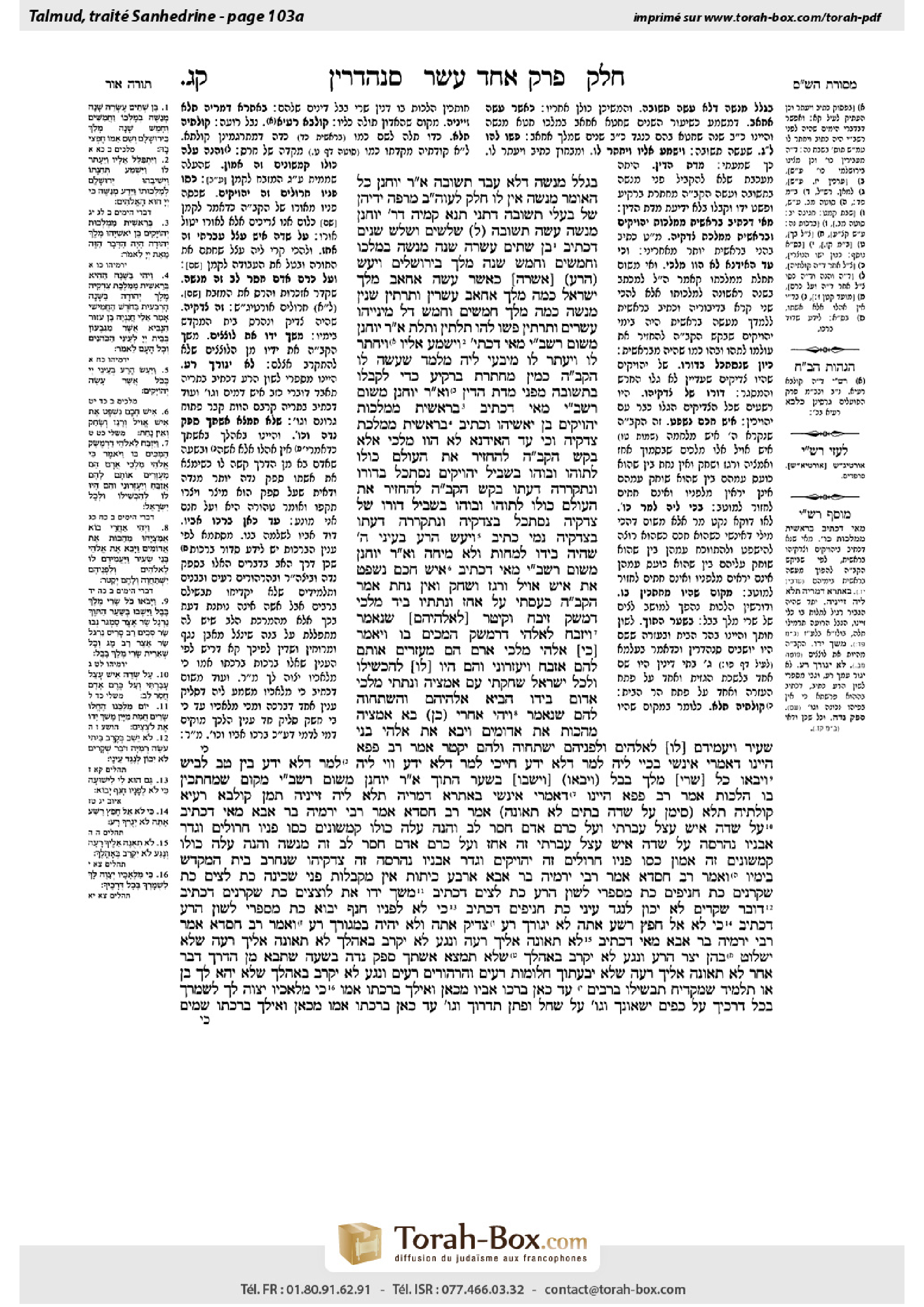
Sanhedrin 103a: Talmud study for Daf Yomi
Daf Yomi is the daily study of one Talmud folio. Explore 37 tractates with scans, Hebrew text, Sefaria English and AI-generated French translations where annotated.
Passage selection and English or AI-generated French translation are available where the scan has annotations. Daf Study is independent of Torah-Box and Sefaria.
Browse Sanhedrin · סנהדרין · All tractatesSanhedrin 103a text and translations
This page of Sanhedrin includes the Aramaic text, an English translation and an AI-generated French translation, alongside the scan above.
סנהדרין ק״ג א · Aramaic and Hebrew text
בִּגְלַל מְנַשֶּׁה, דְּלָא עֲבַד תְּשׁוּבָה.
אָמַר רַבִּי יוֹחָנָן: כׇּל הָאוֹמֵר מְנַשֶּׁה אֵין לוֹ חֵלֶק לָעוֹלָם הַבָּא מְרַפֶּה יְדֵיהֶן שֶׁל בַּעֲלֵי תְשׁוּבָה. דְּתָנֵי תַּנָּא קַמֵּיהּ דְּרַבִּי יוֹחָנָן: מְנַשֶּׁה עָשָׂה תְּשׁוּבָה (לִשְׁלֹשִׁים) [שְׁלֹשִׁים] וְשָׁלֹשׁ שָׁנִים, דִּכְתִיב: ״בֵּן שְׁתֵּים עֶשְׂרֵה שָׁנָה מְנַשֶּׁה בְמׇלְכוֹ וַחֲמִשִּׁים וְחָמֵשׁ שָׁנָה מָלַךְ בִּירוּשָׁלִָים וַיַּעַשׂ (הָרַע) [אֲשֵׁרָה] וְכוּ׳ כַּאֲשֶׁר עָשָׂה אַחְאָב מֶלֶךְ יִשְׂרָאֵל״. כַּמָּה מָלַךְ אַחְאָב? עֶשְׂרִין וְתַרְתֵּין שְׁנִין. מְנַשֶּׁה כַּמָּה מָלַךְ? חֲמִשִּׁים וְחָמֵשׁ. דַּל מִינַּיְיהוּ עֶשְׂרִים וְתַרְתֵּין, פָּשׁוּ לְהוּ תְּלָתִין וּתְלָת.
אָמַר רַבִּי יוֹחָנָן מִשּׁוּם רַבִּי שִׁמְעוֹן בֶּן יוֹחַי: מַאי דִּכְתִיב ״וַיִּשְׁמַע אֵלָיו וַיֵּחָתֶר לוֹ״? ״וַיֵּעָתֶר לוֹ״ מִיבְּעֵי לֵיהּ! מְלַמֵּד שֶׁעָשָׂה לוֹ הַקָּדוֹשׁ בָּרוּךְ הוּא כְּמִין מַחְתֶּרֶת בָּרָקִיעַ, כְּדֵי לְקַבְּלוֹ בִּתְשׁוּבָה, מִפְּנֵי מִדַּת הַדִּין.
וְאָמַר רַבִּי יוֹחָנָן מִשּׁוּם רַבִּי שִׁמְעוֹן בֶּן יוֹחַי: מַאי דִּכְתִיב ״בְּרֵאשִׁית מַמְלֶכֶת יְהוֹיָקִים בֶּן יֹאשִׁיָּהוּ״, וּכְתִיב ״בְּרֵאשִׁית מַמְלֶכֶת צִדְקִיָּה״? וְכִי עַד הָאִידָּנָא לָא הֲווֹ מַלְכֵי?
אֶלָּא, בִּקֵּשׁ הַקָּדוֹשׁ בָּרוּךְ הוּא לְהַחְזִיר אֶת הָעוֹלָם כּוּלּוֹ לְתוֹהוּ וָבוֹהוּ בִּשְׁבִיל יְהוֹיָקִים. נִסְתַּכֵּל בְּדוֹרוֹ, וְנִתְקָרְרָה דַּעְתּוֹ.
בִּקֵּשׁ הַקָּדוֹשׁ בָּרוּךְ הוּא לְהַחְזִיר אֶת הָעוֹלָם כּוּלּוֹ לְתוֹהוּ וָבוֹהוּ בִּשְׁבִיל דּוֹרוֹ שֶׁל צִדְקִיָּה. נִסְתַּכֵּל בְּצִדְקִיָּה וְנִתְקָרְרָה דַּעְתּוֹ. בְּצִדְקִיָּה נָמֵי כְּתִיב: ״וַיַּעַשׂ הָרַע בְּעֵינֵי ה׳״. שֶׁהָיָה בְּיָדוֹ לִמְחוֹת וְלֹא מִיחָה.
וְאָמַר רַבִּי יוֹחָנָן מִשּׁוּם רַבִּי שִׁמְעוֹן בֶּן יוֹחַי: מַאי דִּכְתִיב ״אִישׁ חָכָם נִשְׁפָּט אֶת אִישׁ אֱוִיל וְרָגַז וְשָׂחַק וְאֵין נָחַת״? אָמַר הַקָּדוֹשׁ בָּרוּךְ הוּא: כָּעַסְתִּי עַל אָחָז וּנְתַתִּיו בְּיַד מַלְכֵי דַמֶּשֶׂק, זִיבַּח וְקִיטֵּר [לֵאלֹהֵיהֶם], שֶׁנֶּאֱמַר: ״וַיִּזְבַּח לֵאלֹהֵי דַרְמֶשֶׂק הַמַּכִּים בּוֹ וַיֹּאמֶר [כִּי] אֱלֹהֵי מַלְכֵי אֲרָם הֵם מַעְזְרִים אוֹתָם לָהֶם אֲזַבֵּחַ וְיַעְזְרוּנִי וְהֵם הָיוּ [לוֹ] לְהַכְשִׁילוֹ וּלְכׇל יִשְׂרָאֵל״.
שָׂחַקְתִּי עִם אֲמַצְיָה וְנָתַתִּי מַלְכֵי אֱדוֹם בְּיָדוֹ. הֵבִיא אֱלֹהֵיהֶם וְהִשְׁתַּחֲוָה לָהֶם, שֶׁנֶּאֱמַר: ״וַיְהִי אַחֲרֵי בוֹא אֲמַצְיָהוּ מֵהַכּוֹת אֶת אֲדוֹמִים וַיָּבֵא אֶת אֱלֹהֵי בְּנֵי שֵׂעִיר וַיַּעֲמִידֵם [לוֹ] לֵאלֹהִים וְלִפְנֵיהֶם יִשְׁתַּחֲוֶה וְלָהֶם יְקַטֵּר״. אָמַר רַב פָּפָּא: הַיְינוּ דְּאָמְרִי אִינָשֵׁי, בְּכַיי לֵיהּ לְמָר וְלָא יָדַע, חֲיַיכִי לְמָר וְלָא יָדַע, וַוי לֵיהּ לְמָר דְּלָא יָדַע בֵּין טָב לְבִישׁ.
״וַיָּבֹאוּ כֹּל [שָׂרֵי] מֶלֶךְ בָּבֶל (וַיָּבֹאוּ) [וַיֵּשְׁבוּ] בְּשַׁעַר הַתָּוֶךְ״. אָמַר רַבִּי יוֹחָנָן מִשּׁוּם רַבִּי שִׁמְעוֹן בֶּן יוֹחַי: מָקוֹם שֶׁמְּחַתְּכִין בּוֹ הֲלָכוֹת. אָמַר רַב פָּפָּא: הַיְינוּ דְּאָמְרִי אִינָשֵׁי, בְּאַתְרָא דְּמָרֵיהּ תְּלָא לֵיהּ זְיָינֵיהּ, תַּמָּן קוּלְבָּא רָעֲיָא קוּלְּתֵיהּ תְּלָא.
סִימַן: עַל שְׂדֵה, (בָתִּים) [כִּתִּים], לֹא תְּאוּנֶּה.
אָמַר רַב חִסְדָּא אָמַר רַבִּי יִרְמְיָה בַּר אַבָּא: מַאי דִּכְתִיב ״עַל שְׂדֵה אִישׁ עָצֵל עָבַרְתִּי וְעַל כֶּרֶם אָדָם חֲסַר לֵב וְהִנֵּה עָלָה כֻלּוֹ קִמְּשׂוֹנִים כׇּסּוּ פָנָיו חֲרֻלִּים וְגֶדֶר אֲבָנָיו נֶהֱרָסָה״? ״עַל שְׂדֵה אִישׁ עָצֵל עָבַרְתִּי״ – זֶה אָחָז, ״וְעַל כֶּרֶם אָדָם חֲסַר לֵב״ – זֶה מְנַשֶּׁה, ״וְהִנֵּה עָלָה כֻלּוֹ קִמְּשׂוֹנִים״ – זֶה אָמוֹן, ״כׇּסּוּ פָנָיו חֲרֻלִּים״ – זֶה יְהוֹיָקִים, ״וְגֶדֶר אֲבָנָיו נֶהֱרָסָה״ – זֶה צִדְקִיָּהוּ שֶׁנֶּחְרַב בֵּית הַמִּקְדָּשׁ בְּיָמָיו.
וְאָמַר רַב חִסְדָּא אָמַר רַבִּי יִרְמְיָה בַּר אַבָּא: אַרְבַּע כִּיתּוֹת אֵין מְקַבְּלוֹת פְּנֵי שְׁכִינָה: כַּת לֵצִים, כַּת שַׁקְרָנִים, כַּת חֲנֵיפִים, כַּת מְסַפְּרֵי לָשׁוֹן הָרָע. כַּת לֵצִים – דִּכְתִיב: ״מָשַׁךְ יָדוֹ אֶת לֹצְצִים״. כַּת שַׁקְרָנִים – דִּכְתִיב: ״דֹּבֵר שְׁקָרִים לֹא יִכּוֹן לְנֶגֶד עֵינָי״. כַּת חֲנֵיפִים – דִּכְתִיב: ״כִּי לֹא לְפָנָיו חָנֵף יָבוֹא״. כַּת מְסַפְּרֵי לָשׁוֹן הָרָע – דִּכְתִיב: ״כִּי לֹא אֵל חָפֵץ רֶשַׁע אָתָּה לֹא יְגֻרְךָ רָע״, צַדִּיק אַתָּה וְלֹא יִהְיֶה בִּמְגוּרְךָ רָע.
וְאָמַר רַב חִסְדָּא אָמַר רַבִּי יִרְמְיָה בַּר אַבָּא: מַאי דִּכְתִיב ״לֹא תְאֻנֶּה אֵלֶיךָ רָעָה וְנֶגַע לֹא יִקְרַב בְּאׇהֳלֶךָ״? ״לֹא תְאֻנֶּה אֵלֶיךָ רָעָה״ – שֶׁלֹּא יִשְׁלוֹט בָּהֶן יֵצֶר הָרָע, ״וְנֶגַע לֹא יִקְרַב בְּאׇהֳלֶךָ״ – שֶׁלֹּא תִּמְצָא אִשְׁתְּךָ סְפֵק נִדָּה בְּשָׁעָה שֶׁתָּבֹא מִן הַדֶּרֶךְ.
דָּבָר אַחֵר: ״לֹא תְאֻנֶּה אֵלֶיךָ רָעָה״ – שֶׁלֹּא יְבַעֲתוּךָ חֲלוֹמוֹת רָעִים וְהִרְהוּרִים רָעִים. ״וְנֶגַע לֹא יִקְרַב בְּאׇהֳלֶךָ״ – שֶׁלֹּא יְהֵא לְךָ בֵּן אוֹ תַּלְמִיד שֶׁמַּקְדִּיחַ תַּבְשִׁילוֹ בָּרַבִּים, כְּגוֹן יֵשׁוּ הַנּוֹצְרִי.
עַד כָּאן בֵּרְכוֹ אָבִיו, מִכָּאן וְאֵילָךְ בֵּרְכַתּוּ אִמּוֹ. ״כִּי מַלְאָכָיו יְצַוֶּה לָּךְ לִשְׁמׇרְךָ בְּכׇל דְּרָכֶיךָ. עַל כַּפַּיִם יִשָּׂאוּנְךָ וְגוֹ׳. עַל שַׁחַל וָפֶתֶן תִּדְרֹךְ וְגוֹ׳״.
עַד כָּאן בֵּרְכַתּוּ אִמּוֹ, מִכָּאן וְאֵילָךְ בֵּרְכַתּוּ שָׁמַיִם.
Sanhedrin 103a · English translation
“on account of Manasseh” means because he did not repent, and the people followed in his footsteps.
Rabbi Yoḥanan says: Anyone who says that Manasseh has no share in the World-to-Come discourages penitents, as Manasseh repented and according to them is nevertheless excluded from the World-to-Come. As the tanna taught a baraita before Rabbi Yoḥanan: Manasseh repented for thirty-three years, as it is written: “Manasseh was twelve years old when he began to reign, and he reigned fifty-five years in Jerusalem…And he did that which was evil…And he made an ashera, as did Ahab king of Israel” (II Kings 21:1–3). How many years did Ahab reign? He reigned twenty-two years. How many years did Manasseh reign? He reigned fifty-five years. Deduct from them the twenty-two years during which he performed evil like Ahab, and thirty-three years remain for him to have repented.
Rabbi Yoḥanan says in the name of Rabbi Shimon ben Yoḥai: What is the meaning of that which is written: “And he prayed to Him; and He made an opening for him” (II Chronicles 33:13)? Instead: And He received his entreaty, should have been written. Rather, this teaches that the Holy One, Blessed be He, crafted for him a type of opening in Heaven in order to accept him in repentance. It was necessary for Manasseh to enter the World-to-Come in a clandestine manner, due to the attribute of justice that sought to prevent his entry by claiming that his sentence was irreversible.
§ And Rabbi Yoḥanan says in the name of Rabbi Shimon ben Yoḥai: What is the meaning of that which is written: “In the beginning of the reign of Jehoiakim, son of Josiah” (Jeremiah 26:1), and it is written: “In the beginning of the reign of Zedekiah” (Jeremiah 28:1). But is it so that until now there were no kings? Why did the prophet use the term “in the beginning” exclusively with regard to these two kings, as opposed to: During the first year of his reign, or a similar formulation?
Rather, the reason for the unusual formulation is that the Holy One, Blessed be He, sought to restore the entire world to chaos and void, as it was in the beginning before Creation, on account of Jehoiakim the wicked; but He observed Jehoiakim’s generation, which included the righteous who had not yet been exiled to Babylonia, and His mind was set at ease. The term “in the beginning” is used to signify that it is as though the world had been created anew.
Likewise, the Holy One, Blessed be He, sought to restore the entire world to chaos and void, as it was in the beginning before Creation, on account of the generation of Zedekiah, as only the wicked remained after the exile of the righteous; but He observed Zedekiah and His mind was set at ease. The Gemara asks: With regard to Zedekiah it is also written: “And he did evil in the eyes of the Lord” (II Kings 24:19); why was God’s mind set at ease? The Gemara answers: Zedekiah was not wicked; rather, he had it in his power to rebuke the people of his generation and he did not rebuke them. Therefore, their sins are attributed to him.
And Rabbi Yoḥanan says in the name of Rabbi Shimon ben Yoḥai: What is the meaning of that which is written: “If a wise man contends with a foolish man, whether he is angry or laughs, there is no rest” (Proverbs 29:9)? The Holy One, Blessed be He, said: I was angry with Ahaz and I delivered him into the hand of the kings of Damascus. He then sacrificed offerings and burned incense to their gods, as it is stated: “He sacrificed to the gods of Damascus that smote him; and he said: Because the gods of the kings of Aram help them, I will sacrifice to them, and they will help me. But they were the ruin of him, and of all Israel” (II Chronicles 28:23). When the Holy One, Blessed be He, was angry with Israel and caused them to lose a war to prompt them to repent of their sins, their response was to worship idols.
I smiled upon Amaziah and I delivered the kings of Edom into his hand. In response, he brought their gods and bowed to them, as it is stated: “And it came to pass after Amaziah came from striking the Edomites, that he brought the gods of the children of Seir and set them up to be his gods and prostrated himself before them, and burned incense to them” (II Chronicles 25:14). The response to victory in war was the same, idol worship. They are incorrigible. Rav Pappa says that this is in accordance with the adage that people say: I cried for the master and he did not know, I smiled for the master and he did not know; woe unto the master who does not know the distinction between good and bad. The Jewish people also resorted to idol worship both when God rewarded them and when He afflicted them.
With regard to the verse: “And all the princes of the king of Babylonia came in and sat in the middle gate [sha’ar hattavekh]” (Jeremiah 39:3), Rabbi Yoḥanan said in the name of Rabbi Shimon ben Yoḥai: Sha’ar hattavekh was the place in which they would decide [meḥattekhin] halakhot. Rav Pappa says that this is in accordance with the adage that people say: In the place that the master of the house hangs his weapons, there the despicable shepherd hangs his jug. In the place where the Sanhedrin convened, Nebuchadnezzar the wicked and his princes now assemble.
§ The Gemara cites a mnemonic for the following statements that Rav Ḥisda said that Rabbi Yirmeya bar Abba said: By the field, houses, shall not befall.
Rav Ḥisda says that Rabbi Yirmeya bar Abba says: What is the meaning of that which is written: “I passed by the field of an indolent man, and by the vineyard of a man void of understanding; and behold, it was overgrown with thistles, and its surface was covered with nettles, and its stone wall was broken” (Proverbs 24:30–31)? The verse describes the spiritual and political decline of the kings of Judea. “I passed by the field of an indolent man”; this is a reference to Ahaz. “And by the vineyard of a man void of understanding”; this is a reference to Manasseh. “And behold, it was overgrown with thistles”; this is a reference to Amon. “And its surface was covered with nettles”; this is a reference to Jehoiakim. “And its stone wall was broken”; this is a reference to Zedekiah, in whose days the Temple was destroyed.
Apropos the previous statement, the Gemara cites an additional statement. And Rav Ḥisda says that Rabbi Yirmeya bar Abba says that four groups do not receive the Divine Presence: This pertains to the group of cynics, the group of liars, the group of flatterers, and the group of slanderers. This pertains to the group of cynics, as it is written: “He withdrew His hand with cynics” (Hosea 7:5), indicating that God distanced Himself from them. This pertains to the group of liars, as it is written: “He that speaks falsehoods shall not be established before My eyes” (Psalms 101:7). This pertains to the group of flatterers, as it is written: “That a flatterer shall not come before Him” (Job 13:16). This pertains to the group of slanderers, as it is stated: “For You are not a God who desires wickedness; evil shall not dwell with You” (Psalms 5:5), which means: You are righteous, and there will be no form of evil in Your dwelling.
And Rav Ḥisda says that Rabbi Yirmeya bar Abba says: What is the meaning of that which is written: “No evil shall befall you, nor shall any plague come near your tent” (Psalms 91:10)? “No evil shall befall you” means that the evil inclination shall not dominate them. “Nor shall any plague come near your tent” means that you will never find your wife in a state of uncertainty whether she has the halakhic status of a menstruating woman when you return from a journey. After a period of separation, when a husband desires his wife, her uncertain status may prove more frustrating than a situation where the prohibition is clear-cut.
Alternatively, the phrase “no evil shall befall you” means that you will be frightened neither by bad dreams nor by evil thoughts. “Nor shall any plague come near your tent” means that you will not have a child or student who overcooks his food in public, i.e., sins in public and causes others to sin, such as in the well-known case of Jesus the Nazarene.
Until this point in the psalm, Solomon’s father, David, blessed him, as these are blessings appropriate for a father to bless his son. From this point forward, his mother blessed him, as these are blessings appropriate for a mother to bless her son. “For he shall order His angels to preserve you in all your ways. They shall bear you on their hands, lest they dash your foot against a stone. You shall tread upon the lion and the adder; the young lion and the crocodile shall you trample under foot” (Psalms 91:11–13).
Until this point in the psalm, his mother blessed him. From this point forward, God in Heaven blessed him, as the psalm proceeds to refer to God in the first person, as though speaking in His name:
Sanhedrin 103a · Traduction française (IA)
« À cause de Manassé » signifie : parce qu’il ne s’est pas repenti et que le peuple a suivi ses traces.
Rabbi Yoḥanan dit : Quiconque affirme que Manassé n’a pas de part dans le Monde à venir décourage ceux qui se repentent : Manassé s’est repenti et, selon cette affirmation, serait pourtant exclu du Monde à venir. En effet, un tanna enseigna une baraïta devant Rabbi Yoḥanan : Manassé se repentit pendant trente-trois ans, comme il est écrit : « Manassé avait douze ans lorsqu’il devint roi, et il régna cinquante-cinq ans à Jérusalem… Il fit ce qui est mal… Il fit une achéra, comme l’avait fait Achab, roi d’Israël » (II Rois 21:1–3). Combien d’années Achab régna-t-il ? Il régna vingt-deux ans. Combien d’années Manassé régna-t-il ? Il régna cinquante-cinq ans. Retranchez-en les vingt-deux années durant lesquelles il fit le mal comme Achab, et il reste trente-trois ans pendant lesquels il se repentit.
Rabbi Yoḥanan dit au nom de Rabbi Shimon ben Yoḥai : Quel est le sens de ce qui est écrit : « Il le pria, et Il lui fit une ouverture » (II Chroniques 33:13) ? Il aurait plutôt fallu écrire : « Il accueillit sa supplication ». Cela enseigne que le Saint, béni soit-Il, aménagea pour lui une sorte d’ouverture dans le Ciel afin de l’accueillir après son repentir. Manassé dut entrer au Monde à venir en secret, car l’attribut de justice cherchait à l’en empêcher, arguant que sa sentence était irrévocable.
§ Rabbi Yoḥanan dit au nom de Rabbi Shimon ben Yoḥai : Quel est le sens de ce qui est écrit : « Au commencement du règne de Yehoyaqim, fils de Yoshiyahou » (Jérémie 26:1), et de ce qui est écrit : « Au commencement du règne de Sédécias » (Jérémie 28:1) ? N’y avait-il donc pas de rois auparavant ? Pourquoi le prophète emploie-t-il l’expression « au commencement » uniquement à propos de ces deux rois, au lieu de dire : « Durant la première année de son règne », ou d’employer une formule similaire ?
La raison de cette formulation inhabituelle est plutôt que le Saint, béni soit-Il, chercha à ramener le monde entier au chaos et au vide, comme il l’était au commencement, avant la Création, à cause du méchant Yehoyaqim. Mais Il observa la génération de Yehoyaqim, qui comptait des justes n’ayant pas encore été exilés à Babylone, et Son esprit s’apaisa. L’expression « au commencement » signifie que c’est comme si le monde avait été créé de nouveau.
De même, le Saint, béni soit-Il, chercha à ramener le monde entier au chaos et au vide, comme il l’était au commencement, avant la Création, à cause de la génération de Sédécias, puisque, après l’exil des justes, seuls les méchants étaient restés. Mais Il observa Sédécias et Son esprit s’apaisa. La Guemara demande : À propos de Sédécias, il est aussi écrit : « Il fit ce qui est mal aux yeux du Seigneur » (II Rois 24:19) ; pourquoi Dieu fut-Il apaisé ? La Guemara répond : Sédécias n’était pas méchant ; mais il avait le pouvoir de réprimander les gens de sa génération et ne les réprimanda pas. C’est pourquoi leurs péchés lui sont imputés.
Rabbi Yoḥanan dit au nom de Rabbi Shimon ben Yoḥai : Quel est le sens de ce qui est écrit : « Si un sage entre en dispute avec un insensé, qu’il se mette en colère ou qu’il rie, il n’y a pas de repos » (Proverbes 29:9) ? Le Saint, béni soit-Il, dit : Je me suis mis en colère contre Ahaz et Je l’ai livré aux rois de Damas. Il offrit alors des sacrifices et brûla de l’encens à leurs dieux, comme il est dit : « Il offrit des sacrifices aux dieux de Damas qui l’avaient frappé, et il dit : “Puisque les dieux des rois d’Aram les aident, je leur offrirai des sacrifices, et ils m’aideront.” Mais ils furent sa ruine, ainsi que celle de tout Israël » (II Chroniques 28:23). Lorsque le Saint, béni soit-Il, se mit en colère contre Israël et lui fit perdre une guerre afin de l’inciter à se repentir de ses péchés, le peuple réagit en adorant des idoles.
Je souris à Amatsia et Je livrai les rois d’Édom entre ses mains. En réponse, il apporta leurs dieux et se prosterna devant eux, comme il est dit : « Après qu’Amatsia fut revenu de sa victoire sur les Édomites, il apporta les dieux des fils de Séïr, les installa comme ses dieux, se prosterna devant eux et leur brûla de l’encens » (II Chroniques 25:14). La réaction à la victoire dans la guerre fut la même : le culte des idoles. Ils sont incorrigibles. Rav Pappa dit que cela correspond au dicton populaire : « J’ai pleuré pour le maître, mais il ne l’a pas su ; j’ai souri pour le maître, mais il ne l’a pas su. Malheur au maître qui ne distingue pas le bien du mal. » Le peuple juif recourut lui aussi au culte des idoles, aussi bien lorsque Dieu le récompensait que lorsqu’Il l’accablait.
À propos du verset : « Tous les princes du roi de Babylone entrèrent et s’assirent à la porte du Milieu [sha’ar hattavekh] » (Jérémie 39:3), Rabbi Yoḥanan dit au nom de Rabbi Shimon ben Yoḥai : Sha’ar hattavekh était l’endroit où l’on tranchait [meḥattekhin] les halakhot. Rav Pappa dit que cela correspond au dicton populaire : « Là où le maître de maison accroche ses armes, le berger méprisable accroche sa cruche. » Là où siégeait le Sanhédrin, le méchant Nabuchodonosor et ses princes se réunissent désormais.
§ La Guemara cite un moyen mnémotechnique pour les déclarations suivantes de Rav Ḥisda, rapportées par Rabbi Yirmeya bar Abba : « Par le champ, les maisons, ne surviendra pas. »
Rav Ḥisda dit que Rabbi Yirmeya bar Abba dit : Quel est le sens de ce qui est écrit : « Je suis passé près du champ d’un paresseux et de la vigne d’un homme dépourvu de sens ; et voici qu’elle était envahie de chardons, sa surface couverte d’orties, et son mur de pierres écroulé » (Proverbes 24:30–31) ? Le verset décrit le déclin spirituel et politique des rois de Judée. « Je suis passé près du champ d’un paresseux » : cela fait référence à Ahaz. « Et de la vigne d’un homme dépourvu de sens » : cela fait référence à Manassé. « Et voici qu’elle était envahie de chardons » : cela fait référence à Amon. « Sa surface était couverte d’orties » : cela fait référence à Yehoyaqim. « Et son mur de pierres était écroulé » : cela fait référence à Sédécias, sous le règne duquel le Temple fut détruit.
À propos de la déclaration précédente, la Guemara en cite une autre. Rav Ḥisda dit que Rabbi Yirmeya bar Abba dit que quatre groupes ne bénéficient pas de la Présence divine : les cyniques, les menteurs, les flatteurs et les calomniateurs. Cela concerne les cyniques, comme il est écrit : « Il retira Sa main aux cyniques » (Osée 7:5), ce qui indique que Dieu s’éloigna d’eux. Cela concerne les menteurs, comme il est écrit : « Celui qui dit des mensonges ne sera pas établi devant Mes yeux » (Psaumes 101:7). Cela concerne les flatteurs, comme il est écrit : « Un flatteur ne se présentera pas devant Lui » (Job 13:16). Cela concerne les calomniateurs, comme il est dit : « Car Tu n’es pas un Dieu qui prend plaisir à la méchanceté ; le mal ne séjournera pas auprès de Toi » (Psaumes 5:5), ce qui signifie : Tu es juste, et aucune forme de mal ne résidera dans Ta demeure.
Rav Ḥisda dit que Rabbi Yirmeya bar Abba dit : Quel est le sens de ce qui est écrit : « Aucun mal ne t’arrivera, aucune plaie n’approchera de ta tente » (Psaumes 91:10) ? « Aucun mal ne t’arrivera » signifie que le mauvais penchant ne les dominera pas. « Aucune plaie n’approchera de ta tente » signifie que tu ne trouveras jamais ta femme dans une situation où tu ne sauras pas avec certitude si elle a le statut halakhique d’une femme menstruée lorsque tu rentreras d’un voyage. Après une période de séparation, lorsqu’un mari désire sa femme, l’incertitude quant à son statut peut être plus frustrante qu’une situation où l’interdiction est clairement établie.
Autre interprétation : l’expression « aucun mal ne t’arrivera » signifie que tu ne seras effrayé ni par de mauvais rêves ni par de mauvaises pensées. « Aucune plaie n’approchera de ta tente » signifie que tu n’auras ni enfant ni élève qui fasse trop cuire son plat en public, c’est-à-dire qui pèche publiquement et pousse les autres à pécher, comme dans le cas bien connu de Jésus le Nazaréen.
Jusqu’à ce point du psaume, son père, David, l’a béni, car ce sont des bénédictions qu’un père peut adresser à son fils. À partir de là, sa mère l’a béni, car ce sont des bénédictions qu’une mère peut adresser à son fils. « Car Il ordonnera à Ses anges de te garder dans toutes tes voies. Ils te porteront sur leurs mains, de peur que ton pied ne heurte une pierre. Tu marcheras sur le lion et la vipère ; tu fouleras le jeune lion et le crocodile » (Psaumes 91:11–13).
Jusqu’à ce point du psaume, sa mère l’a béni. À partir de là, Dieu, dans les Cieux, l’a béni, car la suite du psaume parle de Dieu à la première personne, comme s’Il parlait en Son nom :
Traduction française générée par IA à partir de l’édition anglaise de Sefaria. Vérifie toujours un passage avec le texte source.
Text from Sefaria: William Davidson Edition - Vocalized Aramaic (CC BY NC); William Davidson Edition - English (CC BY NC).