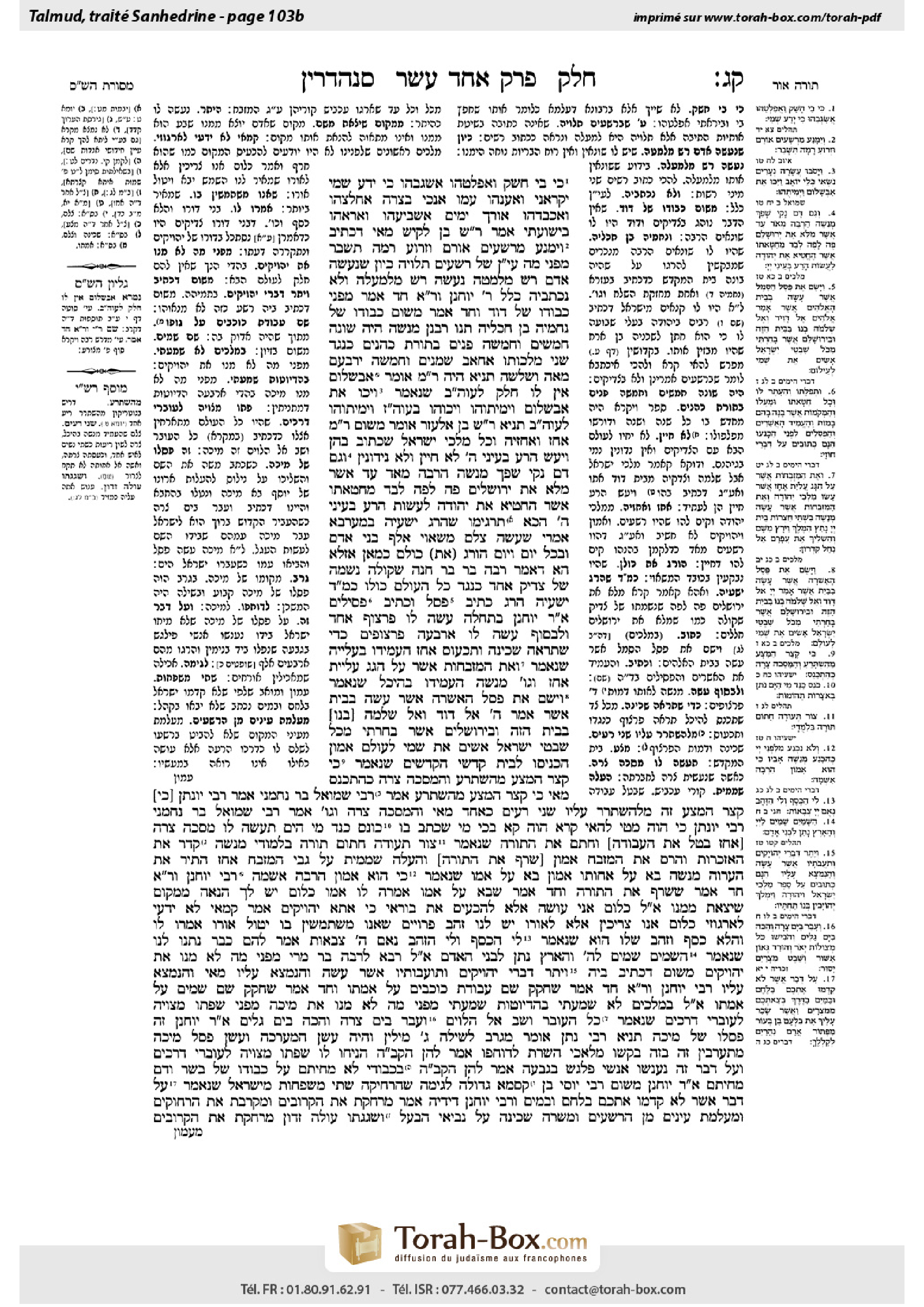
Sanhedrin 103b: Talmud study for Daf Yomi
Daf Yomi is the daily study of one Talmud folio. Explore 37 tractates with scans, Hebrew text, Sefaria English and AI-generated French translations where annotated.
Passage selection and English or AI-generated French translation are available where the scan has annotations. Daf Study is independent of Torah-Box and Sefaria.
Browse Sanhedrin · סנהדרין · All tractatesSanhedrin 103b text and translations
This page of Sanhedrin includes the Aramaic text, an English translation and an AI-generated French translation, alongside the scan above.
סנהדרין ק״ג ב · Aramaic and Hebrew text
״כִּי בִי חָשַׁק וַאֲפַלְּטֵהוּ אֲשַׂגְּבֵהוּ כִּי יָדַע שְׁמִי. יִקְרָאֵנִי וְאֶעֱנֵהוּ עִמּוֹ אָנֹכִי בְצָרָה אֲחַלְּצֵהוּ וַאֲכַבְּדֵהוּ. אוֹרֶךְ יָמִים אַשְׂבִּיעֵהוּ וְאַרְאֵהוּ בִּישׁוּעָתִי״.
אָמַר רַבִּי שִׁמְעוֹן בֶּן לָקִישׁ: מַאי דִּכְתִיב ״וְיִמָּנַע מֵרְשָׁעִים אוֹרָם וּזְרוֹעַ רָמָה תִּשָּׁבֵר״? מִפְּנֵי מָה עַיִן שֶׁל רְשָׁעִים תְּלוּיָה? כֵּיוָן שֶׁנַּעֲשֶׂה אָדָם רָשׁ מִלְּמַטָּה, נַעֲשֶׂה רָשׁ מִלְּמַעְלָה.
וְלָא נִכְתְּבַיהּ כְּלָל? רַבִּי יוֹחָנָן וְרַבִּי אֶלְעָזָר: חַד אָמַר, מִפְּנֵי כְּבוֹדוֹ שֶׁל דָּוִד; וְחַד אָמַר, מִשּׁוּם כְּבוֹדוֹ שֶׁל נְחֶמְיָה בֶּן חֲכַלְיָה.
תָּנוּ רַבָּנַן: מְנַשֶּׁה הָיָה שׁוֹנֶה חֲמִשִּׁים וַחֲמִשָּׁה פָּנִים בְּתוֹרַת כֹּהֲנִים, כְּנֶגֶד שְׁנֵי מַלְכוּתוֹ. אַחְאָב – שְׁמֹנִים וַחֲמִשָּׁה, יָרׇבְעָם – מֵאָה וּשְׁלֹשָׁה.
תַּנְיָא: הָיָה רַבִּי מֵאִיר אוֹמֵר, אַבְשָׁלוֹם אֵין לוֹ חֵלֶק לָעוֹלָם הַבָּא, שֶׁנֶּאֱמַר ״וַיַּכּוּ אֶת אַבְשָׁלוֹם וַיְמִיתֻהוּ״. ״וַיַּכּוּהוּ״ – בְּעוֹלָם הַזֶּה, ״וַיְמִיתֻהוּ״ – לָעוֹלָם הַבָּא. תַּנְיָא: רַבִּי שִׁמְעוֹן בֶּן אֶלְעָזָר אוֹמֵר מִשּׁוּם רַבִּי מֵאִיר, אָחָז וַאֲחַזְיָה וְכׇל מַלְכֵי יִשְׂרָאֵל שֶׁכָּתוּב בָּהֶן ״וַיַּעַשׂ הָרָע בְּעֵינֵי ה׳״ – לֹא חַיִּין וְלֹא נִידּוֹנִין.
״וְגַם דָּם נָקִי שָׁפַךְ מְנַשֶּׁה הַרְבֵּה מְאֹד עַד אֲשֶׁר מִלֵּא אֶת יְרוּשָׁלִַים פֶּה לָפֶה לְבַד מֵחַטָּאתוֹ אֲשֶׁר הֶחֱטִיא אֶת יְהוּדָה לַעֲשׂוֹת הָרַע בְּעֵינֵי ה׳״. הָכָא תַּרְגִּימוּ: שֶׁהָרַג יְשַׁעְיָה. בְּמַעְרְבָא אָמְרִי: שֶׁעָשָׂה צֶלֶם מַשּׂאוֹי אֶלֶף בְּנֵי אָדָם, וּבְכׇל יוֹם וָיוֹם הוֹרֵג (אֶת) כּוּלָּם. כְּמַאן אָזְלָא הָא דְּאָמַר רַבָּה בַּר בַּר חָנָה: שְׁקוּלָה נְשָׁמָה שֶׁל צַדִּיק אֶחָד כְּנֶגֶד כׇּל הָעוֹלָם כּוּלּוֹ? כְּמַאן דְּאָמַר יְשַׁעְיָה הָרַג.
כְּתִיב ״פֶּסֶל״, וּכְתִיב ״פְּסִילִים״. אָמַר רַבִּי יוֹחָנָן: בַּתְּחִלָּה עָשָׂה לוֹ פַּרְצוּף אֶחָד, וּלְבַסּוֹף עָשָׂה לוֹ אַרְבָּעָה פַּרְצוּפִים, כְּדֵי שֶׁתִּרְאֶה שְׁכִינָה וְתִכְעוֹס.
אָחָז הֶעֱמִידוֹ בַּעֲלִיָּיה, שֶׁנֶּאֱמַר: ״וְאֵת הַמִּזְבְּחוֹת אֲשֶׁר עַל הַגָּג עֲלִיַּת אָחָז וְגוֹ׳״. מְנַשֶּׁה הֶעֱמִידוֹ בַּהֵיכָל, שֶׁנֶּאֱמַר: ״וַיָּשֶׂם אֶת פֶּסֶל הָאֲשֵׁרָה אֲשֶׁר עָשָׂה בַּבַּיִת אֲשֶׁר אָמַר ה׳ אֶל דָּוִד וְאֶל שְׁלֹמֹה [בְנוֹ] בַּבַּיִת הַזֶּה וּבִירוּשָׁלִַים אֲשֶׁר בָּחַרְתִּי מִכֹּל שִׁבְטֵי יִשְׂרָאֵל אָשִׂים אֶת שְׁמִי לְעוֹלָם״. אָמוֹן הִכְנִיסוֹ לְבֵית קׇדְשֵׁי הַקֳּדָשִׁים, שֶׁנֶּאֱמַר: ״כִּי קָצַר הַמַּצָּע מֵהִשְׂתָּרֵעַ וְהַמַּסֵּכָה צָרָה כְּהִתְכַּנֵּס״.
מַאי ״כִּי קָצַר הַמַּצָּע מֵהִשְׂתָּרֵעַ״? אָמַר רַבִּי שְׁמוּאֵל בַּר נַחְמָנִי אָמַר רַבִּי יוֹנָתָן: [כִּי] קָצַר הַמַּצָּע זֶה מִלְּהִשְׂתָּרֵר עָלָיו שְׁנֵי רֵעִים כְּאֶחָד. מַאי ״וְהַמַּסֵּכָה צָרָה וְגוֹ׳״? אָמַר רַבִּי שְׁמוּאֵל בַּר נַחְמָנִי: רַבִּי יוֹנָתָן כִּי הֲוָה מָטֵי לְהַאי קְרָא הֲוָה קָא בָכֵי, מִי שֶׁכָּתַב בּוֹ ״כֹּנֵס כַּנֵּד מֵי הַיָּם״ תֵּעָשֶׂה לוֹ מַסֵּכָה צָרָה?
[אָחָז בִּטֵּל אֶת הָעֲבוֹדָה], וְחָתַם אֶת הַתּוֹרָה, שֶׁנֶּאֱמַר: ״צוֹר תְּעוּדָה חֲתוֹם תּוֹרָה בְּלִמּוּדָי״. מְנַשֶּׁה קָדַר אֶת הָאַזְכָּרוֹת, וְהָרַס אֶת הַמִּזְבֵּחַ. אָמוֹן שָׂרַף אֶת הַתּוֹרָה, וְהֶעֱלָה שְׂמָמִית עַל גַּבֵּי הַמִּזְבֵּחַ. אָחָז הִתִּיר אֶת הָעֶרְוָה. מְנַשֶּׁה בָּא עַל אֲחוֹתוֹ.
אָמוֹן בָּא עַל אִמּוֹ, שֶׁנֶּאֱמַר: ״כִּי הוּא אָמוֹן הִרְבָּה אַשְׁמָה״. רַבִּי יוֹחָנָן וְרַבִּי אֶלְעָזָר, חַד אָמַר: שֶׁשָּׂרַף אֶת הַתּוֹרָה, וְחַד אָמַר: שֶׁבָּא עַל אִמּוֹ. אָמְרָה לוֹ אִמּוֹ: כְּלוּם יֵשׁ לְךָ הֲנָאָה מִמָּקוֹם שֶׁיָּצָאתָ מִמֶּנּוּ? אָמַר לָהּ: כְּלוּם אֲנִי עוֹשֶׂה אֶלָּא לְהַכְעִיס אֶת בּוֹרְאִי.
כִּי אֲתָא יְהוֹיָקִים אָמַר: קַמָּאֵי לָא יָדְעִי לְאַרְגּוֹזֵי, כְּלוּם אָנוּ צְרִיכִין אֶלָּא לְאוֹרוֹ? יֵשׁ לָנוּ זְהַב פַּרְוַיִים שֶׁאָנוּ מִשְׁתַּמְּשִׁין בּוֹ, יִטּוֹל אוֹרוֹ. אָמְרוּ לוֹ: וַהֲלֹא כֶּסֶף וְזָהָב שֶׁלּוֹ הוּא, שֶׁנֶּאֱמַר: ״לִי הַכֶּסֶף וְלִי הַזָּהָב נְאֻם ה׳ צְבָאוֹת״? אָמַר לָהֶם: כְּבָר נְתָנוֹ לָנוּ, שֶׁנֶּאֱמַר: ״הַשָּׁמַיִם שָׁמַיִם לַה׳ וְהָאָרֶץ נָתַן לִבְנֵי אָדָם״.
אֲמַר לֵיהּ רָבָא לְרַבָּה בַּר מָרִי: מִפְּנֵי מָה לֹא מָנוּ אֶת יְהוֹיָקִים? מִשּׁוּם דִּכְתִיב בֵּיהּ: ״וְיֶתֶר דִּבְרֵי יְהוֹיָקִים וְתֹעֲבֹתָיו אֲשֶׁר עָשָׂה וְהַנִּמְצָא עָלָיו״. מַאי ״וְהַנִּמְצָא עָלָיו״? רַבִּי יוֹחָנָן וְרַבִּי אֶלְעָזָר – חַד אָמַר: שֶׁחָקַק שֵׁם עֲבוֹדָה זָרָה עַל אַמָּתוֹ, וְחַד אָמַר: שֶׁחָקַק שֵׁם שָׁמַיִם עַל אַמָּתוֹ.
אֲמַר לֵיהּ: בִּמְלָכִים לֹא שָׁמַעְתִּי, בְּהֶדְיוֹטוֹת שָׁמַעְתִּי. מִפְּנֵי מָה לֹא מָנוּ אֶת מִיכָה? מִפְּנֵי שֶׁפִּתּוֹ מְצוּיָה לְעוֹבְרֵי דְּרָכִים, שֶׁנֶּאֱמַר: ״כׇּל הָעוֹבֵר וְשָׁב אֶל הַלְוִיִּם״.
״וְעָבַר בַּיָּם צָרָה וְהִכָּה בַיָּם גַּלִּים״. אָמַר רַבִּי יוֹחָנָן: זֶה פִּסְלוֹ שֶׁל מִיכָה. תַּנְיָא, רַבִּי נָתָן אוֹמֵר: מִגָּרֵב לְשִׁילֹה שְׁלֹשָׁה מִילִין, וְהָיָה עֲשַׁן הַמַּעֲרָכָה וַעֲשַׁן פֶּסֶל מִיכָה מִתְעָרְבִין זֶה בָּזֶה.
בִּקְּשׁוּ מַלְאֲכֵי הַשָּׁרֵת לְדוֹחְפוֹ. אָמַר לָהֶן הַקָּדוֹשׁ בָּרוּךְ הוּא: הַנִּיחוּ לוֹ, שֶׁפִּתּוֹ מְצוּיָה לְעוֹבְרֵי דְּרָכִים. וְעַל דָּבָר זֶה נֶעְנְשׁוּ אַנְשֵׁי פִּלֶגֶשׁ בַּגִּבְעָה. אָמַר לָהֶן הַקָּדוֹשׁ בָּרוּךְ הוּא: בִּכְבוֹדִי לֹא מְחִיתֶם, עַל כְּבוֹדוֹ שֶׁל בָּשָׂר וָדָם מְחִיתֶם!
אָמַר רַבִּי יוֹחָנָן מִשּׁוּם רַבִּי יוֹסֵי בֶּן קִסְמָא: גְּדוֹלָה לְגִימָה, שֶׁהִרְחִיקָה שְׁתֵּי מִשְׁפָּחוֹת מִיִּשְׂרָאֵל, שֶׁנֶּאֱמַר: ״עַל דְּבַר אֲשֶׁר לֹא קִדְּמוּ אֶתְכֶם בַּלֶּחֶם וּבַמַּיִם״. וְרַבִּי יוֹחָנָן דִּידֵיהּ אָמַר: מְרַחֶקֶת אֶת הַקְּרוֹבִים, וּמְקָרֶבֶת אֶת הָרְחוֹקִים, וּמַעֲלֶמֶת עֵינַיִם מִן הָרְשָׁעִים, וּמַשְׁרָה שְׁכִינָה עַל נְבִיאֵי הַבַּעַל, וְשִׁגְגָתוֹ עוֹלָה זָדוֹן.
מְרַחֶקֶת אֶת הַקְּרוֹבִים –
Sanhedrin 103b · English translation
“Because he has desired Me, therefore I will deliver him; I will set him on high, because he has known My name. He shall call upon Me, and I will answer him; I will be with him in trouble; I will deliver him, and honor him. With long life I will satisfy him, and show him My salvation” (Psalms 91:14–16).
Rabbi Shimon ben Lakish says: What is the meaning of that which is written: “And He will withhold their light from the wicked [resha’im], and the high arm shall be broken” (Job 38:15)? For what reason is the letter ayin of the word resha’im suspended slightly above the rest of the letters? It is suspended so that the word will be read rashim, meaning poor people. It means: Once a person becomes poor on earth below and the number of his enemies grows, he becomes poor in Heaven above, as he is certainly a sinner and that is why he is hated.
The Gemara challenges: If that is the meaning, let the ayin not be written at all and let the verse say: Rashim. Rabbi Yoḥanan and Rabbi Elazar both explain why the ayin was not omitted. One says: It was due to the desire to preserve the honor of David, who had numerous enemies below despite the fact that he was a righteous person and had a place in the World-to-Come. And one says: It was due to the desire to preserve the honor of Nehemiah, son of Hacaliah, who also had numerous enemies below, despite his righteousness.
§ The Sages taught in a baraita: Manasseh, king of Judea, would study fifty-five different aspects in interpreting Torat Kohanim, the halakhic midrash on Leviticus, corresponding to the years of his reign, indicating that he possessed great knowledge. Ahab was greater and studied eighty-five aspects, and Jeroboam was greater still and studied one hundred and three aspects.
It is taught in a baraita that Rabbi Meir would say: Absalom has no share in the World-to-Come, as it is stated: “And they smote Absalom and they killed him” (II Samuel 18:15). “And they smote Absalom” is referring to death in this world, while “and they killed him” is referring to death in the World-to-Come. It is taught in a baraita that Rabbi Shimon ben Elazar says in the name of Rabbi Meir: Ahaz and Ahaziah, kings of Judea, and all of the kings of the kingdom of Israel about whom it is written: “And he did evil in the eyes of the Lord” (see, e.g., I Kings 15:34), neither live in the World-to-Come nor are sentenced to Gehenna.
It is stated: “And Manasseh shed a great deal of innocent blood, until he filled Jerusalem from one end to another [peh lafeh], beside his sin that he made Judea sin, to do evil in the eyes of the Lord” (II Kings 21:16). Here, in Babylonia, they interpret the verse to mean that he killed the prophet Isaiah (see Yevamot 49b). In the West, Eretz Yisrael, they say that Manasseh crafted an idol so large that it was a burden requiring one thousand people to carry it, and each and every day he would require them to carry it, which would kill all of them. The Gemara asks: In accordance with whose opinion is that which Rabba bar bar Ḥana says: The soul of one righteous person is equal in value to the entire world? It is in accordance with the opinion of the one who says: He killed Isaiah.
It is written that Manasseh crafted “an idol” (II Chronicles 33:7), and it is written that Manasseh crafted “idols” (II Chronicles 33:19). Rabbi Yoḥanan says: Initially, he crafted one face [partzuf ] for the idol, and ultimately, he crafted four faces for it so that the Divine Presence would see it from each side and become angry.
Ahaz placed that idol in the upper chamber in the Temple, as it is stated: “And the altars that were on the roof of the upper chamber of Ahaz” (II Kings 23:12). Manasseh placed it in the Sanctuary itself, as it is stated: “And he set the graven image of the ashera that he had crafted, in that house of which the Lord said to David, and to Solomon his son: In this house, and in Jerusalem, which I have chosen from all the tribes of Israel, will I put My name forever” (II Kings 21:7). Amon introduced it into the Holy of Holies, as it is stated: “For the bed is too short for spreading, and the covering too narrow for when he gathers himself” (Isaiah 28:20).
What is the meaning of the phrase “For the bed is too short for spreading”? Rabbi Shmuel bar Naḥmani says that Rabbi Yonatan says that it means: For his bed is too narrow for two colleagues to spread upon it together, as it is impossible that service of God and idol worship will coexist there. What is the meaning of the phrase “and the covering [masekha] too narrow [tzara] for when he gathers himself [kehitkanes]”? Rabbi Shmuel bar Naḥmani says: When Rabbi Yonatan would reach this verse he would cry. He about whom it is written: “He gathers [kones] the waters of the sea like a rampart” (Psalms 33:7), shall a graven image [masekha] be a rival [tzara]?
Ahaz nullified the Temple service and sealed the Torah, prohibiting its study, as it is stated: “Bind up the testimony, seal the Torah among my disciples” (Isaiah 8:16). Manasseh excised the mentions of God’s names from sacred books and destroyed the altar. Amon burned the Torah and sacrificed a gecko, an impure creeping animal, upon the altar. Ahaz permitted engaging in sexual intercourse with forbidden relatives, and announced that marriage between those relatives is permitted. Manasseh exploited that pronouncement and engaged in sexual intercourse with his sister.
Amon engaged in sexual intercourse with his mother, as it is stated: “But Amon increased his guilt” (II Chronicles 33:23), indicating that he performed a greater and more disgraceful transgression than anyone else. Rabbi Yoḥanan and Rabbi Elazar disagreed about his transgression; one says that he burned the Torah, and one says that he engaged in sexual intercourse with his mother. His mother said to him: Do you have any pleasure by engaging in intercourse from the place from which you emerged? He said to her: I am doing this only to express insolence to my Creator, not for my pleasure.
When Jehoiakim came along and reigned, he said: My predecessors did not know how to express insolence to God. Do we need God even for his light? Since we have parvayim gold that we use that shines, let God take His light from the world. They said to him: Aren’t the silver and the gold His, as it is stated: “The silver is mine and the gold is mine says the Lord of hosts” (Haggai 2:8)? Jehoiakim said to them: He has already given it to us, as it is stated: “The heavens are the heavens of the Lord, but the earth He has given to the children of men” (Psalms 115:16).
§ Rava said to Rabba bar Mari: For what reason did the tanna’im not enumerate Jehoiakim among the kings who have no share in the World-to-Come? One would imagine that he has no share in the World-to-Come, because it is written concerning him: “And the rest of the acts of Jehoiakim and his abominations that he did, and that which was found on him” (II Chronicles 36:8). The Gemara explains: What is the meaning of the phrase “and that which was found on him”? Rabbi Yoḥanan and Rabbi Elazar disagree; one says that he etched the name of idols on his penis due to his devotion to them, and one says that he etched the name of Heaven on his penis in a display of contempt.
Rabba bar Mari said to Rava: With regard to the list of kings, I did not hear why Jehoiakim was excluded; but with regard to the list of commoners, I heard why a certain sinner was excluded. For what reason did the tanna’im not enumerate Micah among those with no share in the World-to-Come? After all, he crafted idols that the Jewish people worshipped (see Judges, chapter 17). It is due to the fact that his bread was available for passersby, as it is stated: All those who pass by the Levites. He would provide sustenance to all hosted in his house.
With regard to that which is written: “And He shall pass through the sea with affliction and shall strike the waves in the sea” (Zechariah 10:11), Rabbi Yoḥanan says: This affliction is a reference to the idol of Micah, as Micah passed through the sea during the exodus from Egypt. It is taught in a baraita that Rabbi Natan says: The distance from Gerav, where Micah resided, to Shiloh, where the Tabernacle was at that time, was three mil, and the smoke from the arrangement of wood on the altar in Shiloh and the smoke from the worship of the idol of Micah would intermingle with each other.
The ministering angels sought to dismiss him from the world. The Holy One, Blessed be He, said to them: Leave him, as his bread is available for travelers. And it is for this matter, the sin of Micah’s idol, that the people involved in the incident of the concubine in Gibeah were punished. The tribes of Israel waged war with the tribe of Benjamin and forty thousand of them were killed. The Holy One, Blessed be He, said to them: You did not protest for My honor and took no action to destroy Micah’s idol, but you protested for the honor of one of flesh and blood who was killed? Therefore, the other tribes were initially unsuccessful, and many of their soldiers were killed.
Rabbi Yoḥanan says in the name of Rabbi Yosei ben Kisma: Great is eating, as it distanced two clans from the Jewish people, as it is stated: “An Ammonite or a Moabite shall not enter into the assembly of the Lord…because they met you not with bread and with water” (Deuteronomy 23:4–5). And Rabbi Yoḥanan himself says: Food distances the near, and draws near the distant, and averts eyes from the wicked, sparing them from punishment, and causes the Divine Presence to rest on the prophets of the Baal; and an unwitting transgression with regard to it is at times considered an intentional transgression.
The Gemara elaborates: The fact that it distances the near is derived
Sanhedrin 103b · Traduction française (IA)
« Parce qu'il m'a désiré, je le délivrerai ; je l'élèverai, parce qu'il a connu mon nom. Il m'invoquera, et je lui répondrai ; je serai avec lui dans la détresse ; je le délivrerai et je l'honorerai. Je le rassasierai de longue vie, et je lui ferai voir mon salut » (Psaumes 91:14-16).
Rabbi Shimon ben Lakish dit : Quelle est la signification de ce qui est écrit : « Et Il retiendra leur lumière des méchants [resha’im], et le bras élevé sera brisé » (Job 38:15) ? Pourquoi la lettre ayin du mot resha’im est-elle suspendue légèrement au-dessus des autres lettres ? Elle est suspendue afin que le mot soit lu rashim, signifiant les pauvres. Cela signifie : Dès qu'une personne devient pauvre sur la terre en bas et que le nombre de ses ennemis augmente, elle devient pauvre dans le Ciel en haut, car elle est certainement un pécheur et c'est pourquoi elle est haïe.
La Guemara objecte : Si c'est là le sens, qu'il ne soit pas écrit du tout la lettre ayin et que le verset dise : Rashim. Rabbi Yoḥanan et Rabbi Elazar expliquent tous deux pourquoi la lettre ayin n'a pas été omise. L'un dit : C'était par désir de préserver l'honneur de David, qui avait de nombreux ennemis en bas, malgré le fait qu'il était un homme juste et qu'il avait une place dans le Monde à venir. Et l'autre dit : C'était par désir de préserver l'honneur de Néhémie, fils de Hacaliah, qui avait également de nombreux ennemis en bas, malgré sa justice.
§ Les Sages ont enseigné dans une baraïta : Manassé, roi de Juda, étudiait cinquante-cinq aspects différents dans l'interprétation de Torat Kohanim, le midrash halakhique sur Lévitique, correspondant aux années de son règne, ce qui indique qu'il possédait une grande connaissance. Achab était plus grand et étudiait quatre-vingt-cinq aspects, et Jéroboam était encore plus grand et étudiait cent trois aspects.
Il est enseigné dans une baraïta que Rabbi Meir disait : Absalom n'a pas de part dans le Monde à venir, car il est écrit : « Et ils frappèrent Absalom et ils le tuèrent » (II Samuel 18:15). « Et ils frappèrent Absalom » fait référence à la mort dans ce monde, tandis que « et ils le tuèrent » fait référence à la mort dans le Monde à venir. Il est enseigné dans une baraïta que Rabbi Shimon ben Elazar dit au nom de Rabbi Meir : Achaz et Achazia, rois de Juda, et tous les rois du royaume d'Israël au sujet desquels il est écrit : « Et il fit le mal aux yeux de l'Éternel » (voir, par exemple, I Rois 15:34), ne vivent pas dans le Monde à venir et ne sont pas condamnés à la Guéhinna.
Il est écrit : « Et Manassé répandit beaucoup de sang innocent, jusqu'à ce qu'il remplît Jérusalem d'un bout à l'autre [peh lafeh], outre son péché qu'il fit pécher Juda, pour faire le mal aux yeux de l'Éternel » (II Rois 21:16). Ici, en Babylone, ils interprètent le verset pour signifier qu'il tua le prophète Ésaïe (voir Yevamot 49b). Dans l'Ouest, en Terre d'Israël, ils disent que Manassé fabriqua une idole si grande qu'elle constituait une charge nécessitant mille personnes pour la porter, et chaque jour il leur ordonnait de la porter, ce qui tuait tous ceux-ci. La Guemara demande : Selon l'opinion de qui est-ce que Rabba bar bar Ḥana dit : L'âme d'un seul homme juste est égale en valeur à l'ensemble du monde ? C'est selon l'opinion de celui qui dit : Il tua Ésaïe.
Il est écrit que Manassé fabriqua « une idole » (II Chroniques 33:7), et il est écrit que Manassé fabriqua « des idoles » (II Chroniques 33:19). Rabbi Yoḥanan dit : Initialement, il façonna un visage [partzuf] pour l'idole, et finalement, il en façonna quatre, afin que la Présence divine la voie de chaque côté et s'irrite.
Achaz plaça cette idole dans la chambre supérieure du Temple, comme il est écrit : « Et les autels qui étaient sur le toit de la chambre supérieure d'Achaz » (II Rois 23:12). Manassé la plaça dans le Sanctuaire lui-même, comme il est écrit : « Et il plaça l'image taillée de l'asherah qu'il avait fabriquée, dans cette maison à laquelle l'Éternel avait dit à David, et à Salomon son fils : Dans cette maison, et à Jérusalem, que j'ai choisie parmi toutes les tribus d'Israël, je mettrai mon nom pour toujours » (II Rois 21:7). Amon l'introduisit dans le Saint des Saints, comme il est écrit : « Car le lit est trop court pour s'étendre, et la couverture trop étroite pour se recouvrir » (Ésaïe 28:20).
Quelle est la signification de la phrase « Car le lit est trop court pour s'étendre » ? Rabbi Shmuel bar Naḥmani dit que Rabbi Yonatan dit que cela signifie : Car son lit est trop étroit pour que deux compagnons s'y étendent ensemble, car il est impossible que le service de Dieu et le culte des idoles coexistent là. Quelle est la signification de la phrase « et la couverture [masekha] trop étroite [tzara] pour quand il se recouvre [kehitkanes] » ? Rabbi Shmuel bar Naḥmani dit : Quand Rabbi Yonatan atteignait ce verset, il pleurait. Celui au sujet duquel il est écrit : « Il rassemble [kones] les eaux de la mer comme une digue » (Psaumes 33:7), une image taillée [masekha] serait-elle un rival [tzara] ?
Achaz a abrogé le service du Temple et a scellé la Torah, interdisant son étude, comme il est écrit : « Liez le témoignage, scellez la Torah parmi mes disciples » (Ésaïe 8:16). Manassé a excisé les mentions des noms de Dieu des livres sacrés et a détruit l'autel. Amon a brûlé la Torah et a sacrifié un lézard, un animal rampant impur, sur l'autel. Achaz a permis d'avoir des relations sexuelles avec des parents interdits et a annoncé que le mariage entre ces parents est permis. Manassé a exploité cette déclaration et a eu des relations sexuelles avec sa sœur.
Amon a eu des relations sexuelles avec sa mère, comme il est écrit : « Mais Amon augmenta sa faute » (II Chroniques 33:23), indiquant qu'il commettit une transgression plus grave et plus infamante que quiconque. Rabbi Yoḥanan et Rabbi Elazar étaient en désaccord sur sa transgression ; l'un dit qu'il brûla la Torah, et l'autre dit qu'il eut des relations sexuelles avec sa mère. Sa mère lui dit : As-tu du plaisir à avoir des relations depuis l'endroit d'où tu es sorti ? Il lui répondit : Je fais cela seulement pour exprimer de l'insolence envers mon Créateur, et non pour mon plaisir.
Lorsque Jojakim vint et régna, il dit : Mes prédécesseurs ne savaient pas comment exprimer leur insolence envers Dieu. Avons-nous besoin de Dieu même pour Sa lumière ? Puisque nous avons des parvayim d'or que nous utilisons et qui brillent, que Dieu retire Sa lumière du monde. Ils lui dirent : L'argent et l'or ne sont-ils pas à Lui, comme il est écrit : « L'argent est à moi et l'or est à moi, dit l'Éternel des armées » (Aggée 2:8) ? Jojakim leur répondit : Il nous l'a déjà donné, comme il est écrit : « Les cieux sont les cieux de l'Éternel, mais la terre, Il l'a donnée aux enfants des hommes » (Psaumes 115:16).
§ Rava dit à Rabba bar Mari : Pour quelle raison les tannaïm n'ont-ils pas énuméré Jojakim parmi les rois qui n'ont pas de part dans le Monde à venir ? On pourrait imaginer qu'il n'a pas de part dans le Monde à venir, car il est écrit à son sujet : « Et le reste des actes de Jojakim, et ses abominations qu'il a commises, et ce qui fut trouvé sur lui » (II Chroniques 36:8). La Guemara explique : Quelle est la signification de la phrase « et ce qui fut trouvé sur lui » ? Rabbi Yoḥanan et Rabbi Elazar sont en désaccord ; l'un dit qu'il a gravé le nom des idoles sur son pénis en raison de sa dévotion envers elles, et l'autre dit qu'il a gravé le nom du Ciel sur son pénis en signe de mépris.
Rabba bar Mari dit à Rava : S'agissant de la liste des rois, je n'ai pas entendu pourquoi Jojakim était exclu ; mais s'agissant de la liste des gens du commun, j'ai entendu pourquoi un certain pécheur était exclu. Pour quelle raison les tannaïm n'ont-ils pas énuméré Micha parmi ceux qui n'ont pas de part dans le Monde à venir ? Après tout, il a fabriqué des idoles que le peuple juif adorait (voir Juges, chapitre 17). C'est en raison du fait que son pain était disponible pour les passants, comme il est écrit : Tous ceux qui passaient par les Lévites. Il fournissait la subsistance à tous ceux qui étaient hébergés dans sa maison.
S'agissant de ce qui est écrit : « Et Il traversera la mer avec affliction et frappera les vagues de la mer » (Zacharie 10:11), Rabbi Yoḥanan dit : Cette affliction fait référence à l'idole de Micha, car Micha a traversé la mer lors de l'Exode d'Égypte. Il est enseigné dans une baraïta que Rabbi Natan dit : La distance de Gerav, où résidait Micha, à Shilo, où se trouvait alors la Tente, était de trois mil, et la fumée de l'empilement de bois sur l'autel à Shilo et la fumée de l'adoration de l'idole de Micha se mélangeaient l'une à l'autre.
Les anges ministériels cherchèrent à le faire disparaître du monde. Le Saint, béni soit-Il, leur dit : Laissez-le, car son pain est à la disposition des voyageurs. Et c'est à cause de cette affaire, le péché de l'idole de Micha, que les gens impliqués dans l'incident de la concubine à Guibea furent punis. Les tribus d'Israël firent la guerre à la tribu de Benjamin et quarante mille d'entre eux furent tués. Le Saint, béni soit-Il, leur dit : Vous n'avez pas protesté pour Mon honneur et n'avez pris aucune mesure pour détruire l'idole de Micha, mais vous avez protesté pour l'honneur d'un être de chair et de sang qui a été tué ? Par conséquent, les autres tribus furent initialement sans succès, et beaucoup de leurs soldats furent tués.
Rabbi Yoḥanan dit au nom de Rabbi Yosei ben Kisma : Grand est le fait de manger, car il a éloigné deux clans du peuple juif, comme il est écrit : « Un Ammonite ou un Moabite n'entrera pas dans l'assemblée de l'Éternel… parce qu'ils ne vous ont pas accueillis avec du pain et de l'eau » (Deutéronome 23:4–5). Et Rabbi Yoḥanan lui-même dit : La nourriture éloigne le proche, et rapproche le distant, et détourne les yeux des méchants, les épargnant du châtiment, et fait reposer la Présence divine sur les prophètes du Baal ; et une transgression involontaire à son égard est parfois considérée comme une transgression intentionnelle.
La Guemara développe : Le fait qu'elle éloigne le proche est dérivé
Traduction française générée par IA à partir de l’édition anglaise de Sefaria. Vérifie toujours un passage avec le texte source.
Text from Sefaria: William Davidson Edition - Vocalized Aramaic (CC BY NC); William Davidson Edition - English (CC BY NC).