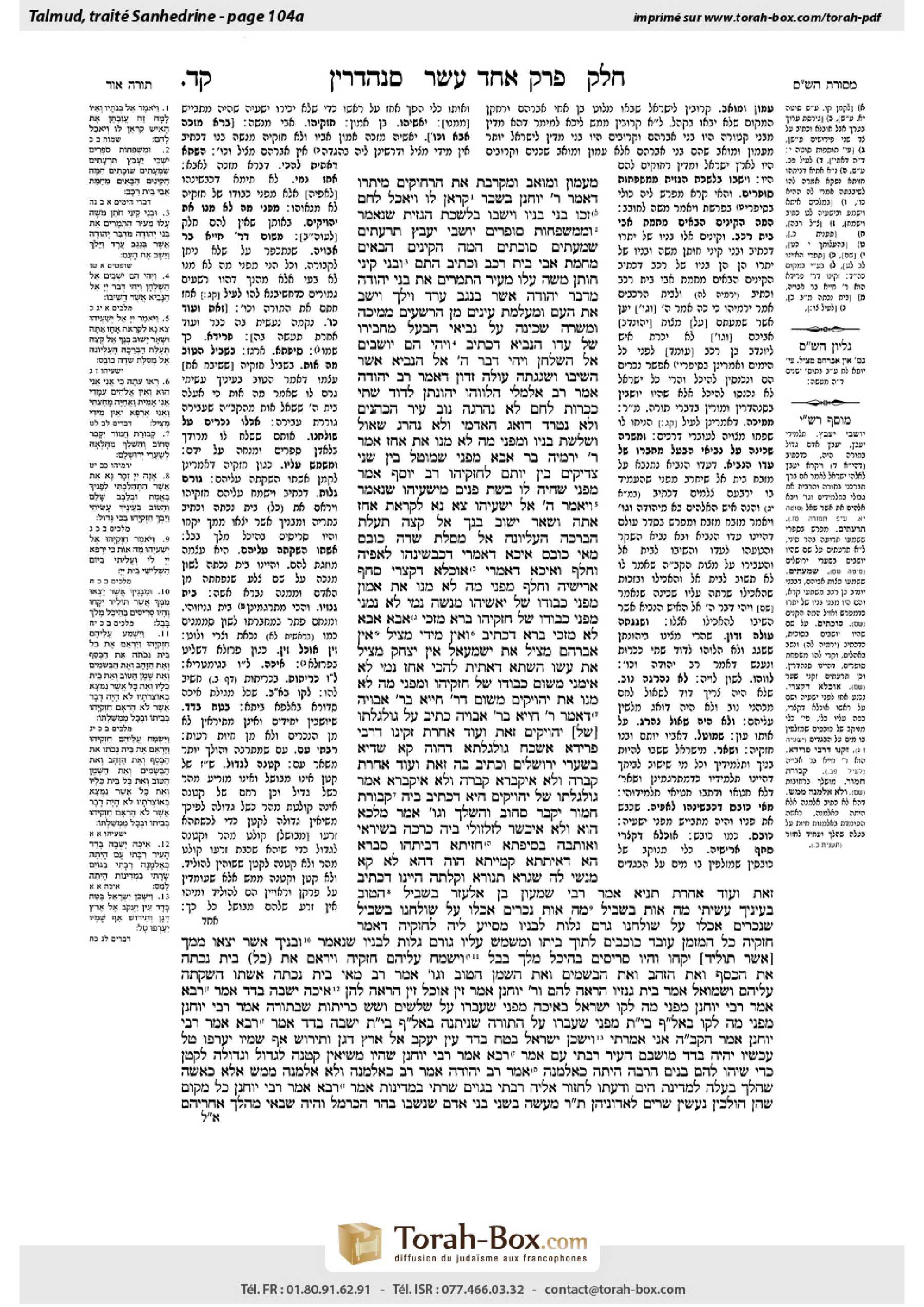
Sanhedrin 104a: Talmud study for Daf Yomi
Daf Yomi is the daily study of one Talmud folio. Explore 37 tractates with scans, Hebrew text, Sefaria English and AI-generated French translations where annotated.
Passage selection and English or AI-generated French translation are available where the scan has annotations. Daf Study is independent of Torah-Box and Sefaria.
Browse Sanhedrin · סנהדרין · All tractatesSanhedrin 104a text and translations
This page of Sanhedrin includes the Aramaic text, an English translation and an AI-generated French translation, alongside the scan above.
סנהדרין ק״ד א · Aramaic and Hebrew text
מֵעַמּוֹן וּמוֹאָב.
וּמְקָרֶבֶת אֶת הָרְחוֹקִים – מִיִּתְרוֹ, דְּאָמַר רַבִּי יוֹחָנָן: בִּשְׂכַר ״קִרְאֶן לוֹ וְיֹאכַל לָחֶם״, זָכוּ בְּנֵי בָנָיו וְיָשְׁבוּ בְּלִשְׁכַּת הַגָּזִית, שֶׁנֶּאֱמַר: ״וּמִשְׁפְּחוֹת סוֹפְרִים יֹשְׁבֵי יַעְבֵּץ תִּרְעָתִים שִׁמְעָתִים שׂוּכָתִים הֵמָּה הַקִּינִים הַבָּאִים מֵחַמַּת אֲבִי בֵית רֵכָב״, וּכְתִיב הָתָם: ״וּבְנֵי קֵינִי חֹתֵן מֹשֶׁה עָלוּ מֵעִיר הַתְּמָרִים אֶת בְּנֵי יְהוּדָה מִדְבַּר יְהוּדָה אֲשֶׁר בְּנֶגֶב עֲרָד וַיֵּלֶךְ וַיֵּשֶׁב אֶת הָעָם״.
וּמַעֲלֶמֶת עֵינַיִם מִן הָרְשָׁעִים – מִמִּיכָה.
וּמַשְׁרָה שְׁכִינָה עַל נְבִיאֵי הַבַּעַל – מֵחֲבֵירוֹ שֶׁל עִדּוֹ הַנָּבִיא, דִּכְתִיב: ״וַיְהִי הֵם יֹשְׁבִים אֶל הַשֻּׁלְחָן וַיְהִי דְּבַר ה׳ אֶל הַנָּבִיא אֲשֶׁר הֱשִׁיבוֹ״.
וְשִׁגְגָתָהּ עוֹלָה זָדוֹן, דְּאָמַר רַב יְהוּדָה אָמַר רַב: אִלְמָלֵי הִלְוָוהוּ יְהוֹנָתָן לְדָוִד שְׁתֵּי כִּכְּרוֹת לֶחֶם, לֹא נֶהֶרְגָה נוֹב עִיר הַכֹּהֲנִים, וְלֹא נִטְרַד דּוֹאֵג הָאֲדֹמִי, וְלֹא נֶהֱרַג שָׁאוּל וּשְׁלֹשֶׁת בָּנָיו.
וּמִפְּנֵי מָה לֹא מָנוּ אֶת אָחָז? אָמַר רַבִּי יִרְמְיָה בַּר אַבָּא: מִפְּנֵי שֶׁמּוּטָל בֵּין שְׁנֵי צַדִּיקִים, בֵּין יוֹתָם לְחִזְקִיָּהוּ. רַב יוֹסֵף אָמַר: מִפְּנֵי שֶׁהָיָה לוֹ בּשֶׁת פָּנִים מִישַׁעְיָהוּ, שֶׁנֶּאֱמַר: ״וַיֹּאמֶר ה׳ אֶל יְשַׁעְיָהוּ צֵא נָא לִקְרַאת אָחָז אַתָּה וּשְׁאָר יָשׁוּב בְּנֶךָ אֶל קְצֵה תְּעָלַת הַבְּרֵכָה הָעֶלְיוֹנָה אֶל מְסִלַּת שְׂדֵה כוֹבֵס״. מַאי ״כּוֹבֵס״? אִיכָּא דְּאָמְרִי: דְּכַבְשִׁינְהוּ לְאַפֵּיהּ וַחֲלַף, וְאִיכָּא דְּאָמְרִי: אוּכְלָא דְּקַצָּרֵי סְחַף אַרֵישֵׁיהּ וַחֲלַף.
מִפְּנֵי מָה לֹא מָנוּ אֶת אָמוֹן? מִפְּנֵי כְּבוֹדוֹ שֶׁל יֹאשִׁיָּהוּ. מְנַשֶּׁה נָמֵי לָא נִמְנֵי מִפְּנֵי כְּבוֹדוֹ שֶׁל חִזְקִיָּהוּ? בְּרָא מְזַכֵּי אַבָּא, אַבָּא לָא מְזַכֵּי בְּרָא. דִּכְתִיב: ״וְאֵין מִיָּדִי מַצִּיל״. אֵין אַבְרָהָם מַצִּיל אֶת יִשְׁמָעֵאל, אֵין יִצְחָק מַצִּיל אֶת עֵשָׂו. הַשְׁתָּא דְּאָתֵית לְהָכִי, אָחָז נָמֵי לָא אִימְּנִי מִשּׁוּם כְּבוֹדוֹ שֶׁל חִזְקִיָּהוּ.
וּמִפְּנֵי מָה לֹא מָנוּ אֶת יְהוֹיָקִים? מִשּׁוּם דְּרַבִּי חִיָּיא בְּרַבִּי אֲבוּיָה, דְּאָמַר רַבִּי חִיָּיא בְּרַבִּי אֲבוּיָה: כְּתִיב עַל גּוּלְגׇּלְתּוֹ [שֶׁל] יְהוֹיָקִים ״זֹאת וְעוֹד אַחֶרֶת״. זְקֵינוֹ דְּרַבִּי פְּרִידָא אַשְׁכַּח גּוּלְגֻּלְתָּא דַּהֲוָה קָא שַׁדְיָא בְּשַׁעֲרֵי יְרוּשָׁלַיִם, וּכְתִיב בָּהּ ״זֹאת וְעוֹד אַחֶרֶת״. קַבְרַהּ וְלָא אִיקְּבַרָא, קַבְרַהּ וְלָא אִיקְּבַרָא.
אָמַר: גּוּלְגׇּלְתּוֹ שֶׁל יְהוֹיָקִים הִיא, דִּכְתִיב בֵּיהּ ״קְבוּרַת חֲמוֹר יִקָּבֵר סָחוֹב וְהַשְׁלֵךְ וְגוֹ׳״. אֲמַר: מַלְכָּא הוּא, וְלָא אִיפְשָׁר לְזַלְזוֹלֵי בֵּיהּ. כַּרְכַהּ בְּשִׁירָאֵי וְאוֹתְבַהּ בְּסִיפְתָּא. חֲזֵיתַהּ דְּבֵיתְהוּ, סְבַרָא: הָא דְּאִיתְּתָא קַמַּיְיתָא הֲוָה, דְּהָא לָא קָא מִנְּשֵׁי לַהּ. שְׁגַרָא תַּנּוּרָא וְקַלְתַּהּ. הַיְינוּ דִּכְתִיב: ״זֹאת וְעוֹד אַחֶרֶת״.
תַּנְיָא, אָמַר רַבִּי שִׁמְעוֹן בֶּן אֶלְעָזָר: בִּשְׁבִיל ״וְהַטּוֹב בְּעֵינֶיךָ עָשִׂיתִי״ – ״מָה אוֹת״. בִּשְׁבִיל ״מָה אוֹת״ – גּוֹיִם אָכְלוּ עַל שׁוּלְחָנוֹ. בִּשְׁבִיל שֶׁגּוֹיִם אָכְלוּ עַל שׁוּלְחָנוֹ – גָּרַם גָּלוּת לְבָנָיו. מְסַיַּיע לֵיהּ לְחִזְקִיָּה, דְּאָמַר חִזְקִיָּה: כָּל הַמְזַמֵּן גּוֹי לְתוֹךְ בֵּיתוֹ וּמְשַׁמֵּשׁ עָלָיו גּוֹרֵם גָּלוּת לְבָנָיו, שֶׁנֶּאֱמַר: ״וּמִבָּנֶיךָ אֲשֶׁר יֵצְאוּ מִמְּךָ [אֲשֶׁר תּוֹלִיד] יִקָּחוּ וְהָיוּ סָרִיסִים בְּהֵיכַל מֶלֶךְ בָּבֶל״.
״וַיִּשְׂמַח עֲלֵיהֶם חִזְקִיָּהוּ וַיַּרְאֵם אֶת בֵּית נְכֹתֹה אֶת הַכֶּסֶף וְאֶת הַזָּהָב וְאֶת הַבְּשָׂמִים וְאֵת הַשֶּׁמֶן הַטּוֹב וְגוֹ׳״. אָמַר רַב: מַאי ״בֵּית נְכֹתֹה״? אִשְׁתּוֹ הִשְׁקְתָה עֲלֵיהֶם. וּשְׁמוּאֵל אָמַר: בֵּית גְּנָזָיו הֶרְאָה לָהֶם. וְרַבִּי יוֹחָנָן אָמַר: זַיִן אוֹכֵל זַיִן הֶרְאָה לָהֶן.
״אֵיכָה יָשְׁבָה בָּדָד״. אָמַר רָבָא אָמַר רַבִּי יוֹחָנָן: מִפְּנֵי מָה לָקוּ יִשְׂרָאֵל בְּאֵיכָה? מִפְּנֵי שֶׁעָבְרוּ עַל שְׁלֹשִׁים וָשֵׁשׁ כָּרֵיתוֹת שֶׁבַּתּוֹרָה.
אָמַר רַבִּי יוֹחָנָן: מִפְּנֵי מָה לָקוּ בְּאָלֶף בֵּית? מִפְּנֵי שֶׁעָבְרוּ עַל הַתּוֹרָה שֶׁנִּיתְּנָה בְּאָלֶף בֵּית.
״יָשְׁבָה בָּדָד״. אָמַר רָבָא אָמַר רַבִּי יוֹחָנָן: אָמַר הַקָּדוֹשׁ בָּרוּךְ הוּא, אֲנִי אָמַרְתִּי ״וַיִּשְׁכֹּן יִשְׂרָאֵל בֶּטַח בָּדָד עֵין יַעֲקֹב אֶל אֶרֶץ דָּגָן וְתִירוֹשׁ אַף שָׁמָיו יַעַרְפוּ טָל״, עַכְשָׁיו יִהְיֶה בָּדָד מוֹשָׁבָם. ״הָעִיר רַבָּתִי עָם״, אָמַר רָבָא אָמַר רַבִּי יוֹחָנָן: שֶׁהָיוּ מַשִּׂיאִין קְטַנָּה לְגָדוֹל וּגְדוֹלָה לְקָטָן, כְּדֵי שֶׁיְּהוּ לָהֶם בָּנִים הַרְבֵּה.
״הָיְתָה כְּאַלְמָנָה״ – אָמַר רַב יְהוּדָה אָמַר רַב: כְּאַלְמָנָה, וְלֹא אַלְמָנָה מַמָּשׁ, אֶלָּא כְּאִשָּׁה שֶׁהָלַךְ בַּעְלָהּ לִמְדִינַת הַיָּם וְדַעְתּוֹ לַחֲזוֹר אֵלֶיהָ. ״רַבָּתִי בַגּוֹיִם שָׂרָתִי בַּמְּדִינוֹת״ – אָמַר רָבָא אָמַר רַבִּי יוֹחָנָן: כׇּל מָקוֹם שֶׁהֵן הוֹלְכִין, נַעֲשִׂין שָׂרִים לַאֲדוֹנֵיהֶן.
תָּנוּ רַבָּנַן: מַעֲשֶׂה בִּשְׁנֵי בְּנֵי אָדָם שֶׁנִּשְׁבּוּ בְּהַר הַכַּרְמֶל, וְהָיָה שַׁבַּאי מְהַלֵּךְ אַחֲרֵיהֶם.
Sanhedrin 104a · English translation
from Ammon and Moab. Although they were relatives of the Jewish people, as they descend from Lot, Abraham’s nephew, it is prohibited for a Jewish woman to marry a convert from either of those nations, because they failed to provide bread and water to the Jewish people in the wilderness.
And the fact that it draws near the distant is derived from Yitro, as Rabbi Yoḥanan says: In reward for Yitro telling his daughters: “Call him, that he may eat bread” (Exodus 2:20), inviting Moses to join them for a meal, Yitro’s descendants were privileged and sat as scribes in session with the Sanhedrin in the Chamber of Hewn Stone. As it is stated: “And the families of the scribes who dwelt in Jabez; the Tirathites, the Shimeathites, the Sucathites. These were the Kenites who came of Hammath, father of the house of Rechab” (I Chronicles 2:55). And it is written there with regard to the identity of the Kenites: “And the children of the Kenite, Moses’ father-in-law, went up from the city of the palm trees with the children of Judah into the wilderness of Judah, which is in the south of Arad; and they went and dwelt with the people” (Judges 1:16).
And the fact that it averts eyes from the wicked is derived from Micah, who was not punished, because he provided bread to passersby.
And the fact that it causes the Divine Presence to rest on the prophets of the Baal is derived from the colleague of Iddo the prophet, the elderly prophet who convinced Iddo to eat with him contrary to the directive of God, when Iddo went to Bethel to prophesy to Jeroboam, as it is written: “And it happened as they sat at the table, that the word of the Lord came to the prophet that brought him back” (I Kings 13:20). Although the elderly prophet was a false prophet, he was rewarded with true prophecy as a reward for hosting Iddo.
And the fact that an unwitting transgression with regard to it is at times considered an intentional transgression is derived as Rav Yehuda says that Rav says: Had Jonathan lent David two loaves of bread when he was fleeing Saul, David would not have sought sustenance from the priests in Nov. The residents of Nov, city of the priests, would not have been killed, and Doeg the Edomite would not have been banished from the World-to-Come, and Saul and his three sons would not have been killed as punishment for that massacre.
§ The Gemara asks: And for what reason did the tanna’im not enumerate Ahaz among the kings with no share in the World-to-Come? His wickedness is extensively recounted in the Bible. Rabbi Yirmeya bar Abba says: He is not enumerated because he is cast between two righteous people, between his father, Jotham, and his son, Hezekiah. Rav Yosef says: He is not enumerated because he had a sense of embarrassment from Isaiah the prophet, as it is stated: “And the Lord said to Isaiah: Go out now to meet Ahaz, you, and Shear-Jashub your son, at the end of the aqueduct of the upper pool in the highway of the launderer’s [koves] field” (Isaiah 7:3). What is the meaning of the term koves? There are those who say: It means concealed [kavash], as Ahaz concealed [dekhavshinhu] his face and passed by the prophet because he was embarrassed to be seen. And there are those who say: He placed a launderer’s vessel over his head and passed by the prophet so that Isaiah would be unable to identify him.
The Gemara continues and asks: For what reason did the tanna’im not enumerate the wicked Amon among the kings with no share in the World-to-Come? The Gemara answers: He is not enumerated due to the honor of Josiah, his righteous son. The Gemara challenges: Let us also not enumerate Manasseh due to the honor of Hezekiah, his righteous father. The Gemara explains: The son confers merit upon the father, as it is to the father’s credit that he raised a righteous son; but the father does not confer merit upon the son, as it is written: “None delivers from My hand” (Deuteronomy 32:39). Abraham does not deliver his son Ishmael from the judgment of Heaven; Isaac does not deliver his son Esau from judgment. The Gemara comments: Now that you have arrived at this understanding, Ahaz too was not enumerated in the mishna due to the honor of his son Hezekiah.
The Gemara asks: And for what reason did the tanna’im not enumerate Jehoiakim among the kings with no share in the World-to-Come? His extreme wickedness is described extensively in the Bible. The Gemara explains: It is due to that which was stated by Rabbi Ḥiyya, son of Rabbi Avuya, as Rabbi Ḥiyya, son of Rabbi Avuya, says: It was written on the skull of Jehoiakim: This and yet another, indicating that he will receive a double punishment. The Gemara relates that Rabbi Perida’s grandfather, apparently Rabbi Ḥiyya, son of Rabbi Avuya, found a skull that was cast near the gates of Jerusalem, and on it was written: This and yet another. He buried it, but it did not stay buried. He buried it again, and again it did not stay buried. Each time he buried the skull it emerged from the grave.
He said: This is no doubt the skull of Jehoiakim, as it is written in his regard: “He shall be buried with the burial of a donkey, drawn and cast forth beyond the gates of Jerusalem” (Jeremiah 22:19). The fulfillment of this verse is exemplified in the inability to bury him. Rabbi Perida’s grandfather said: He is a king, and it is inappropriate to display contempt for it. He wrapped the skull in silk and placed it in a box. His wife saw the box and thought: This was the skull of his first wife, as he is not forgetting her. She ignited the oven and incinerated the skull. When she informed her husband what she had done, he said: That is the meaning of that which is written on the skull: This and yet another. Not only was his corpse discarded in a demeaning manner and not buried, but his skull was incinerated. That ordeal atoned for some of his transgressions, and he received a share in the World-to-Come.
§ It is taught in a baraita that Rabbi Shimon ben Elazar says: Because of Hezekiah’s boastful statement: “And I have done what is good in Your eyes” (II Kings 20:3), he also asked the prophet inappropriately: “What shall be the sign that the Lord shall heal me” (II Kings 20:8). Because of his question: “What shall be the sign,” gentiles ate at his table. The sign was that the sun reversed its path and appeared lower, rather than higher, on the sundial of Ahaz, leading the king of Babylonia to dispatch messengers to Hezekiah. Because gentiles ate at his table, it ultimately caused the exile of his descendants. The Gemara comments: This supports the statement of Ḥizkiyya, as Ḥizkiyya said: Anyone who invites an idol worshipper into his house and serves him causes the exile of his descendants, as it is stated: “And of your sons who shall issue from you, whom you shall beget, shall they take away; and they shall be eunuchs in the palace of the king of Babylonia” (II Kings 20:18).
With regard to the verse: “And Hezekiah was glad of them, and showed them his treasury [beit nekhoto], the silver and the gold, and the spices and the precious ointment” (Isaiah 39:2), Rav says: What is the meaning of beit nekhoto? It means that his wife, who typically did not appear before strangers for reasons of modesty, poured drinks for them. And Shmuel says: It means that he showed them his actual treasury. Rabbi Yoḥanan says: It means that he showed them a weapon so powerful that it breaks another weapon.
§ Apropos the exile of the descendants of the kings of Judea to Babylonia, the Gemara cites an aggadic statement about the destruction of the Temple and the sins of the Jewish people that caused it. With regard to the verse: “How [eikha] does the city sit solitary” (Lamentations 1:1), Rava says that Rabbi Yoḥanan says: For what reason were the Jewish people stricken and their plight bemoaned with the term eikha? It is due to the fact that they violated thirty-six prohibitions punishable with karet that are enumerated in the Torah, corresponding to the numerological value of eikha, spelled alef, yod, kaf, heh.
Rabbi Yoḥanan says: For what reason were the Jewish people stricken, and their plight bemoaned with an acrostic based on the alef beit, as the book of Lamentations contains multiple alphabetical acrostics? It is due to the fact that they violated the Torah, which was given in the language of the alef beit.
With regard to the phrase “Does the city sit solitary,” Rava says that Rabbi Yoḥanan says that the Holy One, Blessed be He, said: I said: “And Israel dwells in safety, the fountain of Jacob in solitude, to a land of grain and wine; also His heavens shall drop down dew” (Deuteronomy 33:28), indicating that their solitude shall be one of wealth and prominence. Now that they have rejected my directive and cleaved to and learned from the gentiles, their dwelling shall be solitary in sorrow. With regard to the phrase: “The city that was full of people” (Lamentations 1:1), Rava says that Rabbi Yoḥanan says: They would marry a younger female to an older male and an older female to a younger male so that they would have many children.
With regard to the phrase describing Jerusalem: “She became like a widow” (Lamentations 1:1), Rav Yehuda says that Rav says: Like a widow, but not an actual widow. Rather, Jerusalem is like a woman whose husband has gone to a country overseas, and yet he intends to return to her. With regard to the phrase: “Great among the nations, and princess among the provinces” (Lamentations 1:1), Rava says that Rabbi Yoḥanan says: Every place they go, when exiled among the nations, the Jewish people become princes to their masters due to their wisdom.
The Sages taught in a baraita: There was an incident involving two Jewish people who were taken captive on Mount Carmel, and their captor was walking behind them.
Sanhedrin 104a · Traduction française (IA)
d’Ammon et de Moab. Bien qu’ils fussent apparentés au peuple juif, puisqu’ils descendent de Loth, le neveu d’Abraham, il est interdit à une femme juive d’épouser un converti issu de l’une ou l’autre de ces nations, car elles n’ont pas fourni de pain ni d’eau au peuple juif dans le désert.
Et le fait qu’elle rapproche ceux qui sont éloignés se déduit de Yitro, car Rabbi Yoḥanan dit : En récompense du fait que Yitro ait dit à ses filles : « Appelez-le, afin qu’il mange du pain » (Exode 2:20), invitant ainsi Moïse à partager leur repas, les descendants de Yitro eurent le privilège de siéger comme scribes auprès du Sanhédrin, dans la Chambre de pierre taillée. Comme il est dit : « Les familles des scribes qui habitaient à Yabets : les Tirathites, les Shimeathites, les Sucathites. Ceux-là étaient les Qénites issus de Hammath, père de la maison de Réchab » (I Chroniques 2:55). Et il est écrit à cet endroit, au sujet de l’identité des Qénites : « Les fils du Qénien, beau-père de Moïse, montèrent de la ville des palmiers avec les fils de Juda, vers le désert de Juda, qui est au sud d’Arad ; ils partirent et habitèrent parmi le peuple » (Juges 1:16).
Et le fait qu’elle détourne les yeux des méchants se déduit de Michée, qui ne fut pas puni parce qu’il avait donné du pain aux passants.
Et le fait qu’elle fasse reposer la Présence divine sur les prophètes du Baal se déduit du compagnon du prophète Iddo, le vieux prophète qui avait convaincu Iddo de manger avec lui, contrairement à l’ordre de Dieu, lorsque Iddo s’était rendu à Béthel pour prophétiser à Jéroboam, comme il est écrit : « Or, tandis qu’ils étaient assis à table, la parole du Seigneur fut adressée au prophète qui l’avait ramené » (I Rois 13:20). Bien que le vieux prophète fût un faux prophète, il fut récompensé par une véritable prophétie pour avoir accueilli Iddo.
Et le fait qu’une transgression commise involontairement à son sujet soit parfois considérée comme une transgression volontaire se déduit de ce que Rav Yehouda dit au nom de Rav : Si Jonathan avait prêté deux miches de pain à David lorsqu’il fuyait Saül, David n’aurait pas cherché de quoi se nourrir auprès des prêtres de Nov. Les habitants de Nov, ville des prêtres, n’auraient pas été tués, Doëg l’Édomite n’aurait pas été banni du monde à venir, et Saül ainsi que ses trois fils n’auraient pas été tués en punition de ce massacre.
§ La Guemara demande : Pour quelle raison les tannaïm n’ont-ils pas compté Ahaz parmi les rois qui n’ont pas de part au monde à venir ? Sa méchanceté est largement relatée dans la Bible. Rabbi Yirmeya bar Abba dit : Il n’est pas compté parce qu’il se trouve entre deux justes, son père Yotam et son fils Hizqiya. Rav Yossef dit : Il n’est pas compté parce qu’il éprouvait de la honte devant le prophète Isaïe, comme il est dit : « Le Seigneur dit à Isaïe : Sors maintenant à la rencontre d’Ahaz, toi et ton fils Chear-Yachouv, à l’extrémité du canal de la piscine supérieure, sur la route du champ du foulon [koves] » (Isaïe 7:3). Que signifie le terme koves ? Certains disent qu’il signifie « dissimulé » [kavash], car Ahaz se cachait [dekhavshinhu] le visage et passait devant le prophète, honteux d’être vu. D’autres disent qu’il avait placé au-dessus de sa tête un récipient de foulon et passait devant le prophète afin qu’Isaïe ne puisse pas le reconnaître.
La Guemara poursuit et demande : Pour quelle raison les tannaïm n’ont-ils pas compté le méchant Amon parmi les rois qui n’ont pas de part au monde à venir ? La Guemara répond : Il n’est pas compté par égard pour Josias, son fils juste. La Guemara objecte : Ne comptons pas non plus Manassé, par égard pour Hizqiya, son père juste. La Guemara explique : Le fils confère un mérite au père, puisque c’est à l’honneur du père d’avoir élevé un fils juste ; mais le père ne confère pas de mérite au fils, comme il est écrit : « Nul ne délivre de ma main » (Deutéronome 32:39). Abraham ne délivre pas son fils Ismaël du jugement céleste ; Isaac ne délivre pas son fils Ésaü du jugement. La Guemara commente : Puisque nous en sommes arrivés à cette compréhension, Ahaz lui aussi n’a pas été compté dans la Michna par égard pour son fils Hizqiya.
La Guemara demande : Pour quelle raison les tannaïm n’ont-ils pas compté Yehoyaqim parmi les rois qui n’ont pas de part au monde à venir ? Son extrême méchanceté est largement décrite dans la Bible. La Guemara explique que cela tient à ce qu’a dit Rabbi Ḥiyya, fils de Rabbi Avouya, car Rabbi Ḥiyya, fils de Rabbi Avouya, dit : On avait écrit sur le crâne de Yehoyaqim : « Ceci, et encore autre chose », indiquant qu’il recevrait une double punition. La Guemara rapporte que le grand-père de Rabbi Perida, apparemment Rabbi Ḥiyya, fils de Rabbi Avouya, trouva un crâne abandonné près des portes de Jérusalem, sur lequel était écrit : « Ceci, et encore autre chose ». Il l’enterra, mais il ne resta pas enterré. Il l’enterra de nouveau, et de nouveau il ne resta pas enterré. Chaque fois qu’il enterrait le crâne, celui-ci ressortait de la tombe.
Il dit : C’est sans aucun doute le crâne de Yehoyaqim, car il est écrit à son sujet : « Il sera enterré comme un âne, traîné et jeté au-delà des portes de Jérusalem » (Jérémie 22:19). L’accomplissement de ce verset se manifeste par l’impossibilité de l’enterrer. Le grand-père de Rabbi Perida dit : C’est un roi, et il ne convient pas de lui témoigner du mépris. Il enveloppa le crâne dans de la soie et le plaça dans une boîte. Sa femme vit la boîte et pensa : C’est le crâne de sa première épouse, puisqu’il ne l’oublie pas. Elle alluma le four et incinéra le crâne. Lorsqu’elle informa son mari de ce qu’elle avait fait, il dit : Voilà le sens de ce qui était écrit sur le crâne : « Ceci, et encore autre chose ». Non seulement son cadavre avait été abandonné de manière dégradante et n’avait pas été enterré, mais son crâne avait été incinéré. Cette épreuve expia une partie de ses transgressions, et il reçut une part au monde à venir.
§ Il est enseigné dans une baraïta que Rabbi Shimon ben Elazar dit : À cause de la déclaration vantarde de Hizqiya : « J’ai fait ce qui est bien à tes yeux » (II Rois 20:3), il demanda aussi au prophète, de manière inconvenante : « Quel sera le signe que le Seigneur me guérira ? » (II Rois 20:8). À cause de sa question : « Quel sera le signe ? », des non-Juifs mangèrent à sa table. Le signe fut que le soleil inversa sa course et apparut plus bas, au lieu de plus haut, sur le cadran solaire d’Ahaz, ce qui amena le roi de Babylone à envoyer des messagers à Hizqiya. Le fait que des non-Juifs aient mangé à sa table finit par provoquer l’exil de ses descendants. La Guemara commente : Cela confirme la déclaration de Ḥizqiyya, car Ḥizqiyya dit : Quiconque invite un idolâtre chez lui et le sert provoque l’exil de ses descendants, comme il est écrit : « Et parmi tes fils, ceux qui sortiront de toi, que tu engendreras, on en prendra pour en faire des eunuques dans le palais du roi de Babylone » (II Rois 20:18).
Au sujet du verset : « Hizqiya se réjouit de leur venue et leur montra son trésor [beit nekhoto], l’argent, l’or, les aromates et l’huile précieuse » (Isaïe 39:2), Rav dit : Que signifie beit nekhoto ? Cela signifie que son épouse, qui d’ordinaire ne se montrait pas devant des étrangers par pudeur, leur servit des boissons. Et Chmouel dit : Cela signifie qu’il leur montra son véritable trésor. Rabbi Yoḥanan dit : Cela signifie qu’il leur montra une arme si puissante qu’elle en brise une autre.
§ À propos de l’exil des descendants des rois de Judée à Babylone, la Guemara cite un enseignement aggadique sur la destruction du Temple et les péchés du peuple juif qui en furent la cause. Au sujet du verset : « Comment [eikha] la ville est-elle assise solitaire ? » (Lamentations 1:1), Rava dit au nom de Rabbi Yoḥanan : Pour quelle raison le peuple juif a-t-il été frappé et son sort déploré par le terme eikha ? C’est parce qu’il a transgressé trente-six interdits passibles de karet, énumérés dans la Torah, ce qui correspond à la valeur numérique de eikha, qui s’écrit alef, yod, kaf, heh.
Rabbi Yoḥanan dit : Pour quelle raison le peuple juif a-t-il été frappé et son sort déploré au moyen d’un acrostiche fondé sur l’alef-bet, puisque le livre des Lamentations contient plusieurs acrostiches alphabétiques ? C’est parce qu’il a transgressé la Torah, qui a été donnée dans la langue de l’alef-bet.
Au sujet de l’expression « La ville est-elle assise solitaire ? », Rava dit au nom de Rabbi Yoḥanan que le Saint, béni soit-Il, a dit : J’ai dit : « Israël habite en sécurité, la source de Jacob à l’écart, dans un pays de blé et de vin ; ses cieux aussi distilleront la rosée » (Deutéronome 33:28), ce qui indique que leur isolement devait être synonyme de richesse et de prestige. Mais maintenant qu’ils ont rejeté ma directive, se sont attachés aux non-Juifs et ont appris d’eux, leur demeure sera solitaire dans la douleur. Au sujet de l’expression : « La ville qui était pleine de monde » (Lamentations 1:1), Rava dit au nom de Rabbi Yoḥanan : Ils mariaient une jeune femme à un homme âgé et une femme âgée à un jeune homme, afin d’avoir beaucoup d’enfants.
Au sujet de l’expression décrivant Jérusalem : « Elle est devenue comme une veuve » (Lamentations 1:1), Rav Yehouda dit au nom de Rav : Comme une veuve, mais pas une véritable veuve. Jérusalem ressemble plutôt à une femme dont le mari est parti dans un pays lointain, mais a l’intention de revenir auprès d’elle. Au sujet de l’expression : « Grande parmi les nations, princesse parmi les provinces » (Lamentations 1:1), Rava dit au nom de Rabbi Yoḥanan : Partout où ils vont, lorsqu’ils sont exilés parmi les nations, les Juifs deviennent les princes de leurs maîtres en raison de leur sagesse.
Les Sages ont enseigné dans une baraïta : Un incident eut lieu avec deux Juifs qui avaient été capturés sur le mont Carmel, et leur ravisseur marchait derrière eux.
Traduction française générée par IA à partir de l’édition anglaise de Sefaria. Vérifie toujours un passage avec le texte source.
Text from Sefaria: William Davidson Edition - Vocalized Aramaic (CC BY NC); William Davidson Edition - English (CC BY NC).