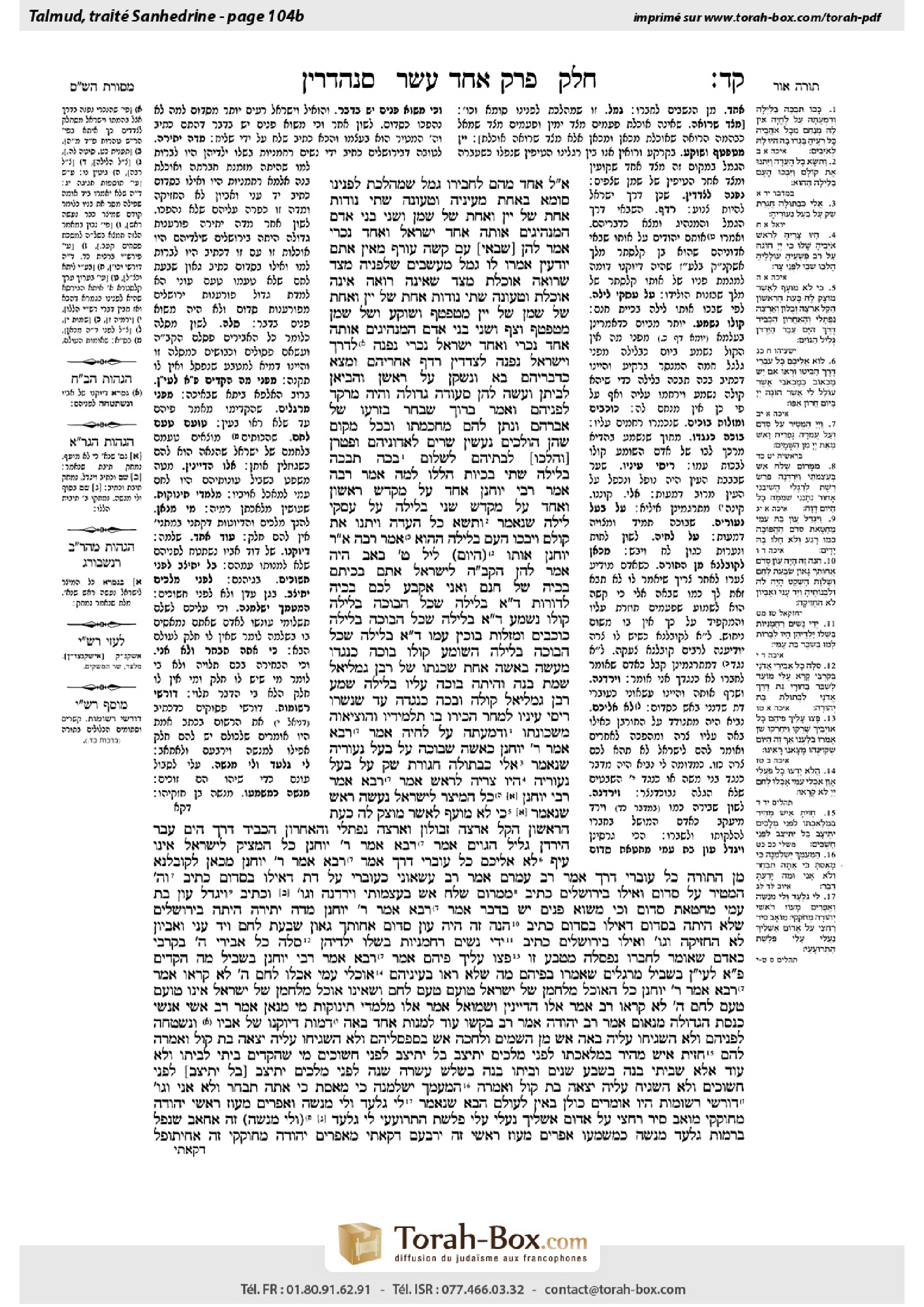
Sanhedrin 104b: Talmud study for Daf Yomi
Daf Yomi is the daily study of one Talmud folio. Explore 37 tractates with scans, Hebrew text, Sefaria English and AI-generated French translations where annotated.
Passage selection and English or AI-generated French translation are available where the scan has annotations. Daf Study is independent of Torah-Box and Sefaria.
Browse Sanhedrin · סנהדרין · All tractatesSanhedrin 104b text and translations
This page of Sanhedrin includes the Aramaic text, an English translation and an AI-generated French translation, alongside the scan above.
סנהדרין ק״ד ב · Aramaic and Hebrew text
אָמַר לוֹ אֶחָד מֵהֶם לַחֲבֵירוֹ: גָּמָל שֶׁמְהַלֶּכֶת לְפָנֵינוּ סוֹמָא בְּאַחַת מֵעֵינֶיהָ, וּטְעוּנָה שְׁתֵּי נוֹדוֹת, אַחַת שֶׁל יַיִן וְאַחַת שֶׁל שֶׁמֶן, וּשְׁנֵי בְּנֵי אָדָם הַמַּנְהִיגִים אוֹתָהּ, אֶחָד יִשְׂרָאֵל וְאֶחָד גּוֹי. אָמַר לָהֶן [שַׁבַּאי]: עַם קְשֵׁה עוֹרֶף! מֵאֵין אַתֶּם יוֹדְעִין?
אָמְרוּ לוֹ: גָּמָל מֵעֲשָׂבִים שֶׁלְּפָנֶיהָ, מִצַּד שֶׁרוֹאָה אוֹכֶלֶת, מִצַּד שֶׁאֵינָהּ רוֹאָה אֵינָהּ אוֹכֶלֶת. וּטְעוּנָה שְׁתֵּי נוֹדוֹת, אַחַת שֶׁל יַיִן וְאַחַת שֶׁל שֶׁמֶן; שֶׁל יַיִן מְטַפְטֵף וְשׁוֹקֵעַ, וְשֶׁל שֶׁמֶן מְטַפְטֵף וְצָף. וּשְׁנֵי בְּנֵי אָדָם הַמַּנְהִיגִים אוֹתָהּ, אֶחָד גּוֹי וְאֶחָד יִשְׂרָאֵל; גּוֹי נִפְנֶה לַדֶּרֶךְ, וְיִשְׂרָאֵל נִפְנֶה לִצְדָדִין.
רָדַף אַחֲרֵיהֶם וּמָצָא כְּדִבְרֵיהֶם. בָּא וּנְשָׁקָן עַל רֹאשָׁן, וֶהֱבִיאָן לְבֵיתוֹ וְעָשָׂה לָהֶן סְעוּדָה גְּדוֹלָה. וְהָיָה מְרַקֵּד לִפְנֵיהֶם וְאָמַר: בָּרוּךְ שֶׁבָּחַר בְּזַרְעוֹ שֶׁל אַבְרָהָם וְנָתַן לָהֶם מֵחׇכְמָתוֹ, וּבְכׇל מָקוֹם שֶׁהֵן הוֹלְכִין נַעֲשִׂין שָׂרִים לַאֲדוֹנֵיהֶם. וּפְטָרָן [וְהָלְכוּ] לְבָתֵּיהֶם לְשָׁלוֹם.
״בָּכֹה תִבְכֶּה בַּלַּיְלָה״ – שְׁתֵּי בְּכִיּוֹת הַלָּלוּ לָמָּה? אָמַר רַבָּה אָמַר רַבִּי יוֹחָנָן: אֶחָד עַל מִקְדָּשׁ רִאשׁוֹן וְאֶחָד עַל מִקְדָּשׁ שֵׁנִי. ״בַּלַּיְלָה״ – עַל עִסְקֵי לַיְלָה, שֶׁנֶּאֱמַר: ״וַתִּשָּׂא כׇּל הָעֵדָה וַיִּתְּנוּ אֶת קוֹלָם וַיִּבְכּוּ הָעָם בַּלַּיְלָה הַהוּא״.
אָמַר רַבָּה אָמַר רַבִּי יוֹחָנָן: אוֹתוֹ הַיּוֹם לֵיל תִּשְׁעָה בְּאָב הָיָה. אָמַר לָהֶן הַקָּדוֹשׁ בָּרוּךְ הוּא לְיִשְׂרָאֵל: אַתֶּם בְּכִיתֶם בְּכִיָּה שֶׁל חִנָּם, וַאֲנִי אֶקְבַּע לָכֶם בְּכִיָּה לְדוֹרוֹת.
דָּבָר אַחֵר: ״בַּלַּיְלָה״ – שֶׁכׇּל הַבּוֹכֶה בַּלַּיְלָה, קוֹלוֹ נִשְׁמָע. דָּבָר אַחֵר: ״בַּלַּיְלָה״ – שֶׁכׇּל הַבּוֹכֶה בַּלַּיְלָה, כּוֹכָבִים וּמַזָּלוֹת בּוֹכִין עִמּוֹ. דָּבָר אַחֵר: ״בַּלַּיְלָה״ – שֶׁכׇּל הַבּוֹכֶה בַּלַּיְלָה, הַשּׁוֹמֵעַ קוֹלוֹ בּוֹכֶה כְּנֶגְדּוֹ. מַעֲשֶׂה בְּאִשָּׁה אַחַת, שְׁכֶנְתּוֹ שֶׁל רַבָּן גַּמְלִיאֵל, שֶׁמֵּת בְּנָהּ וְהָיְתָה בּוֹכָה עָלָיו בַּלַּיְלָה. שָׁמַע רַבָּן גַּמְלִיאֵל קוֹלָהּ וּבָכָה כְּנֶגְדָּהּ, עַד שֶׁנָּשְׁרוּ רִיסֵי עֵינָיו. לְמָחָר הִכִּירוּ בּוֹ תַּלְמִידָיו וְהוֹצִיאוּהָ מִשְּׁכוּנָתוֹ.
״וְדִמְעָתָהּ עַל לֶחֱיָהּ״, אָמַר רָבָא אָמַר רַבִּי יוֹחָנָן: כְּאִשָּׁה שֶׁבּוֹכָה עַל בַּעַל נְעוּרֶיהָ, שֶׁנֶּאֱמַר ״אֱלִי כִּבְתוּלָה חֲגֻרַת שַׂק עַל בַּעַל נְעוּרֶיהָ״. ״הָיוּ צָרֶיהָ לְרֹאשׁ״, אָמַר רָבָא אָמַר רַבִּי יוֹחָנָן: כׇּל הַמֵּיצֵר לְיִשְׂרָאֵל נַעֲשָׂה רֹאשׁ, שֶׁנֶּאֱמַר ״כִּי לֹא מוּעָף לַאֲשֶׁר מוּצָק לָהּ כָּעֵת הָרִאשׁוֹן הֵקַל אַרְצָה זְבֻלוּן וְאַרְצָה נַפְתָּלִי וְהָאַחֲרוֹן הִכְבִּיד דֶּרֶךְ הַיָּם עֵבֶר הַיַּרְדֵּן גְּלִיל הַגּוֹיִם״. אָמַר רָבָא אָמַר רַבִּי יוֹחָנָן: כׇּל הַמֵּצִיק לְיִשְׂרָאֵל אֵינוֹ עָיֵף.
״לֹא אֲלֵיכֶם כׇּל עֹבְרֵי דֶרֶךְ״, אָמַר רָבָא אָמַר רַבִּי יוֹחָנָן: מִכָּאן לְקוּבְלָנָא מִן הַתּוֹרָה. ״כׇּל עֹבְרֵי דֶרֶךְ״, אָמַר רַב עַמְרָם אָמַר רַב: עֲשָׂאוּנִי כְּעוֹבְרֵי עַל דָּת. דְּאִילּוּ בִּסְדוֹם כְּתִיב: ״וַה׳ הִמְטִיר עַל סְדֹם״, וְאִילּוּ בִּירוּשָׁלַיִם כְּתִיב: ״מִמָּרוֹם שָׁלַח אֵשׁ בְּעַצְמֹתַי וַיִּרְדֶּנָּה וְגוֹ׳״. וּכְתִיב: ״וַיִּגְדַּל עֲוֹן בַּת עַמִּי מֵחַטַּאת סְדֹם״.
וְכִי מַשּׂוֹא פָּנִים יֵשׁ בַּדָּבָר? אָמַר רָבָא אָמַר רַבִּי יוֹחָנָן: מִדָּה יְתֵירָה הָיְתָה בִּירוּשָׁלַיִם שֶׁלֹּא הָיְתָה בִּסְדוֹם, דְּאִילּוּ בִּסְדוֹם כְּתִיב: ״הִנֵּה זֶה הָיָה עֲוֹן סְדֹם אֲחוֹתֵךְ גָּאוֹן שִׂבְעַת לֶחֶם וְיַד עָנִי וְאֶבְיוֹן לֹא הֶחֱזִיקָה וְגוֹ׳״, וְאִילּוּ בִּירוּשָׁלַיִם כְּתִיב: ״יְדֵי נָשִׁים רַחֲמָנִיּוֹת בִּשְּׁלוּ יַלְדֵיהֶן״.
״סִלָּה כׇל אַבִּירַי ה׳ בְּקִרְבִּי״, כְּאָדָם שֶׁאוֹמֵר לַחֲבֵרוֹ: נִפְסְלָה מַטְבֵּעַ זוֹ.
״פָּצוּ עָלַיִךְ פִּיהֶם״ – אָמַר רָבָא אָמַר רַבִּי יוֹחָנָן: בִּשְׁבִיל מָה הִקְדִּים פֵּא לְעַיִן? בִּשְׁבִיל מְרַגְּלִים שֶׁאָמְרוּ בְּפִיהֶם מַה שֶּׁלֹּא רָאוּ בְּעֵינֵיהֶם.
״אֹכְלֵי עַמִּי אָכְלוּ לֶחֶם ה׳ לֹא קָרָאוּ״. אָמַר רָבָא אָמַר רַבִּי יוֹחָנָן: כׇּל הָאוֹכֵל מִלַּחְמָן שֶׁל יִשְׂרָאֵל טוֹעֵם טַעַם לֶחֶם, וְשֶׁאֵינוֹ אוֹכֵל מִלַּחְמָן שֶׁל יִשְׂרָאֵל אֵינוֹ טוֹעֵם טַעַם לֶחֶם. ״ה׳ לֹא קָרָאוּ״ – רַב אָמַר: אֵלּוּ הַדַּיָּינִין, וּשְׁמוּאֵל אָמַר: אֵלּוּ מְלַמְּדֵי תִינוֹקוֹת.
מִי מְנָאָן? אָמַר רַב אָשֵׁי: אַנְשֵׁי כְּנֶסֶת הַגְּדוֹלָה מְנָאוּם. אָמַר רַב יְהוּדָה אָמַר רַב: בִּקְּשׁוּ עוֹד לִמְנוֹת אֶחָד. בָּאָה דְּמוּת דְּיוֹקְנוֹ שֶׁל אָבִיו וְנִשְׁתַּטְּחָה לִפְנֵיהֶם, וְלֹא הִשְׁגִּיחוּ עָלֶיהָ. בָּאָה אֵשׁ מִן הַשָּׁמַיִם וְלִחֲכָה (אֵשׁ) בְּסַפְסְלֵיהֶם, וְלֹא הִשְׁגִּיחוּ עָלֶיהָ.
יָצְאָה בַּת קוֹל וְאָמְרָה לָהֶם: ״חָזִיתָ אִישׁ מָהִיר בִּמְלַאכְתּוֹ לִפְנֵי מְלָכִים יִתְיַצָּב בַּל יִתְיַצֵּב לִפְנֵי חֲשֻׁכִּים״. מִי שֶׁהִקְדִּים בֵּיתִי לְבֵיתוֹ, וְלֹא עוֹד אֶלָּא שֶׁבֵּיתִי בָּנָה בְּשֶׁבַע שָׁנִים וּבֵיתוֹ בָּנָה בִּשְׁלֹשׁ עֶשְׂרֵה שָׁנָה. ״לִפְנֵי מְלָכִים יִתְיַצָּב [בַּל יִתְיַצֵּב] לִפְנֵי חֲשֻׁכִּים״. וְלֹא הִשְׁגִּיחַ עָלֶיהָ. יָצְאָה בַּת קוֹל וְאָמְרָה: ״הַמֵעִמְּךָ יְשַׁלְמֶנָּה כִּי מָאַסְתָּ כִּי אַתָּה תִבְחַר וְלֹא אֲנִי וְגוֹ׳״.
דּוֹרְשֵׁי רְשׁוּמוֹת הָיוּ אוֹמְרִים: כּוּלָּן בָּאִין לָעוֹלָם הַבָּא, שֶׁנֶּאֱמַר: ״לִי גִלְעָד וְלִי מְנַשֶּׁה וְאֶפְרַיִם מָעוֹז רֹאשִׁי יְהוּדָה מְחֹקְקִי. מוֹאָב סִיר רַחְצִי עַל אֱדוֹם אַשְׁלִיךְ נַעֲלִי עָלַי פְּלֶשֶׁת הִתְרוֹעָעִי״. ״לִי גִלְעָד (וְלִי מְנַשֶּׁה)״ – זֶה אַחְאָב שֶׁנָּפַל בְּרָמוֹת גִּלְעָד. ״מְנַשֶּׁה״ – כְּמַשְׁמָעוֹ. ״אֶפְרַיִם מָעוֹז רֹאשִׁי״ – זֶה יָרׇבְעָם דְּקָאָתֵי מֵאֶפְרַיִם. ״יְהוּדָה מְחֹקְקִי״ – זֶה אֲחִיתוֹפֶל
Sanhedrin 104b · English translation
One of the captives said to the other: The camel that is walking ahead of us is blind in one of its eyes and laden with two wineskins, one filled with wine and one filled with oil. And two people are driving the camel, one a Jew and one a gentile. The captor said to them: Stiff-necked people, from where do you know these matters that you cannot see?
They said to him: We know that the camel is blind from the grass that is before it, as from the grass on the side that it sees, it eats, and from the grass on the side that it does not see, it does not eat, i.e., it eats grass from only one side. And we know that it is laden with two wineskins, one filled with wine and one filled with oil, as wine drips and sinks into the ground and oil drips and floats on the surface, and we see the difference on the ground. And we know that two people are driving the camel, one a Jew and one a gentile, as the gentile defecates on the road and the Jew, in the interests of modesty, goes to the sides of the road to defecate.
The captor pursued the camel and its drivers to determine whether the statements of the captives were accurate, and found that the reality was in accordance with their statements. He came and respectfully kissed them on their head, and brought them to their house and prepared a great feast for them. And he was dancing before them and said: Blessed is He who chose the descendants of Abraham and granted of His wisdom to them, and in every place that they go they become princes to their lords. And he released them and they went to their houses in peace.
§ The Gemara returns to its interpretation of verses in Lamentations: “She cries [bakho tivke] at night” (Lamentations 1:2). These two cries, indicated by the use of a compound verb, why are they written? Rabba says that Rabbi Yoḥanan says: One is a cry over the destruction of the First Temple, and one is a cry over the destruction of the Second Temple, which was destined to be destroyed. The term “at night” indicates that the crying is over matters of night, as it is stated with regard to the response of the Jewish people to the report of the spies after their return from the land of Canaan: “And all the congregation lifted up their voice, and the people cried that night” (Numbers 14:1).
Rabba says that Rabbi Yoḥanan says: That day that they heard the spies’ report was the evening of the Ninth of Av. The Holy One, Blessed be He, said to the Jewish people: You cried an unwarranted cry, and so I will establish for you a reason to cry for generations.
Alternatively, the term “at night” indicates that with regard to anyone who cries at night, his voice is heard due to the ambient silence. Alternatively, the term “at night” indicates that in the case of anyone who cries at night, the stars and the constellations cry with him. Alternatively, the term “at night” indicates that in the case of anyone who cries at night, one who hears his voice is touched by his suffering and cries with him. There was an incident involving one woman, the neighbor of Rabban Gamliel, whose son died, and she would cry over his death at night. Rabban Gamliel heard her voice and cried with her until his eyelashes fell out. The next day his students noticed that he had been crying, and they removed the woman from his neighborhood so that Rabban Gamliel could sleep.
With regard to the verse: “And her tears are on her cheeks” (Lamentations 1:2), Rava says that Rabbi Yoḥanan says: This is like a woman who cries over the husband of her youth, as it is stated: “Lament like a virgin girded with sackcloth for the husband of her youth” (Joel 1:8). With regard to the verse: “Her adversaries have become the head” (Lamentations 1:5), Rava says that Rabbi Yoḥanan says: This indicates that anyone who torments the Jewish people becomes a leader, as it is stated: “For there is no weariness to him that is set against her; at the first He lightly afflicted the land of Zebulun, and the land of Naphtali and afterward He afflicted her more grievously by the way of the sea, beyond the Jordan and the Galilee of the nations” (Isaiah 8:23). Rava says that Rabbi Yoḥanan says: From this verse one derives that anyone who harasses Israel does not grow weary.
With regard to the verse: “It is nothing to you, all you who pass by” (Lamentations 1:12), Rava says that Rabbi Yoḥanan says: From here there is a source from the Torah for complaint, i.e., it is appropriate for one to make his suffering public so that others will have compassion for him. With regard to the phrase “all you who pass by,” Rav Amram says that Rav says that it is as though Jerusalem said: They have rendered me like a city of those who violate the most fundamental precepts of law and morality, as, with regard to Sodom, it is written: “Then the Lord rained upon Sodom brimstone and fire from the Lord out of Heaven” (Genesis 19:24), while with regard to Jerusalem, it is written: “From above He has sent fire into my bones, and it prevails against them” (Lamentations 1:13). In both cities, fire rained down from Heaven. And it is written: “For the iniquity of the daughter of my people is greater than the sin of Sodom” (Lamentations 4:6).
The Gemara asks: And is there partiality in the matter? Why was Jerusalem not overturned like Sodom? Rava says that Rabbi Yoḥanan says: It is because there was an additional measure of suffering in Jerusalem that was not in Sodom, as with regard to Sodom it is written: “Behold this was the iniquity of your sister Sodom; pride, surfeit of bread and careless ease was in her and in her daughters; and yet she did not strengthen the hand of the poor and needy” (Ezekiel 16:49). The people of Sodom were not subject to the afflictions of hunger and famine. Whereas, with regard to Jerusalem it is written: “The hands of compassionate women cooked their own children” (Lamentations 4:10). The residents of Jerusalem were punished with great severity.
The verse: “The Lord has spurned all my mighty men in the midst of me” (Lamentations 1:15), means that this is like a person who says to another: This coin was invalidated. The prominent residents of Jerusalem were crushed and discredited, and their reputations were irreversibly tainted.
With regard to the verse: “They have opened their mouths against you” (Lamentations 2:16), Rava says that Rabbi Yoḥanan says: For what reason did the prophet precede the verse beginning with the letter peh to the verse beginning with the letter ayin in several chapters of Lamentations? Since peh means mouth and ayin means eye, it is for the spies who said with their mouths [befihem] what they did not see with their eyes [be’eineihem].
With regard to the verse: “The eaters of My people ate bread, and they call not upon the Lord” (Psalms 14:4), Rava says that Rabbi Yoḥanan says: Any gentile thief who eats the bread of the Jewish people tastes the flavor of bread, and one who does not eat from the bread of the Jewish people does not taste the flavor of bread. Apparently they enjoy only what they steal from the Jewish people. With regard to the people referred to in the phrase “And they call not upon the Lord,” Rav says: These are the judges who are not God-fearing, and Shmuel says: These are schoolteachers who do not perform their job in the name of God.
§ The Gemara resumes its discussion of the kings and commoners enumerated in the mishna who have no share in the World-to-Come. The Gemara asks: Who enumerated them? Rav Ashi says: The members of the Great Assembly enumerated them. Rav Yehuda says that Rav says: They sought to enumerate one more, King Solomon, in the list of kings with no share in the World-to-Come. The image of the face of his father, King David, came and prostrated itself before them, pleading to omit Solomon from the list, and they paid it no heed. A fire came from Heaven and the fire scorched their benches [safseleihem], and they paid it no heed.
A Divine Voice emerged and said to the members of the Great Assembly: “Do you see a man diligent in his business? He shall stand before kings; he shall stand not before obscure men” (Proverbs 22:29). See the greatness of Solomon, who preceded construction of My House, the Temple, to the construction of his house. Moreover, My House he built quickly, in just seven years, and his house he constructed in thirteen years. Therefore, “he shall stand before kings; he shall stand not before obscure men,” and it is inappropriate to enumerate him among the wicked. And they paid it no heed. A Divine Voice emerged and said: “Shall His recompense be as you will it? For you loathe it, so that you must choose, and not I? Therefore, speak what you know” (Job 34:33). Only God, and not the people, determines who has a share in the World-to-Come.
The Gemara adds: Those who interpret the Torah metaphorically would say: All of those enumerated who have no share ultimately enter the World-to-Come, as it is stated: “Gilead is Mine, and Manasseh is Mine, and Ephraim also is the strength of My head; Judah is My scepter; Moab is My washing pot; over Edom I will cast My shoe; Philistia, cry aloud because of Me” (Psalms 60:9–10, and see 108:9–10). “Gilead is Mine and Manasseh is Mine”; this is referring to Ahab, who fell in Ramoth Gilead. “Manasseh”, in its plain meaning, is referring to King Manasseh. “Ephraim also is the strength of My head”; this is referring to Jeroboam, who comes from the tribe of Ephraim. “Judah is My scepter”; this is referring to Ahithophel,
Sanhedrin 104b · Traduction française (IA)
L’un des captifs dit à l’autre : « Le chameau qui marche devant nous est aveugle d’un œil et porte deux outres, l’une remplie de vin et l’autre d’huile. Deux personnes conduisent le chameau, l’une juive et l’autre non juive. » Le ravisseur leur dit : « Peuple à la nuque raide, comment connaissez-vous ces choses que vous ne pouvez pas voir ? »
Ils lui dirent : « Nous savons que le chameau est aveugle grâce à l’herbe qui se trouve devant lui : il mange celle du côté qu’il voit, mais pas celle du côté qu’il ne voit pas ; autrement dit, il ne mange de l’herbe que d’un seul côté. Nous savons qu’il porte deux outres, l’une remplie de vin et l’autre d’huile, car le vin goutte et pénètre dans le sol, tandis que l’huile goutte et flotte à la surface ; nous voyons la différence sur le sol. Nous savons que deux personnes conduisent le chameau, l’une juive et l’autre non juive, car le non-Juif défèque sur la route, tandis que le Juif, par souci de pudeur, s’écarte de la route pour déféquer. »
Le ravisseur poursuivit le chameau et ses conducteurs afin de vérifier l’exactitude des déclarations des captifs, et constata que la réalité correspondait à leurs propos. Il revint, les embrassa respectueusement sur la tête, les conduisit chez lui et leur prépara un grand festin. Il dansait devant eux et disait : « Béni soit Celui qui a choisi les descendants d’Abraham et leur a accordé une part de Sa sagesse ; partout où ils vont, ils deviennent les princes de leurs maîtres. » Il les libéra et ils regagnèrent leur maison en paix.
§ La Guemara revient à son interprétation des versets des Lamentations : « Elle pleure et pleure [bakho tivke] pendant la nuit » (Lamentations 1, 2). Pourquoi ces deux pleurs, indiqués par l’emploi d’un verbe composé, sont-ils écrits ? Rabba dit que Rabbi Yoḥanan dit : l’un est un pleur sur la destruction du Premier Temple, et l’autre sur la destruction du Second Temple, qui était destiné à être détruit. L’expression « pendant la nuit » indique que les pleurs portent sur des événements nocturnes, comme il est dit au sujet de la réaction du peuple juif au rapport des explorateurs, après leur retour du pays de Canaan : « Toute la communauté éleva la voix, et le peuple pleura cette nuit-là » (Nombres 14, 1).
Rabba dit que Rabbi Yoḥanan dit : le jour où ils entendirent le rapport des explorateurs était le soir du neuf Av. Le Saint, béni soit-Il, dit au peuple juif : « Vous avez pleuré sans raison ; aussi vais-je vous donner, pour les générations à venir, une raison de pleurer. »
Autre explication : l’expression « pendant la nuit » indique que la voix de quiconque pleure la nuit est entendue en raison du silence ambiant. Autre explication : elle indique que les étoiles et les constellations pleurent avec quiconque pleure la nuit. Autre explication : elle indique que celui qui entend la voix de quelqu’un qui pleure la nuit est touché par sa souffrance et pleure avec lui. Il arriva qu’une femme, voisine de Rabban Gamliel, dont le fils était mort, pleurait sa mort la nuit. Rabban Gamliel entendit sa voix et pleura avec elle, jusqu’à ce que ses cils tombent. Le lendemain, ses élèves remarquèrent qu’il avait pleuré et éloignèrent cette femme de son voisinage, afin que Rabban Gamliel puisse dormir.
Au sujet du verset : « Ses larmes sont sur ses joues » (Lamentations 1, 2), Rava dit que Rabbi Yoḥanan dit : « C’est comme une femme qui pleure le mari de sa jeunesse », comme il est dit : « Lamente-toi comme une vierge ceinte d’un sac pour le mari de sa jeunesse » (Joël 1, 8). Au sujet du verset : « Ses adversaires sont devenus la tête » (Lamentations 1, 5), Rava dit que Rabbi Yoḥanan dit : cela indique que quiconque tourmente le peuple juif devient un chef, comme il est dit : « Car il n’y aura plus de ténèbres pour le pays qui a été dans l’angoisse ; autrefois, il a humilié le pays de Zabulon et le pays de Nephtali, mais ensuite il a accablé plus lourdement la région de la mer, au-delà du Jourdain, la Galilée des nations » (Isaïe 8, 23). Rava dit que Rabbi Yoḥanan dit : on déduit de ce verset que quiconque harcèle Israël ne se lasse pas.
Au sujet du verset : « Cela ne vous est rien, à vous tous qui passez par là » (Lamentations 1, 12), Rava dit que Rabbi Yoḥanan dit : on trouve ici dans la Torah une source autorisant la plainte, c’est-à-dire qu’il convient de rendre publique sa souffrance afin que les autres éprouvent de la compassion pour soi. Au sujet de l’expression « à vous tous qui passez par là », Rav Amram dit que Rav dit que c’est comme si Jérusalem disait : « Ils m’ont rendue semblable à une ville où l’on transgresse les principes les plus fondamentaux du droit et de la morale. » En effet, au sujet de Sodome, il est écrit : « L’Éternel fit pleuvoir sur Sodome du soufre et du feu, de la part de l’Éternel, depuis le ciel » (Genèse 19, 24), tandis qu’au sujet de Jérusalem, il est écrit : « D’en haut, Il a envoyé un feu dans mes os, et il les domine » (Lamentations 1, 13). Dans les deux villes, le feu est tombé du ciel. Et il est écrit : « La faute de la fille de mon peuple est plus grande que le péché de Sodome » (Lamentations 4, 6).
La Guemara demande : y a-t-il donc partialité en la matière ? Pourquoi Jérusalem n’a-t-elle pas été renversée comme Sodome ? Rava dit que Rabbi Yoḥanan dit : c’est parce qu’à Jérusalem, les souffrances ont été plus grandes qu’à Sodome. En effet, au sujet de Sodome, il est écrit : « Voici quelle était la faute de ta sœur Sodome : l’orgueil, l’abondance de nourriture et une tranquillité insouciante régnaient en elle et chez ses filles ; pourtant, elle n’a pas soutenu la main du pauvre et du nécessiteux » (Ézéchiel 16, 49). Les habitants de Sodome n’ont pas connu les afflictions de la faim et de la famine. En revanche, au sujet de Jérusalem, il est écrit : « Les mains de femmes compatissantes ont fait cuire leurs propres enfants » (Lamentations 4, 10). Les habitants de Jérusalem furent punis avec une grande sévérité.
Le verset : « Le Seigneur a rejeté tous mes vaillants hommes au milieu de moi » (Lamentations 1, 15) signifie que c’est comme quelqu’un qui dit à un autre : « Cette pièce de monnaie a été invalidée. » Les notables de Jérusalem furent écrasés et discrédités, et leur réputation fut irrémédiablement ternie.
Au sujet du verset : « Ils ont ouvert la bouche contre toi » (Lamentations 2, 16), Rava dit que Rabbi Yoḥanan dit : pourquoi le prophète a-t-il placé, dans plusieurs chapitres des Lamentations, le verset commençant par la lettre pé avant celui qui commence par la lettre ayin ? Puisque pé signifie « bouche » et ayin « œil », c’est à cause des explorateurs, qui ont dit de leur bouche [befihem] ce qu’ils n’avaient pas vu de leurs yeux [be’eineihem].
Au sujet du verset : « Ceux qui dévorent mon peuple mangent du pain, et ils n’invoquent pas l’Éternel » (Psaumes 14, 4), Rava dit que Rabbi Yoḥanan dit : tout voleur non juif qui mange le pain du peuple juif en goûte la saveur, tandis que celui qui ne mange pas du pain du peuple juif n’en goûte pas la saveur. Il semble qu’ils ne prennent plaisir qu’à ce qu’ils volent au peuple juif. Au sujet des personnes désignées par l’expression « et ils n’invoquent pas l’Éternel », Rav dit : ce sont les juges qui ne craignent pas Dieu ; et Shmuel dit : ce sont les enseignants qui n’accomplissent pas leur tâche au nom de Dieu.
§ La Guemara reprend son étude des rois et des gens du peuple énumérés dans la Michna comme n’ayant pas de part au Monde futur. La Guemara demande : qui les a énumérés ? Rav Ashi dit : les membres de la Grande Assemblée les ont énumérés. Rav Yehuda dit au nom de Rav : ils voulurent ajouter un autre nom à la liste des rois n’ayant pas de part au Monde futur : celui du roi Salomon. L’image du visage de son père, le roi David, apparut et se prosterna devant eux, les suppliant d’omettre Salomon de la liste, mais ils n’en tinrent aucun compte. Un feu descendit du ciel et brûla leurs bancs [safseleihem], mais ils n’en tinrent aucun compte.
Une Voix céleste se fit entendre et dit aux membres de la Grande Assemblée : « As-tu vu un homme habile dans son travail ? Il se tiendra devant des rois ; il ne se tiendra pas devant des hommes obscurs » (Proverbes 22, 29). Considérez la grandeur de Salomon : il a fait passer la construction de Ma Maison, le Temple, avant celle de sa maison. De plus, il a construit Ma Maison rapidement, en sept ans seulement, tandis qu’il a construit sa maison en treize ans. Par conséquent, « il se tiendra devant des rois ; il ne se tiendra pas devant des hommes obscurs », et il ne convient pas de l’énumérer parmi les méchants. Mais ils n’en tinrent aucun compte. Une Voix céleste se fit entendre et dit : « Sa rétribution doit-elle être selon ton bon plaisir ? Puisque tu la rejettes, faut-il que tu choisisses, et non Moi ? Dis donc ce que tu sais » (Job 34, 33). Dieu seul, et non les hommes, détermine qui a une part au Monde futur.
La Guemara ajoute : ceux qui interprètent la Torah de manière allégorique diraient que tous ceux qui ont été énumérés comme n’ayant pas de part finiront par entrer dans le Monde futur, comme il est dit : « Galaad est à Moi, Manassé est à Moi, Éphraïm aussi est la force de Ma tête ; Juda est mon sceptre ; Moab est mon bassin ; sur Édom je jetterai ma chaussure ; Philistie, pousse des cris à cause de Moi » (Psaumes 60, 9-10 ; voir aussi 108, 9-10). « Galaad est à Moi et Manassé est à Moi » : cela fait référence à Achab, qui tomba à Ramoth-Galaad. « Manassé », dans son sens littéral, fait référence au roi Manassé. « Éphraïm aussi est la force de ma tête » : cela fait référence à Jéroboam, qui était issu de la tribu d’Éphraïm. « Juda est mon sceptre » : cela fait référence à Ahitophel,
Traduction française générée par IA à partir de l’édition anglaise de Sefaria. Vérifie toujours un passage avec le texte source.
Text from Sefaria: William Davidson Edition - Vocalized Aramaic (CC BY NC); William Davidson Edition - English (CC BY NC).