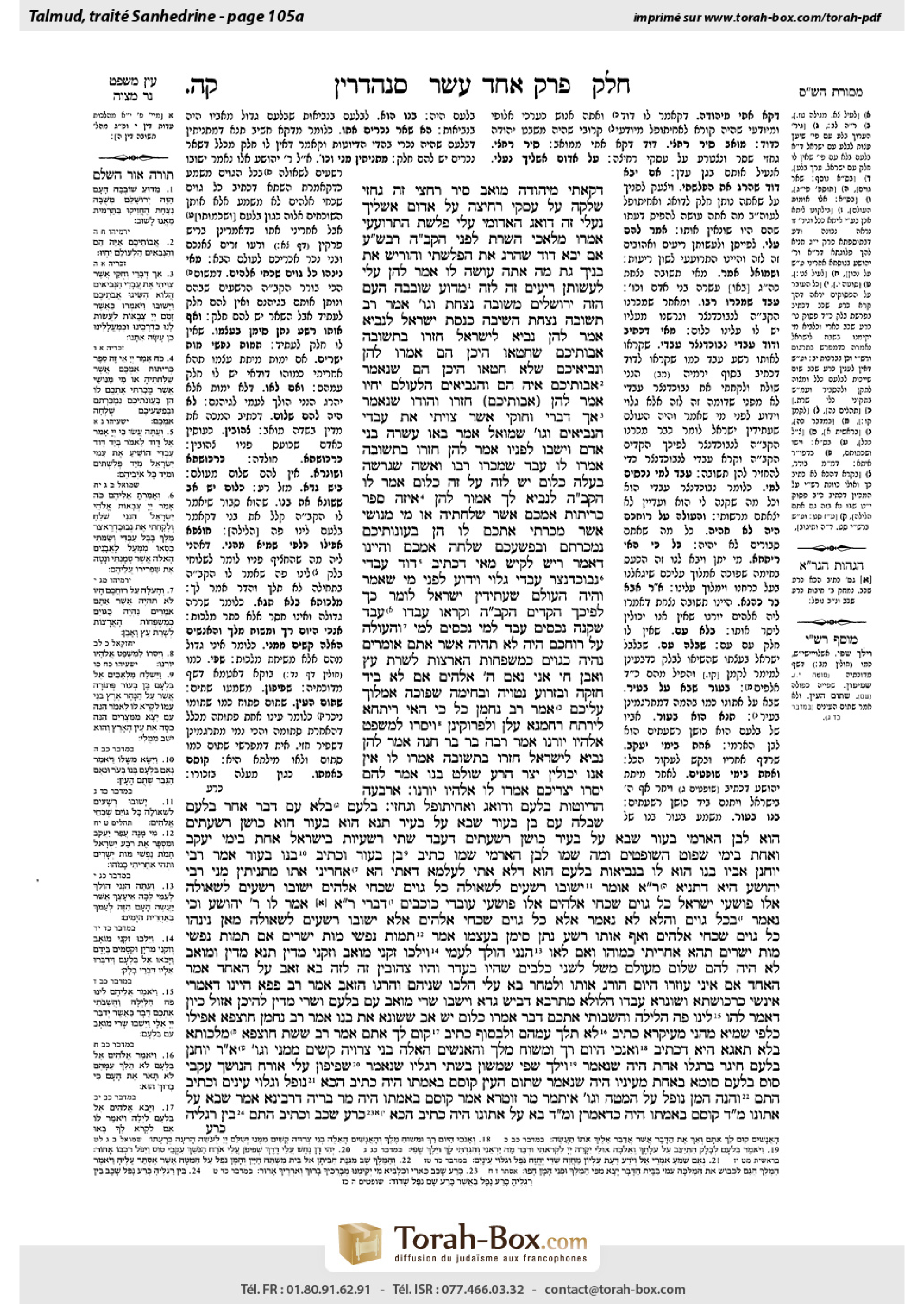
Sanhedrin 105a: Talmud study for Daf Yomi
Daf Yomi is the daily study of one Talmud folio. Explore 37 tractates with scans, Hebrew text, Sefaria English and AI-generated French translations where annotated.
Passage selection and English or AI-generated French translation are available where the scan has annotations. Daf Study is independent of Torah-Box and Sefaria.
Browse Sanhedrin · סנהדרין · All tractatesSanhedrin 105a text and translations
This page of Sanhedrin includes the Aramaic text, an English translation and an AI-generated French translation, alongside the scan above.
סנהדרין ק״ה א · Aramaic and Hebrew text
דְּקָאָתֵי מִיהוּדָה. ״מוֹאָב סִיר רַחְצִי״ – זֶה גֵּחֲזִי, שֶׁלָּקָה עַל עִסְקֵי רְחִיצָה. ״עַל אֱדוֹם אַשְׁלִיךְ נַעֲלִי״ – זֶה דּוֹאֵג הָאֲדוֹמִי. ״עָלַי פְּלֶשֶׁת הִתְרוֹעָעִי״ – אָמְרוּ מַלְאֲכֵי הַשָּׁרֵת לִפְנֵי הַקָּדוֹשׁ בָּרוּךְ הוּא: רִבּוֹנוֹ שֶׁל עוֹלָם, אִם יָבֹא דָּוִד שֶׁהָרַג אֶת הַפְּלִשְׁתִּי וְהוֹרִישׁ אֶת בָּנֶיךָ גַּת, מָה אַתָּה עוֹשֶׂה לוֹ? אָמַר לָהֶן: עָלַי לַעֲשׂוֹתָן רֵיעִים זֶה לָזֶה.
״מַדּוּעַ שׁוֹבְבָה הָעָם הַזֶּה יְרוּשָׁלִַים מְשֻׁבָה נִצַּחַת וְגוֹ׳״. אָמַר רַב: תְּשׁוּבָה נִצַּחַַת הֵשִׁיבָה כְּנֶסֶת יִשְׂרָאֵל לַנָּבִיא. אָמַר לָהֶן נָבִיא לְיִשְׂרָאֵל: חִזְרוּ בִּתְשׁוּבָה! אֲבוֹתֵיכֶם שֶׁחָטְאוּ הֵיכָן הֵם? אָמְרוּ לוֹ: וּנְבִיאֵיכֶם שֶׁלֹּא חָטְאוּ הֵיכָן הֵם? שֶׁנֶּאֱמַר: ״אֲבוֹתֵיכֶם אַיֵּה הֵם וְהַנְּבִאִים הַלְעוֹלָם יִחְיוּ״. אָמַר לָהֶן: (אֲבוֹתֵיכֶם) חָזְרוּ וְהוֹדוּ, שֶׁנֶּאֱמַר: ״אַךְ דְּבָרַי וְחֻקַּי אֲשֶׁר צִוִּיתִי אֶת עֲבָדַי הַנְּבִיאִים וְגוֹ׳״.
שְׁמוּאֵל אָמַר: ״בָּאוּ עֲשָׂרָה בְּנֵי אָדָם וְיָשְׁבוּ לְפָנָיו. אָמַר לָהֶן: חִזְרוּ בִּתְשׁוּבָה! אָמְרוּ לוֹ: עֶבֶד שֶׁמְּכָרוֹ רַבּוֹ, וְאִשָּׁה שֶׁגֵּרְשָׁהּ בַּעְלָהּ, כְּלוּם יֵשׁ לָזֶה עַל זֶה כְּלוּם? אָמַר לוֹ הַקָּדוֹשׁ בָּרוּךְ הוּא לַנָּבִיא: לֵךְ אֱמוֹר לָהֶן: ״אֵי זֶה סֵפֶר כְּרִיתוּת אִמְּכֶם אֲשֶׁר שִׁלַּחְתִּיהָ אוֹ מִי מִנּוֹשַׁי אֲשֶׁר מָכַרְתִּי אֶתְכֶם לוֹ הֵן בַּעֲוֹנוֹתֵיכֶם נִמְכַּרְתֶּם וּבְפִשְׁעֵיכֶם שֻׁלְּחָה אִמְּכֶם״.
וְהַיְינוּ דְּאָמַר רֵישׁ לָקִישׁ: מַאי דִּכְתִיב ״דָּוִד עַבְדִּי״, ״נְבוּכַדְנֶצַּר עַבְדִּי״? גָּלוּי וְיָדוּעַ לִפְנֵי מִי שֶׁאָמַר וְהָיָה הָעוֹלָם שֶׁעֲתִידִין יִשְׂרָאֵל לוֹמַר כָּךְ, לְפִיכָךְ הִקְדִּים הַקָּדוֹשׁ בָּרוּךְ הוּא וּקְרָאוֹ עַבְדּוֹ. עֶבֶד שֶׁקָּנָה נְכָסִים – עֶבֶד לְמִי? נְכָסִים לְמִי?
״וְהָעֹלָה עַל רוּחֲכֶם הָיוֹ לֹא תִהְיֶה אֲשֶׁר אַתֶּם אֹמְרִים נִהְיֶה כַגּוֹיִם כְּמִשְׁפְּחוֹת הָאֲרָצוֹת לְשָׁרֵת עֵץ וָאָבֶן. חַי אָנִי נְאֻם ה׳ אֱלֹהִים אִם לֹא בְּיָד חֲזָקָה וּבִזְרוֹעַ נְטוּיָה וּבְחֵמָה שְׁפוּכָה אֶמְלוֹךְ עֲלֵיכֶם״. אָמַר רַב נַחְמָן: כֹּל כִּי הַאי רִיתְחָא לִירְתַּח רַחְמָנָא עֲלַן וְלִפְרוֹקִינַן.
״וְיִסְּרוֹ לַמִּשְׁפָּט אֱלֹהָיו יוֹרֶנּוּ״ – אָמַר רַבָּה בַּר בַּר חָנָה: אָמַר לָהֶן נָבִיא לְיִשְׂרָאֵל: חִזְרוּ בִּתְשׁוּבָה! אָמְרוּ לוֹ: אֵין אָנוּ יְכוֹלִין, יֵצֶר הָרָע שׁוֹלֵט בָּנוּ. אָמַר לָהֶם: יַסְּרוּ יִצְרֵיכֶם! אָמְרוּ לוֹ: ״אֱלֹהָיו יוֹרֶנּוּ״.
אַרְבָּעָה הֶדְיוֹטוֹת: בִּלְעָם, וְדוֹאֵג, וַאֲחִיתוֹפֶל, וְגֵחֲזִי. בִּלְעָם – בְּלֹא עָם. דָּבָר אַחֵר: בִּלְעָם – שֶׁבִּלָּה עָם. בֶּן בְּעוֹר – שֶׁבָּא עַל בְּעִיר.
תָּנָא: הוּא בְּעוֹר, הוּא כּוּשַׁן רִשְׁעָתַיִם, הוּא לָבָן הָאֲרַמִּי. בְּעוֹר – שֶׁבָּא עַל בְּעִיר. כּוּשַׁן רִשְׁעָתַיִם – דַּעֲבַד שְׁתֵּי רִשְׁעָיוֹת בְּיִשְׂרָאֵל: אַחַת בִּימֵי יַעֲקֹב, וְאַחַת בִּימֵי שְׁפוֹט הַשּׁוֹפְטִים. וּמָה שְׁמוֹ? לָבָן הָאֲרַמִּי שְׁמוֹ.
כְּתִיב: ״בֶּן בְּעוֹר״, וּכְתִיב: ״בְּנוֹ בְעֹר״. אָמַר רַבִּי יוֹחָנָן: אָבִיו בְּנוֹ הוּא לוֹ בִּנְבִיאוּת.
בִּלְעָם הוּא דְּלָא אָתֵי לְעָלְמָא דְּאָתֵי, הָא אַחֲרִינֵי אָתוּ. מַתְנִיתִין מַנִּי?
רַבִּי יְהוֹשֻׁעַ הִיא, דְּתַנְיָא: רַבִּי אֱלִיעֶזֶר אוֹמֵר, ״יָשׁוּבוּ רְשָׁעִים לִשְׁאוֹלָה כׇּל גּוֹיִם שְׁכֵחֵי אֱלֹהִים״. ״יָשׁוּבוּ רְשָׁעִים לִשְׁאוֹלָה״ – אֵלּוּ פּוֹשְׁעֵי יִשְׂרָאֵל, ״כׇּל גּוֹיִם שְׁכֵחֵי אֱלֹהִים״ – אֵלּוּ פּוֹשְׁעֵי גּוֹיִים, דִּבְרֵי רַבִּי אֱלִיעֶזֶר. אָמַר לוֹ רַבִּי יְהוֹשֻׁעַ: וְכִי נֶאֱמַר ״בְּכׇל גּוֹיִם״? וַהֲלֹא לֹא נֶאֱמַר אֶלָּא ״כׇּל גּוֹיִם שְׁכֵחֵי אֱלֹהִים״! אֶלָּא ״יָשׁוּבוּ רְשָׁעִים לִשְׁאוֹלָה״ – מַאן נִינְהוּ? ״כׇּל גּוֹיִם שְׁכֵחֵי אֱלֹהִים״.
וְאַף אוֹתוֹ רָשָׁע נָתַן סִימָן בְּעַצְמוֹ. אָמַר: ״תָּמֹת נַפְשִׁי מוֹת יְשָׁרִים״. אִם תָּמוֹת נַפְשִׁי מוֹת יְשָׁרִים – ״תְּהֵא אַחֲרִיתִי כָּמוֹהוּ״, וְאִם לָאו – ״הִנְנִי הוֹלֵךְ לְעַמִּי״.
״וַיֵּלְכוּ זִקְנֵי מוֹאָב וְזִקְנֵי מִדְיָן״. תָּנָא: מִדְיָן וּמוֹאָב לֹא הָיָה לָהֶם שָׁלוֹם מֵעוֹלָם. מָשָׁל לִשְׁנֵי כְּלָבִים שֶׁהָיוּ בָּעֵדֶר, וְהָיוּ צְהוּבִּין זֶה לָזֶה. בָּא זְאֵב עַל הָאֶחָד. אָמַר הָאֶחָד: אִם אֵינִי עוֹזְרוֹ, הַיּוֹם הוֹרֵג אוֹתוֹ, וּלְמָחָר בָּא עָלַי. הָלְכוּ שְׁנֵיהֶם וְהָרְגוּ הַזְּאֵב. אָמַר רַב פָּפָּא: הַיְינוּ דְּאָמְרִי אִינָשֵׁי: כַּרְכּוּשְׁתָּא וְשׁוּנָּרָא עֲבַדוּ הִלּוּלָא מִתַּרְבָּא דְּבִישׁ גַּדָּא.
״וַיֵּשְׁבוּ שָׂרֵי מוֹאָב עִם בִּלְעָם״. וְשָׂרֵי מִדְיָן לְהֵיכָן אֲזוּל? כֵּיוָן דַּאֲמַר לְהוּ: ״לִינוּ פֹה הַלַּיְלָה וַהֲשִׁיבֹתִי אֶתְכֶם דָּבָר״, אָמְרוּ: כְּלוּם יֵשׁ אָב שֶׁשּׂוֹנֵא אֶת בְּנוֹ?
אָמַר רַב נַחְמָן: חוּצְפָּא אֲפִילּוּ כְּלַפֵּי שְׁמַיָּא מַהֲנֵי. מֵעִיקָּרָא כְּתִיב: ״לֹא תֵלֵךְ עִמָּהֶם״, וּלְבַסּוֹף כְּתִיב: ״קוּם לֵךְ אִתָּם״. אָמַר רַב שֵׁשֶׁת: חוּצְפָּא מַלְכוּתָא בְּלָא תָּאגָא הִיא, דִּכְתִיב: ״וְאָנֹכִי הַיּוֹם רַךְ וּמָשׁוּחַ מֶלֶךְ וְהָאֲנָשִׁים הָאֵלֶּה בְּנֵי צְרוּיָה קָשִׁים מִמֶּנִּי וְגוֹ׳״.
אָמַר רַבִּי יוֹחָנָן: בִּלְעָם חִיגֵּר בְּרַגְלוֹ אַחַת הָיָה, שֶׁנֶּאֱמַר: ״וַיֵּלֶךְ שֶׁפִי״. שִׁמְשׁוֹן בִּשְׁתֵּי רַגְלָיו, שֶׁנֶּאֱמַר: ״שְׁפִיפֹן עֲלֵי אֹרַח הַנּוֹשֵׁךְ עִקְּבֵי סוּס״. בִּלְעָם סוֹמֵא בְּאַחַת מֵעֵינָיו הָיָה, שֶׁנֶּאֱמַר: ״שְׁתֻם הָעָיִן״.
קוֹסֵם בְּאַמָּתוֹ הָיָה. כְּתִיב הָכָא: ״נֹפֵל וּגְלוּי עֵינָיִם״, וּכְתִיב הָתָם: ״וְהָמָן נֹפֵל עַל הַמִּטָּה וְגוֹ׳״. אִיתְּמַר, מָר זוּטְרָא אָמַר: קוֹסֵם בְּאַמָּתוֹ הָיָה. מָר בְּרֵיהּ דְּרָבִינָא אָמַר: שֶׁבָּא עַל אֲתוֹנוֹ. מַאן דְּאָמַר קוֹסֵם בְּאַמָּתוֹ הָיָה – כְּדַאֲמַרַן, וּמַאן דְּאָמַר בָּא עַל אֲתוֹנוֹ הָיָה – כְּתִיב הָכָא: ״כָּרַע שָׁכַב״, וּכְתִיב הָתָם: ״בֵּין רַגְלֶיהָ
Sanhedrin 105a · English translation
who comes from the tribe of Judah. “Moab is My washing pot”; this is referring to Gehazi, who was afflicted with leprosy over matters of washing, as he took money from Naaman, whom he instructed to immerse in the Jordan River. “Over Edom I will cast My shoe”; this is referring to Doeg the Edomite. “Philistia, cry aloud [hitroa’i] because of Me”; this is referring to the fact that the ministering angels said before the Holy One, Blessed be He: Master of the Universe, if David, who killed the Philistine and bequeathed the city of Gath to your sons, will come and complain that You gave a share in the World-to-Come to his enemies Doeg and Ahithophel, what will You do concerning him? Will you accept his complaint? God said to the ministering angels: It is upon me to render David and his enemies friends [re’im] with each other, and even David will agree.
§ With regard to the verse: “Why is this people of Jerusalem slid back in perpetual backsliding?” (Jeremiah 8:5), Rav says: The congregation of Israel answered with a convincing response to the prophet. The prophet said to the Jewish people: Repent, as your ancestors sinned, and where are they? They said to the prophets: And your prophets who did not sin, where are they? They too died, as it is stated: “Your fathers, where are they, and the prophets; do they live forever?” (Zechariah 1:5). The prophet said to the Jewish people: Your ancestors reconsidered and conceded that the admonitions of the prophets were fulfilled, as it is stated: “By my words and My statutes, which I commanded My servants the prophets, did they not overtake your fathers? And they repented and said: As the Lord of hosts intended to do to us, according to our ways, and according to our doings, so has He dealt with us” (Zechariah 1:6).
Shmuel says that this was the convincing answer: Ten people came and sat before the prophet Ezekiel. He said to them: Repent. They said to Ezekiel: In the case of a slave sold by his owner to another master, or a woman divorced by her husband, does this person have any claim upon that person? Since God gave the Jewish people to other masters, the ties that existed between Him and us were severed. The Holy One, Blessed be He, said to the prophet: Go say to them: “Where is your mother’s scroll of severance, with which I sent her away? Or to which of My creditors have I sold you? For your iniquities you sold yourselves and for your transgressions was your mother sent away” (Isaiah 50:1). Learn from this that God did not sever His ties to the Jewish people.
And that is what Reish Lakish says: What is the meaning of that which is written: “David, My slave” (II Samuel 3:18), and: “Nebuchadnezzar, my slave” (Jeremiah 43:10)? How can the wicked Nebuchadnezzar be depicted as a slave of God in the same manner that David was depicted? Rather, it is revealed and known before the One Who spoke and the world came into being, that the Jewish people are destined to say that God sold them to the nations and they no longer have ties to Him. Therefore, the Holy One, Blessed be He, preemptively called Nebuchadnezzar His slave. With regard to the halakha concerning a slave who acquires property, the slave belongs to whom and the property belongs to whom? They both belong to the master, in this case, the Holy One, Blessed be He.
With regard to the verse: “And what comes into your mind shall never come to be, that you say: We will be like the nations, like the families of the countries, to serve wood and stone. As I live, says the Lord God, surely with a mighty hand, and an outstretched arm, and with wrath poured out, will I rule over you” (Ezekiel 20:32–33), Rav Naḥman says: Let the Merciful One become wrathful at us with all that wrath, and redeem us.
With regard to the verse: “And chastise in judgment; his God will instruct him” (Isaiah 28:26), Rabba bar bar Ḥana says that the prophet said to the Jewish people: Repent. They said to him: We cannot, since the evil inclination dominates us. He said to them: Chastise your inclinations. They said to him: “His God will instruct him,” i.e., God should instruct the evil inclination to allow us to overcome him, as we are incapable of doing so on our own.
§ The mishna teaches that four prominent commoners, Balaam, Doeg, Ahithophel, and Gehazi, have no share in the World-to-Come. The Gemara elaborates: The name Balaam is interpreted as a contraction of: Without a nation [belo am], or one who has no share in the World-to-Come with the Jewish nation. Alternatively, the name Balaam is interpreted as one who wore down the Jewish people [bila am]. He is the son of Beor, one who engaged in bestiality [be’ir].
It was taught in a baraita: He is Beor, father of Balaam, he is Cushan-Rishathaim, he is Laban the Aramean. He was called Beor because he engaged in bestiality. He was called Cushan-Rishathaim because he performed two evil deeds [rishiyyot] to the Jewish people, one during the time of Jacob, when he pursued him intending to kill him, and one during the time when the judges judged. And what was his actual name? His name was Laban the Aramean.
It is written: “Son of Beor” (Numbers 22:5), and it is written elsewhere: “His son Beor” (Numbers 24:3). Rabbi Yoḥanan says in resolving the apparent contradiction: Balaam’s father was his son in terms of prophecy, as Balaam was a much greater prophet.
The Gemara infers from the mishna: Balaam is the one who does not come into the World-to-Come; but other gentiles come into the World-to-Come. Whose opinion is expressed in the mishna?
It is in accordance with the opinion of Rabbi Yehoshua, as it is taught in a baraita that Rabbi Eliezer says: It is written: “The wicked shall be turned back to the netherworld, all the nations that forget God” (Psalms 9:18). “The wicked shall be turned back to the netherworld”; these are the sinners of the Jewish people, as only the sinners are sentenced to the netherworld. “All the gentiles that forget God”; these are the sinners of the gentiles. From the fact that it is written: “All the gentiles,” it is apparent that none of the gentiles have a share in the World-to-Come. This is the statement of Rabbi Eliezer. Rabbi Yehoshua said to him: But is it stated in the verse that the sinners of the Jewish people will be like all of the gentiles? It is stated only: “All the gentiles that forget God.” Rather, the wicked shall be turned back to the netherworld, and who are they? They are all the gentiles that forget God. Gentiles who fear God do have a share in the World-to-Come.
And that wicked person, Balaam, also provided a sign with regard to himself. He said: “Let me die the death of the righteous, and let my end be like his” (Numbers 23:10). If I die the death of the righteous, by natural causes, my end will be like his, i.e., I will receive a share in the World-to-Come like the Jewish people. And if I do not die by natural causes: “I will go to my people” (Numbers 24:14), i.e., my fate will be that of the rest of the wicked people in my generation, who have no share in the World-to-Come.
With regard to the verse: “And the elders of Moab and the elders of Midian set out with their divinations in their hands, and they came to Balaam” (Numbers 22:7), it was taught in a baraita: Midian and Moab had previously never had peace between them, and they were always at war with each other. What led them to make peace at that time? There is a parable of two dogs that were with the flock, and they were hostile to one another. A wolf came and attacked one. The other one said: If I do not help him, today he kills him and tomorrow he comes to attack me. They both went and killed the wolf. Moab and Midian joined together to face the potential common threat, the Jewish people. Rav Pappa says that this is in accordance with the adage that people say: A weasel [karkushta] and a cat made a wedding from the fat of the luckless. Despite their hatred of one another, they join together for their mutual benefit at the expense of a third party.
It is written: “And the princes of Moab stayed with Balaam” (Numbers 22:8). The Gemara asks: And to where did the princes of Midian who accompanied the princes of Moab go? The Gemara answers: Once Balaam said to them: “Lodge here this night, and I will bring you word when the Lord speaks to me” (Numbers 22:8), the elders of Midian said: If he seeks permission from the Lord, he will not join us, as is there any father who hates his son? Certainly the Lord will help the Jewish people.
Rav Naḥman says: Impudence is effective even toward Heaven. How so? Initially, it is written that God said to Balaam: “You shall not go with them” (Numbers 22:12), and ultimately after Balaam persisted and asked, it is written: “Rise up and go with them” (Numbers 22:20). Rav Sheshet says: Impudence is monarchy without a crown, as it is an assertion of leadership and lacks only the official coronation as king, as it is written: “And I am this day weak, though anointed king; and these men the sons of Zeruiah are too hard for me” (II Samuel 3:39). The sons of Zeruiah, due to their impudence, were as formidable as David himself.
Rabbi Yoḥanan says: Balaam was disabled in one of his legs, as it is stated concerning him: “And he went limping [shefi]” (Numbers 23:3). Samson was disabled in both his legs, as it is stated with regard to Samson, who was from the tribe of Dan, in the prophetic blessing of Jacob: “Dan shall be a serpent by the way, an adder [shefifon] in the path that bites the horse’s heels” (Genesis 49:17). Rabbi Yoḥanan interprets shefifon as the plural of shefi, indicating disability in both legs. Balaam was blind in one of his eyes, as it is stated: “Whose eye is open” (Numbers 24:3), indicating that one eye was open and the other was blind.
The Gemara relates: Balaam was a diviner by using his penis. It is written here: “Fallen, yet with opened eyes” (Numbers 24:4), and it is written there: “And Haman was fallen upon the divan whereupon Esther was” (Esther 7:8), indicating that the verb fallen has sexual connotations. It was stated that there is an amoraic dispute with regard to this matter. Mar Zutra says: Balaam was a diviner by using his penis. Mar, son of Ravina, says: He engaged in bestiality with his donkey. The one who says that he was a diviner by using his penis derives it as we stated. And the one who says that he engaged in bestiality with his donkey derives it as follows: It is written here: “He crouched, he lay down” (Numbers 24:9), and it is written there: “Between her legs
Sanhedrin 105a · Traduction française (IA)
qui vient de la tribu de Juda. « Moab est mon bassin de lavage » ; cela fait référence à Gehazi, qui fut frappé de lèpre à cause de questions relatives au lavage, car il prit de l'argent de Naaman, qu'il avait instruit de s'immerger dans le fleuve Jourdain. « Sur Édom, je jette ma chaussure » ; cela fait référence à Doeg l'Édomite. « Philistie, crie à haute voix [hitroa'i] à cause de Moi » ; cela fait référence au fait que les anges ministériels dirent devant le Saint, béni soit-Il : Maître de l'univers, si David, qui a tué le Philistin et légué la ville de Gath à Tes fils, vient se plaindre que Tu as donné une part dans le Monde à venir à ses ennemis Doeg et Ahithophel, que feras-Tu à son égard ? Accepteras-Tu sa plainte ? Dieu dit aux anges ministériels : Il m'incombe de faire de David et de ses ennemis des amis [re'im] les uns pour les autres, et même David sera d'accord.
§ Concernant le verset : « Pourquoi ce peuple de Jérusalem s'est-il écarté dans une révolte perpétuelle ? » (Jérémie 8:5), Rav dit : La congrégation d'Israël répondit au prophète par une réponse convaincante. Le prophète dit au peuple juif : Repentez-vous, car vos ancêtres ont péché, et où sont-ils ? Ils dirent aux prophètes : Et vos prophètes qui n'ont pas péché, où sont-ils ? Ils aussi sont morts, comme il est écrit : « Vos pères, où sont-ils, et les prophètes ; vivent-ils pour toujours ? » (Zacharie 1:5). Le prophète dit au peuple juif : Vos ancêtres ont reconsidéré et ont admis que les avertissements des prophètes se sont accomplis, comme il est écrit : « Par mes paroles et Mes statuts, que J'ai commandés à Mes serviteurs les prophètes, n'ont-ils pas atteint vos pères ? Et ils se sont repentis et ont dit : Comme l'Éternel des armées avait l'intention de nous faire, selon nos voies et selon nos actions, ainsi a-t-Il agi envers nous » (Zacharie 1:6).
Chmouel dit que c'était la réponse convaincante : Dix personnes vinrent et s'assirent devant le prophète Ézéchiel. Il leur dit : Repentez-vous. Ils dirent à Ézéchiel : Dans le cas d'un esclave vendu par son maître à un autre maître, ou d'une femme divorcée par son mari, cette personne a-t-elle quelque droit sur cette personne ? Puisque Dieu a donné le peuple juif à d'autres maîtres, les liens qui existaient entre Lui et nous ont été rompus. Le Saint, béni soit-Il, dit au prophète : Va leur dire : « Où est le rouleau de divorce de votre mère, par lequel Je l'ai renvoyée ? Ou à quel de Mes créanciers vous ai-Je vendus ? C'est à cause de vos iniquités que vous vous êtes vendus, et à cause de vos transgressions que votre mère a été renvoyée » (Isaïe 50:1). Apprenez de cela que Dieu n'a pas rompu Ses liens avec le peuple juif.
Et c'est ce que dit Reish Lakish : Quelle est la signification de ce qui est écrit : « David, Mon serviteur » (II Samuel 3:18), et : « Nébucadnetsar, mon serviteur » (Jérémie 43:10) ? Comment le méchant Nébucadnetsar peut-il être décrit comme un serviteur de Dieu de la même manière que David l'était ? Plutôt, il est révélé et connu devant Celui qui a parlé et le monde est venu à l'existence, que le peuple juif est destiné à dire que Dieu les a vendus aux nations et qu'ils n'ont plus de liens avec Lui. Par conséquent, le Saint, béni soit-Il, a préemptivement appelé Nébucadnetsar Son serviteur. Concernant la halakha concernant un esclave qui acquiert des biens, à qui appartient l'esclave et à qui appartient la propriété ? Ils appartiennent tous deux au maître, en l'occurrence, le Saint, béni soit-Il.
Concernant le verset : « Et ce qui vient dans votre esprit ne se réalisera jamais, que vous disiez : Nous serons comme les nations, comme les familles des pays, pour servir le bois et la pierre. Comme je vis, dit l'Éternel Dieu, assurément avec une main puissante, et un bras étendu, et avec une colère répandue, je régnerai sur vous » (Ézéchiel 20:32–33), Rav Naḥman dit : Que le Miséricordieux soit en colère contre nous avec toute cette colère, et nous rachète.
Concernant le verset : « Et châtie en jugement ; son Dieu l'instruira » (Isaïe 28:26), Rabba bar bar Ḥana dit que le prophète dit au peuple juif : Repentez-vous. Ils lui dirent : Nous ne pouvons pas, car l'inclination au mal nous domine. Il leur dit : Châtiez vos inclinations. Ils lui dirent : « Son Dieu l'instruira », c'est-à-dire que Dieu devrait instruire l'inclination au mal de nous permettre de la surmonter, car nous sommes incapables de le faire par nous-mêmes.
§ La Michna enseigne que quatre notables profanes, Balaam, Doeg, Ahithophel et Gehazi, n'ont pas de part dans le Monde à venir. La Guemara développe : Le nom Balaam est interprété comme une contraction de : Sans nation [belo am], ou celui qui n'a pas de part dans le Monde à venir avec la nation juive. Alternativement, le nom Balaam est interprété comme celui qui a usé le peuple juif [bila am]. Il est le fils de Beor, celui qui s'adonnait à l'inceste bestial [be'ir].
Il a été enseigné dans une baraïta : C'est Beor, père de Balaam, c'est Kushan-Rishathaim, c'est Laban l'Araméen. Il était appelé Beor parce qu'il s'adonnait à la bestialité. Il était appelé Kushan-Rishathaim parce qu'il a commis deux actes méchants [rishiyyot] envers le peuple juif, l'un à l'époque de Jacob, lorsqu'il le poursuivit avec l'intention de le tuer, et l'autre à l'époque où les juges rendaient la justice. Et quel était son vrai nom ? Son nom était Laban l'Araméen.
Il est écrit : « Fils de Beor » (Nombres 22:5), et il est écrit ailleurs : « Son fils Beor » (Nombres 24:3). Rabbi Yoḥanan dit, en résolvant la contradiction apparente : Le père de Balaam était son fils en termes de prophétie, car Balaam était un prophète bien plus grand.
La Guemara déduit de la Michna : Balaam est celui qui n'entre pas dans le Monde à venir ; mais d'autres non-Juifs entrent dans le Monde à venir. De qui est l'opinion exprimée dans la Michna ?
Ceci est conforme à l'opinion de Rabbi Yehoshua, car il est enseigné dans une baraïta que Rabbi Eliezer dit : Il est écrit : « Les méchants retourneront au séjour des morts, tous les peuples qui oublient Dieu » (Psaumes 9:18). « Les méchants retourneront au séjour des morts » ; ce sont les pécheurs du peuple juif, car seuls les pécheurs sont condamnés au séjour des morts. « Tous les peuples qui oublient Dieu » ; ce sont les pécheurs parmi les non-Juifs. Du fait qu'il est écrit : « Tous les peuples », il apparaît qu'aucun des non-Juifs n'a de part dans le Monde à venir. C'est là l'affirmation de Rabbi Eliezer. Rabbi Yehoshua lui dit : Mais est-il dit dans le verset que les pécheurs du peuple juif seront comme tous les non-Juifs ? Il n'est dit que : « Tous les peuples qui oublient Dieu ». Plutôt, les méchants retourneront au séjour des morts, et qui sont-ils ? Ce sont tous les peuples qui oublient Dieu. Les non-Juifs qui craignent Dieu ont une part dans le Monde à venir.
Et ce méchant, Balaam, a également fourni un signe à son propre sujet. Il a dit : « Que je meure de la mort des justes, et que ma fin soit comme la sienne » (Nombres 23:10). Si je meurs de la mort des justes, par des causes naturelles, ma fin sera comme la sienne, c'est-à-dire que je recevrai une part dans le Monde à venir comme le peuple juif. Et si je ne meurs pas par des causes naturelles : « Je retournerai vers mon peuple » (Nombres 24:14), c'est-à-dire que mon sort sera celui du reste des méchants de ma génération, qui n'ont pas de part dans le Monde à venir.
Concernant le verset : « Et les anciens de Moab et les anciens de Midian partirent avec leurs devins en main, et ils vinrent vers Balaam » (Nombres 22:7), il a été enseigné dans une baraïta : Midian et Moab n'avaient jamais eu de paix auparavant entre eux, et ils étaient toujours en guerre les uns contre les autres. Qu'est-ce qui les a amenés à faire la paix à ce moment-là ? Il y a une parabole de deux chiens qui étaient avec le troupeau, et qui étaient hostiles l'un envers l'autre. Un loup est venu et a attaqué l'un d'eux. L'autre a dit : Si je ne l'aide pas, aujourd'hui il le tue et demain il viendra m'attaquer. Ils sont tous les deux allés tuer le loup. Moab et Midian se sont unis pour faire face à la menace commune potentielle, le peuple juif. Rav Pappa dit que ceci est conforme au proverbe que les gens disent : Une belette [karkushta] et un chat ont fait un mariage avec la graisse du malheureux. Malgré leur haine mutuelle, ils s'unissent pour leur bénéfice mutuel aux dépens d'une tierce partie.
Il est écrit : « Et les princes de Moab demeurèrent avec Balaam » (Nombres 22:8). La Guemara demande : Et où sont allés les princes de Midian qui accompagnaient les princes de Moab ? La Guemara répond : Une fois que Balaam leur a dit : « Logez ici cette nuit, et je vous apporterai la parole quand l'Éternel me parlera » (Nombres 22:8), les anciens de Midian ont dit : S'il demande la permission à l'Éternel, il ne se joindra pas à nous, car y a-t-il un père qui hait son fils ? Certainement l'Éternel aidera le peuple juif.
Rav Naḥman dit : L'impudence est efficace même envers le Ciel. Comment cela ? Initialement, il est écrit que Dieu a dit à Balaam : « Tu n'iras pas avec eux » (Nombres 22:12), et finalement, après que Balaam a persisté et a demandé, il est écrit : « Lève-toi et va avec eux » (Nombres 22:20). Rav Sheshet dit : L'impudence est une monarchie sans couronne, car c'est une affirmation de leadership qui ne manque que de la couronnement officiel en tant que roi, car il est écrit : « Et moi, je suis faible aujourd'hui, bien qu'on m'ait oint roi ; et ces hommes, les fils de Zeruïa, sont trop forts pour moi » (II Samuel 3:39). Les fils de Zeruïa, en raison de leur impudence, étaient aussi formidables que David lui-même.
Rabbi Yoḥanan dit : Balaam était handicapé d'une de ses jambes, car il est dit à son sujet : « Et il alla en boitant [shefi] » (Nombres 23:3). Samson était handicapé de ses deux jambes, car il est dit à propos de Samson, qui était de la tribu de Dan, dans la bénédiction prophétique de Jacob : « Dan sera un serpent sur le chemin, un basilic [shefifon] sur le sentier qui mord les talons du cheval » (Genèse 49:17). Rabbi Yoḥanan interprète shefifon comme le pluriel de shefi, indiquant un handicap des deux jambes. Balaam était aveugle d'un de ses yeux, car il est dit : « Dont l'œil est ouvert » (Nombres 24:3), indiquant qu'un œil était ouvert et l'autre était aveugle.
La Guemara rapporte : Balaam était devin en utilisant son pénis. Il est écrit ici : « Tombé, mais les yeux ouverts » (Nombres 24:4), et il est écrit là-bas : « Et Haman s’était jeté sur le divan où se trouvait Esther » (Esther 7:8), ce qui indique que le verbe tomber a des connotations sexuelles. Il a été dit qu’il existe un débat amoraïque à ce sujet. Mar Zutra dit : Balaam était devin en utilisant son pénis. Mar, fils de Ravina, dit : Il a commis de la bestialité avec son ânesse. Celui qui dit qu’il était devin en utilisant son pénis en tire la conclusion comme nous l’avons dit. Et celui qui dit qu’il a commis de la bestialité avec son ânesse en tire la conclusion comme suit : Il est écrit ici : « Il s’est accroupi, il s’est couché » (Nombres 24:9), et il est écrit là-bas : « Entre ses jambes »
Traduction française générée par IA à partir de l’édition anglaise de Sefaria. Vérifie toujours un passage avec le texte source.
Text from Sefaria: William Davidson Edition - Vocalized Aramaic (CC BY NC); William Davidson Edition - English (CC BY NC).