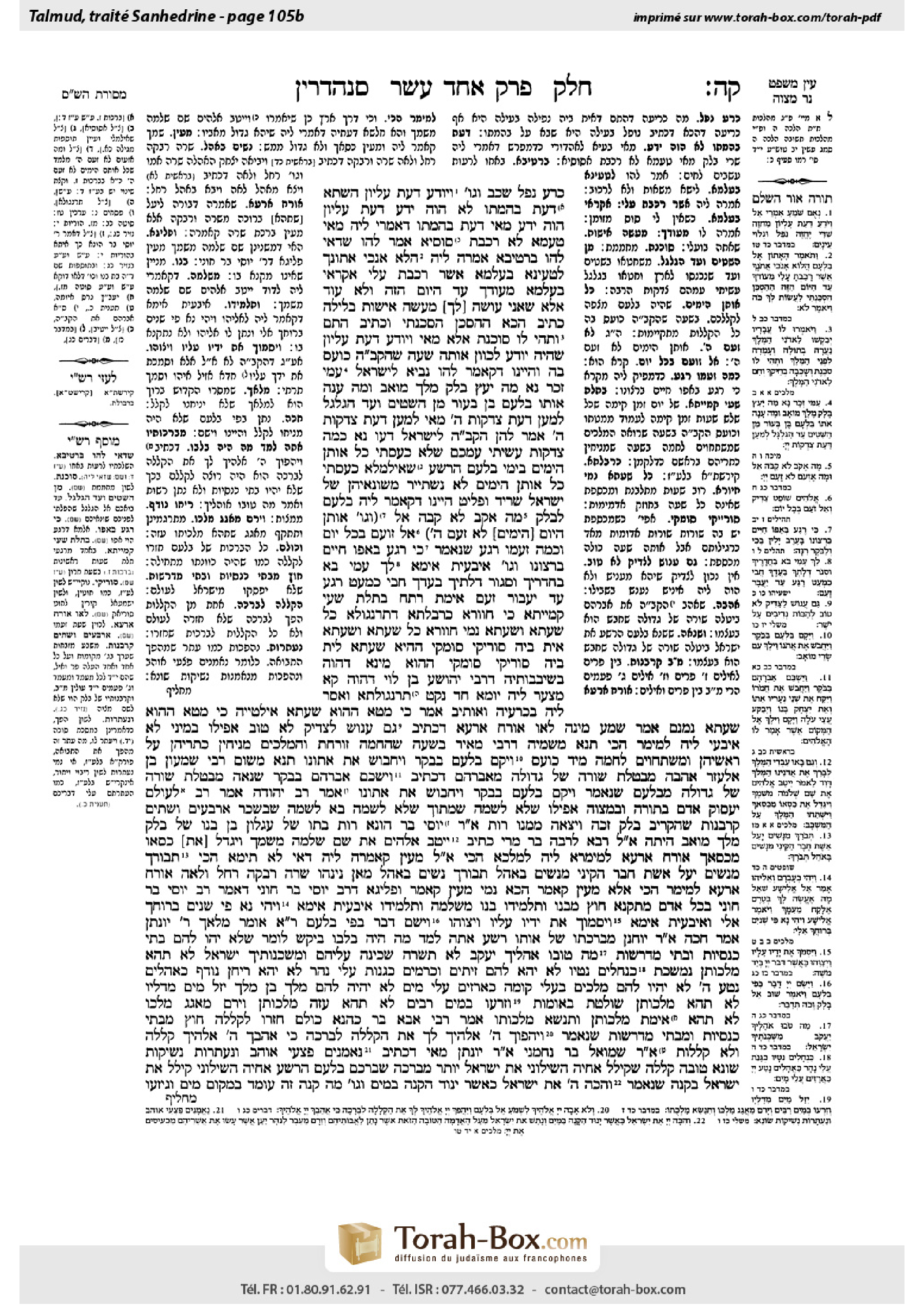
Sanhedrin 105b: Talmud study for Daf Yomi
Daf Yomi is the daily study of one Talmud folio. Explore 37 tractates with scans, Hebrew text, Sefaria English and AI-generated French translations where annotated.
Passage selection and English or AI-generated French translation are available where the scan has annotations. Daf Study is independent of Torah-Box and Sefaria.
Browse Sanhedrin · סנהדרין · All tractatesSanhedrin 105b text and translations
This page of Sanhedrin includes the Aramaic text, an English translation and an AI-generated French translation, alongside the scan above.
סנהדרין ק״ה ב · Aramaic and Hebrew text
כָּרַע נָפַל שָׁכָב וְגוֹ׳״.
״וְיֹדֵעַ דַּעַת עֶלְיוֹן״. הַשְׁתָּא דַּעַת בְּהֶמְתּוֹ לָא הֲוָה יָדַע, דַּעַת עֶלְיוֹן הֲוָה יָדַע? מַאי דַּעַת בְּהֶמְתּוֹ? דְּאָמְרִי לֵיהּ: מַאי טַעְמָא לָא רָכְבַתְּ סוּסְיָא? אֲמַר לְהוּ: שְׁדַאי לֵהּוֹ בִּרְטִיבָא.
אֲמַרָה לֵיהּ: ״הֲלֹא אָנֹכִי אֲתֹנְךָ״! לִטְעִינָא בְּעָלְמָא. ״אֲשֶׁר רָכַבְתָּ עָלַי״! אַקְרַאי בְּעָלְמָא. ״מֵעוֹדְךָ עַד הַיּוֹם הַזֶּה״!
וְלֹא עוֹד, אֶלָּא שֶׁאֲנִי עוֹשָׂה [לְךָ] מַעֲשֵׂה אִישׁוּת בַּלַּיְלָה. כְּתִיב הָכָא: ״הַהַסְכֵּן הִסְכַּנְתִּי״, וּכְתִיב הָתָם: ״וַתְּהִי לוֹ סֹכֶנֶת״.
אֶלָּא מַאי ״וְיֹדֵעַ דַּעַת עֶלְיוֹן״? שֶׁהָיָה יוֹדֵעַ לְכַוֵּון אוֹתָהּ שָׁעָה שֶׁהַקָּדוֹשׁ בָּרוּךְ הוּא כּוֹעֵס בָּהּ.
וְהַיְינוּ דְּקָאָמַר לְהוּ נָבִיא לְיִשְׂרָאֵל: ״עַמִּי זְכָר נָא מַה יָּעַץ בָּלָק מֶלֶךְ מוֹאָב וּמֶה עָנָה אֹתוֹ בִּלְעָם בֶּן בְּעוֹר מִן הַשִּׁטִּים עַד הַגִּלְגָּל לְמַעַן דַּעַת צִדְקוֹת ה׳״. מַאי ״לְמַעַן דַּעַת צִדְקוֹת ה׳״? אָמַר לָהֶן הַקָּדוֹשׁ בָּרוּךְ הוּא לְיִשְׂרָאֵל: דְּעוּ נָא כַּמָּה צְדָקוֹת עָשִׂיתִי עִמָּכֶם, שֶׁלֹּא כָּעַסְתִּי כׇּל אוֹתָן הַיָּמִים בִּימֵי בִּלְעָם הָרָשָׁע, שֶׁאִילְמָלֵא כָּעַסְתִּי כׇּל אוֹתָן הַיָּמִים לֹא נִשְׁתַּיֵּיר מִשּׂוֹנְאֵיהֶן שֶׁל יִשְׂרָאֵל שָׂרִיד וּפָלִיט.
הַיְינוּ דְּקָאָמַר לֵיהּ בִּלְעָם לְבָלָק: ״מָה אֶקֹּב לֹא קַבֹּה אֵל וְגוֹ׳״ (אוֹתָן הַיּוֹם [הַיָּמִים] לֹא זָעַם ה׳). ״אֵל זֹעֵם בְּכׇל יוֹם״, וְכַמָּה זַעְמוֹ? רֶגַע, שֶׁנֶּאֱמַר: ״כִּי רֶגַע בְּאַפּוֹ חַיִּים בִּרְצוֹנוֹ וְגוֹ׳״.
אִיבָּעֵית אֵימָא: ״לֵךְ עַמִּי בֹּא בַחֲדָרֶיךָ וּסְגֹר דְּלָתְךָ בַּעֲדֶךָ חֲבִי כִמְעַט רֶגַע עַד יַעֲבׇר זָעַם״. אֵימַת רָתַח? בִּתְלָת שָׁעֵי קַמָּיָיתָא, כִּי חָוְורָא כַּרְבָּלְתָּא דְּתַרְנְגוֹלָא. כֹּל שַׁעְתָּא וְשַׁעְתָּא נָמֵי חָוְורָא! כֹּל שַׁעְתָּא וְשַׁעְתָּא אִית בֵּיהּ סוּרְיָקֵי סוּמָּקֵי, הָהִיא שַׁעְתָּא לֵית בֵּיהּ סוּרְיָקֵי סוּמָּקֵי.
הָהוּא מִינָא דַּהֲוָה בְּשִׁיבָבוּתֵיהּ דְּרַבִּי יְהוֹשֻׁעַ בֶּן לֵוִי, דַּהֲוָה קָא מְצַעַר לֵיהּ. יוֹמָא חַד נְקַט תַּרְנוּגְלָא, וַאֲסַר לֵיהּ בְּכַרְעֵיהּ, וְאוֹתֵיב. אָמַר: כִּי מְטָא הָהוּא שַׁעְתָּא – אֶילְטְיֵיהּ. כִּי מְטָא הָהוּא שַׁעְתָּא, נַמְנֵם. אֲמַר: שְׁמַע מִינַּהּ לָאו אוֹרַח אַרְעָא, דִּכְתִיב ״גַּם עֲנוֹשׁ לַצַּדִּיק לֹא טוֹב״. אֲפִילּוּ בְּמִינֵי לָא אִיבְּעִי לֵיהּ לְמֵימַר הָכִי.
תָּנָא מִשְּׁמֵיהּ דְּרַבִּי מֵאִיר: בְּשָׁעָה שֶׁהַחַמָּה זוֹרַחַת, וְהַמְּלָכִים מַנִּיחִין כִּתְרֵיהֶן עַל רָאשֵׁיהֶן וּמִשְׁתַּחֲוִים לַחַמָּה, מִיָּד כּוֹעֵס.
״וַיָּקׇם בִּלְעָם בַּבֹּקֶר וַיַּחֲבֹשׁ אֶת אֲתֹנוֹ״. תָּנָא מִשּׁוּם רַבִּי שִׁמְעוֹן בֶּן אֶלְעָזָר: אַהֲבָה מְבַטֶּלֶת שׁוּרָה שֶׁל גְּדוּלָּה מֵאַבְרָהָם, דִּכְתִיב: ״וַיַּשְׁכֵּם אַבְרָהָם בַּבֹּקֶר״. שִׂנְאָה מְבַטֶּלֶת שׁוּרָה שֶׁל גְּדוּלָּה מִבִּלְעָם, שֶׁנֶּאֱמַר: ״וַיָּקׇם בִּלְעָם בַּבֹּקֶר וַיַּחֲבֹשׁ אֶת אֲתֹנוֹ״.
אָמַר רַב יְהוּדָה אָמַר רַב: לְעוֹלָם יַעֲסוֹק אָדָם בְּתוֹרָה וּבְמִצְוָה, אֲפִילּוּ שֶׁלֹּא לִשְׁמָהּ, שֶׁמִּתּוֹךְ שֶׁלֹּא לִשְׁמָהּ בָּא לִשְׁמָהּ. שֶׁבִּשְׂכַר אַרְבָּעִים וּשְׁתַּיִם קׇרְבָּנוֹת שֶׁהִקְרִיב בָּלָק, זָכָה וְיָצְאָה מִמֶּנּוּ רוּת. אָמַר רַבִּי יוֹסֵי בַּר הוּנָא: רוּת בִּתּוֹ שֶׁל עֶגְלוֹן, בֶּן בְּנוֹ שֶׁל בָּלָק מֶלֶךְ מוֹאָב הָיְתָה.
אֲמַר לֵיהּ רָבָא לְרַבָּה בַּר מָרִי: כְּתִיב ״יֵיטֵב אֱלֹהִים אֶת שֵׁם שְׁלֹמֹה מִשְּׁמֶךָ וִיגַדֵּל [אֶת] כִּסְאוֹ מִכִּסְאֶךָ״. אוֹרַח אַרְעָא לְמֵימְרָא לֵיהּ לְמַלְכָּא הָכִי? אֲמַר לֵיהּ: מֵעֵין קָאָמְרָה לֵיהּ.
דְּאִי לָא תֵּימָא הָכִי, ״תְּבֹרַךְ מִנָּשִׁים יָעֵל אֵשֶׁת חֶבֶר הַקֵּינִי מִנָּשִׁים בָּאֹהֶל תְּבֹרָךְ״. נָשִׁים בָּאֹהֶל מַאן נִינְהוּ? שָׂרָה, רִבְקָה, רָחֵל, וְלֵאָה. אוֹרַח אַרְעָא לְמֵימַר הָכִי? אֶלָּא מֵעֵין קָאָמַר. הָכִי נָמֵי, מֵעֵין קָאָמַר.
וּפְלִיגָא דְּרַב יוֹסֵי בַּר חוֹנִי, דְּאָמַר רַב יוֹסֵי בַּר חוֹנִי: בַּכֹּל אָדָם מִתְקַנֵּא, חוּץ מִבְּנוֹ וְתַלְמִידוֹ. בְּנוֹ – מִשְּׁלֹמֹה, וְתַלְמִידוֹ – אִיבָּעֵית אֵימָא: ״וִיהִי נָא פִּי שְׁנַיִם בְּרוּחֲךָ אֵלָי״, וְאִיבָּעֵית אֵימָא: ״וַיִּסְמֹךְ אֶת יָדָיו עָלָיו וַיְצַוֵּהוּ״.
״וַיָּשֶׂם דָּבָר בְּפִי בִּלְעָם״, רַבִּי אֶלְעָזָר אוֹמֵר – מַלְאָךְ, רַבִּי יוֹנָתָן אָמַר – חַכָּה.
אָמַר רַבִּי יוֹחָנָן: מִבִּרְכָתוֹ שֶׁל אוֹתוֹ רָשָׁע אַתָּה לָמֵד מָה הָיָה בְּלִבּוֹ. בִּיקֵּשׁ לוֹמַר שֶׁלֹּא יְהוּ לָהֶם בָּתֵּי כְנֵסִיּוֹת וּבָתֵּי מִדְרָשׁוֹת – ״מַה טֹּבוּ אֹהָלֶיךָ יַעֲקֹב״. לֹא תִּשְׁרֶה שְׁכִינָה עֲלֵיהֶם – ״וּמִשְׁכְּנֹתֶיךָ יִשְׂרָאֵל״. לֹא תְּהֵא מַלְכוּתָן נִמְשֶׁכֶת – ״כִּנְחָלִים נִטָּיוּ״. לֹא יְהֵא לָהֶם זֵיתִים וּכְרָמִים – ״כְּגַנֹּת עֲלֵי נָהָר״. לֹא יְהֵא רֵיחָן נוֹדֵף – ״כַּאֲהָלִים נָטַע ה׳״.
לֹא יִהְיוּ לָהֶם מְלָכִים בַּעֲלֵי קוֹמָה – ״כַּאֲרָזִים עֲלֵי מַיִם״. לֹא יִהְיֶה לָהֶם מֶלֶךְ בֶּן מֶלֶךְ – ״יִזַּל מַיִם מִדָּלְיָו״. לֹא תְּהֵא מַלְכוּתָן שׁוֹלֶטֶת בָּאוּמּוֹת – ״וְזַרְעוֹ בְּמַיִם רַבִּים״. לֹא תְּהֵא עַזָּה מַלְכוּתָן – ״וְיָרֹם מֵאֲגַג מַלְכּוֹ״. לֹא תְּהֵא אֵימַת מַלְכוּתָן – ״וְתִנַּשֵּׂא מַלְכֻתוֹ״.
אָמַר רַבִּי אַבָּא בַּר כָּהֲנָא: כּוּלָּם חָזְרוּ לִקְלָלָה, חוּץ מִבָּתֵּי כְנֵסִיּוֹת וּמִבָּתֵּי מִדְרָשׁוֹת, שֶׁנֶּאֱמַר: ״וַיַּהֲפֹךְ ה׳ אֱלֹהֶיךָ לְּךָ אֶת הַקְּלָלָה לִבְרָכָה כִּי אֲהֵבְךָ ה׳ אֱלֹהֶיךָ״. קְלָלָה, וְלֹא קְלָלוֹת.
אָמַר רַבִּי שְׁמוּאֵל בַּר נַחְמָנִי אָמַר רַבִּי יוֹנָתָן: מַאי דִּכְתִיב ״נֶאֱמָנִים פִּצְעֵי אוֹהֵב וְנַעְתָּרוֹת נְשִׁיקוֹת שׂוֹנֵא״? טוֹבָה קְלָלָה שֶׁקִּילֵּל אֲחִיָּה הַשִּׁילוֹנִי אֶת יִשְׂרָאֵל יוֹתֵר מִבְּרָכָה שֶׁבֵּרְכָם בִּלְעָם הָרָשָׁע. אֲחִיָּה הַשִּׁילוֹנִי קִילֵּל אֶת יִשְׂרָאֵל בְּקָנֶה, שֶׁנֶּאֱמַר: ״וְהִכָּה ה׳ אֶת יִשְׂרָאֵל כַּאֲשֶׁר יָנוּד הַקָּנֶה בַּמַּיִם וְגוֹ׳״. מָה קָנֶה זֶה עוֹמֵד בִּמְקוֹם מַיִם, וְגִיזְעוֹ
Sanhedrin 105b · English translation
he sunk, he fell, he lay” (Judges 5:27), which is interpreted as a reference to sexual intercourse between Sisera and Jael.
§ Balaam describes himself: “And he knows the knowledge of the Most High” (Numbers 24:16), and the Gemara asks: Now, if the knowledge of his animal he did not know, is it possible that the knowledge of the Most High he knew? The Gemara explains: What is the meaning of the knowledge of his animal? The princes accompanying him said to him: What is the reason that you did not ride horses? Balaam said to them: I brought the horses to graze in the pasture and rest there.
The donkey said to him: “Am I not your donkey” (Numbers 22:30)? Balaam said to the donkey: Merely for burdens, not for riding. The donkey said to him: “Upon which you have ridden” (Numbers 22:30). Balaam said to the donkey: That was mere happenstance and is not a regular occurrence. The donkey said to him: “Your whole life until this day” (Numbers 22:30).
The donkey continued: Moreover, I perform a conjugal act for you and we engage in bestiality at night. From where is this derived? It is written here: “Was I ever wont [hahasken hiskanti] to do so to you” (Numbers 22:30)? And it is written there with regard to Abishag the Shunammite: “And let her be a companion [sokhenet] to him” (I Kings 1:2). Just as the root samekh, kaf, nun indicates sexual relations in the case of Abishag, the same is true with regard to the donkey. Balaam was unable to best his donkey in a debate.
The Gemara asks: Rather, what, then, is the meaning of the phrase “And he knows knowledge of the Most High”? Is it possible that he knew the knowledge of the Most High? Rather, he would know to determine the moment during which the Holy One, Blessed be He, is angry. He would curse at that moment and the curse was effective.
And that is what the prophet said to Israel: “My nation, remember what Balak, king of Moab, advised, and how Balaam, son of Beor, responded; from Shittim to Gilgal, so that you may know the righteous acts of the Lord” (Micah 6:5). What is the meaning of the phrase “So that you may know the righteous acts of the Lord”? The Holy One, Blessed be He, said to Israel: Know how many acts of kindness I performed on your behalf, that I did not become angry during all the days of Balaam the wicked, as had I become angry during all those days, no remnant or refugee would have remained among the enemies of Israel, a euphemism for Israel itself. Instead, God restrained His anger and Balaam’s curse went unfulfilled.
That is what Balaam said to Balak: “How can I curse, whom God has not cursed? And how can I condemn, whom God has not condemned?” (Numbers 23:8). Since God did not become angry, Balaam was unable to curse the Jewish people. It is written: “And God is angry every day” (Psalms 7:12). And how long is the duration of His wrath? It is one moment, as it is stated: “For His anger endures but a moment; His favor is for a lifetime” (Psalms 30:6).
If you wish, say instead this proof from another source, as it is stated: “Come, my people, enter you into your chambers, and shut your doors about you; hide yourself for a brief moment, until the anger passes” (Isaiah 26:20), meaning that God’s anger passes in a mere moment. And when is the Holy One, Blessed be He, angry? It is during the first three hours of the day, when the crest of the rooster is white from the sun. The Gemara challenges: Each and every hour of the day the rooster’s crest is also white, as it does not always remain red. The Gemara explains: The difference is that during each and every other hour when the rooster stands that way, there are red streaks in his crest. But at that moment when God is angry, there are no red streaks in the rooster’s crest.
The Gemara relates: There was a certain heretic who was in Rabbi Yehoshua ben Levi’s neighborhood who would upset him by incessantly challenging the legitimacy of biblical verses. One day, Rabbi Yehoshua ben Levi took a rooster and tied it by its legs and sat and waited. He said: When that moment of God’s wrath arrives, I will curse him. When that moment of God’s wrath arrived, Rabbi Yehoshua ben Levi dozed off. When he awakened, he said: Conclude from the fact that I dozed off that it is not proper conduct to curse even the wicked, as it is written: “Punishment, even for the righteous, is not good” (Proverbs 17:26). Even with regard to heretics, a righteous person should not state a curse in order to punish them.
Explaining the cause of God’s anger, it was taught in a baraita in the name of Rabbi Meir: When the sun rises and the kings place their crowns on their heads and bow down to the sun, the Holy One, Blessed be He, immediately grows angry. Since this occurs in the early hours of every day, God becomes angry at His world at that time every day.
§ It is stated: “And Balaam rose early in the morning and saddled his donkey” (Numbers 22:21). It was taught in a baraita in the name of Rabbi Shimon ben Elazar: Love negates the standard conduct of those of prominence. This is derived from Abraham, as it is written: “And Abraham rose early in the morning and saddled his donkey” (Genesis 22:3). Atypically, he saddled the donkey himself and he did not wait for his servants. Likewise, hatred negates the standard conduct of those of prominence. This is derived from Balaam, as it is stated: “And Balaam rose early in the morning and saddled his donkey” (Numbers 22:21).
Rav Yehuda says that Rav says: A person should always engage in Torah study and performance of a mitzva even if he does not do so for their own sake, as through engaging in them not for their own sake, he will ultimately come to engage in them for their own sake. Proof for this can be cited from the example of Balak, as in reward for the forty-two offerings that Balak sacrificed, even though he sacrificed them to facilitate the destruction of the Jewish people, he was privileged and Ruth descended from him. Rabbi Yosei bar Huna says: Ruth was the daughter of Eglon, son of the son of Balak, king of Moab.
Apropos Ruth, matriarch of the Davidic line, the Gemara cites that which Rava said to Rabba bar Mari: It is written that the servants of David said to David: “May God make the name of Solomon better than your name and make his throne greater than your throne [mikisekha]” (I Kings 1:47). Rava asks: Is it proper conduct to speak to a king in that manner and say that his son will be greater than he is? Rabba bar Mari said to Rava: She said to him: May the throne of Solomon be of the nature of your throne.
He explains: As if you do not say so and do not explain it in this manner, then the verse: “Blessed above women Jael, wife of Heber the Kenite; blessed is she more than the women [minashim] in the tent” (Judges 5:24), is difficult. “The women in the tent,” who are they? They are Sarah, Rebecca, Rachel, and Leah. Is it proper conduct to speak in that manner about the Matriarchs? Rather, of the nature of the Matriarchs is what the verse says, not greater. So too in the case of David’s servants: Of the nature of his throne, is what the verse says.
The Gemara notes: This explanation disagrees with the opinion of Rav Yosei bar Ḥoni, as Rav Yosei bar Ḥoni says: A person is jealous of everyone except for his son and his student. Since their success reflects well upon him, he celebrates their success. The fact that one is not jealous of his son is derived from King David’s servants telling him: May Solomon be greater than he is. And the fact that one is not jealous of his student; if you wish, say that it is derived from that which Elisha said to Elijah: “I pray you that a double portion of your spirit be upon me” (II Kings 2:9). He asked of his mentor to be greater than him, indicating that it is not an objectionable matter. And if you wish, say instead that it is derived from Moses: “And he laid his hands upon him and commanded him” (Numbers 27:23). God commanded Moses to lay only one hand upon Joshua, and instead he laid both hands upon him with all his strength.
§ With regard to the verse: “And the Lord placed a matter in Balaam’s mouth” (Numbers 23:5), Rabbi Elazar says: It was an angel that spoke from his mouth. Rabbi Yonatan says: It was a hook placed in his mouth to prevent him from saying anything else.
Rabbi Yoḥanan says: From the blessing of that wicked person, Balaam, you can ascertain what was in his heart. God transformed the curses that he planned into blessings. He sought to say that they should not have synagogues and study halls, and he said instead: “How goodly are your tents, Jacob” (Numbers 24:5), a blessing on their synagogues. He sought to say that the Divine Presence [shekhina] will not rest upon them, and he said instead: “And your dwellings [mishkenot] Israel.” He sought to say that the kingdom of Israel would not continue, and he said instead that it would continue: “Like the winding brooks” (Numbers 24:6), which flow continuously. He sought to say that they would have no olive trees and vineyards, and he said instead: “Like gardens by the river’s side” (Numbers 24:6). He sought to say that their fragrance would not diffuse from their fulfillment of mitzvot, and he said instead: “Like aloes that the Lord has planted” (Numbers 24:6).
He sought to say that they would not have kings of stature, and he said instead: “Like cedar trees beside the waters” (Numbers 24:6). He sought to say that they will not have a king the son of a king, and he said instead: “Water shall flow from his branches” (Numbers 24:7). He sought to say that their kingdom would not rule over the nations, and he said instead: “And his seed shall be in many waters” (Numbers 24:7). He sought to say that their kingdom would not be fierce, and he said instead: “And his king shall be higher than Agag.” He sought to say that there will be no fear of their kingdom, and he said instead: “And his kingdom shall be exalted” (Numbers 24:7).
Rabbi Abba bar Kahana says: All of the blessings ultimately reverted to be fulfilled as the curse that he originally intended, as all of those circumstances befell the Jewish people, except for the destruction of synagogues and study halls, as it is stated: “And the Lord your God transformed the curse into a blessing for you, because the Lord your God loved you” (Deuteronomy 23:6). A curse in the singular, not curses in the plural, was transformed permanently.
Rabbi Shmuel bar Naḥmani says that Rabbi Yonatan says: What is the meaning of that which is written: “Faithful are the wounds of a friend; but the kisses of an enemy are importunate” (Proverbs 27:6)? Better is the curse that Ahijah the Shilonite cursed the Jewish people than the blessing that Balaam the wicked blessed them. Ahijah the Shilonite cursed Israel with a reed, as it is stated: “For the Lord shall smite Israel as a reed is shaken in water” (I Kings 14:15). There is an aspect of blessing in that curse, as he was saying they will be just like a reed that stands in a place near water, as the water sustains it, and its stalk
Sanhedrin 105b · Traduction française (IA)
« Il s’affaissa, il tomba, il resta étendu » (Juges 5:27), ce qui est interprété comme une allusion aux relations sexuelles entre Sisera et Yaël.
§ Balaam se décrit ainsi : « Et il connaît la connaissance du Très-Haut » (Nombres 24:16). La Guemara demande : S’il ne connaissait même pas la pensée de son ânesse, est-il possible qu’il connût celle du Très-Haut ? La Guemara explique : Que signifie « la pensée de son ânesse » ? Les princes qui l’accompagnaient lui dirent : « Pourquoi n’es-tu pas monté à cheval ? » Balaam leur répondit : « J’ai amené les chevaux pour qu’ils paissent dans le pré et s’y reposent. »
L’ânesse lui dit : « Ne suis-je pas ton ânesse ? » (Nombres 22:30). Balaam lui répondit : « Tu ne servais qu’à porter des charges, pas à me porter. » L’ânesse lui dit : « Sur laquelle tu es monté » (Nombres 22:30). Balaam lui répondit : « C’était une simple exception, ce n’est pas quelque chose d’habituel. » L’ânesse lui dit : « Toute ta vie jusqu’à ce jour » (Nombres 22:30).
L’ânesse poursuivit : « De plus, j’accomplis pour toi l’acte conjugal et, la nuit, nous nous livrons à la bestialité. » D’où le déduit-on ? Il est écrit ici : « Ai-je jamais eu l’habitude [hahasken hiskanti] d’agir ainsi envers toi ? » (Nombres 22:30), et il est écrit ailleurs, au sujet d’Abishag la Shounamite : « Qu’elle soit une compagne [sokhenet] pour lui » (I Rois 1:2). De même que la racine samekh-kaf-noun désigne des relations sexuelles dans le cas d’Abishag, il en va de même pour l’ânesse. Balaam ne parvint pas à l’emporter sur son ânesse dans une joute verbale.
La Guemara demande : Que signifie donc l’expression « Et il connaît la connaissance du Très-Haut » ? Est-il possible qu’il connût la connaissance du Très-Haut ? En réalité, il savait déterminer le moment où le Saint, béni soit-Il, se met en colère. Il maudissait à cet instant, et sa malédiction était efficace.
C’est ce que le prophète dit à Israël : « Mon peuple, souviens-toi de ce que Balak, roi de Moab, a conseillé, et de la réponse de Balaam, fils de Beor, depuis Shittim jusqu’à Guilgal, afin que tu connaisses les actes de justice du Seigneur » (Michée 6:5). Que signifie « afin que tu connaisses les actes de justice du Seigneur » ? Le Saint, béni soit-Il, dit à Israël : « Sache combien d’actes de bonté j’ai accomplis pour vous : je ne me suis pas mis en colère durant tous les jours de Balaam le méchant. En effet, si je m’étais mis en colère pendant tous ces jours, il ne serait resté aucun survivant ni aucun rescapé parmi les ennemis d’Israël » — formule euphémistique désignant Israël lui-même. Au contraire, Dieu retint sa colère et la malédiction de Balaam ne se réalisa pas.
C’est ce que Balaam dit à Balak : « Comment maudirais-je celui que Dieu n’a pas maudit ? Comment condamnerais-je celui que Dieu n’a pas condamné ? » (Nombres 23:8). Puisque Dieu ne s’était pas mis en colère, Balaam ne pouvait pas maudire le peuple juif. Il est écrit : « Dieu se met en colère chaque jour » (Psaumes 7:12). Combien de temps dure sa colère ? Un instant, comme il est dit : « Sa colère ne dure qu’un instant, sa faveur dure toute la vie » (Psaumes 30:6).
Si tu le souhaites, on peut plutôt apporter cette preuve tirée d’une autre source, comme il est dit : « Va, mon peuple, entre dans tes chambres et ferme tes portes derrière toi ; cache-toi un bref instant, jusqu’à ce que la colère soit passée » (Isaïe 26:20), ce qui signifie que la colère de Dieu ne dure qu’un instant. Et quand le Saint, béni soit-Il, se met-il en colère ? Durant les trois premières heures du jour, lorsque la crête du coq blanchit sous l’effet du soleil. La Guemara objecte : À chacune des heures de la journée, la crête du coq est également blanche, puisqu’elle ne reste pas toujours rouge. La Guemara explique : La différence est qu’à chacune des autres heures où le coq se tient ainsi, sa crête présente des stries rouges. Mais à l’instant où Dieu se met en colère, il n’y a aucune strie rouge dans la crête du coq.
La Guemara rapporte : Il y avait un hérétique dans le voisinage de Rabbi Yehoshua ben Levi qui le tourmentait en contestant sans cesse la légitimité des versets bibliques. Un jour, Rabbi Yehoshua ben Levi prit un coq, lui attacha les pattes, puis s’assit et attendit. Il se dit : « Lorsque viendra cet instant de colère divine, je le maudirai. » Quand cet instant arriva, Rabbi Yehoshua ben Levi s’assoupit. À son réveil, il dit : « Conclus de ce que je me suis assoupi qu’il n’est pas convenable de maudire même les méchants, car il est écrit : “Même pour le juste, le châtiment n’est pas bon” » (Proverbes 17:26). Même à l’égard des hérétiques, un juste ne doit pas prononcer une malédiction pour les punir.
Pour expliquer la cause de la colère de Dieu, une baraïta fut enseignée au nom de Rabbi Meïr : Lorsque le soleil se lève et que les rois placent leurs couronnes sur leur tête et se prosternent devant le soleil, le Saint, béni soit-Il, se met aussitôt en colère. Puisque cela se produit chaque jour aux premières heures, Dieu se met en colère contre son monde à ce moment-là chaque jour.
§ Il est dit : « Balaam se leva de bon matin et sella son ânesse » (Nombres 22:21). Une baraïta fut enseignée au nom de Rabbi Shimon ben Elazar : L’amour fait déroger les gens éminents à leur conduite habituelle. On le déduit d’Abraham, car il est écrit : « Abraham se leva de bon matin et sella son âne » (Genèse 22:3). Contrairement à l’usage, il sella lui-même son âne et n’attendit pas ses serviteurs. De même, la haine fait déroger les gens éminents à leur conduite habituelle. On le déduit de Balaam, car il est dit : « Balaam se leva de bon matin et sella son ânesse » (Nombres 22:21).
Rav Yehuda dit au nom de Rav : Une personne doit toujours s’adonner à l’étude de la Torah et à l’accomplissement d’une mitsva, même si elle ne le fait pas de manière désintéressée, car en s’y adonnant sans intention désintéressée, elle finira par le faire de manière désintéressée. On peut en apporter la preuve par l’exemple de Balak : en récompense des quarante-deux sacrifices que Balak offrit, même s’il les offrit pour provoquer la destruction du peuple juif, il eut le mérite que Ruth descende de lui. Rabbi Yosei bar Huna dit : Ruth était la fille d’Eglon, fils du fils de Balak, roi de Moab.
À propos de Ruth, ancêtre de la lignée davidique, la Guemara rapporte ce que Rava dit à Rabba bar Mari : Il est écrit que les serviteurs de David lui dirent : « Que Dieu rende le nom de Salomon plus grand que le tien et son trône plus grand que ton trône [mikisekha] » (I Rois 1:47). Rava demande : Est-il convenable de s’adresser ainsi à un roi et de lui dire que son fils sera plus grand que lui ? Rabba bar Mari répondit à Rava : « Elle lui dit : Que le trône de Salomon soit de la même nature que le tien. »
Il explique : Car si tu ne dis pas cela et ne l’expliques pas ainsi, le verset « Bénie entre les femmes soit Yaël, femme de Héber le Kénite ; bénie soit-elle plus que les femmes [minashim] de la tente » (Juges 5:24) est difficile. Qui sont « les femmes de la tente » ? Ce sont Sarah, Rébecca, Rachel et Léa. Est-il convenable de parler ainsi des Matriarches ? En réalité, le verset dit qu’elle était de la nature des Matriarches, et non qu’elle leur était supérieure. De même, dans le cas des serviteurs de David, le verset dit que le trône de Salomon serait de la nature du sien.
La Guemara note que cette explication est en désaccord avec l’opinion de Rav Yosei bar Ḥoni, car Rav Yosei bar Ḥoni dit : Une personne est jalouse de tout le monde, sauf de son fils et de son élève. Leur réussite rejaillit sur elle, et elle s’en réjouit. Le fait qu’on ne soit pas jaloux de son fils se déduit des paroles des serviteurs du roi David, qui lui dirent : « Que Salomon soit plus grand que toi. » Quant au fait qu’on ne soit pas jaloux de son élève, si tu le souhaites, dis qu’on le déduit de ce qu’Élisée dit à Élie : « Je t’en prie, qu’une double part de ton esprit soit sur moi » (II Rois 2:9). Il demanda à son maître de devenir plus grand que lui, ce qui montre qu’il n’y a là rien de répréhensible. Et si tu le souhaites, dis plutôt qu’on le déduit de Moïse : « Il posa ses mains sur lui et lui donna ses instructions » (Nombres 27:23). Dieu ordonna à Moïse de poser une seule main sur Josué, mais il posa ses deux mains sur lui, de toute sa force.
§ À propos du verset : « Le Seigneur mit une parole dans la bouche de Balaam » (Nombres 23:5), Rabbi Elazar dit : C’est un ange qui parla par sa bouche. Rabbi Yonatan dit : C’était un crochet placé dans sa bouche pour l’empêcher de dire autre chose.
Rabbi Yoḥanan dit : À partir de la bénédiction de ce méchant, Balaam, on peut discerner ce qu’il avait dans le cœur. Dieu transforma en bénédictions les malédictions qu’il avait l’intention de prononcer. Il voulait dire qu’ils ne devaient pas avoir de synagogues ni de maisons d’étude, mais il dit à la place : « Qu’elles sont belles tes tentes, Jacob » (Nombres 24:5), bénissant ainsi leurs synagogues. Il voulait dire que la Présence divine [shekhina] ne reposerait pas sur eux, mais il dit à la place : « Et tes demeures [mishkenot], Israël. » Il voulait dire que le royaume d’Israël ne durerait pas, mais il dit à la place qu’il durerait : « Comme des torrents sinueux » (Nombres 24:6), qui coulent sans cesse. Il voulait dire qu’ils n’auraient ni oliviers ni vignes, mais il dit à la place : « Comme des jardins au bord d’un fleuve » (Nombres 24:6). Il voulait dire que leur parfum ne se répandrait pas grâce à l’accomplissement des mitsvot, mais il dit à la place : « Comme des aloès que le Seigneur a plantés » (Nombres 24:6).
Il voulait dire qu’ils n’auraient pas de rois de grande stature, mais il dit à la place : « Comme des cèdres au bord des eaux » (Nombres 24:6). Il voulait dire qu’ils n’auraient pas de roi fils de roi, mais il dit à la place : « De l’eau coulera de ses branches » (Nombres 24:7). Il voulait dire que leur royaume ne dominerait pas les nations, mais il dit à la place : « Et sa descendance sera au milieu de nombreuses eaux » (Nombres 24:7). Il voulait dire que leur royaume ne serait pas redoutable, mais il dit à la place : « Et son roi sera plus élevé qu’Agag. » Il voulait dire que leur royaume ne susciterait aucune crainte, mais il dit à la place : « Et son royaume sera exalté » (Nombres 24:7).
Rabbi Abba bar Kahana dit : Toutes les bénédictions finirent par se réaliser sous la forme des malédictions que Balaam avait d’abord voulu prononcer, car toutes ces circonstances advinrent au peuple juif, à l’exception de la destruction des synagogues et des maisons d’étude. C’est ce qu’indique le verset : « Le Seigneur ton Dieu a transformé pour toi la malédiction en bénédiction, parce que le Seigneur ton Dieu t’aime » (Deutéronome 23:6). C’est la malédiction, au singulier, et non les malédictions, au pluriel, qui fut définitivement transformée.
Rabbi Shmuel bar Naḥmani dit au nom de Rabbi Yonatan : Que signifie ce qui est écrit : « Fidèles sont les blessures d’un ami, mais les baisers d’un ennemi sont excessifs » (Proverbes 27:6) ? La malédiction qu’Ahiya le Shilonite lança contre le peuple juif vaut mieux que la bénédiction que Balaam le méchant lui donna. Ahiya le Shilonite maudit Israël avec un roseau, comme il est dit : « Le Seigneur frappera Israël comme un roseau qui oscille dans l’eau » (I Rois 14:15). Cette malédiction comporte un aspect de bénédiction : il disait qu’ils seraient semblables à un roseau qui se tient près de l’eau, car l’eau le nourrit, et dont la tige
Traduction française générée par IA à partir de l’édition anglaise de Sefaria. Vérifie toujours un passage avec le texte source.
Text from Sefaria: William Davidson Edition - Vocalized Aramaic (CC BY NC); William Davidson Edition - English (CC BY NC).