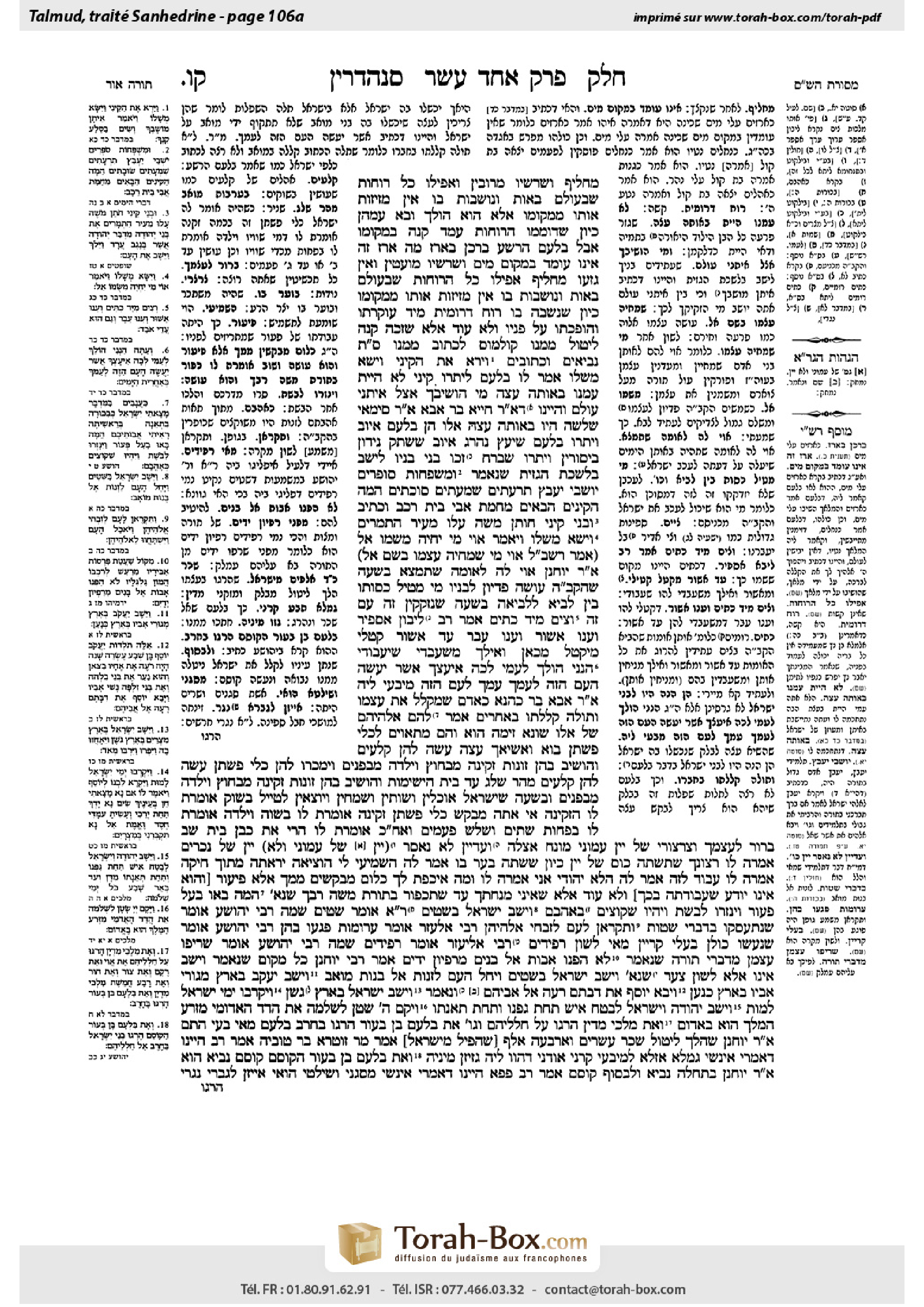
Sanhedrin 106a: Talmud study for Daf Yomi
Daf Yomi is the daily study of one Talmud folio. Explore 37 tractates with scans, Hebrew text, Sefaria English and AI-generated French translations where annotated.
Passage selection and English or AI-generated French translation are available where the scan has annotations. Daf Study is independent of Torah-Box and Sefaria.
Browse Sanhedrin · סנהדרין · All tractatesSanhedrin 106a text and translations
This page of Sanhedrin includes the Aramaic text, an English translation and an AI-generated French translation, alongside the scan above.
סנהדרין ק״ו א · Aramaic and Hebrew text
מַחְלִיף, וְשׇׁרָשָׁיו מְרוּבִּין. וַאֲפִילּוּ כׇּל רוּחוֹת שֶׁבָּעוֹלָם בָּאוֹת וְנוֹשְׁבוֹת בּוֹ, אֵין מְזִיזוֹת אוֹתוֹ מִמְּקוֹמוֹ, אֶלָּא הוּא הוֹלֵךְ וּבָא עִמָּהֶן. כֵּיוָן שֶׁדּוֹמְמוּ הָרוּחוֹת, עָמַד קָנֶה בִּמְקוֹמוֹ.
אֲבָל בִּלְעָם הָרָשָׁע בֵּרְכָן בְּאֶרֶז. מָה אֶרֶז זֶה? אֵינוֹ עוֹמֵד בִּמְקוֹם מַיִם, וְשׇׁרָשָׁיו מוּעָטִין, וְאֵין גִּזְעוֹ מַחְלִיף. אֲפִילּוּ כׇּל הָרוּחוֹת שֶׁבָּעוֹלָם בָּאוֹת וְנוֹשְׁבוֹת בּוֹ, אֵין מְזִיזוֹת אוֹתוֹ מִמְּקוֹמוֹ. כֵּיוָן שֶׁנָּשְׁבָה בּוֹ רוּחַ דְּרוֹמִית, מִיָּד עוֹקַרְתּוֹ וְהוֹפַכְתּוֹ עַל פָּנָיו. וְלֹא עוֹד, אֶלָּא שֶׁזָּכָה קָנֶה לִיטּוֹל מִמֶּנּוּ קוּלְמוֹס לִכְתּוֹב מִמֶּנּוּ סִפְרֵי תוֹרָה, נְבִיאִים וּכְתוּבִים.
״וַיַּרְא אֶת הַקֵּינִי וַיִּשָּׂא מְשָׁלוֹ״. אָמַר לוֹ בִּלְעָם לְיִתְרוֹ: קֵינִי, לֹא הָיִיתָ עִמָּנוּ בְּאוֹתָהּ עֵצָה? מִי הוֹשִׁיבְךָ אֵצֶל אֵיתָנֵי עוֹלָם?
וְהַיְינוּ דְּאָמַר רַבִּי חִיָּיא בַּר אַבָּא אָמַר רַבִּי סִימַאי: שְׁלֹשָׁה הָיוּ בְּאוֹתָהּ עֵצָה, אֵלּוּ הֵן: בִּלְעָם, אִיּוֹב וְיִתְרוֹ. בִּלְעָם שֶׁיָּעַץ – נֶהֱרַג, אִיּוֹב שֶׁשָּׁתַק – נִידּוֹן בְּיִסּוּרִין, וְיִתְרוֹ שֶׁבָּרַח – זָכוּ בְּנֵי בָנָיו לֵישֵׁב בְּלִשְׁכַּת הַגָּזִית, שֶׁנֶּאֱמַר: ״וּמִשְׁפְּחוֹת סוֹפְרִים יוֹשְׁבֵי יַעְבֵּץ תִּרְעָתִים שִׁמְעָתִים שׂוּכָתִים הֵמָּה הַקִּינִים הַבָּאִים מֵחַמַּת אֲבִי בֵית רֵכָב״, וּכְתִיב: ״וּבְנֵי קֵינִי חֹתֵן מֹשֶׁה עָלוּ מֵעִיר הַתְּמָרִים״.
״וַיִּשָּׂא מְשָׁלוֹ וַיֹּאמַר אוֹי מִי יִחְיֶה מִשֻּׂמוֹ אֵל״. אָמַר רַבִּי שִׁמְעוֹן בֶּן לָקִישׁ: אוֹי מִי שֶׁמְּחַיֶּה עַצְמוֹ בְּשֵׁם אֵל. אָמַר רַבִּי יוֹחָנָן: אוֹי לָהּ לָאוּמָּה שֶׁתִּמָּצֵא בְּשָׁעָה שֶׁהַקָּדוֹשׁ בָּרוּךְ הוּא עוֹשֶׂה פִּדְיוֹן לְבָנָיו. מִי מֵטִיל כְּסוּתוֹ בֵּין לָבִיא לִלְבִיאָה בְּשָׁעָה שֶׁנִּזְקָקִין זֶה עִם זֶה?
״וְצִים מִיַּד כִּתִּים״, אָמַר רַב: לִיבּוֹן אַסְפִּיר. ״וְעִנּוּ אַשּׁוּר וְעִנּוּ עֵבֶר״ – עַד אַשּׁוּר קָטְלִי מִיקְטָל, מִכָּאן וְאֵילָךְ מְשַׁעְבְּדִי שַׁיעְבּוֹדֵי.
״הִנְנִי הוֹלֵךְ לְעַמִּי לְכָה אִיעָצְךָ אֲשֶׁר יַעֲשֶׂה הָעָם הַזֶּה לְעַמְּךָ״. ״עַמְּךָ לְעָם הַזֶּה״ מִיבְּעֵי לֵיהּ! אָמַר רַבִּי אַבָּא בַּר כָּהֲנָא: כְּאָדָם שֶׁמְּקַלֵּל אֶת עַצְמוֹ וְתוֹלֶה קִלְלָתוֹ בַּאֲחֵרִים.
אָמַר לָהֶם: אֱלֹהֵיהֶם שֶׁל אֵלּוּ שׂוֹנֵא זִימָּה הוּא, וְהֵם מִתְאַוִּים לִכְלֵי פִשְׁתָּן. בּוֹא וְאַשִּׂיאֲךָ עֵצָה: עֲשֵׂה לָהֶן קְלָעִים, וְהוֹשֵׁיב בָּהֶן זוֹנוֹת, זְקֵינָה מִבַּחוּץ וְיַלְדָּה מִבִּפְנִים, וְיִמְכְּרוּ לָהֶן כְּלֵי פִשְׁתָּן.
עָשָׂה לָהֶן קְלָעִים מֵהַר שֶׁלֶג עַד בֵּית הַיְשִׁימוֹת, וְהוֹשִׁיב בָּהֶן זוֹנוֹת, זְקֵינָה מִבַּחוּץ וְיַלְדָּה מִבִּפְנִים. וּבְשָׁעָה שֶׁיִּשְׂרָאֵל אוֹכְלִין וְשׁוֹתִין וּשְׂמֵחִין וְיוֹצְאִין לְטַיֵּיל בְּשׁוּק, אוֹמֶרֶת לוֹ הַזְּקֵינָה: אִי אַתָּה מְבַקֵּשׁ כְּלֵי פִשְׁתָּן? זְקֵינָה אוֹמֶרֶת לוֹ בְּשָׁוֶה, וְיַלְדָּה אוֹמֶרֶת לוֹ בְּפָחוֹת, שְׁתַּיִם וְשָׁלֹשׁ פְּעָמִים.
וְאַחַר כָּךְ אוֹמֶרֶת לוֹ: הֲרֵי אַתְּ כְּבֶן בַּיִת, שֵׁב בְּרוֹר לְעַצְמְךָ. וְצַרְצוּרי שֶׁל יַיִן עַמּוֹנִי מוּנָּח אֶצְלָהּ, וַעֲדַיִין לֹא נֶאֱסַר יַיִן שֶׁל עַמּוֹנִי וְלֹא יַיִן שֶׁל גּוֹיִם. אָמְרָה לוֹ: רְצוֹנֶךָ שֶׁתִּשְׁתֶּה כּוֹס שֶׁל יַיִן? כֵּיוָן שֶׁשָּׁתָה, בָּעַר בּוֹ.
אֲמַר לָהּ: הִשָּׁמֵיעִי לִי. הוֹצִיאָה יִרְאָתָהּ מִתּוֹךְ חֵיקָהּ, אָמְרָה לוֹ: עֲבוֹד לָזֶה! אֲמַר לָהּ: הֲלֹא יְהוּדִי אֲנִי? אָמְרָה לוֹ: וּמָה אִיכְפַּת לְךָ? כְּלוּם מְבַקְּשִׁים מִמְּךָ אֶלָּא פִּיעוּר? [וְהוּא אֵינוֹ יוֹדֵעַ שֶׁעֲבוֹדָתָהּ בְּכָךְ]. וְלֹא עוֹד אֶלָּא שֶׁאֵינִי מַנַּחְתְּךָ עַד שֶׁתִּכְפּוֹר בְּתוֹרַת מֹשֶׁה רַבְּךָ, שֶׁנֶּאֱמַר: ״הֵמָּה בָּאוּ בַּעַל פְּעוֹר וַיִּנָּזְרוּ לַבֹּשֶׁת וַיִּהְיוּ שִׁקּוּצִים כְּאׇהֳבָם״.
״וַיֵּשֶׁב יִשְׂרָאֵל בַּשִּׁטִּים״. רַבִּי אֱלִיעֶזֶר אוֹמֵר: שִׁטִּים שְׁמָהּ. רַבִּי יְהוֹשֻׁעַ אוֹמֵר: שֶׁנִּתְעַסְקוּ בְּדִבְרֵי שְׁטוּת.
״וַתִּקְרֶאןָ לָעָם לְזִבְחֵי אֱלֹהֵיהֶן״, רַבִּי אֱלִיעֶזֶר אוֹמֵר: עֲרוּמּוֹת פָּגְעוּ בָּהֶן. רַבִּי יְהוֹשֻׁעַ אוֹמֵר: שֶׁנַּעֲשׂוּ כּוּלָּן בַּעֲלֵי קְרָיִין.
מַאי לְשׁוֹן ״רְפִידִים״? רַבִּי אֱלִיעֶזֶר אוֹמֵר: רְפִידִים שְׁמָהּ. רַבִּי יְהוֹשֻׁעַ אוֹמֵר: שֶׁרִיפּוּ עַצְמָן מִדִּבְרֵי תוֹרָה, שֶׁנֶּאֱמַר: ״לֹא הִפְנוּ אָבוֹת אֶל בָּנִים מֵרִפְיוֹן יָדָיִם״.
אָמַר רַבִּי יוֹחָנָן: כׇּל מָקוֹם שֶׁנֶּאֱמַר ״וַיֵּשֶׁב״ אֵינוֹ אֶלָּא לְשׁוֹן צַעַר, שֶׁנֶּאֱמַר: ״וַיֵּשֶׁב יִשְׂרָאֵל בַּשִּׁטִּים וַיָּחֶל הָעָם לִזְנוֹת אֶל בְּנוֹת מוֹאָב״. ״וַיֵּשֶׁב יַעֲקֹב בְּאֶרֶץ מְגוּרֵי אָבִיו בְּאֶרֶץ כְּנָעַן״, ״וַיָּבֵא יוֹסֵף אֶת דִּבָּתָם רָעָה אֶל אֲבִיהֶם״. וְנֶאֱמַר: ״וַיֵּשֶׁב יִשְׂרָאֵל בְּאֶרֶץ גֹּשֶׁן״, ״וַיִּקְרְבוּ יְמֵי יִשְׂרָאֵל לָמוּת״. ״וַיֵּשֶׁב יְהוּדָה וְיִשְׂרָאֵל לָבֶטַח אִישׁ תַּחַת גַּפְנוֹ וְתַחַת תְּאֵנָתוֹ״, ״וַיָּקֶם ה׳ שָׂטָן לִשְׁלֹמֹה אֵת הֲדַד הָאֲדֹמִי מִזֶּרַע הַמֶּלֶךְ הוּא בֶּאֱדוֹם״.
״וְאֶת מַלְכֵי מִדְיָן הָרְגוּ עַל חַלְלֵיהֶם וְגוֹ׳ וְאֶת בִּלְעָם בֶּן בְּעוֹר הָרְגוּ בֶּחָרֶב״. בִּלְעָם מַאי בָּעֵי הָתָם? אָמַר רַבִּי יוֹחָנָן: שֶׁהָלַךְ לִיטּוֹל שְׂכַר עֶשְׂרִים וְאַרְבָּעָה אֶלֶף [שֶׁהִפִּיל מִיִּשְׂרָאֵל]. אָמַר מָר זוּטְרָא בַּר טוֹבִיָּה אָמַר רַב, הַיְינוּ דְּאָמְרִי אִינָשֵׁי: גַּמְלָא אֲזַלָא לְמִיבְעֵי קַרְנֵי, אוּדְנֵי דַּהֲווֹ לֵיהּ גְּזִיזָן מִינֵּיהּ.
״וְאֶת בִּלְעָם בֶּן בְּעוֹר הַקּוֹסֵם״. קוֹסֵם? נָבִיא הוּא! אָמַר רַבִּי יוֹחָנָן: בַּתְּחִלָּה נָבִיא, וּלְבַסּוֹף קוֹסֵם. אָמַר רַב פָּפָּא הַיְינוּ דְּאָמְרִי אִינָשֵׁי: מִסְּגָנֵי וְשִׁילְטִי הֲוַאי, אִיַּיזַן לְגַבְרֵי נַגָּרֵי.
Sanhedrin 106a · English translation
replenishes itself, as if it is cut another grows, and its roots are numerous. And even if all the winds that are in the world come and gust against it, they do not move it from its place and uproot it. Rather, it goes and comes with the winds. And once the winds subside the reed remains in its place.
But Balaam the wicked blessed them with a cedar. There is an aspect of curse in that blessing, as he was saying they will be just like a cedar that does not stand in a place near water, and its roots are few relative to its height, and its trunk does not replenish itself, as if it is cut it does not grow back. And even if all the winds that are in the world come and gust against it, they do not move it from its place and uproot it; but once a southern wind gusts it immediately uproots the cedar and overturns it on its face. Moreover, it is the reed that was privileged to have a quill [kulmos] taken from it to write scrolls of Torah, Prophets, and Writings. Therefore, the curse of Ahijah is better than the blessing of Balaam.
§ It is stated with regard to Balaam: “And he looked at the Kenite and he took up his parable and said: Though firm is your dwelling place, and though your nest be set in rock” (Numbers 24:21). Balaam said to Yitro: Kenite, were you not in Egypt with us in that counsel to drown the newborn males of Israel? Who placed you alongside the mighty of the world?
The Gemara comments: And that is what Rabbi Ḥiyya bar Abba says that Rabbi Simai says: Three were associates in that counsel, and they are: Balaam, Job, and Yitro. Balaam, who advised to drown the newborn males, was killed. Job, who was silent and was reluctant to express his opinion, was sentenced to suffer afflictions. And Yitro, who fled after he disagreed with that counsel and Pharaoh sought to kill him, his descendants were privileged to sit as scribes in session with the Sanhedrin in the Chamber of Hewn Stone, as it is stated: “And the families of the scribes who dwelt in Jabez; the Tirathites, the Shimeathites, the Sucathites. These were the Kenites who came of Hammath the father of the house of Rechab” (I Chronicles 2:55). And it is written there with regard to the identity of the Kenites: “And the children of the Kenite, Moses’ father-in-law, went up from the city of the palm trees” (Judges 1:16).
With regard to the verse: “And he took up his parable, and said: Alas, he who lives from what God has appointed him” (Numbers 24:23), Rabbi Shimon ben Lakish says: Woe unto one who sustains himself in an indulgent manner in the name of God, i.e., Balaam, whose livelihood was from speaking in the name of God. Rabbi Yoḥanan says: Woe unto the nation that will be found hindering the Jewish people at the time when the Holy One, Blessed be He, redeems His children. Who places his garment between a male lion and a female lion when they are mating? One who does so will certainly die.
With regard to the verse: “And ships come from the coast of Kittim” (Numbers 24:24), Rav says: This is the Roman legion [libbun aspir] that will attack Assyria. “And they shall afflict Assyria, and they shall afflict Eber” (Numbers 24:24). Before they reach Assyria they will kill the Jewish people; from that point forward they will enslave them and not kill them.
§ Balaam said to Balak: “Behold, I go to my people; come therefore, and I shall advise you what this people shall do to your people” (Numbers 24:14). Ostensibly, he should have said: What your people shall do to this people. Rabbi Abba bar Kahana says: Balaam spoke like a person who curses himself but does not wish to utter so awful a matter and instead ascribes his curse to take effect on others.
Balaam said to them: The God of these Jewish people despises lewdness, and they desire linen garments, as they have no new garments; come, and I will give you advice. Make for them enclosures using wall hangings and seat prostitutes in them, with an old woman outside the enclosure and a young woman inside, and have the women sell them linen garments.
Balak made for them enclosures using wall hangings from the snow mountain, the Ḥermon, until Beit HaYeshimot, and he sat prostitutes in them, with an old woman outside and a young woman on the inside. And at the time when Jewish people were eating and drinking and were glad and going out to stroll in the marketplace, the old woman would say to a Jew: Aren’t you seeking linen garments? He would enter the enclosure and ask the price, the old woman would quote him a price equal to its value, and the young woman would quote him a price less than its value. That scenario would repeat itself two or three times.
And thereafter she would say to him: You are like a member of our household, sit and choose for yourself the merchandise that you want. And a jug of Ammonite wine was placed near her, and neither Ammonite wine nor gentile wine had been prohibited yet for Jews. She said to him: Is it your wish to drink a cup of wine? Once he drank the wine, his evil inclination burned within him.
He then said to her: Submit to me and engage in intercourse with me. She then removed the idol that she worshipped from her lap and said to him: Worship this. He said to her: Am I not Jewish? I am therefore forbidden from engaging in idol worship. She said to him: And what is your concern? We are asking you to do nothing more than defecate in its presence. But he does not know that its worship is conducted in that manner. Once he did so, she said to him: Moreover, I will not leave you until you deny the Torah of Moses your teacher, as it is stated: “But when they came to Ba’al-Peor they separated themselves to the shameful item; and they became detestable like that which they loved” (Hosea 9:10). They devoted themselves to the disgrace of defecation, and detested the name of God.
With regard to the verse: “And Israel dwelt in Shittim” (Numbers 25:1), Rabbi Eliezer says: Shittim is the name of the place. Rabbi Yehoshua says: It is an allusion to the fact that they were engaged in matters of nonsense [shetut], i.e., prostitution and idol worship.
With regard to the verse: “And they called [vatikrena] the people to the offerings of their gods” (Numbers 25:2), Rabbi Eliezer says: Naked women encountered them. Rabbi Yehoshua says: They all became those who experienced a seminal emission [kerayin] resulting from the lust that they experienced.
Apropos the homiletic interpretation of the names of places, the Gemara asks: What is the connotation of the term Rephidim (see Exodus 19:2)? Rabbi Eliezer says: Rephidim is the name of the place. Rabbi Yehoshua says: It is an allusion to the fact that they enfeebled [rippu] themselves with regard to engaging in matters of Torah, as it is stated: “The fathers do not look back to their children from feebleness [rifyon] of hands” (Jeremiah 47:3). There too, the connotation of the name is dereliction in the study of Torah.
Rabbi Yoḥanan says: Everywhere that it is stated: And he dwelt, it is nothing other than an expression of pain, of an impending calamity, as it is stated: “And Israel dwelt in Shittim, and the people began to commit harlotry with the daughters of Moab” (Numbers 25:1). It is stated: “And Jacob dwelt in the land where his father had sojourned in the land of Canaan” (Genesis 37:1), and it is stated thereafter: “And Joseph brought evil report of them to his father” (Genesis 37:2), which led to the sale of Joseph. And it is stated: “And Israel dwelt in the land of Egypt in the land of Goshen” (Genesis 47:27), and it is stated thereafter: “And the time drew near that Israel was to die” (Genesis 47:29). It is stated: “And Judah and Israel dwelt safely, every man under his vine and under his fig tree” (I Kings 5:5), and it is stated thereafter: “And the Lord raised up an adversary to Solomon, Hadad the Edomite; he was of the king’s seed in Edom” (I Kings 11:14).
§ With regard to Balaam, it is stated: “And they slew the kings of Midian, with the rest of their slain…And Balaam, son of Beor, they slew with the sword” (Numbers 31:8). The Gemara asks: Balaam, what did he seek there; what was his role in that war? He lived in Aram. Rabbi Yoḥanan says: He went to collect payment for twenty-four thousand members of the Jewish people, whom he felled with his advice. Mar Zutra bar Toviya says that Rav says that this is in accordance with the adage that people say: A camel goes to seek horns and the ears that it had are severed from it. Not only was Balaam unsuccessful in collecting his fee, he also lost his life.
It is stated: “And Balaam, son of Beor, the diviner, did the children of Israel slay with the sword among the rest of their slain” (Joshua 13:22). The Gemara asks: Was he a diviner? He is a prophet. Rabbi Yoḥanan says: Initially he was a prophet, but ultimately, he lost his capacity for prophecy and remained merely a diviner. Rav Pappa says that this is in accordance with the adage that people say: This woman was descended from princes and rulers, and was licentious with carpenters.
Sanhedrin 106a · Traduction française (IA)
Il se renouvelle : si on le coupe, un autre pousse, et ses racines sont nombreuses. Même si tous les vents du monde viennent souffler contre lui, ils ne le déplacent pas et ne le déracinent pas. Au contraire, il va et vient avec les vents. Puis, lorsque les vents retombent, le roseau reste à sa place.
Mais Balaam le méchant les bénit en les comparant à un cèdre. Cette bénédiction comporte un aspect de malédiction, car il leur disait qu’ils seraient comme un cèdre qui ne pousse pas près de l’eau, dont les racines sont peu nombreuses par rapport à sa hauteur et dont le tronc ne se renouvelle pas : si on le coupe, il ne repousse pas. Même si tous les vents du monde viennent souffler contre lui, ils ne le déplacent pas et ne le déracinent pas ; mais dès qu’un vent du sud souffle contre lui, il déracine aussitôt le cèdre et le renverse face contre terre. De plus, c’est le roseau qui a eu le mérite de fournir un calame [kulmos] servant à écrire les rouleaux de Torah, des Prophètes et des Hagiographes. La malédiction d’Ahijah vaut donc mieux que la bénédiction de Balaam.
§ Au sujet de Balaam, il est dit : « Il tourna son regard vers le Kénite, prononça son oracle et dit : Bien que ta demeure soit solide et que ton nid soit établi sur le rocher » (Nombres 24:21). Balaam dit à Yitro : « Kénite, n’étais-tu pas en Égypte avec nous, lorsque nous avons participé à ce conseil visant à noyer les nouveau-nés mâles d’Israël ? Qui t’a placé parmi les puissants du monde ? »
La Guemara fait remarquer que c’est ce que Rabbi Ḥiyya bar Abba dit au nom de Rabbi Simai : trois hommes participèrent à ce conseil : Balaam, Job et Yitro. Balaam, qui conseilla de noyer les nouveau-nés mâles, fut tué. Job, qui garda le silence et hésita à exprimer son avis, fut condamné à subir des souffrances. Quant à Yitro, qui s’enfuit après avoir désapprouvé ce conseil et que Pharaon chercha à tuer, ses descendants eurent le mérite de siéger comme scribes auprès du Sanhédrin, dans la Chambre de la pierre taillée, comme il est dit : « Les familles des scribes qui habitaient à Yabets : les Tirathites, les Shimeathites, les Sucathites. Ceux-là étaient les Kénites issus de Hammath, père de la maison de Réchab » (I Chroniques 2:55). Et il est également écrit au sujet de l’identité des Kénites : « Les fils du Kénite, beau-père de Moïse, montèrent de la ville des palmiers » (Juges 1:16).
À propos du verset : « Il prononça son oracle et dit : Hélas, qui vivra quand Dieu aura fixé cela ? » (Nombres 24:23), Rabbi Shimon ben Lakish dit : « Malheur à celui qui assure sa subsistance de manière indulgente au nom de Dieu », c’est-à-dire Balaam, dont le gagne-pain consistait à parler au nom de Dieu. Rabbi Yoḥanan dit : « Malheur à la nation qui entravera le peuple juif lorsque le Saint, béni soit-Il, délivrera Ses enfants. » Qui placerait son vêtement entre un lion mâle et une lionne au moment où ils s’accouplent ? Celui qui le ferait mourrait certainement.
À propos du verset : « Des navires viendront du rivage de Kittim » (Nombres 24:24), Rav dit : « Il s’agit de la légion romaine [libbun aspir] qui attaquera l’Assyrie. » « Ils opprimeront l’Assyrie et opprimeront Éber » (Nombres 24:24). Avant d’atteindre l’Assyrie, ils tueront le peuple juif ; à partir de là, ils le réduiront en esclavage sans le tuer.
§ Balaam dit à Balak : « Voici, je m’en vais vers mon peuple ; viens donc, je vais te conseiller sur ce que ce peuple fera à ton peuple » (Nombres 24:14). À première vue, il aurait dû dire : « ce que ton peuple fera à ce peuple ». Rabbi Abba bar Kahana dit : Balaam parla comme une personne qui se maudit elle-même, mais ne veut pas prononcer une chose aussi terrible et attribue plutôt sa malédiction à d’autres.
Balaam leur dit : « Le Dieu de ce peuple juif déteste la débauche, et eux désirent des vêtements de lin, car ils n’ont pas de vêtements neufs. Venez, je vais vous conseiller. Installez pour eux des enclos au moyen de tentures servant de murs et faites-y asseoir des prostituées, avec une vieille femme à l’extérieur de l’enclos et une jeune femme à l’intérieur ; faites vendre aux femmes des vêtements de lin. »
Balak installa pour eux des enclos au moyen de tentures servant de murs, depuis le mont enneigé de l’Hermon jusqu’à Beit HaYeshimot, et y fit asseoir des prostituées, avec une vieille femme à l’extérieur et une jeune femme à l’intérieur. Lorsque les Juifs mangeaient, buvaient, se réjouissaient et sortaient se promener sur la place du marché, la vieille femme disait à un Juif : « Ne cherches-tu pas des vêtements de lin ? » Il entrait dans l’enclos et demandait le prix ; la vieille femme lui annonçait un prix égal à la valeur de l’article, tandis que la jeune femme lui en annonçait un inférieur. La scène se répétait deux ou trois fois.
Ensuite, elle lui disait : « Tu es comme un membre de notre famille ; assieds-toi et choisis toi-même la marchandise que tu veux. » Une cruche de vin ammonite était placée près d’elle, car le vin ammonite et le vin des non-Juifs n’étaient pas encore interdits aux Juifs. Elle lui disait : « Veux-tu boire un verre de vin ? » Après qu’il avait bu le vin, son mauvais penchant s’enflammait en lui.
Il lui disait alors : « Cède à moi et couche avec moi. » Elle retirait alors de ses genoux l’idole qu’elle adorait et lui disait : « Adore ceci. » Il lui répondait : « Ne suis-je pas juif ? Il m’est donc interdit de pratiquer l’idolâtrie. » Elle lui disait : « Qu’est-ce que cela peut te faire ? Nous ne te demandons rien d’autre que de déféquer en sa présence. » Mais il ignorait que son culte se pratiquait de cette manière. Après qu’il l’eut fait, elle lui dit : « En outre, je ne te laisserai pas partir avant que tu renies la Torah de Moïse, ton maître », comme il est dit : « Mais lorsqu’ils vinrent à Baal-Péor, ils se consacrèrent à l’objet honteux et devinrent abominables comme ce qu’ils avaient aimé » (Osée 9:10). Ils se consacrèrent à l’acte honteux de déféquer et prirent en dégoût le nom de Dieu.
À propos du verset : « Israël demeura à Shittim » (Nombres 25:1), Rabbi Eliezer dit : « Shittim est le nom du lieu. » Rabbi Yehoshua dit : « Cela fait allusion au fait qu’ils s’adonnaient à des choses absurdes [shetut] », c’est-à-dire à la prostitution et à l’idolâtrie.
À propos du verset : « Elles appelèrent [vatikrena] le peuple aux sacrifices de leurs dieux » (Nombres 25:2), Rabbi Eliezer dit : « Des femmes nues les rencontrèrent. » Rabbi Yehoshua dit : « Tous devinrent sujets à des émissions séminales [kerayin] sous l’effet du désir qu’ils éprouvèrent. »
À propos de l’interprétation homilétique des noms de lieux, la Guemara demande : « Que signifie le terme Rephidim ? » (voir Exode 19:2). Rabbi Eliezer dit : « Rephidim est le nom du lieu. » Rabbi Yehoshua dit : « Cela fait allusion au fait qu’ils se relâchèrent [rippu] dans l’étude de la Torah », comme il est dit : « Les pères ne se retournent pas vers leurs enfants, tant leurs mains sont faibles [rifyon] » (Jérémie 47:3). Là aussi, le nom évoque le relâchement dans l’étude de la Torah.
Rabbi Yoḥanan dit : partout où il est écrit « il demeura », il s’agit nécessairement d’une expression de douleur, annonçant une calamité, comme il est dit : « Israël demeura à Shittim, et le peuple se mit à se prostituer avec les filles de Moav » (Nombres 25:1). Il est écrit : « Jacob demeura dans le pays où son père avait séjourné, dans le pays de Canaan » (Genèse 37:1), puis il est écrit : « Joseph rapporta à leur père de mauvais propos à leur sujet » (Genèse 37:2), ce qui conduisit à la vente de Joseph. Il est écrit : « Israël demeura dans le pays d’Égypte, dans le pays de Goshen » (Genèse 47:27), puis il est écrit : « Le temps approcha où Israël devait mourir » (Genèse 47:29). Il est écrit : « Juda et Israël demeuraient en sécurité, chacun sous sa vigne et sous son figuier » (I Rois 5:5), puis il est écrit : « Le Seigneur suscita un adversaire à Salomon : Hadad l’Édomite, de la lignée royale d’Édom » (I Rois 11:14).
§ Au sujet de Balaam, il est dit : « Ils tuèrent les rois de Midian ainsi que les autres morts… et Balaam, fils de Beor, ils le tuèrent par l’épée » (Nombres 31:8). La Guemara demande : « Que venait faire Balaam là-bas ? Quel était son rôle dans cette guerre ? » Il vivait en Aram. Rabbi Yoḥanan dit : « Il était venu réclamer le paiement des vingt-quatre mille membres du peuple juif qu’il avait fait périr par ses conseils. » Mar Zutra bar Toviya dit au nom de Rav que cela correspond au proverbe que les gens récitent : « Un chameau part chercher des cornes et se fait couper les oreilles qu’il avait déjà. » Non seulement Balaam échoua à percevoir ses honoraires, mais il perdit aussi la vie.
Il est dit : « Et les enfants d’Israël tuèrent par l’épée Balaam, fils de Beor, le devin, parmi les autres morts » (Josué 13:22). La Guemara demande : « Était-il devin ? Il était prophète. » Rabbi Yoḥanan dit : « Au début, il était prophète, mais finalement, il perdit sa capacité prophétique et ne fut plus qu’un devin. » Rav Pappa dit que cela correspond au proverbe que les gens récitent : « Cette femme descendait de princes et de souverains, et se conduisait de manière licencieuse avec des charpentiers. »
Traduction française générée par IA à partir de l’édition anglaise de Sefaria. Vérifie toujours un passage avec le texte source.
Text from Sefaria: William Davidson Edition - Vocalized Aramaic (CC BY NC); William Davidson Edition - English (CC BY NC).