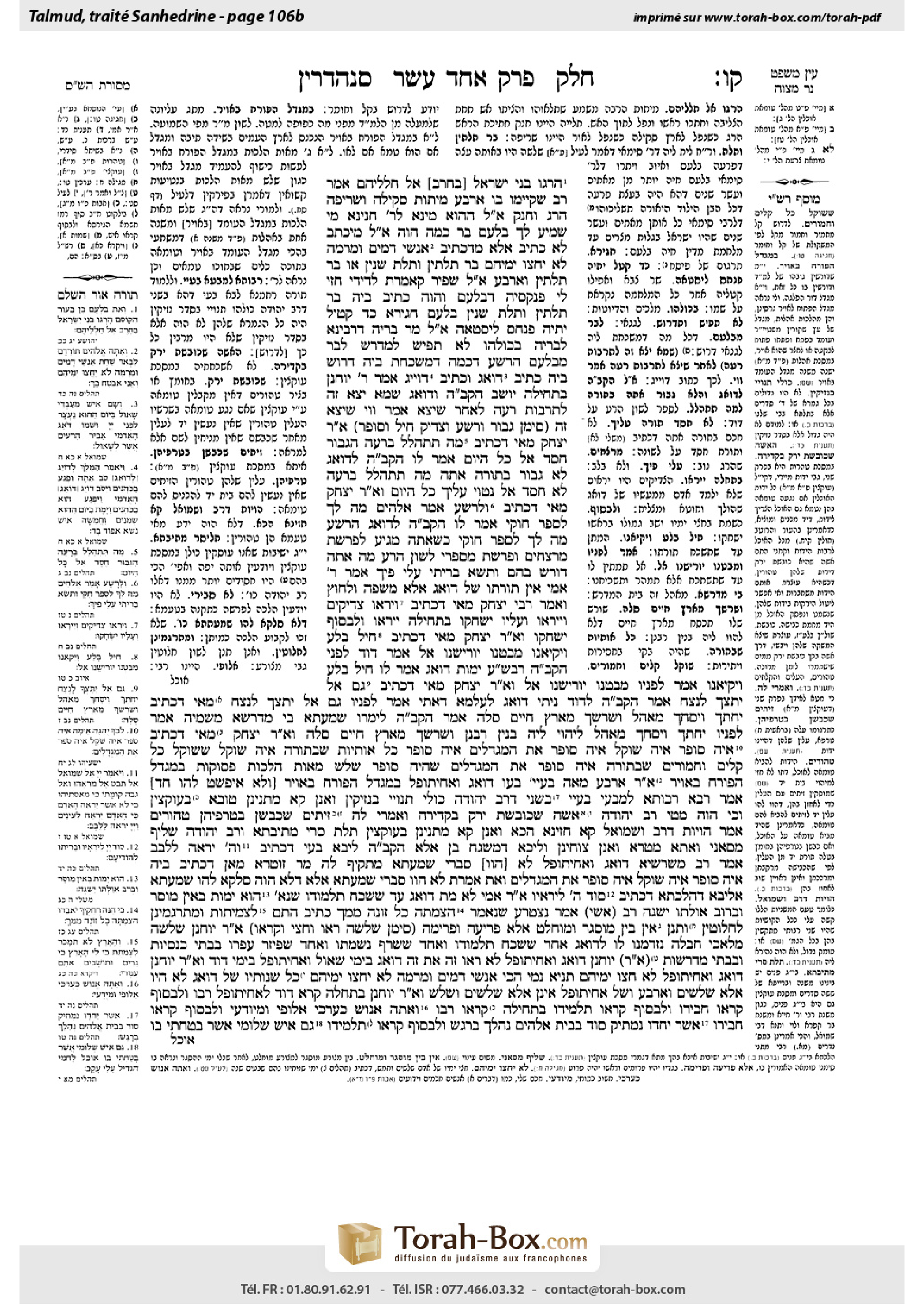
Sanhedrin 106b: Talmud study for Daf Yomi
Daf Yomi is the daily study of one Talmud folio. Explore 37 tractates with scans, Hebrew text, Sefaria English and AI-generated French translations where annotated.
Passage selection and English or AI-generated French translation are available where the scan has annotations. Daf Study is independent of Torah-Box and Sefaria.
Browse Sanhedrin · סנהדרין · All tractatesSanhedrin 106b text and translations
This page of Sanhedrin includes the Aramaic text, an English translation and an AI-generated French translation, alongside the scan above.
סנהדרין ק״ו ב · Aramaic and Hebrew text
״הָרְגוּ בְנֵי יִשְׂרָאֵל [בַּחֶרֶב] אֶל חַלְלֵיהֶם״, אָמַר רַב: שֶׁקִּיְּימוּ בּוֹ אַרְבַּע מִיתוֹת – סְקִילָה, וּשְׂרֵיפָה, הֶרֶג, וָחֶנֶק.
אֲמַר לֵיהּ הָהוּא מִינָא לְרַבִּי חֲנִינָא: מִי שְׁמִיעַ לָךְ בִּלְעָם בַּר כַּמָּה הֲוָה? אֲמַר לֵיהּ: מִיכְתָּב לָא כְּתִיב, אֶלָּא מִדִּכְתִיב ״אַנְשֵׁי דָמִים וּמִרְמָה לֹא יֶחֱצוּ יְמֵיהֶם״, בַּר תְּלָתִין וּתְלָת שְׁנִין אוֹ בַּר תְּלָתִין וְאַרְבַּע. אֲמַר לֵיהּ: שַׁפִּיר קָאָמְרַתְּ, לְדִידִי חֲזֵי לִי פִּנְקָסֵיהּ דְּבִלְעָם, וַהֲוָה כְּתִיב בֵּיהּ: בַּר תְּלָתִין וּתְלָת שְׁנִין בִּלְעָם חֲגִירָא כַּד קָטֵיל יָתֵיהּ פִּנְחָס לִיסְטָאָה.
אֲמַר לֵיהּ מָר בְּרֵיהּ דְּרָבִינָא לִבְרֵיהּ: בְּכוּלְּהוּ לָא תַּפֵּישׁ לְמִדְרַשׁ, לְבַר מִבִּלְעָם הָרָשָׁע, דְּכַמָּה דְּמַשְׁכַּחַתְּ בֵּיהּ דְּרוֹשׁ בֵּיהּ.
כְּתִיב ״דּוֹאֵג״, וּכְתִיב ״דּוֹיֵיג״. אָמַר רַבִּי יוֹחָנָן: בַּתְּחִילָּה יוֹשֵׁב הַקָּדוֹשׁ בָּרוּךְ הוּא וְדוֹאֵג, שֶׁמָּא יֵצֵא זֶה לְתַרְבּוּת רָעָה. לְאַחַר שֶׁיָּצָא, אָמַר: וַוי שֶׁיָּצָא זֶה!
(סִימָן: גִּבּוֹר, רָשָׁע, וְצַדִּיק, חַיִל, וְסוֹפֵר).
אָמַר רַבִּי יִצְחָק, מַאי דִּכְתִיב: ״מַה תִּתְהַלֵּל בְּרָעָה הַגִּבּוֹר חֶסֶד אֵל כׇּל הַיּוֹם״? אָמַר לוֹ הַקָּדוֹשׁ בָּרוּךְ הוּא לְדוֹאֵג: לֹא גִּבּוֹר בַּתּוֹרָה אַתָּה? מַה תִּתְהַלֵּל בְּרָעָה? לֹא חֶסֶד אֵל נָטוּי עָלֶיךָ כׇּל הַיּוֹם?
וְאָמַר רַבִּי יִצְחָק: מַאי דִּכְתִיב ״וְלָרָשָׁע אָמַר אֱלֹהִים מַה לְּךָ לְסַפֵּר חֻקָּי״? אָמַר לוֹ הַקָּדוֹשׁ בָּרוּךְ הוּא לְדוֹאֵג הָרָשָׁע: מַה לְּךָ לְסַפֵּר חֻקָּי? כְּשֶׁאַתָּה מַגִּיעַ לְפָרָשַׁת מְרַצְּחִים וּפָרָשַׁת מְסַפְּרֵי לָשׁוֹן הָרָע, מָה אַתָּה דּוֹרֵשׁ בָּהֶם? ״וַתִּשָּׂא בְרִיתִי עֲלֵי פִיךָ״. אָמַר רַבִּי אַמֵּי: אֵין תּוֹרָתוֹ שֶׁל דּוֹאֵג אֶלָּא מִשָּׂפָה וְלַחוּץ.
וְאָמַר רַבִּי יִצְחָק: מַאי דִּכְתִיב ״וְיִרְאוּ צַדִּיקִים וְיִירָאוּ וְעָלָיו יִשְׂחָקוּ״? בַּתְּחִילָּה יִירָאוּ, וּלְבַסּוֹף יִשְׂחָקוּ.
וְאָמַר רַבִּי יִצְחָק: מַאי דִּכְתִיב ״חַיִל בָּלַע וַיְקִאֶנּוּ מִבִּטְנוֹ יוֹרִישֶׁנּוּ אֵל״? אָמַר דָּוִד לִפְנֵי הַקָּדוֹשׁ בָּרוּךְ הוּא: רִבּוֹנוֹ שֶׁל עוֹלָם, יָמוּת דּוֹאֵג! אָמַר לוֹ: ״חַיִל בָּלַע וַיְקִיאֶנּוּ״. אָמַר לְפָנָיו: ״מִבִּטְנוֹ יוֹרִישֶׁנּוּ אֵל״!
וְאָמַר רַבִּי יִצְחָק: מַאי דִּכְתִיב ״גַּם אֵל יִתׇּצְךָ לָנֶצַח״? אָמַר הַקָּדוֹשׁ בָּרוּךְ הוּא לְדָוִד: נֵיתֵי דּוֹאֵג לְעָלְמָא דְּאָתֵי. אָמַר לְפָנָיו: ״גַּם אֵל יִתׇּצְךָ לָנֶצַח״. מַאי דִּכְתִיב ״יַחְתְּךָ וְיִסָּחֲךָ מֵאֹהֶל וְשֵׁרֶשְׁךָ מֵאֶרֶץ חַיִּים סֶלָה״? אָמַר הַקָּדוֹשׁ בָּרוּךְ הוּא: לֵימְרוּ שְׁמַעְתָּא בֵּי מִדְרְשָׁא מִשְּׁמֵיהּ. אָמַר לְפָנָיו: ״יַחְתְּךָ וְיִסָּחֲךָ מֵאֹהֶל״. לֶיהֱוֵי לֵיהּ בְּנִין רַבָּנַן: ״וְשֵׁרֶשְׁךָ מֵאֶרֶץ חַיִּים סֶלָה״.
וְאָמַר רַבִּי יִצְחָק, מַאי דִּכְתִיב: ״אַיֵּה סֹפֵר אַיֵּה שֹׁקֵל אַיֵּה סֹפֵר אֶת הַמִּגְדָּלִים״? ״אַיֵּה סֹפֵר״ – כׇּל אוֹתִיּוֹת שֶׁבַּתּוֹרָה, ״אַיֵּה שֹׁקֵל״ – שֶׁשּׁוֹקֵל כָּל קַלִּים וַחֲמוּרִים שֶׁבַּתּוֹרָה, ״אַיֵּה סֹפֵר אֶת הַמִּגְדָּלִים״ – שֶׁהָיָה סוֹפֵר שְׁלֹשׁ מֵאוֹת הֲלָכוֹת פְּסוּקוֹת בְּמִגְדָּל הַפּוֹרֵחַ בָּאֲוִיר.
אָמַר רַבִּי: אַרְבַּע מְאָה בַּעְיֵי בְּעוֹ דּוֹאֵג וַאֲחִיתוֹפֶל בְּמִגְדָּל הַפּוֹרֵחַ בָּאֲוִיר, (וְלָא אִיפְּשַׁט לְהוּ חַד). אָמַר רָבָא: רְבוּתָא לְמִבְעֵי בַּעְיֵי? בִּשְׁנֵי דְּרַב יְהוּדָה כּוּלֵּי תַּנּוֹיֵי בִּנְזִיקִין, וַאֲנַן קָא מַתְנֵינַן טוּבָא בְּעוּקְצִין!
וְכִי הֲוָה מָטֵי רַב יְהוּדָה ״אִשָּׁה שֶׁכּוֹבֶשֶׁת יָרָק בִּקְדֵירָה״, וְאָמְרִי לַהּ ״זֵיתִים שֶׁכְּבָשָׁן בְּטַרְפֵיהֶן טְהוֹרִים״, אָמַר: הֲוָיוֹת דְּרַב וּשְׁמוּאֵל קָא חָזֵינָא הָכָא, וַאֲנַן קָא מַתְנֵינַן בְּעוּקְצִין תְּלָת סְרֵי מְתִיבָתָא!
וְרַב יְהוּדָה שָׁלֵיף מְסָאנֵי וְאָתֵי מִטְרָא, וַאֲנַן צָוְחִינַן וְלֵיכָּא דְּמַשְׁגַּח בַּן. אֶלָּא הַקָּדוֹשׁ בָּרוּךְ הוּא לִיבָּא בָּעֵי, דִּכְתִיב: ״וַה׳ יִרְאֶה לַלֵּבָב״.
אָמַר רַב מְשַׁרְשְׁיָא: דּוֹאֵג וַאֲחִיתוֹפֶל לָא [הֲווֹ] סָבְרִי שְׁמַעְתָּא. מַתְקֵיף לַהּ מָר זוּטְרָא: מַאן דִּכְתִיב בֵּיהּ ״אַיֵּה סֹפֵר אַיֵּה שֹׁקֵל אַיֵּה סֹפֵר אֶת הַמִּגְדָּלִים״, וְאַתְּ אָמְרַתְּ לָא הֲווֹ סָבְרִי שְׁמַעְתָּא?! אֶלָּא דְּלָא הֲוָה סָלְקָא לְהוּ שְׁמַעְתָּא אַלִּיבָּא דְהִלְכְתָא, דִּכְתִיב: ״סוֹד ה׳ לִירֵאָיו״.
אָמַר רַבִּי אַמֵּי: לֹא מֵת דּוֹאֵג עַד שֶׁשָּׁכַח תַּלְמוּדוֹ, שֶׁנֶּאֱמַר: ״הוּא יָמוּת בְּאֵין מוּסָר וּבְרֹב אִוַּלְתּוֹ יִשְׁגֶּה״. רַב אָשֵׁי אָמַר: נִצְטָרַע, שֶׁנֶּאֱמַר: ״הִצְמַתָּה כׇּל זוֹנֶה מִמֶּךָּ״.
כְּתִיב הָתָם: ״לַצְּמִתֻת״, וּמְתַרְגְּמִינַן: ״לַחֲלוּטִין״. וּתְנַן: אֵין בֵּין מוּסְגָּר וּמוּחְלָט אֶלָּא פְּרִיעָה וּפְרִימָה.
(סִימָן: שְׁלֹשָׁה, רָאוּ, וְחָצוּ, וְקָרְאוּ)
אָמַר רַבִּי יוֹחָנָן: שְׁלֹשָׁה מַלְאֲכֵי חַבָּלָה נִזְדַּמְּנוּ לוֹ לְדוֹאֵג, אֶחָד שֶׁשִּׁכַּח תַּלְמוּדוֹ, וְאֶחָד שֶׁשָּׂרַף נִשְׁמָתוֹ, וְאֶחָד שֶׁפִּיזֵּר עֲפָרוֹ בְּבָתֵּי כְנֵסִיּוֹת וּבְבָתֵּי מִדְרָשׁוֹת.
אָמַר רַבִּי יוֹחָנָן: דּוֹאֵג וַאֲחִיתוֹפֶל לֹא רָאוּ זֶה אֶת זֶה. דּוֹאֵג בִּימֵי שָׁאוּל, וַאֲחִיתוֹפֶל בִּימֵי דָּוִד.
וְאָמַר רַבִּי יוֹחָנָן: דּוֹאֵג וַאֲחִיתוֹפֶל לֹא חָצוּ יְמֵיהֶם. תַּנְיָא נָמֵי הָכִי: ״אַנְשֵׁי דָמִים וּמִרְמָה לֹא יֶחֱצוּ יְמֵיהֶם״. כׇּל שְׁנוֹתָיו שֶׁל דּוֹאֵג לֹא הָיוּ אֶלָּא שְׁלֹשִׁים וְאַרְבַּע, וְשֶׁל אֲחִיתוֹפֶל אֵינָן אֶלָּא שְׁלֹשִׁים וְשָׁלֹשׁ.
וְאָמַר רַבִּי יוֹחָנָן: בַּתְּחִלָּה קָרָא דָּוִד לַאֲחִיתוֹפֶל רַבּוֹ, וּלְבַסּוֹף קְרָאוֹ חֲבֵירוֹ, וּלְבַסּוֹף קְרָאוֹ תַּלְמִידוֹ. בַּתְּחִלָּה קְרָאוֹ רַבּוֹ – ״וְאַתָּה אֱנוֹשׁ כְּעֶרְכִּי אַלּוּפִי וּמְיֻדָּעִי״. וּלְבַסּוֹף קְרָאוֹ חֲבֵרוֹ – ״אֲשֶׁר יַחְדָּו נַמְתִּיק סוֹד בְּבֵית אֱלֹהִים נְהַלֵּךְ בְּרָגֶשׁ״. וּלְבַסּוֹף קְרָאוֹ תַּלְמִידוֹ – ״גַּם אִישׁ שְׁלוֹמִי אֲשֶׁר בָּטַחְתִּי בוֹ
Sanhedrin 106b · English translation
With regard to the latter part of the verse: “And Balaam, son of Beor, the diviner, did the children of Israel slay with the sword among the rest of their slain” (Joshua 13:22), Rav says: It means that they accomplished in him all four means of court-imposed executions: Stoning, and burning, beheading, and strangulation.
A certain heretic said to Rabbi Ḥanina: Have you heard how old Balaam was when he died? Rabbi Ḥanina said to him: It is not written explicitly in the Torah. But from the fact that it is written: “Bloody and deceitful men shall not live half their days” (Psalms 55:24), this indicates that he was thirty-three or thirty-four years old, less than half the standard seventy-year lifespan. The heretic said to him: You have spoken well, I myself saw the notebook of Balaam and it was written therein: Balaam the lame was thirty-three years old when Pinehas the highwayman killed him.
Mar, son of Ravina, said to his son: With regard to all of those enumerated as not having a share in the World-to-Come, do not extensively interpret verses homiletically in order to denigrate them, except with regard to Balaam the wicked, as any negative element that you discover in his regard, continue to interpret homiletically concerning him, as it is appropriate to attribute wickedness to one so wicked.
§ It is written in one verse: “Doeg the Edomite” (I Samuel 22:9), and it is written in another verse: “And the king said to Doyeig” (I Samuel 22:18). Rabbi Yoḥanan says in explaining the discrepancy: Initially, the Holy One, Blessed be He, sat and was concerned [doeg] that perhaps this person would emerge to undertake an evil path. After he emerged on that path, God said: Alas [vai], that person has emerged to undertake an evil path.
The Gemara cites a mnemonic for the statements of Rabbi Yitzḥak that follow: Mighty, wicked, and righteous, riches, and counter.
Rabbi Yitzḥak says: What is the meaning of that which is written: “Why boast of your evil mighty one? The mercy of God endures continually” (Psalms 52:3)? The Holy One, Blessed be He, said to Doeg: Aren’t you mighty in Torah? Why do you boast of evil? Isn’t God’s mercy extended over you continually when you engage in His Torah?
And Rabbi Yitzḥak says: What is the meaning of that which is written: “But to the wicked, God says: What have you to do to declare My statutes, and that you have taken My covenant in your mouth” (Psalms 50:16)? The Holy One, Blessed be He, said to Doeg the wicked: Why do you speak of My statutes and My Torah? When you reach the Torah portion of murderers and the Torah portion of slanderers, how do you teach them? You have violated both. With regard to the end of that verse: “And that you have taken My covenant in your mouth” (Psalms 50:16), Rabbi Ami says: Doeg’s Torah is only insincere lip service, as it is in his mouth but not in his heart. He does not have a profound understanding of the Torah and does not commit himself to the performance of its mitzvot.
And Rabbi Yitzḥak says: What is the meaning of that which is written: “And the righteous shall see, and fear, and shall laugh at him” (Psalms 52:8)? Initially, they will fear Doeg due to his success, and ultimately they will laugh when they witness his downfall.
And Rabbi Yitzḥak says: What is the meaning of that which is written: “He has swallowed riches and he shall vomit them again; God shall cast them out of his belly” (Job 20:15)? David said before the Holy One, Blessed be He: Master of the Universe, Doeg shall die. God said to him: “He has swallowed riches and he shall vomit them again.” He is filled with Torah and wisdom; wait until he forgets what he has learned. David said before Him: “God shall cast them out of his belly.” God can remove his Torah knowledge from him before he will forget it on his own.
And Rabbi Yitzḥak says: What is the meaning of that which is written: “God shall likewise destroy you forever” (Psalms 52:7)? The Holy One, Blessed be He, said to David: Let Doeg enter the World-to-Come. David said before Him: “God shall likewise destroy you forever,” i.e., let Doeg not have eternal life. What is the meaning of that which is written: “He shall pluck you away, and pluck you from your tent, and root you out from the land of the living. Selah” (Psalms 52:7)? The Holy One, Blessed be He, said to David: At least let them state a halakha in the study hall in his name. David said before Him: “He shall pluck you away, and pluck you from your tent,” i.e., let him be completely removed from the tents of Torah. God said to him: Let him have sons who are Sages. David said: “And root you out from the land of the living. Selah,” i.e., let Doeg be entirely uprooted.
And Rabbi Yitzḥak says: What is the meaning of that which is written: “Where is he that counts; where is he that weighs; where is he that counts the towers [migdalim]” (Isaiah 33:18)? Where is he that counts all the letters of the Torah? Where is he that weighs, who considers all the elements of a fortiori inferences in the Torah? Where is he who counts the towers? This is Doeg, who would count three hundred halakhic conclusions with regard to the purity of a cupboard [migdal] that floats in the air [avir].
Rabbi Yehuda HaNasi says: Doeg and Ahithophel raised four hundred dilemmas with regard to the purity of a cupboard that floats in the air, and they did not resolve even one, an indication of their great knowledge. Rava says: Is it greatness to raise dilemmas? That is not a barometer of greatness, as in the years of Rav Yehuda all of their Torah study was confined to the order of Nezikin, and we study much more than that, and are expert even in tractate Okatzin, the final tractate in the difficult order of Teharot.
Moreover, when Rav Yehuda would encounter the mishna in tractate Okatzin that discusses the extent to which the stems of various fruits and vegetables are considered an integral part of the produce in terms of contracting ritual impurity, where the mishna discusses the halakha concerning a woman who pickles a vegetable in a pot, and some say when he would reach the mishna (Okatzin 2:1): Olives pickled with their leaves are pure, because after pickling, it is no longer possible to lift the fruit by its leaves, so they are no longer considered part of the fruit; he would find it difficult to understand. He would say: Those are the discussions between Rav and Shmuel that we see here. And we, by contrast, teach tractate Okatzin in thirteen academies.
But nevertheless, when Rav Yehuda would remove one of his shoes the rain would immediately fall, whereas we cry out and no one notices us. Rather, the Holy One, Blessed be He, seeks the heart, and the barometer of greatness is devotion of the heart and not the amount of Torah that one studies, as it is written: “But the Lord looks on the heart” (I Samuel 16:7).
Rav Mesharshiyya says: Doeg and Ahithophel did not comprehend halakhic discussions. Mar Zutra objects to this statement: These are people with regard to whom it is written: “Where is he that counts; where is he that weighs; where is he that counts the towers” (Isaiah 33:18), and you say that they did not comprehend halakhic discussions? Rather, Doeg and Ahithophel would not conclude halakhic discussions in accordance with halakhic rulings, as it is written: “The secret of the Lord is with those who fear Him” (Psalms 25:14). Since they did not fear God, they did not arrive at halakhic conclusions despite their keen intellect.
Rabbi Ami says: Doeg died only when he forgot what he learned, as it is stated: “He shall die for want of instruction, and in his folly he shall go astray” (Proverbs 5:23). Rav Ashi says: He was afflicted with leprosy before his death, as it is stated: “Those that go far from You shall perish; You destroy [hitzmatta] all those who go astray from You” (Psalms 73:27).
Where is the allusion to leprosy in this verse? It is written there: “And the land shall not be sold in perpetuity [litzmitut]” (Leviticus 25:23), and we translate it into Aramaic as: Laḥalutin. And we learned in a mishna with regard to lepers (Megilla 8b): The difference between a quarantined leper, i.e., one examined by a priest who found his symptoms to be inconclusive, and who must therefore remain in isolation for a period of up to two weeks to see if conclusive symptoms develop; and a confirmed [muḥlat] leper, i.e., one whose symptoms were conclusive and the priest declared him a confirmed leper, is only with regard to letting the hair on one’s head grow and rending one’s garments. The derivation is based on the etymological similarity between hitzmatta and litzmitut; the translation of litzmitut as laḥalutin, and the etymological similarity between laḥalutin and muḥlat.
The Gemara cites a mnemonic for the halakhot that follow: Three, saw, and half, and called him.
Rabbi Yoḥanan says: Three angels of destruction encountered Doeg: One who caused him to forget his Torah knowledge, one who burned his soul, and one who dispersed the ashes of his soul in synagogues and in study halls to be trampled beneath the feet of the righteous.
Rabbi Yoḥanan says: Doeg and Ahithophel did not see one another, as both died at a young age. Doeg lived in the days of Saul, and Ahithophel lived in the days of David, toward the end of David’s life.
And Rabbi Yoḥanan says: Doeg and Ahithophel did not reach half of their allotted days, as they died before the age of thirty-five, half of the standard lifetime mentioned in the verse: “The days of our years are seventy years” (Psalms 90:10). This is also taught in a baraita: “Bloody and deceitful men shall not live half their days” (Psalms 55:24); all the years of Doeg were only thirty-four, and the years of Ahithophel were only thirty-three.
And Rabbi Yoḥanan says: Initially, David called Ahithophel his teacher, and eventually, he called him his colleague, and ultimately, he called him his student. Initially, David called Ahithophel his teacher, as it is stated: “But it was you, a man my equal, my master [alufi], and my familiar friend” (Psalms 55:14); a teacher is known as aluf as he trains [me’alef ] his students. And eventually, he called him his colleague, as it is stated: “We took sweet counsel together, and walked to the house of God with the throng” (Psalms 55:15); the term together indicates that they were equals. And ultimately, he called him his student, as it is stated: “Even my own familiar friend, in whom I trusted,
Sanhedrin 106b · Traduction française (IA)
À propos de la seconde partie du verset : « Et les enfants d’Israël tuèrent par l’épée Balaam, fils de Beor, le devin, parmi les autres victimes » (Josué 13,22), Rav dit : cela signifie qu’ils lui infligèrent les quatre peines capitales prononcées par un tribunal : la lapidation, le feu, la décapitation et l’étranglement.
Un certain hérétique demanda à Rabbi Ḥanina : « As-tu entendu quel âge avait Balaam lorsqu’il mourut ? » Rabbi Ḥanina lui répondit : « La Torah ne le précise pas explicitement. Mais puisqu’il est écrit : “Les hommes sanguinaires et trompeurs n’atteindront pas la moitié de leurs jours” (Psaumes 55,24), cela indique qu’il avait trente-trois ou trente-quatre ans, soit moins de la moitié des soixante-dix ans que dure habituellement la vie. » L’hérétique lui dit : « Tu as bien parlé. Moi-même, j’ai vu le carnet de Balaam, où il était écrit : “Balaam le boiteux avait trente-trois ans lorsque Pineḥas le bandit de grand chemin le tua.” »
Mar, fils de Ravina, dit à son fils : « Au sujet de tous ceux qui sont énumérés comme n’ayant pas de part au Monde futur, ne t’étends pas dans des interprétations homilétiques des versets pour les dénigrer, sauf dans le cas de Balaam le méchant. Tout élément négatif que tu découvres à son sujet, continue de l’interpréter par la voie homilétique, car il convient d’attribuer la méchanceté à un homme aussi méchant. »
§ Dans un verset, il est écrit : « Doëg l’Édomite » (I Samuel 22,9), et dans un autre : « Et le roi dit à Doyeg » (I Samuel 22,18). Rabbi Yoḥanan explique cette divergence : au début, le Saint, béni soit-Il, était assis et s’inquiétait [doeg], craignant que cet homme ne s’engage dans une mauvaise voie. Après qu’il s’y fut engagé, Dieu dit : « Hélas [vai], cet homme s’est engagé dans une mauvaise voie. »
La Guemara cite un moyen mnémotechnique pour les enseignements de Rabbi Yitsḥak qui suivent : puissant, méchant, juste, richesses et compter.
Rabbi Yitsḥak dit : Quel est le sens de ce qui est écrit : « Pourquoi te glorifies-tu du mal, puissant ? La bonté de Dieu dure sans cesse » (Psaumes 52,3) ? Le Saint, béni soit-Il, dit à Doëg : « N’es-tu pas puissant dans la Torah ? Pourquoi te glorifies-tu du mal ? La bonté de Dieu ne s’étend-elle pas sans cesse sur toi lorsque tu t’adonnes à Sa Torah ? »
Et Rabbi Yitsḥak dit : Quel est le sens de ce qui est écrit : « Mais Dieu dit au méchant : De quel droit récites-tu Mes lois et portes-tu Mon alliance à ta bouche ? » (Psaumes 50,16) ? Le Saint, béni soit-Il, dit à Doëg le méchant : « Pourquoi parles-tu de Mes lois et de Ma Torah ? Lorsque tu arrives au passage de la Torah qui traite des meurtriers et à celui qui traite des calomniateurs, comment les enseignes-tu ? Tu as transgressé les deux. » À propos de la fin de ce verset : « Et portes-tu Mon alliance à ta bouche » (Psaumes 50,16), Rabbi Ami dit : la Torah de Doëg n’est qu’un service des lèvres insincère, car elle est dans sa bouche, mais non dans son cœur. Il ne comprend pas la Torah en profondeur et ne s’engage pas à accomplir ses mitsvot.
Et Rabbi Yitsḥak dit : Quel est le sens de ce qui est écrit : « Le juste le verra, il craindra, puis rira de lui » (Psaumes 52,8) ? D’abord, les justes craindront Doëg en raison de sa réussite ; finalement, ils riront en assistant à sa chute.
Et Rabbi Yitsḥak dit : Quel est le sens de ce qui est écrit : « Il a englouti des richesses, mais il les vomira ; Dieu les chassera de son ventre » (Job 20,15) ? David dit devant le Saint, béni soit-Il : « Maître de l’Univers, Doëg va mourir. » Dieu lui répondit : « Il a englouti des richesses, mais il les vomira. » Il est rempli de Torah et de sagesse ; attends qu’il oublie ce qu’il a appris. David dit devant Lui : « Dieu les chassera de son ventre. » Dieu peut lui retirer sa connaissance de la Torah avant qu’il ne l’oublie de lui-même.
Et Rabbi Yitsḥak dit : Quel est le sens de ce qui est écrit : « Dieu aussi te détruira à jamais » (Psaumes 52,7) ? Le Saint, béni soit-Il, dit à David : « Que Doëg entre dans le Monde futur. » David dit devant Lui : « Dieu aussi te détruira à jamais », c’est-à-dire : que Doëg ne jouisse pas de la vie éternelle. Quel est le sens de ce qui est écrit : « Il t’arrachera, il t’ôtera de ta tente et te déracinera du pays des vivants. Selah » (Psaumes 52,7) ? Le Saint, béni soit-Il, dit à David : « Qu’au moins on enseigne une halakha à son nom dans la maison d’étude. » David lui répondit : « Il t’arrachera, il t’ôtera de ta tente », c’est-à-dire : qu’il soit entièrement écarté des tentes de la Torah. Dieu lui dit : « Qu’il ait des fils qui soient des Sages. » David dit : « Et te déracinera du pays des vivants. Selah », c’est-à-dire : que Doëg soit entièrement déraciné.
Et Rabbi Yitsḥak dit : Quel est le sens de ce qui est écrit : « Où est celui qui compte ? Où est celui qui pèse ? Où est celui qui compte les tours [migdalim] ? » (Isaïe 33,18) Où est celui qui compte toutes les lettres de la Torah ? Où est celui qui pèse, c’est-à-dire qui examine tous les éléments des raisonnements a fortiori dans la Torah ? Où est celui qui compte les tours ? Il s’agit de Doëg, qui comptait trois cents conclusions halakhiques sur la pureté d’une armoire [migdal] flottant dans l’air [avir].
Rabbi Yehouda HaNassi dit : « Doëg et Ahitophel soulevèrent quatre cents difficultés au sujet de la pureté d’une armoire flottant dans l’air, sans en résoudre une seule », ce qui témoigne de l’étendue de leur savoir. Rava dit : « Est-ce une preuve de grandeur que de soulever des difficultés ? Ce n’est pas une mesure de la grandeur. À l’époque de Rav Yehouda, toute leur étude de la Torah se limitait à l’ordre Nezikin, alors que nous étudions bien davantage et maîtrisons même le traité Okatsin, le dernier traité de l’ordre difficile Taharot. »
De plus, lorsque Rav Yehouda rencontrait la Michna du traité Okatsin, qui traite de la mesure dans laquelle les tiges de divers fruits et légumes sont considérées comme faisant partie intégrante du produit pour ce qui est de contracter l’impureté rituelle, il avait du mal à la comprendre. La Michna traite de la halakha concernant une femme qui fait mariner un légume dans une marmite. Certains disent que c’était lorsqu’il arrivait à la Michna (Okatsin 2,1) : « Les olives marinées avec leurs feuilles sont pures », car, après le marinage, on ne peut plus soulever le fruit par ses feuilles, qui ne sont donc plus considérées comme faisant partie du fruit. Il disait : « Voilà les discussions entre Rav et Chmouel que nous voyons ici. » Nous, en revanche, enseignons le traité Okatsin dans treize académies.
Pourtant, lorsque Rav Yehouda retirait l’une de ses chaussures, la pluie se mettait aussitôt à tomber, tandis que nous, nous crions et personne ne nous remarque. En réalité, le Saint, béni soit-Il, sonde le cœur, et la grandeur se mesure au dévouement du cœur, non à la quantité de Torah que l’on étudie, comme il est écrit : « Mais l’Éternel regarde le cœur » (I Samuel 16,7).
Rav Mesharshiyya dit : « Doëg et Ahitophel ne comprenaient pas les discussions halakhiques. » Mar Zutra objecte : « Ce sont des hommes au sujet desquels il est écrit : “Où est celui qui compte ? Où est celui qui pèse ? Où est celui qui compte les tours ?” (Isaïe 33,18), et tu dis qu’ils ne comprenaient pas les discussions halakhiques ? » En réalité, Doëg et Ahitophel ne parvenaient pas à conclure les discussions halakhiques conformément aux décisions de halakha, comme il est écrit : « Le secret de l’Éternel est pour ceux qui Le craignent » (Psaumes 25,14). Puisqu’ils ne craignaient pas Dieu, ils n’arrivaient pas à des conclusions halakhiques malgré leur intelligence pénétrante.
Rabbi Ami dit : Doëg ne mourut qu’après avoir oublié ce qu’il avait appris, comme il est dit : « Il mourra faute d’instruction, et dans sa folie il s’égarera » (Proverbes 5,23). Rav Ashi dit : il fut atteint de lèpre avant sa mort, comme il est dit : « Ceux qui s’éloignent de Toi périront ; Tu détruis [hitzmatta] tous ceux qui se détournent de Toi » (Psaumes 73,27).
Où trouve-t-on dans ce verset une allusion à la lèpre ? Il est écrit ailleurs : « Le pays ne sera pas vendu à perpétuité [litzmitut] » (Lévitique 25,23), et nous traduisons cette expression en araméen par « laḥalutin ». Nous avons aussi appris dans une Michna au sujet des lépreux (Meguila 8b) : « La seule différence entre un lépreux placé en quarantaine — c’est-à-dire examiné par un prêtre qui juge ses symptômes équivoques et doit donc rester isolé jusqu’à deux semaines pour voir si des symptômes concluants apparaissent — et un lépreux confirmé [muḥlat] — c’est-à-dire un homme dont les symptômes étaient concluants et que le prêtre a déclaré lépreux confirmé — concerne le fait de laisser pousser les cheveux et de déchirer ses vêtements. » La déduction repose sur la similitude étymologique entre hitzmatta et litzmitut, sur la traduction de litzmitut par laḥalutin, ainsi que sur la similitude étymologique entre laḥalutin et muḥlat.
La Guemara cite un moyen mnémotechnique pour les halakhot qui suivent : trois, vit, moitié, et l’appela.
Rabbi Yoḥanan dit : Trois anges de destruction rencontrèrent Doëg : l’un lui fit oublier ses connaissances de la Torah, un autre brûla son âme, et un troisième dispersa les cendres de son âme dans les synagogues et les maisons d’étude, afin qu’elles soient piétinées par les pieds des justes.
Rabbi Yoḥanan dit : Doëg et Ahitophel ne se virent pas, car tous deux moururent jeunes. Doëg vécut à l’époque de Saül, et Ahitophel à l’époque de David, vers la fin de la vie de David.
Et Rabbi Yoḥanan dit : Doëg et Ahitophel n’atteignirent pas la moitié de la durée de vie qui leur était impartie, car ils moururent avant l’âge de trente-cinq ans, soit la moitié de la durée de vie habituelle mentionnée dans le verset : « La durée de nos jours est de soixante-dix ans » (Psaumes 90,10). C’est également ce qui est enseigné dans une baraïta : « Les hommes sanguinaires et trompeurs n’atteindront pas la moitié de leurs jours » (Psaumes 55,24) ; Doëg vécut seulement trente-quatre ans, et Ahitophel seulement trente-trois ans.
Et Rabbi Yoḥanan dit : Au début, David appelait Ahitophel son maître, ensuite son collègue, et finalement son élève. David l’appelait d’abord son maître, comme il est écrit : « Mais c’était toi, un homme égal à moi, mon maître [alufi], mon ami intime » (Psaumes 55,14) ; un maître est appelé aluf parce qu’il forme [me’alef] ses élèves. Ensuite, il l’appelait son collègue, comme il est écrit : « Nous échangions de doux conseils et marchions ensemble vers la maison de Dieu au milieu de la foule » (Psaumes 55,15) ; le terme « ensemble » indique qu’ils étaient égaux. Enfin, il l’appelait son élève, comme il est écrit : « Même mon ami intime, en qui j’avais confiance, »
Traduction française générée par IA à partir de l’édition anglaise de Sefaria. Vérifie toujours un passage avec le texte source.
Text from Sefaria: William Davidson Edition - Vocalized Aramaic (CC BY NC); William Davidson Edition - English (CC BY NC).