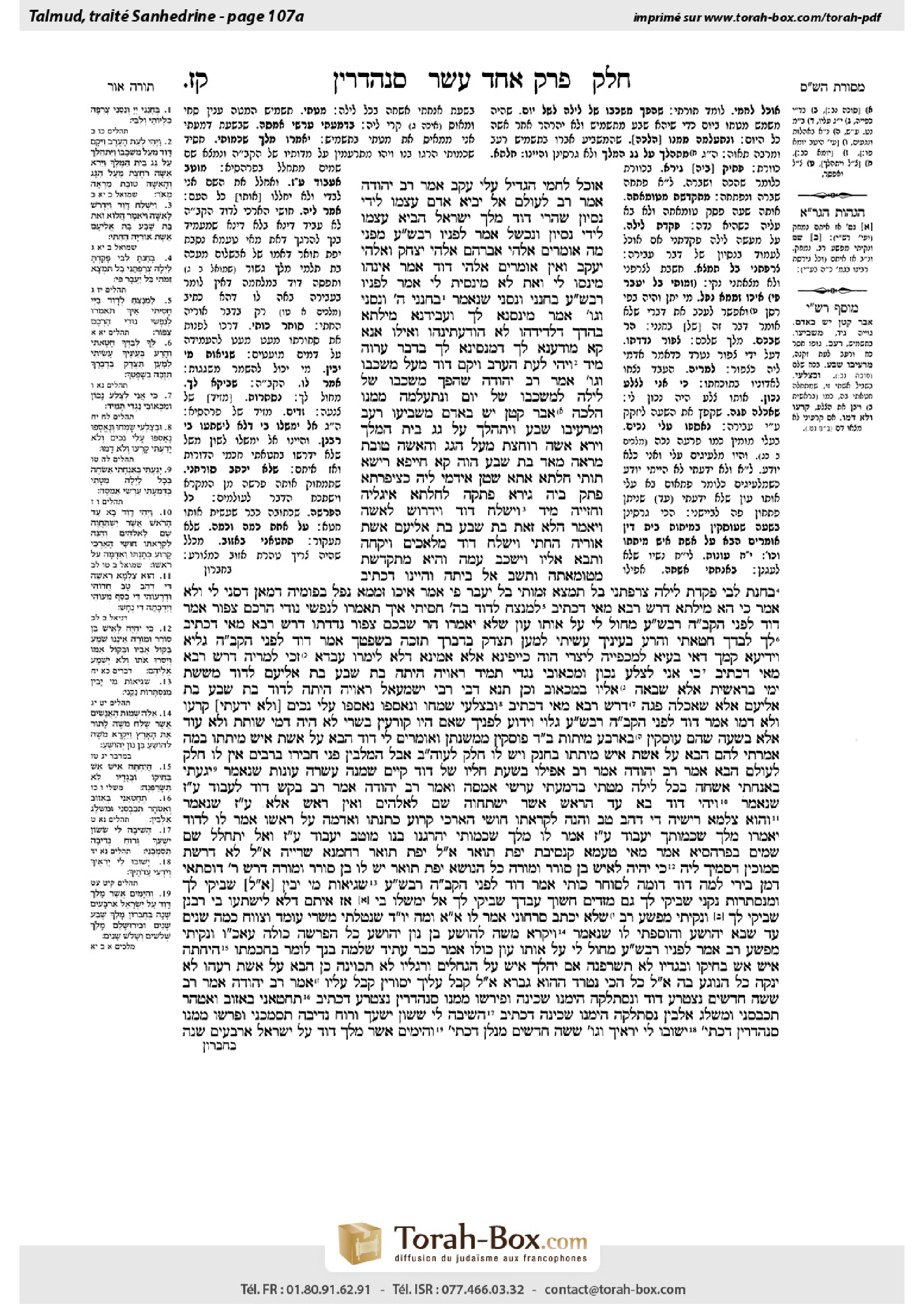
Sanhedrin 107a: Talmud study for Daf Yomi
Daf Yomi is the daily study of one Talmud folio. Explore 37 tractates with scans, Hebrew text, Sefaria English and AI-generated French translations where annotated.
Passage selection and English or AI-generated French translation are available where the scan has annotations. Daf Study is independent of Torah-Box and Sefaria.
Browse Sanhedrin · סנהדרין · All tractatesSanhedrin 107a text and translations
This page of Sanhedrin includes the Aramaic text, an English translation and an AI-generated French translation, alongside the scan above.
סנהדרין ק״ז א · Aramaic and Hebrew text
אוֹכֵל לַחְמִי הִגְדִּיל עָלַי עָקֵב״.
אָמַר רַב יְהוּדָה אָמַר רַב: לְעוֹלָם אַל יָבִיא אָדָם עַצְמוֹ לִידֵי נִסָּיוֹן, שֶׁהֲרֵי דָּוִד מֶלֶךְ יִשְׂרָאֵל הֵבִיא עַצְמוֹ לִידֵי נִסָּיוֹן וְנִכְשָׁל. אָמַר לְפָנָיו: רִבּוֹנוֹ שֶׁל עוֹלָם, מִפְּנֵי מָה אוֹמְרִים ״אֱלֹהֵי אַבְרָהָם, אֱלֹהֵי יִצְחָק וֵאלֹהֵי יַעֲקֹב״, וְאֵין אוֹמְרִים ״אֱלֹהֵי דָוִד״? אָמַר: אִינְהוּ מִינְּסוּ לִי וְאַתְּ לָא מִינַּסֵּית לִי. אָמַר לְפָנָיו: רִבּוֹנוֹ שֶׁל עוֹלָם, בְּחָנֵנִי וְנַסֵּנִי, שֶׁנֶּאֱמַר: ״בְּחָנֵנִי ה׳ וְנַסֵּנִי וְגוֹ׳״.
אֲמַר: מְינַסֵּינָא לָךְ, וְעָבֵידְנָא מִילְּתָא בַּהֲדָךְ, דִּלְדִידְהוּ לָא הוֹדַעְתִּינְהוּ, וְאִילּוּ אֲנָא קָא מוֹדַעְנָא לָךְ דִּמְנַסֵּינָא לָךְ בִּדְבַר עֶרְוָה. מִיָּד, ״וַיְהִי לְעֵת הָעֶרֶב וַיָּקׇם דָּוִד מֵעַל מִשְׁכָּבוֹ וְגוֹ׳״.
אָמַר רַב יְהוּדָה: שֶׁהָפַךְ מִשְׁכָּבוֹ שֶׁל לַיְלָה לְמִשְׁכָּבוֹ שֶׁל יוֹם, וְנִתְעַלְּמָה מִמֶּנּוּ הֲלָכָה. אֵבֶר קָטָן יֵשׁ בָּאָדָם, מַשְׂבִּיעוֹ – רָעֵב, וּמַרְעִיבוֹ – שָׂבֵעַ.
״וַיִּתְהַלֵּךְ עַל גַּג בֵּית הַמֶּלֶךְ וַיַּרְא אִשָּׁה רוֹחֶצֶת מֵעַל הַגָּג וְהָאִשָּׁה טוֹבַת מַרְאֶה מְאֹד״. בַּת שֶׁבַע הֲוָה קָא חָיְיפָא רֵישָׁא תּוּתֵי חַלְּתָא. אֲתָא שָׂטָן, אִידְּמִי לֵיהּ כְּצִיפַּרְתָּא. פְּתַק בֵּיהּ גִּירָא, פַּתְקַהּ לְחַלְּתָא, אִיגַּלַּיה וְחַזְיַיהּ.
מִיָּד: ״וַיִּשְׁלַח דָּוִד וַיִּדְרֹשׁ לָאִשָּׁה וַיֹּאמֶר הֲלוֹא זֹאת בַּת שֶׁבַע בַּת אֱלִיעָם אֵשֶׁת אוּרִיָּה הַחִתִּי. וַיִּשְׁלַח דָּוִד מַלְאָכִים וַיִּקָּחֶהָ וַתָּבוֹא אֵלָיו וַיִּשְׁכַּב עִמָּהּ וְהִיא מִתְקַדֶּשֶׁת מִטֻּמְאָתָהּ וַתָּשׇׁב אֶל בֵּיתָהּ״. וְהַיְינוּ דִּכְתִיב: ״בָּחַנְתָּ לִבִּי פָּקַדְתָּ לַּיְלָה צְרַפְתַּנִי בַל תִּמְצָא זַמֹּתִי בַּל יַעֲבׇר פִּי״. אָמַר: אִיכּוֹ זְמָמָא נְפַל בְּפוּמֵּיהּ דְּמַאן דְּסָנֵי לִי, וְלָא אֲמַר כִּי הָא מִילְּתָא!
דָּרֵשׁ רָבָא: מַאי דִּכְתִיב ״לַמְנַצֵּחַ לְדָוִד בַּה׳ חָסִיתִי אֵיךְ תֹּאמְרוּ לְנַפְשִׁי נוּדִי הַרְכֶם צִפֹּר״? אָמַר דָּוִד לִפְנֵי הַקָּדוֹשׁ בָּרוּךְ הוּא: רִבּוֹנוֹ שֶׁל עוֹלָם, מְחוֹל לִי עַל אוֹתוֹ עָוֹן שֶׁלֹּא יֹאמְרוּ ״הַר שֶׁבָּכֶם צִפּוֹר נִדְּדַתּוּ״.
דָּרֵשׁ רָבָא, מַאי דִּכְתִיב: ״לְךָ לְבַדְּךָ חָטָאתִי וְהָרַע בְּעֵינֶיךָ עָשִׂיתִי לְמַעַן תִּצְדַּק בְּדׇבְרֶךָ תִּזְכֶּה בְשׇׁפְטֶךָ״? אָמַר דָּוִד לִפְנֵי הַקָּדוֹשׁ בָּרוּךְ הוּא: גַּלְיָא וִידִיעָא קַמָּךְ, דְּאִי בְּעַאי לְמִכְפְּיֵיהּ לְיִצְרַי הֲוָה כָּיֵיפְינָא, אֶלָּא אָמֵינָא דְּלָא לֵימְרוּ ״עַבְדָּא זַכְיֵהּ לְמָרֵיהּ״.
דָּרֵשׁ רָבָא: מַאי דִּכְתִיב ״כִּי אֲנִי לְצֶלַע נָכוֹן וּמַכְאוֹבִי נֶגְדִּי תָמִיד״? רְאוּיָה הָיְתָה בַּת שֶׁבַע בַּת אֱלִיעָם לְדָוִד מִשֵּׁשֶׁת יְמֵי בְּרֵאשִׁית, אֶלָּא שֶׁבָּאת עָלָיו בְּמַכְאוֹב. וְכֵן תָּנָא דְּבֵי רַבִּי יִשְׁמָעֵאל: רְאוּיָה הָיְתָה לְדָוִד בַּת שֶׁבַע בַּת אֱלִיעָם, אֶלָּא שֶׁאֲכָלָהּ פַּגָּה.
דָּרֵשׁ רָבָא: מַאי דִּכְתִיב, ״וּבְצַלְעִי שָׂמְחוּ וְנֶאֱסָפוּ נֶאֶסְפוּ עָלַי נֵכִים [וְלֹא יָדַעְתִּי] קָרְעוּ וְלֹא דָמּוּ״? אָמַר דָּוִד לִפְנֵי הַקָּדוֹשׁ בָּרוּךְ הוּא: רִבּוֹנוֹ שֶׁל עוֹלָם, גָּלוּי וְיָדוּעַ לְפָנֶיךָ שֶׁאִם הָיוּ קוֹרְעִין בְּשָׂרִי לֹא הָיָה דָּמִי שׁוֹתֵת.
וְלֹא עוֹד, אֶלָּא בְּשָׁעָה שֶׁהֵם עוֹסְקִין בְּאַרְבַּע מִיתוֹת בֵּית דִּין, פּוֹסְקִין מִמִּשְׁנָתָן וְאוֹמְרִים לִי: דָּוִד, הַבָּא עַל אֵשֶׁת אִישׁ מִיתָתוֹ בַּמֶּה? אָמַרְתִּי לָהֶם: הַבָּא עַל אֵשֶׁת אִישׁ מִיתָתוֹ בְּחֶנֶק, וְיֵשׁ לוֹ חֵלֶק לָעוֹלָם הַבָּא. אֲבָל הַמַּלְבִּין פְּנֵי חֲבֵירוֹ בָּרַבִּים אֵין לוֹ חֵלֶק לָעוֹלָם הַבָּא.
אָמַר רַב יְהוּדָה אָמַר רַב: אֲפִילּוּ בִּשְׁעַת חׇלְיוֹ שֶׁל דָּוִד קִיֵּים שְׁמֹנֶה עֶשְׂרֵה עוֹנוֹת, שֶׁנֶּאֱמַר: ״יָגַעְתִּי בְּאַנְחָתִי אַשְׂחֶה בְכׇל לַיְלָה מִטָּתִי בְּדִמְעָתִי עַרְשִׂי אַמְסֶה״. וְאָמַר רַב יְהוּדָה אָמַר רַב: בִּקֵּשׁ דָּוִד לַעֲבוֹד עֲבוֹדָה זָרָה, שֶׁנֶּאֱמַר: ״וַיְהִי דָּוִד בָּא עַד הָרֹאשׁ אֲשֶׁר יִשְׁתַּחֲוֶה שָׁם לֵאלֹהִים״, וְאֵין ״רֹאשׁ״ אֶלָּא עֲבוֹדָה זָרָה, שֶׁנֶּאֱמַר: ״וְהוּא צַלְמָא רֵישֵׁיהּ דִּי דְהַב טָב״.
״וְהִנֵּה לִקְרָאתוֹ חוּשַׁי הָאַרְכִּי קָרוּעַ כֻּתׇּנְתּוֹ וַאֲדָמָה עַל רֹאשׁוֹ״. אָמַר לוֹ לְדָוִד: יֹאמְרוּ מֶלֶךְ שֶׁכְּמוֹתְךָ יַעֲבוֹד עֲבוֹדָה זָרָה? אָמַר לוֹ: מֶלֶךְ שֶׁכְּמוֹתִי יַהַרְגֶנּוּ בְּנוֹ? מוּטָב יַעֲבוֹד עֲבוֹדָה זָרָה וְאַל יִתְחַלֵּל שֵׁם שָׁמַיִם בְּפַרְהֶסְיָא.
אָמַר: מַאי טַעְמָא קָנְסִיבַתְּ יְפַת תּוֹאַר? אֲמַר לֵיהּ: יְפַת תּוֹאַר רַחֲמָנָא שַׁרְיַיהּ. אֲמַר לֵיהּ: לָא דָּרְשַׁתְּ סְמוּכִין, דִּסְמִיךְ לֵיהּ ״כִּי יִהְיֶה לְאִישׁ בֵּן סוֹרֵר וּמוֹרֶה״? כׇּל הַנּוֹשֵׂא יְפַת תּוֹאַר יֵשׁ לוֹ בֵּן סוֹרֵר וּמוֹרֶה.
דָּרֵשׁ רַבִּי דּוֹסְתַּאי דְּמִן בֵּירֵי: לְמָה דָּוִד דּוֹמֶה? לְסוֹחֵר כּוּתִי. אָמַר דָּוִד לִפְנֵי הַקָּדוֹשׁ בָּרוּךְ הוּא: רִבּוֹנוֹ שֶׁל עוֹלָם, ״שְׁגִיאוֹת מִי יָבִין״! [אֲמַר לֵיהּ:] שְׁבִיקִי לָךְ. ״וּמִנִּסְתָּרוֹת נַקֵּנִי״! שְׁבִיקִי לָךְ. ״גַּם מִזֵּדִים חֲשֹׂךְ עַבְדֶּךָ״! שְׁבִיקִי לָךְ. ״אַל יִמְשְׁלוּ בִי אָז אֵיתָם״, דְּלָא לִישְׁתַּעוֹ בִּי רַבָּנַן. שְׁבִיקִי לָךְ.
״וְנִקֵּיתִי מִפֶּשַׁע רָב״, שֶׁלֹּא יִכָּתֵב סִרְחוֹנִי. אָמַר לוֹ: אִי אֶפְשָׁר. וּמָה יוֹד שֶׁנָּטַלְתִּי מִשָּׂרַי עוֹמֵד וְצוֹוֵחַ כַּמָּה שָׁנִים, עַד שֶׁבָּא יְהוֹשֻׁעַ וְהוֹסַפְתִּי לוֹ, שֶׁנֶּאֱמַר: ״וַיִּקְרָא מֹשֶׁה לְהוֹשֵׁעַ בִּן נוּן יְהוֹשֻׁעַ״. כׇּל הַפָּרָשָׁה כּוּלָּהּ – עַל אַחַת כַּמָּה וְכַמָּה!
״וְנִקֵּיתִי מִפֶּשַׁע רָב״. אָמַר לְפָנָיו: רִבּוֹנוֹ שֶׁל עוֹלָם, מְחוֹל לִי עַל אוֹתוֹ עָוֹן כּוּלּוֹ! אָמַר, כְּבָר עָתִיד שְׁלֹמֹה בִּנְךָ לוֹמַר בְּחׇכְמָתוֹ: ״הֲיַחְתֶּה אִישׁ אֵשׁ בְּחֵיקוֹ וּבְגָדָיו לֹא תִשָּׂרַפְנָה. אִם יְהַלֵּךְ אִישׁ עַל הַגֶּחָלִים וְרַגְלָיו לֹא תִכָּוֶינָה. כֵּן הַבָּא עַל אֵשֶׁת רֵעֵהוּ לֹא יִנָּקֶה כׇּל הַנֹּגֵעַ בָּהּ״. אָמַר לֵיהּ: כֹּל הָכִי נִטְרַד הָהוּא גַּבְרָא? אָמַר לוֹ: קַבֵּל עָלֶיךָ יִסּוּרִין. קִבֵּל עָלָיו.
אָמַר רַב יְהוּדָה אָמַר רַב: שִׁשָּׁה חֳדָשִׁים נִצְטָרַע דָּוִד, וְנִסְתַּלְּקָה הֵימֶנּוּ שְׁכִינָה, וּפֵירְשׁוּ מִמֶּנּוּ סַנְהֶדְרִין. נִצְטָרַע – דִּכְתִיב: ״תְּחַטְּאֵנִי בְאֵזוֹב וְאֶטְהָר תְּכַבְּסֵנִי וּמִשֶּׁלֶג אַלְבִּין״. נִסְתַּלְּקָה הֵימֶנּוּ שְׁכִינָה – דִּכְתִיב: ״הָשִׁיבָה לִּי שְׂשׂוֹן יִשְׁעֶךָ וְרוּחַ נְדִיבָה תִסְמְכֵנִי״. וּפֵרְשׁוּ מִמֶּנּוּ סַנְהֶדְרִין – דִּכְתִיב: ״יָשׁוּבוּ לִי יְרֵאֶיךָ וְגוֹ׳״. שִׁשָּׁה חֳדָשִׁים מְנָלַן? דִּכְתִיב: ״וְהַיָּמִים אֲשֶׁר מָלַךְ דָּוִד עַל יִשְׂרָאֵל אַרְבָּעִים שָׁנָה״.
Sanhedrin 107a · English translation
who did eat of my bread, has lifted his heel against me” (Psalms 41:10). Bread is a metaphor for Torah knowledge.
§ Apropos Ahithophel, the Gemara relates the events that led to his death. Rav Yehuda says that Rav says: A person should never bring himself to undergo an ordeal, as David, king of Israel, brought himself to undergo an ordeal and failed. David said before God: Master of the Universe, for what reason does one say in prayer: God of Abraham, God of Isaac, and God of Jacob, and one does not say: God of David? God said to David: They have undergone ordeals before Me, and you have not undergone an ordeal before Me. David said before Him: Examine me and subject me to an ordeal, as it is stated: “Examine me, Lord, and subject me to an ordeal; try my kidneys and my heart” (Psalms 26:2).
God said to him: I will subject you to an ordeal, and I will perform a matter for you that I did not perform for the Patriarchs, as for them, I did not inform them of the nature of the ordeal, while I am informing you that I will subject you to an ordeal involving a matter of a married woman, with whom relations are forbidden. Immediately, it is written: “And it came to pass one evening that David rose from his bed” (II Samuel 11:2).
Rav Yehuda says: Once David heard the nature of his ordeal, he sought to prevent himself from experiencing lust. He transformed his nighttime bed into his daytime bed, i.e., he engaged in intercourse with his wives during the day, in an attempt to quell his lust. But a halakha, i.e., a Torah statement, escaped him: There is a small limb in man that he employs in sexual intercourse. If he starves the limb, and does not overindulge, it is satiated; but if he satiates the limb and overindulges in sexual intercourse, it is starving, and desires more. Therefore, his plan had the opposite effect.
The verse states: “And he walked upon the roof of the king’s house; from the roof he saw a woman bathing, and the woman was very fair to look upon” (II Samuel 11:2). Bathsheba was shampooing her head behind a beehive, which concealed her from sight. Satan came and appeared to David as a bird. David shot an arrow at the bird, the arrow severed the beehive, Bathsheba was exposed, and David saw her.
Immediately, it is written: “And David sent and inquired after the woman. And one said: Is not this Bathsheba, daughter of Eliam, the wife of Uriah the Hittite? And David sent messengers, and took her, and she came to him, and he lay with her, for she was purified from her impurity, and then she returned to her house” (II Samuel 11:3–4). And that is the meaning of that which is written: “You have proved my heart; You have visited me in the night: You have tried me, but You find nothing; let no presumptuous thought pass my lips” (Psalms 17:3). David said: Oh, that a muzzle would have fallen upon the mouth of the one who hates me, a euphemism for his own mouth, and I would not have said anything like that and I would have withstood the ordeal.
Rava taught: What is the meaning of that which is written: “To the leader, of David. In the Lord I put my trust; how can you say to my soul: Flee like a bird to your mountain” (Psalms 11:1)? David said before the Holy One, Blessed be He: Master of the Universe, pardon me for that sin with Bathsheba so that the wicked people will not say: The mountain that is among you, i.e., the luminary of the generation, David, was driven from the world due to a bird that led to his transgression.
Rava taught: What is the meaning of that which is written: “Against You, only You, have I sinned, and done what is evil in Your eyes; that You are justified when You speak, and right when You judge” (Psalms 51:6)? David said before the Holy One, Blessed be He: It is revealed and known before You that if I sought to suppress my evil inclination, I would have suppressed it; but I said: I will sin, so that they will not say a servant overcame his master and withstood the ordeal even though God said that he would not.
Rava taught: What is the meaning of that which is written: “For I am ready to stumble [letzela] and my pain is always before me” (Psalms 38:18)? Bathsheba, daughter of Eliam, was designated as fit for David from the six days of Creation. Rava interprets that the term letzela is referring to Eve, who was taken from the side [tzela] of Adam, the first man, and explains that she was destined for him, just as Eve was destined for Adam. But she came to him through pain. And likewise, the school of Rabbi Yishmael taught: Bathsheba, daughter of Eliam, was designated as fit for David, but he partook of her unripe, before the appointed time. David would have ultimately married her in a permitted manner after the death of Uriah.
Rava taught: What is the meaning of that which is written: “And when I limped they rejoiced and gathered, the wretched gather themselves together against me, and those whom I know not; they tore and did not cease [dammu]” (Psalms 35:15)? David said before the Holy One, Blessed be He: Master of the Universe. It is revealed and known before you that if my enemies were to tear my flesh, my blood [dami] would not flow to the ground, due to excessive fasting (see II Samuel 12:16–17).
David continued: Moreover, my enemies torment me to the extent that at the time when they are engaged in the public study of the halakhot of the four court-imposed death penalties they interrupt their study and say to me: David, concerning one who engages in intercourse with a married woman, his death is effected with what form of execution? And I said to them: Concerning one who engages in intercourse with a married woman before witnesses and with forewarning, his death is by strangulation, and he has a share in the World-to-Come. But one who humiliates another before the multitudes has no share in the World-to-Come. The transgression of those who humiliated David is clearly more severe than the transgression of David himself.
Rav Yehuda says that Rav says: Even during the time of his illness he fulfilled the mitzva of conjugal rights for eighteen wives, as it is stated: “I am weary with my groaning; every night I speak in my bed; I melt away my couch with tears” (Psalms 6:7). Even when he was weary and groaning he still spoke in his bed, a euphemism for sexual intercourse. And Rav Yehuda says that Rav says: David sought to engage in idol worship during Absalom’s coup, as it is stated: “And it came to pass when David was at the top [rosh] of the ascent, where he would bow to God” (II Samuel 15:32), and rosh means nothing other than idol worship, as it is stated: “As for that image, its head [reishei] was of fine gold” (Daniel 2:32).
It is written: “Behold Hushai the Archite came to meet him with his coat rent and earth upon his head” (II Samuel 15:32). Hushai said to David: Shall they say a king like you will engage in idol worship? David said to him: Is it preferable that they say with regard to a king like me, known to be righteous, that his son will kill him? David continued, referring to himself in third person: It is preferable that he shall engage in idol worship and the name of Heaven shall not be desecrated in public through the murder of a righteous king in this manner.
Hushai said to him: What is the reason that you married a beautiful woman, the mother of Absalom? David said to him: With regard to a beautiful woman, the Merciful One permitted marrying her. Hushai said to him: But you did not interpret the juxtaposed verses, as juxtaposed to the portion of the beautiful woman is the portion beginning: “If a man has a stubborn and rebellious son” (Deuteronomy 21:18). From that juxtaposition it is derived: Anyone who marries a beautiful woman has a stubborn and rebellious son. Therefore, even if Absalom kills you, there will be no desecration of God’s name, as the people will attribute his actions to his mother.
Rabbi Dostai from Biri taught: To what is David comparable? He is comparable to a Samaritan merchant, who incrementally lowers the price until the buyer agrees to purchase the merchandise. David said before the Holy One, Blessed be He: Master of the Universe: “Who can discern his errors” (Psalms 19:13), i.e., forgive me for the unwitting sins that I committed. God said to him: They are forgiven for you. David asked more: “Cleanse me from hidden faults” (Psalms 19:13), i.e., pardon me for transgressions that I committed in private, even if I performed them intentionally. God said to him: They are forgiven for you. David requested: “Keep back your servant also from intentional sins” (Psalms 19:14). God said to him: They are forgiven for you. David requested: “Let them not have dominion over me, then I shall be faultless” (Psalms 19:14), and I further request that the Sages will not speak of me and condemn me. God said to him: They are forgiven for you.
David requested: “And I shall be clear from great transgression” (Psalms 19:14), meaning that my transgression with Bathsheba and Uriah will not be written in the Bible. God said to him: That is impossible. And just as the letter yod that I removed from the name of Sarai, wife of Abraham, when I changed her name to Sarah, was standing and screaming several years over its omission from the Bible until Joshua came and I added the yod to his name, as it is stated: “And Moses called Hosea, son of Nun, Joshua [Yehoshua]” (Numbers 13:16); the entire portion of your transgression, which is fit to be included in the Bible, all the more so it cannot be omitted.
The verse states: “And I shall be clear from great transgression” (Psalms 19:14). David said before God: Master of the Universe, pardon me for that entire sin. God said to him: Your son Solomon is already destined to say with his wisdom: “Can a man take fire in his lap and his garments not be burned? Can one walk on hot coals and his feet not be scorched? So too one who lies with his neighbor’s wife; anyone who touches her shall not go unpunished” (Proverbs 6:27–29). David said to Him: Will that man, David, be expelled for that entire transgression, with no remedy? God said to David: Accept upon yourself afflictions, and that will atone for your sins. He accepted afflictions upon himself.
Rav Yehuda says that Rav says: For six months David was afflicted with leprosy and the Divine Presence abandoned him and the members of the Sanhedrin dissociated themselves from him. He was afflicted with leprosy, as it is stated: “Purge me with hyssop and I shall be clean; wash me, and I shall be whiter than snow” (Psalms 51:9), indicating that he required purification like a leper. The Divine Presence abandoned him, as it is stated: “Restore me to joy of Your salvation; and uphold me with a willing spirit” (Psalms 51:14). And the members of the Sanhedrin dissociated themselves from him, as it is stated: “Let those who fear You turn to me, and those who have known Your testimonies” (Psalms 119:79). From where do we derive that this lasted for six months? It is derived as it is written: “And the days that David reigned over Israel were forty years;
Sanhedrin 107a · Traduction française (IA)
qui mangeait de mon pain a levé le talon contre moi » (Psaumes 41:10). Le pain est une métaphore de la connaissance de la Torah.
§ À propos d’Ahitophel, la Guemara rapporte les événements qui ont conduit à sa mort. Rav Yehouda dit au nom de Rav : Une personne ne devrait jamais s’exposer à une épreuve, car David, roi d’Israël, s’y est exposé et a échoué. David dit devant Dieu : Maître de l’Univers, pourquoi dit-on dans la prière : Dieu d’Abraham, Dieu d’Isaac et Dieu de Jacob, mais pas : Dieu de David ? Dieu dit à David : Ils ont été éprouvés devant Moi, mais toi, tu ne l’as pas été. David lui dit : Examine-moi et soumets-moi à une épreuve, comme il est dit : « Examine-moi, Seigneur, et soumets-moi à l’épreuve ; éprouve mes reins et mon cœur » (Psaumes 26:2).
Dieu lui dit : Je vais te soumettre à une épreuve et accomplir pour toi une chose que Je n’ai pas accomplie pour les Patriarches : à eux, Je n’ai pas révélé la nature de l’épreuve, tandis qu’à toi, Je révèle que Je vais te soumettre à une épreuve impliquant une femme mariée, avec laquelle les relations sont interdites. Aussitôt, il est écrit : « Un soir, David se leva de son lit » (II Samuel 11:2).
Rav Yehouda dit : Dès que David eut appris la nature de son épreuve, il chercha à se préserver du désir. Il transforma son lit de nuit en lit de jour, c’est-à-dire qu’il eut des relations avec ses femmes pendant la journée, dans le but d’apaiser son désir. Mais une halakha, c’est-à-dire un enseignement de la Torah, lui échappa : il y a chez l’homme un petit membre dont il se sert pour les rapports sexuels. S’il affame ce membre et ne s’y adonne pas à l’excès, il est rassasié ; mais s’il le rassasie en multipliant les rapports sexuels, il a faim et en désire davantage. Son projet eut donc l’effet inverse.
Le verset dit : « Il marchait sur le toit de la maison du roi ; du toit, il vit une femme qui se baignait, et cette femme était très belle à regarder » (II Samuel 11:2). Batcheva se lavait les cheveux derrière une ruche qui la cachait. Satan vint et apparut à David sous la forme d’un oiseau. David tira une flèche sur l’oiseau ; la flèche fendit la ruche, Batcheva fut exposée et David la vit.
Aussitôt, il est écrit : « David envoya demander qui était cette femme. On lui dit : N’est-ce pas Batcheva, fille d’Eliam, femme d’Urie le Hittite ? David envoya des messagers et la fit prendre ; elle vint à lui et il coucha avec elle, car elle venait de se purifier de son impureté, puis elle retourna chez elle » (II Samuel 11:3–4). Tel est le sens de ce qui est écrit : « Tu as éprouvé mon cœur, tu m’as visité la nuit ; tu m’as mis à l’épreuve, mais tu n’as rien trouvé ; que nulle pensée présomptueuse ne passe mes lèvres » (Psaumes 17:3). David dit : Ah, si une muselière était tombée sur la bouche de celui qui me hait — expression euphémique pour désigner sa propre bouche —, je n’aurais rien dit de tel et j’aurais résisté à l’épreuve.
Rava enseignait : Quel est le sens de ce qui est écrit : « Au chef de chœur. De David. Je mets ma confiance dans le Seigneur ; comment pouvez-vous dire à mon âme : Fuis comme un oiseau vers ta montagne » (Psaumes 11:1) ? David dit devant le Saint, béni soit-Il : Maître de l’Univers, pardonne-moi cette faute avec Batcheva, afin que les méchants ne disent pas : La montagne qui est parmi vous, c’est-à-dire le luminaire de cette génération, David, a été chassée du monde à cause d’un oiseau qui l’a conduit à sa transgression.
Rava enseignait : Quel est le sens de ce qui est écrit : « C’est contre Toi, contre Toi seul, que j’ai péché et fait ce qui est mal à Tes yeux, afin que Tu sois reconnu juste quand Tu parles et irréprochable quand Tu juges » (Psaumes 51:6) ? David dit devant le Saint, béni soit-Il : Il est révélé et connu devant Toi que si j’avais voulu réprimer mon mauvais penchant, je l’aurais réprimé ; mais je me suis dit : Je pécherai, afin qu’on ne dise pas qu’un serviteur a vaincu son maître et résisté à l’épreuve, alors que Dieu avait dit qu’il n’y résisterait pas.
Rava enseignait : Quel est le sens de ce qui est écrit : « Car je suis prêt à trébucher [letzela], et ma douleur est toujours devant moi » (Psaumes 38:18) ? Batcheva, fille d’Eliam, était destinée à David depuis les six jours de la Création. Rava interprète le terme letzela comme une allusion à Ève, qui fut prise du côté [tzela] d’Adam, le premier homme, et explique que Batcheva était destinée à David, tout comme Ève était destinée à Adam. Mais elle lui advint dans la douleur. De même, l’école de Rabbi Yishmaël enseignait : Batcheva, fille d’Eliam, était destinée à David, mais il s’en empara avant qu’elle fût mûre, avant le moment fixé. David l’aurait finalement épousée de manière permise après la mort d’Urie.
Rava enseignait : Quel est le sens de ce qui est écrit : « Quand je boitais, ils se réjouissaient et se rassemblaient ; les misérables se groupaient contre moi, et ceux que je ne connaissais pas ; ils déchiraient sans cesse [dammu] » (Psaumes 35:15) ? David dit devant le Saint, béni soit-Il : Maître de l’Univers, il est révélé et connu devant Toi que si mes ennemis m’avaient déchiré la chair, mon sang [dami] n’aurait pas coulé à terre, à cause de mes jeûnes excessifs (voir II Samuel 12:16–17).
David poursuivit : De plus, mes ennemis me tourmentent au point que, lorsqu’ils étudient publiquement les halakhot des quatre peines capitales prononcées par le tribunal, ils interrompent leur étude et me demandent : David, quelle peine est infligée à celui qui a des relations avec une femme mariée ? Je leur réponds : Celui qui a des relations avec une femme mariée en présence de témoins et après avoir reçu un avertissement préalable est exécuté par strangulation, et il a une part dans le Monde à venir. Mais celui qui humilie autrui devant la multitude n’a pas de part dans le Monde à venir. La transgression de ceux qui ont humilié David est donc manifestement plus grave que celle de David lui-même.
Rav Yehouda dit au nom de Rav : Même pendant sa maladie, David accomplissait la mitsva des devoirs conjugaux envers ses dix-huit femmes, comme il est dit : « Je suis las de gémir ; chaque nuit, je parle dans mon lit, je fais fondre ma couche de mes larmes » (Psaumes 6:7). Même las et gémissant, il parlait dans son lit, expression euphémique désignant les rapports sexuels. Rav Yehouda dit aussi au nom de Rav : David chercha à pratiquer l’idolâtrie lors du coup d’État d’Absalom, comme il est dit : « Il arriva que David atteignit le sommet [rosh] de la montée, là où il se prosternait devant Dieu » (II Samuel 15:32). Or rosh ne signifie rien d’autre que l’idolâtrie, comme il est dit : « Quant à cette image, sa tête [reishei] était d’or pur » (Daniel 2:32).
Il est écrit : « Voici que Houshaï l’Arkite vint à sa rencontre, son manteau déchiré et de la poussière sur la tête » (II Samuel 15:32). Houshaï dit à David : Va-t-on dire qu’un roi tel que toi pratique l’idolâtrie ? David lui dit : Ne vaut-il pas mieux qu’on dise, au sujet d’un roi tel que moi, réputé juste, que son fils le tuera ? David poursuivit en parlant de lui-même à la troisième personne : Mieux vaut qu’il pratique l’idolâtrie et que le Nom du Ciel ne soit pas profané publiquement par le meurtre d’un roi juste de cette manière.
Houshaï lui dit : Pourquoi as-tu épousé une belle femme, la mère d’Absalom ? David lui répondit : Le Miséricordieux a permis d’épouser une belle femme. Houshaï lui dit : Mais tu n’as pas interprété les versets juxtaposés : la section qui suit celle de la belle femme commence par : « Si un homme a un fils indocile et rebelle » (Deutéronome 21:18). De cette juxtaposition, on déduit que quiconque épouse une belle femme aura un fils indocile et rebelle. Ainsi, même si Absalom te tue, il n’y aura pas de profanation du Nom de Dieu, car les gens attribueront ses actes à sa mère.
Rabbi Dostai de Biri enseignait : À quoi David est-il comparable ? À un marchand samaritain qui baisse progressivement son prix jusqu’à ce que l’acheteur accepte d’acquérir la marchandise. David dit devant le Saint, béni soit-Il : Maître de l’Univers, « Qui peut discerner ses erreurs ? » (Psaumes 19:13), c’est-à-dire : pardonne-moi les péchés involontaires que j’ai commis. Dieu lui dit : Ils te sont pardonnés. David demanda ensuite : « Purifie-moi de mes fautes cachées » (Psaumes 19:13), c’est-à-dire : pardonne-moi les transgressions que j’ai commises en secret, même si je les ai commises intentionnellement. Dieu lui dit : Elles te sont pardonnées. David demanda : « Préserve aussi ton serviteur des péchés volontaires » (Psaumes 19:14). Dieu lui dit : Ils te sont pardonnés. David demanda : « Qu’ils ne dominent pas sur moi, alors je serai irréprochable » (Psaumes 19:14), et je demande aussi que les Sages ne parlent pas de moi pour me condamner. Dieu lui dit : Cela t’est pardonné.
David demanda : « Et je serai quitte d’une grande transgression » (Psaumes 19:14), c’est-à-dire : que ma transgression avec Batcheva et Urie ne soit pas écrite dans la Bible. Dieu lui dit : C’est impossible. La lettre yod que J’avais retirée du nom de Saraï, femme d’Abraham, lorsque J’ai changé son nom en Sarah, se tenait là à crier pendant plusieurs années parce qu’elle avait été omise de la Bible, jusqu’à ce que Josué vienne et que J’ajoute le yod à son nom, comme il est dit : « Moïse donna à Hosée, fils de Noun, le nom de Josué [Yehoshua] » (Nombres 13:16). À plus forte raison, le récit tout entier de ta transgression, qui mérite de figurer dans la Bible, ne peut-il en être omis.
Le verset dit : « Et je serai quitte d’une grande transgression » (Psaumes 19:14). David dit devant Dieu : Maître de l’Univers, pardonne-moi cette faute tout entière. Dieu lui dit : Ton fils Salomon est déjà destiné à dire, dans sa sagesse : « Un homme peut-il porter du feu dans son sein sans que ses vêtements brûlent ? Peut-on marcher sur des charbons ardents sans se brûler les pieds ? Ainsi en est-il de celui qui couche avec la femme de son prochain : quiconque la touche ne restera pas impuni » (Proverbes 6:27–29). David lui dit : Cet homme, David, sera-t-il donc rejeté pour cette transgression tout entière, sans aucun recours ? Dieu dit à David : Accepte les souffrances, et elles expieront tes péchés. David accepta les souffrances.
Rav Yehouda dit au nom de Rav : Pendant six mois, David fut atteint de lèpre, la Présence divine l’abandonna et les membres du Sanhédrin prirent leurs distances avec lui. Il fut atteint de lèpre, comme il est dit : « Purifie-moi avec l’hysope et je serai pur ; lave-moi et je serai plus blanc que la neige » (Psaumes 51:9), ce qui indique qu’il avait besoin d’être purifié comme un lépreux. La Présence divine l’abandonna, comme il est dit : « Rends-moi la joie de Ton salut et soutiens-moi par un esprit volontaire » (Psaumes 51:14). Les membres du Sanhédrin prirent leurs distances avec lui, comme il est dit : « Que ceux qui Te craignent se tournent vers moi, ainsi que ceux qui connaissent Tes témoignages » (Psaumes 119:79). D’où savons-nous que cela dura six mois ? Nous le déduisons de ce qui est écrit : « Le nombre des jours pendant lesquels David régna sur Israël fut de quarante ans ;
Traduction française générée par IA à partir de l’édition anglaise de Sefaria. Vérifie toujours un passage avec le texte source.
Text from Sefaria: William Davidson Edition - Vocalized Aramaic (CC BY NC); William Davidson Edition - English (CC BY NC).