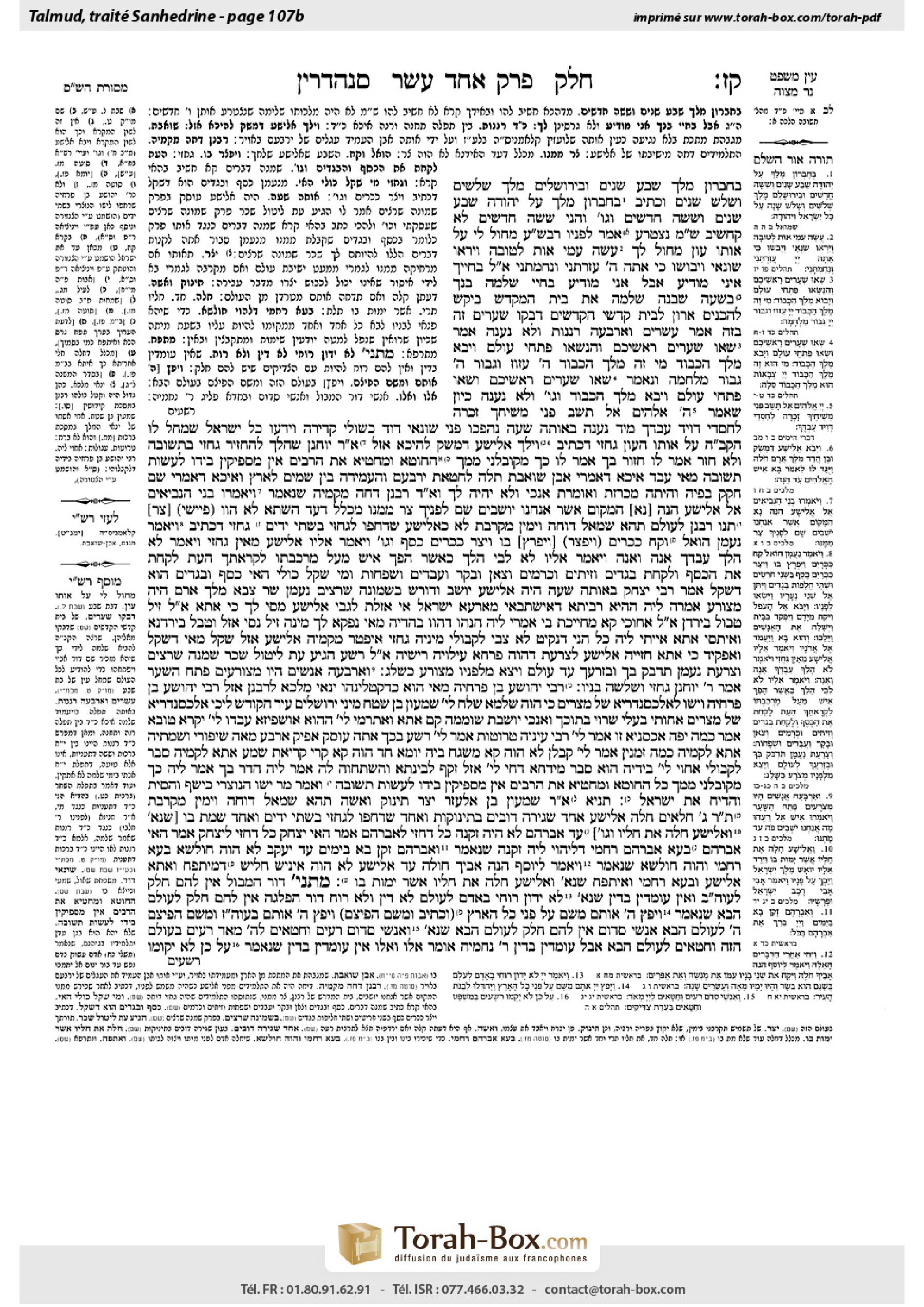
Sanhedrin 107b: Talmud study for Daf Yomi
Daf Yomi is the daily study of one Talmud folio. Explore 37 tractates with scans, Hebrew text, Sefaria English and AI-generated French translations where annotated.
Passage selection and English or AI-generated French translation are available where the scan has annotations. Daf Study is independent of Torah-Box and Sefaria.
Browse Sanhedrin · סנהדרין · All tractatesSanhedrin 107b text and translations
This page of Sanhedrin includes the Aramaic text, an English translation and an AI-generated French translation, alongside the scan above.
סנהדרין ק״ז ב · Aramaic and Hebrew text
״בְּחֶבְרוֹן מָלַךְ שֶׁבַע שָׁנִים וּבִירוּשָׁלִַים מָלַךְ שְׁלֹשִׁים וְשָׁלֹשׁ שָׁנִים״, וּכְתִיב: ״בְּחֶבְרוֹן מָלַךְ עַל יְהוּדָה שֶׁבַע שָׁנִים וְשִׁשָּׁה חֳדָשִׁים וְגוֹ׳״, וְהָנֵי שִׁשָּׁה חֳדָשִׁים לָא קָחָשֵׁיב. שְׁמַע מִינַּהּ נִצְטָרַע.
אָמַר לְפָנָיו: רִבּוֹנוֹ שֶׁל עוֹלָם, מְחוֹל לִי עַל אוֹתוֹ עָוֹן! מָחוּל לָךְ. ״עֲשֵׂה עִמִּי אוֹת לְטוֹבָה וְיִרְאוּ שֹׂנְאַי וְיֵבֹשׁוּ כִּי אַתָּה ה׳ עֲזַרְתַּנִי וְנִחַמְתָּנִי״. אֲמַר לֵיהּ: בְּחַיֶּיךָ אֵינִי מוֹדִיעַ, אֲבָל אֲנִי מוֹדִיעַ בְּחַיֵּי שְׁלֹמֹה בִּנְךָ.
בְּשָׁעָה שֶׁבָּנָה שְׁלֹמֹה אֶת בֵּית הַמִּקְדָּשׁ, בִּיקֵּשׁ לְהַכְנִיס אָרוֹן לְבֵית קׇדְשֵׁי הַקֳּדָשִׁים. דָּבְקוּ שְׁעָרִים זֶה בָּזֶה. אָמַר עֶשְׂרִים וְאַרְבָּעָה רְנָנוֹת וְלֹא נַעֲנָה. אָמַר: ״שְׂאוּ שְׁעָרִים רָאשֵׁיכֶם וְהִנָּשְׂאוּ פִּתְחֵי עוֹלָם וְיָבוֹא מֶלֶךְ הַכָּבוֹד. מִי זֶה מֶלֶךְ הַכָּבוֹד ה׳ עִזּוּז וְגִבּוֹר ה׳ גִּבּוֹר מִלְחָמָה״. וְנֶאֱמַר: ״שְׂאוּ שְׁעָרִים רָאשֵׁיכֶם וּשְׂאוּ פִּתְחֵי עוֹלָם וְיָבוֹא מֶלֶךְ הַכָּבוֹד וְגוֹ׳״, וְלֹא נַעֲנָה.
כֵּיוָן שֶׁאָמַר: ״ה׳ אֱלֹהִים אַל תָּשֵׁב פְּנֵי מְשִׁיחֶךָ זָכְרָה לְחַסְדֵי דָּוִיד עַבְדֶּךָ״, מִיָּד נַעֲנָה. בְּאוֹתָהּ שָׁעָה נֶהְפְּכוּ פְּנֵי שׂוֹנְאֵי דָּוִד כְּשׁוּלֵי קְדֵירָה, וְיָדְעוּ כׇּל יִשְׂרָאֵל שֶׁמָּחַל לוֹ הַקָּדוֹשׁ בָּרוּךְ הוּא עַל אוֹתוֹ הֶעָוֹן.
גֵּחֲזִי, דִּכְתִיב: ״וַיֵּלֶךְ אֱלִישָׁע דַּמֶּשֶׂק״. לְהֵיכָא אֲזַל? אָמַר רַבִּי יוֹחָנָן: שֶׁהָלַךְ לְהַחֲזִיר גֵּחֲזִי בִּתְשׁוּבָה, וְלֹא חָזַר. אָמַר לוֹ: חֲזוֹר בָּךְ. אָמַר לוֹ: כָּךְ מְקוּבְּלַנִי מִמְּךָ: הַחוֹטֵא וּמַחְטִיא אֶת הָרַבִּים אֵין מַסְפִּיקִין בְּיָדוֹ לַעֲשׂוֹת תְּשׁוּבָה.
מַאי עֲבַד? אִיכָּא דְּאָמְרִי: אֶבֶן שׁוֹאֶבֶת תָּלָה לְחַטַּאת יָרׇבְעָם, וְהֶעֱמִידָהּ בֵּין שָׁמַיִם לָאָרֶץ. וְאִיכָּא דְּאָמְרִי: שֵׁם חָקַק בְּפִיהָ, וְהָיְתָה מַכְרֶזֶת וְאוֹמֶרֶת ״אָנֹכִי״ וְ״לֹא יִהְיֶה לְךָ״.
וְאִיכָּא דְּאָמְרִי: רַבָּנַן דְּחָה מִקַּמֵּיהּ, שֶׁנֶּאֱמַר: ״וַיֹּאמְרוּ בְנֵי הַנְּבִיאִים אֶל אֱלִישָׁע הִנֵּה [נָא] הַמָּקוֹם אֲשֶׁר אֲנַחְנוּ יֹשְׁבִים שָׁם לְפָנֶיךָ צַר מִמֶּנּוּ״, מִכְּלָל דְּעַד הַשְׁתָּא לָא הֲווֹ פָּיְישִׁי.
תָּנוּ רַבָּנַן: לְעוֹלָם תְּהֵא שְׂמֹאל דּוֹחָה וְיָמִין מְקָרֶבֶת, לֹא כֶּאֱלִישָׁע שֶׁדְּחָפוֹ לְגֵחֲזִי בִּשְׁתֵּי יָדַיִם, וְלֹא כִּיהוֹשֻׁעַ בֶּן פְּרַחְיָה שֶׁדְּחָפוֹ לְיֵשׁוּ הַנּוֹצְרִי בִּשְׁתֵּי יָדַיִם.
גֵּחֲזִי, דִּכְתִיב: ״וַיֹּאמֶר נַעֲמָן הוֹאֵל וְקַח כִּכָּרָיִם וַיִּפְרׇץ בּוֹ וַיָּצַר כִּכְּרַיִם כֶּסֶף וְגוֹ׳״. ״וַיֹּאמֶר אֵלָיו אֱלִישָׁע מֵאַיִן גֵּחֲזִי וַיֹּאמֶר לֹא הָלַךְ עַבְדְּךָ אָנֶה וָאָנָה. וַיֹּאמֶר אֵלָיו לֹא לִבִּי הָלַךְ כַּאֲשֶׁר הָפַךְ אִישׁ מֵעַל מֶרְכַּבְתּוֹ לִקְרָאתֶךָ הַעֵת לָקַחַת אֶת הַכֶּסֶף וְלָקַחַת בְּגָדִים וְזֵיתִים וּכְרָמִים וְצֹאן וּבָקָר וַעֲבָדִים וּשְׁפָחוֹת״. וּמִי שְׁקַל כּוּלֵּי הַאי? כֶּסֶף וּבְגָדִים הוּא דִּשְׁקַל!
אָמַר רַבִּי יִצְחָק: בְּאוֹתָהּ שָׁעָה הָיָה אֱלִישָׁע יוֹשֵׁב וְדוֹרֵשׁ בִּשְׁמוֹנָה שְׁרָצִים. נַעֲמָן שַׂר צְבָא מֶלֶךְ אֲרָם הָיָה מְצוֹרָע. אֲמַרָה לֵיהּ הָהִיא רָבִיתָא דְּאִישְׁתְּבַאי מֵאַרְעָא יִשְׂרָאֵל: אִי אָזְלַתְּ לְגַבַּי אֱלִישָׁע מַסֵּי לָךְ. כִּי אֲתָא, אֲמַר לֵיהּ: זִיל טְבוֹל בְּיַרְדֵּן. אֲמַר לֵיהּ: אַחוֹכֵי קָא מְחַיְּיכַתְּ בִּי? אָמְרִי לֵיהּ הָנְהוּ דַּהֲווֹ בַּהֲדֵיהּ: מַאי נָפְקָא לָךְ מִינַּהּ? זִיל נַסִּי. אֲזַל וּטְבַל בְּיַרְדְּנָא וְאִיתַּסִּי. אֲתָא אַיְיתִי לֵיהּ כֹּל הָנֵי דְּנָקֵיט. לָא צְבָא לְקַבּוֹלֵי מִינֵּיהּ. גֵּחֲזִי אִיפְּטַר מִקַּמֵּיהּ אֱלִישָׁע, אֲזַל שְׁקַל מַאי דִּשְׁקַל וְאַפְקֵיד.
כִּי אֲתָא, חַזְיַיהּ אֱלִישָׁע לְצָרַעַת דַּהֲוָה פָּרְחָה עִלָּוֵיה רֵישֵׁיהּ. אֲמַר לֵיהּ: רָשָׁע! הִגִּיעַ עֵת לִיטּוֹל שְׂכַר שְׁמֹנָה שְׁרָצִים. ״וְצָרַעַת נַעֲמָן תִּדְבַּק בְּךָ וּבְזַרְעֲךָ לְעוֹלָם וַיֵּצֵא מִלְּפָנָיו מְצֹרָע כַּשָּׁלֶג״. ״וְאַרְבָּעָה אֲנָשִׁים הָיוּ מְצֹרָעִים פֶּתַח הַשָּׁעַר״ – אָמַר רַבִּי יוֹחָנָן: גֵּחֲזִי וּשְׁלֹשֶׁת בָּנָיו.
יְהוֹשֻׁעַ בֶּן פְּרַחְיָה מַאי הִיא? כִּדְקַטְלִינְהוּ יַנַּאי מַלְכָּא לְרַבָּנַן, אֲזַל יְהוֹשֻׁעַ בֶּן פְּרַחְיָה וְיֵשׁוּ לַאֲלֶכְּסַנְדְּרִיָּא שֶׁל מִצְרַיִם. כִּי הֲוָה שְׁלָמָא, שְׁלַח לֵיהּ שִׁמְעוֹן בֶּן שָׁטַח: מִינִּי יְרוּשָׁלַיִם עִיר הַקֹּדֶשׁ לִיכִי אָלֶכְּסַנְדְּרִיָּה שֶׁל מִצְרַיִם, אֲחוֹתִי: בַּעֲלִי שָׁרוּי בְּתוֹכֵךְ וְאָנֹכִי יוֹשֶׁבֶת שׁוֹמֵמָה.
קָם, אֲתָא, וְאִתְרְמִי לֵיהּ הָהוּא אוּשְׁפִּיזָא. עֲבַדוּ לֵיהּ יְקָרָא טוּבָא. אֲמַר: כַּמָּה יָפָה אַכְסַנְיָא זוֹ! אֲמַר לֵיהּ: רַבִּי, עֵינֶיהָ טְרוּטוֹת. אֲמַר לֵיהּ: רָשָׁע! בְּכָךְ אַתָּה עוֹסֵק? אַפֵּיק אַרְבַּע מְאָה שִׁיפּוּרֵי וְשַׁמְּתֵיהּ.
אֲתָא לְקַמֵּיהּ כַּמָּה זִימְנִין, אֲמַר לֵיהּ: קַבְּלָן! לָא הָוֵי קָא מַשְׁגַּח בֵּיהּ. יוֹמָא חַד הֲוָה קָא קָרֵי קְרִיאַת שְׁמַע, אֲתָא לְקַמֵּיהּ. סָבַר לְקַבּוֹלֵי, אַחְוִי לֵיהּ בִּידֵיהּ. הוּא סָבַר: מִידְחָא דָּחֵי לִי. אֲזַל זְקַף לְבֵינְתָּא וְהִשְׁתַּחֲוָה לָהּ. אֲמַר לֵיהּ: הֲדַר בָּךְ! אֲמַר לֵיהּ: כָּךְ מְקוּבְּלַנִי מִמְּךָ: כָּל הַחוֹטֵא וּמַחְטִיא אֶת הָרַבִּים אֵין מַסְפִּיקִין בְּיָדוֹ לַעֲשׂוֹת תְּשׁוּבָה. וְאָמַר מָר: יֵשׁוּ כִּישֵּׁף וְהֵסִית וְהִדִּיחַ אֶת יִשְׂרָאֵל.
תַּנְיָא: אָמַר רַבִּי שִׁמְעוֹן בֶּן אֶלְעָזָר, יֵצֶר, תִּינוֹק, וְאִשָּׁה – תְּהֵא שְׂמֹאל דּוֹחָה וְיָמִין מְקָרֶבֶת.
תָּנוּ רַבָּנַן: שְׁלֹשָׁה חֳלָאִים חָלָה אֱלִישָׁע – אֶחָד שֶׁגֵּירָה דּוּבִּים בַּתִּינוֹקוֹת, וְאֶחָד שֶׁדְּחָפוֹ לְגֵחֲזִי בִּשְׁתֵּי יָדַיִם, וְאֶחָד שֶׁמֵּת בּוֹ, [שֶׁנֶּאֱמַר: ״וֶאֱלִישָׁע חָלָה אֶת חׇלְיוֹ וְגוֹ״].
עַד אַבְרָהָם לֹא הָיָה זִקְנָה. כֹּל דְּחָזֵי לְאַבְרָהָם אֲמַר: הַאי יִצְחָק. כֹּל דְּחָזֵי לְיִצְחָק אָמַר: הַאי אַבְרָהָם. בְּעָא אַבְרָהָם רַחֲמֵי דְּלֶיהְוֵי לֵיהּ זִקְנָה, שֶׁנֶּאֱמַר: ״וְאַבְרָהָם זָקֵן בָּא בַּיָּמִים״. עַד יַעֲקֹב לָא הֲוָה חוּלְשָׁא, בְּעָא רַחֲמֵי וַהֲוָה חוּלְשָׁא, שֶׁנֶּאֱמַר: ״וַיֹּאמֶר לְיוֹסֵף הִנֵּה אָבִיךָ חֹלֶה״. עַד אֱלִישָׁע לָא הֲוָה אִינִישׁ חָלֵישׁ דְּמִיתְּפַח, וַאֲתָא אֱלִישָׁע וּבְעָא רַחֲמֵי וְאִיתְּפַח, שֶׁנֶּאֱמַר: ״וֶאֱלִישָׁע חָלָה אֶת חׇלְיוֹ אֲשֶׁר יָמוּת בּוֹ״.
מַתְנִי׳ דּוֹר הַמַּבּוּל אֵין לָהֶם חֵלֶק לָעוֹלָם הַבָּא, וְאֵין עוֹמְדִין בַּדִּין, שֶׁנֶּאֱמַר: ״לֹא יָדוֹן רוּחִי בָאָדָם לְעֹלָם״ – לֹא דִּין וְלֹא רוּחַ. דּוֹר הַפְּלַגָּה אֵין לָהֶם חֵלֶק לָעוֹלָם הַבָּא, שֶׁנֶּאֱמַר: ״וַיָּפֶץ ה׳ אֹתָם מִשָּׁם עַל פְּנֵי כׇל הָאָרֶץ״, וּכְתִיב: ״וּמִשָּׁם הֱפִיצָם״. ״וַיָּפֶץ ה׳ אֹתָם״ – בָּעוֹלָם הַזֶּה, ״וּמִשָּׁם הֱפִיצָם ה׳״ – לָעוֹלָם הַבָּא. אַנְשֵׁי סְדוֹם אֵין לָהֶם חֵלֶק לָעוֹלָם הַבָּא, שֶׁנֶּאֱמַר: ״וְאַנְשֵׁי סְדֹם רָעִים וְחַטָּאִים לַה׳ מְאֹד״ – רָעִים בָּעוֹלָם הַזֶּה, וְחַטָּאִים לָעוֹלָם הַבָּא. אֲבָל עוֹמְדִין בַּדִּין.
רַבִּי נְחֶמְיָה אוֹמֵר: אֵלּוּ וָאֵלּוּ אֵין עוֹמְדִין בַּדִּין, שֶׁנֶּאֱמַר: ״עַל כֵּן לֹא יָקֻמוּ
Sanhedrin 107b · English translation
in Hebron he reigned seven years, and in Jerusalem he reigned thirty-three years” (I Kings 2:11). And it is written: “In Hebron he reigned over Judah seven years and six months and in Jerusalem he reigned for thirty-three years over all Israel and Judah” (II Samuel 5:5). And those six months, the prophet did not tally them as part of the forty years of King David’s reign. Conclude from it that there were six months that he was not considered king because he was afflicted with leprosy.
David said before Him after this: Master of the Universe, pardon me for this sin. God said to him: It is forgiven for you. David requested: “Perform on my behalf a sign for good, that they that hate me may see it and be put to shame” (Psalms 86:17); show me a sign in my lifetime so that everyone will know that You have forgiven me. God said to him: In your lifetime I will not make it known that you were forgiven, but I will make it known in the lifetime of your son, Solomon.
The Gemara explains: When Solomon built the Temple and sought to bring the Ark into the Holy of Holies, the gates clung together and could not be opened. Solomon uttered twenty-four songs of praise, and his prayer was not answered. He said: “Lift up your heads, you gates, and be you lifted up, you everlasting doors, that the King of glory may come in. Who is the King of glory? The Lord strong and mighty, the Lord mighty in battle” (Psalms 24:7-8). And it is stated: “Lift up your heads, you gates, yea, lift them up, you everlasting doors, that the King of glory may come in. Who then is the King of glory? The Lord of hosts; He is the King of glory. Selah” (Psalms 24:9-10), and he was not answered.
Once he said: “O Lord God, turn not away the face of Your anointed; remember the good deeds of David Your servant” (II Chronicles 6:42), he was immediately answered, and the gates opened (II Chronicles 7:1). At that moment, the faces of all of David’s enemies turned dark like the charred bottom of a pot. And all of the Jewish people knew that the Holy One, Blessed be He, had forgiven him for that sin, as it was only by David’s merit that Solomon’s prayer was answered.
§ The mishna states that Gehazi, the attendant of Elisha, has no share in the World-to-Come. The Gemara explains that this is as it is written: And Elisha went to Damascus (see II Kings 8:7). Where did he go, and for what purpose? Rabbi Yoḥanan says: He went to cause Gehazi to repent, but he did not repent. Elisha said to him: Repent. Gehazi said to him: This is the tradition that I received from you: Whoever sins and causes the masses to sin is not given the opportunity to repent.
What did he do that caused the masses to sin? There are those who say that he hung a magnetic rock on Jeroboam’s sin, i.e., on the golden calf that Jeroboam established as an idol, so that he suspended it between heaven and earth, i.e., he caused it to hover above the ground. This seemingly miraculous occurrence caused the people to worship it even more devoutly than before. And there are those who say: He engraved the sacred name of God on its mouth, and it would declare and say: “I am the Lord your God” (Exodus 20:2), and: “You shall not have other gods” (Exodus 20:3). The idol would quote the two prohibitions from the Ten Commandments that prohibit idol worship, causing the people to worship it even more devoutly than before.
And there are those who say: Gehazi pushed the Sages away from coming before him, i.e., he prevented them from learning from Elisha, as it is stated: “And the sons of the prophets said to Elisha, behold this place where we are staying before you is too cramped for us” (II Kings 6:1). It may be derived by inference that until now they were not numerous and the place was not cramped for them, as Gehazi would turn people away.
The Sages taught: Always have the left hand drive sinners away and the right draw them near, so that the sinner will not totally despair of atonement. This is unlike Elisha, who pushed away Gehazi with his two hands and caused him to lose his share in the World-to-Come, and unlike Yehoshua ben Peraḥya, who pushed away Jesus the Nazarene with his two hands.
Elisha drove Gehazi away, as it is written: “And Naaman said: Be content, take two talents. And he urged him, and bound two talents of silver in two bags, with two changes of garments” (II Kings 5:23). Naaman offered Gehazi payment for the help Elisha had given him. The verse states: “And Elisha said to him: Where from, Gehazi? And he said: Your servant went nowhere at all. And he said to him: Went not my heart with you, when the man turned back from his chariot to meet you? Is it the time to receive silver and to receive garments, and olive groves, and vineyards, and sheep and cattle, and menservants and maidservants?” (II Kings 5:25-26). The Gemara asks: And did Gehazi take all that? It is merely silver and garments that he took.
Rabbi Yitzḥak says: This was the incident involving Gehazi: At that moment, Elisha was sitting and teaching the halakhot of the eight impure creeping animals. Now Naaman, the general of the army of Aram, was a leper. A certain young Jewish woman who had been taken captive from Eretz Yisrael said to him: If you go to Elisha, he will heal you. When Naaman came to him, Elisha said to him: Go immerse in the Jordan. Naaman said to him: Are you mocking me by suggesting that this will cure me? Those companions who were with Naaman said to him: What is the difference to you? Go, try it. Naaman went and immersed in the Jordan and was healed. Naaman came and brought to Elisha all those items that he had taken with him from Aram, and Elisha did not agree to receive them from him. Gehazi took leave from before Elisha and went and took from Naaman what he took, and he deposited them.
When Gehazi came, Elisha saw the leprosy that had grown on Gehazi’s head. Elisha said to him: Wicked one! The time has arrived to take your reward for studying the matter of the eight creeping animals. Since the silver Gehazi received was his reward for studying the matter of the eight creeping animals, Elisha enumerated eight items that Gehazi sought to purchase with the silver that he took. Then Elisha said to Gehazi: “The leprosy of Naaman shall cleave to you and to your seed forever. And he went out of his presence a leper as white as snow” (II Kings 5:27). With regard to the verse: “And there were four men afflicted with leprosy at the entrance of the gate” (II Kings 7:3), Rabbi Yoḥanan says: These were Gehazi and his three sons, as he and his descendants were cursed.
§ What is the incident involving Yehoshua ben Peraḥya? The Gemara relates: When King Yannai was killing the Sages, Yehoshua ben Peraḥya and Jesus, his student, went to Alexandria of Egypt. When there was peace between King Yannai and the Sages, Shimon ben Shataḥ sent a message to Yehoshua ben Peraḥya: From me, Jerusalem, the holy city, to you, Alexandria of Egypt: My sister, my husband is located among you and I sit desolate. The head of the Sages of Israel is out of the country and Jerusalem requires his return.
Yehoshua ben Peraḥya understood the message, arose, came, and happened to arrive at a certain inn on the way to Jerusalem. They treated him with great honor. Yehoshua ben Peraḥya said: How beautiful is this inn. Jesus, his student, said to him: But my teacher, the eyes of the innkeeper’s wife are narrow [terutot]. Yehoshua ben Peraḥya said to him: Wicked one! Do you involve yourself with regard to that matter, the appearance of a married woman? He produced four hundred shofarot and ostracized him.
Jesus came before Yehoshua ben Peraḥya several times and said to him: Accept our, i.e., my, repentance. Yehoshua ben Peraḥya took no notice of him. One day Yehoshua ben Peraḥya was reciting Shema and Jesus came before him with the same request. Yehoshua ben Peraḥya intended to accept his request, and signaled him with his hand to wait until he completed his prayer. Jesus did not understand the signal and thought: He is driving me away. He went and stood a brick upright to serve as an idol and he bowed to it. Yehoshua ben Peraḥya then said to Jesus: Repent. Jesus said to him: This is the tradition that I received from you: Whoever sins and causes the masses to sin is not given the opportunity to repent. And the Master says: Jesus performed sorcery, incited Jews to engage in idolatry, and led Israel astray. Had Yehoshua ben Peraḥya not caused him to despair of atonement, he would not have taken the path of evil.
It is taught in a baraita that Rabbi Shimon ben Elazar says: With regard to the evil inclination, to a child, and to a woman, have the left hand drive them away and the right draw them near. Total rejection of the evil inclination will lead to inaction, unlike channeling its power in a positive direction. One should not draw them too near, lest they lead him to sin, but one should not drive his wife or his child away completely, lest he cause them to abandon the path of righteousness.
The Sages taught: Elisha fell ill with three illnesses: One illness was due to the fact that he incited bears to attack and eat children (see II Kings 2:24-25); and one was due to the fact that he pushed Gehazi away with two hands and caused him to despair of atonement; and one was the illness from which he died, as it is stated: “And Elisha was fallen ill of his illness from which he was to die” (II Kings 13:14), indicating that he had previously suffered other illnesses.
Apropos the death of Elisha, the Gemara says: Until the time of Abraham there was no aging, and the old and the young looked the same. Anyone who saw Abraham said: That is Isaac, and anyone who saw Isaac said: That is Abraham. Abraham prayed for mercy, that he would undergo aging, as it is stated: “And Abraham was old, well stricken in age” (Genesis 24:1). There is no mention of aging before that verse. Until the time of Jacob there was no weakness, i.e., illness. Jacob prayed for mercy and there was weakness, as it is stated: “And one said to Joseph: Behold, your father is ill” (Genesis 48:1). Until the time of Elisha, there was no ill person who recovered, and Elisha came and prayed for mercy and recovered, as it is stated: “And Elisha was fallen ill of his illness from which he was to die” (II Kings 13:14). That is the first mention of a person who was ill and who did not die from that illness.
MISHNA: The members of the generation of the flood have no share in the World-to-Come and will not stand in judgment at the end of days, as it is stated: “My soul shall not abide [yadon] in man forever” (Genesis 6:3); neither will they stand in judgment [din] nor shall their souls be restored to them. The members of the generation of the dispersion have no share in the World-to-Come, as it is stated: “And the Lord scattered them from there upon the face of all the earth” (Genesis 11:8), and it is written: “And from there did the Lord scatter them upon the face of all the earth” (Genesis 11:9). “And the Lord scattered them” indicates in this world; “and from there did the Lord scatter them” indicates for the World-to-Come. The people of Sodom have no share in the World-to-Come, as it is stated: “And the men of Sodom were wicked and sinners before the Lord exceedingly” (Genesis 13:13). “Wicked” indicates in this world; “and sinners” indicates for the World-to-Come. But they will stand in judgment and they will be sentenced to eternal contempt.
Rabbi Neḥemya says: Both these, the people of Sodom, and those, the members of the generation of the flood, will not stand in judgment, as it is stated: “Therefore the wicked shall not stand
Sanhedrin 107b · Traduction française (IA)
« À Hébron, il régna sept ans, et à Jérusalem, il régna trente-trois ans » (I Rois 2:11). Et il est écrit : « À Hébron, il régna sur Juda sept ans et six mois, et à Jérusalem, il régna trente-trois ans sur tout Israël et Juda » (II Samuel 5:5). Le prophète ne compta pas ces six mois parmi les quarante années du règne du roi David. On en déduit qu’il y eut six mois durant lesquels David ne fut pas considéré comme roi, parce qu’il était atteint de lèpre.
Après cela, David lui dit : « Maître de l’univers, pardonne-moi cette faute. » Dieu lui répondit : « Elle t’est pardonnée. » David demanda : « Accorde-moi un signe favorable, afin que ceux qui me haïssent le voient et soient couverts de honte » (Psaumes 86:17) ; montre-moi un signe de mon vivant, afin que tous sachent que Tu m’as pardonné. Dieu lui répondit : « De ton vivant, je ne ferai pas savoir que tu as été pardonné, mais je le ferai savoir du vivant de ton fils Salomon. »
La Guemara explique : Lorsque Salomon construisit le Temple et voulut faire entrer l’Arche dans le Saint des Saints, les portes se soudèrent et ne purent être ouvertes. Salomon récita vingt-quatre chants de louange, mais sa prière ne fut pas exaucée. Il dit : « Levez vos têtes, ô portes, élevez-vous, portes éternelles, afin que le Roi de gloire entre. Qui est le Roi de gloire ? L’Éternel, fort et puissant, l’Éternel, puissant au combat » (Psaumes 24:7-8). Et il est dit : « Levez vos têtes, ô portes, élevez-les, portes éternelles, afin que le Roi de gloire entre. Qui donc est le Roi de gloire ? L’Éternel des armées, c’est lui le Roi de gloire. Sélah » (Psaumes 24:9-10), mais il ne fut pas exaucé.
Dès qu’il dit : « Éternel Dieu, ne détourne pas le visage de ton oint ; souviens-toi des bontés accordées à David, ton serviteur » (II Chroniques 6:42), il fut aussitôt exaucé et les portes s’ouvrirent (II Chroniques 7:1). À cet instant, le visage de tous les ennemis de David s’assombrit comme le fond calciné d’une marmite. Tout le peuple juif sut alors que le Saint, béni soit-Il, avait pardonné cette faute à David, car la prière de Salomon n’avait été exaucée que par le mérite de David.
§ La Michna enseigne que Gué’hazi, le serviteur d’Élisée, n’a pas de part au Monde à venir. La Guemara explique que cela correspond à ce qui est écrit : « Élisée se rendit à Damas » (voir II Rois 8:7). Où se rendit-il, et dans quel but ? Rabbi Yoḥanan dit : Il y alla pour amener Gué’hazi à se repentir, mais celui-ci ne se repentit pas. Élisée lui dit : « Repens-toi. » Gué’hazi lui répondit : « Voici la tradition que j’ai reçue de toi : celui qui faute et fait fauter les masses n’a pas la possibilité de se repentir. »
Qu’avait-il fait pour faire fauter les masses ? Certains disent qu’il suspendit une pierre aimantée au péché de Jéroboam, c’est-à-dire au veau d’or que Jéroboam avait érigé en idole, de sorte que celui-ci resta suspendu entre le ciel et la terre : il le fit flotter au-dessus du sol. Ce phénomène apparemment miraculeux amena le peuple à le vénérer avec encore plus de ferveur qu’auparavant. D’autres disent qu’il grava le Nom sacré de Dieu sur la bouche de l’idole, qui proclamait : « Je suis l’Éternel, ton Dieu » (Exode 20:2), et : « Tu n’auras pas d’autres dieux » (Exode 20:3). L’idole citait ainsi les deux interdictions de l’idolâtrie tirées des Dix Commandements, amenant le peuple à la vénérer avec encore plus de ferveur qu’auparavant.
D’autres disent que Gué’hazi empêchait les Sages de se présenter devant Élisée, c’est-à-dire qu’il les empêchait d’étudier auprès de lui, comme il est dit : « Les fils des prophètes dirent à Élisée : Voici, le lieu où nous demeurons auprès de toi est trop exigu pour nous » (II Rois 6:1). On peut en déduire que jusque-là, ils n’étaient pas nombreux et que le lieu n’était pas trop exigu pour eux, car Gué’hazi renvoyait les gens.
Les Sages ont enseigné : Il faut toujours que la main gauche repousse les pécheurs et que la droite les rapproche, afin que le pécheur ne désespère pas complètement d’obtenir l’expiation. Il ne faut pas agir comme Élisée, qui repoussa Gué’hazi de ses deux mains et lui fit perdre sa part au Monde à venir, ni comme Yehoshua ben Peraḥya, qui repoussa Jésus le Nazaréen de ses deux mains.
Élisée repoussa Gué’hazi, comme il est écrit : « Naaman dit : Je t’en prie, prends deux talents. Il le pressa, et lia deux talents d’argent dans deux sacs, avec deux vêtements de rechange » (II Rois 5:23). Naaman proposait à Gué’hazi une rémunération pour l’aide qu’Élisée lui avait apportée. Le verset poursuit : « Élisée lui dit : D’où viens-tu, Gué’hazi ? Il répondit : Ton serviteur n’est allé nulle part. Élisée lui dit : Mon cœur n’était-il pas avec toi lorsque l’homme est descendu de son char pour venir à ta rencontre ? Est-ce le moment de recevoir de l’argent et des vêtements, des oliveraies, des vignes, des brebis, des bœufs, des serviteurs et des servantes ? » (II Rois 5:25-26). La Guemara demande : Gué’hazi a-t-il vraiment pris tout cela ? Il n’a pris que de l’argent et des vêtements.
Rabbi Yitzḥak dit : Voici ce qui arriva avec Gué’hazi. À ce moment-là, Élisée était assis et enseignait les halakhot des huit reptiles impurs. Or Naaman, le chef de l’armée d’Aram, était lépreux. Une jeune Israélite, captive originaire d’Eretz Israël, lui dit : « Si tu vas voir Élisée, il te guérira. » Lorsque Naaman vint le trouver, Élisée lui dit : « Va te plonger dans le Jourdain. » Naaman lui dit : « Te moques-tu de moi en prétendant que cela me guérira ? » Les compagnons qui l’accompagnaient lui dirent : « Qu’est-ce que cela peut te faire ? Va, essaie. » Naaman alla se plonger dans le Jourdain et fut guéri. Il vint ensuite apporter à Élisée tous les objets qu’il avait emportés d’Aram, mais Élisée refusa de les recevoir. Gué’hazi prit congé d’Élisée, alla prendre auprès de Naaman ce qu’il prit, puis le déposa.
Lorsque Gué’hazi revint, Élisée vit la lèpre qui avait poussé sur sa tête. Élisée lui dit : « Méchant ! Le moment est venu de recevoir ta récompense pour avoir étudié la question des huit reptiles. » Puisque l’argent reçu par Gué’hazi constituait sa récompense pour avoir étudié cette question, Élisée énuméra huit choses que Gué’hazi voulait acheter avec l’argent qu’il avait pris. Puis Élisée lui dit : « La lèpre de Naaman s’attachera à toi et à ta descendance pour toujours. » Gué’hazi sortit de devant lui, lépreux, blanc comme neige (II Rois 5:27). À propos du verset : « Il y avait quatre hommes lépreux à l’entrée de la porte » (II Rois 7:3), Rabbi Yoḥanan dit : « C’étaient Gué’hazi et ses trois fils », car lui-même et sa descendance avaient été maudits.
§ Quel est l’épisode concernant Yehoshua ben Peraḥya ? La Guemara rapporte : Lorsque le roi Yannai faisait tuer les Sages, Yehoshua ben Peraḥya et Jésus, son disciple, se rendirent à Alexandrie, en Égypte. Lorsque la paix fut rétablie entre le roi Yannai et les Sages, Shimon ben Shataḥ envoya un message à Yehoshua ben Peraḥya : « De ma part, Jérusalem, la ville sainte, à toi, Alexandrie d’Égypte : Ma sœur, mon mari se trouve auprès de toi et je demeure dans la désolation. » Le chef des Sages d’Israël est hors du pays, et Jérusalem a besoin qu’il revienne.
Yehoshua ben Peraḥya comprit le message, se leva, partit et arriva par hasard dans une certaine auberge, sur la route de Jérusalem. On lui témoigna de grands égards. Yehoshua ben Peraḥya dit : « Comme cette auberge est belle ! » Jésus, son disciple, lui dit : « Mais, mon maître, les yeux de l’aubergiste sont étroits [terutot]. » Yehoshua ben Peraḥya lui dit : « Méchant ! Te mêles-tu donc de cette affaire, de l’apparence d’une femme mariée ? » Il fit apporter quatre cents chofarot et le mit au ban.
Jésus se présenta plusieurs fois devant Yehoshua ben Peraḥya et lui dit : « Accepte notre repentir », c’est-à-dire le mien. Yehoshua ben Peraḥya ne lui prêta aucune attention. Un jour, Yehoshua ben Peraḥya récitait le Chéma lorsque Jésus se présenta devant lui avec la même demande. Yehoshua ben Peraḥya avait l’intention d’accepter sa demande et lui fit signe de la main d’attendre qu’il ait terminé sa prière. Jésus ne comprit pas le signe et pensa : « Il me repousse. » Il alla dresser une brique sur la tranche pour en faire une idole, puis se prosterna devant elle. Yehoshua ben Peraḥya lui dit alors : « Repens-toi. » Jésus lui répondit : « Voici la tradition que j’ai reçue de toi : celui qui faute et fait fauter les masses n’a pas la possibilité de se repentir. » Et le Maître dit : Jésus pratiquait la sorcellerie, incitait les Juifs à se livrer à l’idolâtrie et égarait Israël. Si Yehoshua ben Peraḥya ne l’avait pas amené à désespérer de l’expiation, il n’aurait pas pris la voie du mal.
Il est enseigné dans une baraïta que Rabbi Shimon ben Elazar dit : « À l’égard du mauvais penchant, d’un enfant et d’une femme, que la main gauche repousse et que la droite rapproche. » Rejeter totalement le mauvais penchant conduirait à l’inaction, contrairement au fait de canaliser sa force dans une direction positive. Il ne faut pas les rapprocher excessivement, de peur qu’ils ne l’amènent à fauter, mais il ne faut pas non plus repousser complètement son épouse ou son enfant, de peur de les pousser à abandonner la voie de la droiture.
Les Sages ont enseigné qu’Élisée fut atteint de trois maladies. L’une était due au fait qu’il avait fait attaquer et dévorer des enfants par des ours (voir II Rois 2:24-25) ; une autre, au fait qu’il avait repoussé Gué’hazi de ses deux mains et l’avait amené à désespérer de l’expiation ; et la troisième était la maladie dont il mourut, comme il est écrit : « Élisée était malade de la maladie dont il devait mourir » (II Rois 13:14), ce qui indique qu’il avait auparavant souffert d’autres maladies.
À propos de la mort d’Élisée, la Guemara dit : Jusqu’à l’époque d’Abraham, il n’y avait pas de vieillissement, et les personnes âgées et les jeunes avaient le même aspect. Quiconque voyait Abraham disait : « C’est Isaac » ; et quiconque voyait Isaac disait : « C’est Abraham. » Abraham pria pour obtenir la miséricorde, afin de vieillir, comme il est écrit : « Abraham était vieux, avancé en âge » (Genèse 24:1). Le vieillissement n’est pas mentionné avant ce verset. Jusqu’à l’époque de Jacob, il n’y avait pas de faiblesse, c’est-à-dire pas de maladie. Jacob pria pour obtenir la miséricorde, et la faiblesse apparut, comme il est écrit : « On dit à Joseph : Voici, ton père est malade » (Genèse 48:1). Jusqu’à l’époque d’Élisée, aucun malade ne guérissait. Élisée vint, pria pour obtenir la miséricorde et guérit, comme il est écrit : « Élisée était malade de la maladie dont il devait mourir » (II Rois 13:14). C’est la première mention d’une personne qui était malade sans mourir de cette maladie.
MICHNA : Les membres de la génération du Déluge n’ont pas de part au Monde à venir et ne comparaîtront pas en jugement à la fin des temps, comme il est écrit : « Mon esprit ne demeurera pas [yadon] dans l’homme éternellement » (Genèse 6:3) ; ils ne comparaîtront pas en jugement [din] et leurs âmes ne leur seront pas rendues. Les membres de la génération de la Dispersion n’ont pas de part au Monde à venir, comme il est écrit : « L’Éternel les dispersa de là sur toute la surface de la terre » (Genèse 11:8), et il est écrit : « De là, l’Éternel les dispersa sur toute la surface de la terre » (Genèse 11:9). « L’Éternel les dispersa » désigne ce monde ; « de là, l’Éternel les dispersa » désigne le Monde à venir. Les habitants de Sodome n’ont pas de part au Monde à venir, comme il est écrit : « Les hommes de Sodome étaient méchants et pécheurs devant l’Éternel, à l’extrême » (Genèse 13:13). « Méchants » désigne ce monde ; « pécheurs » désigne le Monde à venir. Toutefois, ils comparaîtront en jugement et seront condamnés à l’opprobre éternel.
Rabbi Neḥemya dit : Ni ceux-ci, les habitants de Sodome, ni ceux-là, les membres de la génération du Déluge, ne comparaîtront en jugement, comme il est écrit : « C’est pourquoi les méchants ne se tiendront pas
Traduction française générée par IA à partir de l’édition anglaise de Sefaria. Vérifie toujours un passage avec le texte source.
Text from Sefaria: William Davidson Edition - Vocalized Aramaic (CC BY NC); William Davidson Edition - English (CC BY NC).