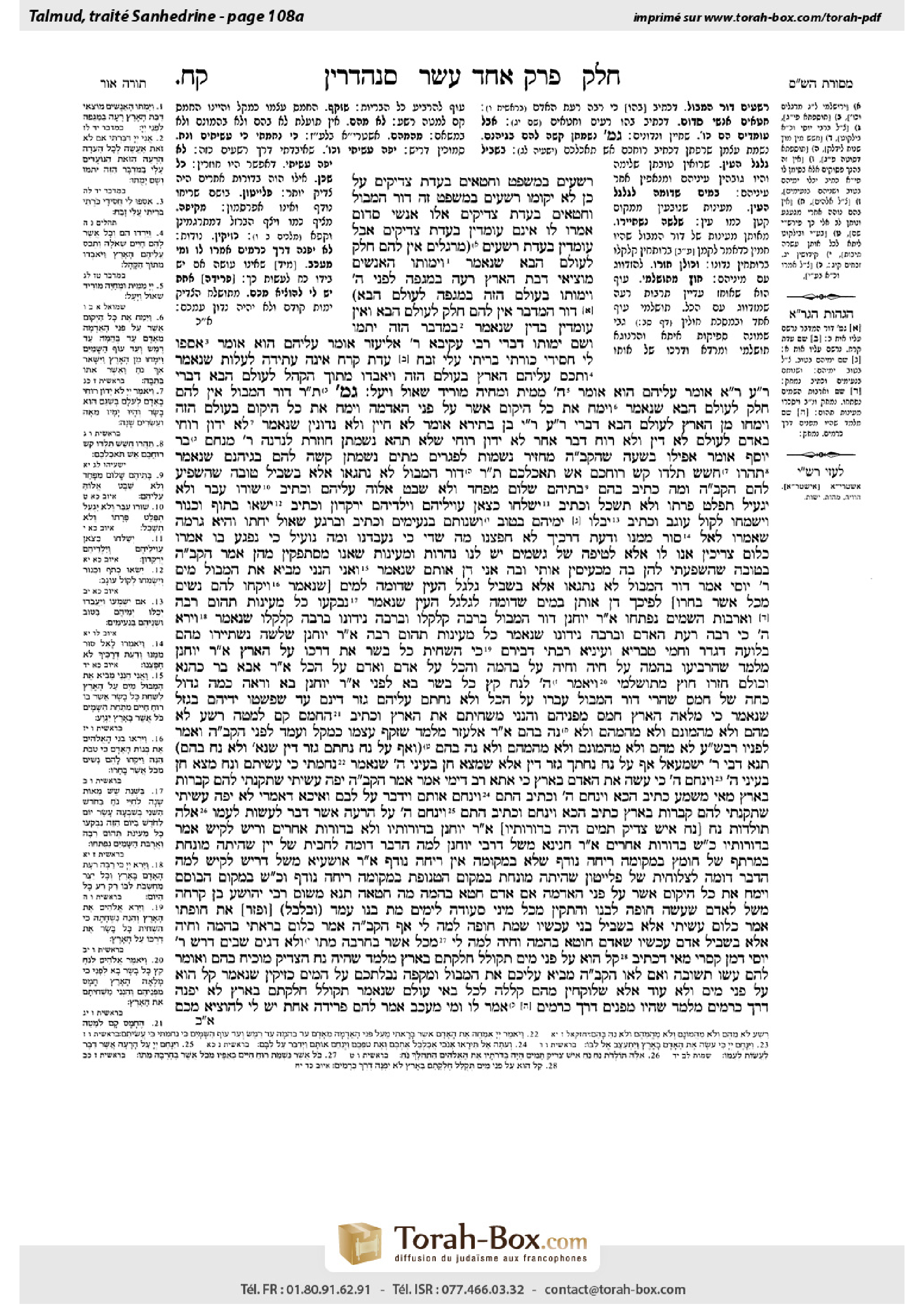
Sanhedrin 108a: Talmud study for Daf Yomi
Daf Yomi is the daily study of one Talmud folio. Explore 37 tractates with scans, Hebrew text, Sefaria English and AI-generated French translations where annotated.
Passage selection and English or AI-generated French translation are available where the scan has annotations. Daf Study is independent of Torah-Box and Sefaria.
Browse Sanhedrin · סנהדרין · All tractatesSanhedrin 108a text and translations
This page of Sanhedrin includes the Aramaic text, an English translation and an AI-generated French translation, alongside the scan above.
סנהדרין ק״ח א · Aramaic and Hebrew text
רְשָׁעִים בַּמִּשְׁפָּט וְחַטָּאִים בַּעֲדַת צַדִּיקִים״. ״עַל כֵּן לֹא יָקוּמוּ רְשָׁעִים בַּמִּשְׁפָּט״ – זֶה דּוֹר הַמַּבּוּל. ״וְחַטָּאִים בַּעֲדַת צַדִּיקִים״ – אֵלּוּ אַנְשֵׁי סְדוֹם. אָמְרוּ לוֹ: אֵינָם עוֹמְדִין בַּעֲדַת צַדִּיקִים, אֲבָל עוֹמְדִין בַּעֲדַת רְשָׁעִים.
מְרַגְּלִים אֵין לָהֶם חֵלֶק לָעוֹלָם הַבָּא, שֶׁנֶּאֱמַר: ״וַיָּמֻתוּ הָאֲנָשִׁים מוֹצִאֵי דִבַּת הָאָרֶץ רָעָה בַּמַּגֵּפָה לִפְנֵי ה׳״. ״וַיָּמֻתוּ״ – בָּעוֹלָם הַזֶּה, ״בַּמַּגֵּפָה״ – לָעוֹלָם הַבָּא.
דּוֹר הַמִּדְבָּר אֵין לָהֶם חֵלֶק לָעוֹלָם הַבָּא, וְאֵין עוֹמְדִין בַּדִּין, שֶׁנֶּאֱמַר: ״בַּמִּדְבָּר הַזֶּה יִתַּמּוּ וְשָׁם יָמֻתוּ״. דִּבְרֵי רַבִּי עֲקִיבָא. רַבִּי אֱלִיעֶזֶר אוֹמֵר, עֲלֵיהֶם הוּא אוֹמֵר: ״אִסְפוּ לִי חֲסִידָי כֹּרְתֵי בְרִיתִי עֲלֵי זָבַח״.
עֲדַת קֹרַח אֵינָהּ עֲתִידָה לַעֲלוֹת, שֶׁנֶּאֱמַר: ״וַתְּכַס עֲלֵיהֶם הָאָרֶץ״ – בָּעוֹלָם הַזֶּה, ״וַיֹּאבְדוּ מִתּוֹךְ הַקָּהָל״ – לָעוֹלָם הַבָּא. דִּבְרֵי רַבִּי עֲקִיבָא. רַבִּי אֱלִיעֶזֶר אוֹמֵר, עֲלֵיהֶם הוּא אוֹמֵר: ״ה׳ מֵמִית וּמְחַיֶּה מוֹרִיד שְׁאוֹל וַיָּעַל״.
גְּמָ׳ תָּנוּ רַבָּנַן: דּוֹר הַמַּבּוּל אֵין לָהֶם חֵלֶק לָעוֹלָם הַבָּא, שֶׁנֶּאֱמַר: ״וַיִּמַח אֶת כׇּל הַיְקוּם אֲשֶׁר עַל פְּנֵי הָאֲדָמָה״. ״וַיִּמַח אֶת כׇּל הַיְּקוּם״ – בָּעוֹלָם הַזֶּה, ״וַיִּמָּחוּ מִן הָאָרֶץ״ – לָעוֹלָם הַבָּא, דִּבְרֵי רַבִּי עֲקִיבָא. רַבִּי יְהוּדָה בֶּן בְּתֵירָא אוֹמֵר: לֹא חַיִּין וְלֹא נִדּוֹנִין, שֶׁנֶּאֱמַר: ״לֹא יָדוֹן רוּחִי בָאָדָם לְעֹלָם״ – לֹא דִּין וְלֹא רוּחַ. דָּבָר אַחֵר: ״לֹא יָדוֹן רוּחִי״ – שֶׁלֹּא תְּהֵא נִשְׁמָתָן חוֹזֶרֶת לִנְדָנָהּ.
רַבִּי מְנַחֵם בְּרַבִּי יוֹסֵף אוֹמֵר: אֲפִילּוּ בְּשָׁעָה שֶׁהַקָּדוֹשׁ בָּרוּךְ הוּא מַחֲזִיר נְשָׁמוֹת לִפְגָרִים מֵתִים, נִשְׁמָתָן קָשָׁה לָהֶם בְּגֵיהִנָּם, שֶׁנֶּאֱמַר: ״תַּהֲרוּ חֲשַׁשׁ תֵּלְדוּ קַשׁ רוּחֲכֶם אֵשׁ תֹּאכַלְכֶם״.
תָּנוּ רַבָּנַן: דּוֹר הַמַּבּוּל לֹא נִתְגָּאוּ אֶלָּא בִּשְׁבִיל טוֹבָה שֶׁהִשְׁפִּיעַ לָהֶם הַקָּדוֹשׁ בָּרוּךְ הוּא, וּמָה כְּתִיב בָּהֶם? ״בָּתֵּיהֶם שָׁלוֹם מִפָּחַד וְלֹא שֵׁבֶט אֱלוֹהַּ עֲלֵיהֶם״, וּכְתִיב: ״שׁוֹרוֹ עִבַּר וְלֹא יַגְעִל תְּפַלֵּט פָּרָתוֹ וְלֹא תְשַׁכֵּל״, וּכְתִיב: ״יְשַׁלְּחוּ כַצֹּאן עֲוִילֵיהֶם וְיַלְדֵיהֶם יְרַקֵּדוּן״, וּכְתִיב: ״יִשְׂאוּ בְּתֹף וְכִנּוֹר וְיִשְׂמְחוּ לְקוֹל עוּגָב״, וּכְתִיב: ״יְכַלּוּ יְמֵיהֶם בַּטּוֹב וּשְׁנֵיהֶם בַּנְּעִימִים״, וּכְתִיב: ״וּבְרֶגַע שְׁאוֹל יֵחָתּוּ״.
וְהִיא גָּרְמָה שֶׁאָמְרוּ לָאֵל: ״סוּר מִמֶּנּוּ וְדַעַת דְּרָכֶיךָ לֹא חָפָצְנוּ. מַה שַׁדַּי כִּי נַעַבְדֶנּוּ וּמַה נּוֹעִיל כִּי נִפְגַּע בּוֹ״. אָמְרוּ: כְּלוּם צְרִיכִין אָנוּ לוֹ אֶלָּא לְטִיפָּה שֶׁל גְּשָׁמִים? יֵשׁ לָנוּ נְהָרוֹת וּמַעֲיָנוֹת שֶׁאָנוּ מִסְתַּפְּקִין מֵהֶן. אָמַר הַקָּדוֹשׁ בָּרוּךְ הוּא: בַּטּוֹבָה שֶׁהִשְׁפַּעְתִּי לָהֶן, בָּהּ מַכְעִיסִין אוֹתִי, וּבָהּ אֲנִי דָּן אוֹתָם, שֶׁנֶּאֱמַר: ״וַאֲנִי הִנְנִי מֵבִיא אֶת הַמַּבּוּל מַיִם״.
רַבִּי יוֹסֵי אָמַר: דּוֹר הַמַּבּוּל לֹא נִתְגָּאוּ אֶלָּא בִּשְׁבִיל גַּלְגַּל הָעַיִן שֶׁדּוֹמֶה לְמַיִם, [שֶׁנֶּאֱמַר: ״וְיִקְחוּ לָהֶם נָשִׁים מִכֹּל אֲשֶׁר בָּחָרוּ״]. לְפִיכָךְ דָּן אוֹתָן בְּמַיִם, שֶׁדּוֹמֶה לְגַלְגַּל הָעַיִן, שֶׁנֶּאֱמַר: ״נִבְקְעוּ כׇּל מַעְיְנוֹת תְּהוֹם רַבָּה וַאֲרֻבּוֹת הַשָּׁמַיִם נִפְתָּחוּ״.
אָמַר רַבִּי יוֹחָנָן: דּוֹר הַמַּבּוּל בְּרַבָּה קִלְקְלוּ, וּבְרַבָּה נִידּוֹנוּ. בְּרַבָּה קִלְקְלוּ, שֶׁנֶּאֱמַר: ״וַיַּרְא ה׳ כִּי רַבָּה רָעַת הָאָדָם״, וּבְרַבָּה נִידּוֹנוּ, שֶׁנֶּאֱמַר: ״כׇּל מַעְיְנוֹת תְּהוֹם רַבָּה״. אָמַר רַבִּי יוֹחָנָן: שְׁלֹשָׁה נִשְׁתַּיְּירוּ מֵהֶם – בְּלוּעָה דְּגָדֵר, וְחַמֵּי טְבֶרְיָא, וְעֵינָא רַבָּתִי דְּבֵירָם.
״כִּי הִשְׁחִית כׇּל בָּשָׂר אֶת דַּרְכּוֹ עַל הָאָרֶץ״, אָמַר רַבִּי יוֹחָנָן: מְלַמֵּד שֶׁהִרְבִּיעוּ בְּהֵמָה עַל חַיָּה, וְחַיָּה עַל בְּהֵמָה, וְהַכֹּל עַל אָדָם, וְאָדָם עַל הַכֹּל. אָמַר רַבִּי אַבָּא בַּר כָּהֲנָא: וְכוּלָּם חָזְרוּ, חוּץ מִתּוּשְׁלְמִי.
״וַיֹּאמֶר ה׳ לְנֹחַ קֵץ כׇּל בָּשָׂר בָּא לְפָנַי״. אָמַר רַבִּי יוֹחָנָן: בֹּא וּרְאֵה כַּמָּה גָּדוֹל כֹּחַ שֶׁל חָמָס, שֶׁהֲרֵי דּוֹר הַמַּבּוּל עָבְרוּ עַל הַכֹּל, וְלֹא נֶחְתַּם עֲלֵיהֶם גְּזַר דִּינָם עַד שֶׁפָּשְׁטוּ יְדֵיהֶם בְּגָזֵל, שֶׁנֶּאֱמַר: ״כִּי מָלְאָה הָאָרֶץ חָמָס מִפְּנֵיהֶם וְהִנְנִי מַשְׁחִיתָם אֶת הָאָרֶץ״. וּכְתִיב: ״הֶחָמָס קָם לְמַטֵּה רֶשַׁע, לֹא מֵהֶם וְלֹא מֵהֲמוֹנָם וְלֹא מֶהֱמֵהֶם וְלֹא נֹהַּ בָּהֶם״.
אָמַר רַבִּי אֶלְעָזָר: מְלַמֵּד שֶׁזָּקַף עַצְמוֹ כְּמַקֵּל, וְעָמַד לִפְנֵי הַקָּדוֹשׁ בָּרוּךְ הוּא, וְאָמַר לְפָנָיו, רִבּוֹנוֹ שֶׁל עוֹלָם: ״לֹא מֵהֶם וְלֹא מֵהֲמוֹנָם וְלֹא מֶהֱמֵהֶם וְלֹא נֹהַּ בָּהֶם״.
(וְאַף עַל נֹחַ נֶחְתַּם גְּזַר דִּין, שֶׁנֶּאֱמַר: ״וְלֹא נֹחַ בָּהֶם״). תָּנָא דְּבֵי רַבִּי יִשְׁמָעֵאל: אַף עַל נֹחַ נֶחְתַּךְ גְּזַר דִּין, אֶלָּא שֶׁמָּצָא חֵן בְּעֵינֵי ה׳, שֶׁנֶּאֱמַר: ״נִחַמְתִּי כִּי עֲשִׂיתֶם וְנֹחַ מָצָא חֵן בְּעֵינֵי ה׳״.
״וַיִּנָּחֶם ה׳ כִּי עָשָׂה אֶת הָאָדָם בָּאָרֶץ״. כִּי אֲתָא רַב דִּימִי אָמַר: אָמַר הַקָּדוֹשׁ בָּרוּךְ הוּא, יָפֶה עָשִׂיתִי שֶׁתִּקַּנְתִּי לָהֶם קְבָרוֹת בָּאָרֶץ. מַאי מַשְׁמַע? כְּתִיב הָכָא ״וַיִּנָּחֶם ה׳״, וּכְתִיב הָתָם ״וַיְנַחֵם אוֹתָם וַיְדַבֵּר עַל לִבָּם״.
וְאִיכָּא דְאָמְרִי: לֹא יָפֶה עָשִׂיתִי שֶׁתִּקַּנְתִּי לָהֶם קְבָרוֹת בָּאָרֶץ. כְּתִיב הָכָא ״וַיִּנָּחֶם״, וּכְתִיב הָתָם: ״וַיִּנָּחֶם ה׳ עַל הָרָעָה אֲשֶׁר דִּבֶּר לַעֲשׂוֹת לְעַמּוֹ״.
״אֵלֶּה תּוֹלְדוֹת נֹחַ [נֹחַ אִישׁ צַדִּיק תָּמִים הָיָה בְּדֹרֹתָיו]״. אָמַר רַבִּי יוֹחָנָן: ״בְּדוֹרוֹתָיו״, וְלֹא בְּדוֹרוֹת אֲחֵרִים. וְרֵישׁ לָקִישׁ אָמַר: ״בְּדוֹרוֹתָיו״, כׇּל שֶׁכֵּן בְּדוֹרוֹת אֲחֵרִים.
אָמַר רַבִּי חֲנִינָא: מָשָׁל דְּרַבִּי יוֹחָנָן, לְמָה הַדָּבָר דּוֹמֶה? לְחָבִית שֶׁל יַיִן שֶׁהָיְתָה מוּנַּחַת בְּמַרְתֵּף שֶׁל חוֹמֶץ. בִּמְקוֹמָהּ – רֵיחָהּ נוֹדֵף, שֶׁלֹּא בִּמְקוֹמָהּ – אֵין רֵיחָהּ נוֹדֵף. אָמַר רַבִּי אוֹשַׁעְיָא: מָשָׁל דְּרֵישׁ לָקִישׁ, לְמָה הַדָּבָר דּוֹמֶה? לִצְלוֹחִית שֶׁל פִּלְיָיטוֹן שֶׁהָיְתָה מוּנַּחַת בִּמְקוֹם הַטִּנּוֹפֶת. בִּמְקוֹמָהּ – רֵיחָהּ נוֹדֵף, וְכׇל שֶׁכֵּן בִּמְקוֹם הַבּוֹסֶם.
״וַיִּמַח אֶת כׇּל הַיְקוּם אֲשֶׁר עַל פְּנֵי הָאֲדָמָה״. אִם אָדָם חָטָא, בְּהֵמָה מָה חָטְאָה?
תָּנָא מִשּׁוּם רַבִּי יְהוֹשֻׁעַ בֶּן קׇרְחָה: מָשָׁל לְאָדָם שֶׁעָשָׂה חוּפָּה לִבְנוֹ, וְהִתְקִין מִכׇּל מִינֵי סְעוּדָה. לְיָמִים מֵת בְּנוֹ. עָמַד וּבִלְבֵּל אֶת חוּפָּתוֹ. אָמַר: כְּלוּם עָשִׂיתִי אֶלָּא בִּשְׁבִיל בְּנִי? עַכְשָׁיו שֶׁמֵּת, חוּפָּה לָמָּה לִי? אַף הַקָּדוֹשׁ בָּרוּךְ הוּא אָמַר: כְּלוּם בָּרָאתִי בְּהֵמָה וְחַיָּה אֶלָּא בִּשְׁבִיל אָדָם? עַכְשָׁיו שֶׁאָדָם חוֹטֵא, בְּהֵמָה וְחַיָּה לָמָּה לִי?
״מִכֹּל אֲשֶׁר בֶּחָרָבָה מֵתוּ״, וְלֹא דָּגִים שֶׁבַּיָּם.
דָּרֵשׁ רַבִּי יוֹסֵי דְּמִן קֵסָרִי: מַאי דִּכְתִיב ״קַל הוּא עַל פְּנֵי מַיִם תְּקֻלַּל חֶלְקָתָם בָּאָרֶץ״? מְלַמֵּד שֶׁהָיָה נֹחַ הַצַּדִּיק מוֹכִיחַ בָּהֶם וְאוֹמֵר לָהֶם: עֲשׂוּ תְּשׁוּבָה, וְאִם לָאו הַקָּדוֹשׁ בָּרוּךְ הוּא מֵבִיא עֲלֵיכֶם אֶת הַמַּבּוּל וּמַקְפֶּה נִבְלַתְכֶם עַל הַמַּיִם כְּזִיקִין, שֶׁנֶּאֱמַר: ״קַל הוּא עַל פְּנֵי מַיִם״. וְלֹא עוֹד, אֶלָּא שֶׁלּוֹקְחִין מֵהֶם קְלָלָה לְכׇל בָּאֵי עוֹלָם, שֶׁנֶּאֱמַר: ״תְּקֻלַּל חֶלְקָתָם בָּאָרֶץ
לֹא יִפְנֶה דֶּרֶךְ כְּרָמִים״, מְלַמֵּד שֶׁהָיוּ מְפַנִּים דֶּרֶךְ כְּרָמִים. אָמְרוּ לוֹ: וּמִי מְעַכֵּב? אָמַר לָהֶם: פְּרֵידָה אַחַת יֵשׁ לִי לְהוֹצִיא מִכֶּם.
Sanhedrin 108a · English translation
in judgment, nor sinners in the congregation of the righteous” (Psalms 1:5). “Therefore the wicked shall not stand in judgment”; this is referring to the generation of the flood, about whom it is written: “The wickedness of man was great upon the earth” (Genesis 6:5). “Nor sinners in the congregation of the righteous”; these are the people of Sodom, about whom it is written: “And the men of Sodom were wicked and sinners” (Genesis 13:13). The Sages said to Rabbi Neḥemya: They will not stand in judgment for resurrection in the congregation of the righteous, but they will stand in judgment in the congregation of the wicked.
The spies who spread an evil report of their visit to Canaan have no share in the World-to-Come, as it is stated: “And those men who spread the evil report about the land died by plague before the Lord” (Numbers 14:37). “And…died” indicates in this world; “by plague” indicates for the World-to-Come.
The members of the generation of the wilderness have no share in the World-to-Come and will not stand in judgment, as it is stated: “In this wilderness they shall be consumed, and there they shall die” (Numbers 14:35). “They shall be consumed” indicates in this world; “and there they shall die” indicates for the World-to-Come; this is the statement of Rabbi Akiva. Rabbi Eliezer says: The members of the generation of the wilderness were essentially righteous, and about them the verse says: “Gather My pious together to Me, those that have entered into My covenant by offering” (Psalms 50:5). It is they who entered into the covenant with God and they will certainly be rewarded in the future.
The assembly of Korah is not destined to arise for resurrection, as it is stated: “And the earth closed upon them” (Numbers 16:33), meaning in this world, and also: “And they perished from among the assembly” (Numbers 16:33), meaning in the World-to-Come; this is the statement of Rabbi Akiva. Rabbi Eliezer says: About them the verse says: “The Lord kills and makes alive; He lowers to the grave, and raises” (I Samuel 2:6), indicating that the assembly of Korah has a share in the World-to-Come.
GEMARA: The Sages taught in a baraita: The members of the generation of the flood have no share in the World-to-Come, as it is stated: “And He obliterated every living thing that was upon the face of the ground, from man to cattle to creeping animal to the birds of the heaven; and they were obliterated from the earth” (Genesis 7:23). “And He obliterated every living thing” indicates in this world, whereas “and they were obliterated from the earth” indicates for the World-to-Come; this is the statement of Rabbi Akiva. Rabbi Yehuda ben Beteira says: The members of the generation of the flood will neither live nor be judged, as it is stated: “My soul shall not abide [yadon] in man forever” (Genesis 6:3), meaning neither will they stand in judgment [din], nor shall their souls be restored to them. Alternatively, “My soul shall not abide” means their souls will not return to their sheaths [nadan], i.e., to their bodies.
Rabbi Menaḥem, son of Rabbi Yosef, says: Even at a time when the Holy One, Blessed be He, restores souls to lifeless corpses, the souls of the generation of the flood will afflict them harshly as if they were in Gehenna, as it is stated: “You shall conceive chaff; you shall bring forth straw; your soul is a fire that shall devour you” (Isaiah 33:11).
The Sages taught in a baraita (Tosefta, Sota 3:10): The generation of the flood became haughty and sinned due only to the excessive goodness that the Holy One, Blessed be He, bestowed upon them. And what is written concerning them, indicating that goodness? “Their houses are safe without fear, nor is the rod of God upon them” (Job 21:9). And it is written: “Their bull sires, and will not fall; their cow calves, and does not cast her calf” (Job 21:10). And it is written: “They send forth their little ones like a flock, and their children dance” (Job 21:11). And it is written: “They sing to the timbrel and harp, and rejoice at the sound of the pipe” (Job 21:12). And it is written: “They shall spend their days in prosperity, and their years in pleasures” (Job 36:11). And it is written: “And peacefully they go down to the grave” (Job 21:13).
And that success caused them to say to God: “Depart from us; for we desire not the knowledge of Your ways. What is the Almighty, that we should serve Him, and what profit should we have if we pray unto Him” (Job 21:14-15). The members of the generation of the flood said: Do we need Him for anything, even for the drop of rain that He causes to fall? We have rivers and springs from which we take our supply of water; we do not fear Him. The Holy One, Blessed be He, said: With the goodness that I bestowed upon them, with that they infuriate Me and with it I will sentence them, as it is stated: “And behold I will bring the flood of water” (Genesis 6:17).
Rabbi Yosei says: The generation of the flood became haughty due only to the covetousness of the eyeball, which is similar to water, as it is stated: “And the sons of the prominent men saw that the daughters of men were fair; and they took for themselves wives from anyone they chose” (Genesis 6:2). Consequently, God punished them with water, which is similar to an eyeball [legalgal ha’ayin], as it is stated: “All the fountains [mayenot] of the great deep were breached, and the flues of heaven were opened” (Genesis 7:11).
Rabbi Yoḥanan says: The members of the generation of the flood sinned with “great” and were punished with “great.” They sinned with “great,” as it is stated: “And the Lord saw that the wickedness of man was great” (Genesis 6:5). And they were punished with great, as it is stated: “All the fountains of the great deep were breached” (Genesis 7:11). Rabbi Yoḥanan says: Three fountains of the great deep that were breached in the flood remained, and boiling water continues to flow in them as it did during the flood. They are: Beloa of Gader, and the hot springs of Tiberias, and the great spring of Beiram.
With regard to the verse: “For all flesh had corrupted its way upon the earth” (Genesis 6:12), Rabbi Yoḥanan says: This teaches that the people of the generation of the flood mated male domesticated animals with female undomesticated animals, and male undomesticated animals with female domesticated animals, and all male animals with human females, and human males with all female animals. Rabbi Abba bar Kahana says: And after the flood all of the creatures returned to mate with their own species, except for the bird called tushlami, which continued to mate with other species.
With regard to the verse: “And God said to Noah: The end of all flesh is come before Me, for the earth is filled with robbery through them, and behold, I will destroy them with the earth” (Genesis 6:13), Rabbi Yoḥanan says: Come and see how great is the power of robbery, as the generation of the flood violated every precept, but their sentence to be destroyed was not sealed until they extended their hands and engaged in robbery, as it is stated: “For the earth is filled with robbery through them, and behold, I will destroy them with the earth” (Genesis 6:13). And it is written: “Robbery is risen up into a rod of wickedness; nothing comes from them, nor from their multitude, nor from any of them, nor shall there be wailing [no’ah] for them” (Ezekiel 7:11).
Rabbi Elazar says: This teaches that robbery straightened itself like a rod and stood before the Holy One, Blessed be He, and said before Him: Master of the Universe: “Nothing comes from them, nor from their multitude, nor from any of them, nor shall there be wailing for them,” i.e., none of the robbers are fit to exist.
And the sentence of Noah was also sealed; he was going to die with the rest of the generation of the flood, as it is stated: Nor shall there be No’aḥ for them. The Gemara interprets the term spelled nun, heh, in the aforementioned verse, as if it were spelled nun, ḥet. The school of Rabbi Yishmael taught: The sentence of Noah was also decided; but he was spared through the kindness of God due to the fact that he found favor in the eyes of God, as it is stated: “For I regret that I have made them. And Noah found favor in the eyes of the Lord” (Genesis 6:7-8). The juxtaposition of the term “and Noah” to the phrase “for I regret that I have made them” indicates that Noah should have been killed as well.
It is written: “Vayyinaḥem the Lord that He made man on the earth [ba’aretz]” (Genesis 6:6). The meaning of the term “vayyinaḥem” is subject to a dispute. When Rav Dimi came from Eretz Yisrael to Babylonia, he said in explanation: The Holy One, Blessed be He, said: I did well that I prepared graves for people in the earth [ba’aretz]. The Gemara asks: From where is it inferred that the term “vayyinaḥem” has a positive connotation? The Gemara answers: It is written here: “Vayyinaḥem,” and it is written there: “And he comforted them [vayenaḥem otam] and spoke to their heart” (Genesis 50:21).
And there are those who say that the term “vayyinaḥem” has a different meaning: I did not do well that I prepared graves for people in the earth, as I should not have created them in order to destroy them. From where is it inferred that the term “vayyinaḥem” has a negative connotation? It is written here: “Vayyinaḥem,” and it is written there: “And the Lord regretted [vayyinaḥem] the evil that He thought to do to His people” (Exodus 32:14).
§ With regard to the verse: “These are the generations of Noah; Noah was a righteous man, and wholehearted in his generations” (Genesis 6:9), Rabbi Yoḥanan says: Relative to the other people of his generation he was righteous and wholehearted, but not relative to those of other generations. And Reish Lakish says: In his generation he was righteous and wholehearted despite being surrounded by bad influences; all the more so would he have been considered righteous and wholehearted in other generations.
Rabbi Ḥanina says: There is a parable for the statement of Rabbi Yoḥanan; to what is this matter comparable? It is comparable to a barrel of wine that was placed in a cellar where vinegar is stored; in its place, its fragrance diffuses, i.e., is noticeable, relative to the odor of the vinegar. When it is not in its place surrounded by vinegar, its fragrance does not diffuse, and its pleasant odor is not sensed. Rabbi Oshaya says: There is a parable for the statement of Reish Lakish; to what is this matter comparable? It is comparable to a flask of perfume [palyaton] that was placed in a location of filth. In its place its fragrance diffuses despite the ambient odor, and all the more so is its fragrance noticeable if it is placed in a location where there is perfume.
With regard to the verse: “And He obliterated every living thing that was upon the face of the ground, from man to cattle to creeping animal to the birds of the heaven” (Genesis 7:23), the Gemara asks: If man sinned, in what way did the animal kingdom sin that it, too, warranted destruction?
The Gemara answers: It was taught in the name of Rabbi Yehoshua ben Korḥa: There is a parable for this matter, to a man who fashioned a wedding canopy for his son and prepared all sorts of food for the wedding feast. Sometime later, before the wedding, his son died. What did the man do? He arose and dismantled his son’s wedding canopy. He said: Did I do this for any reason other than for my son? Now that my son has died, why do I need a wedding canopy? So too, the Holy One, Blessed be He, said: Did I create domesticated animals and non-domesticated animals for any reason other than for man? Now that man sins and is sentenced to destruction, why do I need domesticated animals and non-domesticated animals?
It is written: “Of all that was on dry land died” (Genesis 7:22), from which it is inferred: But not the fish that are in the sea, which are not on dry land.
Rabbi Yosei from Caesarea taught: What is the meaning of that which is written: “He is swift upon the face of the waters; their portion is cursed in the earth; he turns not by way of the vineyards” (Job 24:18)? This teaches that Noah the righteous would rebuke the people of his generation and say to them: Repent. And if you do not, the Holy One, Blessed be He, will bring a flood upon you and float your corpses on the water like wineskins filled with air that float on water, as it is stated: “He is swift upon the face of the waters.” Moreover, a curse is taken from them to all who enter the world, as people will curse others, saying: They shall be like the generation of the flood. As it is stated: “Their portion is cursed in the earth.”
The conclusion of that verse: “He turns not by way of the vineyards,” teaches that they would clear a path through vineyards. They said to Noah: And who is preventing the flood from coming? Noah said to them: I have one pigeon, Methuselah, who will die at his appointed time, which I must remove from among you before the flood.
Sanhedrin 108a · Traduction française (IA)
« … au jugement, ni les pécheurs dans l’assemblée des justes » (Psaumes 1:5). « C’est pourquoi les méchants ne se tiendront pas au jugement » : cela désigne la génération du déluge, au sujet de laquelle il est écrit : « La méchanceté de l’homme était grande sur la terre » (Genèse 6:5). « Ni les pécheurs dans l’assemblée des justes » : cela désigne les habitants de Sodome, au sujet desquels il est écrit : « Les hommes de Sodome étaient méchants et pécheurs » (Genèse 13:13). Les Sages dirent à Rabbi Neḥemya : Ils ne se tiendront pas au jugement pour la résurrection, dans l’assemblée des justes, mais ils se tiendront au jugement dans l’assemblée des méchants.
Les explorateurs qui firent un rapport calomnieux sur leur visite en Canaan n’ont pas de part au monde à venir, comme il est dit : « Ces hommes qui avaient répandu un rapport calomnieux sur le pays moururent frappés par un fléau devant le Seigneur » (Nombres 14:37). « Moururent » indique qu’ils moururent dans ce monde ; « frappés par un fléau » indique qu’ils moururent pour le monde à venir.
Les membres de la génération du désert n’ont pas de part au monde à venir et ne se tiendront pas au jugement, comme il est dit : « Dans ce désert, ils seront consumés, et là, ils mourront » (Nombres 14:35). « Ils seront consumés » indique qu’ils mourront dans ce monde ; « et là, ils mourront » indique qu’ils mourront pour le monde à venir. Telle est l’opinion de Rabbi Akiva. Rabbi Eliezer dit : Les membres de la génération du désert étaient fondamentalement justes, et le verset dit à leur sujet : « Rassemblez auprès de moi mes fidèles, ceux qui ont conclu mon alliance par un sacrifice » (Psaumes 50:5). Ce sont eux qui sont entrés dans l’alliance avec Dieu, et ils seront assurément récompensés à l’avenir.
L’assemblée de Koré n’est pas destinée à ressusciter, comme il est dit : « La terre se referma sur eux » (Nombres 16:33), c’est-à-dire dans ce monde, et aussi : « Ils périrent du milieu de l’assemblée » (Nombres 16:33), c’est-à-dire pour le monde à venir. Telle est l’opinion de Rabbi Akiva. Rabbi Eliezer dit : Le verset dit à leur sujet : « Le Seigneur fait mourir et fait vivre, il fait descendre au Shéol et en fait remonter » (I Samuel 2:6), ce qui indique que l’assemblée de Koré a une part au monde à venir.
GUEMARA : Les Sages ont enseigné dans une baraïta : Les membres de la génération du déluge n’ont pas de part au monde à venir, comme il est dit : « Il effaça tout être vivant qui était à la surface du sol, depuis l’homme jusqu’au bétail, aux reptiles et aux oiseaux du ciel ; ils furent effacés de la terre » (Genèse 7:23). « Il effaça tout être vivant » indique que cela eut lieu dans ce monde, tandis que « ils furent effacés de la terre » indique qu’ils furent effacés pour le monde à venir. Telle est l’opinion de Rabbi Akiva. Rabbi Yehuda ben Beteira dit : Les membres de la génération du déluge ne vivront pas et ne seront pas jugés, comme il est dit : « Mon souffle ne demeurera pas [yadon] éternellement dans l’homme » (Genèse 6:3), ce qui signifie qu’ils ne se tiendront pas en jugement [din] et que leur âme ne leur sera pas rendue. Autre interprétation : « Mon souffle ne demeurera pas » signifie que leur âme ne retournera pas dans son fourreau [nadan], c’est-à-dire dans leur corps.
Rabbi Menaḥem, fils de Rabbi Yosef, dit : Même lorsque le Saint, béni soit-Il, rendra leur âme à des cadavres inanimés, les âmes des membres de la génération du déluge les tourmenteront cruellement, comme s’ils se trouvaient dans la Géhenne, ainsi qu’il est dit : « Vous concevrez de la paille, vous enfanterez du chaume ; votre âme est un feu qui vous dévorera » (Isaïe 33:11).
Les Sages ont enseigné dans une baraïta (Tossefta, Sota 3:10) : La génération du déluge devint arrogante et pécha uniquement à cause de l’abondance de bienfaits que le Saint, béni soit-Il, lui avait accordée. Et que lit-on à leur sujet qui témoigne de cette abondance ? « Leurs maisons sont en sécurité, sans crainte, et le bâton de Dieu n’est pas sur eux » (Job 21:9). Il est aussi écrit : « Leur taureau féconde sans faillir, leur vache vêle sans avorter » (Job 21:10). Il est aussi écrit : « Ils envoient leurs petits comme un troupeau, et leurs enfants dansent » (Job 21:11). Il est aussi écrit : « Ils chantent au son du tambourin et de la harpe, et se réjouissent au son du chalumeau » (Job 21:12). Il est aussi écrit : « Ils passent leurs jours dans le bonheur et leurs années dans les plaisirs » (Job 36:11). Et il est aussi écrit : « Ils descendent paisiblement au Shéol » (Job 21:13).
Cette réussite les amena à dire à Dieu : « Éloigne-toi de nous, car nous ne désirons pas connaître tes voies. Qu’est-ce que le Tout-Puissant, pour que nous le servions ? Et quel profit aurions-nous à le prier ? » (Job 21:14-15). Les membres de la génération du déluge dirent : Avons-nous besoin de Lui, ne serait-ce que pour la goutte de pluie qu’Il fait tomber ? Nous avons des fleuves et des sources où nous pouvons nous approvisionner en eau ; nous ne le craignons pas. Le Saint, béni soit-Il, dit : Les bienfaits que je leur ai accordés, voilà ce par quoi ils m’irritent, et c’est par eux que je les condamnerai, comme il est dit : « Voici que je vais faire venir le déluge d’eau » (Genèse 6:17).
Rabbi Yosei dit : La génération du déluge devint arrogante uniquement à cause de la convoitise de la pupille de l’œil, qui ressemble à l’eau, comme il est dit : « Les fils des puissants virent que les filles des hommes étaient belles, et ils prirent pour femmes celles qu’ils choisirent parmi toutes » (Genèse 6:2). Par conséquent, Dieu les punit par l’eau, qui ressemble à la pupille de l’œil [legalgal ha’ayin], comme il est dit : « Toutes les sources [mayenot] du grand abîme jaillirent, et les écluses du ciel s’ouvrirent » (Genèse 7:11).
Rabbi Yoḥanan dit : Les membres de la génération du déluge péchèrent par le « grand » et furent punis par le « grand ». Ils péchèrent par le « grand », comme il est dit : « Le Seigneur vit que la méchanceté de l’homme était grande » (Genèse 6:5). Et ils furent punis par le « grand », comme il est dit : « Toutes les sources du grand abîme jaillirent » (Genèse 7:11). Rabbi Yoḥanan dit : Trois sources du grand abîme qui jaillirent lors du déluge sont restées, et de l’eau bouillante continue d’en jaillir comme à l’époque du déluge. Ce sont : Beloa de Gader, les sources chaudes de Tibériade et la grande source de Beiram.
À propos du verset : « Toute chair avait corrompu sa voie sur la terre » (Genèse 6:12), Rabbi Yoḥanan dit : Cela enseigne que les membres de la génération du déluge accouplaient des animaux domestiques mâles avec des animaux sauvages femelles, des animaux sauvages mâles avec des animaux domestiques femelles, tous les animaux mâles avec des femmes, et les hommes avec des femelles de toutes les espèces animales. Rabbi Abba bar Kahana dit : Après le déluge, toutes les créatures recommencèrent à s’accoupler avec leur propre espèce, à l’exception de l’oiseau appelé tushlami, qui continua de s’accoupler avec d’autres espèces.
À propos du verset : « Dieu dit à Noé : La fin de toute chair est venue devant moi, car la terre est remplie de violence à cause d’eux ; voici, je vais les détruire avec la terre » (Genèse 6:13), Rabbi Yoḥanan dit : Venez voir combien le vol est puissant : la génération du déluge transgressa tous les préceptes, mais la sentence de sa destruction ne fut scellée qu’après qu’ils eurent tendu les mains et commis des vols, comme il est dit : « La terre est remplie de violence à cause d’eux ; voici, je vais les détruire avec la terre » (Genèse 6:13). Et il est écrit : « Le vol s’est dressé comme un bâton de méchanceté ; rien ne vient d’eux, ni de leur multitude, ni d’aucun d’eux, et il n’y aura pas de lamentation [no’ah] pour eux » (Ézéchiel 7:11).
Rabbi Elazar dit : Cela enseigne que le vol s’est redressé comme un bâton et s’est tenu devant le Saint, béni soit-Il, et lui a dit : « Maître de l’Univers, rien ne vient d’eux, ni de leur multitude, ni d’aucun d’eux, et il n’y aura pas de lamentation pour eux », c’est-à-dire qu’aucun des voleurs n’est digne de subsister.
La sentence de Noé fut également scellée : il devait mourir avec le reste de la génération du déluge, comme il est dit : « Il n’y aura pas de No’aḥ pour eux. » La Guemara interprète le terme écrit avec un noun et un hé comme s’il était écrit avec un noun et un ḥet. L’école de Rabbi Yishmael enseigna : La sentence de Noé fut également prononcée, mais il fut épargné grâce à la bonté de Dieu, parce qu’il avait trouvé grâce aux yeux de Dieu, comme il est dit : « Je regrette de les avoir faits. Et Noé trouva grâce aux yeux du Seigneur » (Genèse 6:7-8). La juxtaposition de l’expression « et Noé » à la phrase « je regrette de les avoir faits » indique que Noé aurait dû être tué lui aussi.
Il est écrit : « Vayyinaḥem le Seigneur d’avoir fait l’homme sur la terre [ba’aretz] » (Genèse 6:6). Le sens du terme « vayyinaḥem » fait l’objet d’un désaccord. Lorsque Rav Dimi vint d’Eretz Yisrael en Babylonie, il expliqua : Le Saint, béni soit-Il, dit : J’ai bien fait de préparer des tombes pour les hommes dans la terre [ba’aretz]. La Guemara demande : D’où déduit-on que le terme « vayyinaḥem » a une connotation positive ? La Guemara répond : Il est écrit ici « vayyinaḥem », et il est écrit ailleurs : « Il les consola [vayenaḥem otam] et leur parla au cœur » (Genèse 50:21).
Certains disent que le terme « vayyinaḥem » a un autre sens : Je n’ai pas bien fait de préparer des tombes pour les hommes dans la terre, car je n’aurais pas dû les créer pour les détruire. D’où déduit-on que le terme « vayyinaḥem » a une connotation négative ? Il est écrit ici « vayyinaḥem », et il est écrit ailleurs : « Le Seigneur regretta [vayyinaḥem] le mal qu’il avait pensé faire à son peuple » (Exode 32:14).
§ À propos du verset : « Voici la descendance de Noé : Noé était un homme juste et intègre parmi ses contemporains » (Genèse 6:9), Rabbi Yoḥanan dit : Par rapport aux autres hommes de sa génération, il était juste et intègre, mais pas par rapport aux hommes des autres générations. Et Reish Lakish dit : Dans sa génération, il était juste et intègre malgré les mauvaises influences qui l’entouraient ; à plus forte raison aurait-il été considéré comme juste et intègre dans les autres générations.
Rabbi Ḥanina dit : Une parabole illustre la déclaration de Rabbi Yoḥanan. À quoi cela ressemble-t-il ? À un tonneau de vin placé dans une cave où l’on entrepose du vinaigre : à cet endroit, son parfum se répand, c’est-à-dire qu’il se remarque, par contraste avec l’odeur du vinaigre. Lorsqu’il n’est pas à cet endroit, entouré de vinaigre, son parfum ne se répand pas et son odeur agréable ne se perçoit pas. Rabbi Oshaya dit : Une parabole illustre la déclaration de Reish Lakish. À quoi cela ressemble-t-il ? À un flacon de parfum [palyaton] placé dans un lieu malodorant : à cet endroit, son parfum se répand malgré l’odeur ambiante ; à plus forte raison son parfum est-il perceptible s’il est placé dans un lieu où se trouve du parfum.
À propos du verset : « Il effaça tout être vivant qui était à la surface du sol, depuis l’homme jusqu’au bétail, aux reptiles et aux oiseaux du ciel » (Genèse 7:23), la Guemara demande : Si l’homme a péché, en quoi le règne animal a-t-il péché pour mériter lui aussi la destruction ?
La Guemara répond : Il a été enseigné au nom de Rabbi Yehoshua ben Korḥa : Une parabole illustre cette question. Cela ressemble à un homme qui avait dressé un dais nuptial pour son fils et préparé toutes sortes de mets pour le festin de noces. Quelque temps plus tard, avant le mariage, son fils mourut. Que fit cet homme ? Il se leva et démonta le dais nuptial de son fils. Il dit : L’avais-je dressé pour une autre raison que pour mon fils ? Maintenant que mon fils est mort, pourquoi aurais-je besoin d’un dais nuptial ? De même, le Saint, béni soit-Il, dit : Ai-je créé les animaux domestiques et les animaux sauvages pour une autre raison que pour l’homme ? Maintenant que l’homme pèche et est condamné à la destruction, pourquoi aurais-je besoin des animaux domestiques et des animaux sauvages ?
Il est écrit : « Tout ce qui était sur la terre ferme mourut » (Genèse 7:22), d’où l’on déduit que les poissons de la mer ne moururent pas, puisqu’ils ne se trouvent pas sur la terre ferme.
Rabbi Yosei de Césarée enseigna : Quel est le sens de ce qui est écrit : « Il passe rapidement sur la surface des eaux ; leur part est maudite sur la terre ; il ne prend pas le chemin des vignes » (Job 24:18) ? Cela enseigne que Noé le juste réprimandait les hommes de sa génération et leur disait : Repentez-vous. Sinon, le Saint, béni soit-Il, fera venir un déluge sur vous et fera flotter vos cadavres sur l’eau comme des outres remplies d’air qui flottent sur l’eau, comme il est dit : « Il passe rapidement sur la surface des eaux. » De plus, une malédiction tirée de leur sort s’étend à tous ceux qui viennent au monde, car les gens maudiront les autres en disant : Qu’ils soient comme la génération du déluge. Comme il est dit : « Leur part est maudite sur la terre. »
La fin de ce verset, « il ne prend pas le chemin des vignes », enseigne qu’ils ouvraient un passage à travers les vignes. Ils dirent à Noé : Et qui empêche le déluge de venir ? Noé leur répondit : J’ai un pigeon, Metoushélah, qui mourra au terme qui lui est fixé ; je dois l’éloigner de parmi vous avant le déluge.
Traduction française générée par IA à partir de l’édition anglaise de Sefaria. Vérifie toujours un passage avec le texte source.
Text from Sefaria: William Davidson Edition - Vocalized Aramaic (CC BY NC); William Davidson Edition - English (CC BY NC).