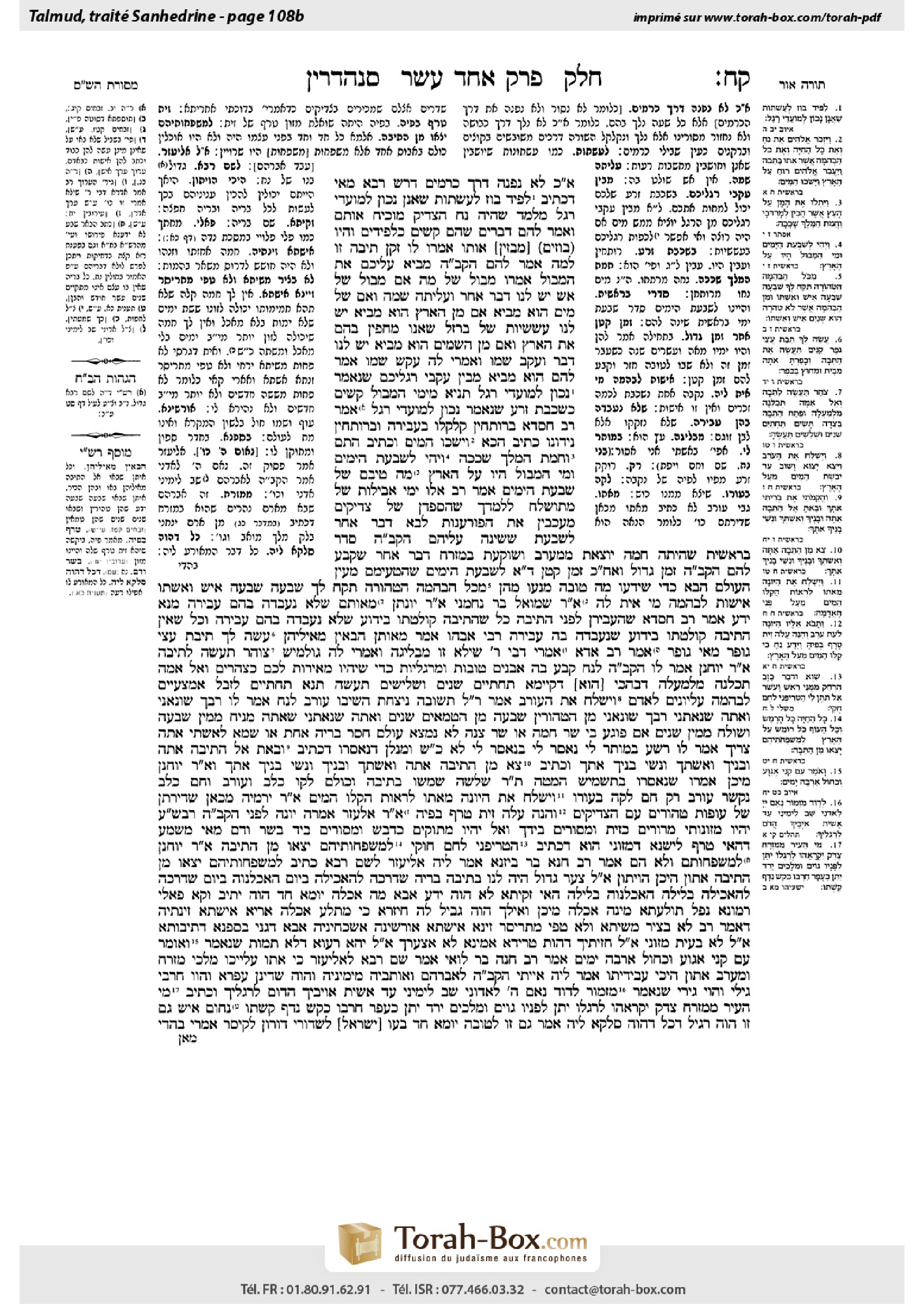
Sanhedrin 108b: Talmud study for Daf Yomi
Daf Yomi is the daily study of one Talmud folio. Explore 37 tractates with scans, Hebrew text, Sefaria English and AI-generated French translations where annotated.
Passage selection and English or AI-generated French translation are available where the scan has annotations. Daf Study is independent of Torah-Box and Sefaria.
Browse Sanhedrin · סנהדרין · All tractatesSanhedrin 108b text and translations
This page of Sanhedrin includes the Aramaic text, an English translation and an AI-generated French translation, alongside the scan above.
סנהדרין ק״ח ב · Aramaic and Hebrew text
אִם כֵּן, לֹא נְפַנֶּה דֶּרֶךְ כְּרָמִים.
דָּרֵשׁ רָבָא: מַאי דִּכְתִיב ״לַפִּיד בּוּז לְעַשְׁתּוּת שַׁאֲנָן נָכוֹן לְמוֹעֲדֵי רָגֶל״? מְלַמֵּד שֶׁהָיָה נֹחַ הַצַּדִּיק מוֹכִיחַ אוֹתָם, וְאָמַר לָהֶם דְּבָרִים שֶׁהֵם קָשִׁים כְּלַפִּידִים, וְהָיוּ בּוֹזִים אוֹתוֹ. אָמְרוּ לוֹ: זָקֵן, תֵּיבָה זוֹ לָמָּה? אָמַר לָהֶם: הַקָּדוֹשׁ בָּרוּךְ הוּא מֵבִיא עֲלֵיכֶם אֶת הַמַּבּוּל. אָמְרוּ: מַבּוּל שֶׁל מָה? אִם מַבּוּל שֶׁל אֵשׁ, יֵשׁ לָנוּ דָּבָר אֶחָד וַעֲלִיתָה שְׁמָהּ. וְאִם שֶׁל מַיִם הוּא מֵבִיא, אִם מִן הָאָרֶץ הוּא מֵבִיא, יֵשׁ לָנוּ עֲשָׁשִׁיּוֹת שֶׁל בַּרְזֶל שֶׁאָנוּ מְחַפִּין בָּהֶם אֶת הָאָרֶץ. וְאִם מִן הַשָּׁמַיִם הוּא מֵבִיא, יֵשׁ לָנוּ דָּבָר וְעָקֵב שְׁמוֹ – וְאָמְרִי לַהּ: עִקֵּשׁ שְׁמוֹ.
אָמַר לָהֶם: הוּא מֵבִיא מִבֵּין עִקְּבֵי רַגְלֵיכֶם, שֶׁנֶּאֱמַר ״נָכוֹן לְמוֹעֲדֵי רָגֶל״. תַּנְיָא: מֵימֵי הַמַּבּוּל קָשִׁים כְּשִׁכְבַת זֶרַע, שֶׁנֶּאֱמַר ״נָכוֹן לְמוֹעֲדֵי רָגֶל״. אָמַר רַב חִסְדָּא: בְּרוֹתְחִין קִלְקְלוּ בַּעֲבֵירָה, וּבְרוֹתְחִין נִידּוֹנוּ. כְּתִיב הָכָא: ״וַיָּשֹׁכּוּ הַמָּיִם״, וּכְתִיב הָתָם: ״וַחֲמַת הַמֶּלֶךְ שָׁכָכָה״.
״וַיְהִי לְשִׁבְעַת הַיָּמִים וּמֵי הַמַּבּוּל הָיוּ עַל הָאָרֶץ״, מָה טִיבָם שֶׁל שִׁבְעַת הַיָּמִים?
אָמַר רַב: אֵלּוּ יְמֵי אֲבֵילוּת שֶׁל מְתוּשֶׁלַח, לְלַמֶּדְךָ שֶׁהֶסְפֵּדָן שֶׁל צַדִּיקִים מְעַכְּבִין אֶת הַפּוּרְעָנוּת לָבֹא. דָּבָר אַחֵר: לְשִׁבְעַת [הַיָּמִים] שֶׁשִּׁינָּה עֲלֵיהֶם הַקָּדוֹשׁ בָּרוּךְ הוּא סֵדֶר בְּרֵאשִׁית, שֶׁהָיְתָה חַמָּה יוֹצֵאת מִמַּעֲרָב וְשׁוֹקַעַת בַּמִּזְרָח. דָּבָר אַחֵר: שֶׁקָּבַע לָהֶם הַקָּדוֹשׁ בָּרוּךְ הוּא זְמַן גָּדוֹל, וְאַחַר כָּךְ זְמַן קָטָן. דָּבָר אַחֵר: לְשִׁבְעַת הַיָּמִים שֶׁהִטְעִימָם מֵעֵין הָעוֹלָם הַבָּא, כְּדֵי שֶׁיֵּדְעוּ מָה טוֹבָה מָנְעוּ מֵהֶן.
״מִכֹּל הַבְּהֵמָה הַטְּהוֹרָה תִּקַּח לְךָ שִׁבְעָה שִׁבְעָה אִישׁ וְאִשְׁתּוֹ״, אִישׁוּת לִבְהֵמָה מִי אִית לַהּ? אָמַר רַבִּי שְׁמוּאֵל בַּר נַחְמָנִי אָמַר רַבִּי יוֹנָתָן: מֵאוֹתָם שֶׁלֹּא נֶעֶבְדָה בָּהֶם עֲבֵירָה.
מְנָא יְדַע? אָמַר רַב חִסְדָּא: שֶׁהֶעֱבִירָן לִפְנֵי הַתֵּיבָה, כֹּל שֶׁהַתֵּיבָה קוֹלַטְתּוֹ – בְּיָדוּעַ שֶׁלֹּא נֶעֶבְדָה בָּהֶם עֲבֵירָה, וְכֹל שֶׁאֵין הַתֵּיבָה קוֹלַטְתּוֹ – בְּיָדוּעַ שֶׁנֶּעֶבְדָה בָּהּ עֲבֵירָה. רַבִּי אֲבָהוּ אָמַר: מֵאוֹתָן הַבָּאִין מֵאֵילֵיהֶן.
״עֲשֵׂה לְךָ תֵּבַת עֲצֵי גֹפֶר״, מַאי גּוֹפֶר? אָמַר רַב אַדָּא: אָמְרִי דְּבֵי רַבִּי שֵׁילָא, זוֹ מַבְלִיגָה. וְאָמְרִי לַהּ: גּוּלְמֵישׁ.
״צֹהַר תַּעֲשֶׂה לַתֵּבָה״ – אָמַר רַבִּי יוֹחָנָן: אָמַר לוֹ הַקָּדוֹשׁ בָּרוּךְ הוּא לְנֹחַ, קְבַע בָּהּ אֲבָנִים טוֹבוֹת וּמַרְגָּלִיּוֹת, כְּדֵי שֶׁיִּהְיוּ מְאִירוֹת לָכֶם כַּצׇּהֳרַיִם.
״וְאֶל אַמָּה תְּכַלֶּנָּה מִלְמַעְלָה״, דִּבְהָכִי [הוּא] דְּקָיְימָא.
״תַּחְתִּיִּם שְׁנִיִּם וּשְׁלִשִׁים תַּעֲשֶׂהָ״ – תָּנָא: תַּחְתִּיִּים לְזֶבֶל, אֶמְצָעִיִּים לַבְּהֵמָה, עֶלְיוֹנִים לָאָדָם.
״וַיְשַׁלַּח אֶת הָעֹרֵב״, אָמַר רֵישׁ לָקִישׁ: תְּשׁוּבָה נִיצַּחַת הֱשִׁיבוֹ עוֹרֵב לְנֹחַ. אָמַר לוֹ: רַבְּךָ שׂוֹנְאֵנִי וְאַתָּה שְׂנֵאתָנִי. רַבְּךָ שׂוֹנְאֵנִי – מִן הַטְּהוֹרִין שִׁבְעָה, מִן הַטְּמֵאִים שְׁנַיִם, וְאַתָּה שְׂנֵאתָנִי – שֶׁאַתָּה מַנִּיחַ מִמִּין שִׁבְעָה וְשׁוֹלֵחַ מִמִּין שְׁנַיִם. אִם פּוֹגֵעַ בִּי שַׂר חַמָּה אוֹ שַׂר צִנָּה, לֹא נִמְצָא עוֹלָם חָסֵר בְּרִיָּה אַחַת? אוֹ שֶׁמָּא לְאִשְׁתִּי אַתָּה צָרִיךְ?
אָמַר לוֹ: רָשָׁע! בַּמּוּתָּר לִי נֶאֱסַר לִי, בַּנֶּאֱסָר לִי לֹא כׇּל שֶׁכֵּן?
וּמְנָלַן דְּנֶאֶסְרוּ? דִּכְתִיב: ״וּבָאתָ אֶל הַתֵּבָה אַתָּה וּבָנֶיךָ וְאִשְׁתְּךָ וּנְשֵׁי בָנֶיךָ אִתָּךְ״, וּכְתִיב: ״צֵא מִן הַתֵּבָה אַתָּה וְאִשְׁתְּךָ וּבָנֶיךָ וּנְשֵׁי בָנֶיךָ אִתָּךְ״. וְאָמַר רַבִּי יוֹחָנָן: מִיכָּן (אָמְרוּ) שֶׁנֶּאֶסְרוּ בְּתַשְׁמִישׁ הַמִּטָּה.
תָּנוּ רַבָּנַן: שְׁלֹשָׁה שִׁמְּשׁוּ בַּתֵּיבָה, וְכוּלָּם לָקוּ. כֶּלֶב וְעוֹרֵב וְחָם. כֶּלֶב נִקְשַׁר, עוֹרֵב רָק, חָם לָקָה בְּעוֹרוֹ.
״וַיְשַׁלַּח אֶת הַיּוֹנָה מֵאִתּוֹ לִרְאוֹת הֲקַלּוּ הַמַּיִם״. אָמַר רַבִּי יִרְמְיָה: מִכָּאן שֶׁדִּירָתָן שֶׁל עוֹפוֹת טְהוֹרִים עִם הַצַּדִּיקִים.
״וְהִנֵּה עֲלֵה זַיִת טָרָף בְּפִיהָ״. אָמַר רַבִּי אֶלְעָזָר: אָמְרָה יוֹנָה לִפְנֵי הַקָּדוֹשׁ בָּרוּךְ הוּא, רִבּוֹנוֹ שֶׁל עוֹלָם, יִהְיוּ מְזוֹנוֹתַי מְרוֹרִים כְּזַיִת וּמְסוּרִים בְּיָדְךָ, וְאַל יִהְיוּ מְתוּקִים כִּדְבַשׁ וּמְסוּרִים בְּיַד בָּשָׂר וָדָם. מַאי מַשְׁמַע דְּהַאי ״טָרָף״ לִישָּׁנָא דִּמְזוֹנֵי הוּא? דִּכְתִיב: ״הַטְרִיפֵנִי לֶחֶם חֻקִּי״.
״לְמִשְׁפְּחֹתֵיהֶם יָצְאוּ מִן הַתֵּבָה״, אָמַר רַבִּי יוֹחָנָן: ״לְמִשְׁפְּחוֹתָם״ וְלֹא ״הֵם״.
אָמַר רַב חָנָא בַּר בִּיזְנָא: אָמַר לֵיהּ אֱלִיעֶזֶר לְשֵׁם רַבָּא, כְּתִיב: ״לְמִשְׁפְּחֹתֵיהֶם יָצְאוּ מִן הַתֵּבָה״. אַתּוּן הֵיכָן הֲוֵיתוּן? אֲמַרוּ לֵיהּ: צַעַר גָּדוֹל הָיָה לָנוּ בַּתֵּיבָה. בְּרִיָּה שֶׁדַּרְכָּהּ לְהַאֲכִילָהּ בַּיּוֹם – הֶאֱכַלְנוּהָ בַּיּוֹם, שֶׁדַּרְכָּהּ לְהַאֲכִילָהּ בַּלַּיְלָה – הֶאֱכַלְנוּהָ בַּלַּיְלָה. הַאי זְקִיתָא לָא הֲוָה יָדַע אַבָּא מָה אָכְלָה. יוֹמָא חַד הֲוָה יָתֵיב וְקָא פָאלֵי רִמּוֹנָא, נְפַל תּוֹלַעְתָּא מִינַּהּ אֲכַלָה. מִיכָּן וְאֵילָךְ הֲוָה גָּבֵיל לַהּ חִיזְרָא, כִּי מַתְלַע אָכְלָה.
אַרְיָא – אֶישָּׁתָא זַנְתֵּיהּ, דְּאָמַר רַב: לָא בְּצִיר מִשִּׁיתָּא וְלָא טְפֵי מִתְּרֵיסַר זָיְנָא אִישָּׁתָא. אוּרְשִׁינָה – אַשְׁכְּחֵיהּ אַבָּא דְּגָנֵי בְּסַפְנָא דְּתֵיבוֹתָא. אֲמַר לֵיהּ: לָא בָּעֵית מְזוֹנֵי? אֲמַר לֵיהּ: חֲזֵיתָיךְ דַּהֲוֵת טְרִידַתְּ, אָמֵינָא לָא אֲצַעֲרָךְ. אֲמַר לֵיהּ: יְהֵא רַעֲוָא דְּלָא תְּמוּת, שֶׁנֶּאֱמַר: ״וָאֹמַר עִם קִנִּי אֶגְוָע וְכַחוֹל אַרְבֶּה יָמִים״.
אָמַר רַב חָנָה בַּר לֵוַאי: אֲמַר שֵׁם רַבָּא לֶאֱלִיעֶזֶר, כִּי אֲתוֹ עֲלַיְיכוּ מַלְכֵי מִזְרָח וּמַעֲרָב, אַתּוּן הֵיכִי עֲבְידִיתוּ? אֲמַר לֵיהּ: אַיְיתִי הַקָּדוֹשׁ בָּרוּךְ הוּא לְאַבְרָהָם וְאוֹתְבֵיהּ מִיַּמִּינֵיהּ, וַהֲוָה שָׁדֵינַן עַפְרָא וְהָווּ חַרְבֵי, גִּילֵי וְהָווּ גִּירֵי, שֶׁנֶּאֱמַר: ״מִזְמוֹר לְדָוִד נְאֻם ה׳ לַאדֹנִי שֵׁב לִימִינִי עַד אָשִׁית אֹיְבֶיךָ הֲדֹם לְרַגְלֶיךָ״, וּכְתִיב: ״מִי הֵעִיר מִמִּזְרָח צֶדֶק יִקְרָאֵהוּ לְרַגְלוֹ יִתֵּן לְפָנָיו גּוֹיִם וּמְלָכִים יַרְדְּ יִתֵּן כֶּעָפָר חַרְבּוֹ כְּקַשׁ נִדָּף קַשְׁתּוֹ״.
נַחוּם אִישׁ גַּם זוֹ הֲוָה רְגִיל, דְּכֹל דַּהֲוָה סָלְקָא לֵיהּ אֲמַר: ״גַּם זוֹ לְטוֹבָה״. יוֹמָא חַד בְּעוֹ [יִשְׂרָאֵל] לְשַׁדּוֹרֵי דּוֹרוֹן לְקֵיסָר. אָמְרִי: בַּהֲדֵי
Sanhedrin 108b · English translation
They said to him: If so we will not clear a path through vineyards, i.e., we will continue to sin.
Rava taught: What is the meaning of that which is written: “A contemptible torch [lapid] in the thought of him that is at ease, a thing ready for them whose foot slips” (Job 12:5)? This teaches that Noah the righteous would rebuke the people of his generation, and he said to them statements that are harsh as torches [kelapidim], and they would treat him with contempt. They said to him: Old man, why are you building this ark? Noah said to them: The Holy One, Blessed be He, is bringing a flood upon you. They said to him: A flood of what? If it is a flood of fire, we have another item and it is called alita, and it is fireproof. And if it is a flood of water that He brings, if He brings the water from the earth, we have iron plates with which we can plate the earth to prevent the water from rising. And if He brings the water from the heavens, we have an item and it is called ekev, and some say it is called ikkesh, which will absorb the water.
Noah said to them: If He wishes He will bring the water from between your feet and you can do nothing to prevent it, as it is stated: “For them whose foot slips.” It is taught in a baraita: The waters of the flood were as hard and thick as semen, as it is stated: “For them whose foot slips”; foot is a euphemism. Rav Ḥisda says: With hot semen they sinned, and with hot water they were punished. As it is written here, at the conclusion of the flood: “And the waters assuaged” (Genesis 8:1), and it is written there: “Then the king’s wrath was assuaged” (Esther 7:10). Just as the term “assuaged” there is referring to the heat of Ahasuerus’s wrath, so too, “assuaged” with regard to the flood is referring to the heat of the waters.
With regard to the verse: “And it came to pass that after seven days the waters of the flood were upon the earth” (Genesis 7:10), the Gemara asks: What is the nature of these seven additional days?
Rav says: These were the days of mourning for the death of Methuselah; and this is to teach you that eulogies for the righteous prevent calamities from ensuing. Alternatively, “after seven days” means that the Holy One, Blessed be He, altered the order of Creation for that generation, i.e., in seven days He reversed the process of Creation, so that the sun would emerge in the west and set in the east. Alternatively, it means that the Holy One, Blessed be He, designated a substantial period for them, one hundred and twenty years, to repent, and thereafter designated a brief period for them, an additional seven days, as a final opportunity for them to repent. Alternatively, “after seven days” means that during those seven days, God gave them a foretaste of the delights of the World-to-Come, which will be actualized during the seventh millennium, so that they would know what munificence their sins prevented them from receiving.
§ With regard to the verse: “Of every kosher animal you shall take to you by sevens, husband and wife” (Genesis 7:2), the Gemara asks: Is there marriage for animals? Rabbi Shmuel bar Naḥmani says that Rabbi Yonatan says: The reference is to those animals with which the transgression of relations with another species was not performed. Therefore, the Torah underscores that the animals that entered the ark were husband and wife.
The Gemara asks: From where did Noah know which animals were not involved in that transgression? Rav Ḥisda says: He passed them before the ark. All animals that the ark accepted, it was known that a transgression had not been performed with them. And any animal that the ark did not accept, it was known that a transgression had been performed with it. Rabbi Abbahu says: Noah took onto the ark only from those animals that came on their own, as it appeared that they were sent from Heaven, and they were certainly fit for this purpose.
With regard to the verse: “Make you an ark of gopher wood” (Genesis 6:14), the Gemara asks: What is gopher wood? Rav Adda says that they say in the school of Rabbi Sheila: This is wood from the mavliga tree; and some say that it is wood from the willow [gulamish] tree.
With regard to the verse: “A tzohar you shall make for the ark” (Genesis 6:16), Rabbi Yoḥanan says that the Holy One, Blessed be He, said to Noah: Set precious stones and jewels in the ark so that they will shine for you as the afternoon [tzohorayim] sun.
With regard to the verse: “And to a cubit you shall finish it above” (Genesis 6:16), the Gemara explains that in that manner, having been built wide at its base and narrow at its top, the ark would stand upright and would not capsize.
With regard to the verse: “With lower, second and third stories shall you make it” (Genesis 6:16), it was taught in a baraita: The bottom story was for manure, the middle story was for animals, and the top story was for people.
With regard to the verse: “And he sent forth the raven, which went forth to and fro, until the waters were dried up from the earth” (Genesis 8:7), Reish Lakish says: The raven provided a convincing response to Noah; when it did not wish to leave the ark the raven said to him: Your Master, God, hates me, and you hate me. Your Master hates me, as He commanded to take from the kosher species seven and from the non-kosher species two. And you hate me, as you disregard those from the species of seven, i.e., the kosher birds, and instead dispatch one from the species of two, i.e., the non-kosher birds. If the angel of heat or the angel of cold harms me and kills me, will the world not be lacking one species of creature, as there was only one pair of ravens? Or perhaps you are sending me because it is my wife that you need, in order to engage in intercourse with her.
Noah said to the raven: Wicked one! If with the woman who is generally permitted to me, my wife, intercourse is forbidden to me, then with regard to domesticated and undomesticated animals, which are generally forbidden to me, is it not all the more so the case that they are forbidden to me?
The Gemara asks: And from where do we derive that it was prohibited for them to engage in intercourse while in the ark? The Gemara answers: It is derived from that which is written: “And you shall come into the ark, you, and your sons, and your wife, and your sons’ wives with you” (Genesis 6:18); and it is written: “Emerge from the ark, you and your wife, and your sons and your sons’ wives with you” (Genesis 8:16). And Rabbi Yoḥanan says: From here, the Sages derived and said that it was prohibited to engage in intercourse while in the ark, as when Noah and his family entered, the husbands and wives were listed separately, and when they emerged, the husbands were listed with their wives.
The Sages taught: Three violated that directive and engaged in intercourse while in the ark, and all of them were punished for doing so. They are: The dog, and the raven, and Ham, son of Noah. The dog was punished in that it is bound; the raven was punished in that it spits, and Ham was afflicted in that his skin turned black.
With regard to the verse: “And he sent forth the dove from him, to see if the waters abated” (Genesis 8:8), Rabbi Yirmeya says: From here it is derived that the dwelling place of kosher birds in the ark was with the righteous people, as the verse emphasizes that Noah dispatched the dove from his place.
With regard to the verse: “And in her mouth was an olive branch plucked off [taraf ]” (Genesis 8:11), Rabbi Elazar says: The dove said before the Holy One, Blessed be He: Master of the Universe, may my sustenance be bitter as the olive and dependent on Your hands, and not sweet as honey and dependent on the hands of flesh and blood. The Gemara asks: From where may it be inferred that taraf is a term that indicates sustenance? The Gemara answers: It is inferred from that which is written: “Feed me [hatrifeni] with my allotted portion” (Proverbs 30:8).
With regard to the verse: “After their kinds [lemishpeḥoteihem], they emerged from the ark” (Genesis 8:19), Rabbi Yoḥanan says: After their kinds [lemishpeḥotam] the animals emerged, but not them [hem] themselves, as some of the animals that entered the ark died during that year and it was their descendants who emerged.
Rav Ḥana bar Bizna says: Eliezer, servant of Abraham, said to Shem the Great, son of Noah: It is written: “After their kinds, they emerged from the ark,” indicating that the different types of animals were not intermingled while in the ark. Where were you and what did you do to care for them while they were in the ark? Shem said to him: We experienced great suffering in the ark caring for the animals. Where there was a creature that one typically feeds during the day, we fed it during the day, and where there was a creature that one typically feeds at night, we fed it at night. With regard to that chameleon, my father did not know what it eats. One day, my father was sitting and peeling a pomegranate. A worm fell from it and the chameleon ate it. From that point forward my father would knead bran with water, and when it became overrun with worms, the chameleon would eat it.
With regard to the lion, a fever sustained it, since when it suffered from a fever, it did not need to eat; as Rav said: For no fewer than six days and no more than twelve days, fever sustains a person; he need not eat and is sustained from his own fats. Shem continued: With regard to the phoenix [avarshina], my father found it lying in its compartment on the side of the ark. He said to the bird: Do you not want food? The bird said to him: I saw that you were busy, and I said I would not trouble you by requesting food. Noah said to the bird: May it be God’s will that you shall not die, and through that bird the verse was fulfilled, as it is stated: “And I said, I shall die in my nest, and I shall multiply my days as the phoenix” (Job 29:18).
§ Rav Ḥana bar Leva’ei says that Shem the Great said to Eliezer, servant of Abraham: When the four great kings of the east and the west came upon you to wage war with Abraham, what did you do? Eliezer said to him: The Holy One, Blessed be He, brought Abraham and placed him to His right, and we would throw dust and it became swords, and we threw straw and it became arrows, as it is stated: “A Psalm of David. The Lord says to my master: Sit to My right, until I make your enemies your footstool” (Psalms 110:1), and it is written: “Who has raised up one from the east at whose steps victory attends? He gives nations before him, and makes him rule over kings; his sword makes them as the dust, his bow as driven straw” (Isaiah 41:2).
Apropos Abraham’s miraculous weapons, the Gemara relates: Naḥum of Gam Zo was accustomed that in response to any circumstance that arose in his regard, he would say: This too [gam zo] is for the best. One day the Jewish people sought to send a gift [doron] to the emperor. They said: With
Sanhedrin 108b · Traduction française (IA)
Ils lui dirent : « Si c’est ainsi, nous ne dégagerons pas de passage à travers les vignes », c’est-à-dire que nous continuerons à pécher.
Rava enseigna : Que signifie ce qui est écrit : « Une torche méprisable [lapid] dans la pensée de celui qui est tranquille, une chose réservée à ceux dont le pied glisse » (Job 12:5) ? Cela enseigne que Noé le juste réprimandait les gens de sa génération et leur adressait des paroles aussi dures que des torches [kelapidim], mais qu’ils le traitaient avec mépris. Ils lui dirent : « Vieillard, pourquoi construis-tu cette arche ? » Noé leur répondit : « Le Saint, béni soit-Il, va faire venir un déluge sur vous. » Ils lui dirent : « Un déluge de quoi ? Si c’est un déluge de feu, nous avons un matériau appelé alita, qui résiste au feu. Et s’Il fait venir un déluge d’eau, si l’eau vient de la terre, nous avons des plaques de fer dont nous pouvons recouvrir le sol pour empêcher l’eau de monter. Et si l’eau vient des cieux, nous avons un matériau appelé ekev, et certains disent qu’il s’appelle ikkesh, qui absorbera l’eau. »
Noé leur dit : « S’Il le veut, Il fera venir l’eau d’entre vos pieds, et vous ne pourrez rien faire pour l’en empêcher », comme il est dit : « Ceux dont le pied glisse ». Il est enseigné dans une baraïta : Les eaux du déluge étaient aussi dures et épaisses que du sperme, comme il est dit : « Ceux dont le pied glisse » ; « pied » est un euphémisme. Rav Ḥisda dit : Ils péchèrent avec du sperme chaud et furent punis par de l’eau chaude. Car il est écrit ici, à la fin du déluge : « Et les eaux s’apaisèrent » (Genèse 8:1), et il est écrit là : « Alors la colère du roi s’apaisa » (Esther 7:10). De même que le terme « s’apaisa » désigne là la chaleur de la colère d’Assuérus, de même, « s’apaisèrent », à propos du déluge, désigne la chaleur des eaux.
À propos du verset : « Et il arriva qu’au bout de sept jours, les eaux du déluge furent sur la terre » (Genèse 7:10), la Guemara demande : Que signifient ces sept jours supplémentaires ?
Rav dit : C’étaient les jours de deuil pour la mort de Mathusalem. Cela t’enseigne que les oraisons funèbres en l’honneur des justes empêchent les calamités de survenir. Autre explication : « Au bout de sept jours » signifie que le Saint, béni soit-Il, bouleversa l’ordre de la Création pour cette génération, c’est-à-dire qu’en sept jours, Il inversa le processus de la Création, de sorte que le soleil se lève à l’ouest et se couche à l’est. Autre explication : le Saint, béni soit-Il, leur accorda une longue période pour se repentir, cent vingt ans, puis une courte période, sept jours supplémentaires, comme ultime occasion de se repentir. Autre explication : « Au bout de sept jours » signifie que pendant ces sept jours, Dieu leur donna un avant-goût des délices du Monde à venir, qui se réaliseront au cours du septième millénaire, afin qu’ils sachent quelle abondance leurs péchés les empêchaient de recevoir.
§ À propos du verset : « De tout animal pur, tu prendras pour toi par sept, mâle et femelle » (Genèse 7:2), la Guemara demande : Les animaux se marient-ils ? Rabbi Shmuel bar Naḥmani dit au nom de Rabbi Yonatan : Il s’agit des animaux avec lesquels aucune transgression de relations avec une autre espèce n’avait été commise. C’est pourquoi la Torah souligne que les animaux entrés dans l’arche étaient mâle et femelle.
La Guemara demande : Comment Noé savait-il quels animaux n’avaient pas participé à cette transgression ? Rav Ḥisda dit : Il les fit passer devant l’arche. Pour tous les animaux que l’arche accepta, on sut qu’aucune transgression n’avait été commise avec eux. Quant à tout animal que l’arche n’accepta pas, on sut qu’une transgression avait été commise avec lui. Rabbi Abbahu dit : Noé ne prit dans l’arche que les animaux qui vinrent d’eux-mêmes, car ils semblaient avoir été envoyés du Ciel et étaient assurément aptes à cette fin.
À propos du verset : « Fais-toi une arche en bois de gopher » (Genèse 6:14), la Guemara demande : Qu’est-ce que le bois de gopher ? Rav Adda dit qu’à l’école de Rabbi Sheila, on enseigne qu’il s’agit du bois de l’arbre mavliga ; certains disent qu’il s’agit du bois du saule [gulamish].
À propos du verset : « Tu feras un tzohar pour l’arche » (Genèse 6:16), Rabbi Yoḥanan dit que le Saint, béni soit-Il, dit à Noé : « Place dans l’arche des pierres précieuses et des joyaux, afin qu’ils brillent pour toi comme le soleil de l’après-midi [tzohorayim]. »
À propos du verset : « Tu l’achèveras à une coudée au-dessus » (Genèse 6:16), la Guemara explique qu’ainsi, construite avec une base large et un sommet étroit, l’arche resterait droite et ne chavirerait pas.
À propos du verset : « Tu la feras avec un étage inférieur, un deuxième et un troisième » (Genèse 6:16), il est enseigné dans une baraïta : L’étage inférieur était réservé au fumier, l’étage du milieu aux animaux et l’étage supérieur aux êtres humains.
À propos du verset : « Il lâcha le corbeau, qui sortit et revint, jusqu’à ce que les eaux aient séché sur la terre » (Genèse 8:7), Reish Lakish dit : Le corbeau donna à Noé une réponse convaincante. Comme il ne voulait pas quitter l’arche, il lui dit : « Ton Maître, Dieu, me déteste, et toi aussi tu me détestes. Ton Maître me déteste, puisqu’Il a ordonné de prendre sept animaux des espèces pures et deux des espèces impures. Et toi, tu me détestes, puisque tu négliges les oiseaux des espèces prises par sept, c’est-à-dire les oiseaux purs, et que tu envoies à la place un oiseau d’une espèce prise par deux, c’est-à-dire un oiseau impur. Si l’ange de la chaleur ou l’ange du froid me fait du mal et me tue, le monde ne sera-t-il pas privé d’une espèce de créature, puisqu’il n’y avait qu’un seul couple de corbeaux ? Ou peut-être m’envoies-tu parce que tu as besoin de ma femelle pour avoir des relations avec elle. »
Noé dit au corbeau : « Mécréant ! Si les relations avec la femme qui m’est habituellement permise, mon épouse, me sont interdites, à plus forte raison les relations avec les animaux domestiques et sauvages, qui me sont habituellement interdits, me sont-elles interdites. »
La Guemara demande : Et d’où déduisons-nous qu’il leur était interdit d’avoir des relations dans l’arche ? La Guemara répond : Cela se déduit de ce qui est écrit : « Tu entreras dans l’arche, toi, tes fils, ta femme et les femmes de tes fils avec toi » (Genèse 6:18), et de ce qui est écrit : « Sors de l’arche, toi, ta femme, tes fils et les femmes de tes fils avec toi » (Genèse 8:16). Rabbi Yoḥanan dit : C’est de là que les Sages ont déduit et enseigné qu’il était interdit d’avoir des relations dans l’arche : lorsque Noé et sa famille entrèrent, les maris et les femmes sont mentionnés séparément, tandis qu’à leur sortie, les maris sont mentionnés avec leurs femmes.
Les Sages ont enseigné : Trois enfreignirent cette directive et eurent des relations dans l’arche, et tous furent punis pour cela. Il s’agit du chien, du corbeau et de Ḥam, fils de Noé. Le chien fut puni en étant attaché ; le corbeau fut puni en crachant ; et Ḥam fut frappé : sa peau devint noire.
À propos du verset : « Il lâcha la colombe loin de lui, pour voir si les eaux avaient baissé » (Genèse 8:8), Rabbi Yirmeya dit : On déduit de là que, dans l’arche, les oiseaux purs logeaient auprès des justes, car le verset souligne que Noé lâcha la colombe depuis son emplacement.
À propos du verset : « Et dans son bec se trouvait un rameau d’olivier fraîchement cueilli [taraf] » (Genèse 8:11), Rabbi Elazar dit : La colombe dit devant le Saint, béni soit-Il : « Maître de l’univers, que ma subsistance soit amère comme l’olive et dépende de Tes mains, et non douce comme le miel et dépendante des mains de chair et de sang. » La Guemara demande : D’où peut-on déduire que taraf est un terme désignant la subsistance ? La Guemara répond : On le déduit de ce qui est écrit : « Donne-moi [hatrifeni] ma part » (Proverbes 30:8).
À propos du verset : « Selon leurs familles [lemishpeḥoteihem], ils sortirent de l’arche » (Genèse 8:19), Rabbi Yoḥanan dit : Les animaux sortirent selon leurs familles [lemishpeḥotam], mais pas eux-mêmes [hem], car certains des animaux entrés dans l’arche moururent durant cette année, et ce furent leurs descendants qui en sortirent.
Rav Ḥana bar Bizna dit : Éliézer, le serviteur d’Abraham, dit à Chem le Grand, fils de Noé : « Il est écrit : “Selon leurs familles, ils sortirent de l’arche”, ce qui indique que les différentes espèces d’animaux ne se mêlèrent pas dans l’arche. Où étais-tu et que faisais-tu pour t’occuper d’eux pendant qu’ils étaient dans l’arche ? » Chem lui dit : « Nous avons beaucoup souffert dans l’arche en nous occupant des animaux. Nous nourrissions de jour les créatures que l’on nourrit habituellement le jour, et de nuit celles que l’on nourrit habituellement la nuit. Quant à ce caméléon, mon père ne savait pas ce qu’il mangeait. Un jour, mon père était assis et épluchait une grenade. Un ver en tomba et le caméléon le mangea. À partir de ce moment, mon père pétrissait du son avec de l’eau ; lorsqu’il grouillait de vers, le caméléon le mangeait. »
Quant au lion, une fièvre le maintenait en vie, car lorsqu’il souffrait de fièvre, il n’avait pas besoin de manger. Rav a dit en effet : La fièvre soutient une personne pendant au moins six jours et au plus douze jours ; elle n’a pas besoin de manger et se nourrit de ses propres graisses. Chem poursuivit : « Quant au phénix [avarshina], mon père le trouva couché dans son compartiment, sur le côté de l’arche. Il dit à l’oiseau : “Ne veux-tu pas de nourriture ?” L’oiseau lui répondit : “J’ai vu que tu étais occupé, et je me suis dit que je ne te dérangerais pas en te demandant de la nourriture.” Noé dit à l’oiseau : “Puisse Dieu faire que tu ne meures pas.” Grâce à cet oiseau, le verset s’accomplit, comme il est dit : “Je me disais : Je mourrai dans mon nid, et je multiplierai mes jours comme le phénix” (Job 29:18). »
§ Rav Ḥana bar Leva’ei dit que Chem le Grand dit à Éliézer, le serviteur d’Abraham : « Lorsque les quatre grands rois de l’est et de l’ouest vinrent contre vous pour faire la guerre à Abraham, qu’avez-vous fait ? » Éliézer lui dit : « Le Saint, béni soit-Il, fit venir Abraham et le plaça à Sa droite ; nous jetions de la poussière, qui se transformait en épées, et nous jetions de la paille, qui se transformait en flèches », comme il est dit : « Psaume de David. L’Éternel dit à mon seigneur : Assieds-toi à ma droite, jusqu’à ce que je fasse de tes ennemis un marchepied pour tes pieds » (Psaumes 110:1), et il est écrit : « Qui a suscité de l’Orient celui que la victoire accompagne à chacun de ses pas ? Il lui livre des nations et lui assujettit des rois ; son épée les réduit en poussière, son arc à de la paille emportée par le vent » (Isaïe 41:2).
À propos des armes miraculeuses d’Abraham, la Guemara rapporte : Naḥum de Gam Zo avait l’habitude de dire, face à toute circonstance qui le concernait : « Cela aussi [gam zo] est pour le bien. » Un jour, le peuple juif voulut envoyer un cadeau [doron] à l’empereur. Ils dirent : « Avec
Traduction française générée par IA à partir de l’édition anglaise de Sefaria. Vérifie toujours un passage avec le texte source.
Text from Sefaria: William Davidson Edition - Vocalized Aramaic (CC BY NC); William Davidson Edition - English (CC BY NC).