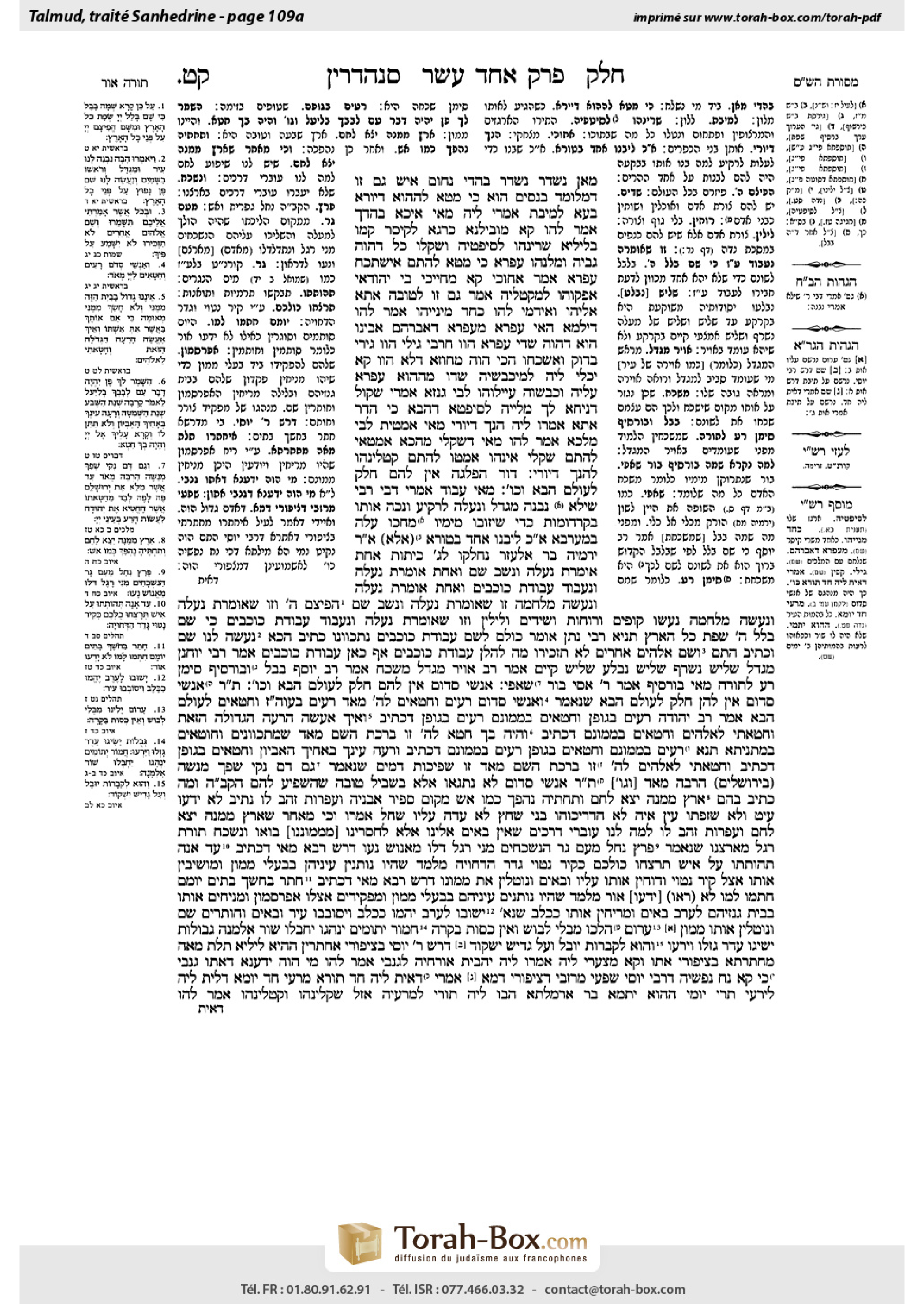
Sanhedrin 109a: Talmud study for Daf Yomi
Daf Yomi is the daily study of one Talmud folio. Explore 37 tractates with scans, Hebrew text, Sefaria English and AI-generated French translations where annotated.
Passage selection and English or AI-generated French translation are available where the scan has annotations. Daf Study is independent of Torah-Box and Sefaria.
Browse Sanhedrin · סנהדרין · All tractatesSanhedrin 109a text and translations
This page of Sanhedrin includes the Aramaic text, an English translation and an AI-generated French translation, alongside the scan above.
סנהדרין ק״ט א · Aramaic and Hebrew text
מַאן נְשַׁדַּר? נְשַׁדַּר בַּהֲדֵי נַחוּם אִישׁ גַּם זוֹ, דִּמְלוּמָּד בְּנִסִּים הוּא.
כִּי מְטָא לְהָהוּא דִּיּוּרָא, בְּעָא לְמֵיבַת. אָמְרִי לֵיהּ: מַאי אִיכָּא בַּהֲדָךְ? אֲמַר לְהוּ: קָא מוֹבֵילְנָא כְּרָגָא לְקֵיסָר. קָמוּ בְּלֵילְיָא, שְׁרוֹנְהוּ לְסִיפְטֵיהּ, וּשְׁקַלוּ כֹּל דַּהֲוָה גַּבֵּיהּ וּמַלּוֹנְהוּ עַפְרָא. כִּי מְטָא לְהָתָם, אִישְׁתְּכַח עַפְרָא. אֲמַר: אַחוֹכֵי קָא מְחַיְּיכִי בִּי יְהוּדָאֵי. אַפְּקוּהּ לְמִקְטְלֵיהּ. אֲמַר: גַּם זוֹ לְטוֹבָה. אֲתָא אֵלִיָּהוּ וְאִידְּמִי לְהוּ כְּחַד מִינַּיְיהוּ. אֲמַר לְהוּ: דִּילְמָא הַאי עַפְרָא מֵעַפְרָא דְּאַבְרָהָם אָבִינוּ הוּא, דַּהֲוָה שָׁדֵי עַפְרָא הָווּ חַרְבֵי, גִּילֵי הָווּ גִּירֵי. בְּדוּק וְאַשְׁכַּחוּ הָכִי.
הֲוָה מָחוֹזָא דְּלָא הֲווֹ קָא יָכְלִי לֵיהּ לְמִיכְבְּשֵׁיהּ. שְׁדוֹ מֵהָהוּא עַפְרָא עֲלֵיהּ וְכַבְשׁוּהּ. עַיְּילוּהּ לְבֵי גִנְזָא, אָמְרִי: שְׁקוֹל דְּנִיחָא לָךְ. מַלְּיֵיהּ לְסִיפְטָא דַּהֲבָא. כִּי הֲדַר אֲתָא, אֲמַרוּ לֵיהּ הָנָךְ דָּיּוֹרֵי: מַאי אַמְטֵית לְבֵי מַלְכָּא? אֲמַר לְהוּ: מַאי דִּשְׁקַלִי מֵהָכָא אַמְטַאי לְהָתָם. שָׁקְלִי אִינְהוּ אַמְטוֹ לְהָתָם. קַטְלִינְהוּ לְהָנָךְ דָּיוֹרֵי.
דּוֹר הַפְּלַגָּה אֵין לָהֶם חֵלֶק לָעוֹלָם הַבָּא וְכוּ׳. מַאי עֲבוּד? אָמְרִי דְּבֵי רַבִּי שֵׁילָא: נִבְנֶה מִגְדָּל וְנַעֲלֶה לָרָקִיעַ, וְנַכֶּה אוֹתוֹ בְּקַרְדּוּמּוֹת כְּדֵי שֶׁיָּזוּבוּ מֵימָיו. מַחֲכוּ עֲלַהּ בְּמַעְרְבָא: אִם כֵּן, לִיבְנוֹ אַחַד טוּרָא!
(אֶלָּא) אָמַר רַבִּי יִרְמְיָה בַּר אֶלְעָזָר: נֶחְלְקוּ לְשָׁלֹשׁ כִּיתּוֹת, אַחַת אוֹמֶרֶת: נַעֲלֶה וְנֵשֵׁב שָׁם, וְאַחַת אוֹמֶרֶת: נַעֲלֶה וְנַעֲבוֹד עֲבוֹדָה זָרָה, וְאַחַת אוֹמֶרֶת: נַעֲלֶה וְנַעֲשֶׂה מִלְחָמָה. זוֹ שֶׁאוֹמֶרֶת נַעֲלֶה וְנֵשֵׁב שָׁם – ״הֱפִיצָם ה׳״, וְזוֹ שֶׁאוֹמֶרֶת נַעֲלֶה וְנַעֲשֶׂה מִלְחָמָה – נַעֲשׂוּ קוֹפִים וְרוּחוֹת וְשֵׁידִים וְלִילִין, וְזוֹ שֶׁאוֹמֶרֶת נַעֲלֶה וְנַעֲבוֹד עֲבוֹדָה זָרָה – ״כִּי שָׁם בָּלַל ה׳ שְׂפַת כׇּל הָאָרֶץ״.
תַּנְיָא, רַבִּי נָתָן אוֹמֵר: כּוּלָּם לְשֵׁם עֲבוֹדָה זָרָה נִתְכַּוְּונוּ. כְּתִיב הָכָא: ״נַעֲשֶׂה לָנוּ שֵׁם״, וּכְתִיב הָתָם: ״וְשֵׁם אֱלֹהִים אֲחֵרִים לֹא תַזְכִּירוּ״. מָה לְהַלָּן עֲבוֹדָה זָרָה, אַף כָּאן עֲבוֹדָה זָרָה.
אָמַר רַבִּי יוֹחָנָן: מִגְדָּל שְׁלִישׁ נִשְׂרַף, שְׁלִישׁ נִבְלַע, שְׁלִישׁ קַיָּים. אָמַר רַב: אֲוִיר מִגְדָּל מְשַׁכֵּחַ. אָמַר רַב יוֹסֵף: בָּבֶל וּבוֹרְסִיף סִימָן רַע לַתּוֹרָה. מַאי בּוֹרְסִיף? אָמַר רַבִּי אַסִּי: בּוֹר שָׁאפֵי.
״אַנְשֵׁי סְדוֹם אֵין לָהֶם חֵלֶק לָעוֹלָם הַבָּא וְכוּ׳״. תָּנוּ רַבָּנַן: אַנְשֵׁי סְדוֹם אֵין לָהֶן חֵלֶק לָעוֹלָם הַבָּא, שֶׁנֶּאֱמַר: ״וְאַנְשֵׁי סְדֹם רָעִים וְחַטָּאִים לַה׳ מְאֹד״. ״רָעִים״ – בָּעוֹלָם הַזֶּה, ״וְחַטָּאִים״ – לָעוֹלָם הַבָּא.
אָמַר רַב יְהוּדָה: רָעִים בְּגוּפָן, וְחַטָּאִים בְּמָמוֹנָם. רָעִים בְּגוּפָן – דִּכְתִיב: ״וְאֵיךְ אֶעֱשֶׂה הָרָעָה הַגְּדֹלָה הַזֹּאת וְחָטָאתִי לֵאלֹהִים״, וְחַטָּאִים בְּמָמוֹנָם – דִּכְתִיב: ״וְהָיָה בְךָ חֵטְא״. ״לַה׳״ – זוֹ בִּרְכַּת הַשֵּׁם. ״מְאֹד״ – שֶׁמִּתְכַּוְּונִים וְחוֹטְאִים.
בְּמַתְנִיתָא תָּנָא: ״רָעִים״ – בְּמָמוֹנָם, ״וְחַטָּאִים״ – בְּגוּפָן. רָעִים בְּמָמוֹנָם, דִּכְתִיב: ״וְרָעָה עֵינְךָ בְּאָחִיךָ הָאֶבְיוֹן״. וְחַטָּאִים בְּגוּפָן, דִּכְתִיב: ״וְחָטָאתִי לֵאלֹהִים״. ״לַה׳״ – זוֹ בִּרְכַּת הַשֵּׁם. ״מְאֹד״ – זוֹ שְׁפִיכוּת דָּמִים, שֶׁנֶּאֱמַר: ״וְגַם דָּם נָקִי שָׁפַךְ מְנַשֶּׁה בִּירוּשָׁלַיִם הַרְבֵּה מְאֹד [וְגוֹ׳]״.
תָּנוּ רַבָּנַן: אַנְשֵׁי סְדוֹם לֹא נִתְגָּאוּ אֶלָּא בִּשְׁבִיל טוֹבָה שֶׁהִשְׁפִּיעַ לָהֶם הַקָּדוֹשׁ בָּרוּךְ הוּא, וּמָה כְּתִיב בָּהֶם? ״אֶרֶץ מִמֶּנָּה יֵצֵא לָחֶם וְתַחְתֶּיהָ נֶהְפַּךְ כְּמוֹ אֵשׁ. מְקוֹם סַפִּיר אֲבָנֶיהָ וְעַפְרֹת זָהָב לוֹ. נָתִיב לֹא יְדָעוֹ עָיִט וְלֹא שְׁזָפַתּוּ עֵין אַיָּה. לֹא הִדְרִיכוּהוּ בְנֵי שָׁחַץ לֹא עָדָה עָלָיו שָׁחַל״.
אָמְרוּ: וְכִי מֵאַחַר שֶׁ״אֶרֶץ מִמֶּנָּה יֵצֵא לָחֶם וְעַפְרֹת זָהָב לוֹ״, לָמָּה לָנוּ עוֹבְרֵי דְרָכִים? שֶׁאֵין בָּאִים אֵלֵינוּ אֶלָּא לְחַסְּרֵינוּ [מִמָּמוֹנֵנוּ]. בּוֹאוּ וּנְשַׁכַּח תּוֹרַת רֶגֶל מֵאַרְצֵנוּ! שֶׁנֶּאֱמַר: ״פָּרַץ נַחַל מֵעִם גָּר הַנִּשְׁכָּחִים מִנִּי רָגֶל דַּלּוּ מֵאֱנוֹשׁ נָעוּ״.
דָּרֵשׁ רָבָא: מַאי דִּכְתִיב ״עַד אָנָה תְּהוֹתְתוּ עַל אִישׁ תְּרׇצְּחוּ כֻלְּכֶם כְּקִיר נָטוּי גָּדֵר הַדְּחוּיָה״? מְלַמֵּד שֶׁהָיוּ נוֹתְנִין עֵינֵיהֶן בְּבַעֲלֵי מָמוֹן, וּמוֹשִׁיבִין אוֹתוֹ אֵצֶל קִיר נָטוּי, וְדוֹחִין אוֹתוֹ עָלָיו, וּבָאִים וְנוֹטְלִין אֶת מָמוֹנוֹ.
דָּרֵשׁ רָבָא: מַאי דִּכְתִיב ״חָתַר בַּחֹשֶׁךְ בָּתִּים יוֹמָם חִתְּמוּ לָמוֹ לֹא יָדְעוּ אוֹר״? מְלַמֵּד שֶׁהָיוּ נוֹתְנִים עֵינֵיהֶם בְּבַעֲלֵי מָמוֹן, וּמַפְקִידִים אֶצְלוֹ אֲפַרְסְמוֹן, וּמַנִּיחִים אוֹתוֹ בְּבֵית גִּנְזֵיהֶם. לָעֶרֶב בָּאִים וּמְרִיחִין אוֹתוֹ כְּכֶלֶב, שֶׁנֶּאֱמַר: ״יָשׁוּבוּ לָעֶרֶב יֶהֱמוּ כַכָּלֶב וִיסוֹבְבוּ עִיר״, וּבָאִים וְחוֹתְרִים שָׁם וְנוֹטְלִין אוֹתוֹ מָמוֹן.
״עָרוֹם יָלִינוּ מִבְּלִי לְבוּשׁ וְאֵין כְּסוּת בַּקָּרָה״, ״חֲמוֹר יְתוֹמִים יִנְהָגוּ יַחְבְּלוּ שׁוֹר אַלְמָנָה״, ״גְּבֻלוֹת יַשִּׂיגוּ עֵדֶר גָּזְלוּ וַיִּרְעוּ״, ״וְהוּא לִקְבָרוֹת יוּבָל וְעַל גָּדִישׁ יִשְׁקוֹד״.
דָּרֵשׁ רַבִּי יוֹסֵי בְּצִיפּוֹרִי. אִחַתְרַין הָהִיא לֵילְיָא תְּלָת מְאָה מַחְתְּרָתָא בְּצִיפּוֹרִי. אֲתוֹ וְקָא מְצַעֲרִי לֵיהּ. אֲמַרוּ לֵיהּ: יְהַבְיתְּ אוֹרְחֵיהּ לְגַנָּבֵי! אֲמַר לְהוּ: מִי הֲוָה יָדַעְנָא דְּאַתּוּ גַּנָּבֵי? כִּי קָא נָח נַפְשֵׁיהּ דְּרַבִּי יוֹסֵי, שָׁפְעִי מַרְזְבֵי דְצִיפּוֹרִי דְּמָא.
אָמְרִי: דְּאִית לֵיהּ חַד תּוֹרָא – מַרְעֵי חַד יוֹמָא, דְּלֵית לֵיהּ – לִירְעֵי תְּרֵי יוֹמֵי. הָהוּא יַתְמָא בַּר אַרְמַלְתָּא, יְהַבוּ לֵיהּ תּוֹרֵי לְמִרְעֵיה. אֲזַל, שַׁקְלִינְהוּ וְקַטְלִינְהוּ. אֲמַר לְהוּ:
Sanhedrin 109a · English translation
whom shall we send the gift? They decided: We will send it with Naḥum of Gam Zo, as he is experienced in miracles.
When he reached a certain lodging, he sought to sleep there. The residents of that lodging said to him: What do you have with you? Naḥum said to them: I am taking the head tax to the emperor. They rose in the night, opened his chest and took everything that was in it, and then filled the chest with dirt. When he arrived there, in Rome, earth was discovered in the chest. The emperor said: The Jews are mocking me by giving me this gift. They took Naḥum out to kill him. Naḥum said: This too is for the best. Elijah the prophet came and appeared to them as one of Naḥum’s traveling party. Elijah said to them: Perhaps this earth is from the earth of Abraham our forefather, who would throw dust and it became swords, and who would throw straw and it became arrows. They examined the dust and discovered that it was indeed the dust of Abraham.
There was a province that the Romans were unable to conquer. They threw some of this earth upon that province and they conquered it. In appreciation for the gift that Naḥum of Gam Zo had brought on behalf of the Jewish people, they brought him into the treasury and said: Take that which is preferable to you. He filled his chest with gold. When he returned to that lodging, those residents said to him: What did you bring to the king’s palace? Naḥum said to them: What I took from here, I brought to there. The residents concluded that the earth with which they had filled the chest had miraculous properties. They took earth and brought it to the emperor. Once the Romans discovered that the earth was ineffective in battle, they executed those residents.
§ The mishna teaches that the members of the generation of the dispersion have no share in the World-to-Come. The Gemara asks: What sin did they perform? Their sin is not explicitly delineated in the Torah. The school of Rabbi Sheila say that the builders of the Tower of Babel said: We will build a tower and ascend to heaven, and we will strike it with axes so that its waters will flow. They laughed at this explanation in the West, Eretz Yisrael, and asked: If that was their objective, let them build a tower on a mountain; why did they build it specifically in a valley (see Genesis 11:2)?
Rather, Rabbi Yirmeya bar Elazar says: They divided into three factions; one said: Let us ascend to the top of the tower and dwell there. And one said: Let us ascend to the top of the tower and engage in idol worship. And one said: Let us ascend to the top of the tower and wage war. With regard to that faction that said: Let us ascend to the top of the tower and dwell there, God dispersed them. And that faction that said: Let us ascend to the top of the tower and wage war, became apes, and spirits, and demons, and female demons. And with regard to that faction that said: Let us ascend to the top of the tower and engage in idol worship, it is written: “Because there the Lord confounded the language of all the earth” (Genesis 11:9).
It is taught in a baraita: Rabbi Natan says: All of those factions intended to build the tower for the sake of idol worship. It is written here: “And let us make a name for us” (Genesis 11:4), and it is written there: “And make no mention of the name of the other gods” (Exodus 23:13). Just as there, the connotation of “name” is idol worship, so too here, the connotation of “name” is idol worship.
Rabbi Yoḥanan says: The uppermost third of the tower was burned, the lowermost third of the tower was swallowed into the earth, and the middle third remained intact. Rav says: The atmosphere of the tower causes forgetfulness; anyone who goes there forgets what he has learned. As a result of the building of the tower, forgetting was introduced into the world. Rav Yosef says: Babylonia and the adjacent place, Bursif, are each a bad omen for Torah, i.e., they cause one to forget his knowledge. The Gemara asks: What is the meaning of Bursif? Rabbi Asi says: It is an abbreviation of empty pit [bor shafi].
§ The mishna teaches: The people of Sodom have no share in the World-to-Come. The Sages taught: The people of Sodom have no share in the World-to-Come, as it is stated: “And the men of Sodom were wicked and sinners before the Lord exceedingly” (Genesis 13:13). “Wicked” indicates in this world; “and sinners” indicates for the World-to-Come.
Rav Yehuda says: “Wicked” is referring to sins they committed with their bodies; “and sinners” is referring to sins they committed with their money. “Wicked” is referring to sins they committed with their bodies, as it is written with regard to Joseph and the wife of Potiphar: “And how can I do this great wickedness, and sin against God” (Genesis 39:9). “And sinners” is referring to sins they committed with their money, as it is written: “And your eye is wicked against your poor brother, and you give him nothing…for it shall be reckoned to you as a sin” (Deuteronomy 15:9). “Before the Lord”; this is referring to blessing, a euphemism for cursing, God. “Exceedingly” means that they had intent and sinned and did not sin unwittingly or driven by lust.
It was taught in a baraita: “Wicked” is referring to sins they committed with their money; “and sinners” is referring to sins they committed with their bodies. “Wicked” is referring to sins they committed with their money, as it is written: “And your eye is wicked against your poor brother and you give him nothing” (Deuteronomy 15:9). “And sinners” is referring to sins they committed with their bodies, as it is written with regard to Joseph and the wife of Potiphar: “And sin against God” (Genesis 39:9). “Before the Lord”; this is referring to blessing, a euphemism for cursing, God. “Exceedingly [meod ]” is referring to bloodshed, as it is stated: “Moreover Manasseh shed very [meod ] much blood” (II Kings 21:16).
The Sages taught: The people of Sodom became haughty and sinned due only to the excessive goodness that the Holy One, Blessed be He, bestowed upon them. And what is written concerning them, indicating that goodness? “As for the earth, out of it comes bread, and underneath it is turned up as it were by fire. Its stones are the place of sapphires, and it has dust of gold. That path no bird of prey knows, neither has the falcon’s eye seen it. The proud beasts have not trodden it, nor has the lion passed thereby” (Job 28:5–8). The reference is to the city of Sodom, which was later overturned, as it is stated thereafter: “He puts forth His hand upon the flinty rock; He overturns the mountains by the roots” (Job 28:9).
The people of Sodom said: Since we live in a land from which bread comes and has the dust of gold, we have everything that we need. Why do we need travelers, as they come only to divest us of our property? Come, let us cause the proper treatment of travelers to be forgotten from our land, as it is stated: “He breaks open a watercourse in a place far from inhabitants, forgotten by pedestrians, they are dried up, they have moved away from men” (Job 28:4).
Rava taught: What is the meaning of that which is written: “How long will you seek to overwhelm a man? You will all be murdered like a leaning wall or a tottering fence” (Psalms 62:4)? This teaches that the people of Sodom set their sights on property owners. They would take one and place him alongside an inclined, flimsy wall that was about to fall, and push it upon him to kill him, and then they would come and take his property.
Rava taught: What is the meaning of that which is written: “In the dark they dig through houses; by day they shut themselves up; they know not the light” (Job 24:16)? This teaches that they would set their sights on property owners. They would take one and they would give him balsam, whose smell diffuses, and the property owner would place it in his treasury. In the evening, the people of Sodom would come and sniff it out like a dog and discover the location of the property owner’s treasury, as it is stated: “They return at evening; they howl like a dog, and go round about the city” (Psalms 59:7). And after discovering the location they would come and dig there, and they would take that property.
The Gemara cites verses that allude to the practices of the people of Sodom: “They lie at night naked without clothing, and they have no covering in the cold” (Job 24:7). And likewise: “They drive away the donkey of the fatherless; they take the widow’s ox as a pledge” (Job 24:3). And likewise: “They trespass; they violently steal flocks and graze them” (Job 24:2). And likewise: “For he is brought to the grave, and watch is kept over his tomb” (Job 21:32).
Rabbi Yosei taught in Tzippori the methods of theft employed in Sodom. That night three hundred tunnels were excavated in Tzippori in order to employ those methods. Homeowners came and harassed him; they said to him: You have given a way for thieves to steal. Rabbi Yosei said to them: Did I know that thieves would come as a result of my lecture? The Gemara relates: When Rabbi Yosei died, the gutters of Tzippori miraculously overflowed with blood as a sign of his death.
The people of Sodom would say: Anyone who has one ox shall herd the city’s oxen for one day. Anyone who does not have any oxen shall herd the city’s oxen for two days. The Gemara relates: They gave oxen to a certain orphan, son of a widow, to herd. He went and took them and killed them. The orphan said to the people of Sodom:
Sanhedrin 109a · Traduction française (IA)
À qui enverrons-nous le cadeau ? Ils décidèrent : Nous l’enverrons avec Naḥum de Gam Zo, car il est habitué aux miracles.
Lorsqu’il arriva dans une certaine auberge, il demanda à y dormir. Les habitants de cette auberge lui dirent : « Qu’as-tu avec toi ? » Naḥum leur répondit : « J’apporte à l’empereur l’impôt par tête. » Ils se levèrent pendant la nuit, ouvrirent son coffre, en prirent tout ce qui s’y trouvait, puis le remplirent de terre. Lorsqu’il arriva à Rome, on découvrit de la terre dans le coffre. L’empereur dit : « Les Juifs se moquent de moi en m’offrant ce cadeau. » Ils emmenèrent Naḥum pour le tuer. Naḥum dit : « Ceci aussi est pour le bien. » Le prophète Élie vint et leur apparut comme l’un des compagnons de voyage de Naḥum. Élie leur dit : « Peut-être cette terre vient-elle de la terre d’Abraham notre père, qui jetait de la poussière et celle-ci devenait des épées, et qui jetait de la paille et celle-ci devenait des flèches. » Ils examinèrent la terre et découvrirent qu’il s’agissait bien de la poussière d’Abraham.
Il y avait une province que les Romains ne parvenaient pas à conquérir. Ils y jetèrent un peu de cette terre et la conquirent. En reconnaissance du cadeau que Naḥum de Gam Zo avait apporté au nom du peuple juif, ils le firent entrer dans le trésor et lui dirent : « Prends ce qui te plaît le plus. » Il remplit son coffre d’or. Lorsqu’il revint à cette auberge, les habitants lui demandèrent : « Qu’as-tu apporté au palais du roi ? » Naḥum leur répondit : « Ce que j’ai pris ici, je l’ai apporté là-bas. » Les habitants en conclurent que la terre dont ils avaient rempli le coffre avait des propriétés miraculeuses. Ils prirent de la terre et l’apportèrent à l’empereur. Lorsque les Romains découvrirent que cette terre était inefficace au combat, ils exécutèrent ces habitants.
§ La Michna enseigne que les membres de la génération de la dispersion n’ont pas de part au Monde futur. La Guemara demande : Quelle faute ont-ils commise ? Leur faute n’est pas explicitement détaillée dans la Torah. Les membres de l’école de Rabbi Sheila disent que les bâtisseurs de la tour de Babel déclarèrent : « Nous allons construire une tour et monter au ciel ; nous le frapperons avec des haches, afin que ses eaux s’écoulent. » En Occident, en terre d’Israël, on se moqua de cette explication et on demanda : « Si tel était leur objectif, qu’ils construisent une tour sur une montagne ; pourquoi l’ont-ils bâtie précisément dans une vallée ? » (voir Genèse 11:2).
Rabbi Yirmeya bar Elazar dit plutôt : Ils se divisèrent en trois factions. L’une dit : « Montons au sommet de la tour et habitons-y. » Une autre dit : « Montons au sommet de la tour et livrons-nous au culte des idoles. » La troisième dit : « Montons au sommet de la tour et faisons la guerre. » Dieu dispersa la faction qui avait dit : « Montons au sommet de la tour et habitons-y. » La faction qui avait dit : « Montons au sommet de la tour et faisons la guerre » devint des singes, des esprits, des démons et des démones. Quant à la faction qui avait dit : « Montons au sommet de la tour et livrons-nous au culte des idoles », il est écrit : « Car c’est là que le Seigneur confondit le langage de toute la terre » (Genèse 11:9).
Il est enseigné dans une baraïta : Rabbi Natan dit : Toutes ces factions avaient l’intention de construire la tour pour pratiquer le culte des idoles. Il est écrit ici : « Faisons-nous un nom » (Genèse 11:4), et il est écrit ailleurs : « Vous ne prononcerez pas le nom d’autres dieux » (Exode 23:13). De même que là, le mot « nom » évoque le culte des idoles, de même ici, le mot « nom » évoque le culte des idoles.
Rabbi Yoḥanan dit : Le tiers supérieur de la tour fut brûlé, le tiers inférieur fut englouti par la terre, et le tiers médian demeura intact. Rav dit : L’atmosphère de la tour provoque l’oubli ; quiconque s’y rend oublie ce qu’il a appris. À la suite de la construction de la tour, l’oubli fut introduit dans le monde. Rav Yosef dit : La Babylonie et la localité voisine de Bursif sont toutes deux de mauvais présages pour la Torah, c’est-à-dire qu’elles font oublier les connaissances. La Guemara demande : Que signifie « Bursif » ? Rabbi Asi dit : C’est une abréviation de « puits vide » [bor shafi].
§ La Michna enseigne : Les habitants de Sodome n’ont pas de part au Monde futur. Les Sages ont enseigné : Les habitants de Sodome n’ont pas de part au Monde futur, comme il est dit : « Les hommes de Sodome étaient méchants et pécheurs envers le Seigneur, extrêmement » (Genèse 13:13). « Méchants » désigne leur conduite en ce monde ; « et pécheurs » désigne leur sort dans le Monde futur.
Rav Yehuda dit : « Méchants » désigne les fautes qu’ils commettaient avec leur corps ; « et pécheurs » désigne les fautes qu’ils commettaient avec leur argent. « Méchants » désigne les fautes qu’ils commettaient avec leur corps, comme il est écrit au sujet de Joseph et de la femme de Potiphar : « Comment pourrais-je commettre cette grande méchanceté et pécher contre Dieu ? » (Genèse 39:9). « Et pécheurs » désigne les fautes qu’ils commettaient avec leur argent, comme il est écrit : « Ton œil sera mauvais envers ton frère pauvre et tu ne lui donneras rien… car cela te sera imputé comme un péché » (Deutéronome 15:9). « Envers le Seigneur » désigne la bénédiction, euphémisme pour la malédiction de Dieu. « Extrêmement » signifie qu’ils péchaient intentionnellement, et non par inadvertance ni sous l’effet de la convoitise.
Il est enseigné dans une baraïta : « Méchants » désigne les fautes qu’ils commettaient avec leur argent ; « et pécheurs » désigne les fautes qu’ils commettaient avec leur corps. « Méchants » désigne les fautes qu’ils commettaient avec leur argent, comme il est écrit : « Ton œil sera mauvais envers ton frère pauvre et tu ne lui donneras rien » (Deutéronome 15:9). « Et pécheurs » désigne les fautes qu’ils commettaient avec leur corps, comme il est écrit au sujet de Joseph et de la femme de Potiphar : « Et pécher contre Dieu » (Genèse 39:9). « Envers le Seigneur » désigne la bénédiction, euphémisme pour la malédiction de Dieu. « Extrêmement [meod] » désigne l’effusion de sang, comme il est dit : « De plus, Manassé versa beaucoup [meod] de sang » (II Rois 21:16).
Les Sages ont enseigné : Les habitants de Sodome devinrent arrogants et ne péchèrent qu’en raison de l’abondance de bienfaits que le Saint, béni soit-Il, leur avait accordée. Et que lit-on à leur sujet pour évoquer ces bienfaits ? « De la terre sort le pain, et, sous elle, on la retourne comme par le feu. Ses pierres sont le lieu des saphirs, et elle contient de la poussière d’or. Ce sentier, aucun rapace ne le connaît, l’œil du faucon ne l’a pas vu. Les fauves orgueilleux ne l’ont pas foulé, et le lion n’y est pas passé » (Job 28:5–8). Il s’agit de la ville de Sodome, qui fut ensuite renversée, comme il est dit par la suite : « Il porte sa main sur le roc dur ; il bouleverse les montagnes jusque dans leurs racines » (Job 28:9).
Les habitants de Sodome dirent : « Puisque nous vivons dans un pays d’où sort le pain et qui contient de la poussière d’or, nous avons tout ce dont nous avons besoin. Pourquoi aurions-nous besoin de voyageurs, puisqu’ils ne viennent que pour nous dépouiller de nos biens ? Allons, faisons en sorte que l’hospitalité envers les voyageurs soit oubliée dans notre pays », comme il est dit : « Ils ouvrent un cours d’eau dans un lieu éloigné des habitants, oublié des passants ; ils se dessèchent, ils s’éloignent des hommes » (Job 28:4).
Rava enseigna : Que signifie ce qui est écrit : « Combien de temps chercherez-vous à accabler un homme ? Vous serez tous assassinés comme un mur incliné ou une clôture chancelante » (Psaumes 62:4) ? Cela enseigne que les habitants de Sodome prenaient pour cible les propriétaires de biens. Ils en prenaient un, le plaçaient près d’un mur incliné et branlant, sur le point de s’effondrer, puis poussaient le mur sur lui pour le tuer ; ensuite, ils venaient prendre ses biens.
Rava enseigna : Que signifie ce qui est écrit : « Dans l’obscurité, ils percent les maisons ; le jour, ils s’enferment ; ils ne connaissent pas la lumière » (Job 24:16) ? Cela enseigne qu’ils prenaient pour cible les propriétaires de biens. Ils en prenaient un et lui donnaient du baume, dont le parfum se répand. Le propriétaire le plaçait dans son trésor. Le soir, les habitants de Sodome venaient le flairer comme un chien et découvraient l’emplacement du trésor du propriétaire, comme il est dit : « Ils reviennent le soir, ils hurlent comme des chiens et rôdent autour de la ville » (Psaumes 59:7). Après avoir découvert l’emplacement, ils venaient creuser à cet endroit et emportaient ces biens.
La Guemara cite des versets qui font allusion aux pratiques des habitants de Sodome : « Ils passent la nuit nus, sans vêtements, et n’ont pas de couverture dans le froid » (Job 24:7). De même : « Ils chassent l’âne de l’orphelin ; ils prennent en gage le bœuf de la veuve » (Job 24:3). De même : « Ils franchissent les limites ; ils volent violemment des troupeaux et les font paître » (Job 24:2). De même : « Car il est porté à la tombe, et l’on veille sur son tombeau » (Job 21:32).
Rabbi Yosei enseigna à Tzippori les méthodes de vol employées à Sodome. Cette nuit-là, trois cents tunnels furent creusés à Tzippori afin d’employer ces méthodes. Les propriétaires vinrent le harceler et lui dirent : « Tu as indiqué aux voleurs comment voler. » Rabbi Yosei leur répondit : « Savais-je que des voleurs viendraient à la suite de mon enseignement ? » La Guemara rapporte : À la mort de Rabbi Yosei, les gouttières de Tzippori débordèrent miraculeusement de sang, signe de sa mort.
Les habitants de Sodome disaient : « Quiconque possède un bœuf gardera les bœufs de la ville pendant un jour. Quiconque ne possède aucun bœuf gardera les bœufs de la ville pendant deux jours. » La Guemara rapporte : Ils confièrent des bœufs à un certain orphelin, fils d’une veuve, pour qu’il les garde. Il partit, prit les bœufs et les tua. L’orphelin dit aux habitants de Sodome :
Traduction française générée par IA à partir de l’édition anglaise de Sefaria. Vérifie toujours un passage avec le texte source.
Text from Sefaria: William Davidson Edition - Vocalized Aramaic (CC BY NC); William Davidson Edition - English (CC BY NC).