Sanhedrin 109b: Talmud study for Daf Yomi
Daf Yomi is the daily study of one Talmud folio. Explore 37 tractates with scans, Hebrew text, Sefaria English and AI-generated French translations where annotated.
Passage selection and English or AI-generated French translation are available where the scan has annotations. Daf Study is independent of Torah-Box and Sefaria.
Browse Sanhedrin · סנהדרין · All tractatesSanhedrin 109b text and translations
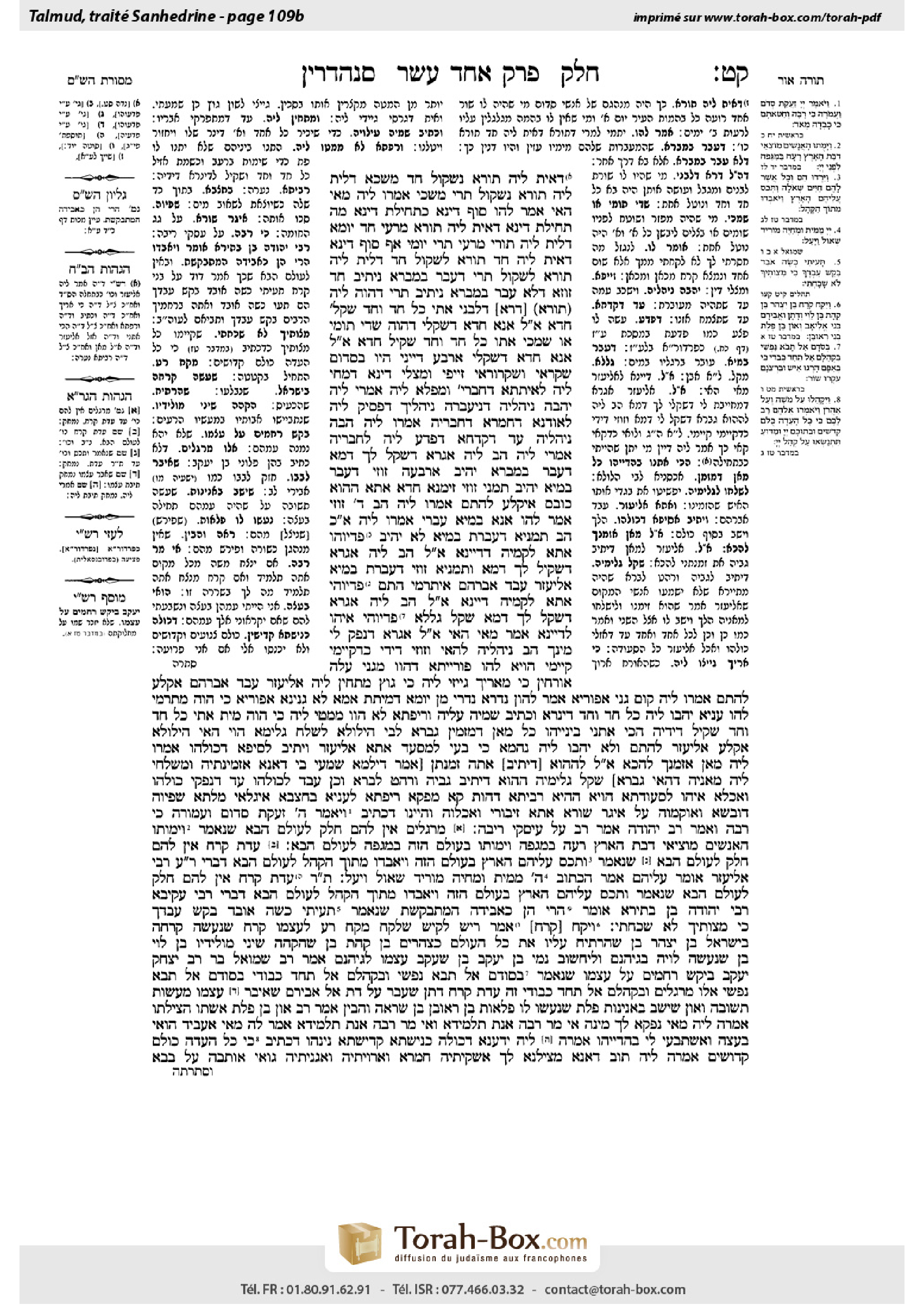
This page of Sanhedrin includes the Aramaic text, an English translation and an AI-generated French translation, alongside the scan above.
סנהדרין ק״ט ב · Aramaic and Hebrew text
דְּאִית לֵיהּ תּוֹרָא – נִשְׁקוֹל חַד מַשְׁכָּא, דְּלֵית לֵיהּ תּוֹרָא – נִשְׁקוֹל תְּרֵי מַשְׁכֵּי. אֲמַרוּ לֵיהּ: מַאי הַאי? אֲמַר לְהוּ: סוֹף דִּינָא כִּתְחִילַּת דִּינָא. מָה תְּחִילַּת דִּינָא? דְּאִית לֵיהּ תּוֹרָא – מַרְעֵי חַד יוֹמָא, דְּלֵית לֵיהּ תּוֹרֵי – מַרְעֵי תְּרֵי יוֹמֵי. אַף סוֹף דִּינָא: דְּאִית לֵיהּ חַד תּוֹרָא – לִשְׁקוֹל חַד, דְּלֵית לֵיהּ תּוֹרָא – לִשְׁקוֹל תְּרֵי.
דְּעָבַר בְּמַבָּרָא – נִיתֵּיב חַד זוּזָא, דְּלָא עָבַר בְּמַבָּרָא – נִיתֵּיב תְּרֵי. דַּהֲוָה לֵיהּ דָּרָא דְּלִבְנֵי, אָתֵי כֹּל חַד וְחַד שָׁקֵיל חֲדָא, אֲמַר לֵיהּ: אֲנָא חֲדָא דִּשְׁקַלִי. דַּהֲוָה שָׁדֵי תּוּמֵי אוֹ שַׁמְכֵי, אֲתוֹ כֹּל חַד וְחַד שָׁקֵיל חֲדָא, אֲמַר לֵיהּ: אֲנָא חֲדָא דִּשְׁקַלִי.
אַרְבַּע דַּיָּינֵי הָיוּ בִּסְדוֹם, שַׁקְרַאי וְשַׁקְרוֹרַאי זַיְיפַי וּמַצְלֵי דִּינָא. דְּמָחֵי לֵיהּ לְאִיתְּתָא דְּחַבְרֵיהּ וּמַפְּלָא (לֵיהּ), אָמְרִי לֵיהּ: יַהֲבַהּ נִיהֲלֵיהּ דְּנִיעַבְּרַהּ נִיהֲלָיךְ. דְּפָסֵיק לֵיהּ לְאוּדְנָא דַּחֲמָרָא דְּחַבְרֵיהּ, אֲמַרוּ לֵיהּ: הֲבַהּ נִיהֲלֵיהּ עַד דְּקָדְחָא. דְּפָדַע לֵיהּ לְחַבְרֵיהּ, אָמְרִי לֵיהּ: הַב לֵיהּ אַגְרָא דִּשְׁקַל לָךְ דְּמָא.
דְּעָבַר בְּמַבָּרָא – יְהֵיב אַרְבְּעָה זוּזֵי, דְּעָבַר בְּמַיָּא – יָהֵיב תְּמָנְיָא זוּזֵי. זִימְנָא חֲדָא אֲתָא הָהוּא כּוֹבֵס, אִיקְּלַע לְהָתָם. אֲמַרוּ לֵיהּ: הַב אַרְבְּעָה זוּזֵי. אָמַר לְהוּ: אֲנָא בְּמַיָּא עֲבַרִי. אֲמַרוּ לֵיהּ: אִם כֵּן, הַב תְּמָנְיָא דַּעֲבַרְתְּ בְּמַיָּא. לָא יְהַב. פַּדְיוּהּ. אֲתָא לְקַמֵּיהּ דְּדַיָּינָא. אֲמַר לֵיהּ: הַב לֵיהּ אַגְרָא דִּשְׁקַל לָךְ דְּמָא, וּתְמָנְיָא זוּזֵי דַּעֲבַרְתְּ בְּמַיָּא.
אֱלִיעֶזֶר עֶבֶד אַבְרָהָם אִיתְרְמִי הָתָם, פַּדְיוּהּי. אֲתָא לְקַמֵּיהּ דַּיָּינָא. אֲמַר לֵיהּ: הַב לֵיהּ אַגְרָא דִּשְׁקַל לָךְ דְּמָא. שְׁקַל גְּלָלָא, פַּדְיֵוהּ אִיהוּ לְדַיָּינָא. אֲמַר: מַאי הַאי? אֲמַר לֵיהּ: אַגְרָא דִּנְפַק לִי מִינָּךְ, הַב נִיהֲלֵיהּ לְהַאי, וְזוּזֵי דִּידִי כִּדְקָיְימִי קָיְימִי.
הָוְיָא לְהוּ פּוּרְיְיתָא דַּהֲווֹ מַגְנִי עֲלַהּ אוֹרְחִין. כִּי מַאֲרֵיךְ – גָּיְיזִי לֵיהּ, כִּי גוּץ – מָתְחִין לֵיהּ. אֱלִיעֶזֶר עֶבֶד אַבְרָהָם אִקְּלַע לְהָתָם. אֲמַרוּ לֵיהּ: קוּם גְּנִי אַפּוּרְיָא. אֲמַר לְהוֹן: נִדְרָא נְדַרִי מִן יוֹמָא דְּמִיתַת אִמָּא לָא גָּנֵינָא אַפּוּרְיָא.
כִּי הֲוָה מִתְרְמֵי לְהוּ עַנְיָא, יְהַבוּ לֵיהּ כֹּל חַד וְחַד דִּינָרָא, וּכְתִיב שְׁמֵיהּ עֲלֵיהּ. וְרִיפְתָּא לָא הֲווֹ מַמְטֵי לֵיהּ. כִּי הֲוָה מָיֵת, אָתֵי כֹּל חַד וְחַד שָׁקֵיל דִּידֵיהּ.
הָכִי אַתְנוֹ בֵּינַיְיהוּ: כֹּל מַאן דְּמַזְמֵין גַּבְרָא לְבֵי הִילּוּלָא, לְשַׁלַּח גְּלִימָא. הֲוִי הַאי הִילּוּלָא, אִקְּלַע אֱלִיעֶזֶר לְהָתָם וְלָא יְהַבוּ לֵיהּ נַהֲמָא. כִּי בָּעֵי לְמִסְעַד, אֲתָא אֱלִיעֶזֶר וִיתֵיב לְסֵיפָא דְּכוּלְּהוּ. אֲמַרוּ לֵיהּ: מַאן אַזְמְנָךְ לְהָכָא? אֲמַר לֵיהּ לְהָהוּא [דְּיָתֵיב]: אַתְּ זַמֵּנְתַּן. [אֲמַר: דִילְמָא שָׁמְעִי בִּי דַּאֲנָא אַזְמֵינְתֵּיהּ וּמְשַׁלְּחִי לֵיהּ מָאנֵיהּ דְּהַאי גַּבְרָא.] שְׁקַל גְּלִימֵיהּ הָהוּא דְּיָתֵיב גַּבֵּיהּ וּרְהַט לְבָרָא. וְכֵן עֲבַד לְכוּלְּהוּ עַד דְּנָפְקִי כּוּלְּהוּ וְאַכְלַאּ אִיהוּ לִסְעוּדְתָּא.
הַוְיָא הָהִיא רָבִיתָא דַּהֲוָת קָא מַפְּקָא רִיפְתָּא לְעַנְיָא בְּחַצְבָּא. אִיגַּלַּאי מִלְּתָא, שַׁפְיוּהָ דּוּבְשָׁא, וְאוֹקְמוּהָ עַל אִיגַּר שׁוּרָא. אֲתֹא זִיבּוּרֵי וְאַכְלוּהָ. וְהַיְינוּ דִּכְתִיב: ״וַיֹּאמֶר ה׳ זַעֲקַת סְדֹם וַעֲמֹרָה כִּי רָבָּה״. וְאָמַר רַב יְהוּדָה אָמַר רַב: עַל עִיסְקֵי רִיבָה.
מְרַגְּלִים אֵין לָהֶם חֵלֶק לָעוֹלָם הַבָּא, שֶׁנֶּאֱמַר: ״וַיָּמֻתוּ הָאֲנָשִׁים מוֹצִאֵי דִבַּת הָאָרֶץ רָעָה בַּמַּגֵּפָה״. ״וַיָּמֻתוּ״ – בָּעוֹלָם הַזֶּה, ״בַּמַּגֵּפָה״ – לָעוֹלָם הַבָּא.
עֲדַת קֹרַח אֵין לָהֶם חֵלֶק לָעוֹלָם הַבָּא, שֶׁנֶּאֱמַר: ״וַתְּכַס עֲלֵיהֶם הָאָרֶץ״ – בָּעוֹלָם הַזֶּה, ״וַיֹּאבְדוּ מִתּוֹךְ הַקָּהָל״ – לָעוֹלָם הַבָּא. דִּבְרֵי רַבִּי עֲקִיבָא. רַבִּי אֱלִיעֶזֶר אוֹמֵר: עֲלֵיהֶם אָמַר הַכָּתוּב ״ה׳ מֵמִית וּמְחַיֶּה מוֹרִיד שְׁאוֹל וַיָּעַל״.
תָּנוּ רַבָּנַן: עֲדַת קֹרַח אֵין לָהֶם חֵלֶק לָעוֹלָם הַבָּא, שֶׁנֶּאֱמַר: ״וַתְּכַס עֲלֵיהֶם הָאָרֶץ״ – בָּעוֹלָם הַזֶּה, ״וַיֹּאבְדוּ מִתּוֹךְ הַקָּהָל״ – לָעוֹלָם הַבָּא. דִּבְרֵי רַבִּי עֲקִיבָא. רַבִּי יְהוּדָה בֶּן בְּתִירָא אוֹמֵר: הֲרֵי הֵן כַּאֲבֵידָה הַמִּתְבַּקֶּשֶׁת, שֶׁנֶּאֱמַר: ״תָּעִיתִי כְּשֶׂה אֹבֵד בַּקֵּשׁ עַבְדֶּךָ כִּי מִצְוֹתֶיךָ לֹא שָׁכָחְתִּי״.
״וַיִּקַּח [קֹרַח]״ – אָמַר רֵישׁ לָקִישׁ: שֶׁלָּקַח מִקָּח רַע לְעַצְמוֹ. ״קֹרַח״ – שֶׁנַּעֲשָׂה קׇרְחָה בְּיִשְׂרָאֵל. ״בֶּן יִצְהָר״ – בֵּן שֶׁהִרְתִּיחַ עָלָיו אֶת כָּל הָעוֹלָם כַּצׇּהֳרַיִם. ״בֶּן קְהָת״ – בֵּן שֶׁהִקְהָה שִׁינֵּי מוֹלִידָיו. ״בֶּן לֵוִי״ – בֵּן שֶׁנַּעֲשָׂה לְוָיָה בְּגֵיהִנָּם.
וְלִיחְשׁוֹב נָמֵי בֶּן יַעֲקֹב, בֵּן שֶׁעָקַב עַצְמוֹ לְגֵיהִנָּם? אָמַר רַב שְׁמוּאֵל בַּר רַב יִצְחָק: יַעֲקֹב בִּיקֵּשׁ רַחֲמִים עַל עַצְמוֹ, שֶׁנֶּאֱמַר ״בְּסֹדָם אַל תָּבֹא נַפְשִׁי בִּקְהָלָם אַל תֵּחַד כְּבֹדִי״. ״בְּסֹדָם אַל תָּבֹא נַפְשִׁי״ – אֵלּוּ מְרַגְּלִים. ״בִּקְהָלָם אַל תֵּחַד כְּבֹדִי״ – זֶה עֲדַת קֹרַח.
״דָּתָן״ – שֶׁעָבַר עַל דָּת אֵל, ״אֲבִירָם״ – שֶׁאִיבֵּר עַצְמוֹ מֵעֲשׂוֹת תְּשׁוּבָה, ״וְאוֹן״ – שֶׁיָּשַׁב בַּאֲנִינוּת, ״פֶּלֶת״ – שֶׁנַּעֲשׂוּ לוֹ פְּלָאוֹת, ״בֶּן רְאוּבֵן״ – בֵּן שֶׁרָאָה וְהֵבִין.
אָמַר רַב: ״אוֹן בֶּן פֶּלֶת אִשְׁתּוֹ הִצִּילַתּוּ. אֲמַרָה לֵיהּ: מַאי נָפְקָא לָךְ מִינַּהּ? אִי מָר רַבָּה – אַנְתְּ תַּלְמִידָא, וְאִי מָר רַבָּה – אַנְתְּ תַּלְמִידָא. אֲמַר לַהּ: מַאי אֶעֱבֵיד? הֲוַאי בְּעֵצָה וְאִשְׁתְּבַעִי לִי בַּהֲדַיְיהוּ. אֲמַרָה לֵיהּ: יָדַעְנָא דְּכוּלַּהּ כְּנִישְׁתָּא קַדִּישְׁתָּא נִינְהוּ, דִּכְתִיב: ״כִּי כׇל הָעֵדָה כֻּלָּם קְדֹשִׁים״. אֲמַרָה לֵיהּ: תּוּב, דַּאֲנָא מַצֵּילְנָא לָךְ. אַשְׁקִיתֵיהּ חַמְרָא וְאַרְוִיתֵיהּ וְאַגְנִיתֵיהּ גַּוַּאי. וִיתִבָא עַל בָּבָא,
Sanhedrin 109b · English translation
Let anyone who has one ox take one hide and let anyone who does not have an ox take two hides. The people of Sodom said to the orphan: What is the reason for this? The orphan said to them: The ultimate rule is parallel to the initial rule; just as the initial rule is that anyone who has one ox shall herd the city’s animals for one day and anyone who does not have any oxen shall herd the city’s animals for two days, so too, the ultimate rule is: Let anyone who has one ox take one hide and let anyone who does not have an ox take two hides.
Furthermore, they declared in Sodom: Let one who crosses on a ferry give one dinar as payment; let one who does not cross on a ferry, but walks in the river, give two dinars. In addition, when there was anyone who had a row of bricks, each and every one of the people of Sodom would come and take one brick and say to him: I am taking only one, and you are certainly not particular about so inconsequential an item, and they would do this until none remained. And when there was anyone who would cast garlic or onions to dry, each and every one of the people of Sodom would come and take one and say to him: I took only one garlic or onion, and they would do this until none remained.
There were four judges in Sodom and they were named for their actions: Shakrai, meaning liar, and Shakrurai, habitual liar, Zayfai, forger, and Matzlei Dina, perverter of justice. These were the judgments that they rendered: In a case of one who strikes the wife of another and causes her to miscarry, they would say to the woman’s husband: Give the woman to the one who struck her, so that she will be impregnated for you again. In a case of one who severed the ear of another’s donkey, they would say to the owner of the donkey: Give the donkey to the one who caused the damage, until the ear grows back. In a case of one who wounds another, they would say to the injured party: Give the one who wounded you a fee, as he let your blood.
And they instituted an ordinance: One who crossed the river on a ferry gives four dinars, and one who crossed the river in the water gives eight dinars. One time a certain launderer came and arrived there. The people of Sodom said to him: Give four dinars as payment for the ferry. He said to them: I crossed in the water. They said to him: If so, give eight dinars, as you crossed in the water. He did not give the payment, and they struck him and wounded him. He came before the judge to seek compensation. The judge said to him: Give your assailant a fee, as he let your blood, and eight dinars, as you crossed the river in the water.
Eliezer, servant of Abraham, happened to come there, and they wounded him. He came before the judge to seek compensation. The judge said to him: Give your assailant a fee, as he let your blood. He took a stone and he wounded the judge. The judge said: What is this? Eliezer said to him: The fee that is to be paid to me by you, give it to that person who wounded me, and my money will remain where it remains.
The Gemara continues to discuss the sins of the people of Sodom: They had beds on which they would lay their guests; when a guest was longer than the bed they would cut him, and when a guest was shorter than the bed they would stretch him. Eliezer, servant of Abraham, happened to come there. They said to him: Come lie on the bed. He said to them: I took a vow that since the day my mother died I do not lie on a bed.
When a poor person would happen to come to Sodom, each and every person would give him a dinar, and the name of the giver was written on each dinar. And they would not give or sell him bread, so that he could not spend the money and would die of hunger. When he would die, each and every person would come and take his dinar.
This is what the people of Sodom stipulated among themselves: Whoever invites a man to a wedding, his cloak will be removed. There was this wedding, and Eliezer, servant of Abraham, arrived there and they did not give him bread. When he sought to dine, Eliezer came and sat at the end, behind everyone. They said to him: Who invited you to here? He said to the one sitting next to him: You invited me. That man said to himself: Perhaps they will hear that I invited him and they will remove the garment of that man, referring to himself. The one who sat next to him took his cloak and ran outside. And likewise, Eliezer did the same for all of them until they all left, and he ate the meal.
There was a young woman who would take bread out to the poor people in a pitcher so the people of Sodom would not see it. The matter was revealed, and they smeared her with honey and positioned her on the wall of the city, and the hornets came and consumed her. And that is the meaning of that which is written: “And the Lord said: Because the cry of Sodom and Gomorrah is great [rabba]” (Genesis 18:20). And Rav Yehuda says that Rav says: Rabba is an allusion to the matter of the young woman [riva] who was killed for her act of kindness. It is due to that sin that the fate of the people of Sodom was sealed.
§ The mishna teaches: The spies who spread an evil report of their visit to Canaan have no share in the World-to-Come, as it is stated: “And those men who spread the evil report about the land died by plague before the Lord” (Numbers 14:37). “And…died” indicates in this world, and “by plague” indicates for the World-to-Come.
The members of the assembly of Korah have no share in the World-to-Come, as it is stated: “And the earth closed upon them” (Numbers 16:33), meaning in this world, and also: “And they perished from among the assembly” (Numbers 16:33), meaning in the World-to-Come; this is the statement of Rabbi Akiva. Rabbi Eliezer says: About the assembly of Korah, the verse states: “The Lord kills and makes alive; He lowers to the grave, and raises” (I Samuel 2:6), indicating that the assembly of Korah has a share in the World-to-Come.
The Sages taught in a baraita (Tosefta 13:9): The members of the assembly of Korah have no share in the World-to-Come, as it is stated: “And the earth closed upon them” (Numbers 16:33), meaning in this world, and also: “And they perished from among the assembly” (Numbers 16:33), meaning in the World-to-Come; this is the statement of Rabbi Akiva. Rabbi Yehuda ben Beteira says: Although it says that they perished, they are like a lost item that is sought, ultimately found, and rehabilitated, as it is stated: “I have gone astray like a lost sheep; seek out your servant, for I do not forget your mitzvot” (Psalms 119:176).
Apropos Korah, the Gemara proceeds to interpret the verses written concerning him. “And Korah, son of Izhar, son of Kohath, son of Levi, took [vayikkaḥ]” (Numbers 16:1), Reish Lakish says: He purchased [lakaḥ] a bad acquisition for himself, as through his actions he drove himself from the world. “Korah” alludes to the fact that because of him a void [korḥa] was created in the children of Israel. “Son of Izhar,” is referring to a son who incited the wrath of the entire world upon him like the heat of the afternoon [tzohorayim]. “Son of Kohath,” is referring to a son who blunted [hik’ha] the teeth of his parents, i.e., he shamed them with his conduct. “Son of Levi,” is referring to a son who became an escort [levaya] in Gehenna.
The Gemara asks: But if Korah’s lineage is being interpreted disparagingly, why not let the Torah also include: Son of Jacob [Ya’akov], and interpret it: A son who contorted [she’akav] himself until he reached Gehenna? Rav Shmuel bar Rav Yitzḥak says: Jacob prayed for mercy for himself that his name would not be included in the lineage of Korah, as it is stated: “Let my soul not come into their council; to their assembly let my honor not be united” (Genesis 49:6). “Let my soul not come into their council”; these are the spies. Jacob prayed that his name would not be mentioned in their regard. “To their assembly let my honor not be united”; this is referring to the assembly of Korah.
The Gemara proceeds to interpret the names of Korah’s cohorts: “Dathan and Abiram, the sons of Eliab, and On, the son of Peleth, sons of Reuben” (Numbers 16:1). “Dathan” is one who violated the precepts [dat] of God. “Abiram” is one who braced [iber] himself from repenting. “And On” indicates one who sat in acute mourning [aninut] over the sin that he committed, and he repented and was spared. “Peleth” is one for whom wonders [pelaot] were performed. Son of Reuben [Reuven], is a son who saw and understood [ra’a vehevin] the nature of what was transpiring and repented.
Rav says: On, son of Peleth, did not repent on his own; rather, his wife saved him. She said to him: What is the difference to you? If this Master, Moses, is the great one, you are the student. And if this Master, Korah, is the great one, you are the student. Why are you involving yourself in this matter? On said to her: What shall I do? I was one of those who took counsel and I took an oath with them that I would be with them. She said to him: I know that the entire assembly is holy, as it is written: “For all the assembly is holy” (Numbers 16:3), and they observe the restrictions of modesty. She said to him: Sit, for I will save you. She gave him wine to drink and caused him to become drunk and laid him on a bed inside their tent. She sat at the entrance of the tent
Sanhedrin 109b · Traduction française (IA)
Que quiconque possède un bœuf prenne une peau, et que quiconque n’en possède pas en prenne deux. Les gens de Sodome dirent à l’orphelin : « Pourquoi donc ? » L’orphelin leur répondit : « La règle finale est parallèle à la règle initiale. De même que, selon la règle initiale, quiconque possède un bœuf doit faire paître les animaux de la ville pendant un jour, tandis que quiconque ne possède aucun bœuf doit les faire paître pendant deux jours, de même, selon la règle finale, que quiconque possède un bœuf prenne une peau, et que quiconque n’en possède pas en prenne deux. »
En outre, ils décrétèrent à Sodome : « Que celui qui traverse le fleuve en bac paie un dinar, et que celui qui ne le traverse pas en bac, mais marche dans l’eau, paie deux dinars. » De plus, lorsqu’une personne possédait une rangée de briques, chacun des gens de Sodome venait en prendre une en disant : « Je n’en prends qu’une, et vous ne vous formaliserez certainement pas pour une chose aussi insignifiante. » Ils continuaient ainsi jusqu’à ce qu’il n’en reste plus. Lorsqu’une personne étendait de l’ail ou des oignons pour les faire sécher, chacun des gens de Sodome venait en prendre un en disant : « Je n’ai pris qu’un ail ou un oignon. » Ils continuaient ainsi jusqu’à ce qu’il n’en reste plus.
Il y avait à Sodome quatre juges, dont les noms reflétaient les actes : Shakrai, c’est-à-dire « menteur » ; Shakrurai, « menteur invétéré » ; Zayfai, « faussaire » ; et Matzlei Dina, « celui qui pervertit la justice ». Voici les jugements qu’ils rendaient : si quelqu’un frappait la femme d’un autre et provoquait une fausse couche, ils disaient au mari : « Donne ta femme à celui qui l’a frappée, afin qu’elle soit de nouveau enceinte pour toi. » Si quelqu’un coupait l’oreille de l’âne d’un autre, ils disaient au propriétaire de l’âne : « Donne l’âne à celui qui a causé le dommage, jusqu’à ce que l’oreille repousse. » Si quelqu’un en blessait un autre, ils disaient à la victime : « Donne des honoraires à celui qui t’a blessé, puisqu’il t’a fait saigner. »
Ils instituèrent aussi une règle : celui qui traversait le fleuve en bac payait quatre dinars, et celui qui le traversait dans l’eau payait huit dinars. Un jour, un blanchisseur arriva là-bas. Les gens de Sodome lui dirent : « Paie quatre dinars pour le bac. » Il leur répondit : « J’ai traversé dans l’eau. » Ils lui dirent : « Dans ce cas, paie huit dinars, puisque tu as traversé dans l’eau. » Il refusa de payer ; ils le frappèrent et le blessèrent. Il se présenta devant le juge pour obtenir réparation. Le juge lui dit : « Donne des honoraires à celui qui t’a agressé, puisqu’il t’a fait saigner, et paie huit dinars, puisque tu as traversé le fleuve dans l’eau. »
Éliézer, le serviteur d’Abraham, arriva là par hasard et ils le blessèrent. Il se présenta devant le juge pour obtenir réparation. Le juge lui dit : « Donne des honoraires à celui qui t’a agressé, puisqu’il t’a fait saigner. » Éliézer prit une pierre et blessa le juge. Celui-ci lui dit : « Qu’est-ce que cela signifie ? » Éliézer lui répondit : « Les honoraires que tu me dois, donne-les à celui qui m’a blessé, et mon argent restera là où il est. »
La Guemara poursuit l’examen des péchés des gens de Sodome : ils avaient des lits sur lesquels ils faisaient coucher leurs hôtes. Si un hôte était plus grand que le lit, ils le coupaient ; s’il était plus petit, ils l’étiraient. Éliézer, le serviteur d’Abraham, arriva là par hasard. Ils lui dirent : « Viens t’allonger sur le lit. » Il leur répondit : « J’ai fait le vœu de ne plus m’allonger sur un lit depuis le jour où ma mère est morte. »
Lorsqu’un pauvre arrivait par hasard à Sodome, chacun lui donnait un dinar sur lequel était inscrit le nom du donateur. Mais ils ne lui donnaient ni ne lui vendaient de pain, si bien qu’il ne pouvait pas dépenser son argent et mourait de faim. Lorsqu’il mourait, chacun venait reprendre son dinar.
Voici ce que les gens de Sodome avaient stipulé entre eux : quiconque inviterait quelqu’un à un mariage se verrait retirer son manteau. Un mariage eut lieu, et Éliézer, le serviteur d’Abraham, y arriva ; on ne lui donna pas de pain. Lorsqu’il voulut prendre part au repas, Éliézer vint s’asseoir tout au bout, derrière tout le monde. Ils lui dirent : « Qui t’a invité ici ? » Il dit à celui qui était assis à côté de lui : « C’est toi qui m’as invité. » Cet homme se dit : « Peut-être vont-ils apprendre que je l’ai invité et me retirer mon manteau. » Celui qui était assis à côté d’Éliézer prit son manteau et sortit en courant. Éliézer fit de même avec chacun d’eux, jusqu’à ce qu’ils soient tous partis, puis il mangea le repas.
Il y avait une jeune femme qui apportait du pain aux pauvres dans une cruche, afin que les gens de Sodome ne la voient pas. La chose fut découverte ; ils l’enduisirent de miel et la placèrent sur le mur de la ville. Des frelons vinrent alors la dévorer. C’est là le sens de ce qui est écrit : « Et le Seigneur dit : Parce que le cri de Sodome et de Gomorrhe est grand [rabba] » (Genèse 18:20). Rav Yehouda dit au nom de Rav : « Rabba » fait allusion à l’histoire de la jeune femme [riva], qui fut tuée pour son acte de bonté. C’est à cause de ce péché que le sort des gens de Sodome fut scellé.
§ La Michna enseigne : Les explorateurs qui ont répandu un rapport calomnieux sur leur visite en Canaan n’ont pas de part au Monde à venir, comme il est dit : « Et ces hommes qui avaient répandu un rapport calomnieux sur le pays moururent frappés d’un fléau devant le Seigneur » (Nombres 14:37). « Moururent » indique qu’ils moururent dans ce monde, et « frappés d’un fléau » indique qu’ils subirent un fléau dans le Monde à venir.
Les membres de l’assemblée de Korah n’ont pas de part au Monde à venir, comme il est dit : « Et la terre se referma sur eux » (Nombres 16:33), c’est-à-dire dans ce monde ; et aussi : « Et ils disparurent du sein de l’assemblée » (Nombres 16:33), c’est-à-dire dans le Monde à venir. Telle est l’opinion de Rabbi Akiva. Rabbi Eliezer dit : « Au sujet de l’assemblée de Korah, le verset dit : “Le Seigneur fait mourir et fait vivre ; il fait descendre au Chéol et en fait remonter” » (I Samuel 2:6), ce qui indique que l’assemblée de Korah a une part au Monde à venir.
Les Sages enseignent dans une baraïta (Tosefta 13:9) : Les membres de l’assemblée de Korah n’ont pas de part au Monde à venir, comme il est dit : « Et la terre se referma sur eux » (Nombres 16:33), c’est-à-dire dans ce monde ; et aussi : « Et ils disparurent du sein de l’assemblée » (Nombres 16:33), c’est-à-dire dans le Monde à venir. Telle est l’opinion de Rabbi Akiva. Rabbi Yehouda ben Beteira dit : « Bien qu’il soit dit qu’ils ont disparu, ils sont comme un objet perdu que l’on recherche, que l’on finit par retrouver et que l’on réhabilite », comme il est dit : « Je me suis égaré comme une brebis perdue ; cherche ton serviteur, car je n’oublie pas tes mitsvot » (Psaumes 119:176).
À propos de Korah, la Guemara entreprend d’interpréter les versets qui le concernent. « Korah, fils de Yitshar, fils de Qehath, fils de Lévi, prit [vayikkaḥ] » (Nombres 16:1). Reish Lakish dit : « Il s’est acquis [lakaḥ] une mauvaise acquisition, car ses actes l’ont chassé du monde. » « Korah » fait allusion au fait qu’à cause de lui un vide [korḥa] fut créé parmi les enfants d’Israël. « Fils de Yitshar » désigne un fils qui a attiré sur lui la colère du monde entier, comme la chaleur de l’après-midi [tzohorayim]. « Fils de Qehath » désigne un fils qui a émoussé [hik’ha] les dents de ses parents, c’est-à-dire qui les a couverts de honte par sa conduite. « Fils de Lévi » désigne un fils qui devint un compagnon [levaya] en Géhenne.
La Guemara demande : « Mais si la généalogie de Korah est interprétée de façon péjorative, pourquoi la Torah n’ajoute-t-elle pas aussi “fils de Jacob [Ya’akov]”, que l’on interpréterait ainsi : un fils qui s’est contorsionné [she’akav] jusqu’à parvenir en Géhenne ? » Rav Shmuel bar Rav Yitzḥak dit : « Jacob implora la miséricorde pour lui-même, afin que son nom ne soit pas inclus dans la généalogie de Korah », comme il est dit : « Que mon âme ne vienne pas dans leur conseil ; que ma gloire ne s’unisse pas à leur assemblée » (Genèse 49:6). « Que mon âme ne vienne pas dans leur conseil » : cela désigne les explorateurs. Jacob pria pour que son nom ne soit pas mentionné à leur sujet. « Que ma gloire ne s’unisse pas à leur assemblée » : cela désigne l’assemblée de Korah.
La Guemara entreprend d’interpréter les noms des complices de Korah : « Datan et Abiram, fils d’Éliab, et On, fils de Pélet, fils de Ruben » (Nombres 16:1). « Datan » désigne celui qui transgressa les préceptes [dat] de Dieu. « Abiram » désigne celui qui s’obstina [iber] à ne pas se repentir. « Et On » évoque celui qui s’assit dans un profond deuil [aninut] à cause du péché qu’il avait commis, se repentit et fut épargné. « Pélet » désigne celui pour qui des merveilles [pelaot] furent accomplies. « Fils de Ruben [Reuven] » désigne un fils qui vit et comprit [ra’a vehevin] la nature de ce qui se passait et se repentit.
Rav dit : « On, fils de Pélet, ne se repentit pas de lui-même ; c’est sa femme qui le sauva. Elle lui dit : “Quelle différence cela fait-il pour toi ? Si ce maître, Moïse, est le grand homme, tu es son disciple. Et si ce maître, Korah, est le grand homme, tu es son disciple. Pourquoi te mêler de cette affaire ?” On lui dit : “Que dois-je faire ? J’étais parmi ceux qui ont tenu conseil, et j’ai prêté serment avec eux d’être des leurs.” Elle lui dit : “Je sais que toute l’assemblée est sainte, comme il est écrit : ‘Car toute l’assemblée est sainte’ (Nombres 16:3), et qu’ils observent les règles de pudeur.” Elle lui dit : “Assieds-toi, car je vais te sauver.” Elle lui fit boire du vin, l’enivra et le coucha sur un lit à l’intérieur de leur tente. Elle s’assit à l’entrée de la tente
Traduction française générée par IA à partir de l’édition anglaise de Sefaria. Vérifie toujours un passage avec le texte source.
Text from Sefaria: William Davidson Edition - Vocalized Aramaic (CC BY NC); William Davidson Edition - English (CC BY NC).