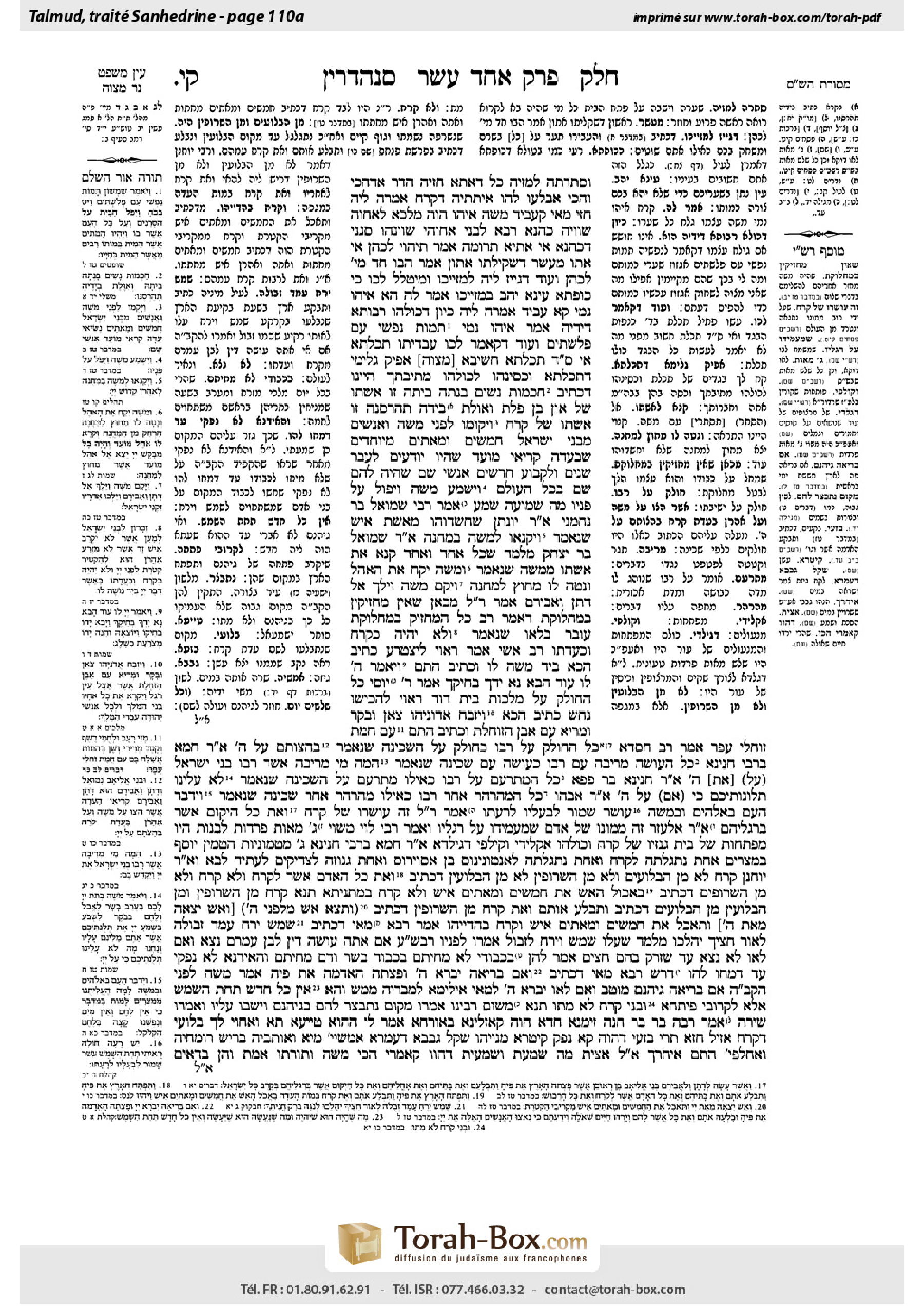
Sanhedrin 110a: Talmud study for Daf Yomi
Daf Yomi is the daily study of one Talmud folio. Explore 37 tractates with scans, Hebrew text, Sefaria English and AI-generated French translations where annotated.
Passage selection and English or AI-generated French translation are available where the scan has annotations. Daf Study is independent of Torah-Box and Sefaria.
Browse Sanhedrin · סנהדרין · All tractatesSanhedrin 110a text and translations
This page of Sanhedrin includes the Aramaic text, an English translation and an AI-generated French translation, alongside the scan above.
סנהדרין ק״י א · Aramaic and Hebrew text
וּסְתַרְתֵּהּ לְמַזְּיַהּ, כֹּל דַּאֲתָא חַזְיַהּ הֲדַר. אַדְּהָכִי וְהָכִי, אִבְּלַעוּ לְהוּ.
אִיתְּתֵיהּ דְּקֹרַח אֲמַרָה לֵיהּ: חֲזִי מַאי קָעָבֵיד מֹשֶׁה. אִיהוּ הֲוָה מַלְכָּא, לַאֲחוּהּ שַׁוְּויֵהּ כָּהֲנָא רַבָּא, לִבְנֵי אֲחוֹהִי שַׁוִּינְהוּ סְגָנֵי דְּכָהֲנָא. אִי אָתְיָא תְּרוּמָה אָמַר ״תֶּיהְוֵי לְכָהֵן״, אִי אָתוּ מַעֲשֵׂר דְּשָׁקְלִיתוּ אַתּוּן אָמַר ״הַבוּ חַד מֵעַשְׂרָה לְכָהֵן״. וְעוֹד דְּגָיֵיז לֵיהּ לְמָזַיְיכוּ וּמִיטַּלַּל בְּכוּ כִּי כוּפְתָּא, עֵינָא יְהַב בְּמָזַיְיכוּ. אֲמַר לַהּ: הָא אִיהוּ נָמֵי קָא עָבֵיד! אֲמַרָה לֵיהּ: כֵּיוָן דְּכוּלְּהוּ רְבוּתָא דִּידֵיהּ, אָמַר אִיהוּ נָמֵי ״תָּמֹת נַפְשִׁי עִם פְּלִשְׁתִּים״.
וְעוֹד, דְּקָאָמַר לְכוּ עָבְדִיתוּ תְּכֵלְתָּא. אִי סָלְקָא דַעְתָּךְ תְּכֵלְתָּא חֲשִׁיבָא [מִצְוָה], אַפֵּיק גְּלִימֵי דִּתְכֵלְתָּא וְכַסִּינְהוּ לְכוּלְּהוּ מְתִיבְתָּךְ. הַיְינוּ דִּכְתִיב: ״חׇכְמוֹת נָשִׁים בָּנְתָה בֵיתָהּ״ – זוֹ אִשְׁתּוֹ שֶׁל אוֹן בֶּן פֶּלֶת, ״וְאִוֶּלֶת בְּיָדָהּ תֶּהֶרְסֶנָּה״ – זוֹ אִשְׁתּוֹ שֶׁל קֹרַח.
״וַיָּקֻמוּ לִפְנֵי מֹשֶׁה וַאֲנָשִׁים מִבְּנֵי יִשְׂרָאֵל חֲמִשִּׁים וּמָאתָיִם [נְשִׂיאֵי עֵדָה]״ – מְיוּחָדִים שֶׁבָּעֵדָה, ״קְרִיאֵי מוֹעֵד״ – שֶׁהָיוּ יוֹדְעִים לְעַבֵּר שָׁנִים וְלִקְבּוֹעַ חֳדָשִׁים, ״אַנְשֵׁי שֵׁם״ – שֶׁהָיָה לָהֶם שֵׁם בְּכׇל הָעוֹלָם.
״וַיִּשְׁמַע מֹשֶׁה וַיִּפֹּל עַל פָּנָיו״. מָה שְׁמוּעָה שְׁמַע? אָמַר רַבִּי שְׁמוּאֵל בַּר נַחְמָנִי אָמַר רַבִּי יוֹנָתָן: שֶׁחֲשָׁדוּהוּ מֵאֵשֶׁת אִישׁ, שֶׁנֶּאֱמַר ״וַיְקַנְאוּ לְמֹשֶׁה בַּמַּחֲנֶה״. אָמַר רַבִּי שְׁמוּאֵל בַּר יִצְחָק: מְלַמֵּד שֶׁכׇּל אֶחָד וְאֶחָד קִנֵּא אֶת אִשְׁתּוֹ מִמֹּשֶׁה, שֶׁנֶּאֱמַר ״וּמֹשֶׁה יִקַּח אֶת הָאֹהֶל וְנָטָה לוֹ מִחוּץ לַמַּחֲנֶה״.
״וַיָּקׇם מֹשֶׁה וַיֵּלֶךְ אֶל דָּתָן וַאֲבִירָם״. אָמַר רֵישׁ לָקִישׁ: מִכָּאן שֶׁאֵין מַחְזִיקִין בְּמַחְלוֹקֶת, דְּאָמַר רַב: כׇּל הַמַּחְזִיק בְּמַחְלוֹקֶת עוֹבֵר בְּלָאו, שֶׁנֶּאֱמַר: ״וְלֹא יִהְיֶה כְקֹרַח וְכַעֲדָתוֹ״.
רַב אָשֵׁי אָמַר: ״רָאוּי לִיצְטָרֵעַ״. כְּתִיב הָכָא: ״בְּיַד מֹשֶׁה לוֹ״, וּכְתִיב הָתָם: ״וַיֹּאמֶר ה׳ לוֹ עוֹד הָבֵא נָא יָדְךָ בְּחֵיקֶךָ״.
אָמַר רַבִּי יוֹסֵי: כׇּל הַחוֹלֵק עַל מַלְכוּת בֵּית דָּוִד רָאוּי לְהַכִּישׁוֹ נָחָשׁ. כְּתִיב הָכָא: ״וַיִּזְבַּח אֲדֹנִיָּהוּ צֹאן וּבָקָר וּמְרִיא עִם אֶבֶן הַזֹּחֶלֶת״, וּכְתִיב הָתָם: ״עִם חֲמַת זֹחֲלֵי עָפָר״.
אָמַר רַב חִסְדָּא: כׇּל הַחוֹלֵק עַל רַבּוֹ כְּחוֹלֵק עַל הַשְּׁכִינָה, שֶׁנֶּאֱמַר: ״בְּהַצֹּתָם עַל ה׳״. אָמַר רַבִּי חָמָא בְּרַבִּי חֲנִינָא: כָּל הָעוֹשֶׂה מְרִיבָה עִם רַבּוֹ כְּעוֹשֶׂה עִם שְׁכִינָה, שֶׁנֶּאֱמַר: ״הֵמָּה מֵי מְרִיבָה אֲשֶׁר רָבוּ בְנֵי יִשְׂרָאֵל אֶת ה׳״.
אָמַר רַבִּי חֲנִינָא בַּר פָּפָּא: כׇּל הַמִּתְרַעֵם עַל רַבּוֹ כְּאִילּוּ מִתְרַעֵם עַל הַשְּׁכִינָה, שֶׁנֶּאֱמַר: ״לֹא עָלֵינוּ תְלֻנֹּתֵיכֶם כִּי אִם עַל ה׳״. אָמַר רַבִּי אֲבָהוּ: כׇּל הַמְהַרְהֵר אַחַר רַבּוֹ כְּאִילּוּ מְהַרְהֵר אַחַר שְׁכִינָה, שֶׁנֶּאֱמַר: ״וַיְדַבֵּר הָעָם בֵּאלֹהִים וּבְמֹשֶׁה״.
״עֹשֶׁר שָׁמוּר לִבְעָלָיו לְרָעָתוֹ״. אָמַר רֵישׁ לָקִישׁ: זֶה עוֹשְׁרוֹ שֶׁל קֹרַח. ״וְאֶת כׇּל הַיְקוּם אֲשֶׁר בְּרַגְלֵיהֶם״ – אָמַר רַבִּי אֶלְעָזָר: זֶה מָמוֹנוֹ שֶׁל אָדָם שֶׁמַּעֲמִידוֹ עַל רַגְלָיו. וְאָמַר רַבִּי לֵוִי: מַשּׂוֹי שְׁלֹשׁ מֵאוֹת פְּרָדוֹת לְבָנוֹת הָיוּ מַפְתְּחוֹת שֶׁל בֵּית גְּנָזָיו שֶׁל קֹרַח, וְכוּלְּהוּ אַקְלִידֵי וְקִילְפֵי דְּגִילְדָּא.
אָמַר רַבִּי חָמָא בְּרַבִּי חֲנִינָא: שָׁלֹשׁ מַטְמוֹנִיּוֹת הִטְמִין יוֹסֵף בְּמִצְרַיִם. אַחַת נִתְגַּלְּתָה לְקֹרַח, וְאַחַת נִתְגַּלְּתָה לְאַנְטוֹנִינוּס בֶּן אַסְוִירוּס, וְאַחַת גְּנוּזָה לְצַדִּיקִים לֶעָתִיד לָבוֹא.
וְאָמַר רַבִּי יוֹחָנָן: קֹרַח לֹא מִן הַבְּלוּעִים וְלֹא מִן הַשְּׂרוּפִין. לֹא מִן הַבְּלוּעִין, דִּכְתִיב: ״וְאֶת כׇּל הָאָדָם אֲשֶׁר לְקֹרַח״ – וְלֹא קֹרַח. וְלֹא מִן הַשְּׂרוּפִים, דִּכְתִיב: ״בַּאֲכֹל הָאֵשׁ אֵת חֲמִשִּׁים וּמָאתַיִם אִישׁ״ – וְלֹא קֹרַח.
בְּמַתְנִיתָא תָּנָא: קֹרַח מִן הַשְּׂרוּפִין וּמִן הַבְּלוּעִין. מִן הַבְּלוּעִים, דִּכְתִיב: ״וַתִּבְלַע אֹתָם וְאֶת קֹרַח״. מִן הַשְּׂרוּפִין, דִּכְתִיב: ״וַתֵּצֵא אֵשׁ מִלִּפְנֵי ה׳ [וְאֵשׁ יָצְאָה מֵאֵת ה׳] וַתֹּאכַל אֵת הַחֲמִשִּׁים וּמָאתַיִם אִישׁ״, וְקֹרַח בַּהֲדַיְיהוּ.
אָמַר רָבָא: מַאי דִּכְתִיב ״שֶׁמֶשׁ יָרֵחַ עָמַד זְבֻלָה לְאוֹר חִצֶּיךָ יְהַלֵּכוּ״? מְלַמֵּד שֶׁעָלוּ שֶׁמֶשׁ וְיָרֵחַ לִזְבוּל. אָמְרוּ לְפָנָיו: רִבּוֹנוֹ שֶׁל עוֹלָם, אִם אַתָּה עוֹשֶׂה דִּין לְבֶן עַמְרָם נֵצֵא, וְאִם לָאו לֹא נֵצֵא. עַד שֶׁזָּרַק בָּהֶם חִצִּים. אָמַר לָהֶן: בִּכְבוֹדִי לֹא מְחִיתֶם, בִּכְבוֹד בָּשָׂר וָדָם מְחִיתֶם? וְהָאִידָּנָא לָא נָפְקִי עַד דְּמָחוּ לְהוּ.
דָּרֵשׁ רָבָא: מַאי דִּכְתִיב ״וְאִם בְּרִיאָה יִבְרָא ה׳ וּפָצְתָה הָאֲדָמָה אֶת פִּיהָ״? אָמַר מֹשֶׁה לִפְנֵי הַקָּדוֹשׁ בָּרוּךְ הוּא: ״אִם בְּרִיאָה״ גֵּיהִנָּם – מוּטָב, וְאִם לָאו – ״יִבְרָא ה׳״. לְמַאי? אִילֵימָא לְמִבְרְיַהּ מַמָּשׁ? וְהָא ״אֵין כׇּל חָדָשׁ תַּחַת הַשָּׁמֶשׁ״! אֶלָּא לְקָרוֹבֵי פִּיתְחָא.
״וּבְנֵי קֹרַח לֹא מֵתוּ״. תָּנָא מִשּׁוּם רַבֵּינוּ אָמְרוּ: מָקוֹם נִתְבַּצֵּר לָהֶם בְּגֵיהִנָּם וְיָשְׁבוּ עָלָיו וְאָמְרוּ שִׁירָה. אָמַר רַבָּה בַּר בַּר חָנָה: זִימְנָא חֲדָא הֲוָה קָאָזֵילְנָא בְּאוֹרְחָא, אֲמַר לִי הַהוּא טַיָּיעָא: תָּא וְאַחְוֵי לָךְ בְּלוּעֵי דְקֹרַח. אֲזַלִי חֲזַאי תְּרֵי בִּזְעֵי דַּהֲוָה קָא נָפֵק קִיטְרָא מִנַּיְיהוּ. שְׁקַל גְּבָבָא דְעַמְרָא, אַמְשְׁיֵיהּ מַיָּא, וְאוֹתְבֵיהּ בְּרֵישׁ רוּמְחֵיהּ, וְאַחְלְפֵיהּ הָתָם. אִיחֲרַךְ. אָמַר לִי: אַצֵּית מָה שָׁמְעַתְּ. וּשְׁמַעִית דַּהֲווֹ קָאָמְרִי הָכִי: ״מֹשֶׁה וְתוֹרָתוֹ אֱמֶת, וְהֵן בַּדָּאִים״.
Sanhedrin 110a · English translation
and exposed her hair as though she were bathing. Anyone who came and saw her stepped back. In the meantime the assembly of Korah was swallowed into the ground, and On, son of Peleth, was spared.
Korah’s wife said to him: See what Moses is doing. He is the king, he appointed his brother High Priest, and he appointed his brother’s sons deputy priests. If teruma comes, he says: Let it be for the priest; if the first tithe comes, which you as Levites take, he says: Give one tenth to the priest. And furthermore, he shears your hair and waves you as if you are as insignificant as excrement (see Numbers 8:5–11), as though he set his sights on your hair and wishes you to be shaven and unsightly. Korah said to her: But didn’t he also do so; he shaved his hair like the rest of the Levites? She said to him: Since it is all done for his own prominence, he also said metaphorically: “Let me die with the Philistines” (Judges 16:30); he was willing to humiliate himself in order to humiliate you.
She said to him: And furthermore, with regard to that which he said to you, to prepare sky-blue dye for your ritual fringes, one could respond to him: If it enters your mind, Moses, that using sky-blue dye is considered a mitzva, take out robes that are made entirely of material colored with sky-blue dye, and dress all the students of your academy in sky-blue robes without ritual fringes; why could one not fulfill the mitzva in that manner? Clearly, Moses is fabricating all this. This is the meaning of that which is written: “The wisdom of women builds her house” (Proverbs 14:1); this is referring to the wife of On, son of Peleth. And: “Folly plucks it down with her hands” (Proverbs 14:1); this is referring to the wife of Korah.
It is written: “And they arose before Moses, with men from the children of Israel, two hundred and fifty princes of the congregation, the elect men of the assembly, men of renown” (Numbers 16:2). These men were the distinctive people of the assembly. “The elect men of the assembly [keri’ei moed]” is referring to those who knew how to intercalate the years and establish the months in order to determine the time for each Festival [moed]. “Men of renown [shem],” is referring to those who had a reputation [shem] throughout the world.
With regard to the verse: “And Moses heard and he fell on his face” (Numbers 16:4), the Gemara asks: What report did he hear that elicited that reaction? Rabbi Shmuel bar Naḥmani says that Rabbi Yonatan says: He heard that they suspected him of adultery with a married woman, as it is stated: “And they were jealous of Moses in the camp” (Psalms 106:16). Rabbi Shmuel bar Yitzḥak says: This teaches that each and every man warned his wife to distance herself from Moses and not enter into seclusion with him, as it is stated: “And Moses would take the tent and pitch it outside the camp” (Exodus 33:7). It was due to this slander that he withdrew from the camp.
§ With regard to the verse: “And Moses arose and went to Dathan and Abiram” (Numbers 16:25), Reish Lakish says: From here we derive that one may not perpetuate a dispute, as Rav says: Anyone who perpetuates a dispute violates a prohibition, as it is stated: “And he will not be like Korah and his assembly, as the Lord spoke by the hand of Moses to him” (Numbers 17:5). Even the aggrieved party must seek to end the dispute. Dathan and Abiram accused Moses and by right should have initiated the reconciliation. Nevertheless, Moses was not insistent on this; he went to them.
Rav Ashi says: One who perpetuates a dispute is fit to be afflicted with leprosy. It is written here: “By the hand of Moses to him,” and it is written there: “And the Lord said furthermore to him: Put now your hand into your bosom. And he put his hand into his bosom; and when he took it out, behold, his hand was leprous, as white as snow” (Exodus 4:6). Based on the verbal analogy based on the term “to him” written in both verses, it is derived that the punishment for perpetuating a dispute is leprosy.
Apropos the prohibition of perpetuating a dispute, Rabbi Yosei says: With regard to anyone who disputes the reign of the house of David, it is fitting for a snake to bite him. As it is written here: “And Adonijah slaughtered sheep and cattle and fatlings by the stone of Zoheleth” (I Kings 1:9); and it is written there: “With the poison of crawling things [zoḥalei] of the dust” (Deuteronomy 32:24). Adonijah, who rebelled against his father, King David, was fit to be bitten by a snake.
Rav Ḥisda says: Anyone who disagrees with his teacher is like one who disagrees with the Divine Presence, as it is stated with regard to Dathan and Abiram: “When they strove against the Lord” (Numbers 26:9), although their dispute was with Moses. Rabbi Ḥama, son of Rabbi Ḥanina, says: Anyone who initiates a quarrel [meriva] with his teacher is like one who initiates a quarrel with the Divine Presence, as it is stated: “These are the waters of Meribah, where the children of Israel quarreled with the Lord” (Numbers 20:13), although their quarrel was with Moses.
Rabbi Ḥanina bar Pappa says: Anyone who expresses resentment against his teacher for wronging him, it is as though he is expressing resentment against the Divine Presence, as it is stated: “Your murmurings are not against us, but against the Lord” (Exodus 16:8). Rabbi Abbahu says: Anyone who suspects his teacher of wrongdoing, it is as though he suspects the Divine Presence, as it is stated: “And the people spoke against God, and against Moses” (Numbers 21:5). The verse likens God and Moses with regard to this matter.
§ With regard to the verse: “Wealth is kept for the owner to his detriment” (Ecclesiastes 5:12), Reish Lakish says: This is referring to the wealth of Korah, which was of no use to him. The fact that Korah was wealthy is derived from the verse: “And all the substance that was at their feet” (Deuteronomy 11:6), as Rabbi Elazar says: This is referring to a person’s property, which stands him on his feet. And Rabbi Levi says: The keys alone to Korah’s treasury were a burden requiring three hundred white mules to transport them, and moreover, all the keys [aklidei] and locks were of leather. This conveys the vastness of his wealth.
Rabbi Ḥama, son of Rabbi Ḥanina, says: Joseph concealed three buried treasures in Egypt that he accumulated from the sale of grain during the years of famine. The location of one was revealed to Korah, and the location of one was revealed to Antoninus, son of Asveirus, emperor of Rome, and one remains hidden for the righteous in the future, i.e., in the messianic era.
And Rabbi Yoḥanan says: Korah was neither among the swallowed nor among the burned; he died in a plague. He was neither among the swallowed, as it is written: “And the earth opened its mouth and swallowed them and their houses and all the men who were with Korah” (Numbers 16:32), from which it is inferred: But not Korah himself. Nor was he among the burned, as it is written: “When the fire consumed two hundred and fifty men” (Numbers 26:10), but not Korah.
It was taught in a baraita: Korah was both among the burned and among the swallowed. He was among the swallowed, as it is written: “And the earth opened its mouth and swallowed them with Korah” (Numbers 26:10). He was among the burned, as it is written: “And fire came forth from the Lord, and devoured the two hundred and fifty men that burned the incense” (Numbers 16:35), and Korah was with them.
Rava says: What is the meaning of that which is written: “The sun and moon stand still in their habitation [zevula], at the light of Your arrows as they go” (Habakkuk 3:11)? This teaches that the sun and moon ascended to zevul, one of the seven firmaments, in which the upper Temple stands. They said before God: Master of the Universe, if You perform justice for Moses, the son of Amram, and prove his righteousness, we will emerge and illuminate the world. And if not, we will not emerge. They did not emerge until God fired arrows at them and said to them: You did not protest with regard to My honor, as people would see the sun and the moon each day and worship them, but you protested for the honor of flesh and blood? And today, the sun and the moon do not emerge until they are struck, as in deference to God they hesitate to emerge.
Rava taught: What is the meaning of that which is written: “But if the Lord creates a new creation and the earth opens its mouth” (Numbers 16:30)? Moses said before the Holy One, Blessed be He: If Gehenna is already created, good, but if not, God should create it now. The Gemara asks: For what was Moses asking? If we say that his request was for God to actually create Gehenna, but isn’t it written: “There is nothing new under the sun” (Ecclesiastes 1:9)? There are no new creations after the six days of Creation. Rather, Moses asked God to bring the opening of Gehenna close to there, so that the assembly of Korah would be buried alive.
With regard to the verse: “And the sons of Korah did not die” (Numbers 26:11), it is taught in a baraita that in the name of our teacher, the Sages said: A place was fortified for them in Gehenna and they sat upon it and recited songs of praise. Rabba bar bar Ḥana said: One time I was walking on the path, and a certain Arab said to me: Come and I will show you those from the assembly of Korah who were swallowed. I went and I saw two fissures in the ground from which smoke was emerging. That Arab took a woolen fleece and dampened it with water and placed it on the tip of his spear and passed it over the fissures there. The fleece was singed, indicating the level of heat there. He said to me: Listen; what do you hear? And I heard that this is what they were saying: Moses and his Torah are truth, and they, referring to themselves, are liars.
Sanhedrin 110a · Traduction française (IA)
et découvrit ses cheveux comme si elle se baignait. Quiconque venait et la voyait reculait. Entre-temps, l’assemblée de Korah fut engloutie dans la terre, et On, fils de Peleth, fut épargné.
La femme de Korah lui dit : « Regarde ce que fait Moïse. Il est roi, il a nommé son frère grand prêtre et les fils de son frère prêtres adjoints. Si la terouma arrive, il dit : “Qu’elle revienne au prêtre.” Si la première dîme arrive, que vous, les Lévites, prélevez, il dit : “Donnez-en un dixième au prêtre.” De plus, il vous rase les cheveux et vous agite comme si vous étiez aussi insignifiants que des excréments (voir Nombres 8:5–11), comme s’il avait jeté son dévolu sur vos cheveux et voulait que vous soyez rasés et disgracieux. » Korah lui dit : « Mais ne l’a-t-il pas fait lui aussi ? Il s’est rasé les cheveux comme les autres Lévites. » Elle lui répondit : « Puisque tout cela vise sa propre gloire, il a aussi dit, au sens figuré : “Laisse-moi mourir avec les Philistins” (Juges 16:30) ; il était prêt à s’humilier lui-même pour vous humilier. »
Elle lui dit : « De plus, au sujet de ce qu’il vous a dit, de préparer une teinture bleu azur pour vos franges rituelles, on pourrait lui répondre : si tu penses, Moïse, que l’emploi de la teinture bleu azur constitue une mitsva, prends des vêtements entièrement faits d’étoffe teinte en bleu azur et habille tous les élèves de ton académie de robes bleu azur sans franges rituelles ; pourquoi ne pourrait-on pas accomplir la mitsva de cette manière ? Il est clair que Moïse invente tout cela. » Tel est le sens de ce qui est écrit : « La sagesse des femmes bâtit sa maison » (Proverbes 14:1) : cela désigne la femme de On, fils de Peleth. Et « la folie la démolit de ses propres mains » (Proverbes 14:1) désigne la femme de Korah.
Il est écrit : « Ils se dressèrent devant Moïse, avec deux cent cinquante hommes parmi les enfants d’Israël, princes de l’assemblée, hommes choisis dans la communauté, hommes de renom » (Nombres 16:2). Ces hommes étaient les personnages éminents de l’assemblée. « Hommes choisis dans la communauté [keri’ei moed] » désigne ceux qui savaient intercaler les années et fixer les mois afin de déterminer la date de chaque fête [moed]. « Hommes de renom [shem] » désigne ceux dont la réputation [shem] s’étendait dans le monde entier.
À propos du verset : « Moïse entendit et tomba sur son visage » (Nombres 16:4), la Guemara demande : quelle nouvelle entendit-il qui provoqua cette réaction ? Rabbi Shmuel bar Naḥmani dit au nom de Rabbi Yonatan : il entendit qu’on le soupçonnait d’avoir eu une relation avec une femme mariée, comme il est dit : « Ils furent jaloux de Moïse dans le camp » (Psaumes 106:16). Rabbi Shmuel bar Yitzḥak dit : cela enseigne que chacun des hommes avertit sa femme de se tenir à distance de Moïse et de ne pas s’isoler avec lui, comme il est dit : « Moïse prenait la tente et la dressait à l’extérieur du camp » (Exode 33:7). C’est à cause de cette calomnie qu’il se retira du camp.
§ À propos du verset : « Moïse se leva et alla vers Dathan et Abiram » (Nombres 16:25), Reish Lakish dit : nous apprenons de là qu’il ne faut pas entretenir une querelle, car Rav dit : quiconque entretient une querelle transgresse une interdiction, comme il est dit : « Il ne sera pas comme Korah et son assemblée, selon ce que l’Éternel a dit par l’intermédiaire de Moïse à son sujet » (Nombres 17:5). Même la partie lésée doit chercher à mettre fin à la querelle. Dathan et Abiram avaient accusé Moïse et auraient dû, à juste titre, prendre l’initiative de la réconciliation. Pourtant, Moïse ne se montra pas inflexible à cet égard : il alla vers eux.
Rav Ashi dit : celui qui entretient une querelle mérite d’être frappé de lèpre. Il est écrit ici : « par l’intermédiaire de Moïse à son sujet », et il est écrit ailleurs : « L’Éternel lui dit encore : “Mets donc ta main dans ton sein.” Il mit sa main dans son sein ; puis, lorsqu’il la retira, voici que sa main était lépreuse, blanche comme la neige » (Exode 4:6). Par l’analogie verbale fondée sur le terme « à son sujet », présent dans les deux versets, on déduit que la punition de celui qui entretient une querelle est la lèpre.
À propos de l’interdiction d’entretenir une querelle, Rabbi Yosei dit : quiconque conteste le règne de la maison de David mérite d’être mordu par un serpent. Il est écrit ici : « Adonias immola des moutons, des bœufs et des animaux gras près de la pierre de Zoheleth » (I Rois 1:9), et il est écrit ailleurs : « par le venin des reptiles [zoḥalei] de la poussière » (Deutéronome 32:24). Adonias, qui se révolta contre son père, le roi David, méritait d’être mordu par un serpent.
Rav Ḥisda dit : quiconque s’oppose à son maître est comme s’il s’opposait à la Présence divine, comme il est dit au sujet de Dathan et Abiram : « Lorsqu’ils se révoltèrent contre l’Éternel » (Nombres 26:9), alors que leur querelle était dirigée contre Moïse. Rabbi Ḥama, fils de Rabbi Ḥanina, dit : quiconque provoque une querelle [meriva] avec son maître est comme s’il provoquait une querelle avec la Présence divine, comme il est dit : « Ce sont les eaux de Meriba, où les enfants d’Israël se querellèrent avec l’Éternel » (Nombres 20:13), alors que leur querelle était dirigée contre Moïse.
Rabbi Ḥanina bar Pappa dit : quiconque exprime du ressentiment envers son maître parce que celui-ci lui a fait du tort, c’est comme s’il exprimait du ressentiment envers la Présence divine, comme il est dit : « Vos murmures ne sont pas contre nous, mais contre l’Éternel » (Exode 16:8). Rabbi Abbahu dit : quiconque soupçonne son maître d’avoir mal agi, c’est comme s’il soupçonnait la Présence divine, comme il est dit : « Le peuple parla contre Dieu et contre Moïse » (Nombres 21:5). Le verset assimile Dieu et Moïse à cet égard.
§ À propos du verset : « La richesse est conservée pour le malheur de son propriétaire » (Ecclésiaste 5:12), Reish Lakish dit : cela désigne la richesse de Korah, qui ne lui fut d’aucune utilité. Le fait que Korah était riche se déduit du verset : « Tout le bien qui se trouvait à leurs pieds » (Deutéronome 11:6), car Rabbi Elazar dit : cela désigne les biens d’une personne, qui la font tenir sur ses pieds. Et Rabbi Levi dit : les seules clés du trésor de Korah constituaient une charge qui nécessitait trois cents mules blanches pour les transporter ; de plus, toutes les clés [aklidei] et les serrures étaient en cuir. Cela donne une idée de l’immensité de sa richesse.
Rabbi Ḥama, fils de Rabbi Ḥanina, dit : Joseph cacha en Égypte trois trésors enfouis, qu’il avait accumulés grâce à la vente de céréales pendant les années de famine. L’emplacement de l’un fut révélé à Korah, celui d’un autre à Antoninus, fils d’Asveirus, empereur de Rome, et le troisième reste caché pour les justes à l’avenir, c’est-à-dire à l’ère messianique.
Et Rabbi Yoḥanan dit : Korah ne fut ni parmi ceux qui furent engloutis ni parmi ceux qui furent brûlés ; il mourut lors d’une épidémie. Il ne fut pas parmi ceux qui furent engloutis, comme il est écrit : « La terre ouvrit sa bouche et les engloutit, eux, leurs maisons et tous les hommes qui étaient avec Korah » (Nombres 16:32), d’où l’on déduit : mais pas Korah lui-même. Il ne fut pas non plus parmi ceux qui furent brûlés, comme il est écrit : « Lorsque le feu dévora deux cent cinquante hommes » (Nombres 26:10), mais pas Korah.
Il a été enseigné dans une baraïta : Korah fut à la fois parmi ceux qui furent brûlés et parmi ceux qui furent engloutis. Il fut parmi ceux qui furent engloutis, comme il est écrit : « La terre ouvrit sa bouche et les engloutit avec Korah » (Nombres 26:10). Il fut parmi ceux qui furent brûlés, comme il est écrit : « Un feu sortit de l’Éternel et dévora les deux cent cinquante hommes qui offraient l’encens » (Nombres 16:35), et Korah était avec eux.
Rava dit : quel est le sens de ce qui est écrit : « Le soleil et la lune s’arrêtent dans leur demeure [zevula], à la lumière de tes flèches qui s’élancent » (Habacuc 3:11) ? Cela enseigne que le soleil et la lune montèrent jusqu’à zevul, l’un des sept firmaments, où se trouve le Temple céleste. Ils dirent devant Dieu : « Maître de l’Univers, si tu rends justice à Moïse, fils d’Amram, et établis son innocence, nous sortirons et illuminerons le monde. Sinon, nous ne sortirons pas. » Ils ne sortirent pas avant que Dieu leur lance des flèches et leur dise : « Vous n’avez pas protesté lorsqu’il s’agissait de défendre mon honneur, alors que les gens voient le soleil et la lune chaque jour et les adorent ; mais vous avez protesté pour l’honneur d’un être de chair et de sang ? » Aujourd’hui encore, le soleil et la lune ne sortent pas avant d’avoir été frappés : par égard pour Dieu, ils hésitent à sortir.
Rava enseigna : quel est le sens de ce qui est écrit : « Mais si l’Éternel crée une création nouvelle et que la terre ouvre sa bouche » (Nombres 16:30) ? Moïse dit devant le Saint, béni soit-Il : « Si la Géhenne a déjà été créée, tant mieux ; sinon, que Dieu la crée maintenant. » La Guemara demande : que demandait Moïse ? Si l’on dit qu’il demandait à Dieu de créer effectivement la Géhenne, n’est-il pas écrit : « Il n’y a rien de nouveau sous le soleil » (Ecclésiaste 1:9) ? Aucune création nouvelle n’a lieu après les six jours de la Création. Moïse demanda plutôt à Dieu de rapprocher l’ouverture de la Géhenne de cet endroit, afin que l’assemblée de Korah y soit ensevelie vivante.
À propos du verset : « Les fils de Korah ne moururent pas » (Nombres 26:11), il est enseigné dans une baraïta que les Sages dirent au nom de notre maître : un endroit fut fortifié pour eux dans la Géhenne ; ils s’y assirent et récitèrent des chants de louange. Rabba bar bar Ḥana dit : un jour, je marchais sur la route et un certain Arabe me dit : « Viens, je vais te montrer ceux de l’assemblée de Korah qui furent engloutis. » J’y allai et je vis deux fissures dans le sol d’où s’échappait de la fumée. Cet Arabe prit une toison de laine, l’humidifia avec de l’eau, la plaça à la pointe de sa lance et la passa au-dessus des fissures. La toison fut roussie, ce qui indiquait le degré de chaleur en cet endroit. Il me dit : « Écoute ; qu’entends-tu ? » J’entendis alors qu’ils disaient : « Moïse et sa Torah sont véridiques, et eux, c’est-à-dire nous, sommes des menteurs. »
Traduction française générée par IA à partir de l’édition anglaise de Sefaria. Vérifie toujours un passage avec le texte source.
Text from Sefaria: William Davidson Edition - Vocalized Aramaic (CC BY NC); William Davidson Edition - English (CC BY NC).