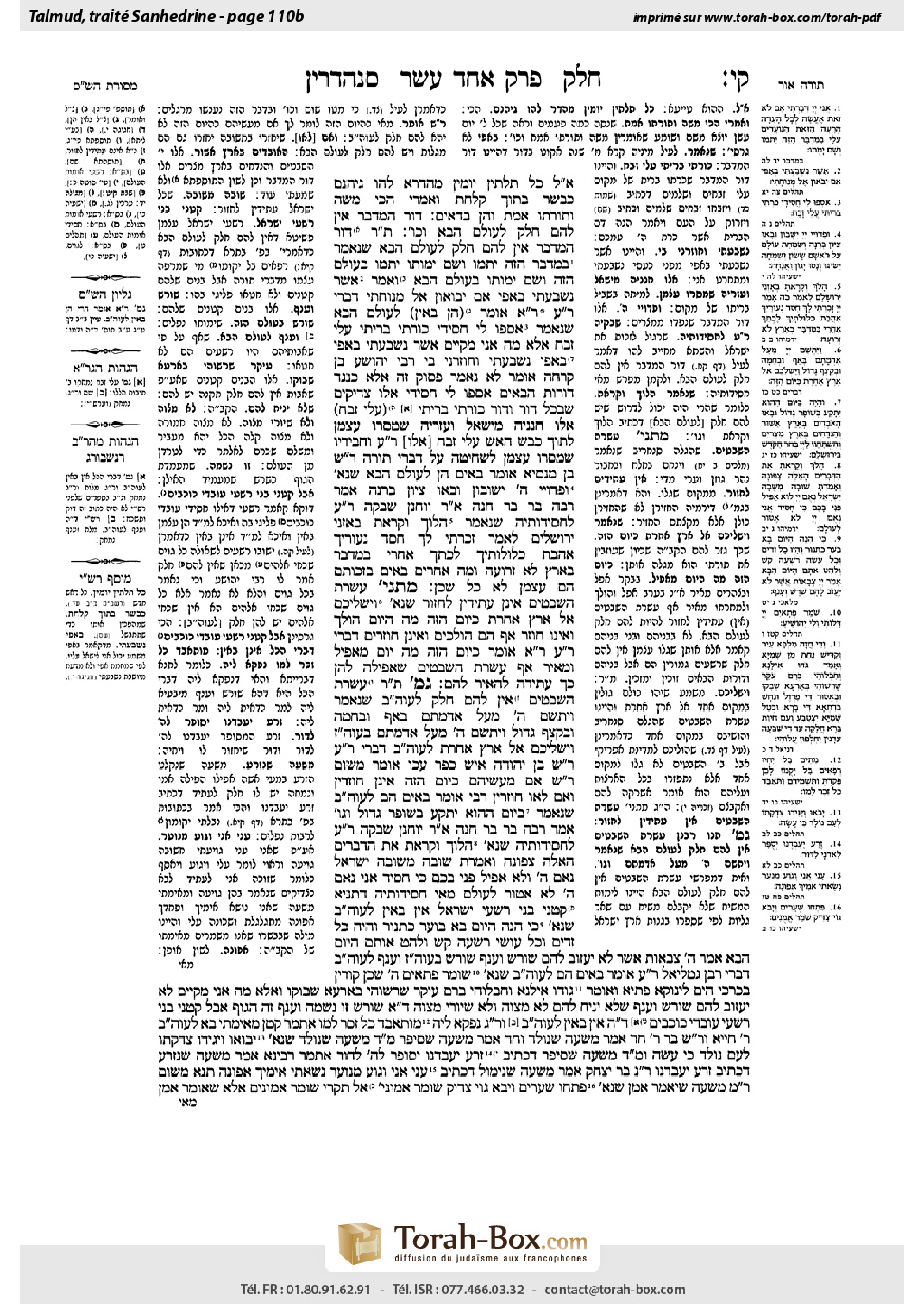
Sanhedrin 110b: Talmud study for Daf Yomi
Daf Yomi is the daily study of one Talmud folio. Explore 37 tractates with scans, Hebrew text, Sefaria English and AI-generated French translations where annotated.
Passage selection and English or AI-generated French translation are available where the scan has annotations. Daf Study is independent of Torah-Box and Sefaria.
Browse Sanhedrin · סנהדרין · All tractatesSanhedrin 110b text and translations
This page of Sanhedrin includes the Aramaic text, an English translation and an AI-generated French translation, alongside the scan above.
סנהדרין ק״י ב · Aramaic and Hebrew text
אֲמַר לֵיהּ: כֹּל תְּלָתִין יוֹמִין מְהַדְּרָא לְהוּ גֵּיהִנָּם כְּבָשָׂר בְּתוֹךְ קַלַּחַת, וְאָמְרִי הָכִי: ״מֹשֶׁה וְתוֹרָתוֹ אֱמֶת, וְהֵן בַּדָּאִים״.
דּוֹר הַמִּדְבָּר אֵין לָהֶם חֵלֶק לָעוֹלָם הַבָּא וְכוּ׳. תָּנוּ רַבָּנַן: דּוֹר הַמִּדְבָּר אֵין לָהֶם חֵלֶק לָעוֹלָם הַבָּא, שֶׁנֶּאֱמַר: ״בַּמִּדְבָּר הַזֶּה יִתַּמּוּ וְשָׁם יָמֻתוּ״. ״יִתַּמּוּ״ – בָּעוֹלָם הַזֶּה, ״וְשָׁם יָמֻתוּ״ – בָּעוֹלָם הַבָּא. וְאָמַר: ״אֲשֶׁר נִשְׁבַּעְתִּי בְאַפִּי אִם יְבֹאוּן אֶל מְנוּחָתִי״. דִּבְרֵי רַבִּי עֲקִיבָא.
רַבִּי אֱלִיעֶזֶר אוֹמֵר: הֵן בָּאִין לָעוֹלָם הַבָּא, שֶׁנֶּאֱמַר: ״אִסְפוּ לִי חֲסִידָי כֹּרְתֵי בְרִיתִי עֲלֵי זָבַח״. אֶלָּא מָה אֲנִי מְקַיֵּים ״אֲשֶׁר נִשְׁבַּעְתִּי בְאַפִּי״? בְּאַפִּי נִשְׁבַּעְתִּי, וְחוֹזְרַנִי בִּי.
רַבִּי יְהוֹשֻׁעַ בֶּן קׇרְחָה אוֹמֵר: לֹא נֶאֱמַר פָּסוּק זֶה אֶלָּא כְּנֶגֶד דּוֹרוֹת הַבָּאִים. ״אִסְפוּ לִי חֲסִידָי״ – אֵלּוּ צַדִּיקִים שֶׁבְּכָל דּוֹר וָדוֹר. ״כֹּרְתֵי בְרִיתִי עֲלֵי זָבַח״ – אֵלּוּ חֲנַנְיָה, מִישָׁאֵל וַעֲזַרְיָה שֶׁמָּסְרוּ עַצְמָן לְתוֹךְ כִּבְשַׁן הָאֵשׁ. ״עֲלֵי זָבַח״ – [אֵלּוּ] רַבִּי עֲקִיבָא וַחֲבֵירָיו שֶׁמָּסְרוּ עַצְמָן לִשְׁחִיטָה עַל דִּבְרֵי תוֹרָה.
רַבִּי שִׁמְעוֹן בֶּן מְנַסְיָא אוֹמֵר: בָּאִים הֵן לָעוֹלָם הַבָּא, שֶׁנֶּאֱמַר: ״וּפְדוּיֵי ה׳ יְשֻׁבוּן וּבָאוּ צִיּוֹן בְּרִנָּה״. אָמַר רַבָּה בַּר בַּר חָנָה אָמַר רַבִּי יוֹחָנָן: שַׁבְקַהּ רַבִּי עֲקִיבָא לַחֲסִידוּתֵיהּ, שֶׁנֶּאֱמַר: ״הָלֹךְ וְקָרָאתָ בְאׇזְנֵי יְרוּשָׁלִַים לֵאמֹר זָכַרְתִּי לָךְ חֶסֶד נְעוּרַיִךְ אַהֲבַת כְּלוּלֹתָיִךְ לֶכְתֵּךְ אַחֲרַי בַּמִּדְבָּר בְּאֶרֶץ לֹא זְרוּעָה״. וּמָה אֲחֵרִים בָּאִים בִּזְכוּתָם, הֵם עַצְמָן לֹא כׇּל שֶׁכֵּן?
מַתְנִי׳ עֲשֶׂרֶת הַשְּׁבָטִים אֵינָן עֲתִידִין לַחֲזוֹר, שֶׁנֶּאֱמַר: ״וַיַּשְׁלִכֵם אֶל אֶרֶץ אַחֶרֶת כַּיּוֹם הַזֶּה״. מָה הַיּוֹם הוֹלֵךְ וְאֵינוֹ חוֹזֵר – אַף הֵם הוֹלְכִים וְאֵינָן חוֹזְרִים, דִּבְרֵי רַבִּי עֲקִיבָא. רַבִּי אֱלִיעֶזֶר אוֹמֵר: ״כַּיּוֹם הַזֶּה״ – מָה יוֹם מַאֲפִיל וּמֵאִיר, אַף עֲשֶׂרֶת הַשְּׁבָטִים שֶׁאֲפֵילָה לָהֶן כָּךְ עֲתִידָה לְהָאִיר לָהֶם.
גְּמָ׳ תָּנוּ רַבָּנַן: עֲשֶׂרֶת הַשְּׁבָטִים אֵין לָהֶם חֵלֶק לָעוֹלָם הַבָּא, שֶׁנֶּאֱמַר: ״וַיִּתְּשֵׁם ה׳ מֵעַל אַדְמָתָם בְּאַף וּבְחֵמָה וּבְקֶצֶף גָּדוֹל״. ״וַיִּתְּשֵׁם ה׳ מֵעַל אַדְמָתָם״ – בְּעוֹלָם הַזֶּה, ״וַיַּשְׁלִכֵם אֶל אֶרֶץ אַחֶרֶת״ – לָעוֹלָם הַבָּא, דִּבְרֵי רַבִּי עֲקִיבָא. רַבִּי שִׁמְעוֹן בֶּן יְהוּדָה אִישׁ כְּפַר עַכּוֹ אוֹמֵר מִשּׁוּם רַבִּי שִׁמְעוֹן: אִם מַעֲשֵׂיהֶם כַּיּוֹם הַזֶּה – אֵינָן חוֹזְרִין, וְאִם לָאו – חוֹזְרִין.
רַבִּי אוֹמֵר: בָּאִים הֵם לָעוֹלָם הַבָּא, שֶׁנֶּאֱמַר: ״בַּיּוֹם הַהוּא יִתָּקַע בְּשׁוֹפָר גָּדוֹל וְגוֹ׳״. אָמַר רַבָּה בַּר בַּר חָנָה אָמַר רַבִּי יוֹחָנָן: שַׁבְקַהּ רַבִּי עֲקִיבָא לַחֲסִידוּתֵיהּ, שֶׁנֶּאֱמַר: ״הָלֹךְ וְקָרָאתָ אֶת הַדְּבָרִים הָאֵלֶּה צָפוֹנָה וְאָמַרְתָּ שׁוּבָה מְשֻׁבָה יִשְׂרָאֵל נְאֻם ה׳ לוֹא אַפִּיל פָּנַי בָּכֶם כִּי חָסִיד אֲנִי נְאֻם ה׳ לֹא אֶטּוֹר לְעוֹלָם״.
מַאי חֲסִידוּתֵיהּ? דְּתַנְיָא: קְטַנֵּי בְּנֵי רִשְׁעֵי יִשְׂרָאֵל אֵין בָּאִין לָעוֹלָם הַבָּא, שֶׁנֶּאֱמַר: ״כִּי הִנֵּה הַיּוֹם בָּא בֹּעֵר כַּתַּנּוּר וְהָיוּ כׇל זֵדִים וְכׇל עֹשֵׂה רִשְׁעָה קַשׁ וְלִהַט אֹתָם הַיּוֹם הַבָּא אָמַר ה׳ צְבָאוֹת אֲשֶׁר לֹא יַעֲזֹב לָהֶם שֹׁרֶשׁ וְעָנָף״. ״שֹׁרֶשׁ״ – בָּעוֹלָם הַזֶּה, ״וְעָנָף״ – לָעוֹלָם הַבָּא; דִּבְרֵי רַבָּן גַּמְלִיאֵל.
רַבִּי עֲקִיבָא אוֹמֵר: בָּאִים הֵם לָעוֹלָם הַבָּא, שֶׁנֶּאֱמַר: ״שֹׁמֵר פְּתָאִים ה׳״, שֶׁכֵּן קוֹרִין בִּכְרַכֵּי הַיָּם לְיָנוֹקָא פַּתְיָא. וְאוֹמֵר: ״גֹּדּוּ אִילָנָא וְחַבְּלוּהִי בְּרַם עִקַּר שׇׁרְשׁוֹהִי בְּאַרְעָא שְׁבֻקוּ״. וְאֶלָּא מָה אֲנִי מְקַיֵּים ״לֹא יַעֲזֹב לָהֶם שֹׁרֶשׁ וְעָנָף״? שֶׁלֹּא יַנִּיחַ לָהֶם לֹא מִצְוָה וְלֹא שִׁיּוּרֵי מִצְוָה. דָּבָר אַחֵר: ״שֹׁרֶשׁ״ – זוֹ נְשָׁמָה, ״וְעָנָף״ – זֶה הַגּוּף.
אֲבָל קְטַנֵּי בְּנֵי רִשְׁעֵי אוּמּוֹת הָעוֹלָם, דִּבְרֵי הַכֹּל, אֵין בָּאִין לָעוֹלָם הַבָּא. וְרַבָּן גַּמְלִיאֵל נָפְקָא לֵיהּ מִ״וַּתְּאַבֵּד כׇּל זֵכֶר לָמוֹ״.
אִתְּמַר: קָטָן, מֵאֵימָתַי בָּא לָעוֹלָם הַבָּא? רַבִּי חִיָּיא וְרַבִּי שִׁמְעוֹן בַּר רַבִּי – חַד אָמַר: מִשָּׁעָה שֶׁנּוֹלַד, וְחַד אָמַר: מִשָּׁעָה שֶׁסִּיפֵּר. מַאן דְּאָמַר מִשָּׁעָה שֶׁנּוֹלַד – שֶׁנֶּאֱמַר: ״יָבֹאוּ וְיַגִּידוּ צִדְקָתוֹ לְעַם נוֹלָד כִּי עָשָׂה״. וּמַאן דְּאָמַר מִשָּׁעָה שֶׁסִּיפֵּר – דִּכְתִיב: ״זֶרַע יַעַבְדֶנּוּ יְסֻפַּר לַה׳ לַדּוֹר״.
אִתְּמַר: רָבִינָא אָמַר, מִשָּׁעָה שֶׁנִּזְרַע, דִּכְתִיב: ״זֶרַע יַעַבְדֶנּוּ״. רַבִּי נַחְמָן בַּר יִצְחָק אָמַר, מִשָּׁעָה שֶׁנִּימּוֹל, דִּכְתִיב: ״עָנִי אֲנִי וְגֹוֵעַ מִנֹּעַר נָשָׂאתִי אֵמֶיךָ אָפוּנָה״.
תָּנָא מִשּׁוּם רַבִּי מֵאִיר: מִשָּׁעָה שֶׁיֹּאמַר ״אָמֵן״, שֶׁנֶּאֱמַר: ״פִּתְחוּ שְׁעָרִים וְיָבֹא גוֹי צַדִּיק שֹׁמֵר אֱמֻנִים״. אַל תִּקְרֵי ״שֹׁמֵר אֱמֻנִים״, אֶלָּא ״שֶׁאוֹמֵר אָמֵן״.
Sanhedrin 110b · English translation
The Arab said to him: Every thirty days Gehenna returns them to this place like meat cooking in a cauldron, and they say this: Moses and his Torah are truth, and they are liars.
§ The mishna teaches: The members of the generation of the wilderness have no share in the World-to-Come. The Sages taught: The members of the generation of the wilderness have no share in the World-to-Come, as it is stated: “In this wilderness they shall be consumed, and there they shall die” (Numbers 14:35). “They shall be consumed” indicates in this world; “and there they shall die” indicates for the World-to-Come. And the verse states with regard to the generation of the wilderness: “Wherefore I took an oath in My anger that they should not enter into My rest” (Psalms 95:11), indicating that they will not be privileged to gain eternal rest; this is the statement of Rabbi Akiva.
Rabbi Eliezer says: They come to the World-to-Come, as it is stated: “Gather My pious together to Me, those that have entered into My covenant by offering” (Psalms 50:5). Those who left Egypt entered into an eternal covenant with God at Mount Sinai. But how do I realize the meaning of the phrase “Wherefore I took an oath in My anger”? It must be understood: In My anger I took an oath, and I reconsidered and dissolved the oath when My anger subsided.
Rabbi Yehoshua ben Korḥa says: This verse was stated to the generation of the wilderness only with regard to future generations, and should be understood in this manner: “Gather My pious together to Me”; these are the righteous that are in each and every generation. “Those that have entered into My covenant by offering”; these are Hananiah, Mishael, and Azariah, who submitted themselves to the fiery furnace to sanctify God’s name. “By offering”; this is a reference to Rabbi Akiva and his colleagues, who gave themselves up to slaughter over matters of Torah.
Rabbi Shimon ben Menasya says: The generation of the wilderness comes to the World-to-Come, as it is stated: “And the redeemed of the Lord shall return and come singing into Zion” (Isaiah 35:10), meaning that those whom God redeemed will yet come to Zion. Rabba bar bar Ḥana says that Rabbi Yoḥanan says: Rabbi Akiva abandoned his piety and uncharacteristically interpreted the verses harshly, as it is stated with regard to the generation of the wilderness: “Go and cry in the ears of Jerusalem saying, so says the Lord: I remember for you the affection of your youth, the love of your espousals, how you went after Me in the wilderness, in a land that was not sown” (Jeremiah 2:2). Now, if others come into the World-to-Come in the merit of the generation that left Egypt and followed God in the wilderness, is it not all the more so that the generation of the wilderness themselves have a share in the World-to-Come?
MISHNA: The ten tribes are not destined to return to Eretz Yisrael, even during the messianic era, as it is stated: “And He cast them into another land, as it is this day” (Deuteronomy 29:27). Just as the day passes never to return, so too, the ten tribes go into exile and do not return; this is the statement of Rabbi Akiva. Rabbi Eliezer says: “As it is this day,” meaning just as the day darkens and then the sky brightens the next day, with regard to the ten tribes as well, although it is dark for them now, so it is destined to brighten for them.
GEMARA: The Sages taught in a baraita (Tosefta 13:12): The ten tribes have no share in the World-to-Come, as it is stated: “And the Lord rooted them out of their land in anger, and in wrath, and in great indignation; and He cast them into another land, as it is this day” (Deuteronomy 29:27). “And the Lord rooted them out of their land” indicates in this world; “and cast them into another land” indicates for the World-to-Come; this is the statement of Rabbi Akiva. Rabbi Shimon ben Yehuda of the village of Akko says in the name of Rabbi Shimon: If their actions continue to be “as it is this day” and they continue to sin, they do not return to Eretz Yisrael. And if not, and they repent, they return to Eretz Yisrael.
Rabbi Yehuda HaNasi says: The members of the ten tribes come to the World-to-Come, as it is stated: “And it shall come to pass on that day, that a great shofar will be sounded, and they shall come who were lost in the land of Assyria and who were dispersed in the land of Egypt, and they shall worship the Lord at the holy mountain in Jerusalem” (Isaiah 27:13). Rabba bar bar Ḥana says that Rabbi Yoḥanan says: Here too, Rabbi Akiva abandoned his piety and uncharacteristically interpreted the verses harshly, as it is stated with regard to the ten tribes: “Go and proclaim these words toward the north, and say: Return you faithless Israel, says the Lord; I will not frown upon you; for I am merciful, says the Lord, and I will not bear a grudge forever” (Jeremiah 3:12). The prophet prophesies about the return of the ten tribes to Eretz Yisrael.
§ The Gemara asks: What is the characteristic piety of Rabbi Akiva mentioned above? The Gemara answers: It is as it is taught in a baraita: The minor children of the wicked of the Jewish people, who died with neither their own virtue nor the virtue of their parents, do not come into the World-to-Come, as it is stated: “For behold the day is coming; it burns like a furnace, and all the arrogant and all who do wickedly shall be straw; and the day that is coming shall burn them up, says the Lord of hosts, so that it will leave them neither root nor branch” (Malachi 3:19). “Root” and “branch” are referring to descendants; they will have neither a root in this world nor a branch in the World-to-Come; this is the statement of Rabban Gamliel.
Rabbi Akiva says: They come into the World-to-Come, as it is stated: “The Lord preserves the simple [peta’im]” (Psalms 116:6), as in the cities overseas the residents call a child patya. And the verse states with regard to Nebuchadnezzar: “Hew down the tree and destroy it; yet leave the stump of its roots in the earth” (Daniel 4:20). If that is the case with regard to Nebuchadnezzar, all the more so it is the case with regard to the wicked people of Israel. But how do I realize the meaning of the phrase: “So that it will leave them neither root nor branch”? It means that God will not leave for the wicked a mitzva nor the remnants of a mitzva for which they will be rewarded. Rabbi Akiva dug deep to find a way into the World-to-Come for these children. Alternatively, “root”; this is referring to the soul. “Nor branch”; this is referring to the body.
But everyone agrees that the minor children of the wicked of the nations of the world will not come into the World-to-Come, as they have no virtue at all. And Rabban Gamliel derives this matter concerning those children from the verse: “And you have caused all their memory to perish” (Isaiah 26:14).
It was stated: With regard to a minor who dies, from when, i.e., from what stage, does he come into the World-to-Come? There is a dispute between Rabbi Ḥiyya and Rabbi Shimon bar Rabbi Yehuda HaNasi. One of them says: From the moment that he is born, and the other one says: From the moment that he begins to talk. The Gemara elaborates: The one who says: From the moment that he is born, derives it from that which is stated: “They shall come and shall declare His righteousness to a people that shall be born, that He has done this” (Psalms 22:32). And the one who says: From the moment that he begins to talk, derives it from that which is written: “Their seed shall serve Him; it shall be told of the Lord to the coming generation” (Psalms 22:31), as from the moment he talks, he belongs to God.
It was stated that additional amora’im expressed opinions about the same matter. Ravina says: From the moment that the child is conceived, even before his birth, he can enter the World-to-Come, as it is written: “Their seed shall serve Him” (Psalms 22:31); even as seed the child merits to enter the World-to-Come. Rabbi Naḥman bar Yitzḥak says: From the moment that he is circumcised, as it is written: “I am poor and close to death from youth; I suffered your terrors [emekha], I am numb” (Psalms 88:16). From the moment that one bears the mark that the Jewish people have due to fear of God [eima], he turns to God and he belongs to Him.
It is taught in the name of Rabbi Meir: From the moment that the child will say amen, as it is stated: “Open the gates, so that the righteous nation that keeps faithfulness may enter” (Isaiah 26:2). Do not read the verse as “that keeps faithfulness [shomer emunim]”; rather, read it as: That says amen [she’omer amen]. From the moment he says amen, the gates to the World-to-Come open.
Sanhedrin 110b · Traduction française (IA)
L’Arabe lui dit : « Tous les trente jours, la Géhenne les ramène à cet endroit, comme de la viande qui cuit dans un chaudron, et ils disent : “Moïse et sa Torah sont vérité, et eux sont des menteurs.” »
§ La Michna enseigne : Les membres de la génération du désert n’ont pas de part au Monde à venir. Les Sages ont enseigné : Les membres de la génération du désert n’ont pas de part au Monde à venir, comme il est dit : « Dans ce désert, ils seront consumés, et là ils mourront » (Nombres 14:35). « Ils seront consumés » désigne ce monde, et « là ils mourront » désigne le Monde à venir. Le verset dit également au sujet de la génération du désert : « C’est pourquoi, dans ma colère, j’ai juré qu’ils n’entreraient pas dans mon repos » (Psaumes 95:11), ce qui indique qu’ils ne seront pas admis au repos éternel. Telle est l’opinion de Rabbi Akiva.
Rabbi Eliezer dit : Ils accéderont au Monde à venir, comme il est dit : « Rassemblez auprès de moi mes fidèles, ceux qui sont entrés dans mon alliance par le sacrifice » (Psaumes 50:5). Ceux qui ont quitté l’Égypte sont entrés dans une alliance éternelle avec Dieu au mont Sinaï. Mais comment comprendre l’expression « C’est pourquoi, dans ma colère, j’ai juré » ? Il faut la comprendre ainsi : « Dans ma colère, j’ai juré », puis je me suis ravisé et j’ai annulé le serment lorsque ma colère s’est apaisée.
Rabbi Yehoshua ben Korḥa dit : Ce verset ne concerne la génération du désert qu’en référence aux générations futures, et il faut le comprendre ainsi : « Rassemblez auprès de moi mes fidèles » : ce sont les justes de chaque génération. « Ceux qui sont entrés dans mon alliance par le sacrifice » : ce sont Hanania, Mishael et Azaria, qui se sont soumis à la fournaise ardente afin de sanctifier le nom de Dieu. « Par le sacrifice » : cela fait référence à Rabbi Akiva et à ses collègues, qui se sont livrés au massacre pour des questions de Torah.
Rabbi Shimon ben Menasya dit : La génération du désert accédera au Monde à venir, comme il est dit : « Les rachetés de l’Éternel reviendront et entreront à Sion en chantant » (Isaïe 35:10), c’est-à-dire que ceux que Dieu a rachetés viendront encore à Sion. Rabba bar bar Ḥana dit au nom de Rabbi Yoḥanan : Rabbi Akiva a renoncé à sa piété et, contrairement à son habitude, a interprété les versets de manière sévère, comme il est dit au sujet de la génération du désert : « Va proclamer aux oreilles de Jérusalem : Ainsi parle l’Éternel : Je me souviens de l’attachement de ta jeunesse, de l’amour de tes fiançailles, lorsque tu me suivais dans le désert, dans un pays qui n’était pas ensemencé » (Jérémie 2:2). Or, si d’autres accèdent au Monde à venir grâce au mérite de la génération qui a quitté l’Égypte et suivi Dieu dans le désert, à plus forte raison les membres de la génération du désert eux-mêmes ont-ils une part au Monde à venir !
MICHNA : Les dix tribus ne sont pas destinées à revenir en Eretz Yisrael, même à l’époque messianique, comme il est dit : « Il les a jetés dans un autre pays, comme c’est le cas aujourd’hui » (Deutéronome 29:27). De même que le jour passe sans jamais revenir, ainsi les dix tribus partent en exil et ne reviennent pas. Telle est l’opinion de Rabbi Akiva. Rabbi Eliezer dit : « Comme c’est le cas aujourd’hui » signifie que, de même que le jour s’assombrit puis que le ciel s’éclaircit le lendemain, de même, pour les dix tribus, bien qu’il fasse sombre pour elles à présent, leur avenir s’éclaircira.
GUEMARA : Les Sages ont enseigné dans une baraïta (Tosefta 13:12) : Les dix tribus n’ont pas de part au Monde à venir, comme il est dit : « L’Éternel les a déracinés de leur terre, dans la colère, dans le courroux et dans une grande indignation, et les a jetés dans un autre pays, comme c’est le cas aujourd’hui » (Deutéronome 29:27). « L’Éternel les a déracinés de leur terre » désigne ce monde, et « les a jetés dans un autre pays » désigne le Monde à venir. Telle est l’opinion de Rabbi Akiva. Rabbi Shimon ben Yehuda, du village d’Akko, dit au nom de Rabbi Shimon : Si leur conduite demeure « comme c’est le cas aujourd’hui » et qu’ils continuent à pécher, ils ne reviendront pas en Eretz Yisrael. Dans le cas contraire, s’ils se repentent, ils reviendront en Eretz Yisrael.
Rabbi Yehuda HaNasi dit : Les membres des dix tribus accéderont au Monde à venir, comme il est dit : « En ce jour-là, un grand shofar retentira ; ceux qui étaient perdus au pays d’Assyrie et ceux qui étaient dispersés au pays d’Égypte viendront, et ils se prosterneront devant l’Éternel sur la montagne sainte, à Jérusalem » (Isaïe 27:13). Rabba bar bar Ḥana dit au nom de Rabbi Yoḥanan : Ici aussi, Rabbi Akiva a renoncé à sa piété et, contrairement à son habitude, a interprété les versets de manière sévère, comme il est dit au sujet des dix tribus : « Va proclamer ces paroles vers le nord et dis : Reviens, Israël infidèle, dit l’Éternel ; je ne tournerai pas vers toi un visage irrité, car je suis miséricordieux, dit l’Éternel, et je ne garderai pas rancune éternellement » (Jérémie 3:12). Le prophète prophétise le retour des dix tribus en Eretz Yisrael.
§ La Guemara demande : En quoi consiste la piété de Rabbi Akiva mentionnée plus haut ? La Guemara répond : C’est ce qui est enseigné dans une baraïta : Les jeunes enfants des méchants du peuple juif, qui sont morts sans avoir de mérite propre ni bénéficier du mérite de leurs parents, n’accèdent pas au Monde à venir, comme il est dit : « Car voici, le jour vient, brûlant comme une fournaise ; tous les arrogants et tous ceux qui commettent le mal seront comme de la paille, et le jour qui vient les consumera, dit l’Éternel des Armées, si bien qu’il ne leur laissera ni racine ni branche » (Malachie 3:19). « Racine » et « branche » désignent les descendants : ils n’auront ni racine dans ce monde ni branche dans le Monde à venir. Telle est l’opinion de Rabban Gamliel.
Rabbi Akiva dit : Ils accèdent au Monde à venir, comme il est dit : « L’Éternel protège les simples [peta’im] » (Psaumes 116:6), car, dans les villes d’outre-mer, les habitants appellent un enfant patya. Le verset dit également au sujet de Nabuchodonosor : « Abattez l’arbre et détruisez-le, mais laissez en terre la souche de ses racines » (Daniel 4:20). S’il en est ainsi pour Nabuchodonosor, à plus forte raison en est-il ainsi pour les méchants d’Israël. Mais comment comprendre l’expression « si bien qu’il ne leur laissera ni racine ni branche » ? Cela signifie que Dieu ne laissera aux méchants ni mitsva ni le moindre reste d’une mitsva pour lequel ils pourraient être récompensés. Rabbi Akiva a creusé profondément pour trouver à ces enfants une voie vers le Monde à venir. Autre interprétation : « Racine » désigne l’âme ; « ni branche » désigne le corps.
Mais tous conviennent que les jeunes enfants des méchants des nations du monde n’accéderont pas au Monde à venir, puisqu’ils n’ont aucun mérite. Rabban Gamliel déduit le cas de ces enfants du verset : « Tu as fait périr tout leur souvenir » (Isaïe 26:14).
Il a été rapporté : À partir de quel moment, c’est-à-dire à quel stade, un enfant qui meurt accède-t-il au Monde à venir ? Rabbi Ḥiyya et Rabbi Shimon bar Rabbi Yehuda HaNasi sont en désaccord. L’un dit : Dès sa naissance ; l’autre dit : Dès qu’il commence à parler. La Guemara développe : Celui qui dit « dès sa naissance » le déduit de ce qui est dit : « Ils viendront et proclameront sa justice à un peuple qui naîtra, car il a agi ainsi » (Psaumes 22:32). Celui qui dit « dès qu’il commence à parler » le déduit de ce qui est écrit : « Leur descendance le servira ; on parlera du Seigneur à la génération à venir » (Psaumes 22:31), car dès qu’il parle, il appartient à Dieu.
Il a été rapporté que d’autres amoraïm ont exprimé des opinions sur la même question. Ravina dit : Dès la conception de l’enfant, avant même sa naissance, il peut accéder au Monde à venir, comme il est écrit : « Leur descendance le servira » (Psaumes 22:31) : même en tant que descendance, l’enfant mérite d’accéder au Monde à venir. Rabbi Naḥman bar Yitzḥak dit : Dès sa circoncision, comme il est écrit : « Je suis pauvre et proche de la mort depuis ma jeunesse ; j’ai subi tes terreurs [emekha], je suis engourdi » (Psaumes 88:16). Dès qu’il porte la marque que le peuple juif porte par crainte de Dieu [eima], il se tourne vers Dieu et lui appartient.
Il est enseigné au nom de Rabbi Meir : Dès que l’enfant est capable de dire amen, comme il est dit : « Ouvrez les portes, afin que la nation juste, qui garde la fidélité, y entre » (Isaïe 26:2). Ne lis pas le verset comme « qui garde la fidélité [shomer emunim] », mais plutôt comme « qui dit amen [she’omer amen] ». Dès qu’il dit amen, les portes du Monde à venir s’ouvrent.
Traduction française générée par IA à partir de l’édition anglaise de Sefaria. Vérifie toujours un passage avec le texte source.
Text from Sefaria: William Davidson Edition - Vocalized Aramaic (CC BY NC); William Davidson Edition - English (CC BY NC).