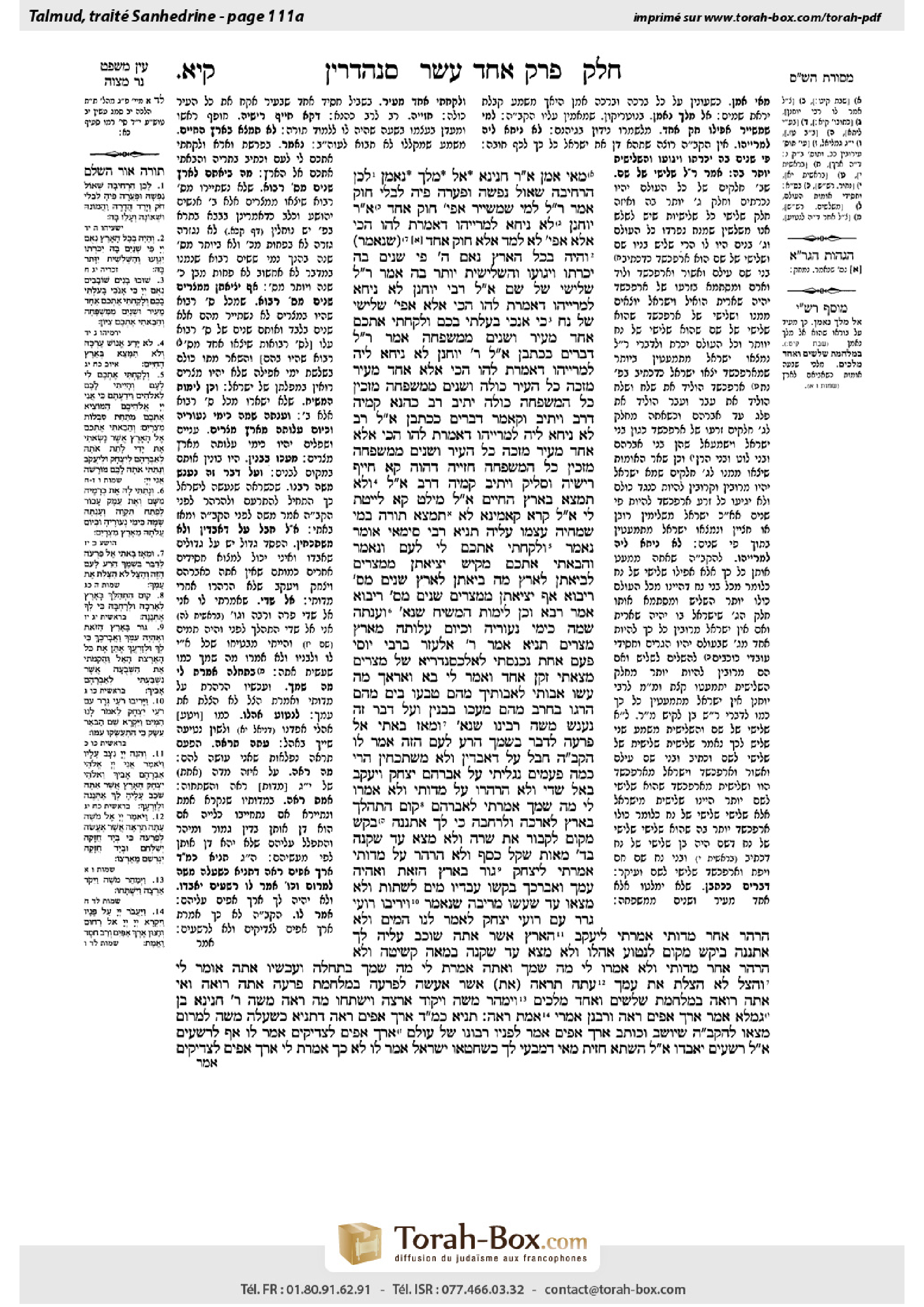
Sanhedrin 111a: Talmud study for Daf Yomi
Daf Yomi is the daily study of one Talmud folio. Explore 37 tractates with scans, Hebrew text, Sefaria English and AI-generated French translations where annotated.
Passage selection and English or AI-generated French translation are available where the scan has annotations. Daf Study is independent of Torah-Box and Sefaria.
Browse Sanhedrin · סנהדרין · All tractatesSanhedrin 111a text and translations
This page of Sanhedrin includes the Aramaic text, an English translation and an AI-generated French translation, alongside the scan above.
סנהדרין קי״א א · Aramaic and Hebrew text
מַאי ״אָמֵן״? אָמַר רַבִּי חֲנִינָא: ״אֵל מֶלֶךְ נֶאֱמָן״.
״לָכֵן הִרְחִיבָה שְּׁאוֹל נַפְשָׁהּ וּפָעֲרָה פִיהָ לִבְלִי חֹק״. אָמַר רֵישׁ לָקִישׁ: לְמִי שֶׁמְּשַׁיֵּיר אֲפִילּוּ חוֹק אֶחָד. אָמַר רַבִּי יוֹחָנָן: לָא נִיחָא לְמָרַיְיהוּ דְּאָמְרַתְּ לְהוּ הָכִי, אֶלָּא אֲפִילּוּ לֹא לָמַד אֶלָּא חוֹק אֶחָד.
(שֶׁנֶּאֱמַר) ״וְהָיָה בְכׇל הָאָרֶץ נְאֻם ה׳ פִּי שְׁנַיִם בָּהּ יִכָּרְתוּ יִגְוָעוּ וְהַשְּׁלִישִׁית יִוָּתֶר בָּהּ״. אָמַר רֵישׁ לָקִישׁ: שְׁלִישִׁי שֶׁל שֵׁם. אֲמַר לֵיהּ רַבִּי יוֹחָנָן: לָא נִיחָא לְמָרַיְיהוּ דְּאָמְרַתְּ לְהוּ הָכִי, אֶלָּא אֲפִילּוּ שְׁלִישִׁי שֶׁל נֹחַ.
״כִּי אָנֹכִי בָּעַלְתִּי בָכֶם וְלָקַחְתִּי אֶתְכֶם אֶחָד מֵעִיר וּשְׁנַיִם מִמִּשְׁפָּחָה״. אָמַר רֵישׁ לָקִישׁ: דְּבָרִים כִּכְתָבָן. אֲמַר לֵיהּ רַבִּי יוֹחָנָן: לָא נִיחָא לֵיהּ לְמָרַיְיהוּ דְּאָמְרַתְּ לְהוּ הָכִי, אֶלָּא אֶחָד מֵעִיר מְזַכֶּה כָּל הָעִיר כּוּלָּהּ, וּשְׁנַיִם מִמִּשְׁפָּחָה מְזַכִּין כָּל הַמִּשְׁפָּחָה כּוּלָּהּ. יָתֵיב רַב כָּהֲנָא קַמֵּיהּ דְּרַב וְיָתֵיב וְקָאָמַר: דְּבָרִים כִּכְתָבָן. אֲמַר לֵיהּ רַב: לָא נִיחָא לֵיהּ לְמָרַיְיהוּ דְּאָמְרַתְּ לְהוּ הָכִי, אֶלָּא אֶחָד מֵעִיר מְזַכֶּה כָּל הָעִיר, וּשְׁנַיִם מִמִּשְׁפָּחָה מְזַכִּין כָּל הַמִּשְׁפָּחָה.
חַזְיֵיהּ דַּהֲוָה קָא חָיֵיף רֵישֵׁיהּ וְסָלֵיק וְיָתֵיב קַמֵּיהּ דְּרַב. אֲמַר לֵיהּ: ״וְלֹא תִמָּצֵא בְּאֶרֶץ הַחַיִּים״. אֲמַר לֵיהּ: מֵילָט קָא לָיְיטַתְּ לִי? אֲמַר לֵיהּ: קְרָא קָאָמֵינָא, לֹא תִּמָּצֵא תּוֹרָה בְּמִי שֶׁמְּחַיֶּה עַצְמוֹ עָלֶיהָ.
תַּנְיָא: רַב סִימַאי אוֹמֵר, נֶאֱמַר: ״וְלָקַחְתִּי אֶתְכֶם לִי לְעָם״, וְנֶאֱמַר: ״וְהֵבֵאתִי אֶתְכֶם״. מַקִּישׁ יְצִיאָתָן מִמִּצְרַיִם לְבִיאָתָן לָאָרֶץ. מָה בִּיאָתָן לָאָרֶץ – שְׁנַיִם מִשִּׁשִּׁים רִיבּוֹא, אַף יְצִיאָתָן מִמִּצְרַיִם – שְׁנַיִם מִשִּׁשִּׁים רִיבּוֹא. אָמַר רָבָא: וְכֵן לִימוֹת הַמָּשִׁיחַ, שֶׁנֶּאֱמַר: ״וְעָנְתָה שָּׁמָּה כִּימֵי נְעוּרֶיהָ וּכְיוֹם עֲלוֹתָהּ מֵאֶרֶץ מִצְרָיִם״.
תַּנְיָא: אָמַר רַבִּי אֶלְעָזָר בְּרַבִּי יוֹסֵי, פַּעַם אַחַת נִכְנַסְתִּי לַאֲלֶכְּסַנְדְּרִיָּא שֶׁל מִצְרַיִם. מָצָאתִי זָקֵן אֶחָד וְאָמַר לִי: בֹּא וְאַרְאֶךָּ מָה עָשׂוּ אֲבוֹתַי לַאֲבוֹתֶיךָ. מֵהֶם טִבְּעוּ בַּיָּם, מֵהֶם הָרְגוּ בַּחֶרֶב, מֵהֶם מָעֲכוּ בְּבִנְיָן. וְעַל דָּבָר זֶה נֶעֱנַשׁ מֹשֶׁה רַבֵּינוּ, שֶׁנֶּאֱמַר: ״וּמֵאָז בָּאתִי אֶל פַּרְעֹה לְדַבֵּר בִּשְׁמֶךָ הֵרַע לָעָם הַזֶּה״.
אָמַר לוֹ הַקָּדוֹשׁ בָּרוּךְ הוּא: חֲבָל עַל דְּאָבְדִין וְלָא מִשְׁתַּכְחִין. הֲרֵי כַּמָּה פְּעָמִים נִגְלֵיתִי עַל אַבְרָהָם יִצְחָק וְיַעֲקֹב בְּאֵל שַׁדַּי, וְלֹא הִרְהֲרוּ עַל מִדּוֹתַי, וְלֹא אָמְרוּ לִי ״מַה שְּׁמֶךָ״. אָמַרְתִּי לְאַבְרָהָם ״קוּם הִתְהַלֵּךְ בָּאָרֶץ לְאׇרְכָּהּ וּלְרׇחְבָּהּ כִּי לְךָ אֶתְּנֶנָּה״. בִּקֵּשׁ מָקוֹם לִקְבּוֹר אֶת שָׂרָה וְלֹא מָצָא, עַד שֶׁקָּנָה בְּאַרְבַּע מֵאוֹת שֶׁקֶל כֶּסֶף, וְלֹא הִרְהֵר עַל מִדּוֹתַי.
אָמַרְתִּי לְיִצְחָק: ״גּוּר בָּאָרֶץ הַזֹּאת וְאֶהְיֶה עִמְּךָ וַאֲבָרְכֶךָּ״. בִּקְּשׁוּ עֲבָדָיו מַיִם לִשְׁתּוֹת וְלֹא מָצְאוּ, עַד שֶׁעָשׂוּ מְרִיבָה, שֶׁנֶּאֱמַר: ״וַיָּרִיבוּ רֹעֵי גְרָר עִם רֹעֵי יִצְחָק לֵאמֹר לָנוּ הַמָּיִם״. וְלֹא הִרְהֵר אַחַר מִדּוֹתַי.
אָמַרְתִּי לְיַעֲקֹב: ״הָאָרֶץ אֲשֶׁר אַתָּה שֹׁכֵב עָלֶיהָ לְךָ אֶתְּנֶנָּה״. בִּיקֵּשׁ מָקוֹם לִנְטוֹעַ אׇהֳלוֹ, וְלֹא מָצָא, עַד שֶׁקָּנָה בְּמֵאָה קְשִׂיטָה, וְלֹא הִרְהֵר אַחַר מִדּוֹתַי, וְלֹא אָמְרוּ לִי: ״מַה שְּׁמֶךָ״, וְאַתָּה אָמְרַתְּ לִי: ״מַה שְּׁמֶךָ״ בַּתְּחִלָּה, וְעַכְשָׁיו אַתָּה אוֹמֵר לִי: ״וְהַצֵּל לֹא הִצַּלְתָּ אֶת עַמֶּךָ״. ״עַתָּה תִרְאֶה אֵת אֲשֶׁר אֶעֱשֶׂה לְפַרְעֹה״. בְּמִלְחֶמֶת פַּרְעֹה אַתָּה רוֹאֶה, וְאִי אַתָּה רוֹאֶה בְּמִלְחֶמֶת שְׁלֹשִׁים וְאֶחָד מְלָכִים.
״וַיְמַהֵר מֹשֶׁה וַיִּקֹּד אַרְצָה וַיִּשְׁתָּחוּ״. מָה רָאָה מֹשֶׁה?
רַבִּי חֲנִינָא בֶּן גַּמְלָא אָמַר: ״אֶרֶךְ אַפַּיִם״ רָאָה, וְרַבָּנַן אָמְרִי: ״אֱמֶת״ רָאָה. תַּנְיָא כְּמַאן דְּאָמַר ״אֶרֶךְ אַפַּיִם״ רָאָה, דְּתַנְיָא: כְּשֶׁעָלָה מֹשֶׁה לְמָרוֹם מְצָאוֹ לְהַקָּדוֹשׁ בָּרוּךְ הוּא שֶׁיּוֹשֵׁב וְכוֹתֵב ״אֶרֶךְ אַפַּיִם״. אָמַר לְפָנָיו: רִבּוֹנוֹ שֶׁל עוֹלָם, ״אֶרֶךְ אַפַּיִם״ לַצַּדִּיקִים? אָמַר לוֹ: ״אַף לָרְשָׁעִים״. אֲמַר לֵיהּ: רְשָׁעִים יֹאבֵדוּ! אֲמַר לֵיהּ: הַשְׁתָּא חָזֵית (מַאי) דְּמִבְּעֵי לָךְ.
כְּשֶׁחָטְאוּ יִשְׂרָאֵל, אָמַר לוֹ: לֹא כָּךְ אָמַרְתָּ לִי ״אֶרֶךְ אַפַּיִם לַצַּדִּיקִים״?
Sanhedrin 111a · English translation
What is the meaning of the term amen? Rabbi Ḥanina says: It is an acronym of the words: God, faithful King [El Melekh ne’eman].
§ With regard to the verse: “Therefore, the netherworld has enlarged itself and opened its mouth without measure [livli ḥok]” (Isaiah 5:14), Reish Lakish says: It is referring to one who leaves even one statute [ḥok] unfulfilled; the netherworld expands for him. Rabbi Yoḥanan says: It is not satisfactory to God, their Master, that you said this about them, as according to Reish Lakish’s opinion most of the Jewish people would be doomed to Gehenna. Rather, even if one learned only one statute, he has a share in the World-to-Come, and “livli ḥok” means one who has learned no statutes at all.
With regard to that which is stated: “And it shall come to pass that in all the land, says the Lord, two parts shall be excised and die, but the third shall remain in it” (Zechariah 13:8), Reish Lakish says: “The third” means that only one-third of the descendants of Shem, son of Noah, will remain, and everyone else will die. Rabbi Yoḥanan said to Reish Lakish: It is not satisfactory to God, their Master, that you said this about them, that the overwhelming majority of the world will be destroyed. Rather, even as many as one-third of the descendants of Noah, one-third of the population of the world, will remain.
With regard to the verse: “For I have taken you to Myself: And I will take out one of a city, and two of a family” (Jeremiah 3:14), Reish Lakish says: The meaning of this statement is as it is written, that only individuals will be spared and the rest will be destroyed. Rabbi Yoḥanan said to him: It is not satisfactory to God, their Master, that you said this about them. Rather, the merit of one from the city causes the entire city to benefit, and the merit of two from a family causes the entire family to benefit and be redeemed. Likewise, the Gemara relates that Rav Kahana sat before Rav, and sat and said: The meaning of this statement is as it is written. Rav said to him: It is not satisfactory to God, their Master, that you said this about them. Rather, the merit of one from the city causes the entire city to benefit, and the merit of two from a family causes the entire family to benefit and be redeemed.
The Gemara relates that Rav saw that Rav Kahana was washing the hair on his head and then arose and sat before Rav. Rav said to Rav Kahana: “Nor shall it be found in the land of the living [haḥayyim]” (Job 28:13). Rav Kahana thought that Rav addressed that verse to him and he said to Rav: Are you cursing me? Rav said to him: It is a verse that I am saying to remind you that Torah will not be found in one who sustains [meḥayye] himself in an indulgent manner in its study; rather, Torah is acquired through suffering and difficulty.
It is taught in a baraita with regard to the few that are destined to be redeemed: Rav Simai says that it is stated: “And I will take you to Me as a people” (Exodus 6:7), and juxtaposed to that verse it is stated: “And I will bring you into the land” (Exodus 6:8). The Torah compares their exodus from Egypt to their entry into the land; just as during their entry into the land only two of six hundred thousand entered the land, as they all died in the wilderness except for Caleb and Joshua, so too, during their exodus from Egypt, in terms of the ratio, only two of six hundred thousand left Egypt and the rest died there. Rava says: And likewise, that will be the situation in the messianic era, as it is stated: “And she shall respond there, as in the days of her youth, and as in the day when she came up out of the land of Egypt” (Hosea 2:17). The ultimate redemption and the exodus from Egypt are juxtaposed, indicating that in the messianic era too, only few will survive.
§ It is taught in a baraita that Rabbi Elazar, son of Rabbi Yosei, says: One time I entered Alexandria of Egypt. I found one old man and he said to me: Come and I will show you what my ancestors, the Egyptians, did to your ancestors, the Jewish people. Some of them they drowned in the sea, some of them they killed with the sword, and some of them they crushed in the buildings. And it is over this matter, Moses’ protest of the afflictions suffered by the Jewish people, that Moses, our teacher, was punished, as it is stated: “For since I came to Pharaoh to speak in Your name, he has done evil to this people, neither have You delivered Your people at all” (Exodus 5:23).
The Holy One, Blessed be He, said to Moses: Woe over those who are gone and are no longer found; as several times I revealed Myself to Abraham, Isaac, and Jacob as God Almighty [El Shaddai] and they did not question My attributes, and did not say to Me: What is Your name? I said to Abraham: “Arise, walk through the land in the length of it and in the breadth of it; for unto you I will give it” (Genesis 13:17). Ultimately, he sought a place to bury Sarah and did not find one until he purchased it for four hundred silver shekels, and he did not question My attributes and did not protest that I failed to fulfill My promise to give him the land.
I said to Isaac: “Sojourn in this land, and I will be with you and will bless you” (Genesis 26:3). His servants sought water to drink and they did not find it until they started a quarrel, as it is stated: “And the herdsmen of Gerar quarreled with Isaac’s herdsmen saying: The water is ours” (Genesis 26:20), and he did not question My attributes.
I said to Jacob: “The land upon which you lie, to you I will give it” (Genesis 28:13). He sought a place to pitch his tent and he did not find one until he purchased it for one hundred coins, and he did not question My attributes, and did not say to Me: What is Your name? And you, Moses, ask Me: What is Your name, initially, after witnessing My greatness more than they ever did. And now you say to Me: “Neither have You delivered Your people” (Exodus 5:23). The verse then states: “Now shall you see what I will do to Pharaoh” (Exodus 6:1). One can infer: The war with Pharaoh and his downfall you shall see, but you will not see the war with the thirty-one kings in Eretz Yisrael, as you will not be privileged to conquer Eretz Yisrael for the Jewish people.
§ With regard to the verse: “And the Lord passed before him and proclaimed: The Lord, the Lord, compassionate and gracious God, slow to anger, abounding in loving-kindness and truth, extending loving-kindness to thousands of generations…and Moses made haste and bowed his head toward the earth and prostrated himself” (Exodus 34:6–8), the Gemara asks: What did Moses see in these attributes that caused him to hastily prostrate himself?
Rabbi Ḥanina ben Gamla says: He saw the attribute of slow to anger; and the Rabbis say: He saw the attribute of truth. It is taught in a baraita in accordance with the opinion of the one who said: He saw the attribute of slow to anger, as it is taught in a baraita: When Moses ascended on high, he discovered the Holy One, Blessed be He, sitting and writing: Slow to anger. Moses said before Him: Master of the Universe, is Your attribute of slow to anger only to be used for the righteous? God said to him: It is an attribute even for the wicked. Moses said to Him: Let the wicked be doomed. God said to him: Now, you will see that you will need this, as ultimately you will reconsider that statement.
When the Jewish people sinned in the sin of the spies and Moses asked God to forgive them, the Holy One, Blessed be He, said to Moses: Didn’t you say to Me that the attribute of slow to anger is for the righteous alone? They are not worthy of atonement.
Sanhedrin 111a · Traduction française (IA)
Que signifie le terme amen ? Rabbi Ḥanina dit : C’est l’acronyme des mots « Dieu, Roi fidèle » [El Melekh ne’eman].
§ À propos du verset : « C’est pourquoi le Séjour des morts s’est agrandi et a ouvert sa bouche sans mesure [livli ḥok] » (Isaïe 5:14), Reish Lakish dit : Il s’agit de celui qui laisse même une seule loi [ḥok] inaccomplie ; le Séjour des morts s’agrandit pour lui. Rabbi Yoḥanan dit : Il ne convient pas à Dieu, leur Maître, que tu dises cela à leur sujet, car, selon l’avis de Reish Lakish, la plupart du peuple juif serait vouée à la Géhenne. Au contraire, même celui qui n’a étudié qu’une seule loi a une part dans le Monde futur, et « livli ḥok » désigne celui qui n’a étudié aucune loi.
À propos de ce qui est dit : « Il arrivera dans tout le pays, dit l’Éternel, que deux parts seront retranchées et périront, mais que la troisième y subsistera » (Zacharie 13:8), Reish Lakish dit : « La troisième » signifie que seul un tiers des descendants de Sem, fils de Noé, subsistera, et que tous les autres périront. Rabbi Yoḥanan dit à Reish Lakish : Il ne convient pas à Dieu, leur Maître, que tu dises cela à leur sujet, comme si l’immense majorité du monde devait être détruite. Au contraire, même un tiers des descendants de Noé, soit un tiers de la population mondiale, subsistera.
À propos du verset : « Car je vous ai pris à moi ; je prendrai un homme d’une ville et deux d’une famille » (Jérémie 3:14), Reish Lakish dit : Cette déclaration signifie exactement ce qu’elle dit : seuls des individus seront épargnés et les autres seront détruits. Rabbi Yoḥanan lui dit : Il ne convient pas à Dieu, leur Maître, que tu dises cela à leur sujet. Au contraire, le mérite d’une personne de la ville fait que toute la ville en bénéficie, et le mérite de deux personnes d’une famille fait que toute la famille en bénéficie et soit délivrée. De même, la Guemara rapporte que Rav Kahana était assis devant Rav et dit : Cette déclaration signifie exactement ce qu’elle dit. Rav lui dit : Il ne convient pas à Dieu, leur Maître, que tu dises cela à leur sujet. Au contraire, le mérite d’une personne de la ville fait que toute la ville en bénéficie, et le mérite de deux personnes d’une famille fait que toute la famille en bénéficie et soit délivrée.
La Guemara rapporte que Rav vit Rav Kahana se laver les cheveux, puis se lever et s’asseoir devant lui. Rav dit à Rav Kahana : « On ne la trouve pas dans le pays des vivants [haḥayyim] » (Job 28:13). Rav Kahana pensa que Rav lui adressait ce verset et lui dit : « Me maudis-tu ? » Rav lui répondit : « Je cite un verset pour te rappeler que la Torah ne se trouve pas chez celui qui se ménage [meḥayye] dans son étude ; au contraire, la Torah s’acquiert par la souffrance et les difficultés. »
Une baraïta enseigne, à propos du petit nombre destiné à être délivré : Rav Simai dit qu’il est écrit : « Je vous prendrai pour peuple » (Exode 6:7), et, juste après, il est écrit : « Je vous ferai entrer dans le pays » (Exode 6:8). La Torah compare leur sortie d’Égypte à leur entrée dans le pays : de même qu’à leur entrée dans le pays, seuls deux hommes sur six cent mille y entrèrent, car tous moururent dans le désert à l’exception de Caleb et de Josué, de même, lors de leur sortie d’Égypte, seuls deux hommes sur six cent mille, proportionnellement, sortirent d’Égypte, tandis que les autres y moururent. Rava dit : Il en sera de même à l’époque messianique, comme il est écrit : « Elle répondra là comme aux jours de sa jeunesse, comme au jour où elle est montée du pays d’Égypte » (Osée 2:17). La délivrance ultime et la sortie d’Égypte sont rapprochées, ce qui indique qu’à l’époque messianique aussi, seuls quelques-uns survivront.
§ Une baraïta enseigne que Rabbi Elazar, fils de Rabbi Yosei, dit : Un jour, je suis entré à Alexandrie d’Égypte. J’y ai trouvé un vieil homme qui m’a dit : « Viens, je vais te montrer ce que mes ancêtres, les Égyptiens, ont fait à tes ancêtres, le peuple juif. Ils en ont noyé certains dans la mer, en ont tué d’autres par l’épée et en ont écrasé d’autres encore dans les bâtiments. » C’est à propos de cette protestation de Moïse contre les souffrances endurées par le peuple juif que Moïse notre maître fut puni, comme il est écrit : « Depuis que je suis venu auprès de Pharaon pour parler en ton nom, il a fait du mal à ce peuple, et tu n’as nullement délivré ton peuple » (Exode 5:23).
Le Saint, béni soit-Il, dit à Moïse : « Malheur à ceux qui sont partis et ne sont plus ! À plusieurs reprises, je me suis révélé à Abraham, à Isaac et à Jacob comme Dieu Tout-Puissant [El Shaddai], et ils n’ont pas remis en question mes attributs ni ne m’ont dit : “Quel est ton nom ?” J’ai dit à Abraham : “Lève-toi, parcours le pays dans sa longueur et dans sa largeur, car je te le donnerai” (Genèse 13:17). Pourtant, par la suite, il chercha un endroit où ensevelir Sarah et n’en trouva pas avant de l’acheter pour quatre cents sicles d’argent ; il ne remit pas en question mes attributs et ne protesta pas en disant que je n’avais pas tenu ma promesse de lui donner le pays.
« J’ai dit à Isaac : “Séjourne dans ce pays, je serai avec toi et je te bénirai” (Genèse 26:3). Ses serviteurs cherchèrent de l’eau à boire et n’en trouvèrent pas avant qu’une querelle éclate, comme il est écrit : “Les bergers de Guérar se disputèrent avec les bergers d’Isaac, en disant : ‘L’eau est à nous’” (Genèse 26:20). Pourtant, il ne remit pas en question mes attributs.
« J’ai dit à Jacob : “Le pays sur lequel tu es couché, je te le donnerai” (Genèse 28:13). Il chercha un endroit où dresser sa tente et n’en trouva pas avant de l’acheter pour cent pièces ; il ne remit pas en question mes attributs et ne me dit pas : “Quel est ton nom ?” Et toi, Moïse, tu me demandes d’abord : “Quel est ton nom ?”, alors que tu as été témoin de ma grandeur bien davantage qu’eux. Et maintenant, tu me dis : “Tu n’as nullement délivré ton peuple” (Exode 5:23). Le verset dit ensuite : “Maintenant, tu verras ce que je ferai à Pharaon” (Exode 6:1). On peut en déduire que tu verras la guerre contre Pharaon et sa chute, mais que tu ne verras pas la guerre contre les trente et un rois en Eretz Yisrael, car tu n’auras pas le mérite de conquérir Eretz Yisrael pour le peuple juif.
§ À propos du verset : « L’Éternel passa devant lui et proclama : “L’Éternel, l’Éternel, Dieu compatissant et bienveillant, lent à la colère, riche en bonté et en vérité, qui étend sa bonté sur des milliers de générations…” Moïse se hâta alors d’incliner la tête vers la terre et de se prosterner » (Exode 34:6–8), la Guemara demande : Qu’a vu Moïse dans ces attributs pour se prosterner avec tant de hâte ?
Rabbi Ḥanina ben Gamla dit : Il a vu l’attribut de lenteur à la colère. Les Rabbins disent : Il a vu l’attribut de vérité. Une baraïta est enseignée conformément à l’avis de celui qui dit qu’il a vu l’attribut de lenteur à la colère, car une baraïta enseigne : Lorsque Moïse monta dans les hauteurs, il découvrit le Saint, béni soit-Il, assis et écrivant : « Lent à la colère ». Moïse lui dit : « Maître de l’univers, ton attribut de lenteur à la colère ne s’applique-t-il qu’aux justes ? » Dieu lui dit : « Cet attribut s’applique aussi aux méchants. » Moïse lui dit : « Que les méchants soient condamnés ! » Dieu lui dit : « Tu vas voir que tu en auras besoin, car, par la suite, tu reviendras sur cette déclaration. »
Lorsque le peuple juif pécha dans l’affaire des explorateurs et que Moïse demanda à Dieu de lui pardonner, le Saint, béni soit-Il, dit à Moïse : « Ne m’as-tu pas dit que l’attribut de lenteur à la colère était réservé aux seuls justes ? Ils ne méritent pas l’expiation. »
Traduction française générée par IA à partir de l’édition anglaise de Sefaria. Vérifie toujours un passage avec le texte source.
Text from Sefaria: William Davidson Edition - Vocalized Aramaic (CC BY NC); William Davidson Edition - English (CC BY NC).