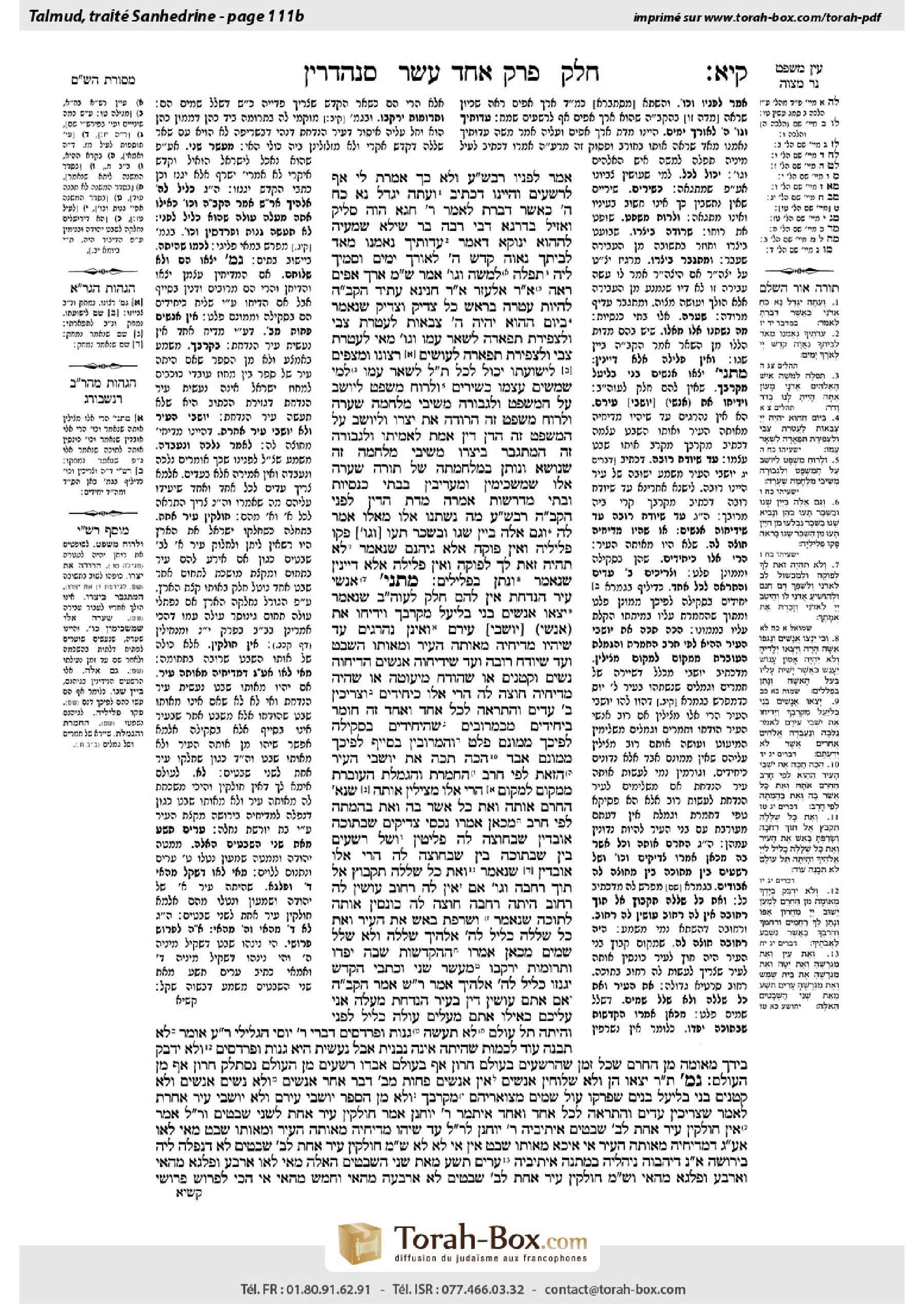
Sanhedrin 111b: Talmud study for Daf Yomi
Daf Yomi is the daily study of one Talmud folio. Explore 37 tractates with scans, Hebrew text, Sefaria English and AI-generated French translations where annotated.
Passage selection and English or AI-generated French translation are available where the scan has annotations. Daf Study is independent of Torah-Box and Sefaria.
Browse Sanhedrin · סנהדרין · All tractatesSanhedrin 111b text and translations
This page of Sanhedrin includes the Aramaic text, an English translation and an AI-generated French translation, alongside the scan above.
סנהדרין קי״א ב · Aramaic and Hebrew text
אָמַר לְפָנָיו: רִבּוֹנוֹ שֶׁל עוֹלָם, וְלֹא כָּךְ אָמַרְתָּ לִי: ״אַף לָרְשָׁעִים״? וְהַיְינוּ דִּכְתִיב: ״וְעַתָּה יִגְדַּל נָא כֹּחַ ה׳ כַּאֲשֶׁר דִּבַּרְתָּ לֵאמֹר״.
רַבִּי חַגָּא הֲוָה סָלֵיק וְאָזֵיל בְּדַרְגָּא דְּבֵי רַבָּה בַּר שֵׁילָא. שַׁמְעֵיהּ לְהָהוּא יָנוֹקָא דְּאָמַר: ״עֵדֹתֶיךָ נֶאֶמְנוּ מְאֹד לְבֵיתְךָ נַאֲוָה קֹדֶשׁ ה׳ לְאֹרֶךְ יָמִים״, וּסְמִיךְ לֵיהּ ״תְּפִלָּה לְמֹשֶׁה וְגוֹ׳״. אֲמַר: שְׁמַע מִינַּהּ אֶרֶךְ אַפַּיִם רָאָה.
אָמַר רַבִּי אֶלְעָזָר אָמַר רַבִּי חֲנִינָא: עָתִיד הַקָּדוֹשׁ בָּרוּךְ הוּא לִהְיוֹת עֲטָרָה בְּרֹאשׁ כׇּל צַדִּיק וְצַדִּיק, שֶׁנֶּאֱמַר: ״בַּיּוֹם הַהוּא יִהְיֶה ה׳ צְבָאוֹת לַעֲטֶרֶת צְבִי וְלִצְפִירַת תִּפְאָרָה לִשְׁאָר עַמּוֹ וְגוֹ׳״. מַאי ״לַעֲטֶרֶת צְבִי וְלִצְפִירַת תִּפְאָרָה״? לָעוֹשִׂים רְצוֹנוֹ וּמְצַפִּים לִישׁוּעָתוֹ. יָכוֹל לַכֹּל? תַּלְמוּד לוֹמַר: ״לִשְׁאָר עַמּוֹ״ – לְמִי שֶׁמֵּשִׂים עַצְמוֹ כְּשִׁירַיִם.
״וּלְרוּחַ מִשְׁפָּט לַיּוֹשֵׁב עַל הַמִּשְׁפָּט וְלִגְבוּרָה מְשִׁיבֵי מִלְחָמָה שָׁעְרָה״. ״וּלְרוּחַ מִשְׁפָּט״ – זֶה הָרוֹדֶה אֶת יִצְרוֹ, ״וְלַיּוֹשֵׁב עַל הַמִּשְׁפָּט״ – זֶה הַדָּן דִּין אֱמֶת לַאֲמִיתּוֹ, ״וְלִגְבוּרָה״ – זֶה הַמִּתְגַּבֵּר בְּיִצְרוֹ, ״מְשִׁיבֵי מִלְחָמָה״ – זֶה שֶׁנּוֹשֵׂא וְנוֹתֵן בְּמִלְחַמְתָּהּ שֶׁל תּוֹרָה, ״שָׁעְרָה״ – אֵלּוּ שֶׁמַּשְׁכִּימִין וּמַעֲרִיבִין בְּבָתֵּי כְנֵסִיּוֹת וּבָתֵּי מִדְרָשׁוֹת.
אָמְרָה מִדַּת הַדִּין לִפְנֵי הַקָּדוֹשׁ בָּרוּךְ הוּא: רִבּוֹנוֹ שֶׁל עוֹלָם, מָה נִשְׁתַּנּוּ אֵלּוּ מֵאֵלּוּ? אָמַר לָהּ: ״וְגַם אֵלֶּה בַּיַּיִן שָׁגוּ וּבַשֵּׁכָר תָּעוּ [וְגוֹ׳] פָּקוּ פְּלִילִיָּה״. וְאֵין פּוּקָה אֶלָּא גֵּיהִנָּם, שֶׁנֶּאֱמַר: ״לֹא תִהְיֶה זֹאת לְךָ לְפוּקָה״. וְאֵין פְּלִילָה אֶלָּא דַּיָּינִין, שֶׁנֶּאֱמַר: ״וְנָתַן בִּפְלִלִים״.
מַתְנִי׳ אַנְשֵׁי עִיר הַנִּדַּחַת אֵין לָהֶם חֵלֶק לָעוֹלָם הַבָּא, שֶׁנֶּאֱמַר: ״יָצְאוּ אֲנָשִׁים בְּנֵי בְלִיַּעַל מִקִּרְבֶּךָ וַיַּדִּיחוּ אֶת יֹשְׁבֵי עִירָם לֵאמֹר״. וְאֵינָן נֶהֱרָגִים עַד שֶׁיִּהְיוּ מַדִּיחֶיהָ מֵאוֹתָהּ הָעִיר וּמֵאוֹתוֹ הַשֵּׁבֶט, וְעַד שֶׁיּוּדַח רוּבָּהּ, וְעַד שֶׁיַּדִּיחוּהָ אֲנָשִׁים. הִדִּיחוּהָ נָשִׁים וּקְטַנִּים, אוֹ שֶׁהוּדַּח מִיעוּטָהּ, אוֹ שֶׁהָיוּ מַדִּיחֶיהָ חוּצָה לָהּ – הֲרֵי אֵלּוּ כִּיחִידִים, וּצְרִיכִין שְׁנֵי עֵדִים וְהַתְרָאָה לְכׇל אֶחָד וְאֶחָד.
זֶה חוֹמֶר בַּיְחִידִים מִבַּמְרוּבִּים, שֶׁהַיְּחִידִים בִּסְקִילָה; לְפִיכָךְ מָמוֹנָם פָּלֵט, וְהַמְרוּבִּין בְּסַיִיף; לְפִיכָךְ מָמוֹנָם אָבֵד.
״הַכֵּה תַכֶּה אֶת יֹשְׁבֵי הָעִיר הַזֹּאת לְפִי חֶרֶב״. הַחַמֶּרֶת וְהַגַּמֶּלֶת הָעוֹבֶרֶת מִמָּקוֹם לְמָקוֹם, הֲרֵי אֵלּוּ מַצִּילִין אוֹתָהּ.
שֶׁנֶּאֱמַר ״הַחֲרֵם אֹתָהּ וְאֶת כׇּל אֲשֶׁר בָּהּ וְאֶת בְּהֶמְתָּהּ לְפִי חָרֶב״, מִכָּאן אָמְרוּ: נִכְסֵי צַדִּיקִים שֶׁבְּתוֹכָהּ – אוֹבְדִין, שֶׁבְּחוּצָה לָהּ – פְּלֵיטִין. וְשֶׁל רְשָׁעִים, בֵּין שֶׁבְּתוֹכָהּ בֵּין שֶׁבְּחוּצָה לָהּ – הֲרֵי אֵלּוּ אוֹבְדִין.
שֶׁנֶּאֱמַר, ״וְאֶת כׇּל שְׁלָלָהּ תִּקְבֹּץ אֶל תּוֹךְ רְחֹבָהּ וְגוֹ׳״, אִם אֵין לָהּ רְחוֹב, עוֹשִׂין לָהּ רְחוֹב. הָיְתָה רְחֹבָהּ חוּצָה לָהּ, כּוֹנְסִין אוֹתָהּ לְתוֹכָהּ.
שֶׁנֶּאֱמַר ״וְשָׂרַפְתָּ בָאֵשׁ אֶת הָעִיר וְאֶת כׇּל שְׁלָלָהּ כָּלִיל לַה׳ אֱלֹהֶיךָ״, שְׁלָלָהּ, וְלֹא שְׁלַל שָׁמַיִם. מִכָּאן אָמְרוּ: הַהֶקְדֵּשׁוֹת שֶׁבָּהּ יִפָּדוּ, וּתְרוּמוֹת יֵרָקְבוּ, מַעֲשֵׂר שֵׁנִי וְכִתְבֵי הַקֹּדֶשׁ יִגָּנְזוּ.
״כָּלִיל לַה׳ אֱלֹהֶיךָ״, אָמַר רַבִּי שִׁמְעוֹן: אָמַר הַקָּדוֹשׁ בָּרוּךְ הוּא, אִם אַתֶּם עוֹשִׂין דִּין בְּעִיר הַנִּדַּחַת, מַעֲלֶה אֲנִי עֲלֵיכֶם כְּאִילּוּ אַתֶּם מַעֲלִים עוֹלָה כָּלִיל לְפָנַי.
״וְהָיְתָה תֵּל עוֹלָם״ – לֹא תֵּעָשֶׂה גַּנּוֹת וּפַרְדֵּסִים, דִּבְרֵי רַבִּי יוֹסֵי הַגְּלִילִי. רַבִּי עֲקִיבָא אוֹמֵר: ״לֹא תִּבָּנֶה עוֹד״ – לִכְמוֹת שֶׁהָיְתָה אֵינָהּ נִבְנֵית, אֲבָל נַעֲשֵׂית הִיא גַּנּוֹת וּפַרְדֵּסִים. ״וְלֹא יִדְבַּק בְּיָדְךָ מְאוּמָה מִן הַחֵרֶם״ – שֶׁכׇּל זְמַן שֶׁהָרְשָׁעִים בָּעוֹלָם, חֲרוֹן אַף בָּעוֹלָם; אָבְדוּ רְשָׁעִים מִן הָעוֹלָם, נִסְתַּלֵּק חֲרוֹן אַף מִן הָעוֹלָם.
גְּמָ׳ תָּנוּ רַבָּנַן: ״יָצְאוּ״ – הֵן, וְלֹא שְׁלוּחִין. ״אֲנָשִׁים״ – אֵין אֲנָשִׁים פָּחוֹת מִשְּׁנַיִם. דָּבָר אַחֵר: ״אֲנָשִׁים״ – וְלֹא נָשִׁים, ״אֲנָשִׁים״ – וְלֹא קְטַנִּים.
״בְּנֵי בְּלִיַּעַל״ – בָּנִים שֶׁפָּרְקוּ עוֹל שָׁמַיִם מִצַּוְּארֵיהֶם. ״מִקִּרְבֶּךָ״ – וְלֹא מִן הַסְּפָר. ״יֹשְׁבֵי עִירָם״ – וְלֹא יוֹשְׁבֵי עִיר אַחֶרֶת. ״לֵאמֹר״ – שֶׁצְּרִיכִין עֵדִים וְהַתְרָאָה לְכׇל אֶחָד וְאֶחָד.
אִיתְּמַר, רַבִּי יוֹחָנָן אָמַר: חוֹלְקִין עִיר אַחַת לִשְׁנֵי שְׁבָטִים; וְרֵישׁ לָקִישׁ אָמַר: אֵין חוֹלְקִין עִיר אַחַת לִשְׁנֵי שְׁבָטִים. אֵיתִיבֵיהּ רַבִּי יוֹחָנָן לְרֵישׁ לָקִישׁ: עַד שֶׁיְּהוּ מַדִּיחֶיהָ מֵאוֹתָהּ הָעִיר וּמֵאוֹתוֹ שֵׁבֶט – מַאי לָאו, אַף עַל גַּב דְּמַדִּיחֶיהָ מֵאוֹתָהּ הָעִיר, אִי אִיכָּא מֵאוֹתוֹ שֵׁבֶט – אִין, אִי לָא – לָא? שְׁמַע מִינַּהּ: חוֹלְקִין עִיר אַחַת לִשְׁנֵי שְׁבָטִים!
לָא, דִּנְפַלָה לֵיהּ בִּירוּשָׁה. אִי נָמֵי, דְּיַהֲבוּהָ נִיהֲלֵיהּ בְּמַתָּנָה.
אֵיתִיבֵיהּ: ״עָרִים תֵּשַׁע מֵאֵת שְׁנֵי הַשְּׁבָטִים הָאֵלֶּה״. מַאי לָאו: אַרְבַּע וּפַלְגָא מֵהַאי, וְאַרְבַּע וּפַלְגָא מֵהַאי? וּשְׁמַע מִינַּהּ: חוֹלְקִין עִיר אַחַת לִשְׁנֵי שְׁבָטִים! לָא, אַרְבַּע מֵהַאי וְחָמֵשׁ מֵהַאי.
אִי הָכִי, לִפְרוֹשׁ פָּרוֹשֵׁי!
Sanhedrin 111b · English translation
Moses said before Him: Master of the Universe, and isn’t this what You said to me: It is an attribute even for the wicked? And that is the meaning of that which is written: “And now, I pray You, let the power of my Lord be great, as You have spoken, saying” (Numbers 14:17). Moses was repeating God’s promise with regard to His employment of the attribute of slow to anger.
The Gemara relates: Rabbi Ḥagga was walking up the stairs in the school of Rabba bar Sheila. He heard a certain child who said: “Your testimonies are very sure; sanctity becomes Your house, Lord, for the length of days” (Psalms 93:5). The phrase “length of days” is a reference to the attribute of slow to anger. And juxtaposed to it is the phrase: “A prayer of Moses” (Psalms 90:1), indicating that this chapter was also stated by Moses our teacher. Upon hearing those verses, Rabbi Ḥagga said: Conclude from it that it was the attribute of slow to anger that Moses saw.
§ Rabbi Elazar says that Rabbi Ḥanina says: The Holy One, Blessed be He, is destined to be a crown on the head of each and every righteous person, as it is stated: “In that day shall the Lord of hosts be for a crown of glory, and for a diadem of beauty, unto the remnant of His people” (Isaiah 28:5). What is the meaning of the phrase: “For a crown of glory, and for a diadem of beauty”? It means: A crown for those who perform His will and a diadem for those who await His salvation. One might have thought that this extends to everyone in those categories. Therefore, the verse states: “Unto the remnant of His people,” meaning that God will be a crown and a diadem to one who humbly establishes himself like a remnant, and does not conduct himself with self-importance.
The Gemara interprets a verse in Isaiah. “And for a spirit of justice to him that sits in judgment and for strength to them who retaliate in battle to the gate” (Isaiah 28:6). “And for a spirit of justice”; this is referring to one who subdues his evil inclination and prevents himself from sinning. “To him that sits in judgment”; this is referring to one who judges a true judgment truthfully. “And for strength”; this is referring to one who overcomes his evil inclination. “Them who retaliate in battle”; this is referring to one who gives and takes and engages in the battle, i.e., in the discourse of Torah. “To the gate” is referring to those Torah scholars who arrive early and remain late within the gates of synagogues and study halls.
The attribute of justice said before the Holy One, Blessed be He: Master of the Universe, how do these people, who possess these qualities, differ from those who engage in Torah study but lack these qualities? God said to the attribute of justice that those others do not receive the crown and diadem because: “These also reel through wine, and stagger through strong drink…they stumble [paku] in judgment [peliliyya]” (Isaiah 28:7). And puka in this context is referring to nothing other than Gehenna, as it is stated: “That this shall not be a cause of stumbling [puka] for you” (I Samuel 25:31). And the term of pelila in the verse in Isaiah is referring to nothing other than judges, as it is stated: “And he shall pay as the judges [biflilim] determine” (Exodus 21:22). Those who lack the qualities listed in the previous verses are not worthy of the aforementioned reward.
MISHNA: The residents of an idolatrous city have no share in the World-to-Come, as it is stated: “Certain men, wicked persons, are gone out from your midst, and have subverted the inhabitants of their city, saying: Let us go and let us worship other gods” (Deuteronomy 13:14). And idol worshippers are not executed as residents of an idolatrous city unless its subverters are from that city and from that tribe, and unless most of the inhabitants of the city are subverted, and unless men subvert the inhabitants of the city. If it occurs that women or children subvert the inhabitants of the city, or that a minority of the inhabitants of the city were subverted, or that its subverters were from outside the city and were neither residents of that city nor members of that tribe, these idol worshippers are judged as individuals. And to judge the inhabitants of a city one requires two witnesses and forewarning for each and every one who engaged in idol worship.
This is a stringency with regard to individuals who worship idols that is more stringent than the halakha with regard to multitudes who worship idols: As the individuals who worship idols are executed by stoning; therefore, since there is a stringency with regard to their mode of execution, their property is spared and is inherited by their heirs. And the multitudes are executed by the sword; therefore, since there is a leniency with regard to their mode of execution, their property is eliminated.
From the verse: “You shall smite the inhabitants of that city with the edge of the sword” (Deuteronomy 13:16), it is derived that the caravan of donkeys and the caravan of camels that move from place to place, these donkey or camel drivers save the city. If they were residing in the city for a period, they could join the minority of permanent residents who were not subverted to idol worship in order to create a majority and prevent the destruction of the city and its contents.
It is stated: “Destroy it utterly, and all that is in it and its animals, with the edge of the sword” (Deuteronomy 13:16). From here, the Sages stated: The property of the righteous, who did not engage in idol worship, that is inside the city is destroyed with the rest of the city and its contents; but the property of the righteous that is outside the city is spared. And the property of the wicked, whether it is inside the city or whether it is outside the city, these items are destroyed.
It is stated: “And you shall gather all of its spoils into the midst of its square” (Deuteronomy 13:17). If the city has no square, one creates a square for the city in order to fulfill the mitzva as it is written. If there was a square outside of the city, they bring it inside the city by expanding the city wall to include the square.
It is stated in the continuation of the verse: “And you shall burn it with fire, both the city and all its spoils, entirely for the Lord your God.” The mishna infers: “Its spoils,” but not the spoils of Heaven. From here the Sages stated: The consecrated property in it, which was no longer the property of its inhabitants, must be redeemed, and terumot are neither eaten nor burned; rather they must be left to decay. And second tithe and sacred scrolls that were in the city must be interred.
With regard to the phrase: “Entirely [kalil] for the Lord your God,” Rabbi Shimon says: The Holy One, Blessed be He, says: If you implement judgment on an idolatrous city, I ascribe you credit as though you have sacrificed an entirely [kalil] burnt offering before Me.
It is written: “And it shall be a heap forever” (Deuteronomy 13:17), meaning: The idolatrous city shall not be converted even into gardens and orchards; this is the statement of Rabbi Yosei HaGelili. Rabbi Akiva says: From the end of that verse: “It shall not be built again,” it is derived: To restore it to the way it was before destruction, it may not be built; but it may be converted into gardens and orchards. The next verse states: “And there shall cleave nothing of that which was devoted to your hand” (Deuteronomy 13:18). This teaches that as long as the wicked exist in the world, there is wrath in the world; once the wicked are eliminated from the world, wrath leaves the world.
GEMARA: The Sages taught an interpretation of the verse: “Certain men, wicked persons, are gone out from your midst, and have subverted the inhabitants of their city saying: Let us go and let us worship other gods that you have not known” (Deuteronomy 13:14). From the term “are gone out” it is derived that these halakhot apply only if they, the subverters themselves, subverted the residents, but not agents whom they designated to subvert. From the term “men” it is derived that men in the plural means no less than two. Alternatively, it is derived: Men, but not women; men, but not children.
The phrase “wicked persons [benei veliyya’al]” is an abbreviation of banim beli ol, meaning: Sons who have cast off the yoke of Heaven from their necks. From the term “from your midst” it is derived that these halakhot apply only to a city located in the center of the country, but not to a city located on the border. From the phrase “inhabitants of their city” it is inferred: But not inhabitants of another city. The term “saying” alludes to the halakha that in order to convict them one requires witnesses and forewarning for each and every one who worshipped idols.
It was stated that there is an amoraic dispute. Rabbi Yoḥanan says: One divides one city into the tribal territory of two tribes; and Reish Lakish says: One does not divide one city into the tribal territory of two tribes. Rabbi Yoḥanan raised an objection to the opinion of Reish Lakish from the mishna, which states: Unless its subverters are from that city and from that tribe; what, is it not that although its subverters are from that city, if they are from that tribe, yes, they render the city an idolatrous city, and if not, no, they do not render the city an idolatrous city? Conclude from it: One divides one city into the tribal territory of two tribes, as otherwise, by definition, a resident of that city is a member of that tribe.
The Gemara rejects that proof: No, even if a city is not divided between two tribes, the scenario in the mishna is possible in a case where the property in the city fell to him as an inheritance from the family of his mother, who was from a different tribe. Alternatively, it is possible in a case where they gave him that property as a gift.
Rabbi Yoḥanan raised an objection to the opinion of Reish Lakish from a verse written with regard to the cities designated for the Levites: “Nine cities from those two tribes” (Joshua 21:16). What, is it not that those nine cities were equally divided; four-and-a-half from this tribe, and four-and-a-half from that tribe, and conclude from it that one divides one city into the tribal territory of two tribes? The Gemara rejects that proof: No, those nine cities were divided in this manner: Four cities from this tribe and five cities from that tribe.
The Gemara asks: If so, let the verse state explicitly from which tribe the additional city was taken.
Sanhedrin 111b · Traduction française (IA)
Moïse lui dit : « Maître de l’Univers, n’est-ce pas ce que Tu m’as dit : cette qualité s’applique même aux méchants ? » Tel est le sens de ce qui est écrit : « Et maintenant, je T’en prie, que la puissance de mon Seigneur soit grande, comme Tu l’as annoncé en disant » (Nombres 14:17). Moïse rappelait la promesse de Dieu concernant l’exercice de la qualité de lenteur à la colère.
La Guemara rapporte : Rabbi Ḥagga montait les escaliers de la maison d’étude de Rabba bar Sheila. Il entendit un enfant réciter : « Tes témoignages sont tout à fait sûrs ; la sainteté convient à Ta maison, Seigneur, pour la longueur des jours » (Psaumes 93:5). L’expression « la longueur des jours » fait référence à la qualité de lenteur à la colère. Juste après figure l’expression « Prière de Moïse » (Psaumes 90:1), indiquant que ce chapitre fut également prononcé par Moïse notre maître. En entendant ces versets, Rabbi Ḥagga dit : « Conclus-en que c’est la qualité de lenteur à la colère que Moïse vit. »
§ Rabbi Elazar dit au nom de Rabbi Ḥanina : Le Saint, béni soit-Il, est destiné à être une couronne sur la tête de chacun des justes, comme il est dit : « En ce jour, le Seigneur des armées sera une couronne de gloire et un diadème de beauté pour le reste de Son peuple » (Isaïe 28:5). Que signifie l’expression « une couronne de gloire et un diadème de beauté » ? Une couronne pour ceux qui accomplissent Sa volonté, et un diadème pour ceux qui attendent Son salut. On aurait pu penser que cela s’applique à tous ceux qui appartiennent à ces catégories. Le verset précise donc : « Pour le reste de Son peuple », ce qui signifie que Dieu sera une couronne et un diadème pour celui qui se tient humblement comme un reste, sans se comporter avec suffisance.
La Guemara interprète un verset d’Isaïe : « Et un esprit de justice pour celui qui siège au tribunal, et une force pour ceux qui repoussent l’ennemi au combat jusqu’à la porte » (Isaïe 28:6). « Et un esprit de justice » désigne celui qui maîtrise son mauvais penchant et s’empêche de pécher. « Pour celui qui siège au tribunal » désigne celui qui rend un jugement véridique avec intégrité. « Et une force » désigne celui qui triomphe de son mauvais penchant. « Ceux qui repoussent l’ennemi au combat » désigne celui qui donne et reçoit, et prend part au combat, c’est-à-dire au débat de Torah. « Jusqu’à la porte » désigne les érudits de Torah qui arrivent tôt et restent tard dans les synagogues et les maisons d’étude.
La qualité de justice dit devant le Saint, béni soit-Il : « Maître de l’Univers, en quoi ces personnes, qui possèdent ces qualités, diffèrent-elles de ceux qui étudient la Torah sans les posséder ? » Dieu répondit à la qualité de justice que les autres ne reçoivent ni la couronne ni le diadème, car : « Ceux-ci aussi chancellent à cause du vin, titubent à cause des boissons fortes… ils trébuchent [paku] dans le jugement [peliliyya] » (Isaïe 28:7). Dans ce contexte, puka ne désigne rien d’autre que la Géhenne, comme il est dit : « Que cela ne soit pas pour toi une cause de trébuchement [puka] » (I Samuel 25:31). Et le terme pelila dans le verset d’Isaïe ne désigne rien d’autre que des juges, comme il est dit : « Il paiera selon ce que les juges [biflilim] auront déterminé » (Exode 21:22). Ceux qui ne possèdent pas les qualités énumérées dans les versets précédents ne sont pas dignes de la récompense mentionnée.
Michna : Les habitants d’une ville idolâtre n’ont pas de part au Monde à venir, comme il est dit : « Des hommes, des vauriens, sont sortis de ton milieu et ont entraîné les habitants de leur ville en disant : Allons servir d’autres dieux » (Deutéronome 13:14). Les idolâtres ne sont exécutés en tant qu’habitants d’une ville idolâtre que si ceux qui les ont entraînés sont originaires de cette ville et de cette tribu, si la majorité des habitants de la ville a été entraînée, et si ceux qui ont entraîné les habitants de la ville sont des hommes. Si des femmes ou des enfants entraînent les habitants de la ville, si seule une minorité des habitants a été entraînée, ou si ceux qui les ont entraînés viennent de l’extérieur et ne sont ni habitants de cette ville ni membres de cette tribu, ces idolâtres sont jugés individuellement. Pour juger les habitants d’une ville, il faut deux témoins et un avertissement préalable pour chacun de ceux qui ont pratiqué l’idolâtrie.
C’est une rigueur concernant les individus qui pratiquent l’idolâtrie, plus sévère que la halakha relative aux multitudes qui pratiquent l’idolâtrie : les individus qui pratiquent l’idolâtrie sont exécutés par lapidation ; aussi, puisque leur mode d’exécution est plus sévère, leurs biens sont épargnés et transmis à leurs héritiers. Les multitudes, quant à elles, sont exécutées par l’épée ; aussi, puisque leur mode d’exécution est moins sévère, leurs biens sont anéantis.
Du verset « Tu frapperas les habitants de cette ville du tranchant de l’épée » (Deutéronome 13:16), on déduit que les caravanes d’ânes et de chameaux qui se déplacent d’un endroit à l’autre — c’est-à-dire leurs conducteurs — sauvent la ville. S’ils y résidaient pendant un certain temps, ils pourraient s’ajouter à la minorité des résidents permanents qui n’ont pas été entraînés vers l’idolâtrie, afin de former une majorité et d’empêcher la destruction de la ville et de tout ce qu’elle contient.
Il est dit : « Tu la voueras entièrement à la destruction, ainsi que tout ce qu’elle contient et ses animaux, par le tranchant de l’épée » (Deutéronome 13:16). Les Sages en déduisent que les biens des justes qui se trouvent dans la ville, eux qui n’ont pas pratiqué l’idolâtrie, sont détruits avec le reste de la ville et de ce qu’elle contient, tandis que les biens des justes qui se trouvent hors de la ville sont épargnés. Quant aux biens des méchants, qu’ils se trouvent dans la ville ou hors de la ville, ils sont détruits.
Il est dit : « Tu rassembleras toutes ses prises au milieu de sa place » (Deutéronome 13:17). Si la ville n’a pas de place, on lui en aménage une afin d’accomplir la mitsva conformément au verset. Si une place se trouve à l’extérieur de la ville, on l’intègre à la ville en agrandissant son enceinte pour l’y inclure.
La suite du verset dit : « Tu la brûleras par le feu, la ville et toutes ses prises, entièrement pour le Seigneur ton Dieu. » La Michna déduit de l’expression « ses prises » que cela ne concerne pas les biens appartenant au Ciel. Les Sages en déduisent que les biens consacrés qui s’y trouvent, qui n’appartenaient plus à ses habitants, doivent être rachetés ; la terouma ne doit être ni consommée ni brûlée, mais laissée à se décomposer. La seconde dîme et les rouleaux sacrés qui se trouvaient dans la ville doivent être enterrés.
À propos de l’expression « entièrement [kalil] pour le Seigneur ton Dieu », Rabbi Shimon dit : « Le Saint, béni soit-Il, dit : Si vous appliquez le jugement à une ville idolâtre, Je vous en attribue le mérite comme si vous aviez offert devant Moi un holocauste entièrement consumé [kalil]. »
Il est écrit : « Elle sera un monceau pour toujours » (Deutéronome 13:17), ce qui signifie que la ville idolâtre ne peut pas être transformée en jardins ou en vergers ; telle est la position de Rabbi Yosei HaGelili. Rabbi Akiva dit : La fin du verset, « elle ne sera plus jamais rebâtie », enseigne qu’on ne peut pas la rebâtir pour lui rendre son état antérieur à la destruction, mais qu’on peut la transformer en jardins et en vergers. Le verset suivant dit : « Rien de ce qui est voué à la destruction ne s’attachera à ta main » (Deutéronome 13:18). Cela enseigne que tant que les méchants existent dans le monde, la colère y règne ; une fois les méchants éliminés du monde, la colère le quitte.
Guemara : Les Sages enseignèrent une interprétation du verset : « Des hommes, des vauriens, sont sortis de ton milieu et ont entraîné les habitants de leur ville en disant : Allons servir d’autres dieux que vous n’avez pas connus » (Deutéronome 13:14). On déduit du terme « sont sortis » que ces halakhot ne s’appliquent que si les instigateurs eux-mêmes ont entraîné les habitants, mais pas s’ils ont désigné des agents pour les entraîner. Du terme « hommes », on déduit que le pluriel signifie au moins deux. On peut aussi en déduire : des hommes, mais pas des femmes ; des hommes, mais pas des enfants.
L’expression « fils de Bélial [benei veliyya’al] » est une forme abrégée de banim beli ol, qui signifie : des fils qui ont rejeté de leurs épaules le joug du Royaume des Cieux. On déduit de l’expression « de ton milieu » que ces halakhot ne s’appliquent qu’à une ville située au centre du pays, et non à une ville située à la frontière. De l’expression « les habitants de leur ville », on déduit : mais pas les habitants d’une autre ville. Le terme « en disant » fait allusion à la halakha selon laquelle il faut des témoins et un avertissement préalable pour condamner chacun de ceux qui a pratiqué l’idolâtrie.
Il a été rapporté qu’il existe un désaccord entre les amoraïm. Rabbi Yoḥanan dit : Une ville peut être répartie entre les territoires tribaux de deux tribus ; Reish Lakish dit : Une ville ne peut pas être répartie entre les territoires tribaux de deux tribus. Rabbi Yoḥanan souleva une objection à l’opinion de Reish Lakish à partir de la Michna, qui dit : « À moins que ceux qui les ont entraînés soient originaires de cette ville et de cette tribu. » N’est-ce pas à dire que, même si ceux qui les ont entraînés sont originaires de cette ville, s’ils appartiennent à cette tribu, oui, ils font de la ville une ville idolâtre, mais s’ils n’appartiennent pas à cette tribu, non, ils n’en font pas une ville idolâtre ? Conclus-en qu’une ville peut être répartie entre les territoires tribaux de deux tribus ; sinon, par définition, un habitant de cette ville serait membre de cette tribu.
La Guemara rejette cette preuve : Non, même si une ville n’est pas répartie entre deux tribus, le cas de la Michna peut se présenter lorsque les biens qu’il possède dans la ville lui sont échus en héritage de la famille de sa mère, qui appartenait à une autre tribu. On peut aussi envisager le cas où ces biens lui ont été donnés.
Rabbi Yoḥanan souleva une objection à l’opinion de Reish Lakish à partir d’un verset concernant les villes attribuées aux Lévites : « Neuf villes de ces deux tribus » (Josué 21:16). N’est-ce pas à dire que ces neuf villes étaient réparties également — quatre et demie de cette tribu et quatre et demie de l’autre — et qu’on peut donc conclure qu’une ville peut être répartie entre les territoires tribaux de deux tribus ? La Guemara rejette cette preuve : Non, ces neuf villes étaient réparties ainsi : quatre villes de cette tribu et cinq de l’autre.
La Guemara demande : Dans ce cas, que le verset précise de quelle tribu provenait la ville supplémentaire.
Traduction française générée par IA à partir de l’édition anglaise de Sefaria. Vérifie toujours un passage avec le texte source.
Text from Sefaria: William Davidson Edition - Vocalized Aramaic (CC BY NC); William Davidson Edition - English (CC BY NC).