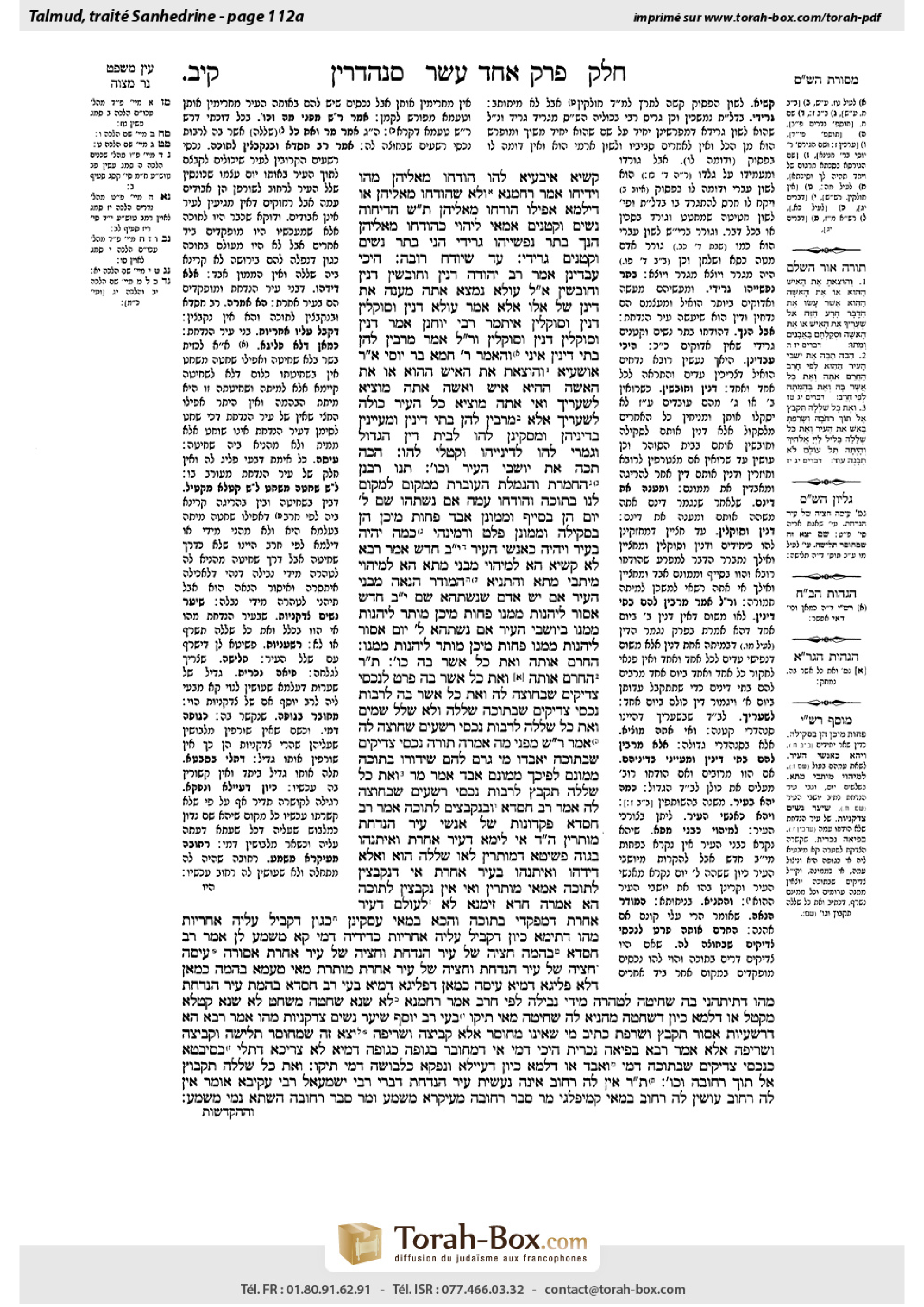
Sanhedrin 112a: Talmud study for Daf Yomi
Daf Yomi is the daily study of one Talmud folio. Explore 37 tractates with scans, Hebrew text, Sefaria English and AI-generated French translations where annotated.
Passage selection and English or AI-generated French translation are available where the scan has annotations. Daf Study is independent of Torah-Box and Sefaria.
Browse Sanhedrin · סנהדרין · All tractatesSanhedrin 112a text and translations
This page of Sanhedrin includes the Aramaic text, an English translation and an AI-generated French translation, alongside the scan above.
סנהדרין קי״ב א · Aramaic and Hebrew text
קַשְׁיָא.
אִיבַּעְיָא לְהוּ: הוּדְּחוּ מֵאֲלֵיהֶן, מַהוּ? ״וַיַּדִּיחוּ״ אָמַר רַחֲמָנָא, וְלֹא שֶׁהוּדְּחוּ מֵאֲלֵיהֶן? אוֹ דִילְמָא, אֲפִילּוּ הוּדְּחוּ מֵאֲלֵיהֶן?
תָּא שְׁמַע: הִדִּיחוּהָ נָשִׁים וּקְטַנִּים, אַמַּאי? לֶיהֱוֵי כְּהוּדְּחוּ מֵאֲלֵיהֶן! הָנָךְ בָּתַר נַפְשַׁיְיהוּ גְּרִידִי, הָנֵי בָּתַר נָשִׁים וּקְטַנִּים גְּרִידִי.
עַד שֶׁיּוּדַח רוּבָּהּ. הֵיכִי עָבְדִינַן? אָמַר רַב יְהוּדָה: דָּנִין וְחוֹבְשִׁין, דָּנִין וְחוֹבְשִׁין. אֲמַר לֵיהּ עוּלָּא: נִמְצָא אַתָּה מְעַנֶּה אֶת דִּינָן שֶׁל אֵלּוּ! אֶלָּא, אָמַר עוּלָּא: דָּנִין וְסוֹקְלִין, דָּנִין וְסוֹקְלִין.
אִיתְּמַר, רַבִּי יוֹחָנָן אָמַר: דָּנִין וְסוֹקְלִין, דָּנִין וְסוֹקְלִין, וְרֵישׁ לָקִישׁ אָמַר: מַרְבִּין לָהֶן בָּתֵּי דִינִין.
אִינִי? וְהָאָמַר רַבִּי חָמָא בַּר יוֹסֵי אָמַר רַבִּי אוֹשַׁעְיָא: ״וְהוֹצֵאתָ אֶת הָאִישׁ הַהוּא אוֹ אֶת הָאִשָּׁה הָהִיא״ – אִישׁ וְאִשָּׁה אַתָּה מוֹצִיא לִשְׁעָרֶיךָ, וְאִי אַתָּה מוֹצִיא כָּל הָעִיר כּוּלָּהּ לִשְׁעָרֶיךָ! אֶלָּא, מַרְבִּין לָהֶן בָּתֵּי דִינִין וּמְעַיְּינִין בְּדִינֵיהֶן, וּמַסְּקִינַן לְהוּ לְבֵית דִּין הַגָּדוֹל, וְגָמְרִי לְהוּ לְדִינַיְיהוּ, וְקָטְלִי לְהוּ.
״הַכֵּה תַכֶּה אֶת יֹשְׁבֵי הָעִיר וְכוּ׳״. תָּנוּ רַבָּנַן: הַחַמֶּרֶת וְהַגַּמֶּלֶת הָעוֹבֶרֶת מִמָּקוֹם לְמָקוֹם, לָנוּ בְּתוֹכָהּ וְהוּדְּחוּ עִמָּהּ – אִם נִשְׁתַּהוּ שָׁם שְׁלֹשִׁים יוֹם, הֵן בְּסַיִיף וּמָמוֹנָן אָבֵד. פָּחוֹת מִיכָּן, הֵן בִּסְקִילָה וּמָמוֹנָן פָּלֵט.
וּרְמִינְהִי: כַּמָּה יִהְיֶה בָּעִיר וְיִהְיֶה כְּאַנְשֵׁי הָעִיר? שְׁנֵים עָשָׂר חֹדֶשׁ! אָמַר רָבָא: לָא קַשְׁיָא, הָא לְמִיהְוֵי מִבְּנֵי מָתָא, הָא לְמִיהְוֵי מִיָּתְבֵי מָתָא.
וְהָתַנְיָא: הַמּוּדָּר הֲנָאָה מִבְּנֵי הָעִיר, אִם יֵשׁ אָדָם שֶׁנִּשְׁתַּהָא שָׁם שְׁנֵים עָשָׂר חֹדֶשׁ – אָסוּר לֵיהָנוֹת מִמֶּנּוּ, פָּחוֹת מִיכָּן – מוּתָּר לֵיהָנוֹת מִמֶּנּוּ. בְּיוֹשְׁבֵי הָעִיר, אִם נִשְׁתַּהָא שְׁלֹשִׁים יוֹם – אָסוּר לֵיהָנוֹת מִמֶּנּוּ, פָּחוֹת מִיכָּן – מוּתָּר לֵיהָנוֹת מִמֶּנּוּ.
״הַחֲרֵם אֹתָהּ וְאֶת כׇּל אֲשֶׁר בָּהּ״ כּוּ׳. תָּנוּ רַבָּנַן: ״הַחֲרֵם אוֹתָהּ וְאֶת כׇּל אֲשֶׁר בָּהּ״ – פְּרָט לְנִכְסֵי צַדִּיקִים שֶׁבְּחוּצָה לָהּ. ״וְאֶת כׇּל אֲשֶׁר בָּהּ״ – לְרַבּוֹת נִכְסֵי צַדִּיקִים שֶׁבְּתוֹכָהּ. ״שְׁלָלָהּ״ – וְלֹא שְׁלַל שָׁמַיִם. ״וְאֶת כׇּל שְׁלָלָהּ״ – לְרַבּוֹת נִכְסֵי רְשָׁעִים שֶׁחוּצָה לָהּ.
אָמַר רַבִּי שִׁמְעוֹן: מִפְּנֵי מָה אָמְרָה תּוֹרָה נִכְסֵי צַדִּיקִים שֶׁבְּתוֹכָהּ יֹאבֵדוּ? מִי גָּרַם לָהֶם שֶׁיָּדוּרוּ בְּתוֹכָהּ? מָמוֹנָם. לְפִיכָךְ מָמוֹנָם אָבֵד. אָמַר מָר: ״וְאֶת כׇּל שְׁלָלָהּ תִּקְבֹּץ״ – לְרַבּוֹת נִכְסֵי רְשָׁעִים שֶׁבְּחוּצָה לָהּ. אָמַר רַב חִסְדָּא: וּבְנִקְבָּצִים לְתוֹכָהּ.
אָמַר רַב חִסְדָּא: פִּקְדוֹנוֹת שֶׁל אַנְשֵׁי עִיר הַנִּדַּחַת מוּתָּרִין. הֵיכִי דָמֵי? אִי לֵימָא דְּעִיר אַחֶרֶת וְאִיתַנְהוּ בְּגַוַּהּ – פְּשִׁיטָא דְּמוּתָּרִין, לָאו שְׁלָלָהּ הוּא! וְאֶלָּא דִּידְהוּ וְאִיתַנְהוּ בְּעִיר אַחֶרֶת. אִי דְּנִקְבָּצִין לְתוֹכָהּ – אַמַּאי מוּתָּרִין? וְאִי אֵין נִקְבָּצִין לְתוֹכָהּ – הָא אַמְרַהּ חֲדָא זִימְנָא!
לָא, לְעוֹלָם דְּעִיר אַחֶרֶת דְּמַפְקְדִי בְּתוֹכָהּ. וְהָכָא בְּמַאי עָסְקִינַן? כְּגוֹן דְּקַבֵּיל עֲלֵיהּ אַחְרָיוּת. מַהוּ דְּתֵימָא: כֵּיוָן דְּקַבֵּיל עֲלֵיהּ אַחְרָיוּת, כְּדִידֵיהּ דָּמֵי? קָא מַשְׁמַע לַן.
אָמַר רַב חִסְדָּא: בְּהֵמָה חֶצְיָהּ שֶׁל עִיר הַנִּדַּחַת וְחֶצְיָהּ שֶׁל עִיר אַחֶרֶת – אֲסוּרָה. עִיסָּה חֶצְיָהּ שֶׁל עִיר הַנִּדַּחַת וְחֶצְיָהּ שֶׁל עִיר אַחֶרֶת – מוּתֶּרֶת. מַאי טַעְמָא? בְּהֵמָה כְּמַאן דְּלָא פְּלִיגָא דָּמְיָא, עִיסָּה כְּמַאן דִּפְלִיגָא דָּמְיָא.
בָּעֵי רַב חִסְדָּא: בֶּהֱמַת עִיר הַנִּדַּחַת מַהוּ דְּתִיתְהֲנֵי בַּהּ שְׁחִיטָה לְטַהֲרָהּ מִידֵי נְבֵילָה? לְפִי חֶרֶב אָמַר רַחֲמָנָא, לָא שְׁנָא שַׁחֲטַהּ מִשְׁחָט, לָא שְׁנָא קַטְלַהּ מִקְטָל. אוֹ דִלְמָא, כֵּיוָן דְּשַׁחְטַהּ מַהְנְיָא לַהּ שְׁחִיטָה? מַאי? תֵּיקוּ.
בָּעֵי רַב יוֹסֵף: שְׂעַר נָשִׁים צִדְקָנִיּוֹת מַהוּ? אָמַר רָבָא: הָא דִּרְשָׁעִיּוֹת אָסוּר? ״תִּקְבֹּץ וְשָׂרַפְתָּ״ כְּתִיב. מִי שֶׁאֵינוֹ מְחוּסָּר אֶלָּא קְבִיצָה וּשְׂרֵיפָה – יָצָא זֶה שֶׁמְחוּסָּר תְּלִישָׁה וּקְבִיצָה וּשְׂרֵיפָה.
אֶלָּא אָמַר רָבָא: בְּפֵיאָה נׇכְרִית, הֵיכִי דָמֵי? אִי דִּמְחוּבָּר בְּגוּפַהּ, כְּגוּפַהּ דָּמְיָא. לָא צְרִיכָא דִּתְלֵי בְּסִיבְטָא. כְּנִכְסֵי צַדִּיקִים שֶׁבְּתוֹכָהּ דָּמֵי וְאָבַד? אוֹ דִלְמָא, כֵּיוָן דְּעָיְילָא וְנָפְקָא, כִּלְבוּשַׁהּ דָּמֵי? תֵּיקוּ.
״וְאֶת כׇּל שְׁלָלָהּ תִּקְבֹּץ אֶל תּוֹךְ רְחֹבָהּ״ וְכוּ׳. תָּנוּ רַבָּנַן: אֵין לָהּ רְחוֹב – אֵינָהּ נַעֲשֵׂית עִיר הַנִּדַּחַת, דִּבְרֵי רַבִּי יִשְׁמָעֵאל. רַבִּי עֲקִיבָא אוֹמֵר: אֵין לָהּ רְחוֹב – עוֹשִׂין לָהּ רְחוֹב. בְּמַאי קָמִיפַּלְגִי? מָר סָבַר: ״רְחוֹבָהּ״ – מֵעִיקָּרָא מַשְׁמַע, וּמָר סָבַר: ״רְחוֹבָהּ״ – הַשְׁתָּא נָמֵי מַשְׁמַע.
Sanhedrin 112a · English translation
The Gemara comments: The matter presents a difficulty with the opinion of Reish Lakish.
A dilemma was raised before the Sages: If the inhabitants of an idolatrous city subverted themselves to idol worship and were not subverted by others, what is the halakha? Since the Merciful One states: “And have subverted,” perhaps it may be inferred: But not if they subvert themselves; or perhaps even if they subverted themselves to idol worship, the city can be deemed an idolatrous city.
The Gemara suggests: Come and hear a resolution of the dilemma from the mishna: If women or children subvert the inhabitants of the city, these idol worshippers are judged as individuals. Why is that so? Let their status be considered as though they subverted themselves. Apparently, if the inhabitants subverted themselves the city is not deemed an idolatrous city. The Gemara rejects this proof: These cases are not comparable, as these, who subverted themselves, are drawn after their own initiative and worship idols wholeheartedly, and therefore perhaps the city is rendered an idolatrous city. Those, who are subverted by women and children, are drawn after women and children and are not committed to idol worship, and therefore, perhaps the city is not rendered an idolatrous city.
§ The mishna teaches that a city is not deemed an idolatrous city unless most of the inhabitants of the city are subverted. The Gemara asks: How do we act in order to determine if most of the inhabitants have been subverted? Rav Yehuda says: The court judges each inhabitant suspected of idol worship, and if he is found liable imprisons him in a jail, and it judges and imprisons each succeeding idolater until a majority of the city has been convicted. Ulla said to him: That will result in you delaying justice for those already sentenced and awaiting execution, and it is prohibited to delay justice. Rather, Ulla says: The court judges each inhabitant and stones him if he is found liable, then judges and stones each succeeding idolater until half of the city is found guilty, and all future convicted idolaters are executed by the sword.
It was stated that there is a parallel amoraic dispute. Rabbi Yoḥanan says: The court judges and stones the idolater, then judges and stones each succeeding idolater. And Reish Lakish says: One increases the number of courts for them so that all the inhabitants of the city can stand trial at the same time and the means of their execution will be determined with no delay of justice.
The Gemara asks: Is that so? But doesn’t Rabbi Ḥama bar Yosei say that Rabbi Oshaya says that it is written: “And you shall take that man or that woman out…to your gates” (Deuteronomy 17:5), from which it is derived: You take a man and a woman out to your gates and they are judged by the local court, but you do not take the entire city out to your gates; instead, they stand trial before the Great Sanhedrin. Rather, the procedure is that one increases the number of courts for them and those courts analyze their cases, and when they conclude that a majority of the inhabitants are guilty of idolatry they are not sentenced; instead, we take them to the High Court [Sanhedrin] and the court issues the verdict of the idolaters and executes them.
§ It is written: “You shall smite the inhabitants of that city with the edge of the sword, destroy it utterly, and all that is in it and its animals, with the edge of the sword” (Deuteronomy 13:16). The Sages taught in a baraita: The caravan of donkeys and the caravan of camels that move from place to place, that lodged in the city and were subverted with it, if they had stayed there thirty days they are executed by the sword and their property is destroyed. If they had stayed there less than that, they are executed by stoning, as individual idolaters, and their property is spared.
And the Gemara raises a contradiction from a baraita: How long shall one be in the city and as a result, his status will be like that of the residents of the city with regard to giving charity and paying taxes? He is obligated if he remained there twelve months, and not thirty days. Rava says: This contradiction is not difficult, and it may be resolved: This period of twelve months is the period required to become one of the citizens of the city; this period of thirty days is the period required to become one of the inhabitants of the city.
And so it is taught in a baraita: With regard to one prohibited by a vow from deriving benefit from the citizens of the city, if there is a person who had stayed there twelve months, it is prohibited for the one for whom deriving benefit is forbidden to derive benefit from him. If a person had stayed there less than that, it is permitted for the one for whom deriving benefit is forbidden to derive benefit from him. With regard to one prohibited by a vow from deriving benefit from the inhabitants of the city, if there is a person who had stayed there thirty days, it is prohibited for the one for whom deriving benefit is forbidden to derive benefit from him. If a person had stayed there less than that, it is permitted for the one for whom deriving benefit is forbidden to derive benefit from him. In the context of an idolatrous city, the reference is to the inhabitants of the city, which includes anyone who had stayed there for thirty days.
It is written: “Destroy it utterly, and all that is in it” (Deuteronomy 13:16). The Sages taught in a baraita with regard to that which is written: “Destroy it utterly, and all that is in it”; this serves to exclude the property of the righteous that is located outside the city, which is not destroyed. “And all that is in it”; this serves to include the property of the righteous that is located inside the city; it is also destroyed. It is stated: “And you shall gather all of its spoils into the midst of its square” (Deuteronomy 13:17). From the term “its spoils” it is derived: But not the spoils of Heaven; all consecrated property is excluded. The phrase “and you shall gather all of its spoils” serves to include the property of the wicked that is located outside the city; it is also destroyed.
Rabbi Shimon said: For what reason does the Torah say that the property of the righteous that is in it shall be destroyed? Why must they suffer for the sins of others? The reason is: Who caused the righteous to live in this city inhabited by wicked people? It is their property that tied them to this city; therefore, their property is destroyed. The Master said that the phrase “and you shall gather all of its spoils” serves to include the property of the wicked that is located outside the city; it is also destroyed. Rav Ḥisda says: And this is the halakha only with regard to property that can be gathered into the city.
Rav Ḥisda says: Deposits of the inhabitants of an idolatrous city are permitted, i.e., they are not destroyed. The Gemara asks: What are the circumstances? If we say that Rav Ḥisda is referring to property belonging to inhabitants of another city and that property is deposited within the idolatrous city, it is obvious that the deposits are permitted, as the deposits are not “its spoils”; they are the property of others. But rather, say that Rav Ḥisda is referring to property belonging to the inhabitants of the idolatrous city, and it is deposited within another city. If so, the status of that property should be like any other property belonging to the inhabitants of the idolatrous city; if it is property that can be gathered into the city, why are the deposits permitted? It was already established that the property of the wicked is destroyed. And if it is property that cannot be gathered into the city, didn’t Rav Ḥisda already say once that this property is not burned?
The Gemara answers: No, Rav Ḥisda is actually referring to property belonging to inhabitants of another city that is deposited within the idolatrous city; and what are we dealing with here? It is a case where an inhabitant of the idolatrous city assumes financial responsibility for the deposit in his possession. Lest you say: Once he assumes financial responsibility for the deposit in his possession, the status of the deposit is like that of his own property and it should be destroyed, therefore Rav Ḥisda teaches us that deposits are permitted and not destroyed.
Rav Ḥisda says: An animal that is half the property of an idolatrous city and half the property of another city is forbidden. By contrast, with regard to dough that is half the property of an idolatrous city and half the property of another city, the half that belongs to the other city is permitted. The Gemara asks: What is the reason for the difference between them? The Gemara explains: An animal is like an entity that is not divided, as it is possible to eat part of an animal only through the slaughter of the entire animal. Therefore, if any portion of the animal is forbidden, the entire animal is forbidden. Dough is like an entity that is divided. Therefore, the fact that one portion of the dough is forbidden does not render the entire dough forbidden.
Rav Ḥisda raises a dilemma: With regard to the animal of an idolatrous city, what is the halakha; is ritual slaughter effective at least in purifying it from the ritual impurity of an unslaughtered animal carcass? If the animals of the city are killed but not ritually slaughtered, they are impure with the impurity of a carcass and transmit impurity by means of contact as well as if they are lifted. Will the ritual slaughter of those animals prevent the transmission of that impurity? Is it so that since the Merciful One states: “And its animals, with the edge of the sword,” indicating that it is no different if one ritually slaughtered the animal, and it is no different if one killed the animal in another way, its status is that of a carcass and it transmits impurity? Or perhaps, since one ritually slaughtered the animal, ritual slaughter is effective. What is the halakha? The dilemma shall stand unresolved.
Rav Yosef raises a dilemma: What is the status of the hair of pious women in the idolatrous city; must it be destroyed? Rava says: Is that to say that the hair of wicked women is forbidden and must be destroyed? “And you shall gather…and you shall burn” (Deuteronomy 13:17), is written, and it is derived: An item that is lacking, i.e., that requires, only gathering and burning must be destroyed, excluding this hair, which is lacking detaching, gathering, and burning. Therefore, even the hair of a wicked woman is not forbidden.
Rather, Rava says: This dilemma is raised with regard to a wig. The Gemara asks: What are the circumstances? If the wig is attached to her body, its status is like that of her body. The Gemara answers: No, this dilemma is necessary only in a case where the wig is hanging on a peg. Is its status like that of the property of the righteous inside the city and therefore it is destroyed, or perhaps, since she enters and exits with the wig, its status is like that of a garment, and it is not destroyed? This dilemma shall stand unresolved.
With regard to the verse: “And you shall gather all of its spoils into the midst of its square” (Deuteronomy 13:17), the Sages taught: If the city has no square, it does not become an idolatrous city, as it does not fulfill the criterion mandated by the verse; this is the statement of Rabbi Yishmael. Rabbi Akiva says: If the city has no square, one creates a square for the city. The Gemara asks: With regard to what principle do they disagree? The Gemara explains: One Sage, Rabbi Yishmael, holds “its square” indicates a square that existed from the outset. And one Sage, Rabbi Akiva, holds that “its square” can also indicate a square that was created now.
Sanhedrin 112a · Traduction française (IA)
La Guemara fait remarquer : cette question pose une difficulté à l’opinion de Reish Lakish.
Une question fut posée aux Sages : si les habitants d’une ville idolâtre se sont eux-mêmes entraînés à pratiquer l’idolâtrie, sans que d’autres les y aient entraînés, quelle est la halakha ? Puisque le Miséricordieux dit : « et ils ont entraîné », peut-être peut-on en déduire que cela ne s’applique pas s’ils se sont entraînés eux-mêmes ; ou peut-être la ville peut-elle être considérée comme une ville idolâtre même si ses habitants se sont eux-mêmes entraînés à pratiquer l’idolâtrie.
La Guemara propose : Viens et entends une réponse à cette question tirée de la Michna : si des femmes ou des enfants entraînent les habitants de la ville à l’idolâtrie, ces idolâtres sont jugés individuellement. Pourquoi en est-il ainsi ? Leur statut ne devrait-il pas être considéré comme s’ils s’étaient entraînés eux-mêmes ? Il semble donc que si les habitants se sont entraînés eux-mêmes, la ville n’est pas considérée comme une ville idolâtre. La Guemara rejette cette preuve : ces cas ne sont pas comparables. Ceux qui se sont entraînés eux-mêmes suivent leur propre initiative et pratiquent l’idolâtrie de tout leur cœur ; peut-être la ville est-elle donc considérée comme une ville idolâtre. Ceux qui ont été entraînés par des femmes et des enfants les suivent, sans être attachés à l’idolâtrie ; peut-être la ville n’est-elle donc pas considérée comme une ville idolâtre.
§ La Michna enseigne qu’une ville n’est considérée comme une ville idolâtre que si la majorité de ses habitants a été entraînée à l’idolâtrie. La Guemara demande : comment procède-t-on pour déterminer si la majorité des habitants a été entraînée ? Rav Yehuda dit : le tribunal juge chaque habitant soupçonné d’idolâtrie et, s’il le déclare coupable, l’emprisonne ; il juge et emprisonne ensuite chaque idolâtre à son tour, jusqu’à ce qu’une majorité des habitants de la ville ait été déclarée coupable. Ulla lui dit : cela conduira à retarder la justice pour ceux qui ont déjà été condamnés et attendent leur exécution, or il est interdit de retarder la justice. Ulla dit plutôt : le tribunal juge chaque habitant et le lapide s’il est reconnu coupable ; il juge et lapide ensuite chaque idolâtre à son tour, jusqu’à ce que la moitié de la ville soit reconnue coupable, et tous les idolâtres condamnés par la suite sont exécutés par l’épée.
Il a été enseigné qu’il existe une controverse parallèle entre les amoraïm. Rabbi Yoḥanan dit : le tribunal juge et lapide l’idolâtre, puis juge et lapide chaque idolâtre à son tour. Reish Lakish dit : on multiplie les tribunaux pour eux, afin que tous les habitants de la ville puissent être jugés en même temps et que le mode d’exécution soit déterminé sans retarder la justice.
La Guemara demande : Est-ce bien le cas ? Rabbi Ḥama bar Yosei ne dit-il pas au nom de Rabbi Oshaya qu’il est écrit : « Tu feras sortir cet homme ou cette femme… à tes portes » (Deutéronome 17:5), ce dont on déduit qu’on fait sortir un homme ou une femme à tes portes, où ils sont jugés par le tribunal local, mais qu’on ne fait pas sortir toute la ville à tes portes ; ses habitants sont plutôt jugés devant le Grand Sanhédrin. La procédure est donc plutôt la suivante : on multiplie les tribunaux pour eux, et ces tribunaux examinent leurs affaires. Lorsqu’ils concluent que la majorité des habitants est coupable d’idolâtrie, ils ne les condamnent pas ; on les conduit plutôt devant la Haute Cour [Sanhédrin], qui prononce le verdict concernant les idolâtres et les fait exécuter.
§ Il est écrit : « Tu frapperas les habitants de cette ville du tranchant de l’épée, tu la voueras à la destruction, ainsi que tout ce qui s’y trouve et ses animaux, du tranchant de l’épée » (Deutéronome 13:16). Les Sages enseignent dans une baraïta : une caravane d’ânes et une caravane de chameaux qui se déplacent d’un endroit à l’autre, qui ont fait halte dans la ville et ont été entraînées à l’idolâtrie avec elle, sont exécutées par l’épée et leurs biens sont détruits si elles y sont restées trente jours. Si elles y sont restées moins longtemps, elles sont exécutées par lapidation, comme des idolâtres jugés individuellement, et leurs biens sont épargnés.
La Guemara soulève une contradiction à partir d’une baraïta : combien de temps faut-il séjourner dans une ville pour avoir le statut de ses habitants en matière de dons de charité et de paiement des impôts ? On est assujetti à ces obligations si l’on y est resté douze mois, et non trente jours. Rava dit : cette contradiction n’est pas difficile et peut être résolue ainsi : les douze mois sont la durée requise pour devenir l’un des citoyens de la ville ; les trente jours sont la durée requise pour devenir l’un de ses habitants.
Et c’est ainsi qu’il est enseigné dans une baraïta : pour celui qui, par vœu, s’est interdit de tirer profit des citoyens de la ville, il est interdit de tirer profit d’une personne qui y a séjourné douze mois. Si une personne y a séjourné moins longtemps, il est permis d’en tirer profit. Pour celui qui, par vœu, s’est interdit de tirer profit des habitants de la ville, il est interdit de tirer profit d’une personne qui y a séjourné trente jours. Si une personne y a séjourné moins longtemps, il est permis d’en tirer profit. Dans le contexte d’une ville idolâtre, il s’agit des habitants de la ville, ce qui inclut toute personne qui y a séjourné trente jours.
Il est écrit : « Tu la voueras à la destruction, ainsi que tout ce qui s’y trouve » (Deutéronome 13:16). À propos de ces mots, les Sages enseignent dans une baraïta : cela exclut les biens des justes situés à l’extérieur de la ville, qui ne sont pas détruits. « Ainsi que tout ce qui s’y trouve » sert à inclure les biens des justes situés à l’intérieur de la ville ; ils sont eux aussi détruits. Il est dit : « Tu rassembleras toutes ses dépouilles au milieu de sa place » (Deutéronome 13:17). Du terme « ses dépouilles », on déduit : mais pas les biens consacrés au Ciel ; tous les biens consacrés sont exclus. L’expression « tu rassembleras toutes ses dépouilles » sert à inclure les biens des méchants situés à l’extérieur de la ville ; ils sont eux aussi détruits.
Rabbi Shimon dit : pour quelle raison la Torah dit-elle que les biens des justes qui se trouvent dans la ville doivent être détruits ? Pourquoi doivent-ils souffrir des péchés d’autrui ? La raison est la suivante : qui a amené les justes à habiter dans cette ville peuplée de méchants ? Ce sont leurs biens qui les ont attachés à cette ville ; leurs biens sont donc détruits. Le maître a dit que l’expression « tu rassembleras toutes ses dépouilles » sert à inclure les biens des méchants situés à l’extérieur de la ville ; ils sont eux aussi détruits. Rav Ḥisda dit : cette halakha ne concerne toutefois que les biens qui peuvent être rassemblés dans la ville.
Rav Ḥisda dit : les dépôts appartenant aux habitants d’une ville idolâtre sont permis, c’est-à-dire qu’ils ne sont pas détruits. La Guemara demande : dans quelles circonstances ? Si l’on dit que Rav Ḥisda parle des biens appartenant aux habitants d’une autre ville et déposés dans la ville idolâtre, il est évident que les dépôts sont permis, puisqu’ils ne sont pas « ses dépouilles » : ce sont les biens d’autrui. Il faut plutôt dire que Rav Ḥisda parle des biens appartenant aux habitants de la ville idolâtre et déposés dans une autre ville. Dans ce cas, ces biens devraient avoir le même statut que tous les autres biens appartenant aux habitants de la ville idolâtre ; s’il s’agit de biens qui peuvent être rassemblés dans la ville, pourquoi les dépôts sont-ils permis ? Il a déjà été établi que les biens des méchants sont détruits. Et s’il s’agit de biens qui ne peuvent pas être rassemblés dans la ville, Rav Ḥisda n’a-t-il pas déjà dit que ces biens ne sont pas brûlés ?
La Guemara répond : non, Rav Ḥisda parle en réalité des biens appartenant aux habitants d’une autre ville et déposés dans la ville idolâtre. De quoi s’agit-il ici ? D’un cas où un habitant de la ville idolâtre assume la responsabilité financière du dépôt qu’il détient. De peur que l’on dise : dès lors qu’il assume la responsabilité financière du dépôt qu’il détient, celui-ci a le statut de ses propres biens et doit être détruit, Rav Ḥisda nous enseigne que les dépôts sont permis et ne sont pas détruits.
Rav Ḥisda dit : un animal qui appartient pour moitié à une ville idolâtre et pour moitié à une autre ville est interdit. En revanche, pour une pâte qui appartient pour moitié à une ville idolâtre et pour moitié à une autre ville, la moitié appartenant à l’autre ville est permise. La Guemara demande : quelle est la raison de cette différence ? La Guemara explique : un animal est comme une entité indivisible, car on ne peut en manger une partie qu’en abattant l’animal entier. Par conséquent, si une partie de l’animal est interdite, l’animal tout entier est interdit. Une pâte est comme une entité divisible. Par conséquent, le fait qu’une partie de la pâte soit interdite ne rend pas toute la pâte interdite.
Rav Ḥisda soulève une question : concernant un animal d’une ville idolâtre, quelle est la halakha ? L’abattage rituel permet-il au moins de le purifier de l’impureté rituelle d’une carcasse animale non abattue rituellement ? Si les animaux de la ville sont tués sans être abattus rituellement, ils sont impurs de l’impureté d’une carcasse et transmettent l’impureté aussi bien par contact que lorsqu’on les soulève. L’abattage rituel de ces animaux empêche-t-il la transmission de cette impureté ? Faut-il considérer que, puisque le Miséricordieux dit : « et ses animaux, du tranchant de l’épée », cela indique que le statut est identique, que l’animal soit abattu rituellement ou tué d’une autre manière : il a le statut d’une carcasse et transmet l’impureté ? Ou peut-être l’abattage rituel est-il efficace, puisque l’animal a été abattu rituellement ? Quelle est la halakha ? La question reste sans réponse.
Rav Yosef soulève une question : quel est le statut des cheveux des femmes pieuses dans la ville idolâtre ? Doivent-ils être détruits ? Rava dit : cela voudrait-il dire que les cheveux des femmes méchantes sont interdits et doivent être détruits ? Il est écrit : « Tu rassembleras… et tu brûleras » (Deutéronome 13:17), et l’on en déduit qu’un objet qui ne requiert que d’être rassemblé et brûlé doit être détruit ; cela exclut ces cheveux, qu’il faut d’abord détacher, puis rassembler et brûler. Par conséquent, même les cheveux d’une femme méchante ne sont pas interdits.
Rava dit plutôt : cette question porte sur une perruque. La Guemara demande : dans quelles circonstances ? Si la perruque est attachée à son corps, elle a le statut de son corps. La Guemara répond : non, cette question ne se pose que dans le cas où la perruque est suspendue à une cheville. A-t-elle le statut des biens des justes qui se trouvent dans la ville et doit-elle donc être détruite, ou peut-être, puisqu’elle entre et sort avec la perruque, a-t-elle le statut d’un vêtement et n’est-elle donc pas détruite ? La question reste sans réponse.
À propos du verset : « Tu rassembleras toutes ses dépouilles au milieu de sa place » (Deutéronome 13:17), les Sages enseignent : si la ville n’a pas de place, elle ne devient pas une ville idolâtre, car elle ne satisfait pas au critère prescrit par le verset ; telle est la déclaration de Rabbi Yishmael. Rabbi Akiva dit : si la ville n’a pas de place, on en aménage une pour elle. La Guemara demande : sur quel principe sont-ils en désaccord ? La Guemara explique : un Sage, Rabbi Yishmael, considère que « sa place » désigne une place qui existait dès le départ. L’autre Sage, Rabbi Akiva, considère que « sa place » peut aussi désigner une place aménagée maintenant.
Traduction française générée par IA à partir de l’édition anglaise de Sefaria. Vérifie toujours un passage avec le texte source.
Text from Sefaria: William Davidson Edition - Vocalized Aramaic (CC BY NC); William Davidson Edition - English (CC BY NC).