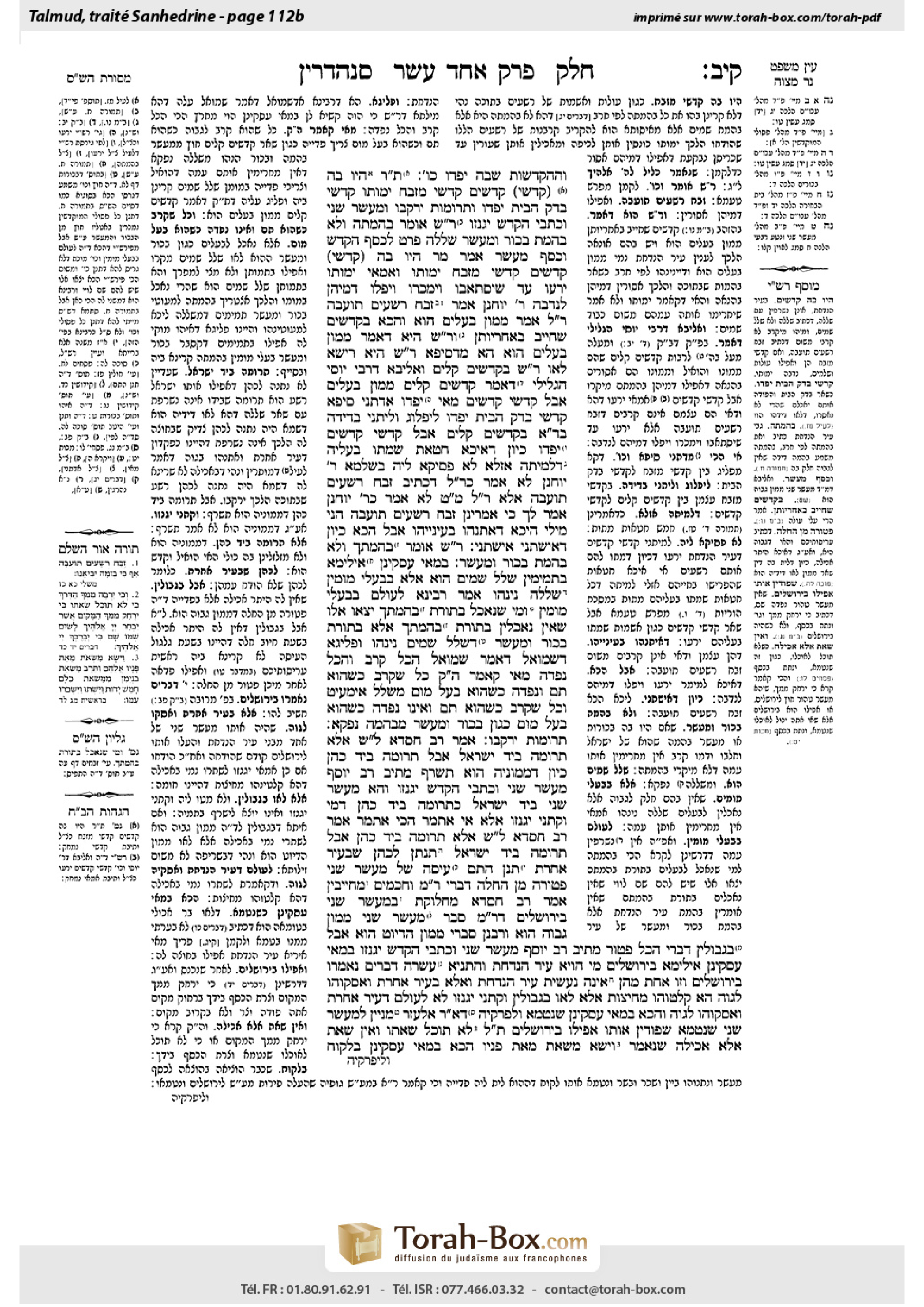
Sanhedrin 112b: Talmud study for Daf Yomi
Daf Yomi is the daily study of one Talmud folio. Explore 37 tractates with scans, Hebrew text, Sefaria English and AI-generated French translations where annotated.
Passage selection and English or AI-generated French translation are available where the scan has annotations. Daf Study is independent of Torah-Box and Sefaria.
Browse Sanhedrin · סנהדרין · All tractatesSanhedrin 112b text and translations
This page of Sanhedrin includes the Aramaic text, an English translation and an AI-generated French translation, alongside the scan above.
סנהדרין קי״ב ב · Aramaic and Hebrew text
וְהַהֶקְדֵּשׁוֹת שֶׁבָּהּ יִפָּדוּ כּוּ׳. תָּנוּ רַבָּנַן: הָיוּ בָּהּ קׇדְשֵׁי קֳדָשִׁים, קׇדְשֵׁי מִזְבֵּחַ – יָמוּתוּ, קׇדְשֵׁי בֶּדֶק הַבַּיִת – יִפָּדוּ, וּתְרוּמוֹת – יֵרָקְבוּ, וּמַעֲשֵׂר שֵׁנִי וְכִתְבֵי הַקֹּדֶשׁ – יִגָּנְזוּ. רַבִּי שִׁמְעוֹן אוֹמֵר: ״בְּהֶמְתָּהּ״ – וְלֹא בֶּהֱמַת בְּכוֹר וּמַעֲשֵׂר, ״שְׁלָלָהּ״ – פְּרָט לְכֶסֶף הֶקְדֵּשׁ וְכֶסֶף מַעֲשֵׂר.
אָמַר מָר: הָיוּ בָּהּ קׇדְשֵׁי קֳדָשִׁים, קׇדְשֵׁי מִזְבֵּחַ – יָמוּתוּ. וְאַמַּאי יָמוּתוּ? יִרְעוּ עַד שֶׁיִּסְתָּאֲבוּ, וְיִמָּכְרוּ, וְיִפְּלוּ דְּמֵיהֶן לִנְדָבָה.
רַבִּי יוֹחָנָן אָמַר: ״זֶבַח רְשָׁעִים תּוֹעֵבָה״. רֵישׁ לָקִישׁ אָמַר: מָמוֹן בְּעָלִים הוּא. וְהָכָא בְּקָדָשִׁים שֶׁחַיָּיב בְּאַחְרָיוּתָן, וְרַבִּי שִׁמְעוֹן הִיא דְּאָמַר: מָמוֹן בְּעָלִים הוּא.
הָא מִדְּסֵיפָא רַבִּי שִׁמְעוֹן הִיא, רֵישָׁא לָאו רַבִּי שִׁמְעוֹן? בְּקָדָשִׁים קַלִּים, וְאַלִּיבָּא דְּרַבִּי יוֹסֵי הַגְּלִילִי דְּאָמַר: קָדָשִׁים קַלִּים מָמוֹן בְּעָלִים. אֲבָל קׇדְשֵׁי קָדָשִׁים מַאי? יִפָּדוּ.
אַדְּתָנֵי סֵיפָא: קׇדְשֵׁי בֶּדֶק הַבַּיִת יִפָּדוּ, לִיפְלוֹג וְלִיתְנֵי בְּדִידַהּ: בַּמֶּה דְּבָרִים אֲמוּרִים? בְּקָדָשִׁים קַלִּים, אֲבָל קׇדְשֵׁי קָדָשִׁים – יִפָּדוּ. כֵּיוָן דְּאִיכָּא חַטָּאת שֶׁמֵּתוּ בְּעָלֶיהָ, דִּלְמִיתָה אָזְלָא, לָא פְּסִיקָא לֵיהּ.
בִּשְׁלָמָא רַבִּי יוֹחָנָן לָא אָמַר כְּרֵישׁ לָקִישׁ, דִּכְתִיב: ״זֶבַח רְשָׁעִים תּוֹעֵבָה״. אֶלָּא רֵישׁ לָקִישׁ, מַאי טַעְמָא לָא אָמַר כְּרַבִּי יוֹחָנָן? אָמַר לָךְ: כִּי אָמְרִינַן ״זֶבַח רְשָׁעִים תּוֹעֵבָה״, הָנֵי מִילֵּי הֵיכָא דְּאִיתַנְהוּ בְּעֵינַיְיהוּ, אֲבָל הָכָא, כֵּיוָן דְּאִישְׁתַּנִּי – אִישְׁתַּנִּי.
רַבִּי שִׁמְעוֹן אוֹמֵר: ״בְּהֶמְתָּהּ״ – וְלֹא בֶּהֱמַת בְּכוֹר וּמַעֲשֵׂר. בְּמַאי עָסְקִינַן? אִילֵימָא בִּתְמִימִין – שְׁלַל שָׁמַיִם הוּא! אֶלָּא בְּבַעֲלֵי מוּמִין – שְׁלָלָהּ נִינְהוּ?
אָמַר רָבִינָא: לְעוֹלָם בְּבַעֲלֵי מוּמִין, וּמִי שֶׁנֶּאֱכָל בְּתוֹרַת בְּהֶמְתָּהּ. יָצְאוּ אֵלּוּ שֶׁאֵין נֶאֱכָלִין בְּתוֹרַת בְּהֶמְתָּהּ, אֶלָּא בְּתוֹרַת בְּכוֹר וּמַעֲשֵׂר, דִּשְׁלַל שָׁמַיִם נִינְהוּ.
וּפְלִיגָא דִּשְׁמוּאֵל, דְּאָמַר שְׁמוּאֵל: הַכֹּל קָרֵב וְהַכֹּל נִפְדֶּה. מַאי קָאָמַר? הָכִי קָאָמַר: כׇּל שֶׁקָּרֵב כְּשֶׁהוּא תָּם, וְנִפְדֶּה כְּשֶׁהוּא בַּעַל מוּם – מִ״שְּׁלָלָהּ״ אִימְּעִיט, וְכׇל שֶׁקָּרֵב כְּשֶׁהוּא תָּם וְאֵינוֹ נִפְדָּה כְּשֶׁהוּא בַּעַל מוּם, כְּגוֹן בְּכוֹר וּמַעֲשֵׂר – מִ״בְּהֶמְתָּהּ״ נָפְקָא.
תְּרוּמוֹת יֵרָקְבוּ. אָמַר רַב חִסְדָּא: לֹא שָׁנוּ אֶלָּא תְּרוּמָה בְּיַד יִשְׂרָאֵל, אֲבָל תְּרוּמָה בְּיַד כֹּהֵן, כֵּיוָן דְּמָמוֹנֵיהּ הוּא, תִּשָּׂרֵף.
מֵתִיב רַב יוֹסֵף: מַעֲשֵׂר שֵׁנִי וְכִתְבֵי הַקֹּדֶשׁ יִגָּנְזוּ. וְהָא מַעֲשֵׂר שֵׁנִי בְּיַד יִשְׂרָאֵל כִּתְרוּמָה בְּיַד כֹּהֵן דָּמֵי, וְקָתָנֵי יִגָּנְזוּ! אֶלָּא, אִי אִתְּמַר הָכִי אִתְּמַר: אָמַר רַב חִסְדָּא, לֹא שָׁנוּ אֶלָּא תְּרוּמָה בְּיַד כֹּהֵן, אֲבָל תְּרוּמָה בְּיַד יִשְׂרָאֵל תִּנָּתֵן לְכֹהֵן שֶׁבְּעִיר אַחֶרֶת.
תְּנַן הָתָם: עִיסָּה שֶׁל מַעֲשֵׂר שֵׁנִי פְּטוּרָה מִן הַחַלָּה, דִּבְרֵי רַבִּי מֵאִיר. וַחֲכָמִים מְחַיְּיבִין. אָמַר רַב חִסְדָּא: מַחְלוֹקֶת בְּמַעֲשֵׂר שֵׁנִי בִּירוּשָׁלַיִם, דְּרַבִּי מֵאִיר סָבַר מַעֲשֵׂר שֵׁנִי מָמוֹן גָּבוֹהַּ הוּא, וְרַבָּנַן סָבְרִי מָמוֹן הֶדְיוֹט הוּא. אֲבָל בִּגְבוּלִין, דִּבְרֵי הַכֹּל פָּטוּר.
מֵתִיב רַב יוֹסֵף: מַעֲשֵׂר שֵׁנִי וְכִתְבֵי הַקֹּדֶשׁ יִגָּנְזוּ. בְּמַאי עָסְקִינַן? אִילֵימָא בִּירוּשָׁלַיִם, מִי הָוְיָא עִיר הַנִּדַּחַת? וְהָתַנְיָא: עֲשָׂרָה דְּבָרִים נֶאֶמְרוּ בִּירוּשָׁלַיִם, וְזוֹ אַחַת מֵהֶן – אֵינָהּ נַעֲשֵׂית עִיר הַנִּדַּחַת! וְאֶלָּא בְּעִיר אַחֶרֶת, וְאַסְּקוּהּ לְגַוַּהּ? הָא קַלְטוּהּ מְחִיצוֹת!
אֶלָּא לָאו בִּגְבוּלִין, וְקָתָנֵי: יִגָּנְזוּ? לָא, לְעוֹלָם דְּעִיר אַחֶרֶת, וְאַסְּקוּהּ לְגַוַּהּ. וְהָכָא בְּמַאי עָסְקִינַן? שֶׁנִּטְמָא.
וְלִפְרְקֵיהּ? דְּאָמַר רַבִּי אֶלְעָזָר: מִנַּיִין לְמַעֲשֵׂר שֵׁנִי שֶׁנִּטְמָא שֶׁפּוֹדִין אוֹתוֹ אֲפִילּוּ בִּירוּשָׁלַיִם? תַּלְמוּד לוֹמַר: ״לֹא תוּכַל שְׂאֵתוֹ״, וְאֵין שְׂאֵת אֶלָּא אֲכִילָה, שֶׁנֶּאֱמַר: ״וַיִּשָּׂא מַשְׂאֹת מֵאֵת פָּנָיו״. הָכָא בְּמַאי עָסְקִינַן? בְּלָקוּחַ.
Sanhedrin 112b · English translation
§ The mishna teaches: And the consecrated property in it must be redeemed. The Sages taught in a baraita (Tosefta 14:5): If there were offerings of the most sacred order in it, if they were animals consecrated for sacrifice on the altar, they shall die; one causes their death. Items consecrated for Temple maintenance must be redeemed, and terumot must be left to decay, and second tithe and sacred scrolls must be interred. Rabbi Shimon says: That is not so; rather, the term: “Its animals” (Deuteronomy 13:16), serves to exclude a firstborn animal and animal tithe, as they never belonged to the idolatrous city. The term: “Its spoils” (Deuteronomy 13:17), serves to exclude consecrated money and tithe money.
The Gemara proceeds to analyze the baraita. The Master said: If there were offerings of the most sacred order in it, if they were animals consecrated for sacrifice on the altar, they shall die. The Gemara asks: But why shall they die? They should graze until they become unfit, and then they should be sold and their value should be allocated for communal gift offerings.
Rabbi Yoḥanan says: They shall die, as it is written: “The offering of the wicked is an abomination” (Proverbs 21:27), and it is unacceptable for sacrifice on the altar. Reish Lakish says: They shall die because the animal is the property of its owner and is not exclusively consecrated property. And the reason it is considered the property of the owner is that here, the tanna is referring to offerings with regard to which one bears financial responsibility for their replacement. That responsibility renders the status of these consecrated animals like that of his property. And this is in accordance with the opinion of Rabbi Shimon, who says: An offering with regard to which one bears financial responsibility for its replacement is the property of its owner.
The Gemara challenges: From the fact that the latter clause of the baraita is the opinion of Rabbi Shimon, one may infer that the first clause is not in accordance with the opinion of Rabbi Shimon. The Gemara suggests a new explanation: Rather, the animals that shall die are offerings of lesser sanctity, and the ruling of the baraita is in accordance with the opinion of Rabbi Yosei HaGelili, who says: Offerings of lesser sanctity are the property of their owner. The Gemara infers: But offerings of the most sacred order, what shall be done with them? They shall be redeemed.
The Gemara asks: If so, rather than teaching in the latter clause of the baraita: Items consecrated for Temple maintenance must be redeemed, let the tanna distinguish and teach a distinction within the category of animals consecrated for sacrifice on the altar itself, as follows: In what case is this statement, that animals shall die, said? It is stated with regard to offerings of lesser sanctity; but with regard to offerings of the most sacred order, they shall be redeemed. The Gemara answers: Since there is among offerings of the most sacred order the case of the sin-offering whose owners were killed in the idolatrous city, rendering the animal a sin-offering whose owners have died, which is left to die, that distinction is not clear-cut for the tanna, as offerings of the most sacred order are not always redeemed. Therefore, the tanna preferred to cite a distinction without exceptions.
The Gemara comments: Granted, Rabbi Yoḥanan does not say his explanation of the baraita in accordance with the opinion of Reish Lakish, due to the fact that it is written: “The offering of the wicked is an abomination,” and he bases his explanation on that verse. But Reish Lakish, what is the reason he does not say his explanation of the baraita in accordance with the opinion of Rabbi Yoḥanan? The Gemara answers: He could have said to you that when we say: “The offering of the wicked is an abomination,” this statement applies in a case where the offering is in its unadulterated form. But here, since if they were to redeem it, it would have changed and would no longer be the animal of the wicked itself, but rather an animal purchased with the proceeds of the redemption of the original, it would have changed, and it would no longer be an abomination.
§ The baraita continues. Rabbi Shimon says that the term “its animals” serves to exclude a firstborn animal and animal tithe. The Gemara asks: What animals are we dealing with? If we say that Rabbi Shimon is speaking with regard to unblemished animals, like all other offerings they are the spoils of Heaven and not the spoils of the inhabitants of the city. Rather, Rabbi Shimon is speaking with regard to blemished animals, which belong to their owners. If so, they are the spoils of the city, and what is the reason that Rabbi Shimon says that there is no obligation to destroy these animals?
Ravina says: Actually, Rabbi Shimon is speaking with regard to blemished animals, and his statement should be understood as follows: The mitzva is to destroy that which is eaten as its animals, i.e., as the property of an inhabitant of an idolatrous city. Excluded are those firstborn and tithe animals, which, even when blemished, are not eaten as its animals; rather, they are eaten as firstborn and tithe animals. They are given as gifts to priests, and are considered the spoils of Heaven.
And this halakha disputes the statement of Shmuel, as Shmuel says: Everything is sacrificed and everything is redeemed. The Gemara asks: What is he saying? The Gemara explains that this is what he is saying: Any offering that is sacrificed on the altar when it is unblemished and is redeemed when it is blemished is excluded from the term “its spoils,” since it is considered the spoils of Heaven. And the halakha concerning any offering that is sacrificed on the altar when it is unblemished and is not redeemed when it is blemished, e.g., a firstborn animal and animal tithe, is derived from the term “its animals,” as they are not the city’s animals and they are not included in the city’s property.
§ The baraita continues: Terumot must be left to decay. Rav Ḥisda says: The Sages taught this only with regard to teruma that is still in the possession of an Israelite, who has not yet given it to a priest. But concerning teruma that is already in the possession of a priest who lives in the idolatrous city, since it is his property, it shall be burned.
Rav Yosef raises an objection from the mishna: Second tithe and sacred scrolls must be interred. But isn’t the status of second tithe in the possession of an Israelite like that of teruma in the possession of a priest, as he may partake of it and benefit from it in Jerusalem; and nevertheless, it is taught: They must be interred? Rather, if the statement of Rav Ḥisda was stated, this is what was stated: Rav Ḥisda says: The Sages taught this only with regard to teruma that is already in the possession of a priest who lives in the idolatrous city, as even though it is his property, it maintains the sanctity of teruma. But teruma that is still in the possession of an Israelite, which is not his property at all, shall be given to a priest who is in another city, and should not be left to decay.
We learned in a baraita there: Second-tithe dough is exempt from having ḥalla separated since it is property belonging to the Most High; this is the statement of Rabbi Meir. And the Rabbis deem one liable to separate ḥalla from second-tithe dough. Rav Ḥisda says: This dispute is with regard to second tithe in Jerusalem; as Rabbi Meir holds: Second-tithe produce is property belonging to the Most High, but the Torah permitted its owners to partake of it in Jerusalem. Since it is the property of Heaven, one is exempt from separating priestly gifts. And the Rabbis hold: It is non-sacred property from which one is liable to separate ḥalla. But with regard to second-tithe dough in the outlying areas, everyone agrees that one is exempt from separating ḥalla, as outside of Jerusalem it is prohibited to partake of it.
Rav Yosef raises an objection from the mishna: Second tithe and sacred scrolls must be interred. What are we dealing with? If we say that the reference is to second tithe in Jerusalem, can Jerusalem be an idolatrous city? But isn’t it taught in a baraita: Ten matters were stated with regard to Jerusalem, and this is one of them: It does not become an idolatrous city. Rather, apparently the reference is to second tithe in a different city that was rendered an idolatrous city, and before it was so rendered one took the second-tithe produce up into Jerusalem. The Gemara asks: In that case, wasn’t the produce admitted by the walls of Jerusalem, making it no longer associated with the idolatrous city, and it should therefore be permitted to partake of it?
Rather, is the reference in the mishna not to second-tithe produce in an outlying area? And it is taught: They must be interred. Apparently, second-tithe produce is not the property of Heaven; it belongs to an inhabitant of the idolatrous city. The Gemara rejects this: No, actually, the reference in the mishna is to second-tithe produce in a different city, and before it was rendered an idolatrous city one took the second-tithe produce up into Jerusalem. And what are we dealing with here? We are dealing with a case where that second-tithe produce became ritually impure. Since it is prohibited to partake of it, there is no alternative to interment.
The Gemara challenges: And let him redeem it in Jerusalem, as Rabbi Elazar says: From where is it derived with regard to second-tithe produce that became impure, that one may redeem it even in Jerusalem? As the verse states: “And if the way is too long for you so that you are unable to carry it [se’eto]…and you shall turn it into money” (Deuteronomy 14:24–25). And se’et means nothing other than eating, as it is stated: “And he took portions [masot] from before him” (Genesis 43:34), indicating that second-tithe produce that cannot be eaten, whether due to the distance from Jerusalem or due to its impurity, may be redeemed. The Gemara answers: What are we dealing with here? It is not a case where the second-tithe produce became impure; rather, it is a case where an item purchased with second-tithe money became impure.
Sanhedrin 112b · Traduction française (IA)
§ La Michna enseigne : « Et les biens consacrés qui s’y trouvent doivent être rachetés. » Les Sages ont enseigné dans une baraïta (Tosefta 14:5) : S’il s’y trouve des offrandes de très haute sainteté, si ce sont des animaux consacrés au sacrifice sur l’autel, ils doivent mourir ; on les fait mourir. Les biens consacrés à l’entretien du Temple doivent être rachetés, les teroumot doivent être laissées à se décomposer, et la seconde dîme ainsi que les rouleaux sacrés doivent être ensevelis. Rabbi Shimon dit : Il n’en est pas ainsi ; au contraire, le terme « ses animaux » (Deutéronome 13:16) sert à exclure les animaux premiers-nés et ceux de la dîme du bétail, car ils n’ont jamais appartenu à la ville idolâtre. Le terme « son butin » (Deutéronome 13:17) sert à exclure l’argent consacré et l’argent de la dîme.
La Guemara analyse la baraïta. Le Maître a dit : S’il s’y trouve des offrandes de très haute sainteté, si ce sont des animaux consacrés au sacrifice sur l’autel, ils doivent mourir. La Guemara demande : Mais pourquoi doivent-ils mourir ? Ils devraient paître jusqu’à devenir impropres, puis être vendus et leur valeur affectée à des offrandes volontaires communautaires.
Rabbi Yoḥanan dit : Ils doivent mourir, comme il est écrit : « Le sacrifice des méchants est une abomination » (Proverbes 21:27), et il ne convient pas de l’offrir sur l’autel. Reish Lakish dit : Ils doivent mourir parce que l’animal est la propriété de son propriétaire et n’est pas exclusivement un bien consacré. La raison pour laquelle il est considéré comme la propriété de son propriétaire est qu’ici, le tanna parle d’offrandes dont on est financièrement responsable du remplacement. Cette responsabilité confère à ces animaux consacrés le statut de ses biens. Cela correspond à l’opinion de Rabbi Shimon, qui dit : Une offrande dont on est financièrement responsable du remplacement est la propriété de son propriétaire.
La Guemara objecte : Puisque la dernière partie de la baraïta exprime l’opinion de Rabbi Shimon, on peut en déduire que la première partie n’est pas conforme à son opinion. La Guemara propose une nouvelle explication : Au contraire, les animaux qui doivent mourir sont des offrandes de moindre sainteté, et la règle de la baraïta est conforme à l’opinion de Rabbi Yosei HaGelili, qui dit : Les offrandes de moindre sainteté sont la propriété de leur propriétaire. La Guemara en déduit : Mais que faut-il faire des offrandes de très haute sainteté ? Elles doivent être rachetées.
La Guemara demande : Dans ce cas, au lieu d’enseigner dans la dernière partie de la baraïta que les biens consacrés à l’entretien du Temple doivent être rachetés, que le tanna distingue au sein même de la catégorie des animaux consacrés au sacrifice sur l’autel et enseigne ceci : Dans quel cas a-t-on dit que les animaux doivent mourir ? Cela concerne les offrandes de moindre sainteté ; mais les offrandes de très haute sainteté doivent être rachetées. La Guemara répond : Puisque, parmi les offrandes de très haute sainteté, il y a le cas du sacrifice expiatoire dont les propriétaires ont été tués dans la ville idolâtre, si bien que l’animal est un sacrifice expiatoire dont les propriétaires sont morts et qu’il doit être laissé à mourir, cette distinction n’est pas assez nette pour le tanna, car les offrandes de très haute sainteté ne sont pas toujours rachetées. Le tanna a donc préféré présenter une distinction sans exception.
La Guemara fait remarquer : Il est compréhensible que Rabbi Yoḥanan ne donne pas son explication de la baraïta conformément à l’opinion de Reish Lakish, puisqu’il fonde son explication sur le verset : « Le sacrifice des méchants est une abomination. » Mais Reish Lakish, pourquoi ne donne-t-il pas son explication de la baraïta conformément à l’opinion de Rabbi Yoḥanan ? La Guemara répond : Il aurait pu te dire que lorsque nous disons : « Le sacrifice des méchants est une abomination », cela s’applique à un cas où le sacrifice est dans son état d’origine, sans avoir été altéré. Mais ici, si l’on rachetait l’animal, il serait transformé et ne serait plus l’animal même du méchant, mais un animal acheté avec le produit du rachat de l’animal initial ; il aurait donc changé et ne serait plus une abomination.
§ La baraïta se poursuit. Rabbi Shimon dit que le terme « ses animaux » sert à exclure les animaux premiers-nés et ceux de la dîme du bétail. La Guemara demande : De quels animaux s’agit-il ? Si l’on dit que Rabbi Shimon parle d’animaux sans défaut, ceux-ci, comme toutes les autres offrandes, constituent un butin du Ciel et non un butin appartenant aux habitants de la ville. Rabbi Shimon parle donc d’animaux présentant un défaut, qui appartiennent à leurs propriétaires. Dans ce cas, ils constituent le butin de la ville ; pour quelle raison Rabbi Shimon dit-il qu’il n’y a pas lieu de détruire ces animaux ?
Ravina dit : En réalité, Rabbi Shimon parle d’animaux présentant un défaut, et sa déclaration doit être comprise ainsi : La mitsva consiste à détruire ce qui est consommé comme « ses animaux », c’est-à-dire comme un bien appartenant à un habitant d’une ville idolâtre. Sont exclus les animaux premiers-nés et ceux de la dîme, qui, même lorsqu’ils présentent un défaut, ne sont pas consommés comme « ses animaux », mais en tant qu’animaux premiers-nés et animaux de la dîme. Ils sont donnés aux prêtres et considérés comme un butin du Ciel.
Cette halakha contredit l’affirmation de Shmuel, car Shmuel dit : Tout est sacrifié et tout est racheté. La Guemara demande : Que veut-il dire ? La Guemara explique qu’il veut dire ceci : Toute offrande qui, sans défaut, est sacrifiée sur l’autel et qui, lorsqu’elle présente un défaut, est rachetée, est exclue du terme « son butin », puisqu’elle est considérée comme un butin du Ciel. Quant à la halakha relative à toute offrande qui, sans défaut, est sacrifiée sur l’autel et qui, lorsqu’elle présente un défaut, n’est pas rachetée, par exemple un animal premier-né ou un animal de la dîme du bétail, elle découle du terme « ses animaux », car ces animaux ne sont pas ceux de la ville et ne sont pas inclus dans ses biens.
§ La baraïta se poursuit : Les teroumot doivent être laissées à se décomposer. Rav Ḥisda dit : Les Sages n’ont enseigné cela qu’à propos de la terouma qui se trouve encore en possession d’un Israélite, lequel ne l’a pas encore donnée à un prêtre. Mais la terouma qui se trouve déjà en possession d’un prêtre vivant dans la ville idolâtre doit être brûlée, puisqu’elle est sa propriété.
Rav Yosef objecte à partir de la Michna : La seconde dîme et les rouleaux sacrés doivent être ensevelis. Mais le statut de la seconde dîme en possession d’un Israélite n’est-il pas semblable à celui de la terouma en possession d’un prêtre, puisque l’Israélite peut en manger et en tirer profit à Jérusalem ? Et pourtant, il est enseigné qu’elle doit être ensevelie. Il faut plutôt dire que, si la déclaration de Rav Ḥisda a été formulée, voici ce qu’il a dit : Les Sages n’ont enseigné cela qu’à propos de la terouma qui se trouve déjà en possession d’un prêtre vivant dans la ville idolâtre, car, bien qu’elle soit sa propriété, elle conserve la sainteté de la terouma. Mais la terouma qui se trouve encore en possession d’un Israélite, et qui ne lui appartient nullement, doit être donnée à un prêtre d’une autre ville et ne doit pas être laissée à se décomposer.
Nous avons appris dans une baraïta : La pâte de seconde dîme est exemptée du prélèvement de la ḥalla, puisqu’elle est un bien appartenant au Très-Haut ; telle est l’opinion de Rabbi Meir. Les Sages, eux, obligent à prélever la ḥalla sur la pâte de seconde dîme. Rav Ḥisda dit : Cette controverse concerne la seconde dîme à Jérusalem. Rabbi Meir estime que les produits de la seconde dîme sont un bien appartenant au Très-Haut, mais que la Torah a permis à leurs propriétaires d’en manger à Jérusalem. Puisqu’ils sont la propriété du Ciel, on est exempté des prélèvements destinés aux prêtres. Les Sages, eux, estiment qu’il s’agit de biens profanes, sur lesquels on est tenu de prélever la ḥalla. Mais, à propos de la pâte de seconde dîme dans les régions périphériques, tous s’accordent à dire qu’on est exempté du prélèvement de la ḥalla, car il est interdit d’en manger hors de Jérusalem.
Rav Yosef objecte à partir de la Michna : La seconde dîme et les rouleaux sacrés doivent être ensevelis. De quel cas s’agit-il ? Si l’on dit qu’il s’agit de la seconde dîme à Jérusalem, Jérusalem peut-elle être une ville idolâtre ? N’est-il pas enseigné dans une baraïta que dix dispositions ont été énoncées à propos de Jérusalem, dont celle-ci : elle ne peut pas devenir une ville idolâtre ? Il s’agit donc apparemment de la seconde dîme dans une autre ville devenue une ville idolâtre, et, avant qu’elle ne le devienne, on avait transporté les produits de la seconde dîme à Jérusalem. La Guemara demande : Dans ce cas, les remparts de Jérusalem n’ont-ils pas accueilli les produits, de sorte qu’ils ne sont plus liés à la ville idolâtre et que leur consommation devrait donc être permise ?
La Michna parle donc de produits de la seconde dîme situés dans une région périphérique, n’est-ce pas ? Et il est enseigné qu’ils doivent être ensevelis. Apparemment, les produits de la seconde dîme ne sont pas la propriété du Ciel ; ils appartiennent à un habitant de la ville idolâtre. La Guemara rejette cette conclusion : Non, en réalité, la Michna parle de produits de la seconde dîme se trouvant dans une autre ville, et, avant que celle-ci ne devienne une ville idolâtre, on avait transporté ces produits à Jérusalem. De quel cas s’agit-il ici ? D’un cas où ces produits de la seconde dîme sont devenus rituellement impurs. Puisqu’il est interdit d’en manger, il ne reste d’autre possibilité que de les ensevelir.
La Guemara objecte : Ne peut-on pas les racheter à Jérusalem ? Car Rabbi Elazar dit : D’où déduit-on, à propos de produits de la seconde dîme devenus impurs, qu’on peut les racheter même à Jérusalem ? Le verset dit : « Et si le chemin est trop long pour toi, au point que tu ne puisses pas le porter [se’eto]… tu le changeras en argent » (Deutéronome 14:24-25). Or, se’et signifie uniquement « manger », comme il est dit : « Et il leur fit porter des portions [masot] de ce qui était devant lui » (Genèse 43:34). Cela indique que les produits de la seconde dîme qui ne peuvent pas être consommés, que ce soit en raison de l’éloignement de Jérusalem ou de leur impureté, peuvent être rachetés. La Guemara répond : De quel cas s’agit-il ici ? Il ne s’agit pas de produits de la seconde dîme devenus impurs, mais d’un objet acheté avec l’argent de la seconde dîme qui est devenu impur.
Traduction française générée par IA à partir de l’édition anglaise de Sefaria. Vérifie toujours un passage avec le texte source.
Text from Sefaria: William Davidson Edition - Vocalized Aramaic (CC BY NC); William Davidson Edition - English (CC BY NC).