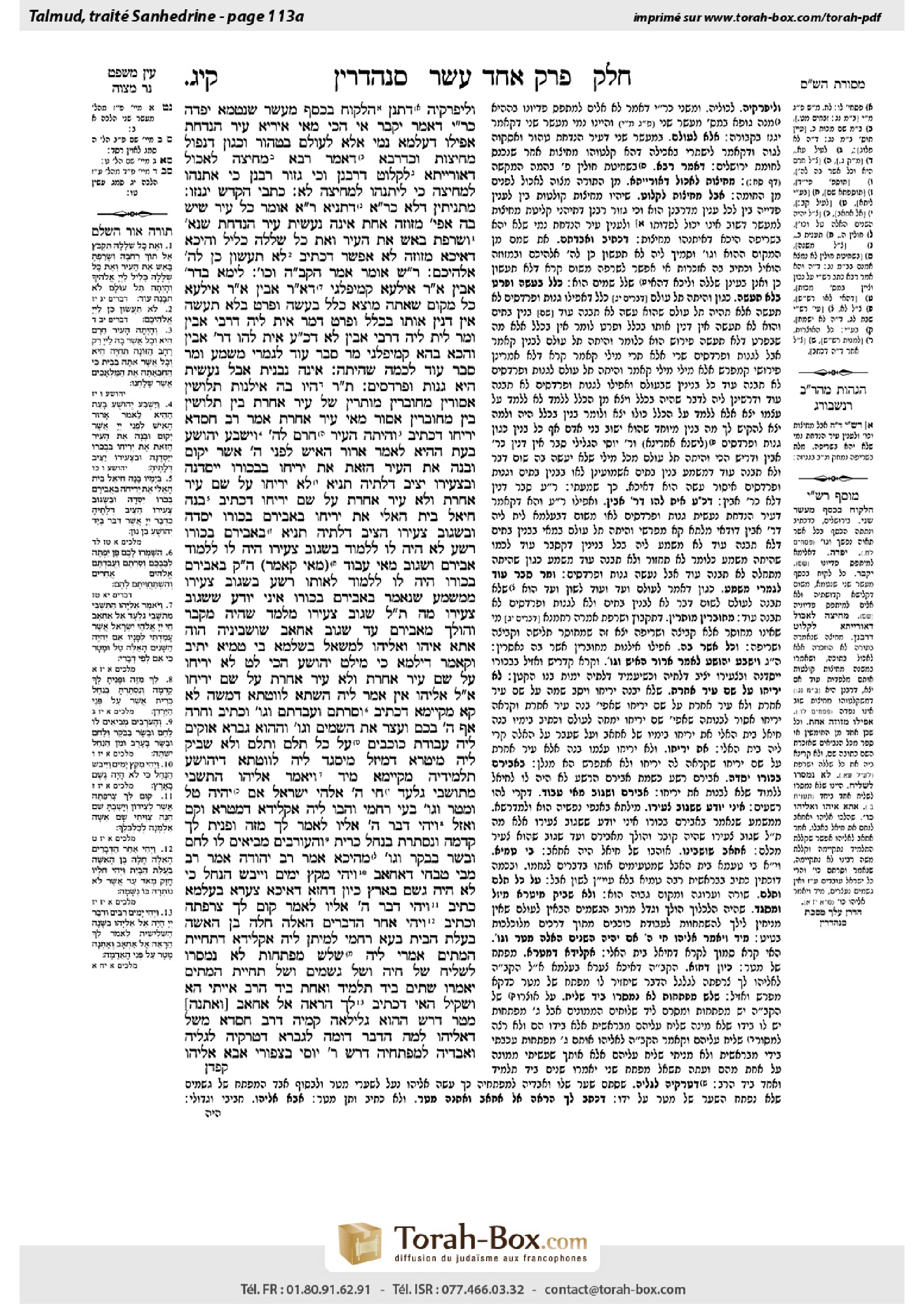
Sanhedrin 113a: Talmud study for Daf Yomi
Daf Yomi is the daily study of one Talmud folio. Explore 37 tractates with scans, Hebrew text, Sefaria English and AI-generated French translations where annotated.
Passage selection and English or AI-generated French translation are available where the scan has annotations. Daf Study is independent of Torah-Box and Sefaria.
Browse Sanhedrin · סנהדרין · All tractatesSanhedrin 113a text and translations
This page of Sanhedrin includes the Aramaic text, an English translation and an AI-generated French translation, alongside the scan above.
סנהדרין קי״ג א · Aramaic and Hebrew text
וְלִיפְרְקֵיהּ, דִּתְנַן: הַלָּקוּחַ בְּכֶסֶף מַעֲשֵׂר שֶׁנִּטְמָא – יִפָּדֶה. כְּרַבִּי יְהוּדָה, דְּאָמַר: יִקָּבֵר. אִי הָכִי, מַאי אִירְיָא עִיר הַנִּדַּחַת? אֲפִילּוּ דְּעָלְמָא נָמֵי!
אֶלָּא לְעוֹלָם בְּטָהוֹר, וּכְגוֹן דִּנְפוּל מְחִיצוֹת, וְכִדְרָבָא דְּאָמַר רָבָא: מְחִיצָה לֶאֱכוֹל – דְּאוֹרָיְיתָא, לִקְלוֹט – דְּרַבָּנַן. וְכִי גְּזוּר רַבָּנַן כִּי אִתַנְהוּ לִמְחִיצוֹת, כִּי לֵיתַנְהוּ לִמְחִיצוֹת – לָא.
כִּתְבֵי הַקֹּדֶשׁ יִגָּנְזוּ. מַתְנִיתִין דְּלָא כְּרַבִּי אֱלִיעֶזֶר, דְּתַנְיָא: רַבִּי אֱלִיעֶזֶר אוֹמֵר, כׇּל עִיר שֶׁיֵּשׁ בָּהּ אֲפִילּוּ מְזוּזָה אַחַת אֵינָהּ נַעֲשֵׂית עִיר הַנִּדַּחַת, שֶׁנֶּאֱמַר: ״וְשָׂרַפְתָּ בָאֵשׁ אֶת הָעִיר וְאֶת כׇּל שְׁלָלָהּ כָּלִיל״. וְהֵיכָא דְּאִיכָּא מְזוּזָה לָא אֶפְשָׁר, דִּכְתִיב: ״לֹא תַעֲשׂוּן כֵּן לַה׳ אֱלֹהֵיכֶם״.
רַבִּי שִׁמְעוֹן אוֹמֵר: אָמַר הַקָּדוֹשׁ בָּרוּךְ הוּא וְכוּ׳. לֵימָא בִּדְרַבִּי אָבִין אָמַר רַבִּי אִילְעָא קָמִיפַּלְגִי? דְּאָמַר רַבִּי אָבִין אָמַר רַבִּי אִילְעָא: כׇּל מָקוֹם שֶׁאַתָּה מוֹצֵא כְּלָל בַּעֲשֵׂה וּפְרָט בְּלֹא תַעֲשֶׂה, אֵין דָּנִין אוֹתוֹ בִּכְלָל וּפְרָט.
דְּמָר אִית לֵיהּ דְּרַבִּי אָבִין, וּמָר לֵית לֵיהּ דְּרַבִּי אָבִין.
לָא, דְּכוּלֵּי עָלְמָא אִית לְהוּ דְּרַבִּי אָבִין, וְהָכָא בְּהָא קָמִיפַּלְגִי: מָר סָבַר ״עוֹד״ לִגְמָרֵי מַשְׁמַע, וּמָר סָבַר ״עוֹד״ – לִכְמָה שֶׁהָיְתָה אֵינָהּ נִבְנֵית, אֲבָל נַעֲשֵׂית הִיא גַּנּוֹת וּפַרְדֵּסִים.
תָּנוּ רַבָּנַן: הָיוּ בָּהּ אִילָנוֹת תְּלוּשִׁין – אֲסוּרִין, מְחוּבָּרִין – מוּתָּרִין. שֶׁל עִיר אַחֶרֶת, בֵּין תְּלוּשִׁין בֵּין מְחוּבָּרִין – אֲסוּרִין. מַאי ״עִיר אַחֶרֶת״? אָמַר רַב חִסְדָּא: יְרִיחוֹ, דִּכְתִיב: ״וְהָיְתָה הָעִיר חֵרֶם לַה׳... וַיַּשְׁבַּע יְהוֹשֻׁעַ בָּעֵת הַהִיא לֵאמֹר אָרוּר הָאִישׁ לִפְנֵי ה׳ אֲשֶׁר יָקוּם וּבָנָה אֶת הָעִיר הַזֹּאת אֶת יְרִיחוֹ בִּבְכֹרוֹ יְיַסְּדֶנָּה וּבִצְעִירוֹ יַצִּיב דְּלָתֶיהָ״.
תַּנְיָא: לֹא יְרִיחוֹ עַל שֵׁם עִיר אַחֶרֶת, וְלֹא עִיר אַחֶרֶת עַל שֵׁם יְרִיחוֹ, דִּכְתִיב: ״בָּנָה חִיאֵל בֵּית הָאֱלִי אֶת יְרִיחֹה בַּאֲבִירָם בְּכֹרוֹ יִסְּדָהּ וּבִשְׂגוּב צְעִירוֹ הִצִּיב דְּלָתֶיהָ״.
תַּנְיָא: בַּאֲבִירָם בְּכוֹרוֹ, רָשָׁע, לֹא הָיָה לוֹ לִלְמוֹד. בִּשְׂגוּב צְעִירוֹ, הָיָה לוֹ לִלְמוֹד.
אֲבִירָם וּשְׂגוּב מַאי עֲבוּד? מַאי קָאָמַר? הָכִי קָאָמַר: בַּאֲבִירָם בְּכוֹרוֹ הָיָה לוֹ לִלְמוֹד לְאוֹתוֹ רָשָׁע, בִּשְׂגוּב צְעִירוֹ. מִמַּשְׁמָע שֶׁנֶּאֱמַר ״בַּאֲבִירָם בְּכוֹרוֹ״ אֵינִי יוֹדֵעַ שֶׁשְּׂגוּב צְעִירוֹ? מָה תַּלְמוּד לוֹמַר ״שְׂגוּב צְעִירוֹ״? מְלַמֵּד שֶׁהָיָה מְקַבֵּר וְהוֹלֵךְ מֵאֲבִירָם עַד שְׂגוּב.
אַחְאָב שׁוֹשְׁבִינֵיהּ הֲוָה. אֲתָא אִיהוּ וְאֵלִיָּהוּ לְמִשְׁאַל בִּשְׁלָמָא בֵּי טַמְיָא. יָתֵיב וְקָאָמַר: דִּילְמָא כִּי לָט יְהוֹשֻׁעַ הָכִי לָט – לֹא יְרִיחוֹ עַל שֵׁם עִיר אַחֶרֶת, וְלֹא עִיר אַחֶרֶת עַל שֵׁם יְרִיחוֹ? אָמַר לֵיהּ אֵלִיָּהוּ: אִין. אֲמַר לֵיהּ: הַשְׁתָּא לְוָוטְתָא דְּמֹשֶׁה לָא קָא מִקַּיְימָא, דִּכְתִיב ״וְסַרְתֶּם וַעֲבַדְתֶּם וְגוֹ׳״ וּכְתִיב ״וְחָרָה אַף ה׳ בָּכֶם וְעָצַר אֶת הַשָּׁמַיִם וְגוֹ׳״, וְהָהוּא גַּבְרָא אוֹקֵים לֵיהּ עֲבוֹדָה זָרָה עַל כׇּל תֶּלֶם וְתֶלֶם וְלָא שָׁבֵיק לֵיהּ מִיטְרָא לְמֵיזַל מִיסְגָּד לֵיהּ. לְוָוטְתָא דִּיהוֹשֻׁעַ תַּלְמִידֵיהּ מִקַּיְימָא?
מִיָּד: ״וַיֹּאמֶר אֵלִיָּהוּ הַתִּשְׁבִּי מִתֹּשָׁבֵי גִלְעָד חַי ה׳ אֱלֹהֵי יִשְׂרָאֵל אִם יִהְיֶה טַל וּמָטָר וְגוֹ׳״. בָּעֵי רַחֲמֵי, וִיהַבוּ לֵיהּ אַקְלִידָא דְּמִטְרָא, וְקָם וַאֲזַל.
״וַיְהִי דְבַר ה׳ אֵלָיו לֵאמֹר. לֵךְ מִזֶּה וּפָנִיתָ לְּךָ קֵדְמָה וְנִסְתַּרְתָּ בְּנַחַל כְּרִית״. ״וְהָעֹרְבִים מְבִיאִים לוֹ לֶחֶם וּבָשָׂר בַּבֹּקֶר וְגוֹ׳״. מֵהֵיכָא? אָמַר רַב יְהוּדָה אָמַר רַב: מִבֵּי טַבָּחֵי דְאַחְאָב. ״וַיְהִי מִקֵּץ יָמִים וַיִּיבַשׁ הַנָּחַל כִּי לֹא הָיָה גֶשֶׁם בָּאָרֶץ״. כֵּיוָן דַּחֲזָא דְּאִיכָּא צַעֲרָא בְּעָלְמָא, כְּתִיב: ״וַיְהִי דְבַר ה׳ אֵלָיו לֵאמֹר. קוּם לֵךְ צָרְפַתָה״.
וּכְתִיב: ״וַיְהִי אַחַר הַדְּבָרִים הָאֵלֶּה חָלָה בֶּן הָאִשָּׁה בַּעֲלַת הַבָּיִת״. בְּעָא רַחֲמֵי לְמִיתַּן לֵיהּ אַקְלִידָא דִּתְחִיַּית הַמֵּתִים. אָמְרִי לֵיהּ: שָׁלֹשׁ מַפְתְּחוֹת לֹא נִמְסְרוּ לְשָׁלִיחַ: שֶׁל חַיָּה, וְשֶׁל גְּשָׁמִים, וְשֶׁל תְּחִיַּית הַמֵּתִים. יֹאמְרוּ: שְׁתַּיִם בְּיַד תַּלְמִיד וְאַחַת בְּיַד הָרַב! אַיְיתִי הָא וּשְׁקֵיל הַאי. דִּכְתִיב: ״לֵךְ הֵרָאֵה אֶל אַחְאָב וְאֶתְּנָה מָטָר״.
דְּרַשׁ הַהוּא גָּלִילָאָה קַמֵּיהּ דְּרַב חִסְדָּא: מָשָׁל דְּאֵלִיָּהוּ, לָמָּה הַדָּבָר דּוֹמֶה? לְגַבְרָא דְּטַרְקֵיהּ לְגַלֵּיהּ וְאַבְּדֵיהּ לְמַפְתְּחֵיהּ.
דָּרֵשׁ רַבִּי יוֹסֵי בְּצִיפּוֹרִי: אַבָּא אֵלִיָּהוּ
Sanhedrin 113a · English translation
The Gemara challenges: And let him redeem that which was purchased with second-tithe money and became ritually impure, as we learned in a mishna (Ma’aser Sheni 3:10): An item that is purchased with second-tithe money and that became ritually impure shall be redeemed. The Gemara answers: The mishna is in accordance with the opinion of Rabbi Yehuda, who says: An item that is purchased with second-tithe money and that became ritually impure shall be buried, and it may no longer be redeemed. The Gemara asks: If so, and the mishna is referring to an item purchased with second-tithe money that became ritually impure, why did the mishna cite this halakha specifically in the case of an idolatrous city? The same would hold true even in cities in general as well, as in Rabbi Yehuda’s opinion, the halakha there too is that the item is buried.
Rather, actually, the case in the mishna is with regard to pure second-tithe produce of an idolatrous city that was taken into Jerusalem, and it is a case where the walls of Jerusalem then fell. And this halakha is in accordance with the opinion of Rava, as Rava says: The capacity of the wall of Jerusalem to enable one to partake of second-tithe produce is by Torah law. By contrast, the capacity of the wall of Jerusalem to admit second-tithe produce, in the sense that once it enters Jerusalem the produce assumes the status of the property of the Most High and may no longer be redeemed, is by rabbinic law. And the case where the Sages issue the decree that entry into Jerusalem admits the produce is where the wall is intact; however, in a case where the wall is not intact, no, the Sages did not issue a decree, and the second tithe remains the spoils of the idolatrous city.
§ The mishna teaches: Sacred scrolls must be interred. The Gemara comments: The halakha cited in the mishna is not in accordance with the opinion of Rabbi Eliezer, as it is taught in a baraita that Rabbi Eliezer says: Any city in which there is even one mezuza is not rendered an idolatrous city, as it is stated: “And you shall burn it with fire, both the city and all its spoils, entirely for the Lord your God” (Deuteronomy 13:17). And in a city where there is a mezuza it is not possible to burn all its spoils, as it is written: “You shall not do so to the Lord your God” (Deuteronomy 12:4), from which it is derived that it is prohibited to destroy any item upon which the name of God appears.
The mishna teaches that Rabbi Shimon says: The Holy One, Blessed be He, says: If you implement judgment on an idolatrous city, I ascribe you credit as though you have sacrificed an entirely burnt offering before Me, and Rabbi Akiva and Rabbi Yosei HaGelili disagree as to whether one may convert the ruins of the idolatrous city into gardens and orchards. The Gemara posits: Let us say that it is with regard to the statement that Rabbi Avin says that Rabbi Ile’a says that these tanna’im disagree, as Rabbi Avin says that Rabbi Ile’a says: Anywhere that you find a generalization formulated as a positive mitzva followed by a detail formulated as a prohibition, one does not deduce from it that the generalization includes only the detail based on the hermeneutical principle of a generalization and a detail; rather, one interprets them as two independent halakhot.
On that basis, say that the dispute is that one Sage, Rabbi Yosei HaGelili, is of the opinion that the ruling is in accordance with the opinion of Rabbi Avin, and one Sage, Rabbi Akiva, is of the opinion that the ruling is not in accordance with the opinion of Rabbi Avin. Rabbi Yosei HaGelili holds that the positive mitzva: “And it shall be a heap forever,” and the succeeding prohibition: “It shall not be built again” (Deuteronomy 13:17), are independent mitzvot. The result is that the city must remain a heap and may not be converted into gardens and orchards. Rabbi Akiva employs the hermeneutical principle and deduces that the generalization “and it shall be a heap forever” means only that “it shall not be built again,” but converting the ruins of the idolatrous city into gardens and orchards is permitted.
The Gemara rejects this: No, everyone is of the opinion that the ruling is in accordance with the opinion of Rabbi Avin, and here, they disagree about this: One Sage, Rabbi Yosei HaGelili, holds that the term “again” indicates that it is entirely prohibited to rebuild it at all. And one Sage, Rabbi Akiva, holds that the term “again” indicates that it is not built to be as it was, but it may be converted into gardens and orchards.
§ The Sages taught in a baraita: In a case where there were trees in the city, if they are detached from the ground, they are forbidden and must be burned as the spoils of an idolatrous city; if they are attached to the ground they are permitted, i.e., they are not destroyed. By contrast, trees of another city, whether detached or attached, are forbidden. The Gemara asks: To what is the baraita referring with the phrase: Another city? Rav Ḥisda says: The reference is to Jericho, as it is written: “And the city shall be devoted, it and all that is in it, to the Lord…And Joshua charged them at that time by oath, saying: Cursed be the man before the Lord, that rises up to build this city Jericho; he shall lay its foundation with his firstborn, and with his youngest son shall he set up the gates of it” (Joshua 6:17, 26).
It is taught in a baraita that this includes a prohibition not to build Jericho even after changing its name to the name of another city, and not to build another city after giving it the name of Jericho, as it is written: “Hiel the Bethelite built Jericho; with Abiram, his firstborn, he laid its foundation, and with his young son Segub set up its gates” (I Kings 16:34).
It is taught in a baraita: From the death of Abiram, his firstborn, the wicked, it was not incumbent upon him to learn not to build Jericho, as Abiram’s death could be attributed to chance. But with the death of Segub his young son, it was incumbent upon him to learn that it was due to Joshua’s curse that they died.
The Gemara asks: What did Abiram and Segub do that they are characterized as wicked, and what is the baraita saying? The Gemara answers that this is what the baraita is saying: From the death of Abiram, his firstborn, that wicked man Hiel should have learned about the cause of the death of Segub his young son. By inference from that which is stated: “With Abiram, his firstborn,” do I not know that Segub was his young son? Rather, what is the meaning when the verse states: “His young son Segub”? It teaches that he gradually buried all his sons from Abiram through Segub, and he should have suspected that Joshua’s curse caused the deaths.
Ahab was Hiel’s close friend and groomsman. He and Elijah came to inquire about Hiel’s welfare in the house of mourning [bei tamya]. Hiel sat and said: Perhaps when Joshua cursed, this is what he cursed: Not to build Jericho even after changing its name to the name of another city, and not to build another city after giving it the name of Jericho. Elijah said to him: Yes, that is the curse. Ahab said to Elijah: Now the curse of Moses is not fulfilled, as it is written: “And you go astray and worship other gods,” and it is written: “Then the Lord’s anger will flare against you, and He will close the heavens, and there will be no rain” (Deuteronomy 11:16–17). And that man, referring to himself, established an object of idol worship on each and every furrow in the kingdom of Israel, and the rain is so plentiful that it does not allow him to go and worship it; will the curse of his student, Joshua, be fulfilled?
The verse relates Elijah’s reaction: Immediately: “And Elijah the Tishbite, who was of the inhabitants of Gilead, said to Ahab: As the Lord God of Israel lives, before whom I stand, there shall not be dew or rain these years, but according to my word” (I Kings 17:1). Elijah prayed for mercy and they gave him the key to rainfall enabling him to dictate when it would rain, and he arose and went.
It is written about Elijah: “And the word of the Lord came to him, saying: Go from here, and turn eastward, and hide yourself by Wadi Cherith…And the ravens brought him bread and meat in the morning” (I Kings 17:2–3, 6). The Gemara asks: From where did they bring him bread and meat? Rabbi Yehuda says that Rav says: They brought it from the slaughterhouse of Ahab. And it is written: “And it came to pass after some days, that the wadi dried up, because there was no rain in the land” (I Kings 17:7). Since God saw that there is suffering in the world and Elijah was insensitive to it, it is written: “And the word of the Lord came to him, saying: Arise, go to Zarephath” (I Kings 17:8–9), to initiate a chain of events that would lead Elijah to return the key to rainfall to God.
And it is written: “And it came to pass after these matters, that the son of the woman, the mistress of the house, became sick” (I Kings 17:17). Elijah prayed for mercy, for God to give him the key to the resurrection of the dead. They said to him from Heaven: Three keys were not typically passed to an agent: The key to a woman in childbirth, the key to rainfall, and the key to the resurrection of the dead. You already have the key to rainfall; do you also request the key to the resurrection of the dead? People will say: Two keys are in the possession of the student and one key is in the possession of the Master. Bring Me this key to rainfall, and take this key to the resurrection of the dead. Due to Elijah’s request, he was forced to revoke his oath, as it is written: “Go, appear before Ahab; and I will give rain” (I Kings 18:1).
A certain Galilean taught before Rav Ḥisda: There is a parable for the actions of Elijah; to what is this matter comparable? It is comparable to a man who slammed his door and lost his key. Elijah first prevented the rain from falling, and then no longer had possession of the key to enable it to fall again.
Rabbi Yosei of Tzippori taught: Father Elijah, a deferential and affectionate characterization for Elijah the prophet,
Sanhedrin 113a · Traduction française (IA)
La Guemara objecte : Qu’il rachète donc ce qui a été acheté avec l’argent de la seconde dîme et est devenu rituellement impur, comme nous l’avons appris dans une Michna (Ma’aser Sheni 3:10) : Un objet acheté avec l’argent de la seconde dîme et devenu rituellement impur doit être racheté. La Guemara répond : La Michna suit l’opinion de Rabbi Yehuda, selon laquelle un objet acheté avec l’argent de la seconde dîme et devenu rituellement impur doit être enterré et ne peut plus être racheté. La Guemara demande : Dans ce cas, si la Michna parle d’un objet acheté avec l’argent de la seconde dîme et devenu rituellement impur, pourquoi cite-t-elle cette halakha précisément à propos d’une ville idolâtre ? La même règle s’appliquerait aussi aux villes en général, puisque, selon l’opinion de Rabbi Yehuda, l’objet doit également y être enterré.
En réalité, le cas de la Michna concerne des produits purs de la seconde dîme provenant d’une ville idolâtre, qui ont été apportés à Jérusalem, puis dont les murailles de Jérusalem se sont effondrées. Cette halakha suit l’opinion de Rava, car Rava dit : La capacité des murailles de Jérusalem à permettre la consommation des produits de la seconde dîme relève de la Torah. En revanche, le fait que les murailles de Jérusalem confèrent aux produits de la seconde dîme le statut de biens du Très-Haut dès leur entrée dans la ville, de sorte qu’ils ne peuvent plus être rachetés, relève de la loi rabbinique. Les Sages ont décrété que l’entrée à Jérusalem confère ce statut lorsque les murailles sont intactes ; en revanche, si elles ne le sont pas, les Sages n’ont pas prononcé de décret, et la seconde dîme reste le butin de la ville idolâtre.
§ La Michna enseigne que les rouleaux sacrés doivent être enterrés. La Guemara fait remarquer : La halakha citée dans la Michna ne suit pas l’opinion de Rabbi Eliezer, car il est enseigné dans une baraïta que Rabbi Eliezer dit : Toute ville où se trouve ne serait-ce qu’une seule mezouza n’est pas déclarée ville idolâtre, comme il est dit : « Tu la brûleras par le feu, la ville et tout son butin, entièrement pour le Seigneur ton Dieu » (Deutéronome 13:17). Or, dans une ville où se trouve une mezouza, il est impossible de brûler tout le butin, car il est écrit : « Vous n’agirez pas ainsi envers le Seigneur votre Dieu » (Deutéronome 12:4), d’où l’on déduit qu’il est interdit de détruire tout objet sur lequel apparaît le nom de Dieu.
La Michna enseigne que Rabbi Shimon dit : Le Saint, béni soit-Il, dit : « Si vous appliquez le jugement à une ville idolâtre, Je vous en donne le mérite comme si vous aviez offert devant Moi un holocauste entièrement consumé. » Rabbi Akiva et Rabbi Yosei HaGelili sont en désaccord sur la question de savoir si l’on peut transformer les ruines de la ville idolâtre en jardins et en vergers. La Guemara propose : Disons que leur désaccord porte sur l’affirmation de Rabbi Avin au nom de Rabbi Ile’a, puisque Rabbi Avin dit au nom de Rabbi Ile’a : Chaque fois que l’on trouve une généralité formulée comme une mitsva positive, suivie d’un détail formulé comme une interdiction, on n’en déduit pas, selon le principe exégétique de la généralité et du détail, que la généralité ne comprend que le détail ; on interprète plutôt ces deux éléments comme deux halakhot indépendantes.
Sur cette base, disons que le désaccord tient à ceci : l’un des Sages, Rabbi Yosei HaGelili, estime que la halakha suit l’opinion de Rabbi Avin, tandis que l’autre Sage, Rabbi Akiva, estime qu’elle ne la suit pas. Rabbi Yosei HaGelili considère que la mitsva positive « Elle restera un monceau pour toujours » et l’interdiction qui suit, « Elle ne sera pas reconstruite » (Deutéronome 13:17), sont des mitsvot indépendantes. Il en résulte que la ville doit rester un monceau et ne peut pas être transformée en jardins et en vergers. Rabbi Akiva applique le principe exégétique et déduit que la généralité « elle restera un monceau pour toujours » signifie seulement qu’« elle ne sera pas reconstruite » ; il est donc permis de transformer les ruines de la ville idolâtre en jardins et en vergers.
La Guemara rejette cette explication : Non, tous estiment que la halakha suit l’opinion de Rabbi Avin, et leur désaccord porte ici sur ceci : l’un des Sages, Rabbi Yosei HaGelili, considère que le terme « de nouveau » indique qu’il est absolument interdit de reconstruire la ville. L’autre Sage, Rabbi Akiva, considère que le terme « de nouveau » indique qu’elle ne doit pas être reconstruite telle qu’elle était, mais qu’elle peut être transformée en jardins et en vergers.
§ Les Sages ont enseigné dans une baraïta : S’il y avait des arbres dans la ville, ceux qui ont été arrachés du sol sont interdits et doivent être brûlés comme butin d’une ville idolâtre ; ceux qui sont encore enracinés sont permis, c’est-à-dire qu’ils ne sont pas détruits. En revanche, les arbres d’une autre ville sont interdits, qu’ils soient arrachés ou encore enracinés. La Guemara demande : À quoi renvoie l’expression « une autre ville » dans la baraïta ? Rav Ḥisda dit : Elle renvoie à Jéricho, comme il est écrit : « La ville sera vouée à l’interdit, elle et tout ce qui s’y trouve, pour le Seigneur […] Et Josué fit alors prêter serment au peuple en disant : Maudit soit devant le Seigneur l’homme qui se lèvera pour rebâtir cette ville, Jéricho ; il en posera les fondations au prix de son premier-né et en placera les portes au prix de son plus jeune fils » (Josué 6:17, 26).
Il est enseigné dans une baraïta que cela inclut l’interdiction de bâtir Jéricho même après lui avoir donné le nom d’une autre ville, ainsi que celle de bâtir une autre ville après lui avoir donné le nom de Jéricho, comme il est écrit : « Hiel de Béthel bâtit Jéricho ; il en posa les fondations au prix d’Abiram, son premier-né, et en plaça les portes au prix de Segoub, son plus jeune fils » (I Rois 16:34).
Il est enseigné dans une baraïta : Après la mort d’Abiram, son premier-né, cet impie n’était pas encore tenu de comprendre qu’il ne fallait pas bâtir Jéricho, car la mort d’Abiram pouvait être attribuée au hasard. Mais après la mort de Segoub, son plus jeune fils, il aurait dû comprendre que leur mort était due à la malédiction de Josué.
La Guemara demande : Qu’avaient fait Abiram et Segoub pour être qualifiés d’impies, et que dit la baraïta ? La Guemara répond que voici ce que dit la baraïta : Après la mort d’Abiram, son premier-né, cet homme impie, Hiel, aurait dû comprendre la cause de la mort de Segoub, son plus jeune fils. D’après ce qui est dit : « au prix d’Abiram, son premier-né », ne sais-je pas que Segoub était son plus jeune fils ? Que signifie donc la précision du verset : « son plus jeune fils Segoub » ? Elle enseigne qu’il enterra peu à peu tous ses fils, d’Abiram jusqu’à Segoub, et qu’il aurait dû soupçonner que la malédiction de Josué avait causé leur mort.
Ahab était un ami intime de Hiel et son garçon d’honneur. Lui et Élie vinrent prendre des nouvelles de Hiel dans la maison de deuil [bei tamya]. Hiel s’assit et dit : Peut-être que, lorsqu’il a prononcé sa malédiction, Josué a voulu dire ceci : ne pas bâtir Jéricho même après lui avoir donné le nom d’une autre ville, et ne pas bâtir une autre ville après lui avoir donné le nom de Jéricho. Élie lui dit : Oui, telle était la malédiction. Ahab dit à Élie : À présent, la malédiction de Moïse ne s’accomplit pas, comme il est écrit : « Vous vous égarerez et vous adorerez d’autres dieux », puis : « La colère du Seigneur s’enflammera contre vous, Il fermera les cieux et il n’y aura pas de pluie » (Deutéronome 11:16–17). Or cet homme — parlant de lui-même — a érigé un objet d’idolâtrie dans chacun des sillons du royaume d’Israël, et la pluie est si abondante qu’elle ne lui permet pas d’aller l’adorer ; la malédiction de son disciple Josué, elle, s’accomplirait-elle ?
Le verset rapporte la réaction d’Élie : « Aussitôt, Élie le Tishbite, qui était parmi les habitants de Galaad, dit à Ahab : Par le Seigneur, le Dieu d’Israël, devant qui je me tiens, il n’y aura ces années-ci ni rosée ni pluie, sauf à ma parole » (I Rois 17:1). Élie pria pour obtenir la miséricorde divine, et on lui remit la clé de la pluie, qui lui permettait de décider quand il pleuvrait ; puis il se leva et partit.
Il est écrit au sujet d’Élie : « La parole du Seigneur lui fut adressée en ces termes : Va d’ici, dirige-toi vers l’est et cache-toi près du torrent de Kerit […] Les corbeaux lui apportaient du pain et de la viande le matin » (I Rois 17:2–3, 6). La Guemara demande : D’où lui apportaient-ils le pain et la viande ? Rabbi Yehuda dit au nom de Rav : Ils les apportaient de l’abattoir d’Ahab. Et il est écrit : « Au bout de quelque temps, le torrent se dessécha, car il n’y avait pas eu de pluie dans le pays » (I Rois 17:7). Comme Dieu vit qu’il y avait de la souffrance dans le monde et qu’Élie y était insensible, il est écrit : « La parole du Seigneur lui fut adressée en ces termes : Lève-toi, va à Sarepta » (I Rois 17:8–9), afin d’amorcer une suite d’événements qui conduirait Élie à rendre à Dieu la clé de la pluie.
Et il est écrit : « Après ces événements, le fils de la maîtresse de la maison tomba malade » (I Rois 17:17). Élie pria pour obtenir la miséricorde divine, afin que Dieu lui donne la clé de la résurrection des morts. On lui dit du Ciel : Trois clés ne sont habituellement pas confiées à un agent : la clé de l’accouchement, la clé de la pluie et la clé de la résurrection des morts. Tu as déjà la clé de la pluie ; demandes-tu aussi la clé de la résurrection des morts ? Les gens diront : Deux clés sont entre les mains du disciple et une seule entre celles du Maître. Rends-Moi la clé de la pluie, et prends celle de la résurrection des morts. À la suite de la demande d’Élie, il fut contraint de révoquer son serment, comme il est écrit : « Va, présente-toi devant Ahab, et Je ferai venir la pluie » (I Rois 18:1).
Un certain Galiléen enseigna devant Rav Ḥisda : Les actes d’Élie peuvent être illustrés par une parabole. À quoi cette affaire ressemble-t-elle ? À un homme qui claqua sa porte et perdit sa clé. Élie empêcha d’abord la pluie de tomber, puis ne posséda plus la clé qui lui aurait permis de faire tomber la pluie de nouveau.
Rabbi Yosei de Tzippori enseigna : « Père Élie », expression respectueuse et affectueuse pour désigner le prophète Élie,
Traduction française générée par IA à partir de l’édition anglaise de Sefaria. Vérifie toujours un passage avec le texte source.
Text from Sefaria: William Davidson Edition - Vocalized Aramaic (CC BY NC); William Davidson Edition - English (CC BY NC).