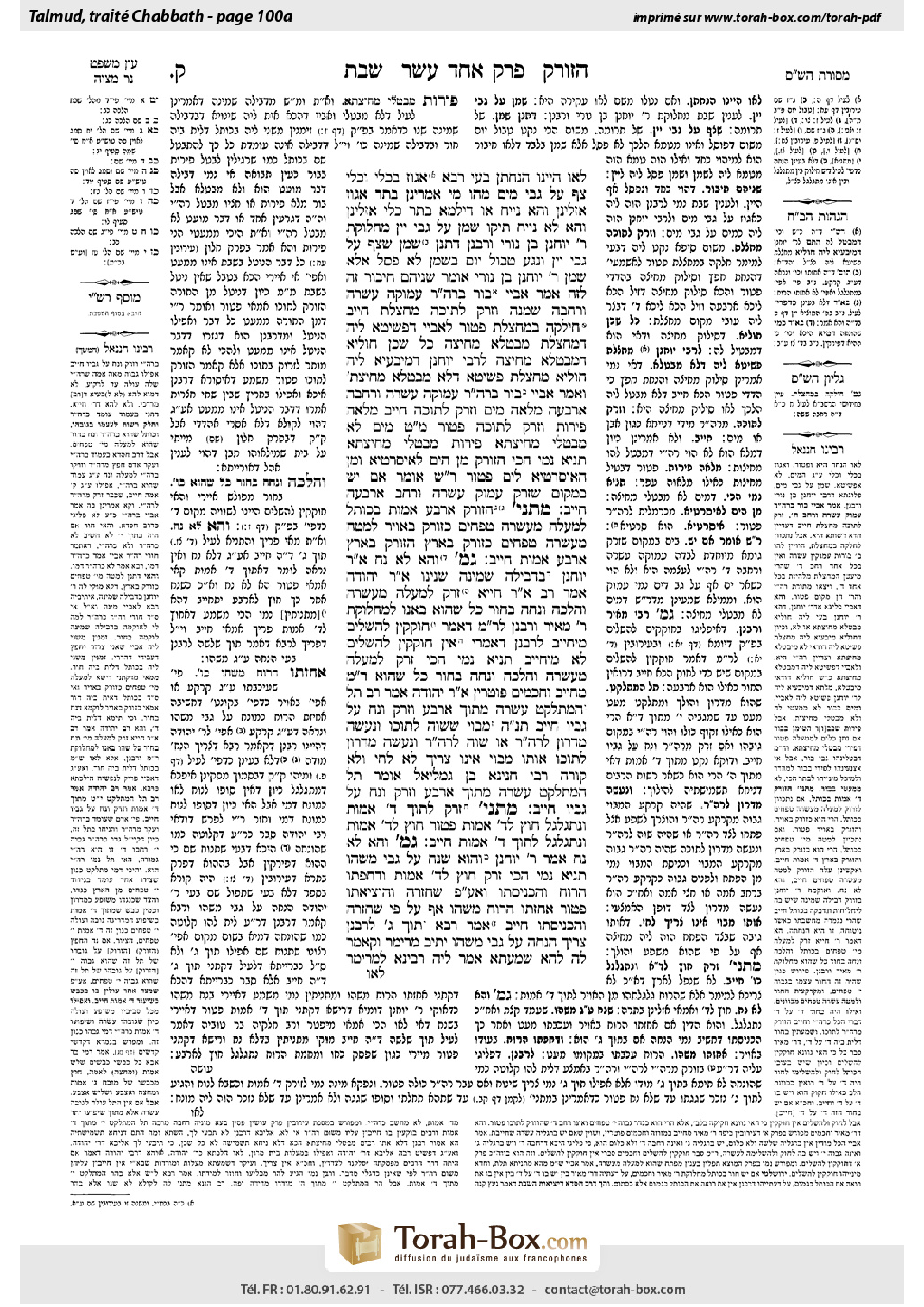
Shabbat 100a: Talmud study for Daf Yomi
Daf Yomi is the daily study of one Talmud folio. Explore 37 tractates with scans, Hebrew text, Sefaria English and AI-generated French translations where annotated.
Passage selection and English or AI-generated French translation are available where the scan has annotations. Daf Study is independent of Torah-Box and Sefaria.
Browse Shabbat · שבת · All tractatesShabbat 100a text and translations
This page of Shabbat includes the Aramaic text, an English translation and an AI-generated French translation, alongside the scan above.
שבת ק׳ א · Aramaic and Hebrew text
לָאו הַיְינוּ הַנָּחָתָן. בָּעֵי רָבָא: אֱגוֹז בִּכְלִי וּכְלִי צָף עַל גַּבֵּי מַיִם — מַהוּ? מִי אָמְרִינַן בָּתַר אֱגוֹז אָזְלִינַן, וְהָא נָיַיח, אוֹ דִילְמָא בָּתַר כְּלִי אָזְלִינַן, וְהָא לָא נָיַיח. תֵּיקוּ.
שֶׁמֶן עַל גַּבֵּי יַיִן, מַחֲלוֹקֶת רַבִּי יוֹחָנָן בֶּן נוּרִי וְרַבָּנַן. דִּתְנַן: שֶׁמֶן שֶׁצָּף עַל גַּבֵּי יַיִן, וְנָגַע טְבוּל יוֹם בַּשֶּׁמֶן — לֹא פָּסַל אֶלָּא שֶׁמֶן. רַבִּי יוֹחָנָן בֶּן נוּרִי אוֹמֵר: שְׁנֵיהֶם חִיבּוּר זֶה לָזֶה.
אָמַר אַבָּיֵי: בּוֹר בִּרְשׁוּת הָרַבִּים עֲמוּקָּה עֲשָׂרָה וּרְחָבָה שְׁמֹנָה, וְזָרַק לְתוֹכָהּ מַחְצֶלֶת — חַיָּיב. חִילְּקָהּ בְּמַחְצֶלֶת — פָּטוּר. לְאַבָּיֵי דִּפְשִׁיטָא לֵיהּ דְּמַחְצֶלֶת מְבַטְּלָא מְחִיצְתָּא — כׇּל שֶׁכֵּן חוּלְיָא דִּמְבַטְּלָא מְחִיצְתָּא. לְרַבִּי יוֹחָנָן דְּמִיבַּעְיָא לֵיהּ חוּלְיָא, מַחְצֶלֶת פְּשִׁיטָא דְּלָא מְבַטְּלָא מְחִיצְתָּא.
וְאָמַר אַבָּיֵי: בּוֹר בִּרְשׁוּת הָרַבִּים עֲמוּקָּה עֲשָׂרָה וּרְחָבָה אַרְבָּעָה מְלֵאָה מַיִם, וְזָרַק לְתוֹכָהּ — חַיָּיב. מְלֵאָה פֵּירוֹת, וְזָרַק לְתוֹכָהּ — פָּטוּר, מַאי טַעְמָא? — מַיִם לָא מְבַטְּלִי מְחִיצְתָּא, פֵּירוֹת מְבַטְּלִי מְחִיצְתָּא. תַּנְיָא נָמֵי הָכִי: הַזּוֹרֵק מִן הַיָּם לְאִיסְרַטְיָא וּמִן הָאִיסְרַטְיָא לַיָּם — פָּטוּר. רַבִּי שִׁמְעוֹן אוֹמֵר: אִם יֵשׁ בִּמְקוֹם שֶׁזָּרַק עָמוֹק עֲשָׂרָה וְרָחָב אַרְבָּעָה — חַיָּיב.
מַתְנִי׳ הַזּוֹרֵק אַרְבַּע אַמּוֹת בַּכּוֹתֶל, לְמַעְלָה מֵעֲשָׂרָה טְפָחִים — כְּזוֹרֵק בָּאֲוִיר. לְמַטָּה מֵעֲשָׂרָה טְפָחִים — כְּזוֹרֵק בָּאָרֶץ. הַזּוֹרֵק בָּאָרֶץ אַרְבַּע אַמּוֹת — חַיָּיב.
גְּמָ׳ וְהָא לָא נָח? אָמַר רַבִּי יוֹחָנָן: בִּדְבֵילָה שְׁמֵינָה שָׁנִינוּ.
אָמַר רַב יְהוּדָה, אָמַר רַב, אָמַר רַבִּי חִיָּיא: זָרַק לְמַעְלָה מֵעֲשָׂרָה, וְהָלְכָה וְנָחָה בְּחוֹר כׇּל שֶׁהוּא, בָּאנוּ לְמַחְלוֹקֶת רַבִּי מֵאִיר וְרַבָּנַן. לְרַבִּי מֵאִיר דְּאָמַר חוֹקְקִין לְהַשְׁלִים — מִיחַיַּיב. לְרַבָּנַן דְּאָמְרִי אֵין חוֹקְקִין לְהַשְׁלִים — לָא מִיחַיַּיב. תַּנְיָא נָמֵי הָכִי: זָרַק לְמַעְלָה מֵעֲשָׂרָה, וְהָלְכָה וְנָחָה בְּחוֹר כׇּל שֶׁהוּא — רַבִּי מֵאִיר מְחַיֵּיב וַחֲכָמִים פּוֹטְרִין.
אָמַר רַב יְהוּדָה אָמַר רַב: תֵּל הַמִּתְלַקֵּט עֲשָׂרָה מִתּוֹךְ אַרְבַּע, וְזָרַק וְנָח עַל גַּבָּיו — חַיָּיב. תַּנְיָא נָמֵי הָכִי: מָבוֹי שֶׁשָּׁוָה לְתוֹכוֹ, וְנַעֲשָׂה מִדְרוֹן לִרְשׁוּת הָרַבִּים, אוֹ שָׁוָה לִרְשׁוּת הָרַבִּים וְנַעֲשָׂה מִדְרוֹן לְתוֹכוֹ — אוֹתוֹ מָבוֹי אֵינוֹ צָרִיךְ לֹא לֶחִי וְלֹא קוֹרָה. רַבִּי חֲנִינָא בֶּן גַּמְלִיאֵל אוֹמֵר: תֵּל הַמִּתְלַקֵּט עֲשָׂרָה מִתּוֹךְ אַרְבַּע, וְזָרַק וְנָח עַל גַּבָּיו — חַיָּיב.
מַתְנִי׳ זָרַק לְתוֹךְ אַרְבַּע אַמּוֹת וְנִתְגַּלְגֵּל חוּץ לְאַרְבַּע אַמּוֹת — פָּטוּר. חוּץ לְאַרְבַּע אַמּוֹת וְנִתְגַּלְגֵּל לְתוֹךְ אַרְבַּע אַמּוֹת — חַיָּיב.
גְּמָ׳ וְהָא לָא נָח? אָמַר רַבִּי יוֹחָנָן: וְהוּא שֶׁנָּח עַל גַּבֵּי מַשֶּׁהוּ. תַּנְיָא נָמֵי הָכִי: זָרַק חוּץ לְאַרְבַּע אַמּוֹת וּדְחָפַתּוּ הָרוּחַ וְהִכְנִיסַתּוּ, וְאַף עַל פִּי שֶׁחָזְרָה וְהוֹצִיאַתּוּ — פָּטוּר. אֲחָזַתּוּ הָרוּחַ מַשֶּׁהוּ, אַף עַל פִּי שֶׁחָזְרָה וְהִכְנִיסַתּוּ — חַיָּיב.
אָמַר רָבָא: תּוֹךְ שְׁלֹשָׁה לְרַבָּנַן צָרִיךְ הַנָּחָה עַל גַּבֵּי מַשֶּׁהוּ. יָתֵיב מָרִימָר וְקָאָמַר לַהּ לְהָא שְׁמַעְתָּא. אֲמַר לֵיהּ רָבִינָא לְמָרִימָר:
Shabbat 100a · English translation
it is not considered its placement. However, Rava raised a dilemma: In a case where there is a nut in a vessel and the vessel is floating on water, what is the ruling? Is it permitted to lift the nut on Shabbat if one is in another domain? The two sides of the dilemma are: Do we say that we go according to the status of the nut, and it is at rest in the vessel? Or perhaps we go according to the status of the vessel, and it is not at rest. No resolution was found to this dilemma. Therefore, let it stand unresolved as well.
However, with regard to oil floating on wine, there is a dispute between Rabbi Yoḥanan ben Nuri and the Rabbis. As we learned in a mishna: In the case of oil floating on wine, and one who immersed himself during the day, i.e., one who was impure, immersed himself in a ritual bath, but will not become completely pure until sunset, touched the oil, he invalidated only the oil and not the wine. Rabbi Yoḥanan ben Nuri says: With regard to the two, i.e., the oil and the wine, they are considered to have a connection to each other. Since he made the oil impure, the wine is also impure. Their dispute is whether or not the oil is considered to be placed atop the wine.
Abaye said: In the case of a pit in the public domain that is ten handbreadths deep and precisely eight handbreadths wide, and one threw a mat into it, he is liable. However, if he divided the pit with a mat that split it in two, each one slightly less than four handbreadths wide, he is exempt because neither part is considered a private domain. The Gemara comments: According to the opinion of Abaye, for whom it is obvious that the mat eliminates the partition of the pit, all the more so that a segment of dirt thrown into a pit that is ten handbreadths deep, rendering it less than ten handbreadths, eliminates the partition, and he has no dilemma with regard to Rabbi Yoḥanan’s case. According to Rabbi Yoḥanan, who raised a dilemma with regard to a segment of dirt, it is obvious that a mat does not eliminate the partition.
Abaye said: With regard to a pit in the public domain that is ten handbreadths deep and four handbreadths wide and filled with water, and one threw an object into it on Shabbat, one is liable because the pit is considered a private domain. And if the pit was filled with fruit and one threw an object into it, he is exempt. What is the reason for the different rulings? Water is not significant enough to eliminate the partition; fruit eliminates the partition. This was also taught in a baraita: One who throws an object from the sea to the street or from the street to the sea is exempt because the sea is considered a karmelit, and one is not liable according to Torah law in that case. Rabbi Shimon says: If the area in the sea where he threw it is ten handbreadths deep and four handbreadths wide, he is liable, as he is considered as one who threw an object into a private domain. Apparently, the water in the sea does not eliminate the status of a private domain.
MISHNA: With regard to one who throws an object four cubits in the public domain, if the object hits the wall above ten handbreadths from the ground, which is an exempt domain, it is as if one threw it in the air, and he is exempt. If it hits the wall below ten handbreadths from the ground, it is as if he threw it and it landed on the ground, and one who throws an object four cubits and it lands on the ground is liable.
GEMARA: We learned in the mishna that if one throws an object in the public domain a distance of four cubits and it hits a wall below ten handbreadths from the ground, he is liable if he threw it. The Gemara asks: And we discussed it: How could he be liable for carrying in that case? Since the object did not come to rest on the wall, there was no placement. And Rabbi Yoḥanan said: It is with regard to the case of a juicy cake of figs that sticks to the wall when thrown against it that we learned in the mishna.
Rav Yehuda said that Rav said that Rabbi Ḥiyya said: If one threw a stone at a wall above ten handbreadths from the ground, and it went and came to rest in a hole in the wall of any size less than four handbreadths, we have come to the dispute between Rabbi Meir and the Rabbis. According to the opinion of Rabbi Meir, who said: One carves out the space to complete it, he is liable. We complete the hole by conceptually carving it to four handbreadths because doing so is theoretically possible. Since the hole is considered ten handbreadths high and four handbreadths wide, one is liable for transferring an object from a public domain to a private one. According to the opinion of the Rabbis, who say: One does not carve out the space to complete it, the thrower is not liable because the hole is actually less than four handbreadths wide at present. That was also taught in a baraita: If one threw an object above ten handbreadths, and it went and came to rest in a small hole, Rabbi Meir deems him liable, while the Rabbis deem him exempt.
Rav Yehuda said that Rav said: In the case of a mound that is an inclined plane that gradually attains a height of ten handbreadths over a horizontal space of four cubits, and one threw an object from the public domain and it came to rest atop that mound, he is liable because it is considered a partition. That was also taught in a baraita: An alleyway that is level inside and becomes an inclined or declined plane as it enters the public domain, which is higher or lower than the alleyway, or if the entrance to the alleyway is level when entering the public domain and inside it is inclined, that alleyway requires neither a post alongside its entrance or a beam across its entrance in order to distinguish it from the public domain because the incline itself is considered a partition. Rabbi Ḥanina ben Gamliel says: In the case of a mound that gradually attains a height of ten handbreadths over a horizontal space of four cubits, and one threw an object from the public domain and it came to rest atop that mound, he is liable.
MISHNA: If one threw an object in the public domain, intending for it to land within four cubits, meaning that he had no intention of violating the Torah prohibition of carrying, and the object rolled and went beyond four cubits, he is exempt. However, if one threw an object with the intention of it landing beyond four cubits, and the object rolled back within four cubits, he is liable from when he originally threw the object.
GEMARA: We learned in the mishna that if one threw an object beyond four cubits and it rolled back within four cubits, he is liable. The Gemara asks: The object did not come to rest beyond four cubits, so how can the one who threw it be liable? Rabbi Yoḥanan said: And that liability was established when the object came to rest atop something. That was also taught in a baraita: If one threw an object beyond four cubits and the wind blew it while still in the air and brought it within four cubits, he is exempt even though it, i.e., the wind, then brought it back out because the object did not come to rest in the place where it was thrown. However, if the wind seized it briefly and it stayed on the ground for a brief period of time (Tosafot), even though the wind then brought it in, the individual is liable.
Rava said: Despite the principle of lavud, which states that within three handbreadths of the ground an object is considered to be attached to it, according to the Rabbis, who maintain that an object in airspace is not considered at rest, the object must come to rest atop something to establish liability. The Gemara relates that Mareimar sat and stated this halakha. Ravina said to Mareimar:
Shabbat 100a · Traduction française (IA)
Cela n’est pas considéré comme son emplacement. Cependant, Rava souleva une question : dans le cas où une noix se trouve dans un récipient qui flotte sur l’eau, quelle est la halakha ? Est-il permis de soulever la noix pendant Chabbat lorsqu’on se trouve dans un autre domaine ? Les deux possibilités sont les suivantes : doit-on se fonder sur le statut de la noix, qui est au repos dans le récipient ? Ou peut-être doit-on se fonder sur le statut du récipient, qui n’est pas au repos ? Aucune réponse ne fut trouvée à cette question. Elle reste donc elle aussi sans réponse.
Toutefois, au sujet de l’huile qui flotte sur le vin, Rabbi Yoḥanan ben Nouri et les rabbins sont en désaccord. En effet, nous avons appris dans une Michna : dans le cas d’huile qui flotte sur du vin, si une personne qui s’est immergée pendant la journée — c’est-à-dire une personne qui était impure et s’est immergée dans un bain rituel, mais ne deviendra complètement pure qu’au coucher du soleil — touche l’huile, elle ne rend impure que l’huile, et non le vin. Rabbi Yoḥanan ben Nouri dit : les deux, c’est-à-dire l’huile et le vin, sont considérés comme liés l’un à l’autre. Puisqu’il a rendu l’huile impure, le vin est lui aussi impur. Leur désaccord porte sur la question de savoir si l’huile est considérée comme reposant sur le vin.
Abaye dit : dans le cas d’une fosse située dans le domaine public, profonde de dix téfaḥim et exactement large de huit téfaḥim, si quelqu’un y jette une natte, il est passible. En revanche, s’il divise la fosse en deux au moyen d’une natte, chaque partie ayant alors une largeur légèrement inférieure à quatre téfaḥim, il est exempt, car aucune des deux parties n’est considérée comme un domaine privé. La Guemara fait remarquer : selon Abaye, pour qui il est évident que la natte supprime la cloison de la fosse, à plus forte raison un amas de terre jeté dans une fosse profonde de dix téfaḥim, qui la rend ainsi moins profonde que dix téfaḥim, supprime la cloison ; il n’a donc aucune question concernant le cas de Rabbi Yoḥanan. Selon Rabbi Yoḥanan, qui a soulevé une question à propos d’un amas de terre, il est évident qu’une natte ne supprime pas la cloison.
Abaye dit : dans le cas d’une fosse située dans le domaine public, profonde de dix téfaḥim, large de quatre téfaḥim et remplie d’eau, si quelqu’un y jette un objet pendant Chabbat, il est passible, car la fosse est considérée comme un domaine privé. Si la fosse est remplie de fruits et qu’il y jette un objet, il est exempt. Pourquoi ces décisions diffèrent-elles ? L’eau n’est pas assez importante pour supprimer la cloison, tandis que les fruits la suppriment. Cela a également été enseigné dans une baraïta : celui qui jette un objet de la mer dans la rue, ou de la rue dans la mer, est exempt, car la mer est considérée comme un karmelit et, dans ce cas, on n’est pas passible selon la Torah écrite. Rabbi Chimon dit : si l’endroit de la mer où il a jeté l’objet est profond de dix téfaḥim et large de quatre téfaḥim, il est passible, car il est considéré comme ayant jeté un objet dans un domaine privé. Il apparaît donc que l’eau de la mer ne supprime pas le statut de domaine privé.
MICHNA : Celui qui jette un objet sur une distance de quatre coudées dans le domaine public : si l’objet heurte le mur à plus de dix téfaḥim du sol, dans un domaine exempt, c’est comme s’il l’avait jeté dans les airs, et il est exempt. S’il heurte le mur à moins de dix téfaḥim du sol, c’est comme s’il l’avait jeté et qu’il était tombé au sol ; or, celui qui jette un objet sur une distance de quatre coudées et le fait tomber au sol est passible.
GUEMARA : Nous avons appris dans la Michna que si quelqu’un jette un objet dans le domaine public à une distance de quatre coudées et qu’il heurte le mur à moins de dix téfaḥim du sol, il est passible. La Guemara demande : or, nous avons soulevé cette difficulté : comment peut-il être passible dans ce cas ? Puisque l’objet ne s’est pas immobilisé sur le mur, il n’y a pas eu de dépôt. Rabbi Yoḥanan dit : la Michna enseigne le cas d’un gâteau de figues juteux qui adhère au mur lorsqu’on le jette contre celui-ci.
Rav Yehouda dit au nom de Rav, qui le dit au nom de Rabbi Ḥiyya : si quelqu’un jette une pierre contre un mur à plus de dix téfaḥim du sol et que la pierre finit par se poser dans une cavité du mur de dimensions inférieures à quatre téfaḥim, quelle qu’en soit la taille, nous sommes en présence du désaccord entre Rabbi Meïr et les rabbins. Selon Rabbi Meïr, qui dit : « On creuse l’espace pour le compléter », il est passible. On complète la cavité en considérant qu’on y creuse jusqu’à atteindre quatre téfaḥim, puisque cela est théoriquement possible. Comme la cavité est alors considérée comme ayant dix téfaḥim de hauteur et quatre téfaḥim de largeur, on est passible pour avoir transféré un objet du domaine public vers un domaine privé. Selon les rabbins, qui disent : « On ne creuse pas l’espace pour le compléter », celui qui a jeté l’objet n’est pas passible, car la cavité mesure en réalité moins de quatre téfaḥim. Cela a également été enseigné dans une baraïta : si quelqu’un jette un objet à plus de dix téfaḥim et que celui-ci finit par se poser dans une petite cavité, Rabbi Meïr le déclare passible, tandis que les rabbins le déclarent exempt.
Rav Yehouda dit au nom de Rav : dans le cas d’un talus dont la pente atteint progressivement une hauteur de dix téfaḥim sur une distance horizontale de quatre coudées, si quelqu’un jette un objet depuis le domaine public et que celui-ci se pose au sommet du talus, il est passible, car le talus est considéré comme une cloison. Cela a également été enseigné dans une baraïta : une ruelle qui est de niveau à l’intérieur et dont l’accès forme une pente montante ou descendante lorsqu’elle débouche dans le domaine public, situé plus haut ou plus bas que la ruelle, ou encore une ruelle dont l’entrée est de niveau avec le domaine public, mais dont l’intérieur est en pente, n’a besoin ni d’un poteau près de son entrée ni d’une poutre au-dessus de son entrée pour la distinguer du domaine public, car la pente elle-même est considérée comme une cloison. Rabbi Ḥanina ben Gamliel dit : dans le cas d’un talus dont la pente atteint progressivement une hauteur de dix téfaḥim sur une distance horizontale de quatre coudées, si quelqu’un jette un objet depuis le domaine public et que celui-ci se pose au sommet du talus, il est passible.
MICHNA : Si quelqu’un jette un objet dans le domaine public avec l’intention qu’il tombe à moins de quatre coudées — c’est-à-dire qu’il n’avait pas l’intention de transgresser l’interdit de la Torah relatif au transport — mais que l’objet roule et dépasse quatre coudées, il est exempt. En revanche, si quelqu’un jette un objet avec l’intention qu’il tombe au-delà de quatre coudées et que l’objet roule en sens inverse jusqu’à se retrouver à moins de quatre coudées, il est passible dès le moment où il a initialement jeté l’objet.
GUEMARA : Nous avons appris dans la Michna que si quelqu’un jette un objet au-delà de quatre coudées et que celui-ci roule en sens inverse jusqu’à se retrouver à moins de quatre coudées, il est passible. La Guemara demande : l’objet ne s’est pas immobilisé au-delà de quatre coudées ; comment celui qui l’a jeté peut-il donc être passible ? Rabbi Yoḥanan dit : cette responsabilité a été établie dans le cas où l’objet s’est posé sur quelque chose. Cela a également été enseigné dans une baraïta : si quelqu’un jette un objet au-delà de quatre coudées et que le vent le pousse alors qu’il est encore en l’air et le ramène à moins de quatre coudées, il est exempt, même si le vent le pousse ensuite à nouveau au-delà de quatre coudées, car l’objet ne s’est pas immobilisé à l’endroit où il a été jeté. Toutefois, si le vent l’a brièvement saisi et que l’objet est resté au sol pendant un court instant (Tossefot), l’individu est passible, même si le vent l’a ensuite ramené à moins de quatre coudées.
Rava dit : malgré le principe de lavoud, selon lequel un objet situé à moins de trois téfaḥim du sol est considéré comme lui étant rattaché, selon les rabbins, qui soutiennent qu’un objet dans l’espace aérien n’est pas considéré comme étant au repos, l’objet doit se poser sur quelque chose pour que l’on soit passible. La Guemara rapporte que Mareimar était assis et énonçait cette halakha. Ravina dit à Mareimar :
Traduction française générée par IA à partir de l’édition anglaise de Sefaria. Vérifie toujours un passage avec le texte source.
Text from Sefaria: William Davidson Edition - Vocalized Aramaic (CC BY NC); William Davidson Edition - English (CC BY NC).