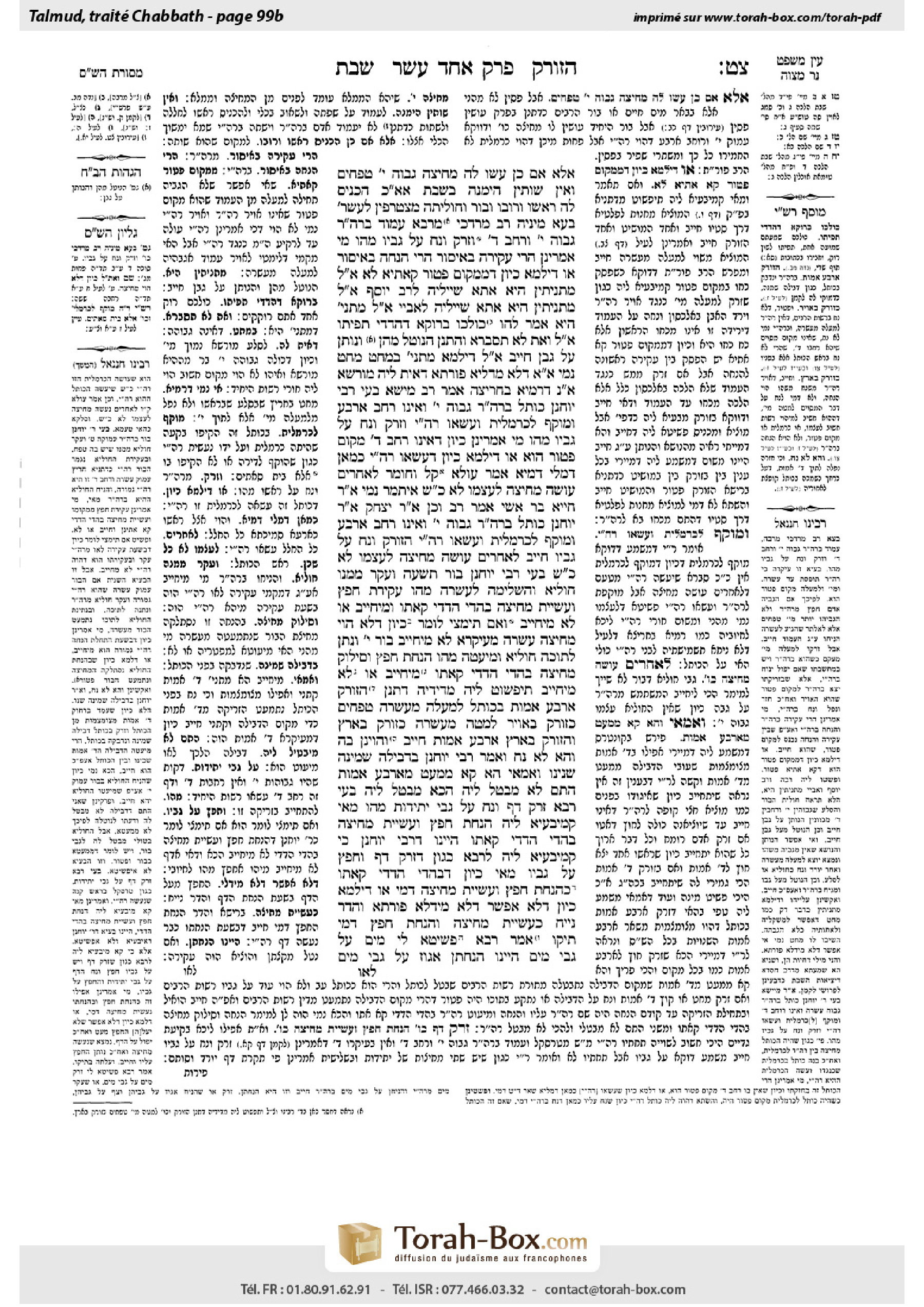
Shabbat 99b: Talmud study for Daf Yomi
Daf Yomi is the daily study of one Talmud folio. Explore 37 tractates with scans, Hebrew text, Sefaria English and AI-generated French translations where annotated.
Passage selection and English or AI-generated French translation are available where the scan has annotations. Daf Study is independent of Torah-Box and Sefaria.
Browse Shabbat · שבת · All tractatesShabbat 99b text and translations
This page of Shabbat includes the Aramaic text, an English translation and an AI-generated French translation, alongside the scan above.
שבת צ״ט ב · Aramaic and Hebrew text
אֶלָּא אִם כֵּן עָשׂוּ לָהּ מְחִיצָה גְּבוֹהָה עֲשָׂרָה טְפָחִים, וְאֵין שׁוֹתִין הֵימֶנָּה בְּשַׁבָּת אֶלָּא אִם כֵּן הִכְנִיס לָהּ רֹאשׁוֹ וְרוּבּוֹ. וּבוֹר וְחוּלְיָתָהּ מִצְטָרְפִין לַעֲשָׂרָה.
בְּעָא מִינֵּיהּ רַב מָרְדֳּכַי מֵרָבָא: עַמּוּד בִּרְשׁוּת הָרַבִּים גָּבוֹהַּ עֲשָׂרָה וְרָחָב אַרְבָּעָה, וְזָרַק וְנָח עַל גַּבָּיו — מַהוּ? מִי אָמְרִינַן: הֲרֵי עֲקִירָה בְּאִיסּוּר, הֲרֵי הַנָּחָה בְּאִיסּוּר. אוֹ דִילְמָא: כֵּיוָן דְּמִמְּקוֹם פְּטוּר קָאָתְיָא — לָא.
אֲמַר לֵיהּ: מַתְנִיתִין הִיא. אֲתָא שַׁיְילֵיהּ לְרַב יוֹסֵף, אֲמַר לֵיהּ: מַתְנִיתִין הִיא. אֲתָא שַׁיְילֵיהּ לְאַבָּיֵי, אֲמַר לֵיהּ: מַתְנִיתִין הִיא. אֲמַר לְהוּ: כּוּלְּכוּ בְּרוּקָּא דַהֲדָדֵי תָּפִיתוּ.
אֲמַרוּ לֵיהּ: וְאַתְּ לָא תִּסְבְּרָא? וְהָתְנַן: הַנּוֹטֵל מֵהֶן וְנוֹתֵן עַל גַּבָּן — חַיָּיב! אֲמַר לְהוּ: דִילְמָא מַתְנִיתִין בְּמַחַט.
מַחַט נָמֵי אִי אֶפְשָׁר דְּלָא מִדַּלְיָא פּוּרְתָּא! דְּאִית לֵיהּ מוּרְשָׁא. אִי נָמֵי, דְּרַמְיָא בַּחֲרִיצָה.
אָמַר רַב מְיָשָׁא, בָּעֵי רַבִּי יוֹחָנָן: כּוֹתֶל בִּרְשׁוּת הָרַבִּים גָּבוֹהַּ עֲשָׂרָה וְאֵינוֹ רָחָב אַרְבַּע וּמוּקָּף לְכַרְמְלִית וַעֲשָׂאוֹ רְשׁוּת הַיָּחִיד, וְזָרַק וְנָח עַל גַּבָּיו, מַהוּ? מִי אָמְרִינַן כֵּיוָן דְּאֵינוֹ רָחָב אַרְבַּע — מְקוֹם פְּטוּר הוּא, אוֹ דִילְמָא: כֵּיוָן דַּעֲשָׂאוֹ רְשׁוּת הַיָּחִיד — כְּמַאן דְּמַלְיָא דָּמְיָא.
אָמַר עוּלָּא: קַל וָחוֹמֶר, לַאֲחֵרִים עוֹשֶׂה מְחִיצָה, לְעַצְמוֹ לֹא כׇּל שֶׁכֵּן?! אִיתְּמַר נָמֵי, אָמַר רַבִּי חִיָּיא בַּר אָשֵׁי אָמַר רַב, וְכֵן אָמַר רַבִּי יִצְחָק אָמַר רַבִּי יוֹחָנָן: כּוֹתֶל בִּרְשׁוּת הָרַבִּים גָּבוֹהַּ עֲשָׂרָה וְאֵינוֹ רָחָב אַרְבַּע וּמוּקָּף לְכַרְמְלִית וַעֲשָׂאוֹ רְשׁוּת הַיָּחִיד, וְזָרַק וְנָח עַל גַּבָּיו — חַיָּיב. לַאֲחֵרִים עוֹשֶׂה מְחִיצָה, לְעַצְמוֹ לֹא כׇּל שֶׁכֵּן?!
בָּעֵי רַבִּי יוֹחָנָן בּוֹר תִּשְׁעָה וְעָקַר מִמֶּנָּה חוּלְיָא וְהִשְׁלִימָהּ לַעֲשָׂרָה — מַהוּ? עֲקִירַת חֵפֶץ וַעֲשִׂיַּית מְחִיצָה בַּהֲדֵי הֲדָדֵי (קָאָתוּ), מִיחַיַּיב אוֹ לָא מִיחַיַּיב? וְאִם תִּימְצֵי לוֹמַר כֵּיוָן דְּלָא הָוֵי מְחִיצָה עֲשָׂרָה מֵעִיקָּרָא לָא מִיחַיַּיב: בּוֹר עֲשָׂרָה וְנָתַן לְתוֹכָהּ חוּלְיָא וּמִיעֲטָהּ, מַהוּ? הַנָּחַת חֵפֶץ וְסִילּוּק מְחִיצָה בַּהֲדֵי הֲדָדֵי (קָאָתוּ), מִיחַיַּיב אוֹ לָא מִיחַיַּיב.
תִּיפְשׁוֹט לֵיהּ מִדִּידֵיהּ, דַּתְנַן: הַזּוֹרֵק אַרְבַּע אַמּוֹת בַּכּוֹתֶל, לְמַעְלָה מֵעֲשָׂרָה טְפָחִים — כְּזוֹרֵק בָּאֲוִיר. לְמַטָּה מֵעֲשָׂרָה — כְּזוֹרֵק בָּאָרֶץ, וְהַזּוֹרֵק בָּאָרֶץ אַרְבַּע אַמּוֹת — חַיָּיב. וְהָוֵינַן בַּהּ: וְהָא לָא נָח?
וְאָמַר רַבִּי יוֹחָנָן: בִּדְבֵילָה שְׁמֵינָה שָׁנִינוּ. וְאַמַּאי? הָא קָא מְמַעֵט מֵאַרְבַּע אַמּוֹת.
הָתָם לָא מְבַטֵּל לַהּ. הָכָא — מְבַטֵּל לַהּ.
בָּעֵי רָבָא: זָרַק דַּף וְנָח עַל גַּבֵּי יְתֵידוֹת, מַהוּ? מַאי קָמִיבַּעְיָא לֵיהּ — הַנָּחַת חֵפֶץ וַעֲשִׂיַּית מְחִיצָה בַּהֲדֵי הֲדָדֵי (קָאָתוּ)? הַיְינוּ דְּרַבִּי יוֹחָנָן!
כִּי קָמִיבַּעְיָא לֵיהּ לְרָבָא כְּגוֹן דְּזָרַק דַּף וְחֵפֶץ עַל גַּבָּיו, מַאי? כֵּיוָן דְּבַהֲדֵי הֲדָדֵי קָאָתוּ כְּהַנָּחַת חֵפֶץ וַעֲשִׂיַּית מְחִיצָה דָּמֵי, אוֹ דִילְמָא: כֵּיוָן דְּלָא אֶפְשָׁר דְּלָא מִידְּלֵי פּוּרְתָּא וַהֲדַר נָיַיח, כַּעֲשִׂיַּית מְחִיצָה וְהַנָּחַת חֵפֶץ דָּמֵי. תֵּיקוּ.
אָמַר רָבָא: פְּשִׁיטָא לִי מַיִם עַל גַּבֵּי מַיִם — הַיְינוּ הַנָּחָתָן. אֱגוֹז עַל גַּבֵּי מַיִם —
Shabbat 99b · English translation
unless they constructed a partition around it that is ten handbreadths high. Everything within the partition is then considered a private domain, and one standing within the partition may draw water from the pit. And similarly, one may only drink water from the pit on Shabbat if he inserts his head and most of his body into the well. And a pit and its bank join together to constitute the total of ten handbreadths, as stated by Rabbi Yoḥanan.
Rav Mordekhai raised a dilemma before Rava: In a case where there is a column in the public domain that is ten handbreadths high and four handbreadths wide, and one threw an object and it landed atop the column, what is the ruling? The two sides of the dilemma are: Do we say that the lifting from the public domain was performed in a prohibited manner and the placing in the private domain was performed in a prohibited manner, and therefore one is liable? Or perhaps, we say that since the object comes from an exempt domain, the one who threw the object would not be liable. Prior to landing on the column, the object traveled through the airspace above the public domain. The airspace of a public domain extends ten handbreadths from the ground. Beyond that point the airspace is an exempt domain.
Rava said to Rav Mordekhai: It is our mishna that states that one who places an object atop a boulder that is more than ten handbreadths high is liable. Rav Mordekhai came and asked Rav Yosef about the same dilemma: Rav Yosef said to him: It is our mishna. Rav Mordekhai came and asked Abaye. He said to him: It is our mishna. Rav Mordekhai said to them: You are all spewing the same spittle. None of you taught anything new. You repeat the same unsatisfactory answer.
They said to Rav Mordekhai: And do you not hold this to be correct? Didn’t we learn explicitly in the mishna: One who takes an object from them, and one who places an object atop them is liable? He said to them: Perhaps the mishna is referring to a needle that can be placed atop the column without passing through the exempt area above ten handbreadths, since it is so small and hardly takes up any space.
They said to him: With regard to a needle, too, it is still impossible that it will not be raised somewhat above the public domain. He answered them: It is possible that the boulder has a protrusion below ten handbreadths from the ground. Since the protrusion is not significant in and of itself, it has the legal status of a hole in the wall of a private domain. One who throws an object into it is liable, just like one who throws into the private domain itself. Alternatively, it is possible that the needle is placed in a groove that is below ten handbreadths from the ground. The needle did not enter the groove from above ten handbreadths. It passed directly into the groove, which is a private domain. Therefore, Rav Mordekhai’s dilemma is not resolved from the mishna.
Rav Meyasha said that Rabbi Yoḥanan raised a dilemma: There is a wall in the public domain that is ten handbreadths high and is not quite four handbreadths wide, and it surrounds a karmelit and renders the area that it encloses the private domain. The wall serves as a partition of this private domain. And if one threw an object from the public domain and it landed atop the wall, what is the ruling? Do we say: Since it is not four handbreadths wide it is an exempt domain, and the one who threw the object is exempt? Or perhaps we say that since it rendered the karmelit the private domain, the wall together with the private domain is considered to be filled. Therefore, the object is considered to have landed on an area that is four handbreadths wide, and the one who threw the object is liable.
Ulla said: The fact that it is considered a private domain is derived by means of an a fortiori inference: If this wall creates a partition that renders other areas surrounded by the wall a private domain, all the more so does it render itself a private domain. It was also stated that Rabbi Ḥiyya bar Ashi said that Rav said, and so too, Rabbi Yitzḥak said that Rabbi Yoḥanan said: With regard to a wall in the public domain that is ten handbreadths high and is not quite four handbreadths wide, and it surrounds a karmelit and renders the area that it surrounds the private domain, if one threw an object from the public domain and it landed atop the wall, he is liable. If this wall creates a partition that renders other areas a private domain, all the more so does it render itself a private domain.
Rabbi Yoḥanan raised a dilemma: In a case where there is a pit that is nine handbreadths deep, and one dug out a segment of earth from the bottom of the pit and thereby completed the depth of the pit to ten handbreadths, and then he proceeded to throw the earth into the public domain, what is the ruling? The two sides to the dilemma are: Is it that the lifting of the object and establishment of the ten-handbreadth partition came about simultaneously, and he is liable? Or perhaps he is not liable. And if you say: Since the partition was not ten handbreadths deep initially, he is not liable, then in a case where there is a pit that is ten handbreadths deep, and one placed a segment of earth into the pit and thereby minimized its depth to less than ten handbreadths, nullifying its status as a private domain, what is the ruling? The two sides of the question are: Is it that placement of the object and the elimination of the ten-handbreadth partition came about simultaneously, and he is liable? Or perhaps, he is not liable because the partition was not intact throughout the performance of the action.
The Gemara suggests: Resolve Rabbi Yoḥanan’s dilemma from his own statement, as we learned in a mishna: With regard to one who throws an object four cubits in the public domain and it hits the wall above ten handbreadths from the ground, which is an exempt domain, it is as if he threw it in the air, and he is exempt. If it was below ten handbreadths from the ground, it is as if he threw it and it landed on the ground, and one who throws an object four cubits and it lands on the ground is liable. And we discussed it: How could he be liable for carrying in that case? The object did not come to rest on the wall and there was no placement.
And Rabbi Yoḥanan said: It is with regard to the case of a juicy cake of figs that sticks to the wall when thrown against it that we learned in the mishna. The Gemara asks: And why is one liable in that case? When the cake of figs sticks to the wall, it reduces the distance the figs traveled from the measure of four cubits that determines liability. If one threw the cake of figs at a distance of exactly four cubits from the wall, and, based on Rabbi Yoḥanan, the object becomes part of the wall, the distance that the cake of figs traveled is slightly less than four cubits, and therefore he should be exempt. Since Rabbi Yoḥanan did not take this into account, apparently, in his opinion, when the placement of the object and the elimination of the partition are simultaneous, one is liable.
The Gemara rejects this and says: The cases are not similar because there, in the case of the cake of figs, the one who threw it does not nullify its independent existence vis-à-vis the wall, as the food will eventually be removed from the wall. Here, in the case of the dirt in the pit, one nullifies its independent existence vis-à-vis the pit, and it eliminates the ten-handbreadth partition.
Rava raised a similar dilemma: In a case where one threw a board and it landed on top of stakes that are ten handbreadths high but not four handbreadths wide, what is the ruling? Once the board lands, the surface is ten handbreadths high and four handbreadths wide. The Gemara asks: What is his dilemma? Does his dilemma pertain to the ruling in a case where the placement of the object and the establishment of the partition came about simultaneously? That is precisely the dilemma raised by Rabbi Yoḥanan.
The Gemara answers: The case where Rava raised a dilemma is more complex. His dilemma is with regard to a case where one threw a board and there was an object resting atop the board. In that case, what is the ruling? The two sides of the dilemma are: Since the board and the object come simultaneously, the legal status is similar to a case where the placement of the object and the establishment of the partition came about simultaneously. The object and the board are a single unit that creates a partition when it lands, and therefore one is exempt. Or perhaps we say that since it is impossible, when they land, for the object not to rise slightly and then land because the object and the board are not connected, it is like the case where the establishment of the partition was completed and the placement of the object followed, and therefore one is liable. These dilemmas remain, and therefore let it stand unresolved.
Rava raised an issue related to the previous dilemmas, and before doing so he sought to clarify certain points. Rava said: It is obvious to me that if one poured water onto water that is its placement, and if one did so from one domain to another he is liable. If one placed a nut onto water,
Shabbat 99b · Traduction française (IA)
à moins qu’ils n’aient construit autour de lui une cloison de dix téfaḥim de hauteur. Tout ce qui se trouve à l’intérieur de la cloison est alors considéré comme un domaine privé, et celui qui s’y tient peut puiser de l’eau dans la fosse. De même, on ne peut boire l’eau de la fosse pendant Chabbat que si l’on plonge la tête et la majeure partie du corps dans le puits. La fosse et son rebord s’additionnent pour atteindre une hauteur totale de dix téfaḥim, comme l’a enseigné Rabbi Yoḥanan.
Rav Mordekhaï soumit à Rava le dilemme suivant : si une colonne de dix téfaḥim de hauteur et de quatre téfaḥim de largeur se trouve dans le domaine public, et que quelqu’un lance un objet qui atterrit au sommet de la colonne, quelle est la halakha ? Les deux possibilités sont les suivantes : faut-il dire que le prélèvement de l’objet dans le domaine public a été effectué de manière interdite et que son dépôt dans le domaine privé l’a également été, de sorte que le lanceur est passible ? Ou peut-être faut-il dire que, puisque l’objet provient d’un domaine exempt, celui qui l’a lancé n’est pas passible ? Avant d’atterrir sur la colonne, l’objet a traversé l’espace aérien situé au-dessus du domaine public. L’espace aérien du domaine public s’étend jusqu’à dix téfaḥim au-dessus du sol. Au-delà, il s’agit d’un domaine exempt.
Rava dit à Rav Mordekhaï : C’est notre Michna qui enseigne que celui qui dépose un objet au sommet d’un rocher de plus de dix téfaḥim de hauteur est passible. Rav Mordekhaï alla ensuite interroger Rav Yossef sur le même dilemme. Rav Yossef lui répondit : « C’est notre Michna. » Rav Mordekhaï alla interroger Abayé, qui lui répondit : « C’est notre Michna. » Rav Mordekhaï leur dit : « Vous crachez tous la même salive. Aucun de vous n’a rien enseigné de nouveau. Vous répétez tous la même réponse insatisfaisante. »
Ils dirent à Rav Mordekhaï : « Et toi, ne considères-tu pas cela comme juste ? N’avons-nous pas appris explicitement dans la Michna : “Celui qui prend un objet de dessus eux, ou qui dépose un objet au-dessus d’eux, est passible” ? » Il leur répondit : « Peut-être la Michna parle-t-elle d’une aiguille, que l’on peut poser au sommet de la colonne sans traverser la zone exempte située au-dessus de dix téfaḥim, puisqu’elle est si petite et occupe à peine de place. »
Ils lui dirent : « Même pour une aiguille, il est impossible qu’elle ne soit pas soulevée quelque peu au-dessus du domaine public. » Il leur répondit : « Il est possible que le rocher ait une saillie située à moins de dix téfaḥim du sol. Comme cette saillie n’a pas d’importance en elle-même, elle a le statut juridique d’un trou dans le mur d’un domaine privé. Celui qui y lance un objet est passible, tout comme celui qui le lance dans le domaine privé lui-même. Il est également possible que l’aiguille soit déposée dans une rainure située à moins de dix téfaḥim du sol. L’aiguille n’est pas entrée dans la rainure depuis une hauteur supérieure à dix téfaḥim ; elle y est passée directement, dans ce qui constitue un domaine privé. Le dilemme de Rav Mordekhaï n’est donc pas résolu par la Michna. »
Rav Meïasha dit que Rabbi Yoḥanan souleva un dilemme : dans le domaine public se trouve un mur de dix téfaḥim de hauteur et d’un peu moins de quatre téfaḥim de largeur, qui entoure une karmelit et confère le statut de domaine privé à la zone qu’il enclôt. Le mur sert de cloison à ce domaine privé. Si quelqu’un lance un objet depuis le domaine public et que celui-ci atterrit au sommet du mur, quelle est la halakha ? Faut-il dire que, puisqu’il fait moins de quatre téfaḥim de largeur, le mur constitue un domaine exempt et que le lanceur n’est pas passible ? Ou peut-être faut-il dire que, puisqu’il a conféré à la karmelit le statut de domaine privé, le mur et le domaine privé sont considérés comme formant une seule surface continue. L’objet est donc considéré comme ayant atterri sur une surface de quatre téfaḥim de largeur, et le lanceur est passible.
Oulla dit : Son statut de domaine privé se déduit par raisonnement a fortiori : si ce mur forme une cloison qui confère le statut de domaine privé aux autres zones qu’il entoure, à plus forte raison confère-t-il ce statut à lui-même. Il a également été enseigné que Rabbi Ḥiyya bar Ashi a dit au nom de Rav, et que Rabbi Yitsḥak a lui aussi dit au nom de Rabbi Yoḥanan : à propos d’un mur situé dans le domaine public, haut de dix téfaḥim et large d’un peu moins de quatre téfaḥim, qui entoure une karmelit et confère le statut de domaine privé à la zone qu’il enclôt, si quelqu’un lance un objet depuis le domaine public et que celui-ci atterrit au sommet du mur, il est passible. Si ce mur forme une cloison qui confère le statut de domaine privé aux autres zones, à plus forte raison le confère-t-il à lui-même.
Rabbi Yoḥanan souleva un dilemme : une fosse a neuf téfaḥim de profondeur. Quelqu’un en retire un morceau de terre du fond, portant ainsi sa profondeur à dix téfaḥim, puis lance la terre dans le domaine public. Quelle est la halakha ? Les deux possibilités sont les suivantes : le prélèvement de l’objet et la création d’une cloison de dix téfaḥim se sont-ils produits simultanément, de sorte qu’il est passible ? Ou peut-être ne l’est-il pas ? Et si tu dis que, puisque la cloison n’avait pas initialement dix téfaḥim de profondeur, il n’est pas passible, alors quelle est la halakha dans le cas d’une fosse de dix téfaḥim de profondeur, où quelqu’un y dépose un morceau de terre, réduisant ainsi sa profondeur à moins de dix téfaḥim et annulant son statut de domaine privé ? Les deux possibilités sont les suivantes : le dépôt de l’objet et la suppression de la cloison de dix téfaḥim se sont-ils produits simultanément, de sorte qu’il est passible ? Ou peut-être ne l’est-il pas, parce que la cloison n’est pas restée intacte pendant toute l’exécution de l’action ?
La Guemara propose de résoudre le dilemme de Rabbi Yoḥanan à partir de l’un de ses propres enseignements, car nous avons appris dans une Michna : celui qui lance un objet sur quatre coudées dans le domaine public et qui heurte le mur à plus de dix téfaḥim du sol, dans un domaine exempt, c’est comme s’il l’avait lancé dans les airs et il est exempt. Si l’objet heurte le mur à moins de dix téfaḥim du sol, c’est comme s’il l’avait lancé et qu’il avait atterri au sol ; or, celui qui lance un objet sur quatre coudées et le fait atterrir au sol est passible. Nous avons alors examiné ce cas : comment peut-il être passible d’avoir transporté l’objet ? Celui-ci ne s’est pas immobilisé sur le mur et il n’y a pas eu de dépôt.
Et Rabbi Yoḥanan a dit que la Michna parle d’un gâteau de figues juteux qui adhère au mur lorsqu’on le lance contre celui-ci. La Guemara demande : pourquoi est-on passible dans ce cas ? Lorsque le gâteau de figues adhère au mur, cela réduit la distance parcourue par les figues par rapport aux quatre coudées qui déterminent la responsabilité. Si quelqu’un lance le gâteau de figues à une distance exactement égale à quatre coudées du mur et que, selon Rabbi Yoḥanan, l’objet devient partie intégrante du mur, la distance parcourue par le gâteau est légèrement inférieure à quatre coudées ; le lanceur devrait donc être exempt. Puisque Rabbi Yoḥanan n’a pas tenu compte de cela, il semble que, selon lui, lorsque le dépôt de l’objet et la suppression de la cloison sont simultanés, on est passible.
La Guemara rejette cette conclusion et dit que les cas ne sont pas comparables. Dans le cas du gâteau de figues, le lanceur ne fait pas perdre au gâteau son existence indépendante par rapport au mur, puisque la nourriture sera finalement retirée du mur. Ici, dans le cas de la terre dans la fosse, on lui fait perdre son existence indépendante par rapport à la fosse, et elle supprime la cloison de dix téfaḥim.
Rava souleva un dilemme similaire : si quelqu’un lance une planche qui atterrit au sommet de pieux hauts de dix téfaḥim, mais larges de moins de quatre téfaḥim, quelle est la halakha ? Une fois la planche posée, la surface se trouve à dix téfaḥim de hauteur et mesure quatre téfaḥim de largeur. La Guemara demande : quel est son dilemme ? Porte-t-il sur la halakha dans le cas où le dépôt de l’objet et la création de la cloison se produisent simultanément ? C’est précisément le dilemme soulevé par Rabbi Yoḥanan.
La Guemara répond que le cas au sujet duquel Rava a soulevé un dilemme est plus complexe. Il s’agit d’un cas où quelqu’un lance une planche sur laquelle repose un objet. Quelle est alors la halakha ? Les deux possibilités sont les suivantes : puisque la planche et l’objet arrivent simultanément, le statut juridique est semblable à celui d’un cas où le dépôt de l’objet et la création de la cloison se produisent simultanément. L’objet et la planche constituent une seule unité qui forme une cloison en atterrissant ; le lanceur est donc exempt. Ou peut-être faut-il dire que, lorsqu’ils atterrissent, il est impossible que l’objet ne s’élève pas légèrement avant de retomber, puisqu’il n’est pas attaché à la planche. Le cas est alors semblable à celui où la création de la cloison s’est achevée avant le dépôt de l’objet, et le lanceur est donc passible. Ces dilemmes restent sans réponse ; il faut donc les laisser en suspens.
Rava souleva une question liée aux dilemmes précédents et, avant de le faire, chercha à clarifier certains points. Rava dit : « Il m’est évident que si quelqu’un verse de l’eau sur de l’eau, cela constitue un dépôt, et que s’il le fait d’un domaine à un autre, il est passible. Si quelqu’un pose une noix sur de l’eau… »
Traduction française générée par IA à partir de l’édition anglaise de Sefaria. Vérifie toujours un passage avec le texte source.
Text from Sefaria: William Davidson Edition - Vocalized Aramaic (CC BY NC); William Davidson Edition - English (CC BY NC).