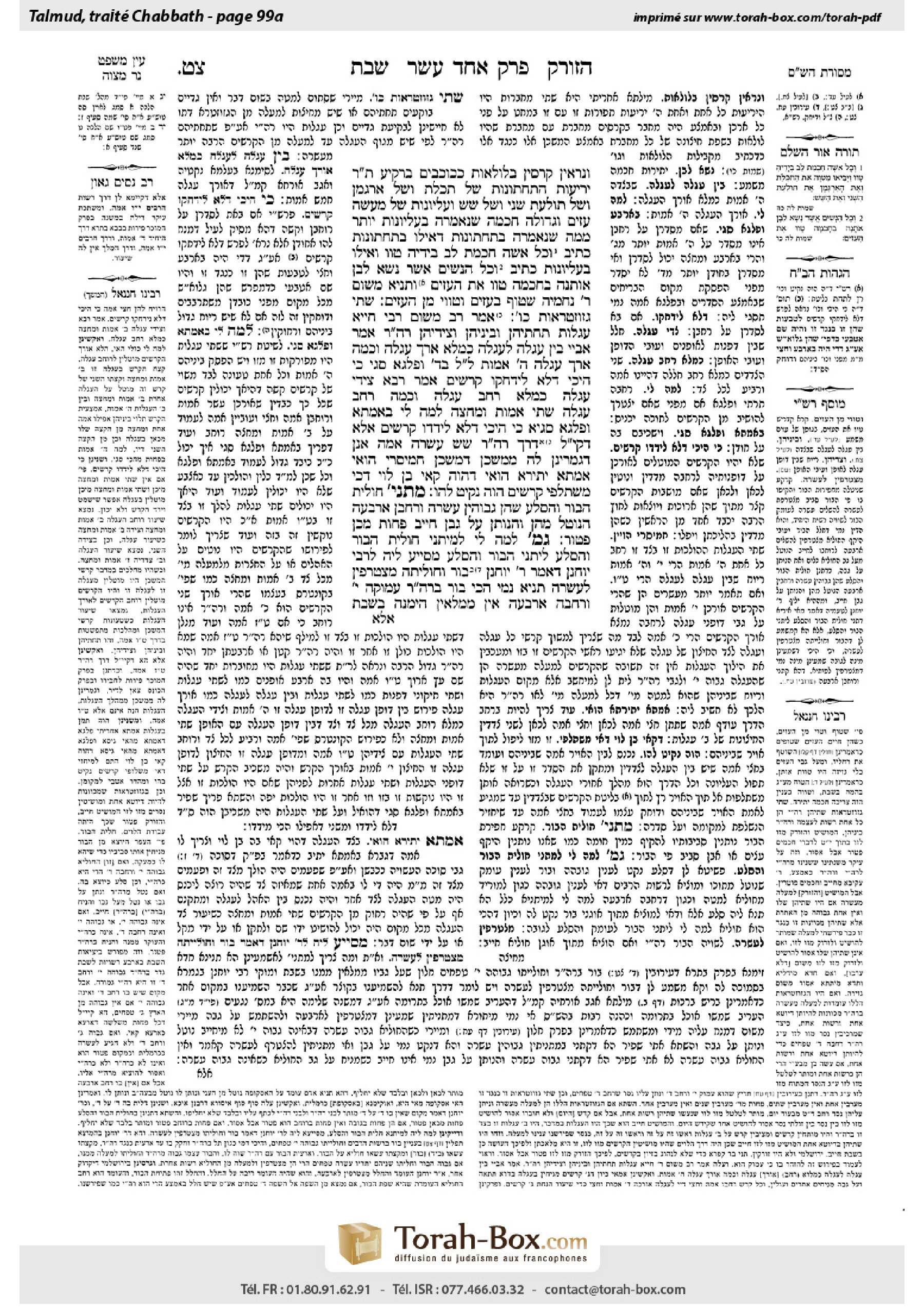
Shabbat 99a: Talmud study for Daf Yomi
Daf Yomi is the daily study of one Talmud folio. Explore 37 tractates with scans, Hebrew text, Sefaria English and AI-generated French translations where annotated.
Passage selection and English or AI-generated French translation are available where the scan has annotations. Daf Study is independent of Torah-Box and Sefaria.
Browse Shabbat · שבת · All tractatesShabbat 99a text and translations
This page of Shabbat includes the Aramaic text, an English translation and an AI-generated French translation, alongside the scan above.
שבת צ״ט א · Aramaic and Hebrew text
וְנִרְאִין קְרָסִין בַּלּוּלָאוֹת כְּכוֹכָבִים בָּרָקִיעַ.
תָּנוּ רַבָּנַן: יְרִיעוֹת הַתַּחְתּוֹנוֹת שֶׁל תְּכֵלֶת וְשֶׁל אַרְגָּמָן וְשֶׁל תּוֹלַעַת שָׁנִי וְשֶׁל שֵׁשׁ, וְעֶלְיוֹנוֹת שֶׁל מַעֲשֵׂה עִזִּים. וּגְדוֹלָה חָכְמָה שֶׁנֶּאֶמְרָה בָּעֶלְיוֹנוֹת יוֹתֵר מִמַּה שֶּׁנֶּאֶמְרָה בְּתַחְתּוֹנוֹת, דְּאִילּוּ בְּתַחְתּוֹנוֹת כְּתִיב: ״וְכׇל אִשָּׁה חַכְמַת לֵב בְּיָדֶיהָ טָווּ״, וְאִילּוּ בְּעֶלְיוֹנוֹת כְּתִיב: ״וְכׇל הַנָּשִׁים אֲשֶׁר נָשָׂא לִבָּן אֹתָנָה בְּחׇכְמָה טָווּ אֶת הָעִזִּים״. וְתַנְיָא מִשּׁוּם רַבִּי נְחֶמְיָה: שָׁטוּף בָּעִזִּים וְטָווּי מִן הָעִזִּים.
שְׁתֵּי גְזוּזְטְרָאוֹת כּוּ׳. אָמַר רַב מִשּׁוּם רַבִּי חִיָּיא: עֲגָלוֹת — תַּחְתֵּיהֶן וּבֵינֵיהֶן וְצִידֵּיהֶן רְשׁוּת הָרַבִּים. אָמַר אַבָּיֵי: בֵּין עֲגָלָה לַעֲגָלָה כִּמְלֹא אֹרֶךְ עֲגָלָה. וְכַמָּה אֹרֶךְ עֲגָלָה — חָמֵשׁ אַמּוֹת. לְמָה לִי? בְּאַרְבַּע וּפַלְגָא סַגִּי! כִּי הֵיכִי דְּלָא לִידַּחְקוּ קְרָשִׁים.
אָמַר רָבָא: צִידֵּי עֲגָלָה כִּמְלֹא רֹחַב עֲגָלָה. וְכַמָּה רֹחַב עֲגָלָה — שְׁתֵּי אַמּוֹת וּמֶחֱצָה. לְמָה לִי? בְּאַמְּתָא וּפַלְגָא סַגִּיא! כִּי הֵיכִי דְּלָא לִידַדּוּ קְרָשִׁים.
אֶלָּא דְּקַיְימָא לַן דֶּרֶךְ רְשׁוּת הָרַבִּים שֵׁשׁ עֶשְׂרֵה אַמָּה, אֲנַן דְּגָמְרִינַן לַהּ מִמִּשְׁכָּן — דְּמִשְׁכָּן חֲמֵיסְרֵי הֲוַאי! אַמְּתָא יַתִּירָא הֲוַאי דַּהֲוָה קָאֵי בֶּן לֵוִי, דְּכִי מִשְׁתַּלְּפִי קְרָשִׁים הֲוָה נָקֵיט לְהוּ.
מַתְנִי׳ חוּלְיַת הַבּוֹר וְהַסֶּלַע שֶׁהֵן גְּבוֹהִין עֲשָׂרָה וְרׇחְבָּן אַרְבָּעָה, הַנּוֹטֵל מֵהֶן וְהַנּוֹתֵן עַל גַּבָּן — חַיָּיב, פָּחוֹת מִכֵּן — פָּטוּר.
גְּמָ׳ לְמָה לִי לְמִיתְנֵי ״חוּלְיַת הַבּוֹר וְהַסֶּלַע״? לִיתְנֵי ״הַבּוֹר וְהַסֶּלַע״! מְסַיַּיע לֵיהּ לְרַבִּי יוֹחָנָן, דְּאָמַר רַבִּי יוֹחָנָן: בּוֹר וְחוּלְיָתָהּ מִצְטָרְפִין לַעֲשָׂרָה. תַּנְיָא נָמֵי הָכִי: בּוֹר בִּרְשׁוּת הָרַבִּים עֲמוּקָּה עֲשָׂרָה וּרְחָבָה אַרְבָּעָה, אֵין מְמַלְּאִין הֵימֶנָּה בְּשַׁבָּת
Shabbat 99a · English translation
Additionally, the clasps in the loops, which connected the curtains to one another, looked like stars in the sky.
Our Sages taught: The bottom curtains in the Tabernacle were made of sky blue wool, and of purple wool, and of scarlet wool, and of fine linen; and the top curtains were made of goat hair, even though that material is considered to be inferior and common. However, the wisdom that was stated with regard to the top curtains was greater than that which was stated with regard to the bottom ones. This is because, with regard to the bottom curtains, it is written: “And every wise-hearted woman spun with her hands, and they brought that which they had spun, the blue, and the purple, the scarlet, and the linen” (Exodus 35:25); while with regard to the top curtains, it is written: “And all of the women whose hearts inspired them with wisdom spun the goats” (Exodus 35:26). The phrase “whose hearts inspired them” suggests a greater degree of wisdom. Apparently, spinning the goat’s hair curtains required greater skill than spinning the various kinds of wool. And on a similar note, it was taught in a baraita in the name of Rabbi Neḥemya: The hair was rinsed on the goats, and it was even spun from the goats, which required a great deal of skill.
We learned in the mishna with regard to two balconies. Rav said in the name of Rabbi Ḥiyya: With regard to the wagons on which the beams of the Tabernacle were transported, the areas beneath them, and between them, and to their sides are considered to be the public domain. Abaye said: The space between one wagon and the wagon alongside it equaled the full length of a wagon. And how much was the length of a wagon? It was five cubits. The Gemara asks: Why do I need the wagon to be five cubits long? Four and a half cubits would suffice whether the beams were arranged in three stacks, each a cubit and a half wide, or four stacks, each one cubit wide. The Gemara answers: You need the wagon to be five cubits long so that space remains between the beams and they will not be pressed against each other.
Rava said: The area on the sides of the wagon between the wagon and the wheel and the thickness of the wheel together equaled the full width of the wagon (Tosafot). And how much was the width of the wagon? It was two and a half cubits. The Gemara asks: Why do I need the wagon to be two and a half cubits wide? A cubit and a half would suffice. The Gemara answers: So that the beams would not teeter. Ten-cubit beams on a one-and-a-half-cubit wide surface would be unstable.
The Gemara comments: However, with regard to the principle that we maintain that a thoroughfare in the public domain is sixteen cubits wide; we who derive it from the Tabernacle encounter a difficulty: The thoroughfare associated with the Tabernacle was fifteen cubits wide. When two wagons stood side by side, the width of the wagons plus the space between them and the space on their sides totaled fifteen cubits. The Gemara explains: There was an extra cubit where a member of the tribe of Levi stood, to ensure that if the beams fell, he would take hold of them and restore them to their stack. Therefore, the total width was no less than sixteen cubits.
MISHNA: With regard to the bank surrounding a pit and the boulder that are ten handbreadths high and four handbreadths wide, one who takes an object from them to the public domain and similarly one who places an object from the public domain atop them is liable for carrying from one domain to another. If the height or width of the pit or the boulder is less than that height, ten handbreadths, one is exempt because the legal status of those protrusions is not distinct from that of the surrounding public domain.
GEMARA: The Gemara asks: Why do I need to teach in the mishna about the cases of the bank of a pit and a boulder? Let the mishna simply teach about a pit and a boulder. One could derive the halakha with regard to an object that is ten handbreadths high from the case of the boulder, and the halakha with regard to an object that is ten handbreadths deep from the pit. The fact that the mishna taught the case of the bank of a pit supports the opinion of Rabbi Yoḥanan, as Rabbi Yoḥanan said: A pit and its bank join together to constitute the total ten handbreadths. If the distance from the bottom of the pit to the top of its bank is ten handbreadths, it is considered a private domain, even though some of the ten handbreadths are above ground and some are below. That halakha was also taught in the following baraita: With regard to a pit in the public domain that is ten handbreadths deep and four handbreadths wide, one may not fill water from it on Shabbat because the pit itself is a private domain, and carrying water from the pit to the public domain is prohibited
Shabbat 99a · Traduction française (IA)
De plus, les agrafes insérées dans les boucles, qui reliaient les tentures les unes aux autres, ressemblaient à des étoiles dans le ciel.
Nos Sages ont enseigné : Les tentures inférieures du Tabernacle étaient faites de laine bleu ciel, de laine pourpre, de laine écarlate et de lin fin ; les tentures supérieures, quant à elles, étaient faites de poil de chèvre, bien que cette matière soit considérée comme inférieure et ordinaire. Cependant, la sagesse dont témoignait la confection des tentures supérieures était plus grande que celle dont témoignait celle des tentures inférieures. En effet, au sujet des tentures inférieures, il est écrit : « Toute femme habile de cœur filait de ses mains, et elles apportèrent ce qu’elles avaient filé : le bleu, la pourpre, l’écarlate et le lin » (Exode 35,25) ; tandis qu’au sujet des tentures supérieures, il est écrit : « Toutes les femmes que leur cœur avait inspirées de sagesse filèrent le poil de chèvre » (Exode 35,26). L’expression « que leur cœur avait inspirées » suggère un degré de sagesse supérieur. Apparemment, filer les tentures en poil de chèvre exigeait davantage d’habileté que filer les différentes sortes de laine. Dans le même ordre d’idées, une baraïta fut enseignée au nom de Rabbi Neḥemya : Le poil était lavé sur les chèvres, et il était même filé à même les chèvres, ce qui exigeait beaucoup d’habileté.
Nous avons appris dans la Michna au sujet de deux balcons. Rav dit au nom de Rabbi Ḥiyya : Les espaces sous les chariots qui transportaient les poutres du Tabernacle, entre eux et sur leurs côtés sont considérés comme faisant partie du domaine public. Abayé dit : L’espace entre un chariot et celui qui se trouvait à côté de lui était égal à la longueur entière d’un chariot. Et quelle était la longueur d’un chariot ? Elle était de cinq coudées. La Guemara demande : Pourquoi le chariot devait-il mesurer cinq coudées de long ? Quatre coudées et demie auraient suffi, que les poutres soient disposées en trois piles, chacune large d’une coudée et demie, ou en quatre piles, chacune large d’une coudée. La Guemara répond : Il fallait que le chariot mesure cinq coudées de long afin qu’il reste un espace entre les poutres et qu’elles ne soient pas serrées les unes contre les autres.
Rava dit : L’espace sur les côtés du chariot, entre le chariot et la roue, ajouté à l’épaisseur de la roue, équivalait à la largeur totale du chariot (Tosafot). Et quelle était la largeur du chariot ? Elle était de deux coudées et demie. La Guemara demande : Pourquoi le chariot devait-il mesurer deux coudées et demie de large ? Une coudée et demie aurait suffi. La Guemara répond : Afin que les poutres ne vacillent pas. Des poutres de dix coudées posées sur une surface large d’une coudée et demie auraient été instables.
La Guemara fait remarquer : Toutefois, concernant le principe selon lequel une voie de passage dans le domaine public mesure seize coudées de large, nous qui le déduisons du Tabernacle rencontrons une difficulté : la voie de passage associée au Tabernacle ne mesurait que quinze coudées de large. Lorsque deux chariots étaient côte à côte, la largeur des chariots, l’espace entre eux et l’espace sur leurs côtés totalisaient quinze coudées. Il y avait une coudée supplémentaire où se tenait un membre de la tribu de Lévi, afin que, si les poutres tombaient, il puisse les retenir et les remettre sur leur pile. Par conséquent, la largeur totale n’était pas inférieure à seize coudées.
MICHNA : Concernant le rebord d’une fosse et un rocher, lorsqu’ils mesurent dix palmes de haut et quatre palmes de large, celui qui en prend un objet pour le transporter dans le domaine public, ainsi que celui qui dépose sur eux un objet venant du domaine public, est passible d’une peine pour avoir transporté d’un domaine à l’autre. Si la hauteur ou la largeur du rebord de la fosse ou du rocher est inférieure à dix palmes, il est exempt, car ces saillies n’ont pas un statut juridique distinct de celui du domaine public environnant.
GUEMARA : La Guemara demande : Pourquoi la Michna doit-elle enseigner les cas du rebord d’une fosse et d’un rocher ? Qu’elle enseigne simplement les cas d’une fosse et d’un rocher. On pourrait déduire la halakha concernant un objet qui s’élève à dix palmes du cas du rocher, et la halakha concernant un objet situé à dix palmes de profondeur du cas de la fosse. Le fait que la Michna enseigne le cas du rebord d’une fosse appuie l’opinion de Rabbi Yoḥanan, car Rabbi Yoḥanan a dit : Une fosse et son rebord s’additionnent pour constituer une hauteur totale de dix palmes. Si la distance entre le fond de la fosse et le sommet de son rebord est de dix palmes, elle est considérée comme un domaine privé, même si une partie de ces dix palmes se trouve au-dessus du sol et l’autre au-dessous. Cette halakha fut également enseignée dans la baraïta suivante : Concernant une fosse située dans le domaine public, profonde de dix palmes et large de quatre palmes, il est interdit d’y puiser de l’eau pendant Chabbat, car la fosse elle-même est un domaine privé, et il est interdit de transporter l’eau de la fosse vers le domaine public
Traduction française générée par IA à partir de l’édition anglaise de Sefaria. Vérifie toujours un passage avec le texte source.
Text from Sefaria: William Davidson Edition - Vocalized Aramaic (CC BY NC); William Davidson Edition - English (CC BY NC).