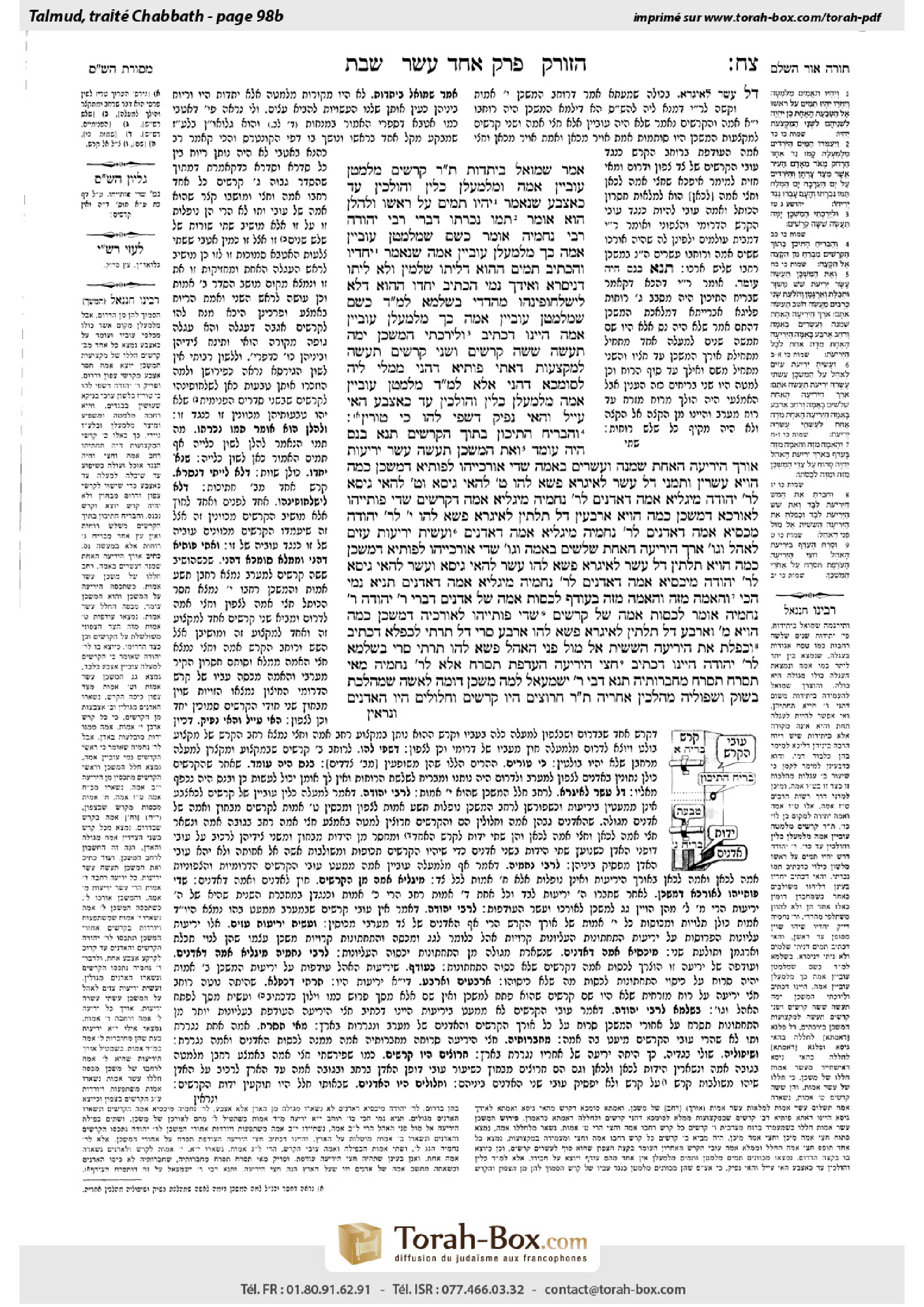
Shabbat 98b: Talmud study for Daf Yomi
Daf Yomi is the daily study of one Talmud folio. Explore 37 tractates with scans, Hebrew text, Sefaria English and AI-generated French translations where annotated.
Passage selection and English or AI-generated French translation are available where the scan has annotations. Daf Study is independent of Torah-Box and Sefaria.
Browse Shabbat · שבת · All tractatesShabbat 98b text and translations
This page of Shabbat includes the Aramaic text, an English translation and an AI-generated French translation, alongside the scan above.
שבת צ״ח ב · Aramaic and Hebrew text
אָמַר שְׁמוּאֵל: בִּיתֵדוֹת.
תָּנוּ רַבָּנַן: קְרָשִׁים מִלְּמַטָּן עוֹבְיָין אַמָּה, וּמִלְּמַעְלָן כָּלִין וְהוֹלְכִין עַד כְּאֶצְבַּע, שֶׁנֶּאֱמַר: ״יִהְיוּ תַמִּים עַל רֹאשׁוֹ״, וּלְהַלָּן הוּא אוֹמֵר: ״תַּמּוּ נִכְרָתוּ״. דִּבְרֵי רַבִּי יְהוּדָה. רַבִּי נְחֶמְיָה אוֹמֵר: כְּשֵׁם שֶׁמִּלְּמַטָּן עוֹבְיָין אַמָּה, כָּךְ מִלְּמַעְלָן עוֹבְיָין אַמָּה, שֶׁנֶּאֱמַר: ״יַחְדָּיו״.
וְהָכְתִיב ״תַּמִּים״! הַהוּא דְּלֵיתוֹ שַׁלְמִין וְלָא לֵיתוֹ דְּנִיסְרָא. וְאִידַּךְ נָמֵי, הָכְתִיב ״יַחְדָּו״! הָהוּא דְּלָא לִישַׁלְחוֹפִינְהוּ מֵהֲדָדֵי.
בִּשְׁלָמָא לְמַאן דְּאָמַר כְּשֵׁם שֶׁמִּלְּמַטָּן עוֹבְיָין אַמָּה כָּךְ מִלְּמַעְלָן עוֹבְיָין אַמָּה, הַיְינוּ דִּכְתִיב: ״וּלְיַרְכְּתֵי הַמִּשְׁכָּן יָמָּה תַּעֲשֶׂה שִׁשָּׁה קְרָשִׁים. וּשְׁנֵי קְרָשִׁים תַּעֲשֶׂה לִמְקֻצְעֹת״ — דְּאָתֵי פּוּתְיָא דְהָנֵי, מְמַלֵּי לֵיהּ לְסוּמְכָא דְהָנֵי. אֶלָּא לְמַאן דְּאָמַר מִלְּמַטָּן עוֹבְיָין אַמָּה, מִלְּמַעְלָן כָּלִין וְהוֹלְכִין עַד כְּאֶצְבַּע, הַאי עָיֵיל וְהַאי נָפֵיק! דְּשָׁפֵי לְהוּ כִּי טוּרִין.
״וְהַבְּרִיחַ הַתִּיכֹן בְּתוֹךְ הַקְּרָשִׁים״, תָּנָא: בְּנֵס הָיָה עוֹמֵד.
״וְאֶת הַמִּשְׁכָּן תַּעֲשֶׂה עֶשֶׂר יְרִיעֹת ... אֹרֶךְ הַיְרִיעָה הָאַחַת שְׁמֹנֶה וְעֶשְׂרִים בָּאַמָּה״. שְׁדִי אוּרְכַּיְיהוּ לְפוּתְיָא דְמִשְׁכָּן, כַּמָּה הָוְיָא — עֶשְׂרִין וְתַמְנֵי. דַּל עֲשַׂר לְאִיגָּרָא — פָּשׁוּ לְהוּ תֵּשַׁע לְהַאי גִּיסָא וְתֵשַׁע לְהַאי גִּיסָא. לְרַבִּי יְהוּדָה מִיגַּלְּיָא אַמָּה דַאֲדָנִים, לְרַבִּי נְחֶמְיָה מִיגַּלְּיָא אַמָּה דִקְרָשִׁים.
שְׁדִי פּוּתַיְיהוּ לְאוּרְכֵּהּ דְּמִשְׁכָּן, כַּמָּה הָוְיָא — אַרְבְּעִין. דַּל תְּלָתִין לְאִיגָּרָא — פָּשָׁא לְהוּ עֲשַׂר, לְרַבִּי יְהוּדָה, מִכַּסְּיָא אַמָּה דַאֲדָנִים לְרַבִּי נְחֶמְיָה מִיגַּלְּיָא אַמָּה דַאֲדָנִים.
״וְעָשִׂיתָ יְרִיעֹת עִזִּים לְאֹהֶל וְגוֹ׳ אֹרֶךְ הַיְרִיעָה הָאַחַת שְׁלֹשִׁים בָּאַמָּה וְגוֹ׳״. שְׁדִי אוּרְכַּיְיהוּ לְפוּתְיָא דְמִשְׁכָּן, כַּמָּה הָוְיָא — תְּלָתִין, דַּל עֲשַׂר לְאִיגָּרָא, פָּשׁוּ לְהוּ עֲשַׂר לְהַאי גִּיסָא וַעֲשַׂר לְהַאי גִּיסָא. לְרַבִּי יְהוּדָה מִיכַּסְּיָא אַמָּה דַאֲדָנִים, לְרַבִּי נְחֶמְיָה מִיגַּלְּיָא אַמָּה דַאֲדָנִים.
תַּנְיָא נָמֵי הָכִי: ״וְהָאַמָּה מִזֶּה וְהָאַמָּה מִזֶּה בָּעֹדֵף״ — לְכַסּוֹת אַמָּה שֶׁל אֲדָנִים, דִּבְרֵי רַבִּי יְהוּדָה. רַבִּי נְחֶמְיָה אוֹמֵר: לְכַסּוֹת אַמָּה שֶׁל קְרָשִׁים. שְׁדִי פּוּתַיְיהוּ לְאוּרְכֵּיהּ דְמִשְׁכָּן, כַּמָּה הָוְיָא? אַרְבְּעִין וְאַרְבְּעֵי. דַּל תְּלָתִין לְאִיגָּרָא — פָּשׁוּ לְהוּ אַרְבֵּסְרֵי. דַּל תַּרְתֵּי לְכַפְלָא, דִּכְתִיב: ״וְכָפַלְתָּ אֶת הַיְרִיעָה הַשִּׁשִּׁית אֶל מוּל פְּנֵי הָאֹהֶל״ — פָּשׁוּ לְהוּ תַּרְתֵּי סְרֵי.
בִּשְׁלָמָא לְרַבִּי יְהוּדָה, הַיְינוּ דִּכְתִיב: ״חֲצִי הַיְרִיעָה הָעֹדֶפֶת תִּסְרַח״. אֶלָּא לְרַבִּי נְחֶמְיָה, מַאי ״תִּסְרַח״? תִּסְרַח מֵחַבְרוֹתֶיהָ. תָּנָא דְּבֵי רַבִּי יִשְׁמָעֵאל: לְמָה מִשְׁכָּן דּוֹמֶה — לְאִשָּׁה שֶׁמְהַלֶּכֶת בַּשּׁוּק וְשִׁפּוּלֶיהָ מְהַלְּכִין אַחֲרֶיהָ.
תָּנוּ רַבָּנַן: חֲרוּצִים הָיוּ קְרָשִׁים וַחֲלוּלִים הָיוּ אֲדָנִים,
Shabbat 98b · English translation
Shmuel said: It is referring to the stakes of the Tabernacle. Before the Levites would place the beams on the wagon, they would position the stakes, which were particularly narrow. Therefore, the space between them was greater than three handbreadths, and the area beneath the wagons was therefore considered an uncovered public domain (ge’onim).
The Sages taught: The Tabernacle beams were one cubit thick at the bottom, and they narrowed to a fingerbreadth as they reached the top, as it is stated: “And they shall match at the bottom, and together they will be ended [tamim] at the top toward a single ring; so shall it be for them both, they shall form the two corners” (Exodus 26:24). And below, when the children of Israel crossed the Jordan River, it says: “And those who went down toward the Sea of Arava at the Dead Sea came to an end [tamu]” (Joshua 3:16). Tam means finished or terminated. Here, too, the beams narrowed as they reached the top until they were virtually terminated; this is the statement of Rabbi Yehuda. Rabbi Neḥemya says: Just as they were one cubit thick at the bottom, so too, they were one cubit thick at the top, as it is stated: Together.
The Gemara asks: Isn’t it written: Tamim? The Gemara answers: Rabbi Neḥemya explains that this word teaches that they should bring whole beams and they should not bring planks and attach them. The Gemara asks: And according to the other opinion, Rabbi Yehuda’s opinion, isn’t it written: Together? The Gemara answers: That comes to teach that they should not be positioned askew from each other; rather, they should be perfectly aligned.
The Gemara asks further: Granted, according to the one who said: Just as they were one cubit thick at the bottom, so too, they were one cubit thick at the top, it is understandable why it is written: “And for the back of the Tabernacle westward you shall make six beams. And you shall make two beams for the corners of the Tabernacle in the back” (Exodus 26:22–23). This means that the width of these beams comes and covers the remaining thickness of those. However, according to the one who said that they were one cubit thick at the bottom and they narrowed to a fingerbreadth as they reached the top, they would not be perfectly aligned, as at the corners this beam goes in and this beam goes out. Part of the beam would protrude out of the Tabernacle. The Gemara answers that it was not only the thickness of the beam that narrowed. One pared the width of the beams as well so they were sloped like mountains and did not protrude.
Following the dispute over the Tabernacle beams, the Gemara interprets other verses according to the two positions. It is written: “And the middle bar in the midst of the beams shall pass through from end to end” (Exodus 26:28). One of the Sages taught: It stood by means of a miracle, as this verse indicates that the middle bar was a single rod that ran along the length and width of the Tabernacle. The middle bar was miraculously bent through the beams on three sides.
The Gemara cites a verse with regard to the dispute between Rabbi Yehuda and Rabbi Neḥemya: “And you shall make the Tabernacle with ten curtains…the length of each curtain shall be twenty-eight cubits and the width of each curtain four cubits; all the curtains shall have the same measurement” (Exodus 26:1–2). Place their length, i.e., the curtains’ length, across the width of the Tabernacle. How much was their length? It was twenty-eight cubits. Subtract ten cubits for the width of the roof of the Tabernacle, and nine cubits remain on this side, and nine on that side. According to Rabbi Yehuda, who maintains that the beams narrowed to a fingerbreadth, the cubit of the sockets was exposed, as the beams were ten cubits high and the bottom cubit of the beams was placed in the sockets. According to Rabbi Neḥemya, the cubit at the top of the beams must be added to the overall width of the Tabernacle. In addition to the cubit of the sockets, a cubit of the beams themselves was exposed.
Place their width, i.e., the curtains’ width, across the length of the Tabernacle. How much was their width? It was forty cubits. Subtract thirty cubits for the length of the Tabernacle’s roof and ten cubits remain. According to Rabbi Yehuda, who maintains that the beams narrowed to a fingerbreadth, the curtain hung down the western side of the Tabernacle and the cubit of the sockets was covered. According to Rabbi Neḥemya, the cubit of the sockets was exposed.
It is also written: “And you shall make curtains from goat hair for a tent over the Tabernacle; eleven curtains you shall make them. The length of each curtain shall be thirty cubits and the width of each curtain four cubits; each of the eleven curtains should have the same measurement” (Exodus 26:7–8). Place their length across the width of the Tabernacle. How much was their length? It was thirty cubits. Subtract ten for the width of the roof and there will remain ten on this side and ten on that side. According to Rabbi Yehuda, the cubit of the sockets was covered. According to Rabbi Neḥemya, the cubit of the sockets was exposed.
That was also taught in a baraita. The verse states, “And the cubit on the one side, and the cubit on the other side of what remains of the length of the curtains of the tent shall hang over the sides of the Tabernacle, on this side and on that side to cover it” (Exodus 26:13). What remains of the length of the curtains is to cover the cubit of the sockets; this is the statement of Rabbi Yehuda. Rabbi Neḥemya says: It is to cover the cubit of the beams. Place their width across the length of the Tabernacle. How much was their width? It was forty-four cubits. Subtract thirty for the roof, and fourteen remain. Subtract two for the doubling of the sixth curtain, as it is written: “And you shall double the sixth curtain over the front of the tent” (Exodus 26:9), and twelve remain.
Granted, according to the opinion of Rabbi Yehuda, who maintains that the beams narrowed to a fingerbreadth, and therefore the top of the beams did not take up any of the width of the curtains, which enabled the curtain to cover the entire wall of the Tabernacle with part of the curtain on the ground, it is understandable why it is written: “And as for the overhanging part that remained from the curtains of the tent, the half curtain that remained shall hang over the back of the Tabernacle” (Exodus 26:12). However, according to Rabbi Neḥemya, who maintains that it is necessary for the width of the curtains to cover the thickness at the top of the beams, what is the meaning of the phrase shall hang? The Gemara answers: It means that it will hang more than the others. In his opinion, this curtain is two cubits longer than the other curtains covering the Tabernacle. With regard to this, the school of Rabbi Yishmael taught: To what is the Tabernacle similar? It is similar to a woman walking in the marketplace with her skirts following after her.
The Sages taught with regard to the construction of the Tabernacle: The bottoms of the beams were grooved and the sockets were hollow, and the grooves were inserted into the sockets to support the beams.
Shabbat 98b · Traduction française (IA)
Chemouel a dit : Cela fait référence aux piquets du Tabernacle. Avant de placer les poutres sur le chariot, les Lévites installaient les piquets, qui étaient particulièrement étroits. L’espace entre eux était donc supérieur à trois téfa’him, et la zone située sous les chariots était par conséquent considérée comme un domaine public non couvert (guéonim).
Les Sages ont enseigné : Les poutres du Tabernacle avaient une épaisseur d’une coudée à leur base et s’amincissaient jusqu’à l’épaisseur d’un doigt en arrivant au sommet, comme il est dit : « Elles s’ajusteront en bas et, ensemble, elles s’achèveront [tamim] en haut, vers un seul anneau ; il en sera ainsi pour elles deux, elles formeront les deux angles » (Exode 26,24). Et plus loin, lorsque les enfants d’Israël traversèrent le Jourdain, il est dit : « Ceux qui descendaient vers la mer de la Arava, à la mer Morte, furent achevés [tamu] » (Josué 3,16). Tam signifie achevé ou terminé. Ici aussi, les poutres s’amincissaient en arrivant au sommet, jusqu’à être presque terminées ; telle est l’opinion de Rabbi Yehouda. Rabbi Ne’hemya dit : De même qu’elles avaient une épaisseur d’une coudée à leur base, elles avaient aussi une épaisseur d’une coudée à leur sommet, comme il est dit : « Ensemble. »
La Guemara demande : N’est-il pas écrit : « Tamim » ? La Guemara répond : Rabbi Ne’hemya explique que ce mot enseigne qu’il faut apporter des poutres entières et ne pas apporter des planches pour les assembler. La Guemara demande : Et selon l’autre opinion, celle de Rabbi Yehouda, n’est-il pas écrit : « Ensemble » ? La Guemara répond : Cela vient enseigner qu’elles ne doivent pas être placées de travers les unes par rapport aux autres, mais parfaitement alignées.
La Guemara demande encore : Certes, selon celui qui dit que, de même qu’elles avaient une épaisseur d’une coudée à leur base, elles avaient aussi une épaisseur d’une coudée à leur sommet, on comprend pourquoi il est écrit : « Pour le côté arrière du Tabernacle, à l’ouest, tu feras six poutres. Et tu feras deux poutres pour les angles du Tabernacle, à l’arrière » (Exode 26,22-23). Cela signifie que la largeur de ces poutres vient couvrir l’épaisseur restante de celles-là. Cependant, selon celui qui dit qu’elles avaient une épaisseur d’une coudée à leur base et s’amincissaient jusqu’à l’épaisseur d’un doigt en arrivant au sommet, elles ne seraient pas parfaitement alignées, car, aux angles, cette poutre rentrerait tandis que celle-ci sortirait. Une partie de la poutre dépasserait du Tabernacle. La Guemara répond que ce n’était pas seulement l’épaisseur des poutres qui s’amincissait : on en réduisait aussi la largeur, si bien qu’elles étaient inclinées comme des montagnes et ne dépassaient pas.
À la suite de la controverse sur les poutres du Tabernacle, la Guemara interprète d’autres versets selon les deux opinions. Il est écrit : « La barre centrale, au milieu des poutres, passera d’un bout à l’autre » (Exode 26,28). L’un des Sages enseigna : Elle tenait en place par miracle, car ce verset indique que la barre centrale était une seule tige qui longeait le Tabernacle sur toute sa longueur et sa largeur. Par miracle, la barre centrale se courbait à travers les poutres sur trois côtés.
La Guemara cite un verset au sujet de la controverse entre Rabbi Yehouda et Rabbi Ne’hemya : « Tu feras le Tabernacle avec dix tentures… La longueur de chaque tenture sera de vingt-huit coudées et la largeur de chaque tenture de quatre coudées ; toutes les tentures auront la même mesure » (Exode 26,1-2). Dispose leur longueur, c’est-à-dire la longueur des tentures, dans le sens de la largeur du Tabernacle. Quelle était leur longueur ? Vingt-huit coudées. Soustrais dix coudées pour la largeur du toit du Tabernacle : il reste neuf coudées de ce côté et neuf de l’autre. Selon Rabbi Yehouda, qui soutient que les poutres s’amincissaient jusqu’à l’épaisseur d’un doigt, la coudée des socles restait visible, car les poutres avaient dix coudées de hauteur et leur coudée inférieure était placée dans les socles. Selon Rabbi Ne’hemya, il faut ajouter à la largeur totale du Tabernacle la coudée située au sommet des poutres. En plus de la coudée des socles, une coudée des poutres elles-mêmes restait visible.
Dispose leur largeur, c’est-à-dire la largeur des tentures, dans le sens de la longueur du Tabernacle. Quelle était leur largeur ? Quarante coudées. Soustrais trente coudées pour la longueur du toit du Tabernacle : il reste dix coudées. Selon Rabbi Yehouda, qui soutient que les poutres s’amincissaient jusqu’à l’épaisseur d’un doigt, la tenture pendait le long du côté ouest du Tabernacle et recouvrait la coudée des socles. Selon Rabbi Ne’hemya, la coudée des socles restait visible.
Il est également écrit : « Tu feras des tentures en poil de chèvre pour servir de tente au-dessus du Tabernacle ; tu en feras onze. La longueur de chaque tenture sera de trente coudées et la largeur de chaque tenture de quatre coudées ; les onze tentures auront la même mesure » (Exode 26,7-8). Dispose leur longueur dans le sens de la largeur du Tabernacle. Quelle était leur longueur ? Trente coudées. Soustrais-en dix pour la largeur du toit : il en restera dix de ce côté et dix de l’autre. Selon Rabbi Yehouda, la coudée des socles était recouverte. Selon Rabbi Ne’hemya, la coudée des socles restait visible.
Cela a également été enseigné dans une baraïta. Le verset dit : « La coudée d’un côté et la coudée de l’autre côté, qui restent de la longueur des tentures de la tente, pendront sur les côtés du Tabernacle, de part et d’autre, pour le couvrir » (Exode 26,13). Ce qui reste de la longueur des tentures doit couvrir la coudée des socles ; telle est l’opinion de Rabbi Yehouda. Rabbi Ne’hemya dit : Cela doit couvrir la coudée des poutres. Dispose leur largeur dans le sens de la longueur du Tabernacle. Quelle était leur largeur ? Quarante-quatre coudées. Soustrais-en trente pour le toit : il en reste quatorze. Soustrais-en deux pour le pli de la sixième tenture, comme il est écrit : « Tu plieras en deux la sixième tenture sur le devant de la tente » (Exode 26,9) ; il en reste douze.
Certes, selon l’opinion de Rabbi Yehouda, qui soutient que les poutres s’amincissaient jusqu’à l’épaisseur d’un doigt et que, par conséquent, leur sommet n’occupait aucune partie de la largeur des tentures, ce qui permettait à la tenture de couvrir tout le mur du Tabernacle, avec une partie de la tenture au sol, on comprend pourquoi il est écrit : « Quant à la partie qui dépassait et restait des tentures de la tente, la moitié de la tenture qui restait pendra sur l’arrière du Tabernacle » (Exode 26,12). Cependant, selon Rabbi Ne’hemya, qui soutient que la largeur des tentures doit couvrir l’épaisseur au sommet des poutres, que signifie l’expression « pendra » ? La Guemara répond : Cela signifie qu’elle pendra davantage que les autres. Selon son opinion, cette tenture est plus longue de deux coudées que les autres tentures qui couvrent le Tabernacle. À ce sujet, l’école de Rabbi Yichmaël enseigna : À quoi le Tabernacle ressemble-t-il ? Il ressemble à une femme qui marche au marché, sa jupe traînant derrière elle.
Les Sages ont enseigné au sujet de la construction du Tabernacle : Le bas des poutres était rainuré et les socles étaient creux ; les rainures étaient insérées dans les socles afin de soutenir les poutres.
Traduction française générée par IA à partir de l’édition anglaise de Sefaria. Vérifie toujours un passage avec le texte source.
Text from Sefaria: William Davidson Edition - Vocalized Aramaic (CC BY NC); William Davidson Edition - English (CC BY NC).