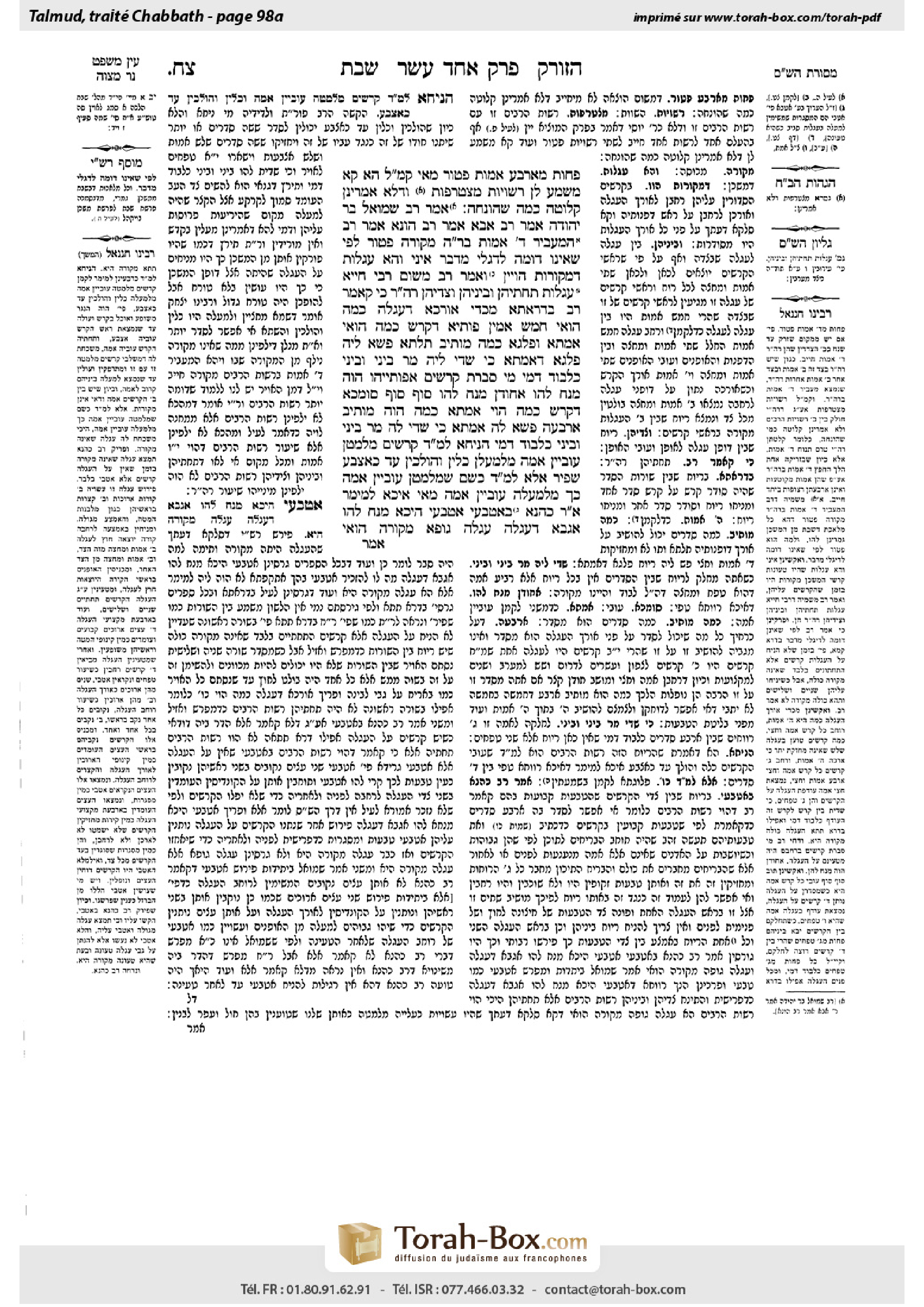
Shabbat 98a: Talmud study for Daf Yomi
Daf Yomi is the daily study of one Talmud folio. Explore 37 tractates with scans, Hebrew text, Sefaria English and AI-generated French translations where annotated.
Passage selection and English or AI-generated French translation are available where the scan has annotations. Daf Study is independent of Torah-Box and Sefaria.
Browse Shabbat · שבת · All tractatesShabbat 98a text and translations
This page of Shabbat includes the Aramaic text, an English translation and an AI-generated French translation, alongside the scan above.
שבת צ״ח א · Aramaic and Hebrew text
פָּחוֹת מֵאַרְבַּע אַמּוֹת — פָּטוּר. מַאי קָא מַשְׁמַע לַן? הָא קָא מַשְׁמַע לַן: רְשׁוּיוֹת מִצְטָרְפוֹת — וּדְלָא אָמְרִינַן קְלוּטָה כְּמָה שֶׁהוּנְּחָה.
אָמַר רַב שְׁמוּאֵל בַּר יְהוּדָה, אָמַר רַב אַבָּא, אָמַר רַב הוּנָא, אָמַר רַב: הַמַּעֲבִיר אַרְבַּע אַמּוֹת בִּרְשׁוּת הָרַבִּים מְקוֹרֶה — פָּטוּר, לְפִי שֶׁאֵינוֹ דּוֹמֶה לְדִגְלֵי מִדְבָּר. אִינִי?! וְהָא עֲגָלוֹת דִּמְקוֹרוֹת הָוְיָין, וְאָמַר רַב מִשּׁוּם רַבִּי חִיָּיא: עֲגָלוֹת, תַּחְתֵּיהֶן וּבֵינֵיהֶן וְצִדֵּיהֶן רְשׁוּת הָרַבִּים! כִּי קָאָמַר רַב בְּדָרָאתָא.
מִכְּדֵי, אוּרְכָּא דַעֲגָלָה כַּמָּה הֲוַאי — חֲמֵשׁ אַמִּין, פּוּתְיָא דְקֶרֶשׁ כַּמָּה הֲוַאי — אַמְּתָא וּפַלְגָא, כַּמָּה מוֹתֵיב — תְּלָתָא, פָּשׁ לֵיהּ פַּלְגָא דְאַמְּתָא, כִּי שָׁדֵי לֵיהּ מָר בֵּינֵי וּבֵינֵי — כְּלָבוּד דָּמֵי! מִי סָבְרַתְּ קְרָשִׁים אַפּוּתַיְיהוּ הֲוָה מַנַּח לְהוּ? אַחוּדָּן מַנַּח לְהוּ.
סוֹף סוֹף סוּמְכָא דְקֶרֶשׁ כַּמָּה הָוֵי — אַמְּתָא, כַּמָּה הֲוָה מוֹתִיב — אַרְבְּעָה, פָּשָׁא לַהּ אַמְּתָא, כִּי שָׁדֵי לַהּ מָר בֵּינֵי וּבֵינֵי, כְּלָבוּד דָּמֵי. הָנִיחָא לְמַאן דְּאָמַר קְרָשִׁים מִלְּמַטָּן עוֹבְיָין אַמָּה, מִלְּמַעְלָן כָּלִין וְהוֹלְכִין עַד כְּאֶצְבַּע — שַׁפִּיר. אֶלָּא לְמַאן דְּאָמַר כְּשֵׁם שֶׁמִּלְּמַטָּן עוֹבְיָין אַמָּה כָּךְ מִלְּמַעְלָן עוֹבְיָין אַמָּה, מַאי אִיכָּא לְמֵימַר?
אָמַר רַב כָּהֲנָא: בְּאַטְבְּעֵי! אַטְבְּעֵי הֵיכָא מַנַּח לְהוּ — אַגַּבָּא דַעֲגָלָה, עֲגָלָה גּוּפַהּ מְקוֹרָה הֲוַאי.
Shabbat 98a · English translation
If he throws it less than four cubits, he is exempt, as he is neither liable for carrying from domain to domain nor for carrying in the public domain. The Gemara asks: What is he teaching us with this halakha? The Gemara answers: He is teaching us the following two things. First, that domains join together; even though one public domain is separated from the other by a private domain, they are treated as one domain. And second, that we do not say that an object in airspace is considered at rest. The object is not considered to have landed in a private domain, and therefore the one who threw it is exempt.
Rav Shmuel bar Yehuda said that Rav Abba said that Rav Huna said that Rav said: One who carries an object four cubits in the covered public domain is exempt because it is not similar to the flags of the camp of Israel in the desert, which were not covered. The Gemara wonders: Is that so? Weren’t the wagons on which they transported the beams of the Tabernacle covered? The beams formed a covering over the wagons. And even so, Rav said in the name of Rabbi Ḥiyya: The areas that were beneath the wagons, and between them, and on their sides are all considered to have been the public domain. Apparently, even a covered public domain, like the space beneath the wagons, has the legal status of a public domain. The Gemara answers: When Rav said that the space beneath the wagons had the legal status of a public domain, he was referring to when the beams were arranged in stacks. The beams did not cover the entire area of the wagon. There was space between the stacks.
The Gemara asks: After all, how much was the length of a wagon? It was five cubits. How much was the width of a beam? It was a cubit and a half. How many beams could one place on a wagon? One could place three stacks of beams, totaling four and a half cubits. If so, half a cubit of open space remained. When the Master distributes half a cubit between the stacks of beams it is considered lavud, attached, as the space between each stack was less than three handbreadths. The Gemara answers: Do you maintain that they would place the beams on their width? They would place them on their depth, which was one cubit wide, and therefore there was a greater distance between the rows.
The Gemara asks: Ultimately, how much was the depth of a beam? It was one cubit. How many stacks would they place? They would place four stacks. One cubit of open space remained. When the Master distributes one cubit between the four stacks of beams it is considered lavud, as two handbreadths separated each stack. The Gemara adds: This statement of Rav works out well according to the opinion of the one who said that the beams in the Tabernacle were one cubit thick at the bottom, and they narrowed to a fingerbreadth as they reached the top. According to that opinion, there was a space larger than three handbreadths at least between the tops of the beams, and therefore the area beneath that part of the wagon was not covered. However, according to the opinion of the one who said that just as they were one cubit thick at the bottom, so too, the beams were one cubit thick on top, what can be said? In that case, the space between the stacks was less than three handbreadths, and area beneath the wagon had the legal status of a covered public domain.
Rav Kahana said: When we said that the underside of the wagon was considered to be a public domain, the statement was not referring to when the beams were stacked on them. When the wagon was empty and consisted of the frames that held the beams in place, beneath the wagon was an uncovered public domain. The Gemara asks: But where would they place the frames? On top of the wagon when the beams were already stacked on it and the wagon itself was already covered by the beams, as stated above (ge’onim).
Shabbat 98a · Traduction française (IA)
S’il le lance à moins de quatre coudées, il est exempt, car il n’est responsable ni d’un transfert d’un domaine à un autre ni d’un transport dans le domaine public. La Guemara demande : Que nous enseigne cette halakha ? La Guemara répond : Elle nous enseigne deux choses. Premièrement, les domaines se joignent : bien qu’un domaine public soit séparé d’un autre par un domaine privé, ils sont considérés comme un seul domaine. Deuxièmement, nous ne disons pas qu’un objet dans l’espace aérien est considéré comme étant au repos. L’objet n’est pas considéré comme ayant atterri dans un domaine privé ; celui qui l’a lancé est donc exempt.
Rav Shmuel bar Yehouda dit que Rav Abba dit que Rav Houna dit que Rav dit : Celui qui transporte un objet sur quatre coudées dans un domaine public couvert est exempt, car cette situation ne ressemble pas à celle des étendards du camp d’Israël dans le désert, qui n’étaient pas couverts. La Guemara s’étonne : Est-ce vraiment le cas ? Les chariots sur lesquels on transportait les poutres du Tabernacle n’étaient-ils pas couverts ? Les poutres formaient un toit au-dessus des chariots. Pourtant, Rav a dit au nom de Rabbi Ḥiyya que les espaces situés sous les chariots, entre eux et sur leurs côtés étaient tous considérés comme faisant partie du domaine public. Il semble donc que même un domaine public couvert, tel l’espace sous les chariots, ait le statut juridique de domaine public. La Guemara répond : Lorsque Rav a dit que l’espace sous les chariots avait le statut juridique de domaine public, il faisait référence au cas où les poutres étaient disposées en piles. Les poutres ne couvraient pas toute la surface du chariot ; il y avait de l’espace entre les piles.
La Guemara demande : Après tout, quelle était la longueur d’un chariot ? Cinq coudées. Quelle était la largeur d’une poutre ? Une coudée et demie. Combien de poutres pouvait-on placer sur un chariot ? On pouvait y placer trois piles de poutres, soit un total de quatre coudées et demie. Il restait donc un demi-coudée d’espace libre. Lorsque le Maître répartit ce demi-coudée entre les piles de poutres, l’espace est considéré comme lavoud, c’est-à-dire comme si les piles étaient jointes, car l’espace entre chacune d’elles était inférieur à trois palmes. La Guemara répond : Penses-tu qu’ils plaçaient les poutres sur leur largeur ? Ils les plaçaient sur leur épaisseur, qui était d’une coudée ; la distance entre les rangées était donc plus grande.
La Guemara demande : En définitive, quelle était l’épaisseur d’une poutre ? Une coudée. Combien de piles plaçaient-ils ? Ils en plaçaient quatre. Il restait un coudée d’espace libre. Lorsque le Maître répartit cette coudée entre les quatre piles de poutres, l’espace est considéré comme lavoud, puisque deux palmes séparaient chaque pile. La Guemara ajoute : Cette déclaration de Rav s’accorde bien avec l’opinion de celui qui dit que les poutres du Tabernacle avaient une épaisseur d’une coudée à leur base et s’amincissaient jusqu’à un doigt à leur sommet. Selon cette opinion, il y avait au moins un espace supérieur à trois palmes entre les sommets des poutres ; la partie correspondante du chariot n’était donc pas couverte. Mais que peut-on dire selon l’opinion de celui qui dit que les poutres avaient une épaisseur d’une coudée à leur sommet, tout comme à leur base ? Dans ce cas, l’espace entre les piles était inférieur à trois palmes et l’espace sous le chariot avait le statut juridique d’un domaine public couvert.
Rav Kahana dit : Lorsque nous avons dit que la face inférieure du chariot était considérée comme faisant partie du domaine public, nous ne faisions pas référence au cas où les poutres étaient empilées dessus. Lorsque le chariot était vide et qu’il ne restait que les cadres qui maintenaient les poutres en place, l’espace sous le chariot constituait un domaine public non couvert. La Guemara demande : Mais où plaçaient-ils les cadres ? Au-dessus du chariot, alors que les poutres y étaient déjà empilées et que le chariot lui-même était déjà couvert par les poutres, comme indiqué plus haut (ge’onim).
Traduction française générée par IA à partir de l’édition anglaise de Sefaria. Vérifie toujours un passage avec le texte source.
Text from Sefaria: William Davidson Edition - Vocalized Aramaic (CC BY NC); William Davidson Edition - English (CC BY NC).