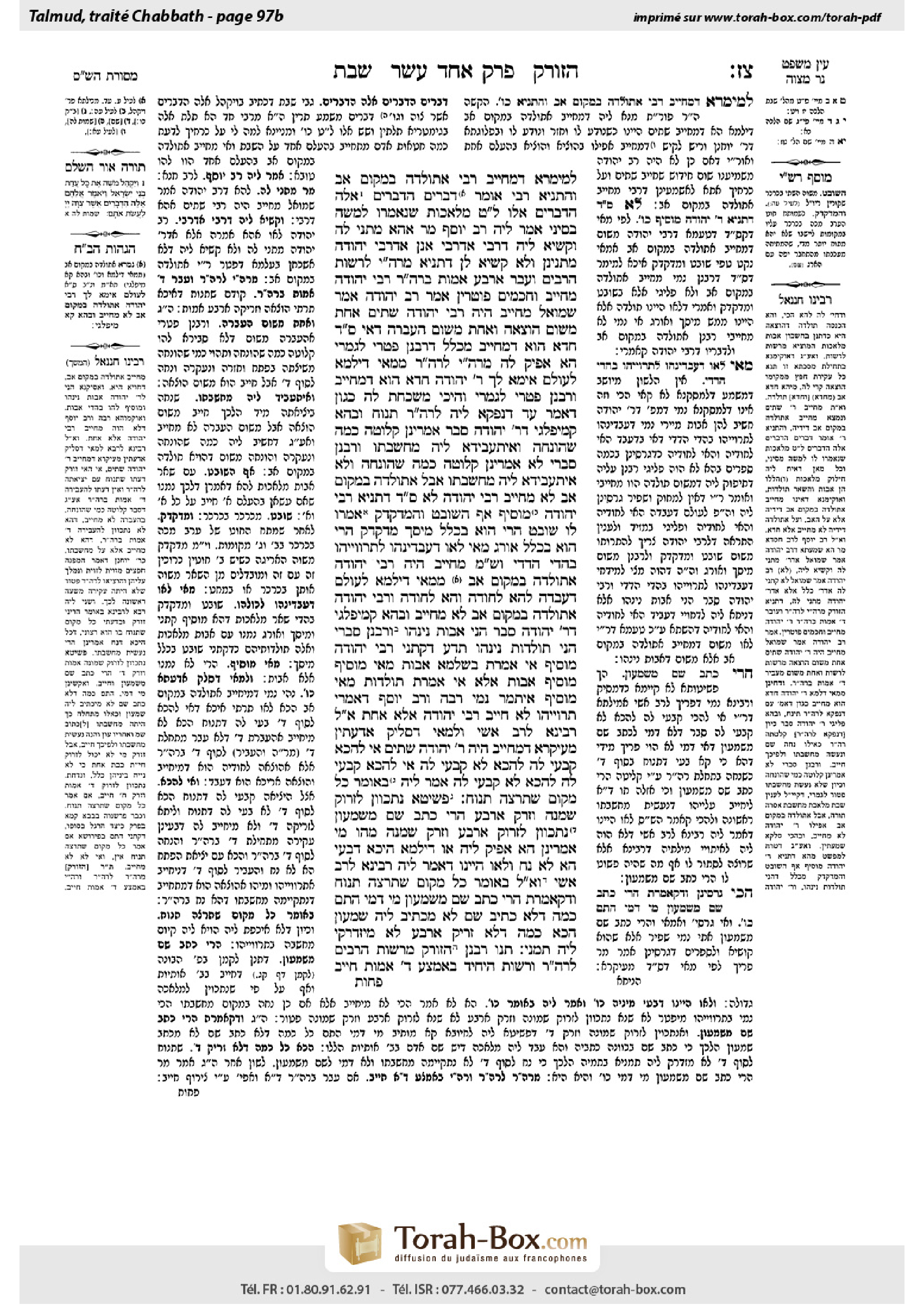
Shabbat 97b: Talmud study for Daf Yomi
Daf Yomi is the daily study of one Talmud folio. Explore 37 tractates with scans, Hebrew text, Sefaria English and AI-generated French translations where annotated.
Passage selection and English or AI-generated French translation are available where the scan has annotations. Daf Study is independent of Torah-Box and Sefaria.
Browse Shabbat · שבת · All tractatesShabbat 97b text and translations
This page of Shabbat includes the Aramaic text, an English translation and an AI-generated French translation, alongside the scan above.
שבת צ״ז ב · Aramaic and Hebrew text
לְמֵימְרָא דִּמְחַיֵּיב רַבִּי אַתּוֹלָדָה בִּמְקוֹם אָב?
וְהָתַנְיָא, רַבִּי אוֹמֵר: ״דְּבָרִים״ ״הַדְּבָרִים״ ״אֵלֶּה הַדְּבָרִים״ — אֵלּוּ שְׁלֹשִׁים וָתֵשַׁע מְלָאכוֹת שֶׁנֶּאֶמְרוּ לְמֹשֶׁה בְּסִינַי!
אֲמַר לֵיהּ רַב יוֹסֵף: מָר אַהָא מַתְנֵי לַהּ, וְקַשְׁיָא לֵיהּ דְּרַבִּי אַדְּרַבִּי. אֲנַן אַדְּרַבִּי יְהוּדָה מַתְנִינַן — וְלָא קַשְׁיָא לַן.
דְּתַנְיָא: מֵרְשׁוּת הַיָּחִיד לִרְשׁוּת הָרַבִּים וְעָבַר אַרְבַּע אַמּוֹת בִּרְשׁוּת הָרַבִּים — רַבִּי יְהוּדָה מְחַיֵּיב וַחֲכָמִים פּוֹטְרִין.
אָמַר רַב יְהוּדָה אָמַר שְׁמוּאֵל: מְחַיֵּיב הָיָה רַבִּי יְהוּדָה שְׁתַּיִם — אַחַת מִשּׁוּם הוֹצָאָה וְאַחַת מִשּׁוּם הַעֲבָרָה. דְּאִי סָלְקָא דַּעְתָּךְ חֲדָא הוּא דִּמְחַיֵּיב, מִכְּלָל דְּרַבָּנַן פָּטְרִי לִגְמָרֵי? הָא אַפֵּיק לַהּ מֵרְשׁוּת הַיָּחִיד לִרְשׁוּת הָרַבִּים. מִמַּאי? דִּילְמָא לְעוֹלָם אֵימָא לָךְ רַבִּי יְהוּדָה חֲדָא הוּא דִּמְחַיֵּיב, וְרַבָּנַן פָּטְרִי לִגְמָרֵי, וְהֵיכִי מַשְׁכַּחַתְּ לַהּ? כְּגוֹן דְּאָמַר עַד דְּנָפְקָא לֵיהּ לִרְשׁוּת הָרַבִּים תְּנוּח.
וּבְהָא קָמִיפַּלְגִי, דְּרַבִּי יְהוּדָה סָבַר: אָמְרִינַן קְלוּטָה כְּמָה שֶׁהוּנְּחָה, וְאִיתְעֲבִידָא לֵיהּ מַחְשַׁבְתּוֹ. וְרַבָּנַן סָבְרִי: לָא אָמְרִינַן קְלוּטָה כְּמָה שֶׁהוּנְּחָה, וְלָא אִיתְעֲבִידָא לֵיהּ מַחְשַׁבְתּוֹ! אֲבָל אַתּוֹלָדָה בִּמְקוֹם אָב לָא מְחַיֵּיב רַבִּי יְהוּדָה.
לָא סָלְקָא דַּעְתָּךְ, דְּתַנְיָא: רַבִּי יְהוּדָה מוֹסִיף אַף הַשּׁוֹבֵט וְהַמְדַקְדֵּק. אָמְרוּ לוֹ: שׁוֹבֵט הֲרֵי הוּא בִּכְלַל מֵיסֵךְ, מְדַקְדֵּק הֲרֵי הוּא בִּכְלַל אוֹרֵג. מַאי לָאו דְּעַבְדִינְהוּ לְתַרְוַויְיהוּ בַּהֲדֵי הֲדָדֵי, וּשְׁמַע מִינַּהּ מְחַיֵּיב הָיָה רַבִּי יְהוּדָה אַתּוֹלָדָה בִּמְקוֹם אָב!
מִמַּאי? דִּילְמָא לְעוֹלָם דְּעַבְדַּהּ לְהָא לְחוּדַּהּ וְהָא לְחוּדַּהּ, וְרַבִּי יְהוּדָה אַתּוֹלָדָה בִּמְקוֹם אָב לָא מְחַיֵּיב, וּבְהָא קָמִיפַּלְגִי: דְּרַבִּי יְהוּדָה סָבַר הָנֵי אָבוֹת נִינְהוּ, וְרַבָּנַן סָבְרִי הָנֵי תּוֹלְדוֹת נִינְהוּ.
תֵּדַע, דְּקָתָנֵי ״רַבִּי יְהוּדָה מוֹסִיף״. אִי אָמְרַתְּ בִּשְׁלָמָא אָבוֹת, מַאי מוֹסִיף — מוֹסִיף אָבוֹת. אֶלָּא אִי אָמְרַתְּ תּוֹלָדוֹת, מַאי מוֹסִיף? אִיתְּמַר נָמֵי, רַבָּה וְרַב יוֹסֵף דְּאָמְרִי תַּרְוַיְיהוּ: לֹא חִיֵּיב רַבִּי יְהוּדָה אֶלָּא אַחַת.
אֲמַר לֵיהּ רָבִינָא לְרַב אָשֵׁי: וּלְמַאי דִּסְלֵיק אַדַּעְתִּין מֵעִיקָּרָא דִּמְחַיֵּיב הָיָה רַבִּי יְהוּדָה שְׁתַּיִם? אִי לְהָכָא קָבָעֵי לַהּ — לְהָכָא לָא קָבָעֵי לַהּ. אִי לְהָכָא קָבָעֵי לַהּ — לְהָכָא לָא קָבָעֵי לַהּ. אֲמַר לֵיהּ: בְּאוֹמֵר ״כׇּל מָקוֹם שֶׁתִּרְצֶה — תָּנוּחַ״.
פְּשִׁיטָא נִתְכַּוֵּון לִזְרוֹק שְׁמֹנֶה וְזָרַק אַרְבַּע — הֲרֵי כָּתַב ״שֵׁם״ מִשִּׁמְעוֹן. נִתְכַּוֵּון לִזְרוֹק אַרְבַּע וְזָרַק שְׁמֹנֶה — מַהוּ? מִי אָמְרִינַן: הָא אַפֵּיק לֵיהּ, אוֹ דִילְמָא: הֵיכָא דְּבָעֵי, הָא לָא נָח. וְלָאו הַיְינוּ דַּאֲמַר לֵיהּ רָבִינָא לְרַב אָשֵׁי, וַאֲמַר לֵיהּ: בְּאוֹמֵר ״כׇּל מָקוֹם שֶׁתִּרְצֶה תָּנוּחַ״.
וּדְקָאָמְרַתְּ הֲרֵי כָּתַב ״שֵׁם״ מִשִּׁמְעוֹן, מִי דָּמֵי? הָתָם כַּמָּה דְּלָא כְּתִיב ״שֵׁם״ לָא מִכְּתִיב לֵיהּ ״שִׁמְעוֹן״, הָכָא כַּמָּה דְּלָא זָרֵיק אַרְבַּע — לָא מִיזְדַּרְקִי לֵיהּ תַּמְנֵי?!
תָּנוּ רַבָּנַן: הַזּוֹרֵק מֵרְשׁוּת הָרַבִּים לִרְשׁוּת הָרַבִּים וּרְשׁוּת הַיָּחִיד בָּאֶמְצַע, אַרְבַּע אַמּוֹת — חַיָּיב,
Shabbat 97b · English translation
Is that to say that Rabbi Yehuda HaNasi deems one liable for a subcategory of prohibited labor when performed with a primary category of prohibited labor? After all, carrying out and carrying in constitute a primary category of prohibited labor and its subcategory.
Wasn’t it taught in a baraita that Rabbi Yehuda HaNasi says that Shabbat is mentioned in the verse: “These are the things [eleh hadevarim] that God has commanded to perform them” (Exodus 35:1)? Several points are derived from the superfluous emphases in this verse. The Torah could simply have stated: This is a thing [davar]. When it states things [devarim] in the plural, it teaches at least two points. The addition of the definite article the in the term the things [hadevarim] adds at least a third point. The numerological value of letters of the word eleh, which are alef, one; lamed, thirty; and heh, five, is thirty-six. The phrase: These are the things, alludes to three plus thirty-six derivation, i.e., the thirty-nine prohibited labors that were stated to Moses at Sinai. Since Rabbi Yehuda HaNasi maintains that there are a fixed number of primary categories of labor, he would certainly hold a person liable for the primary categories but not for the subcategories.
Rav Yosef said to him: The Master taught Rav Yehuda’s statement with regard to this, and consequently, he encounters a difficulty. One statement of Rabbi Yehuda HaNasi contradicts another statement of Rabbi Yehuda HaNasi. We learn the statement of Rav Yehuda with regard to the opinion of Rabbi Yehuda, and therefore there is no difficulty for us.
As it was taught in a baraita: With regard to one who threw an object from the private domain to the public domain, and it traveled four cubits in the public domain, Rabbi Yehuda deems him liable and the Rabbis deem him exempt.
Rav Yehuda said that Shmuel said: Rabbi Yehuda would deem him liable to bring two sin-offerings in this case, one for carrying out from the private domain into the public domain and one for carrying the object four cubits through the public domain. The Rabbis deem him exempt for carrying four cubits in the public domain. And it must be interpreted that way because if it would enter your mind to say that Rabbi Yehuda deems him liable to bring only one sin-offering, by inference, the Rabbis deem him completely exempt. How is that possible? Didn’t he carry an object out from the private domain into the public domain? This proof is rejected: And from where do you draw that conclusion? Perhaps I could actually say to you that Rabbi Yehuda deems him liable to bring one sin-offering and the Rabbis deem him completely exempt, and how do you find that circumstance? In a case where he said: My intention is that as soon it, the object, goes out into the public domain it will immediately come to rest.
And they disagree with regard to this: Rabbi Yehuda maintains that we say: An object in airspace is considered at rest, and therefore his intention was fulfilled. As soon as the object enters the airspace of the public domain it is considered to have come to rest. And the Rabbis maintain that we do not say: An object in airspace is considered at rest, and therefore his intention was not fulfilled and he is exempt. However, Rabbi Yehuda does not hold one liable for a subcategory of labor performed together with a primary category of labor.
The Gemara rejects this explanation: It could not enter your mind to say so, as it was taught in a baraita: Rabbi Yehuda adds even lining up the threads of the warp and beating the threads of the woof to the list of primary categories of labor. The Rabbis said to him: Lining up is a subcategory subsumed under the primary category of stretching the threads of the warp within the loom, and beating is subsumed under the primary category of weaving. Is this not referring to a case where one performed both lining up and beating together, and learn from it that Rabbi Yehuda deems one liable for both a subcategory and a primary category of labor when they are performed together?
The Gemara rejects this proof: And from where do you draw that conclusion? Perhaps it is actually referring to a case where one performed this action alone and this action alone, and Rabbi Yehuda does not deem one liable for a subcategory of labor performed together with a primary category of labor. And Rabbi Yehuda and the Rabbis disagree with regard to this. Rabbi Yehuda maintains as follows: These actions of lining up and beating are additional primary categories of labor, and the Rabbis maintain as follows: These are subcategories.
Know that this is so, as the baraita teaches: Rabbi Yehuda adds. The Gemara explains this quote from the baraita: Granted, if you say that Rabbi Yehuda meant that these are primary categories of labor, what is the meaning of: He adds? It means he adds primary categories of labor. However, if you say that he meant that these are subcategories, what is the meaning of: He adds? It was also stated that it was Rabba and Rav Yosef who both said: Rabbi Yehuda deemed him liable to bring only one sin-offering.
Ravina said to Rav Ashi: And according to what originally entered our mind that Rabbi Yehuda deemed him liable to bring two sin-offerings, how could he be liable for both carrying out from the private domain and for carrying four cubits in the public domain? If one only wanted the object to land here at the beginning of the public domain, he did not want it to land here, four cubits into the public domain. Conversely, if one only wanted the object to land here, four cubits into the public domain, he did not want it to land here, at the beginning of the public domain. Rav Ashi said to Ravina: It is possible in a case where one says: Any place that it wants to come to rest, let it come to rest. One indicated that his intention would be fulfilled wherever the thrown object lands.
Concerning throwing an object on Shabbat from one domain to another and within a single domain, the Gemara raises several issues with regard to intention when throwing. It is obvious that one who intended to throw an object eight cubits in a public domain and actually threw it only four cubits is liable because that case is similar to a case where one wrote the word shem, the first two letters of the name Shimon. In the case of writing shem, the individual performed the prohibited labor of writing a two-letter word, even though he did not complete the word that he originally intended to write. The question is as follows: What is the halakha if one intended to throw an object four cubits and threw it eight? Do we say he did indeed carry the object, or perhaps we say that ultimately the object did not land where he wanted it to land? But is that not precisely what Ravina said to Rav Ashi, as mentioned above? And Rav Ashi said in response that it is referring to a case where one says: Any place that it wants to come to rest, let it come to rest. In such a scenario one is liable, because he expressed the fact that he is contented with any labor that will be performed with the object.
Furthermore, the first case, which seems obvious, also requires clarification. And that which you said, that this is similar to a case where one wrote the word shem, the first two letters of the name Shimon, is it in fact similar? There, as long as the letters of shem, shin and mem, are not written, the name Shimon cannot be written. Here, where one intended to throw the object eight cubits and he threw it only four, is it true that as long as it was not thrown four cubits it cannot be thrown eight? An object can be thrown eight cubits without first landing after four cubits. The question remains unresolved.
The Sages taught: With regard to one who throws an object on Shabbat from the public domain to the other public domain through the private domain, he is liable if he throws an object a total of four cubits in both parts of the public domain.
Shabbat 97b · Traduction française (IA)
Faut-il en conclure que Rabbi Yehouda HaNassi tient une personne responsable d’une sous-catégorie de travail interdit lorsqu’elle est accomplie avec une catégorie principale de travail interdit ? Après tout, le transfert du domaine privé au domaine public et le transfert du domaine public au domaine privé constituent une catégorie principale de travail interdit et sa sous-catégorie.
N’a-t-on pas enseigné dans une baraïta que Rabbi Yehouda HaNassi dit que le Chabbat est mentionné dans le verset : « Voici les choses [eleh hadevarim] que Dieu a ordonné d’accomplir » (Exode 35:1) ? Plusieurs éléments sont déduits des emphases superflues de ce verset. La Torah aurait pu simplement dire : « Voici une chose [davar] ». En employant le pluriel « les choses [devarim] », elle enseigne au moins deux éléments. L’ajout de l’article défini dans l’expression « les choses [hadevarim] » en ajoute au moins un troisième. La valeur numérique des lettres du mot eleh — alef, un ; lamed, trente ; et hé, cinq — est de trente-six. L’expression « Voici les choses » fait allusion à trois plus trente-six, c’est-à-dire aux trente-neuf travaux interdits qui furent énoncés à Moïse au Sinaï. Puisque Rabbi Yehouda HaNassi soutient qu’il existe un nombre fixe de catégories principales de travail, il tiendrait certainement une personne responsable des catégories principales, mais pas des sous-catégories.
Rav Yossef lui dit : « Le Maître a enseigné la déclaration de Rav Yehouda à ce sujet, et se trouve donc confronté à une difficulté. Une déclaration de Rabbi Yehouda HaNassi contredit une autre déclaration de Rabbi Yehouda HaNassi. Nous, nous apprenons la déclaration de Rav Yehouda au sujet de l’opinion de Rabbi Yehouda ; il n’y a donc pas de difficulté pour nous. »
Comme cela a été enseigné dans une baraïta : celui qui a lancé un objet du domaine privé vers le domaine public et lui a fait parcourir quatre coudées dans le domaine public, Rabbi Yehouda le déclare responsable, tandis que les Sages l’en exemptent.
Rav Yehouda a dit au nom de Chmouel : Rabbi Yehouda le déclarerait responsable de deux sacrifices expiatoires dans ce cas, l’un pour avoir fait sortir l’objet du domaine privé vers le domaine public, et l’autre pour l’avoir transporté sur quatre coudées dans le domaine public. Les Sages l’exemptent pour le transport sur quatre coudées dans le domaine public. Il faut interpréter la baraïta ainsi, car si tu pensais que Rabbi Yehouda le déclare responsable d’un seul sacrifice expiatoire, il s’ensuivrait que les Sages l’en exemptent entièrement. Comment est-ce possible ? N’a-t-il pas fait sortir un objet du domaine privé vers le domaine public ? Cette preuve est rejetée : d’où tires-tu cette conclusion ? Peut-être pourrais-je effectivement te dire que Rabbi Yehouda le déclare responsable d’un seul sacrifice expiatoire et que les Sages l’en exemptent entièrement. Et dans quelle circonstance cela se produit-il ? Lorsqu’il a dit : « Dès que l’objet sortira dans le domaine public, qu’il se pose aussitôt. »
Leur désaccord porte sur ce point : Rabbi Yehouda soutient que nous considérons comme au repos un objet dans l’espace aérien ; son intention a donc été réalisée. Dès que l’objet pénètre dans l’espace aérien du domaine public, il est considéré comme s’étant posé. Les Sages, eux, soutiennent que nous ne considérons pas comme au repos un objet dans l’espace aérien ; son intention n’a donc pas été réalisée et il est exempt. Toutefois, Rabbi Yehouda ne tient pas une personne responsable d’une sous-catégorie de travail accomplie avec une catégorie principale de travail.
La Guemara rejette cette explication : il est impossible de le penser, car il a été enseigné dans une baraïta que Rabbi Yehouda ajoute à la liste des catégories principales de travail l’alignement des fils de chaîne et le battage des fils de trame. Les Sages lui dirent : « L’alignement est une sous-catégorie incluse dans la catégorie principale qui consiste à tendre les fils de chaîne sur le métier à tisser, et le battage est inclus dans la catégorie principale du tissage. » Cela ne se rapporte-t-il pas à un cas où l’on a accompli ensemble l’alignement et le battage ? Il faut en déduire que Rabbi Yehouda tient une personne responsable à la fois d’une sous-catégorie et d’une catégorie principale de travail lorsqu’elles sont accomplies ensemble.
La Guemara rejette cette preuve : d’où tires-tu cette conclusion ? Peut-être cela se rapporte-t-il en réalité à un cas où l’on a accompli chacune de ces actions séparément, et Rabbi Yehouda ne tient pas une personne responsable d’une sous-catégorie de travail accomplie avec une catégorie principale de travail. Rabbi Yehouda et les Sages sont en désaccord sur ce point. Rabbi Yehouda soutient que l’alignement et le battage sont des catégories principales de travail supplémentaires, tandis que les Sages soutiennent qu’il s’agit de sous-catégories.
Sache que c’est bien ainsi, car la baraïta enseigne : « Rabbi Yehouda ajoute. » La Guemara explique cette citation de la baraïta : certes, si tu dis que Rabbi Yehouda voulait dire qu’il s’agit de catégories principales de travail, que signifie « il ajoute » ? Cela signifie qu’il ajoute des catégories principales de travail. Mais si tu dis qu’il voulait dire qu’il s’agit de sous-catégories, que signifie « il ajoute » ? Il a également été rapporté que Rabba et Rav Yossef ont tous deux dit : Rabbi Yehouda le déclarait responsable d’un seul sacrifice expiatoire.
Ravina dit à Rav Achi : selon ce que nous avions d’abord pensé, à savoir que Rabbi Yehouda le déclarait responsable de deux sacrifices expiatoires, comment pourrait-il être tenu responsable à la fois d’avoir fait sortir l’objet du domaine privé et de l’avoir transporté sur quatre coudées dans le domaine public ? S’il voulait seulement que l’objet se pose ici, au début du domaine public, il ne voulait pas qu’il se pose ici, quatre coudées à l’intérieur du domaine public. À l’inverse, s’il voulait seulement que l’objet se pose ici, quatre coudées à l’intérieur du domaine public, il ne voulait pas qu’il se pose ici, au début du domaine public. Rav Achi dit à Ravina : c’est possible dans le cas où l’on dit : « Partout où il voudra se poser, qu’il s’y pose. » Il a indiqué que son intention serait réalisée quel que soit l’endroit où l’objet lancé se poserait.
À propos du lancer d’un objet pendant Chabbat d’un domaine à un autre, ou à l’intérieur d’un même domaine, la Guemara soulève plusieurs questions concernant l’intention au moment du lancer. Il est évident que celui qui avait l’intention de lancer un objet sur huit coudées dans le domaine public, mais ne l’a effectivement lancé que sur quatre coudées, est responsable, car ce cas ressemble à celui où l’on a écrit le mot shem, les deux premières lettres du nom Chimon. Dans le cas de l’écriture de shem, la personne a accompli le travail interdit d’écrire un mot de deux lettres, même si elle n’a pas achevé le mot qu’elle voulait initialement écrire. Voici la question : quelle est la halakha si l’on avait l’intention de lancer un objet sur quatre coudées, mais qu’on l’a lancé sur huit ? Disons-nous qu’il a bien transporté l’objet, ou peut-être disons-nous qu’en fin de compte l’objet ne s’est pas posé à l’endroit où il voulait qu’il se pose ? Mais n’est-ce pas précisément ce que Ravina a dit à Rav Achi, comme mentionné plus haut ? Rav Achi a répondu que cela se rapporte à un cas où l’on dit : « Partout où il voudra se poser, qu’il s’y pose. » Dans une telle situation, la personne est responsable, car elle a exprimé qu’elle acceptait que le travail soit accompli avec l’objet, quel qu’il soit.
En outre, le premier cas, qui semble évident, doit lui aussi être clarifié. Et ce que tu as dit, que cela ressemble au cas où l’on a écrit le mot shem, les deux premières lettres du nom Chimon, est-ce vraiment comparable ? Là, tant que les lettres de shem, chin et mem, ne sont pas écrites, le nom Chimon ne peut pas être écrit. Ici, alors qu’on avait l’intention de lancer l’objet sur huit coudées mais qu’on ne l’a lancé que sur quatre, est-il vrai que tant qu’il n’a pas été lancé sur quatre coudées, il ne peut pas être lancé sur huit ? Un objet peut être lancé sur huit coudées sans d’abord s’arrêter après quatre coudées. La question demeure sans réponse.
Les Sages ont enseigné : celui qui lance un objet pendant Chabbat d’un domaine public vers un autre domaine public en passant par le domaine privé est responsable s’il lance l’objet sur une distance totale de quatre coudées dans les deux parties du domaine public.
Traduction française générée par IA à partir de l’édition anglaise de Sefaria. Vérifie toujours un passage avec le texte source.
Text from Sefaria: William Davidson Edition - Vocalized Aramaic (CC BY NC); William Davidson Edition - English (CC BY NC).