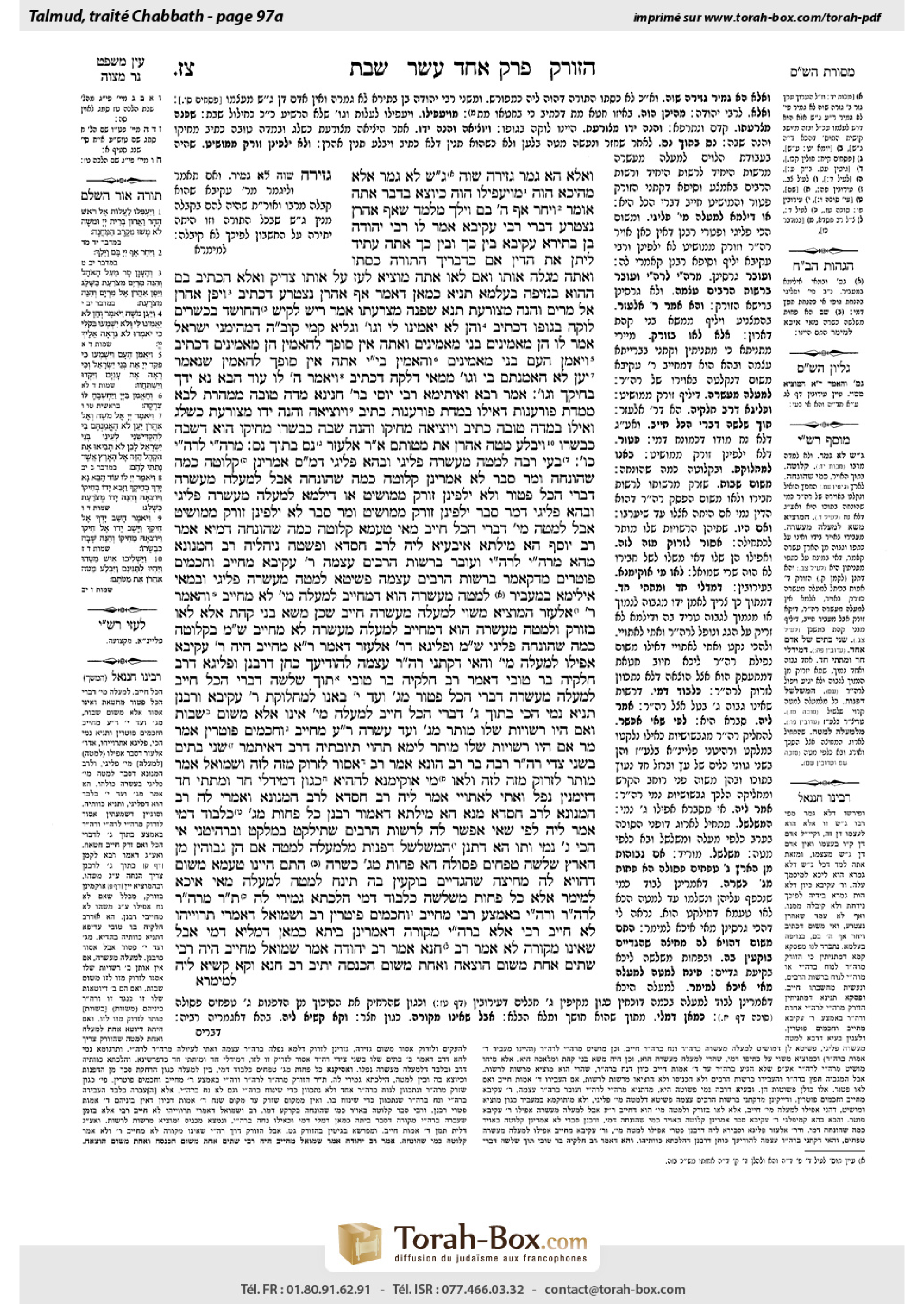
Shabbat 97a: Talmud study for Daf Yomi
Daf Yomi is the daily study of one Talmud folio. Explore 37 tractates with scans, Hebrew text, Sefaria English and AI-generated French translations where annotated.
Passage selection and English or AI-generated French translation are available where the scan has annotations. Daf Study is independent of Torah-Box and Sefaria.
Browse Shabbat · שבת · All tractatesShabbat 97a text and translations
This page of Shabbat includes the Aramaic text, an English translation and an AI-generated French translation, alongside the scan above.
שבת צ״ז א · Aramaic and Hebrew text
וְאֶלָּא הָא גָּמַר גְּזֵירָה שָׁוָה! גְּזֵירָה שָׁוָה לָא גָּמַר. אֶלָּא מֵהֵיכָא הֲוָה? מִ״וַּיַּעְפִּילוּ״ הֲוָה.
כַּיּוֹצֵא בַּדָּבָר, אַתָּה אוֹמֵר: ״וַיִּחַר אַף ה׳ בָּם וַיֵּלַךְ״ — מְלַמֵּד שֶׁאַף אַהֲרֹן נִצְטָרַע, דִּבְרֵי רַבִּי עֲקִיבָא. אָמַר לוֹ רַבִּי יְהוּדָה בֶּן בְּתִירָא: עֲקִיבָא, בֵּין כָּךְ וּבֵין כָּךְ אַתָּה עָתִיד לִיתֵּן אֶת הַדִּין. אִם כִּדְבָרֶיךָ — הַתּוֹרָה כִּסַּתּוּ וְאַתָּה מְגַלֶּה אוֹתוֹ?! וְאִם לָאו — אַתָּה מוֹצִיא לַעַז עַל אוֹתוֹ צַדִּיק.
וְאֶלָּא הָכְתִיב ״בָּם״! הַהוּא בִּנְזִיפָה בְּעָלְמָא. תַּנְיָא כְּמַאן דְּאָמַר אַף אַהֲרֹן נִצְטָרַע, דִּכְתִיב: ״וַיִּפֶן אַהֲרֹן אֶל מִרְיָם וְהִנֵּה מְצֹרָעַת״, תָּנָא: שֶׁפָּנָה מִצָּרַעְתּוֹ.
אָמַר רֵישׁ לָקִישׁ: הַחוֹשֵׁד בִּכְשֵׁרִים — לוֹקֶה בְּגוּפוֹ, דִּכְתִיב: ״וְהֵן לֹא יַאֲמִינוּ לִי וְגוֹ׳״, וְגַלְיָא קַמֵּי קוּדְשָׁא בְּרִיךְ הוּא דִּמְהֵימְנִי יִשְׂרָאֵל. אָמַר לוֹ: הֵן מַאֲמִינִים בְּנֵי מַאֲמִינִים, וְאַתָּה אֵין סוֹפְךָ לְהַאֲמִין.
הֵן מַאֲמִינִים, דִּכְתִיב: ״וַיַּאֲמֵן הָעָם״. בְּנֵי מַאֲמִינִים — ״וְהֶאֱמִין בַּייָ״. אַתָּה אֵין סוֹפְךָ לְהַאֲמִין, שֶׁנֶּאֱמַר: ״יַעַן לֹא הֶאֱמַנְתֶּם בִּי וְגוֹ׳״. מִמַּאי דִּלְקָה, דִּכְתִיב: ״וַיֹּאמֶר ה׳ לוֹ עוֹד הָבֵא נָא יָדְךָ בְּחֵיקֶךָ וְגוֹ׳״.
אָמַר רָבָא, וְאִיתֵּימָא רַבִּי יוֹסֵי בְּרַבִּי חֲנִינָא: מִדָּה טוֹבָה מְמַהֶרֶת לָבֹא מִמִּדַּת פּוּרְעָנוּת. דְּאִילּוּ בְּמִדַּת פּוּרְעָנוּת כְּתִיב: ״וַיּוֹצִיאָהּ וְהִנֵּה יָדוֹ מְצֹרַעַת כַּשָּׁלֶג״, וְאִילּוּ בְּמִדָּה טוֹבָה כְּתִיב: ״וַיּוֹצִיאָהּ מֵחֵיקוֹ וְהִנֵּה שָׁבָה כִּבְשָׂרוֹ״ — מֵחֵיקוֹ הוּא דְּשָׁבָה כִּבְשָׂרוֹ.
״וַיִּבְלַע מַטֵּה אַהֲרֹן אֶת מַטֹּתָם״, אָמַר רַבִּי אֶלְעָזָר: נֵס בְּתוֹךְ נֵס.
מֵרְשׁוּת הַיָּחִיד לִרְשׁוּת הַיָּחִיד.
בָּעֵי רַבָּה: לְמַטָּה מֵעֲשָׂרָה פְּלִיגִי, וּבְהָא פְּלִיגִי — דְּמָר סָבַר אָמְרִינַן קְלוּטָה כְּמָה שֶׁהוּנְּחָה, וּמָר סָבַר לָא אָמְרִינַן קְלוּטָה כְּמָה שֶׁהוּנְּחָה. אֲבָל לְמַעְלָה מֵעֲשָׂרָה — דִּבְרֵי הַכֹּל פָּטוּר, וְלָא יָלְפִינַן זוֹרֵק מִמּוֹשִׁיט.
אוֹ דִילְמָא: לְמַעְלָה מֵעֲשָׂרָה פְּלִיגִי, וּבְהָא פְּלִיגִי — דְּמָר סָבַר יָלְפִינַן זוֹרֵק מִמּוֹשִׁיט, וּמָר סָבַר לָא יָלְפִינַן זוֹרֵק מִמּוֹשִׁיט. אֲבָל לְמַטָּה מֵעֲשָׂרָה — דִּבְרֵי הַכֹּל חַיָּיב, מַאי טַעְמָא? — קְלוּטָה כְּמָה שֶׁהוּנְּחָה דָּמְיָא.
אָמַר רַב יוֹסֵף: הָא מִילְּתָא אִיבַּעְיָא לֵיהּ לְרַב חִסְדָּא, וּפַשְׁטַהּ נִיהֲלֵיהּ רַב הַמְנוּנָא מֵהָא: מֵרְשׁוּת הַיָּחִיד לִרְשׁוּת הַיָּחִיד וְעוֹבֵר בִּרְשׁוּת הָרַבִּים עַצְמָהּ — רַבִּי עֲקִיבָא מְחַיֵּיב, וַחֲכָמִים פּוֹטְרִים. מִדְּקָאָמַר ״בִּרְשׁוּת הָרַבִּים עַצְמָהּ״, פְּשִׁיטָא לְמַטָּה מֵעֲשָׂרָה פְּלִיגִי.
וּבְמַאי? אִילֵימָא בְּמַעֲבִיר, לְמַטָּה מֵעֲשָׂרָה — הוּא דִּמְחַיֵּיב, לְמַעְלָה מֵעֲשָׂרָה — לָא מְחַיֵּיב? וְהָאָמַר רַבִּי אֶלְעָזָר: הַמּוֹצִיא מַשּׂוֹי לְמַעְלָה מֵעֲשָׂרָה — חַיָּיב, שֶׁכֵּן מַשָּׂא בְּנֵי קְהָת. אֶלָּא לָאו בְּזוֹרֵק, וּלְמַטָּה מֵעֲשָׂרָה הוּא דִּמְחַיֵּיב, לְמַעְלָה מֵעֲשָׂרָה — לָא מְחַיֵּיב, שְׁמַע מִינַּהּ בִּקְלוּטָה כְּמָה שֶׁהוּנְּחָה פְּלִיגִי. שְׁמַע מִינַּהּ.
וּפְלִיגָא דְּרַבִּי אֶלְעָזָר. דְּאָמַר רַבִּי אֶלְעָזָר: מְחַיֵּיב הָיָה רַבִּי עֲקִיבָא אֲפִילּוּ לְמַעְלָה מֵעֲשָׂרָה, וְהַאי דְּקָתָנֵי ״רְשׁוּת הָרַבִּים עַצְמָהּ״ — לְהוֹדִיעֲךָ כֹּחָן דְּרַבָּנַן.
וּפְלִיגָא דְּרַב חִלְקִיָּה בַּר טוֹבִי, דַּאֲמַר רַב חִלְקִיָּה בַּר טוֹבִי: תּוֹךְ שְׁלֹשָׁה — דִּבְרֵי הַכֹּל חַיָּיב. לְמַעְלָה מֵעֲשָׂרָה — דִּבְרֵי הַכֹּל פָּטוּר. מִשְּׁלֹשָׁה וְעַד עֲשָׂרָה — בָּאנוּ לְמַחְלוֹקֶת רַבִּי עֲקִיבָא וְרַבָּנַן.
תַּנְיָא נָמֵי הָכִי: בְּתוֹךְ שְׁלֹשָׁה — דִּבְרֵי הַכֹּל חַיָּיב, לְמַעְלָה מֵעֲשָׂרָה — אֵינוֹ אֶלָּא מִשּׁוּם שְׁבוּת. וְאִם הָיוּ רְשׁוּיוֹת שֶׁלּוֹ — מוּתָּר. מִשְּׁלֹשָׁה וְעַד עֲשָׂרָה — רַבִּי עֲקִיבָא מְחַיֵּיב וַחֲכָמִים פּוֹטְרִין.
אָמַר מָר: אִם הָיוּ רְשׁוּיוֹת שֶׁלּוֹ — מוּתָּר. לֵימָא תִּהְוֵי תְּיוּבְתֵּיהּ דְּרַב, דְּאִיתְּמַר: שְׁנֵי בָתִּים בִּשְׁנֵי צִדֵּי רְשׁוּת הָרַבִּים, רַבָּה בַּר רַב הוּנָא אָמַר רַב: אָסוּר לִזְרוֹק מִזֶּה לָזֶה. וּשְׁמוּאֵל אָמַר: מוּתָּר לִזְרוֹק מִזֶּה לָזֶה. וְלָאו מִי אוֹקֵימְנָא לְהַהִיא כְּגוֹן דְּמִידְּלֵי חַד וּמִתַּתֵּי חַד — דְּזִימְנִין נָפֵל, וְאָתֵי לְאֵתוּיֵי.
אֲמַר לֵיהּ רַב חִסְדָּא לְרַב הַמְנוּנָא, וְאָמְרִי לַהּ רַב הַמְנוּנָא לְרַב חִסְדָּא: מְנַָא הָא מִילְּתָא דַאֲמוּר רַבָּנַן: כׇּל פָּחוֹת מִשְּׁלֹשָׁה — כְּלָבוּד דָּמֵי? אֲמַר לֵיהּ: לְפִי שֶׁאִי אֶפְשָׁר לָהּ לִרְשׁוּת הָרַבִּים שֶׁתִּילָּקֵט בְּמַלְקֵט וּבְרָהִיטָנֵי.
אִי הָכִי, שְׁלֹשָׁה נָמֵי? וְתוּ, הָא דִּתְנַן: הַמְשַׁלְשֵׁל דְּפָנוֹת מִלְּמַעְלָה לְמַטָּה, אִם הֵן גְּבוֹהִין מִן הָאָרֶץ שְׁלֹשָׁה טְפָחִים — פְּסוּלָה. הָא פָּחוֹת מִשְּׁלֹשָׁה — כְּשֵׁרָה.
הָתָם הַיְינוּ טַעְמָא, מִשּׁוּם דְּהָוְיָא לַהּ מְחִיצָה שֶׁהַגְּדָיִים בּוֹקְעִין בָּהּ. תִּינַח לְמַטָּה, לְמַעְלָה מַאי אִיכָּא לְמֵימַר? אֶלָּא כׇּל פָּחוֹת מִשְּׁלֹשָׁה כְּלָבוּד דָּמֵי — הִלְכְתָא גְּמִירִי לַהּ.
תָּנוּ רַבָּנַן: מֵרְשׁוּת הָרַבִּים לִרְשׁוּת הָרַבִּים וּרְשׁוּת הַיָּחִיד בָּאֶמְצַע — רַבִּי מְחַיֵּיב, וַחֲכָמִים פּוֹטְרִין. רַב וּשְׁמוּאֵל דְּאָמְרִי תַּרְוַיְיהוּ: לֹא חִיֵּיב רַבִּי אֶלָּא בִּרְשׁוּת הַיָּחִיד מְקוֹרֶה, דְּאָמְרִינַן בֵּיתָא כְּמַאן דְּמַלְיָא דָּמֵי, אֲבָל שֶׁאֵינוֹ מְקוֹרֶה לָא. אָמַר רַב חָנָא אָמַר רַב יְהוּדָה אָמַר שְׁמוּאֵל: מְחַיֵּיב הָיָה רַבִּי שְׁתַּיִם — אַחַת מִשּׁוּם הוֹצָאָה, וְאַחַת מִשּׁוּם הַכְנָסָה.
יָתֵיב רַב חָנָא וְקָא קַשְׁיָא לֵיהּ:
Shabbat 97a · English translation
The Gemara asks: However, didn’t Rabbi Akiva derive this by means of a verbal analogy? The Gemara answers: Rabbi Yehuda ben Beteira did not learn a verbal analogy. Rabbi Yehuda ben Beteira had no tradition of this verbal analogy from his teachers, and therefore he disagreed with Rabbi Akiva’s conclusion. The Gemara asks: However, according to Rabbi Yehuda ben Beteira, from where was Zelophehad’s liability derived? Why was he executed? The Gemara answers: Zelophehad was among those who “presumed to ascend to the top of the mountain” (Numbers 14:44) in the wake of the sin of the spies.
On a similar note, Rabbi Akiva revealed an additional matter not explicitly articulated in the Torah. You say that when Aaron and Miriam spoke against Moses, both Aaron and Miriam were struck with leprosy, as it written: “And God became angry at them and He left, and the cloud departed from above the tent, and behold, Miriam was leprous like snow. And Aaron turned toward Miriam, and behold, she was leprous” (Numbers 12:9–10). The verse’s statement that God became angry at both of them teaches that Aaron, too, became leprous; this is the statement of Rabbi Akiva. Rabbi Yehuda ben Beteira said to him: Akiva, in either case you will be judged in the future for this teaching. If the truth is in accordance with your statement, the Torah concealed Aaron’s punishment and you reveal it. And if the truth is not in accordance with your statement, you are unjustly slandering that righteous man.
The Gemara asks: However, didn’t Rabbi Akiva derive this from the plural pronoun them, meaning that God was angry with both of them? The Gemara answers: God’s anger in that verse was manifest in a mere rebuke, not in leprosy. A baraita was taught in accordance with the opinion of Rabbi Akiva, who said that Aaron also became leprous, as it is written: “And Aaron turned toward Miriam, and behold, she was leprous” (Numbers 12:10), and it was taught: This teaches that he turned, i.e., he was healed, from his leprosy, as he too had been afflicted.
On the topic of Miriam’s leprosy, the Gemara cites that which Reish Lakish said: One who suspects the innocent of indiscretion is afflicted in his body, as it is written: “And Moses answered and said: But they will not believe me and will not hearken to my voice, for they will say, God did not appear to you” (Exodus 4:1), and it is revealed before the Holy One, Blessed be He, that the Jewish people would believe. The Holy One, Blessed be He, said to Moses: They are believers, the children of believers; and ultimately, you will not believe.
They are believers, as it is written: “And the people believed once they heard that God had remembered the children of Israel, and that He saw their affliction, and they bowed and they prostrated” (Exodus 4:31). The children of believers, as it says with regard to Abraham our Patriarch: “And he believed in God, and He counted it for him as righteousness” (Genesis 15:6). Ultimately, you will not believe, as it is stated: “And God said to Moses and to Aaron: Because you did not believe in Me to sanctify Me in the eyes of the children of Israel” (Numbers 20:12). From where do we know that Moses was afflicted in his body? As it is written: “And God said to him further: Bring your hand to your bosom, and he brought his hand to his bosom and he took it out and behold, his hand was leprous like snow” (Exodus 4:6).
On this topic, Rava said, and some say that it was Rabbi Yosei, son of Rabbi Ḥanina, who said: The divine attribute of beneficence takes effect more quickly than the divine attribute of punishment. From where is this derived? While, with regard to the divine attribute of punishment, it is written, “And he took it out and behold, his hand was leprous like snow” (Exodus 4:6), with regard to the divine attribute of beneficence it is written: “And He said: Return your hand to your bosom, and he returned his hand to his bosom and he took it out from his bosom and behold, it had returned to be like his original flesh” (Exodus 4:7). The Gemara analyzes this as follows: It was already from his bosom that it returned to be like his original flesh. Moses’ hand was healed even before he took his hand out.
The Gemara proceeds to discuss another miracle that transpired at that time. With regard to the verse, “And each man threw down his staff and they became serpents, and Aaron’s staff swallowed their staffs” (Exodus 7:12), Rabbi Elazar said: This was a miracle within a miracle. It was Aaron’s staff, not his serpent, that swallowed the other staffs.
We learned in the mishna that there is a dispute between Rabbi Akiva and the Rabbis in a case where one threw an object from the private domain to the other private domain through the public domain between the two. Rabbi Akiva deems him liable, as one who threw an object from the private domain to the public domain, and the Rabbis deem him exempt.
Rabba raised a dilemma with regard to their dispute: Are they disagreeing with regard to a case where the object traveled below ten handbreadths from the ground? And, if so, it is with regard to this point that they disagree: As this Master, Rabbi Akiva holds: We say that an object in airspace is considered at rest. The object is considered as if it was actually placed in the public domain after being lifted from the private domain. And this Master, i.e., the Rabbis, holds: We do not say that an object in airspace is considered at rest. However, with regard to a case where the object traveled above ten handbreadths from the ground, everyone agrees that one is exempt, and we do not derive the legal status of throwing from the legal status of passing. Although everyone agrees that one who passes an object from a private domain to another private domain via a public domain is liable, even if it was passed above ten handbreadths, as that was the service of the Levites, one who throws an object in that manner is exempt.
Or perhaps, they are disagreeing with regard to a case where the object traveled above ten handbreadths from the ground, and it is with regard to this that they disagree: As this Master, Rabbi Akiva, holds: We derive the legal status of throwing from the legal status of passing. Therefore, one who throws an object that passes through the airspace of a public domain higher than ten handbreadths from the ground is liable. And this Master, i.e., the Rabbis, holds: We do not derive throwing from passing. However, with regard to a case where the object traveled beneath the ten handbreadth airspace of the public domain, everyone agrees that he is liable. What is the reason for that? An object in airspace is considered at rest.
Rav Yosef said: Rav Ḥisda had a dilemma with regard to this matter, and Rav Hamnuna resolved it for him from this baraita: With regard to an object that travels from the private domain to the other private domain, and it passes through the public domain itself, Rabbi Akiva deems one liable and the Rabbis deem one exempt. From the fact that it says in the baraita: Through the public domain itself, it is obvious that it is with regard to a case where the object traveled below ten handbreadths from the ground that they disagree.
And with regard to what form of transfer is the baraita dealing? If you say it refers to passing an object in his hand, is it only when he passes it below ten handbreadths that he is liable? When he passes it above ten handbreadths is he not liable? Didn’t Rabbi Elazar say: One who carries out a load from a private domain to a public domain above ten handbreadths from the ground is liable, as that was the manner in which the descendants of Kehat, from whom we derived the laws of carrying, carried their burden in the Tabernacle? Rather, isn’t this baraita referring to a case of throwing, and it is in a case where the object travels below ten handbreadths from the ground that one is liable, and above ten handbreadths from the ground one is not liable? Learn from it that it is with regard to whether or not an object in airspace is considered at rest that they disagree. The Gemara summarizes: Indeed, learn from it that this is the crux of their dispute.
And this conclusion disagrees with the opinion of Rabbi Elazar, as Rabbi Elazar said: Rabbi Akiva deems one liable even if the object travels above ten handbreadths. And that term that was taught in the baraita, the public domain itself, is to convey to you the far-reaching nature of the opinion of the Rabbis, who deem one exempt even if the object traveled in the public domain itself, and all the more so if it traveled above ten handbreadths, which is no longer within the bounds of the public domain.
This opinion of Rabbi Elazar disagrees with the opinion of Rav Ḥilkiya bar Tovi, as Rav Ḥilkiya bar Tovi said: If the thrown object traveled within three handbreadths from the ground, everyone agrees that one is liable because the Sages established the principle of lavud. Lavud means that any object within three handbreadths of another object is considered to be attached to it. Therefore, an object that traveled within three handbreadths of the ground is considered to have come to a complete rest. If the thrown object traveled above ten handbreadths from the ground, everyone agrees that one is exempt. If the thrown object traveled between three handbreadths and ten handbreadths from the ground, we have come to the dispute between Rabbi Akiva and the Rabbis.
That was also taught in a baraita: Within three handbreadths of the ground, everyone agrees that one is liable; above ten handbreadths from the ground, everyone agrees that one is exempt by Torah law, and it is only prohibited due to rabbinic decree. The Sages prohibited throwing or passing an object from the private domain of one person set to the private domain of another person unless a joining of the courtyards is set. And if both of the private domains were his it is permitted. If the thrown object traveled between three handbreadths and ten handbreadths from the ground, Rabbi Akiva deems one liable and the Sages deem him exempt.
The Master said in the baraita cited above: And if both of the private domains were his, i.e., they belonged to the same person, it is permitted. Let us say that this is a conclusive refutation of Rav’s opinion, as an amoraic dispute was stated with regard to the following case: Concerning two houses on two opposite sides of the public domain, even if they belong to the same person, Rabba bar Rav Huna said that Rav said: It is prohibited to throw an object from this private domain to that private domain. And Shmuel said: It is permitted to throw from this private domain to that private domain. The Gemara rejects this and states: Didn’t we already establish that Rav’s statement is referring to a case where one of the houses was elevated and one was low? Due to the disparity in height, the concern is that at times the object will fall into the public domain, and one will come to bring it in from there and thereby violate a Torah prohibition.
Rav Ḥisda said to Rav Hamnuna, and some say that Rav Hamnuna said to Rav Ḥisda: From where is this matter that the Sages stated: Any objects less than three handbreadths apart are considered to be lavud, attached? He said to him: Because it is impossible for the public domain to be made level with planes. Since the space cannot be completely smooth, even the minor differences in the ground level throughout the public domain must be taken into consideration.
He asked him: If so, if that is the reason, objects within three handbreadths should also be considered lavud. Why is it that only objects within less than three handbreadths are considered attached? And furthermore, an inference can be made from that which we learned in the mishna with regard to the halakhot of sukka: If one lowers the walls of a sukka from the top to the bottom, if the bottom of the wall is above three handbreadths from the ground, the sukka is invalid because it is considered to be lacking walls. By inference, if one lowers the walls so that the bottom of the wall is below three handbreadths from the ground, it is valid. In this case, the rationale that it is impossible for the public domain to be made level does not apply.
He rejects this: There, the reason that a space larger than three handbreadths is not considered to be part of the wall is because it, i.e., the wall, is a partition that goats pass through. Therefore, it is a partition incapable of serving its function. Once a partition is below three handbreadths, it will obstruct the passage of the goats. Furthermore, according to this explanation, it works out well when the measure of three handbreadths is below, adjacent to the ground. If any more than three handbreadths of space are between the ground and the wall, it is not considered a wall. However, there are several halakhot in which lavud applies above and not near the ground, e.g., when the roofing of the sukka is not connected to the walls. What, then, can be said to explain that halakha? Rather, the conclusion is that the halakha which states that anything that is less than three is considered to be lavud is a halakha transmitted to Moses from Sinai, learned through tradition.
The Sages taught a case in a baraita similar to the one discussed in the mishna: One who throws an object from the public domain to the other public domain and the object passes through the private domain between the two, Rabbi Yehuda HaNasi deems him liable for carrying into the private domain, and the Rabbis deem him exempt. With regard to this, Rav and Shmuel both said: Rabbi Yehuda HaNasi holds him liable only if the private domain between the two public areas is covered with a roof. In that case, we say that the house is considered full and an object that passes through it is considered as if it landed upon an actual object. However, if the private domain is not covered, he is not liable even according to Rabbi Yehuda HaNasi. On this topic, Rav Ḥana said that Rav Yehuda said that Shmuel said: Rabbi Yehuda HaNasi would deem him liable to bring two sin-offerings in this case, one for carrying out from the private domain into the second public domain, and one for carrying in, when the object initially entered the private domain.
The Gemara relates that Rav Ḥana was sitting, and the following point was difficult for him:
Shabbat 97a · Traduction française (IA)
La Guemara demande : Pourtant, Rabbi Akiva n’a-t-il pas déduit cela au moyen d’une analogie verbale ? La Guemara répond : Rabbi Yehuda ben Beteira n’avait pas appris cette analogie verbale. Il n’en avait pas reçu la tradition de ses maîtres ; c’est pourquoi il était en désaccord avec la conclusion de Rabbi Akiva. La Guemara demande : Mais, selon Rabbi Yehuda ben Beteira, d’où venait la culpabilité de Tselof’had ? Pourquoi a-t-il été exécuté ? La Guemara répond : Tselof’had faisait partie de ceux qui « présumèrent monter au sommet de la montagne » (Nombres 14:44), à la suite de la faute des explorateurs.
Dans le même ordre d’idées, Rabbi Akiva révéla un autre fait qui n’est pas explicitement énoncé dans la Torah. Il dit que, lorsque Aaron et Myriam parlèrent contre Moïse, Aaron et Myriam furent tous deux frappés de lèpre, comme il est écrit : « Dieu se mit en colère contre eux et partit ; la nuée se retira d’au-dessus de la tente, et voici que Myriam était lépreuse, blanche comme la neige. Aaron se tourna vers Myriam, et voici qu’elle était lépreuse » (Nombres 12:9–10). La mention, dans le verset, de la colère de Dieu contre eux deux enseigne qu’Aaron aussi fut atteint de lèpre ; telle est l’opinion de Rabbi Akiva. Rabbi Yehuda ben Beteira lui dit : « Akiva, dans les deux cas, tu seras jugé un jour pour cet enseignement. Si ce que tu dis est vrai, la Torah a dissimulé la punition d’Aaron, et toi, tu la révèles. Et si ce que tu dis n’est pas vrai, tu calomnies injustement cet homme juste. »
La Guemara demande : Pourtant, Rabbi Akiva n’a-t-il pas déduit cela du pronom pluriel « eux », qui signifie que Dieu était en colère contre eux deux ? La Guemara répond : Dans ce verset, la colère de Dieu s’est manifestée par un simple reproche, et non par la lèpre. Une baraïta fut enseignée conformément à l’opinion de Rabbi Akiva, selon laquelle Aaron aussi fut atteint de lèpre, comme il est écrit : « Aaron se tourna vers Myriam, et voici qu’elle était lépreuse » (Nombres 12:10). Et il fut enseigné : Cela enseigne qu’il se tourna, c’est-à-dire qu’il fut guéri de sa lèpre, lui aussi ayant été atteint.
À propos de la lèpre de Myriam, la Guemara rapporte ce que Reish Lakish a dit : Celui qui soupçonne à tort un innocent d’inconduite est frappé dans son corps, comme il est écrit : « Moïse répondit : Mais ils ne me croiront pas et n’écouteront pas ma voix, car ils diront : Dieu ne t’est pas apparu » (Exode 4:1). Or, il était révélé au Saint, béni soit-Il, que le peuple juif le croirait. Le Saint, béni soit-Il, dit à Moïse : « Ils sont croyants, enfants de croyants ; et, en fin de compte, toi, tu ne croiras pas. »
« Ils sont croyants », comme il est écrit : « Le peuple crut lorsqu’il entendit que Dieu s’était souvenu des enfants d’Israël et qu’il avait vu leur affliction ; ils s’inclinèrent et se prosternèrent » (Exode 4:31). « Enfants de croyants », comme il est dit au sujet d’Abraham notre père : « Il eut foi en Dieu, et Il le lui compta comme justice » (Genèse 15:6). « En fin de compte, toi, tu ne croiras pas », comme il est dit : « Dieu dit à Moïse et à Aaron : Parce que vous n’avez pas eu foi en Moi pour Me sanctifier aux yeux des enfants d’Israël » (Nombres 20:12). D’où savons-nous que Moïse fut frappé dans son corps ? Comme il est écrit : « Dieu lui dit encore : Mets ta main dans ton sein. Il mit sa main dans son sein, la retira, et voici que sa main était lépreuse, blanche comme la neige » (Exode 4:6).
À ce propos, Rava dit — certains disent que ce fut Rabbi Yosei, fils de Rabbi Ḥanina, qui le dit : L’attribut divin de bienveillance se manifeste plus rapidement que l’attribut divin de punition. D’où cela se déduit-il ? Concernant l’attribut divin de punition, il est écrit : « Il la retira, et voici que sa main était lépreuse, blanche comme la neige » (Exode 4:6). En revanche, concernant l’attribut divin de bienveillance, il est écrit : « Il dit : Remets ta main dans ton sein. Il remit sa main dans son sein, la retira de son sein, et voici qu’elle était redevenue comme sa chair d’origine » (Exode 4:7). La Guemara analyse ainsi : C’est alors qu’elle était encore dans son sein qu’elle redevint comme sa chair d’origine. La main de Moïse fut guérie avant même qu’il ne la retire.
La Guemara poursuit en évoquant un autre miracle qui se produisit à ce moment-là. Au sujet du verset : « Chaque homme jeta son bâton, et ils devinrent des serpents ; mais le bâton d’Aaron avala leurs bâtons » (Exode 7:12), Rabbi Elazar dit : « Ce fut un miracle au sein d’un miracle. C’est le bâton d’Aaron, et non son serpent, qui avala les autres bâtons. »
Nous avons appris dans la Michna qu’il existe un désaccord entre Rabbi Akiva et les Sages dans le cas où quelqu’un lance un objet d’un domaine privé vers un autre domaine privé, en passant par le domaine public qui se trouve entre les deux. Rabbi Akiva le déclare coupable, comme quelqu’un qui lance un objet d’un domaine privé vers le domaine public, tandis que les Sages le déclarent quitte.
Rabba souleva une question concernant leur désaccord : S’opposent-ils dans le cas où l’objet a parcouru une trajectoire à moins de dix palmes du sol ? Si oui, voici sur quoi porte leur désaccord : ce maître, Rabbi Akiva, considère qu’un objet dans l’espace aérien est réputé au repos. L’objet est considéré comme s’il avait effectivement été déposé dans le domaine public après avoir été soulevé du domaine privé. Tandis que cet autre maître, c’est-à-dire les Sages, considère qu’un objet dans l’espace aérien n’est pas réputé au repos. Toutefois, dans le cas où l’objet a parcouru une trajectoire à plus de dix palmes du sol, tous conviennent que l’on est quitte, et l’on ne déduit pas le statut du lancer de celui du passage. Bien que tous conviennent que celui qui fait passer un objet d’un domaine privé à un autre domaine privé en passant par un domaine public est coupable, même si l’objet est passé à plus de dix palmes de hauteur, puisque c’était ainsi que les Lévites accomplissaient leur service, celui qui lance un objet de cette manière est quitte.
Ou peut-être s’opposent-ils dans le cas où l’objet a parcouru une trajectoire à plus de dix palmes du sol, et voici sur quoi porte leur désaccord : ce maître, Rabbi Akiva, considère que l’on déduit le statut du lancer de celui du passage. Par conséquent, celui qui lance un objet qui traverse l’espace aérien d’un domaine public à plus de dix palmes du sol est coupable. Tandis que cet autre maître, c’est-à-dire les Sages, considère que l’on ne déduit pas le statut du lancer de celui du passage. Toutefois, dans le cas où l’objet a parcouru une trajectoire à moins de dix palmes du sol, tous conviennent qu’il est coupable. Pour quelle raison ? Un objet dans l’espace aérien est réputé au repos.
Rav Yosef dit : Rav Ḥisda s’interrogeait sur cette question, et Rav Hamnuna la résolut pour lui à partir de cette baraïta : concernant un objet qui va d’un domaine privé à un autre domaine privé en passant par le domaine public lui-même, Rabbi Akiva déclare la personne coupable, et les Sages la déclarent quitte. Puisque la baraïta dit « en passant par le domaine public lui-même », il est évident qu’ils s’opposent dans le cas où l’objet a parcouru une trajectoire à moins de dix palmes du sol.
Et de quelle forme de transfert la baraïta traite-t-elle ? Si tu dis qu’elle parle du passage d’un objet tenu à la main, serait-on coupable uniquement lorsqu’on le fait passer à moins de dix palmes de hauteur ? Ne serait-on pas coupable lorsqu’on le fait passer à plus de dix palmes ? Rabbi Elazar n’a-t-il pas dit : Celui qui transporte une charge d’un domaine privé vers un domaine public à plus de dix palmes du sol est coupable, car c’est ainsi que les descendants de Kehat, dont nous avons déduit les lois du transport, portaient leur charge dans le Tabernacle ? Il faut donc dire que cette baraïta concerne un cas où l’objet est lancé : on est coupable lorsque l’objet parcourt une trajectoire à moins de dix palmes du sol, et l’on n’est pas coupable lorsqu’il passe à plus de dix palmes du sol. Apprends-en que leur désaccord porte sur la question de savoir si un objet dans l’espace aérien est réputé au repos. La Guemara conclut : En effet, apprends-en que tel est le fond de leur désaccord.
Cette conclusion est en désaccord avec l’opinion de Rabbi Elazar, car Rabbi Elazar a dit : Rabbi Akiva déclare la personne coupable même si l’objet passe à plus de dix palmes de hauteur. L’expression enseignée dans la baraïta, « le domaine public lui-même », sert à te montrer la portée extrême de l’opinion des Sages : ils déclarent la personne quitte même si l’objet a traversé le domaine public lui-même, à plus forte raison s’il est passé à plus de dix palmes de hauteur, c’est-à-dire au-delà des limites du domaine public.
Cette opinion de Rabbi Elazar est en désaccord avec celle de Rav Ḥilkiya bar Tovi, car Rav Ḥilkiya bar Tovi a dit : Si l’objet lancé a parcouru une trajectoire à moins de trois palmes du sol, tous conviennent que la personne est coupable, car les Sages ont établi le principe de lavoud. Lavoud signifie que tout objet situé à moins de trois palmes d’un autre est considéré comme y étant attaché. Par conséquent, un objet qui a parcouru une trajectoire à moins de trois palmes du sol est considéré comme s’étant immobilisé complètement. Si l’objet lancé a parcouru une trajectoire à plus de dix palmes du sol, tous conviennent que la personne est quitte. Si l’objet lancé a parcouru une trajectoire entre trois et dix palmes du sol, nous sommes en présence du désaccord entre Rabbi Akiva et les Sages.
Cela aussi fut enseigné dans une baraïta : à moins de trois palmes du sol, tous conviennent que la personne est coupable ; à plus de dix palmes du sol, tous conviennent qu’elle est quitte selon la Torah, et que l’acte n’est interdit que par décret rabbinique. Les Sages ont interdit de lancer ou de faire passer un objet du domaine privé d’une personne vers le domaine privé d’une autre, à moins qu’un érouv des cours n’ait été établi. Si les deux domaines privés lui appartiennent, c’est permis. Si l’objet lancé a parcouru une trajectoire entre trois et dix palmes du sol, Rabbi Akiva déclare la personne coupable et les Sages la déclarent quitte.
Le maître a dit dans la baraïta citée plus haut : « Si les deux domaines privés lui appartiennent », c’est-à-dire s’ils appartiennent à la même personne, c’est permis. Faut-il en conclure que cela réfute définitivement l’opinion de Rav ? Une controverse entre amoraïm fut rapportée au sujet du cas suivant : concernant deux maisons situées de part et d’autre du domaine public, même si elles appartiennent à la même personne, Rabba bar Rav Huna dit au nom de Rav : « Il est interdit de lancer un objet de ce domaine privé vers cet autre domaine privé. » Et Shmuel dit : « Il est permis de lancer un objet de ce domaine privé vers cet autre domaine privé. » La Guemara rejette cette conclusion et dit : N’avons-nous pas déjà établi que la déclaration de Rav concerne un cas où l’une des maisons était surélevée et l’autre basse ? En raison de la différence de hauteur, on craint que l’objet ne tombe parfois dans le domaine public et que quelqu’un ne vienne le récupérer de là, transgressant ainsi une interdiction de la Torah.
Rav Ḥisda dit à Rav Hamnuna — certains disent que Rav Hamnuna dit à Rav Ḥisda : « D’où vient cette règle énoncée par les Sages, selon laquelle tous les objets séparés par moins de trois palmes sont réputés reliés par lavoud ? » Il lui répondit : « Parce qu’il est impossible que le domaine public soit parfaitement plat. » Puisque le sol ne peut être complètement lisse, même les légères différences de niveau dans tout le domaine public doivent être prises en compte.
Il lui demanda : « Si c’est ainsi, si telle en est la raison, les objets séparés de trois palmes ou moins devraient eux aussi être considérés comme reliés par lavoud. Pourquoi seuls les objets séparés par moins de trois palmes sont-ils considérés comme reliés ? De plus, on peut déduire une règle de ce que nous avons appris dans la Michna au sujet des lois de la soukka : si l’on abaisse les parois d’une soukka depuis le haut, et que le bas de la paroi se trouve à plus de trois palmes du sol, la soukka est invalide, car elle est considérée comme dépourvue de parois. Par déduction, si l’on abaisse les parois de sorte que leur bas se trouve à moins de trois palmes du sol, la soukka est valide. Dans ce cas, la raison selon laquelle il est impossible que le domaine public soit parfaitement plat ne s’applique pas. »
Il réfute cette objection : dans ce cas, si un espace supérieur à trois palmes n’est pas considéré comme faisant partie de la paroi, c’est parce que celle-ci est une cloison que les chèvres traversent. Elle est donc incapable de remplir sa fonction. Lorsque la cloison se trouve à moins de trois palmes du sol, elle bloque le passage des chèvres. De plus, selon cette explication, cela convient lorsque les trois palmes se mesurent au-dessous, près du sol : si l’espace entre le sol et la paroi dépasse trois palmes, celle-ci n’est pas considérée comme une paroi. Or, il existe plusieurs règles où lavoud s’applique au-dessus, et non près du sol, par exemple lorsque le toit de la soukka n’est pas relié aux parois. Que peut-on alors dire pour expliquer cette règle ? Il faut donc conclure que la règle selon laquelle tout ce qui est à moins de trois palmes est considéré comme relié par lavoud est une halakha transmise à Moïse au Sinaï, reçue par tradition.
Les Sages enseignèrent dans une baraïta un cas semblable à celui abordé dans la Michna : celui qui lance un objet d’un domaine public vers un autre domaine public, en le faisant passer par le domaine privé situé entre les deux, Rabbi Yehuda HaNasi le déclare coupable d’avoir fait entrer l’objet dans le domaine privé, et les Sages le déclarent quitte. À ce sujet, Rav et Shmuel ont tous deux dit : Rabbi Yehuda HaNasi ne le déclare coupable que si le domaine privé situé entre les deux domaines publics est couvert d’un toit. Dans ce cas, on considère que la maison est pleine et qu’un objet qui la traverse est réputé s’être posé sur un objet réel. Toutefois, si le domaine privé n’est pas couvert, il n’est pas coupable, même selon Rabbi Yehuda HaNasi. À ce sujet, Rav Ḥana dit au nom de Rav Yehuda, au nom de Shmuel : Rabbi Yehuda HaNasi le déclarerait coupable de deux sacrifices expiatoires dans ce cas, l’un pour avoir fait sortir l’objet du domaine privé vers le second domaine public, et l’autre pour l’avoir fait entrer, lorsque l’objet pénétra d’abord dans le domaine privé.
La Guemara rapporte que Rav Ḥana était assis et que le point suivant lui posait problème :
Traduction française générée par IA à partir de l’édition anglaise de Sefaria. Vérifie toujours un passage avec le texte source.
Text from Sefaria: William Davidson Edition - Vocalized Aramaic (CC BY NC); William Davidson Edition - English (CC BY NC).