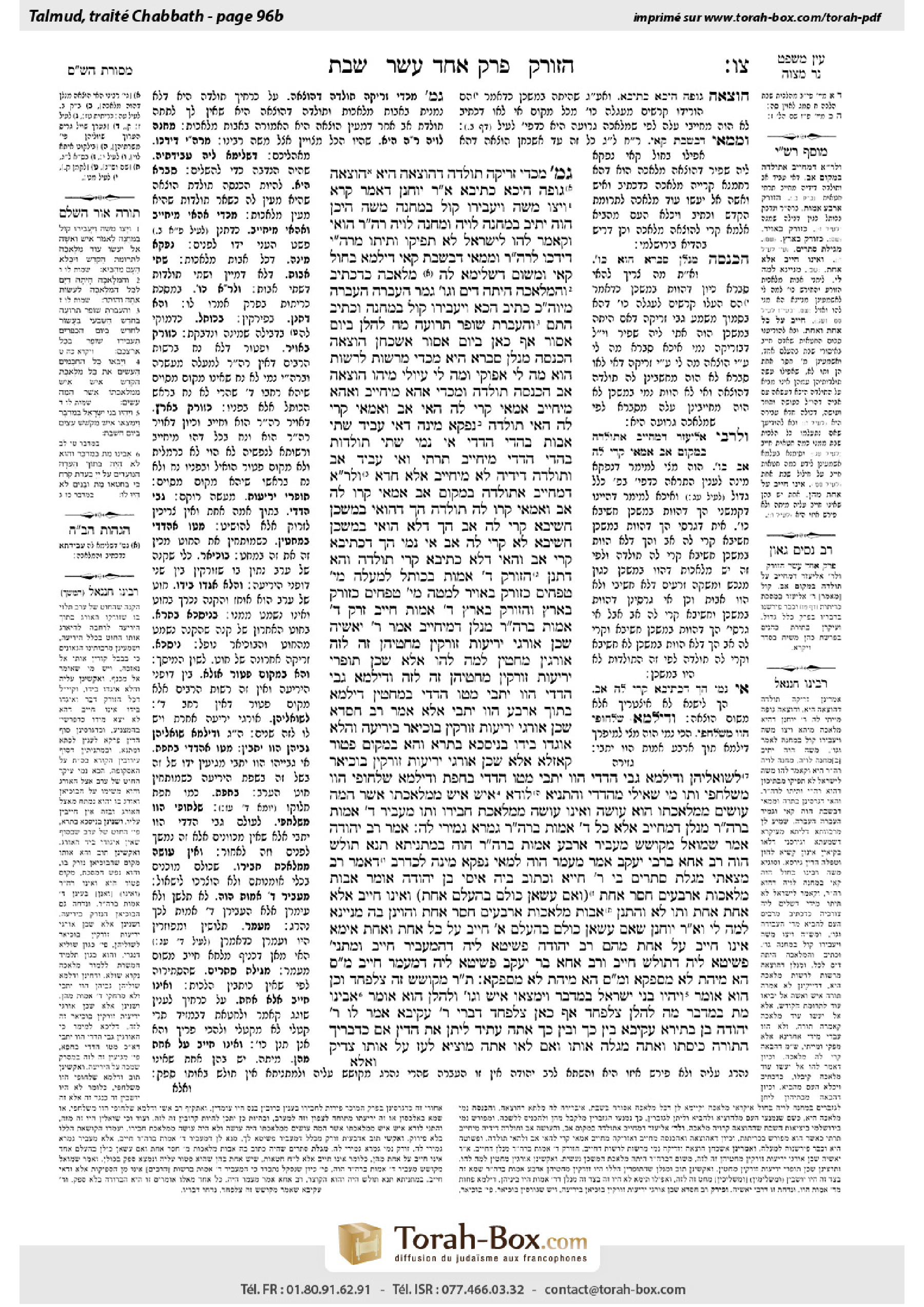
Shabbat 96b: Talmud study for Daf Yomi
Daf Yomi is the daily study of one Talmud folio. Explore 37 tractates with scans, Hebrew text, Sefaria English and AI-generated French translations where annotated.
Passage selection and English or AI-generated French translation are available where the scan has annotations. Daf Study is independent of Torah-Box and Sefaria.
Browse Shabbat · שבת · All tractatesShabbat 96b text and translations
This page of Shabbat includes the Aramaic text, an English translation and an AI-generated French translation, alongside the scan above.
שבת צ״ו ב · Aramaic and Hebrew text
גְּמָ׳ מִכְּדֵי זְרִיקָה תּוֹלָדָה דְהוֹצָאָה הִיא, הוֹצָאָה גּוּפַהּ הֵיכָא כְּתִיבָא? אָמַר רַבִּי יוֹחָנָן, דְּאָמַר קְרָא: ״וַיְצַו מֹשֶׁה וַיַּעֲבִירוּ קוֹל בַּמַּחֲנֶה״, מֹשֶׁה הֵיכָן הֲוָה יָתֵיב? — בְּמַחֲנֵה לְוִיָּה, וּמַחֲנֵה לְוִיָּה רְשׁוּת הָרַבִּים הֲוַאי, וְקָאֲמַר לְהוּ לְיִשְׂרָאֵל: לָא תַּפִּיקוּ וְתַיְתוֹ מֵרְשׁוּת הַיָּחִיד דִּידְכוּ לִרְשׁוּת הָרַבִּים.
וּמִמַּאי דִּבְשַׁבָּת קָאֵי? דִּילְמָא בְּחוֹל קָאֵי, וּמִשּׁוּם דִּשְׁלִימָא לַהּ מְלָאכָה, כְּדִכְתִיב: ״וְהַמְּלָאכָה הָיְתָה דַיָּם וְגוֹ׳״?! — גָּמַר ״הַעֲבָרָה״ ״הַעֲבָרָה״ מִיּוֹם הַכִּפּוּרִים:
כְּתִיב הָכָא: ״וַיַּעֲבִירוּ קוֹל בַּמַּחֲנֶה״, וּכְתִיב הָתָם: ״וְהַעֲבַרְתָּ שׁוֹפַר תְּרוּעָה״, מַה לְּהַלָּן — בַּיּוֹם אָסוּר, אַף כָּאן — בַּיּוֹם אָסוּר.
אַשְׁכְּחַן הוֹצָאָה, הַכְנָסָה מְנָלַן? סְבָרָא הִיא: מִכְּדֵי מֵרְשׁוּת לִרְשׁוּת הוּא, מָה לִי אַפּוֹקֵי וּמָה לִי עַיּוֹלֵי! מִיהוּ, הוֹצָאָה — אָב, הַכְנָסָה — תּוֹלָדָה.
וּמִכְּדֵי אַהָא מִיחַיַּיב וְאַהָא מִיחַיַּיב, אַמַּאי קָרֵי לַהּ הַאי ״אָב״, וְאַמַּאי קָרֵי לַהּ הַאי ״תּוֹלָדָה״?
נָפְקָא מִינַּהּ דְּאִי עָבֵיד שְׁתֵּי אָבוֹת בַּהֲדֵי הֲדָדֵי, אִי נָמֵי שְׁתֵּי תוֹלָדוֹת בַּהֲדֵי הֲדָדֵי — מִיחַיַּיב תַּרְתֵּי, וְאִי עָבֵיד אָב וְתוֹלָדָה דִידֵיהּ — לָא מִיחַיַּיב אֶלָּא חֲדָא.
וּלְרַבִּי אֱלִיעֶזֶר דִּמְחַיֵּיב אַתּוֹלָדָה בִּמְקוֹם אָב — אַמַּאי קָרוּ לַהּ ״אָב״, וְאַמַּאי קָרוּ לַהּ ״תּוֹלָדָה״? הָךְ דַּהֲוַאי בְּמִשְׁכָּן חֲשִׁיבָא — קָרֵי לַהּ ״אָב״, הָךְ דְּלָא הֲוַאי בַּמִּשְׁכָּן חֲשִׁיבָא — לָא קָרֵי לַהּ ״אָב״. אִי נָמֵי: הָךְ דִּכְתִיבָא — קָרֵי ״אָב״, וְהָךְ דְּלָא כְּתִיבָא קָרֵי ״תּוֹלָדָה״.
וְהָא דִּתְנַן: הַזּוֹרֵק אַרְבַּע אַמּוֹת בַּכּוֹתֶל, לְמַעְלָה מֵעֲשָׂרָה טְפָחִים — כְּזוֹרֵק בָּאֲוִיר. לְמַטָּה מֵעֲשָׂרָה טְפָחִים — כְּזוֹרֵק בָּאָרֶץ, וְהַזּוֹרֵק בָּאָרֶץ אַרְבַּע אַמּוֹת — חַיָּיב.
זָרַק אַרְבַּע אַמּוֹת בִּרְשׁוּת הָרַבִּים, מְנָלַן דְּמִיחַיַּיב? אָמַר רַבִּי יֹאשִׁיָּה: שֶׁכֵּן אוֹרְגֵי יְרִיעוֹת זוֹרְקִין מַחֲטֵיהֶן זֶה לָזֶה. אוֹרְגִין, מְחָטִין לְמָה לְהוּ? אֶלָּא, שֶׁכֵּן תּוֹפְרֵי יְרִיעוֹת זוֹרְקִין מַחֲטֵיהֶן זֶה לָזֶה.
וְדִילְמָא גַּבֵּי הֲדָדֵי הֲווֹ יָתְבִי?! מָטוּ הֲדָדֵי בְּמַחְטִין. דִּילְמָא בְּתוֹךְ אַרְבַּע הֲווֹ יָתְבִי?
אֶלָּא אָמַר רַב חִסְדָּא: שֶׁכֵּן אוֹרְגֵי יְרִיעוֹת זוֹרְקִין בּוּכְיָאר בַּיְּרִיעָה. וַהֲלֹא אוֹגְדּוֹ בְּיָדוֹ! — בְּנִיסְכָּא בָּתְרָא.
וְהָא בִּמְקוֹם פְּטוּר קָאָזְלָא! — אֶלָּא, שֶׁכֵּן אוֹרְגֵי יְרִיעוֹת זוֹרְקִין בּוּכְיָאר לְשׁוֹאֲלֵיהֶן. וְדִילְמָא גַּבֵּי הֲדָדֵי הֲווֹ יָתְבִי?! מָטוּ הֲדָדֵי בְּחֵפֶת.
וְדִילְמָא שַׁלְחוֹפֵי הֲווֹ מְשַׁלְחֲפִי?! וְתוּ, מִי שָׁאיְלִי מֵהֲדָדֵי? וְהָתָנֵי לוּדָּא: ״אִישׁ אִישׁ מִמְּלַאכְתּוֹ אֲשֶׁר הֵמָּה עֹשִׂים״ — מִמְּלַאכְתּוֹ הוּא עוֹשֶׂה וְאֵינוֹ עוֹשֶׂה מִמְּלֶאכֶת חֲבֵירוֹ!
וְתוּ: מַעֲבִיר אַרְבַּע אַמּוֹת בִּרְשׁוּת הָרַבִּים מְנָלַן דְּמִחַיַּיב? אֶלָּא: כׇּל אַרְבַּע אַמּוֹת בִּרְשׁוּת הָרַבִּים גְּמָרָא גְּמִירִי לַהּ.
אָמַר רַב יְהוּדָה אָמַר שְׁמוּאֵל: מְקוֹשֵׁשׁ, מַעֲבִיר אַרְבַּע אַמּוֹת בִּרְשׁוּת הָרַבִּים הֲוָה. בְּמַתְנִיתָא תָּנָא: תּוֹלֵשׁ הֲוָה. רַב אַחָא בְּרַבִּי יַעֲקֹב אָמַר: מְעַמֵּר הֲוָה.
לְמַאי נָפְקָא מִינַּהּ? לְכִדְרַב, דְּאָמַר רַב: מָצָאתִי מְגִלַּת סְתָרִים בֵּי רַבִּי חִיָּיא וְכָתוּב בָּהּ, אִיסִי בֶּן יְהוּדָה אוֹמֵר: אֲבוֹת מְלָאכוֹת אַרְבָּעִים חָסֵר אַחַת וְאִם עֲשָׂאָן כּוּלָּן בְּהֶעְלֵם אַחַת וְאֵינוֹ חַיָּיב אֶלָּא אַחַת. אַחַת וְתוּ לָא? וְהָתְנַן: אֲבוֹת מְלָאכוֹת אַרְבָּעִים חָסֵר אַחַת, וְהָוֵינַן בַּהּ: מִנְיָינָא לְמָה לִי? וְאָמַר רַבִּי יוֹחָנָן: שֶׁאִם עֲשָׂאָן כּוּלָּם בְּהֶעְלֵם אַחַת — חַיָּיב עַל כׇּל אַחַת וְאַחַת.
אֵימָא: אֵינוֹ חַיָּיב עַל אַחַת מֵהֶם.
רַב יְהוּדָה פְּשִׁיטָא לֵיהּ דְּהַמַּעֲבִיר חַיָּיב, וּמַתְנִיתִין פְּשִׁיטָא לֵיהּ דְּתוֹלֵשׁ חַיָּיב, וְרַב אַחָא בַּר יַעֲקֹב פְּשִׁיטָא לֵיהּ דִּמְעַמֵּר חַיָּיב. מָר סָבַר הָא מִיהַת לָא מְסַפְּקָא, וּמָר סָבַר הָא מִיהַת לָא מְסַפְּקָא.
תָּנוּ רַבָּנַן: מְקוֹשֵׁשׁ זֶה צְלָפְחָד, וְכֵן הוּא אוֹמֵר: ״וַיִּהְיוּ בְנֵי יִשְׂרָאֵל בַּמִּדְבָּר וַיִּמְצְאוּ אִישׁ וְגוֹ׳״, וּלְהַלָּן הוּא אוֹמֵר: ״אָבִינוּ מֵת בַּמִּדְבָּר״, מַה לְּהַלָּן צְלָפְחָד, אַף כָּאן צְלָפְחָד — דִּבְרֵי רַבִּי עֲקִיבָא.
אָמַר לוֹ רַבִּי יְהוּדָה בֶּן בְּתִירָא: עֲקִיבָא, בֵּין כָּךְ וּבֵין כָּךְ אַתָּה עָתִיד לִיתֵּן אֶת הַדִּין: אִם כִּדְבָרֶיךָ — הַתּוֹרָה כִּיסַּתּוּ, וְאַתָּה מְגַלֶּה אוֹתוֹ?! וְאִם לָאו — אַתָּה מוֹצִיא לַעַז עַל אוֹתוֹ צַדִּיק.
Shabbat 96b · English translation
GEMARA: With regard to the main issue, the Gemara asks: After all, throwing is a subcategory of carrying out. Where is the primary category of prohibited labor of carrying out itself written in the Torah? Isn’t it necessary to clarify the primary category before discussing the subcategory? Rabbi Yoḥanan said: As the verse said: “And Moses commanded, and they passed a proclamation throughout the camp saying: Neither man nor woman should perform any more work to contribute to the Sanctuary; and the people stopped bringing” (Exodus 36:6). According to Rabbi Yoḥanan, Moses commanded the people to cease bringing contributions in order to prevent them from bringing their contributions on Shabbat. He then explains: Where was Moses sitting? He was in the camp of the Levites, and the Levites’ camp was the public domain. And he said to Israel: Do not carry out and bring objects from the private domain, your camp, to the public domain, the camp of the Levites.
The Gemara asks: And how do you know that he was standing and commanding the people on Shabbat? Perhaps he was standing during the week, and Moses commanded the cessation of contributions because the labor of the Tabernacle was completed, since all the necessary material was already donated, as it is written: “And the work was sufficient for them for all of the work to perform it, and there was extra” (Exodus 36:7). Rather, derive this by means of a verbal analogy between passing mentioned in this context and passing mentioned with regard to Yom Kippur.
It is written here, with regard to the Tabernacle: “And they passed a proclamation throughout the camp,” and it is written there, with regard to Yom Kippur: “And you shall pass a blast of a shofar on the tenth day of the seventh month, on Yom Kippur you shall sound a shofar throughout your land” (Leviticus 25:9). Just as there, with regard to the shofar of the Jubilee Year, passing is on a day on which it is prohibited to perform labor, so too, here passing is on a day on which it is prohibited to perform labor.
The Gemara asks: We found a source prohibiting carrying out from a private domain into the camp of the Levites. From where do we derive that carrying in is also considered a prohibited labor? The Gemara answers: It is a logical inference. After all, carrying is from one domain to another, so what difference is there to me whether it is carrying out or carrying in? Carrying from one domain to another is prohibited; the direction in which the object is carried makes no difference. However, carrying out is a primary category, while carrying in is a subcategory, as it is not stated explicitly in the biblical text.
The Gemara now questions the distinction between primary categories and subcategories of labor. After all, one is liable for this, carrying out, and one is liable for that, carrying in. Why is this called a primary category, and why is this called a subcategory? What is the point of the distinction?
The Gemara answers: The practical ramification is that if one performs two different primary categories together, or alternatively, if one performs two subcategories of two different primary categories together, he is liable to bring two sin-offerings. And if one performs a primary category of labor together with its own subcategory, he is liable to bring only one sin-offering.
The Gemara further asks: And according to the opinion of Rabbi Eliezer, who renders one liable for the performance of a subcategory of prohibited labor when performed together with a primary category, why is this called a primary category, and why is this called a subcategory? The Gemara answers: According to him, that which was a significant labor in the Tabernacle is called a primary category; that which was not a significant labor in the Tabernacle is not called a primary category. Alternatively, perhaps that which is written explicitly in the Torah is called a primary category, and that which is not written explicitly in the Torah is called a subcategory.
And as for the halakha that we learned in a mishna: With regard to one who throws an object on Shabbat a distance of four cubits in the public domain and it lands on a wall, if the wall was higher than ten handbreadths, it is as if he threw it into the air, and he is exempt. If the wall was lower than ten handbreadths, it is as if he threw it onto the ground, and one who throws an object a distance of four cubits onto the ground in the public domain is liable.
The Gemara asks: If one threw an object four cubits in the public domain, and it did not go from one domain to another, from where do we derive that he is liable? The Gemara answers: Rabbi Yoshiya said: Because the weavers of the tapestries in the Tabernacle throw their needles to each other when they need to borrow the other’s needle. Throwing was a labor performed in the Tabernacle; therefore, one is liable for performing it. The Gemara wonders: Why do weavers need needles? Rather, emend the statement to say: Because those who sewed the tapestries throw their needles to each other.
The Gemara asks: Is it clear that they had to throw needles to each other? Perhaps they sat next to each other. The Gemara answers: It is clear that they kept their distance from each other. If they sat too close, they would reach each other and hurt one another with their needles. The Gemara asks: Perhaps, even though they kept their distance, they sat within four cubits of each other, and they would not throw the needles farther than that. In the absence of proof of their sitting arrangement, this halakha cannot be derived from those who sewed the tapestries.
Rather, Rav Ḥisda said: Throwing an object four cubits in the public domain is prohibited because the weavers of the tapestries in the Tabernacle threw the shuttle, to which the thread of the warp was tied on the tapestry. Weaving entails throwing the thread of the warp through the threads of the woof. The Gemara asks: That is not actually throwing, as didn’t the weaver hold the end of the thread in his hand? One is not liable for throwing an object when part of it remains in his hand. Rather, this must be referring to the final throw, when the weaving was finished and the weaver released the thread from his hand.
The Gemara asks: Doesn’t the shuttle go in an exempt domain? The tapestry was less than four handbreadths wide, rendering it an exempt domain even though it is four cubits long. One who throws in an exempt domain is exempt. Rather, it is because the weavers of tapestries throw the shuttle to those who seek to borrow it from them. The Gemara asks: But perhaps they sat next to each other? The Gemara answers: That is impossible because they would reach one another and disturb one another when tightening the thread at the end of the tapestry.
The Gemara asks: And perhaps they were not in a straight line but staggered. That would enable the weavers to sit adjacent to each other without disturbing each other’s work. And furthermore, did they borrow from each another? Wasn’t the following taught in a baraita of the Sage Luda? The verse states: “And all the wise men who performed all of the work of the Sanctuary came, each one from the work he was doing” (Exodus 36:4). From that verse it is derived: Each performed the labor from his own work, and they would not perform the labor from their friends’ work. Each person had his own tools and did not need to borrow from others.
And furthermore, the Gemara asks: Even if the halakha of throwing was derived from here, from where do we derive that one who carries an object four cubits in the public domain is liable? Rather, apparently, this halakha is not derived from the labor performed in the construction of the Tabernacle. Rather, all the halakhot related to carrying four cubits in the public domain are learned through tradition and not derived from the text.
Rav Yehuda said that Shmuel said: The wood gatherer who was sentenced to death for desecrating Shabbat (see Numbers 15:33–36) was one who carried four cubits in the public domain. He was stoned for performing the prohibited labor of carrying. It was taught in a baraita: He was one who detached still-growing branches. He was stoned for performing the prohibited labor of detaching. Rav Aḥa, son of Rabbi Ya’akov, said: He was one who gathered sticks together into a pile.
The Gemara asks: What is the practical ramification of determining precisely which prohibited labor the wood gatherer performed? The Gemara answers: The ramification is with regard to the statement of Rav, as Rav said: I found a hidden scroll in the house of Rabbi Ḥiyya. And in it, it is written that Isi ben Yehuda says: The number of primary categories of labor prohibited on Shabbat is forty-less-one. And if one performed all of them in the course of one lapse of awareness, he is liable to bring only one sin-offering. The Gemara asks: One and no more? We learned in a mishna: The number of primary categories of prohibited labors on Shabbat is forty-less-one, which the mishna proceeds to list. And we discussed this mishna: Why do I need this tally of forty-less-one? And Rabbi Yoḥanan said: The tally was included to teach that if one performed all the prohibited labors in the course of one lapse of awareness, during which he was unaware of the prohibition involved, he is liable for each and every one.
This citation from the hidden scroll cannot be accurate. Rather, emend this statement in the hidden scroll and say that one is not liable for one of them. There is a primary category of labor among the thirty-nine primary categories of prohibited labor whose violation does not incur the death penalty. The identity of this category that is not punishable by death was not specified.
It is obvious to Rav Yehuda that one who carries four cubits in the public domain is liable to receive the death penalty. And it is obvious to the baraita that one who detaches is liable to receive the death penalty. And it is obvious to Rav Aḥa bar Ya’akov that one who gathers is liable to receive the death penalty. In other words, this Master maintains: With regard to this labor, in any case, there is no uncertainty. And this Master maintains: With regard to that labor, in any case, there is no uncertainty. Each Sage maintains that the prohibited labor that he attributed to the wood gatherer incurs the death penalty and is certainly not the labor referred to in the hidden scroll.
On the topic of the wood gatherer, the Gemara cites that which the Sages taught in a baraita: The wood gatherer mentioned in the Torah was Zelophehad, and it says: “And the children of Israel were in the desert and they found a man gathering wood on the day of Shabbat” (Numbers 15:32), and below, in the appeal of the daughters of Zelophehad, it is stated: “Our father died in the desert and he was not among the company of them that gathered themselves together against the Lord in the company of Korah, but he died in his own sin, and he had no sons” (Numbers 27:3). Just as below the man in the desert is Zelophehad, so too, here, in the case of the wood gatherer, the unnamed man in the desert is Zelophehad; this is the statement of Rabbi Akiva.
Rabbi Yehuda ben Beteira said to him: Akiva, in either case you will be judged in the future for this teaching. If the truth is in accordance with your statement that the wood gatherer was Zelophehad, the Torah concealed his identity, and you reveal it. And if it the truth is not in accordance with your statement, you are unjustly slandering that righteous man.
Shabbat 96b · Traduction française (IA)
GUEMARA : À propos de la question principale, la Guemara demande : Après tout, le lancer est une sous-catégorie du transport hors d’un domaine. Où la Torah écrite mentionne-t-elle la catégorie principale de travail interdit qu’est le transport hors d’un domaine lui-même ? Ne faut-il pas préciser la catégorie principale avant de discuter de la sous-catégorie ? Rabbi Yoḥanan dit : Comme le dit le verset : « Moïse donna un ordre, et l’on fit proclamer dans le camp : “Que ni homme ni femme ne fasse plus de travail pour apporter une contribution au Sanctuaire.” Et le peuple cessa d’apporter » (Exode 36,6). Selon Rabbi Yoḥanan, Moïse ordonna au peuple de cesser d’apporter des contributions afin d’éviter qu’il ne les apporte pendant Chabbat. Il explique alors : Où Moïse était-il assis ? Dans le camp des Lévites, qui constituait le domaine public. Il dit aux enfants d’Israël : Ne transportez pas d’objets hors de votre domaine privé, votre camp, pour les apporter dans le domaine public, le camp des Lévites.
La Guemara demande : Et d’où sait-on qu’il se tenait là et ordonnait au peuple de cesser d’apporter des contributions pendant Chabbat ? Peut-être se tenait-il là en semaine, et Moïse ordonna-t-il l’arrêt des contributions parce que les travaux du Tabernacle étaient achevés, puisque tout le matériel nécessaire avait déjà été donné, comme il est écrit : « Le matériel était suffisant pour tout le travail à accomplir, et il y en avait en trop » (Exode 36,7). Il faut plutôt le déduire au moyen d’une analogie verbale entre le terme « proclamation », mentionné ici, et le même terme, mentionné à propos de Yom Kippour.
Il est écrit ici, à propos du Tabernacle : « Et l’on fit proclamer dans le camp », et il est écrit là, à propos de Yom Kippour : « Tu feras retentir le son du shofar le dixième jour du septième mois ; le jour de Yom Kippour, vous ferez retentir le shofar dans tout votre pays » (Lévitique 25,9). De même que là, à propos du shofar de l’année jubilaire, la proclamation a lieu un jour où il est interdit d’accomplir des travaux, de même ici, la proclamation a lieu un jour où il est interdit d’accomplir des travaux.
La Guemara demande : Nous avons trouvé une source interdisant de transporter un objet depuis un domaine privé vers le camp des Lévites. D’où déduit-on que le transport vers l’intérieur est également considéré comme un travail interdit ? La Guemara répond : Cela se déduit par logique. Après tout, transporter consiste à passer d’un domaine à un autre ; quelle différence cela fait-il que l’on transporte vers l’extérieur ou vers l’intérieur ? Le transport d’un domaine à un autre est interdit, quelle que soit la direction dans laquelle l’objet est transporté. Cependant, le transport vers l’extérieur est une catégorie principale, tandis que le transport vers l’intérieur est une sous-catégorie, puisqu’il n’est pas explicitement mentionné dans le texte biblique.
La Guemara remet maintenant en question la distinction entre catégories principales et sous-catégories de travaux. Après tout, on est passible d’une sanction pour ceci, le transport vers l’extérieur, et on est passible d’une sanction pour cela, le transport vers l’intérieur. Pourquoi ceci est-il appelé une catégorie principale et cela une sous-catégorie ? À quoi sert cette distinction ?
La Guemara répond : La conséquence pratique est que si quelqu’un accomplit deux catégories principales différentes ensemble, ou bien deux sous-catégories relevant de deux catégories principales différentes, il est tenu d’apporter deux sacrifices expiatoires. En revanche, s’il accomplit ensemble une catégorie principale de travail et sa propre sous-catégorie, il n’est tenu d’apporter qu’un seul sacrifice expiatoire.
La Guemara demande en outre : Et selon l’opinion de Rabbi Eliezer, qui rend passible d’une sanction celui qui accomplit une sous-catégorie de travail interdit en même temps qu’une catégorie principale, pourquoi ceci est-il appelé une catégorie principale et cela une sous-catégorie ? La Guemara répond : Selon lui, un travail qui était important dans le Tabernacle est appelé catégorie principale ; un travail qui n’y était pas important n’est pas appelé catégorie principale. Autre possibilité : ce qui est explicitement écrit dans la Torah est appelé catégorie principale, et ce qui n’y est pas explicitement écrit est appelé sous-catégorie.
Et quant à la halakha que nous avons apprise dans une Michna : celui qui lance un objet sur une distance de quatre coudées dans le domaine public et le fait tomber sur un mur, si le mur dépasse dix palmes de hauteur, c’est comme s’il l’avait lancé dans les airs et il est exempt. Si le mur fait moins de dix palmes de hauteur, c’est comme s’il l’avait lancé sur le sol ; or celui qui lance un objet sur une distance de quatre coudées jusqu’au sol dans le domaine public est passible d’une sanction.
La Guemara demande : Si quelqu’un lance un objet sur une distance de quatre coudées dans le domaine public sans le faire passer d’un domaine à un autre, d’où déduit-on qu’il est passible d’une sanction ? Rabbi Yoshiya dit : Les tisserands des tentures du Tabernacle se lançaient leurs aiguilles lorsqu’ils avaient besoin d’emprunter celle de l’autre. Le lancer était donc un travail effectué dans le Tabernacle ; c’est pourquoi celui qui l’accomplit est passible d’une sanction. La Guemara s’étonne : Pourquoi des tisserands auraient-ils besoin d’aiguilles ? Il faut plutôt corriger la formulation et dire que ceux qui cousaient les tentures se lançaient leurs aiguilles.
La Guemara demande : Est-il certain qu’ils devaient se lancer leurs aiguilles ? Peut-être étaient-ils assis côte à côte. La Guemara répond : Il est certain qu’ils se tenaient à distance les uns des autres. S’ils s’étaient assis trop près, ils se seraient atteints et blessés avec leurs aiguilles. La Guemara demande : Peut-être que, malgré cette distance, ils étaient assis à moins de quatre coudées les uns des autres et ne lançaient pas les aiguilles plus loin. Faute de preuve quant à la disposition de leurs sièges, on ne peut pas déduire cette halakha de ceux qui cousaient les tentures.
Rav Ḥisda dit plutôt : Le lancer d’un objet sur une distance de quatre coudées dans le domaine public est interdit parce que les tisserands des tentures du Tabernacle lançaient la navette, à laquelle était attaché le fil de chaîne de la tenture. Le tissage consiste à faire passer le fil de chaîne à travers les fils de trame. La Guemara demande : Ce n’est pas véritablement un lancer, car le tisserand ne tenait-il pas l’extrémité du fil dans sa main ? On n’est pas passible d’une sanction pour avoir lancé un objet lorsqu’une partie de celui-ci reste dans sa main. Il faut plutôt comprendre qu’il s’agit du dernier lancer, lorsque le tissage était achevé et que le tisserand lâchait le fil.
La Guemara demande : La navette ne se déplaçait-elle pas dans un domaine exempt ? La tenture faisait moins de quatre palmes de largeur, ce qui en faisait un domaine exempt, même si elle mesurait quatre coudées de long. Celui qui lance un objet dans un domaine exempt est exempt. Il faut plutôt dire que les tisserands des tentures lançaient la navette à ceux qui souhaitaient la leur emprunter. La Guemara demande : Mais peut-être étaient-ils assis côte à côte ? La Guemara répond : C’est impossible, car ils se seraient atteints et gênés lorsqu’ils tendaient le fil à l’extrémité de la tenture.
La Guemara demande : Et peut-être n’étaient-ils pas alignés, mais disposés en quinconce. Ainsi, les tisserands auraient pu s’asseoir les uns à côté des autres sans gêner leur travail respectif. En outre, s’empruntaient-ils des objets les uns aux autres ? N’est-il pas enseigné dans une baraïta du tanna Luda : Le verset dit : « Tous les sages qui accomplissaient tous les travaux du Sanctuaire vinrent, chacun depuis le travail qu’il faisait » (Exode 36,4). On déduit de ce verset que chacun accomplissait le travail qui lui était propre et ne faisait pas celui de ses collègues. Chacun avait ses propres outils et n’avait pas besoin d’en emprunter aux autres.
La Guemara demande en outre : Même si l’on déduisait d’ici la halakha relative au lancer, d’où déduirait-on que celui qui transporte un objet sur une distance de quatre coudées dans le domaine public est passible d’une sanction ? Il semble donc que cette halakha ne se déduise pas du travail effectué lors de la construction du Tabernacle. Toutes les halakhot relatives au transport sur une distance de quatre coudées dans le domaine public sont plutôt transmises par tradition et ne sont pas déduites du texte.
Rav Yehouda dit au nom de Chmouel : Le ramasseur de bois qui fut condamné à mort pour avoir profané Chabbat (voir Nombres 15,33–36) était quelqu’un qui avait transporté un objet sur une distance de quatre coudées dans le domaine public. Il fut lapidé pour avoir accompli le travail interdit de transport. Une baraïta enseigne qu’il avait arraché des branches encore en croissance. Il fut lapidé pour avoir accompli le travail interdit d’arrachage. Rav Aḥa, fils de Rabbi Ya’akov, dit : Il avait rassemblé des bâtons en un tas.
La Guemara demande : Quelle est la conséquence pratique du fait de déterminer précisément quel travail interdit le ramasseur de bois avait accompli ? La Guemara répond : Cela a une conséquence pour l’enseignement de Rav, car Rav dit : J’ai trouvé un rouleau caché dans la maison de Rabbi Ḥiyya. Il y est écrit qu’Isi ben Yehouda dit : Le nombre de catégories principales de travaux interdits le Chabbat est de trente-neuf. Si quelqu’un les accomplit toutes au cours d’une seule inadvertance, il n’est tenu d’apporter qu’un seul sacrifice expiatoire. La Guemara demande : Un seul, et pas davantage ? Nous avons appris dans une Michna : Le nombre de catégories principales de travaux interdits le Chabbat est de trente-neuf, et la Michna les énumère. Nous avons alors demandé à propos de cette Michna : Pourquoi mentionner ce total de trente-neuf ? Rabbi Yoḥanan a dit : Ce décompte a été inclus pour enseigner que si quelqu’un accomplit tous les travaux interdits au cours d’une seule inadvertance, alors qu’il ignorait l’interdiction en cause, il est passible d’une sanction pour chacun d’eux.
Cette citation du rouleau caché ne peut pas être exacte. Il faut plutôt corriger son énoncé et dire que l’on n’est pas passible d’une sanction pour l’un d’entre eux. Parmi les trente-neuf catégories principales de travaux interdits, il y en a une dont la transgression n’entraîne pas la peine de mort. L’identité de cette catégorie non punissable de la peine de mort n’a pas été précisée.
Pour Rav Yehouda, il est évident que celui qui transporte un objet sur une distance de quatre coudées dans le domaine public est passible de la peine de mort. Pour la baraïta, il est évident que celui qui arrache est passible de la peine de mort. Et pour Rav Aḥa bar Ya’akov, il est évident que celui qui rassemble est passible de la peine de mort. Autrement dit, ce Sage estime qu’en ce qui concerne ce travail, il n’y a aucune incertitude ; cet autre Sage estime qu’en ce qui concerne cet autre travail, il n’y a aucune incertitude. Chacun de ces Sages estime que le travail interdit qu’il attribue au ramasseur de bois entraîne la peine de mort et ne peut donc certainement pas être le travail visé dans le rouleau caché.
À propos du ramasseur de bois, la Guemara cite ce que les Sages enseignent dans une baraïta : Le ramasseur de bois mentionné dans la Torah était Tselofḥad. Il est dit : « Les enfants d’Israël étaient dans le désert et ils trouvèrent un homme qui ramassait du bois le jour du Chabbat » (Nombres 15,32). Et plus loin, dans la requête des filles de Tselofḥad, il est dit : « Notre père est mort dans le désert ; il ne faisait pas partie de la bande de ceux qui s’étaient ligués contre l’Éternel, de la bande de Koré ; il est mort pour son propre péché et il n’avait pas de fils » (Nombres 27,3). De même que, plus loin, l’homme dans le désert est Tselofḥad, de même ici, dans le récit du ramasseur de bois, l’homme anonyme dans le désert est Tselofḥad. Telle est la déclaration de Rabbi Akiva.
Rabbi Yehouda ben Beteira lui dit : Akiva, dans tous les cas, tu devras répondre un jour de cet enseignement. Si tu as raison d’affirmer que le ramasseur de bois était Tselofḥad, la Torah a dissimulé son identité et toi, tu la révèles. Et si tu as tort, tu diffames injustement cet homme juste.
Traduction française générée par IA à partir de l’édition anglaise de Sefaria. Vérifie toujours un passage avec le texte source.
Text from Sefaria: William Davidson Edition - Vocalized Aramaic (CC BY NC); William Davidson Edition - English (CC BY NC).