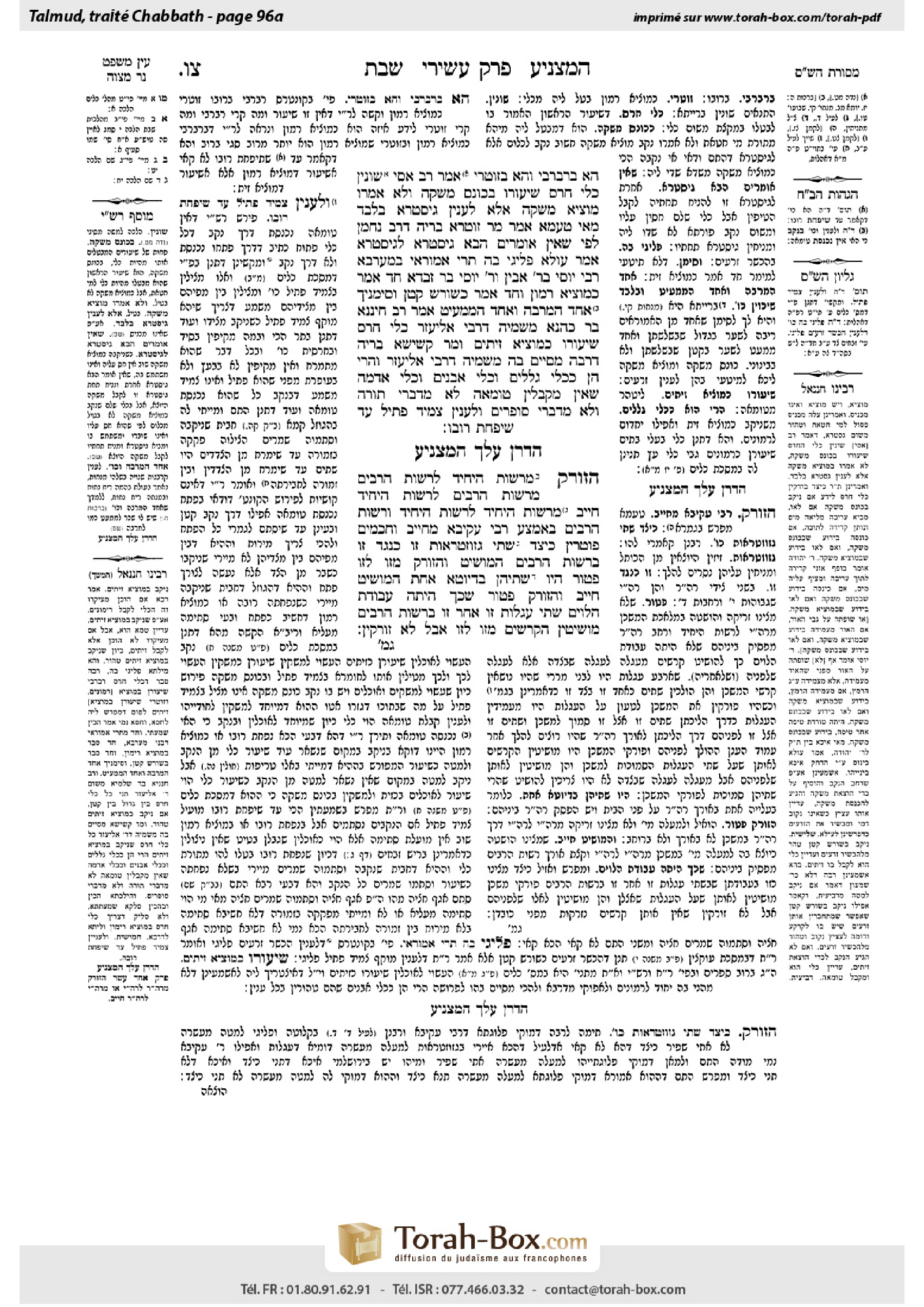
Shabbat 96a: Talmud study for Daf Yomi
Daf Yomi is the daily study of one Talmud folio. Explore 37 tractates with scans, Hebrew text, Sefaria English and AI-generated French translations where annotated.
Passage selection and English or AI-generated French translation are available where the scan has annotations. Daf Study is independent of Torah-Box and Sefaria.
Browse Shabbat · שבת · All tractatesShabbat 96a text and translations
This page of Shabbat includes the Aramaic text, an English translation and an AI-generated French translation, alongside the scan above.
שבת צ״ו א · Aramaic and Hebrew text
הָא בְּרַבְרְבֵי, וְהָא בְּזוּטְרֵי. אָמַר רַב אַסִּי, שׁוֹנִין: כְּלֵי חֶרֶס שִׁיעוּרוֹ בְּכוֹנֵס מַשְׁקֶה. וְלֹא אָמְרוּ מוֹצִיא מַשְׁקֶה אֶלָּא לְעִנְיַן גִּיסְטְרָא בִּלְבַד. מַאי טַעְמָא? אָמַר מָר זוּטְרָא בְּרֵיהּ דְּרַב נַחְמָן: לְפִי, שֶׁאֵין אוֹמְרִים ״הָבֵא גִּיסְטְרָא לְגִיסְטְרָא״.
אָמַר עוּלָּא: פְּלִיגִי בַּהּ תְּרֵי אָמוֹרָאֵי בְּמַעְרְבָא, רַבִּי יוֹסֵי בְּרַבִּי אָבִין וְרַבִּי יוֹסֵי בַּר זַבְדָּא. חַד אָמַר כְּמוֹצִיא רִמּוֹן, וְחַד אָמַר: כְּשׁוֹרֶשׁ קָטָן. וְסִימָנָיךְ, אֶחָד הַמַּרְבֶּה וְאֶחָד הַמַּמְעִיט. אָמַר רַב חִינָּנָא בַּר כָּהֲנָא מִשְּׁמֵיהּ דְּרַבִּי אֱלִיעֶזֶר: כְּלִי חֶרֶס שִׁיעוּרוֹ כְּמוֹצִיא זֵיתִים. וּמָר קַשִּׁישָׁא בְּרֵיהּ דְּרַבָּה מְסַיֵּים בַּהּ מִשְּׁמֵיהּ דְּרַבִּי אֱלִיעֶזֶר: וַהֲרֵי הֵן כִּכְלֵי גְלָלִים וּכְלֵי אֲבָנִים וּכְלֵי אֲדָמָה — שֶׁאֵין מְקַבְּלִין טוּמְאָה לֹא מִדִּבְרֵי תוֹרָה וְלֹא מִדִּבְרֵי סוֹפְרִים. וּלְעִנְיַן צָמִיד פָּתִיל, עַד שֶׁיִּפְחַת רוּבּוֹ.
הדרן עלך המצניע
מַתְנִי׳ הַזּוֹרֵק מֵרְשׁוּת הַיָּחִיד לִרְשׁוּת הָרַבִּים, מֵרְשׁוּת הָרַבִּים לִרְשׁוּת הַיָּחִיד — חַיָּיב. מֵרְשׁוּת הַיָּחִיד לִרְשׁוּת הַיָּחִיד וּרְשׁוּת הָרַבִּים בָּאֶמְצַע — רַבִּי עֲקִיבָא מְחַיֵּיב, וַחֲכָמִים פּוֹטְרִין.
כֵּיצַד? שְׁתֵּי גְזוּזְטְרָאוֹת זוֹ כְּנֶגֶד זוֹ בִּרְשׁוּת הָרַבִּים, הַמּוֹשִׁיט וְהַזּוֹרֵק מִזּוֹ לָזוֹ — פָּטוּר, הָיוּ שְׁתֵּיהֶן בִּדְיוֹטָא אַחַת — הַמּוֹשִׁיט חַיָּיב וְהַזּוֹרֵק פָּטוּר, שֶׁכָּךְ הָיְתָה עֲבוֹדַת הַלְוִיִּם.
שְׁתֵּי עֲגָלוֹת זוֹ אַחַר זוֹ בִּרְשׁוּת הָרַבִּים, מוֹשִׁיטִין הַקְּרָשִׁים מִזּוֹ לָזוֹ, אֲבָל לֹא זוֹרְקִין.
Shabbat 96a · English translation
This statement, that a hole must be large enough to enable a pomegranate to go out in order to purify the vessel, is referring to large vessels. And this statement, that teaches that a vessel is purified only when the majority of the vessel is broken, is referring to small vessels. Rav Asi said that they teach this halakha: With regard to an earthenware vessel, the measure of the hole that renders it unable to become ritually impure is large enough to enable liquid to enter it. And they only said: The measure of a small hole from which liquid seeps, with regard to the impurity of a shard [gistera]. The Gemara asks: What is the reason for this? The Gemara answers that Mar Zutra, son of Rav Naḥman, said: A shard is used as a plate beneath a perforated earthenware vessel. If the shard is also perforated and leaks, it is no longer of any use. Because one does not say: Bring another shard to seal the leak of a shard, but throws it out immediately.
Ulla said: Two amora’im in the West, Eretz Yisrael, disagree about this topic: They are Rabbi Yosei, son of Rabbi Avin, and Rabbi Yosei bar Zavda. One said: The measure of a hole that purifies an earthenware vessel is large enough to enable a pomegranate to go out. And one said: The size of a small root. And your mnemonic to remember that neither holds that the measure is size of an olive is the expression: Both one who increases and one who decreases. They hold extreme positions in this dispute and eschew the intermediate position. Rav Ḥinnana bar Kahana said an intermediate position in the name of Rabbi Eliezer: An earthenware vessel becomes ritually pure with a hole large enough to enable olives to go out. And Mar Kashisha, son of Rabba, concluded this halakha in the name of Rabbi Eliezer: And vessels that have been perforated are like dung vessels, and so too, stone vessels and earth vessels that were not baked in a kiln, which neither become impure by Torah law nor by rabbinic law. And, as far as the matter of an earthenware vessel with a sealed cover in a room with a corpse, it maintains its impurity until the majority of it is broken.
MISHNA: One who throws an object on Shabbat from the private domain to the public domain or from the public domain to the private domain is liable. However, one who throws an object from the private domain to the other private domain, and the object passes through the public domain between the two, Rabbi Akiva deems him liable for carrying into the public domain, and the Rabbis deem him exempt.
How so? If there are two balconies [gezuztra’ot] that are private domains opposite each other on either side of the public domain, one who passes or throws an object from the one on this side to the one on that side is exempt. However, if the balconies were on the same level on the same side of the public thoroughfare, and the public domain separated the two, one who passes from one to the other is liable, and one who throws is exempt, as that method, passing, was the service of the Levites who carried the beams of the Tabernacle.
In the Tabernacle, two wagons along the same level stood behind one another in the public domain, and the Levites passed the beams from one wagon to the other through the public domain on the same side of a thoroughfare. But they did not throw from one wagon to another because the beams were heavy. Passing, which was performed in the Tabernacle, is prohibited. Throwing, which was not performed in the Tabernacle, is not prohibited.
Shabbat 96a · Traduction française (IA)
Cette déclaration, selon laquelle le trou doit être assez grand pour laisser sortir une grenade afin que le récipient soit purifié, concerne les grands récipients. L’autre déclaration, qui enseigne qu’un récipient n’est purifié que lorsque la majeure partie en est brisée, concerne les petits récipients. Rav Asi dit que cette halakha s’enseigne au sujet d’un récipient en terre cuite : le trou qui le rend incapable de contracter l’impureté rituelle doit être assez grand pour laisser entrer un liquide. La mesure d’un petit trou par lequel un liquide s’écoule ne s’applique qu’à l’impureté d’un tesson [gistera]. La Guemara demande : Quelle en est la raison ? La Guemara répond que Mar Zutra, fils de Rav Naḥman, dit : un tesson sert de soucoupe sous un récipient en terre cuite perforé. Si le tesson est lui aussi percé et fuit, il ne sert plus à rien, car on ne dit pas : « Apportez un autre tesson pour boucher la fuite d’un tesson » ; on le jette aussitôt.
Oulla dit : deux amoraïm d’Occident, c’est-à-dire d’Erets Israël, sont en désaccord sur ce sujet : Rabbi Yosei, fils de Rabbi Avin, et Rabbi Yosei bar Zavda. L’un dit que le trou qui purifie un récipient en terre cuite doit être assez grand pour laisser sortir une grenade ; l’autre dit qu’il doit être de la taille d’une petite racine. Le moyen mnémotechnique pour se rappeler qu’aucun des deux ne soutient que la mesure est celle d’une olive est l’expression : « l’un augmente et l’autre diminue ». Ils défendent des positions extrêmes dans cette controverse et écartent la position intermédiaire. Rav Ḥinnana bar Kahana enseigne une position intermédiaire au nom de Rabbi Eliezer : un récipient en terre cuite est purifié rituellement si son trou est assez grand pour laisser sortir des olives. Mar Kashisha, fils de Rabba, conclut cette halakha au nom de Rabbi Eliezer : les récipients perforés sont comme des récipients à fumier ; il en va de même des récipients en pierre et des récipients en terre qui n’ont pas été cuits dans un four. Ceux-ci ne peuvent contracter l’impureté ni selon la Torah ni selon la loi rabbinique. Quant au cas d’un récipient en terre cuite muni d’un couvercle scellé, dans une pièce où se trouve un cadavre, il reste impur jusqu’à ce que la majeure partie en soit brisée.
MICHNA : Celui qui lance un objet, le Chabbat, du domaine privé au domaine public ou du domaine public au domaine privé est passible. En revanche, celui qui lance un objet d’un domaine privé à un autre domaine privé, en le faisant passer par le domaine public qui les sépare, Rabbi Akiva le déclare passible d’avoir transporté un objet dans le domaine public, tandis que les Sages le déclarent quitte.
Comment cela ? Si deux balcons [gezuztra’ot], qui sont des domaines privés, se font face de part et d’autre du domaine public, celui qui fait passer ou lance un objet du balcon situé de ce côté vers celui situé de l’autre côté est quitte. En revanche, si les balcons se trouvent au même niveau et du même côté de la voie publique, et que le domaine public sépare les deux, celui qui fait passer un objet de l’un à l’autre est passible, tandis que celui qui le lance est quitte, car le fait de faire passer l’objet était la méthode employée par les Lévites, qui transportaient les poutres du Tabernacle.
Dans le Tabernacle, deux chariots se trouvaient au même niveau, l’un derrière l’autre, dans le domaine public, et les Lévites faisaient passer les poutres d’un chariot à l’autre par le domaine public, du même côté de la voie publique. Mais ils ne lançaient pas les poutres d’un chariot à l’autre, car elles étaient lourdes. Le fait de les faire passer, pratique qui avait cours dans le Tabernacle, est interdit. Le fait de les lancer, pratique qui n’avait pas cours dans le Tabernacle, n’est pas interdit.
Traduction française générée par IA à partir de l’édition anglaise de Sefaria. Vérifie toujours un passage avec le texte source.
Text from Sefaria: William Davidson Edition - Vocalized Aramaic (CC BY NC); William Davidson Edition - English (CC BY NC).