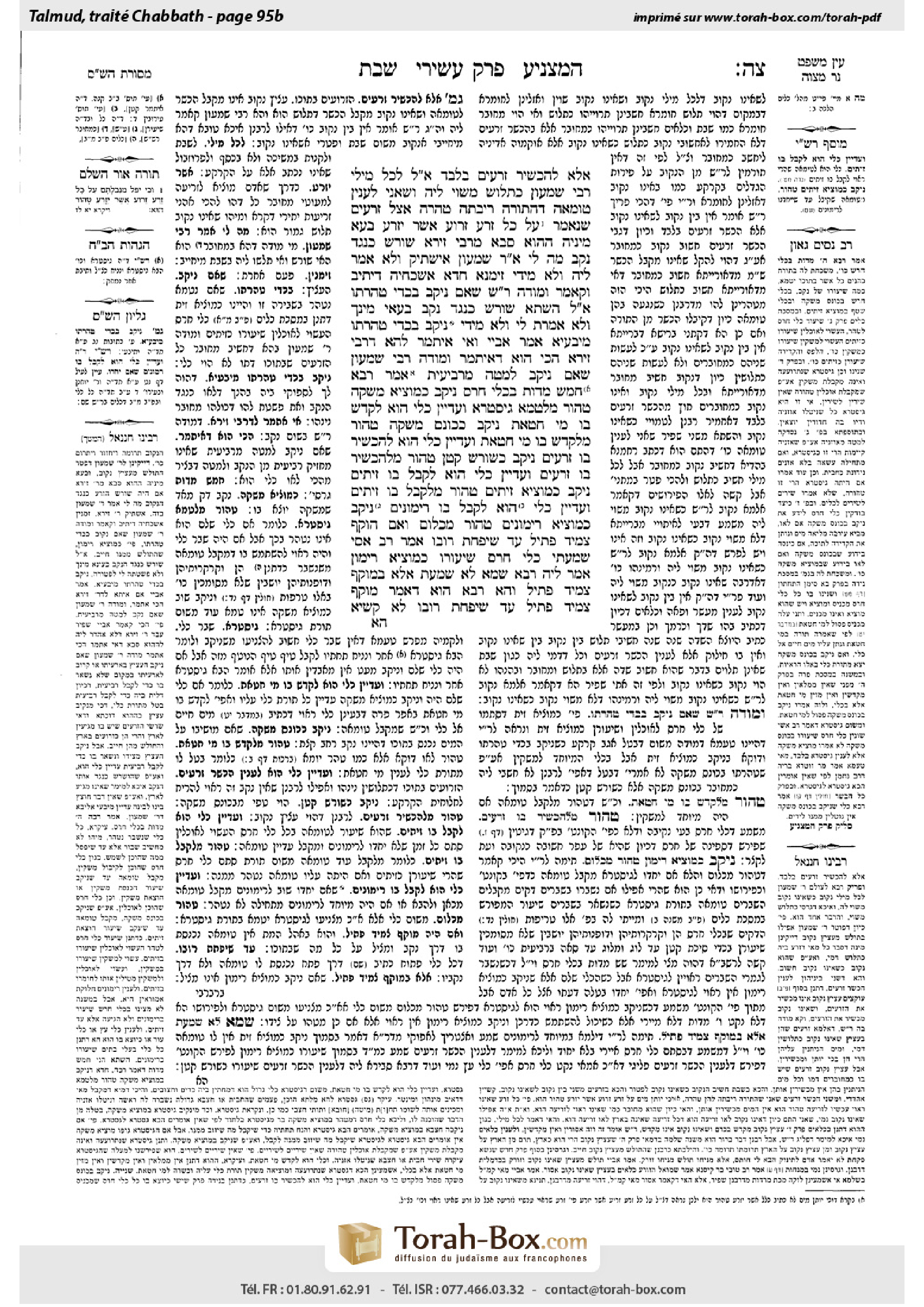
Shabbat 95b: Talmud study for Daf Yomi
Daf Yomi is the daily study of one Talmud folio. Explore 37 tractates with scans, Hebrew text, Sefaria English and AI-generated French translations where annotated.
Passage selection and English or AI-generated French translation are available where the scan has annotations. Daf Study is independent of Torah-Box and Sefaria.
Browse Shabbat · שבת · All tractatesShabbat 95b text and translations
This page of Shabbat includes the Aramaic text, an English translation and an AI-generated French translation, alongside the scan above.
שבת צ״ה ב · Aramaic and Hebrew text
אֶלָּא לְהַכְשִׁיר זְרָעִים בִּלְבַד! אֲמַר לֵיהּ: לְכׇל מִילֵּי רַבִּי שִׁמְעוֹן כְּתָלוּשׁ מְשַׁוֵּי לֵיהּ, וְשָׁאנֵי לְעִנְיַן טוּמְאָה, דְּהַתּוֹרָה רִיבְּתָה טׇהֳרָה אֵצֶל זְרָעִים, שֶׁנֶּאֱמַר: ״עַל כׇּל זֶרַע זֵרוּעַ אֲשֶׁר יִזָּרֵעַ״.
בְּעָא מִינֵּיהּ הָהוּא סָבָא מֵרַבִּי זֵירָא: שׁוֹרֶשׁ כְּנֶגֶד נֶקֶב מַה לִּי אָמַר רַבִּי שִׁמְעוֹן? אִישְׁתִּיק וְלָא אֲמַר לֵיהּ וְלָא מִידֵּי. זִימְנָא חֲדָא אַשְׁכְּחֵיהּ דְּיָתֵיב וְקָאָמַר: וּמוֹדֶה רַבִּי שִׁמְעוֹן שֶׁאִם נִיקַּב בִּכְדֵי טׇהֳרָתוֹ. אֲמַר לֵיהּ: הַשְׁתָּא שׁוֹרֶשׁ כְּנֶגֶד נֶקֶב בְּעַאי מִינָּךְ וְלָא אֲמַרְתְּ לִי וְלָא מִידֵּי, נִיקַּב בִּכְדֵי טׇהֳרָתוֹ מִיבַּעְיָא?!
אָמַר אַבָּיֵי: וְאִי אִיתְּמַר לְהָא דְּרַבִּי זֵירָא, הָכִי הוּא דְּאִיתְּמַר: וּמוֹדֶה רַבִּי שִׁמְעוֹן שֶׁאִם נִיקַּב לְמַטָּה מֵרְבִיעִית.
אָמַר רָבָא, חָמֵשׁ מִדּוֹת בִּכְלֵי חֶרֶס: נִיקַּב כְּמוֹצִיא מַשְׁקֶה — טָהוֹר מִלְּטַמֵּא גִּיסְטְרָא וַעֲדַיִין כְּלִי הוּא לְקַדֵּשׁ בּוֹ מֵי חַטָּאת; נִיקַּב כְּכוֹנֵס מַשְׁקֶה — טָהוֹר מִלְּקַדֵּשׁ בּוֹ מֵי חַטָּאת וַעֲדַיִין כְּלִי הוּא לְהַכְשִׁיר בּוֹ זְרָעִים; נִיקַּב כְּשׁוֹרֶשׁ קָטָן — טָהוֹר מִלְּהַכְשִׁיר בּוֹ זְרָעִים וַעֲדַיִין כְּלִי הוּא לְקַבֵּל בּוֹ זֵיתִים; נִיקַּב כְּמוֹצִיא זֵיתִים — טָהוֹר מִלְּקַבֵּל בּוֹ זֵיתִים וַעֲדַיִין כְּלִי הוּא לְקַבֵּל בּוֹ רִימּוֹנִים; נִיקַּב כְּמוֹצִיא רִימּוֹנִים — טָהוֹר מִכְּלוּם. וְאִם הוּקַּף צָמִיד פָּתִיל — עַד שֶׁיִּפָּחֵת רוּבּוֹ.
אָמַר רַב אַסִּי: שָׁמַעְתִּי כְּלִי חֶרֶס שִׁיעוּרוֹ כְּמוֹצִיא רִימּוֹן. אֲמַר לֵיהּ רָבָא: שֶׁמָּא לֹא שָׁמַעְתָּ אֶלָּא בְּמוּקָּף צְמִיד פָּתִיל. וְהָא רָבָא הוּא דְּאָמַר מוּקָּף צְמִיד פָּתִיל עַד שֶׁיִּפָּחֵת רוּבּוֹ! לָא קַשְׁיָא,
Shabbat 95b · English translation
is with regard to rendering seeds capable of becoming ritually impure. Seeds that are in a perforated pot have the legal status of seeds planted in the ground and, as such, cannot become ritually impure. Seeds that are in an imperforated pot are considered detached from the ground and can become ritually impure. Apparently, in other areas of halakha, Rabbi Shimon holds that a plant in a perforated pot has the legal status of a plant in the ground (Me’iri). He said to him: With regard to all matters of halakha, Rabbi Shimon equates the status of a perforated pot with that of being detached. However, the matter of impurity is different, as the Torah amplified purity with regard to seeds, as it is stated: “And if anything falls from their carcasses upon any sowing seed that is sown, it is pure” (Leviticus 11:37). The repetitive language: “Any sowing seed that is sown” teaches that any seed that can be characterized as sowing, including one growing in a perforated pot, remains pure. However, in other areas of halakha, the status of a perforated pot is equal to that of an imperforated pot.
A certain Elder raised a dilemma before Rabbi Zeira: In a case where the root of a plant in a perforated pot is opposite the hole, what would Rabbi Shimon say in terms of whether or not it is considered attached to the ground? He was silent and did not say anything to him. The Gemara relates that once the same Elder found Rabbi Zeira, who was sitting and saying: And Rabbi Shimon agrees that if the hole in the flowerpot is large enough to render it ritually pure, i.e., unable to hold olives, it is considered attached to the earth with regard to Shabbat. He said to him: Now, I raised a dilemma before you as to Rabbi Shimon’s ruling in a case where the root is opposite the hole, and you did not say anything to me. With regard to a case where the root is not actually opposite the hole, but its hole is large enough to render it pure, do you need to tell me that the dilemma whether or not it is considered detached is unresolved? Rather, this must certainly be understood differently.
Abaye said: And if the statement of Rabbi Zeira that Rabbi Shimon holds that a perforated pot is considered attached to the ground, was stated, it was stated as follows: And Rabbi Shimon agrees that if the pot was perforated below the level where it could hold a quarter of a log, it is no longer considered a vessel, and the plants are considered attached to the ground.
Apropos the purification of an earthenware vessel, the Gemara cites that Rava said: Five measures were stated with regard to holes in an earthenware vessel: If it was perforated with a small hole from which liquid seeps, it is no longer a vessel and is ritually pure in terms of the impurity of a shard. Certain shards of impure earthenware vessels remain impure if they can still be used. If it has a hole, even a small one that liquids can flow through, it can no longer transmit ritual impurity. However, it remains a complete vessel in which to sanctify the purification waters of the red heifer, which require a whole vessel. And if it was perforated with a hole large enough to enable liquid to enter the vessel, it is ritually pure in terms of sanctifying the purification waters in it, but it remains a vessel in terms of rendering seeds in it capable of becoming ritually impure. And if it was perforated with a hole the size of a small root, it is ritually pure in terms of rendering seeds in it capable of becoming ritually impure, but it remains a vessel that can become ritually impure in terms of holding olives. And if it was perforated with a hole large enough to enable olives to go out, it is pure in terms of the impurity of all other vessels that can hold olives, but it remains a vessel in terms of holding pomegranates. If the vessel is designated for use in holding pomegranates, it can become ritually impure because it is suitable for that use. If it was perforated with a hole large enough to enable pomegranates to go out, it is ritually pure from any type of impurity. And if the mouth of an earthenware vessel that is in a room with a corpse is surrounded by a sealed cover, it does not become ritually pure, even if its hole was large enough to enable a pomegranate to go out. It protects whatever is inside the vessel from contracting impurity, unless the majority of the vessel is broken.
Rav Asi said: I heard that with regard to an earthenware vessel, the measure of the hole that renders it unable to become ritually impure is large enough to enable a pomegranate to go out. Rava said to him: Perhaps you only heard this when its mouth is surrounded by a sealed cover, but an ordinary earthenware vessel becomes ritually pure with a hole big enough to enable an olive to go out. The Gemara asks: Isn’t Rava himself the one who said that an earthenware vessel that is surrounded by a sealed cover protects whatever is inside the vessel from contracting impurity unless the majority of the vessel is broken? The Gemara answers: This is not difficult.
Shabbat 95b · Traduction française (IA)
Cela concerne la capacité des graines à devenir rituellement impures. Les graines placées dans un pot percé ont le statut de graines plantées en terre et, à ce titre, ne peuvent pas devenir rituellement impures. Les graines placées dans un pot non percé sont considérées comme détachées du sol et peuvent devenir rituellement impures. Il semble donc que, dans d’autres domaines de la halakha, Rabbi Shimon considère qu’une plante dans un pot percé a le statut d’une plante en terre (Meïri). Il lui dit : Dans tous les domaines de la halakha, Rabbi Shimon assimile le statut d’un pot percé à celui d’un objet détaché. Toutefois, la question de l’impureté est différente, car la Torah a élargi les règles de pureté concernant les graines, comme il est dit : « Et si quelque chose tombe de leurs carcasses sur toute semence destinée à être semée, elle est pure » (Lévitique 11, 37). La formulation répétitive « toute semence destinée à être semée » enseigne que toute graine qui peut être qualifiée de semence, y compris une graine qui pousse dans un pot percé, reste pure. En revanche, dans les autres domaines de la halakha, le statut d’un pot percé est identique à celui d’un pot non percé.
Un certain ancien posa une question à Rabbi Zeïra : dans le cas où la racine d’une plante dans un pot percé se trouve en face du trou, que dirait Rabbi Shimon quant à savoir si elle est considérée comme attachée au sol ? Il garda le silence et ne lui répondit pas. La Guemara rapporte qu’un jour, ce même ancien trouva Rabbi Zeïra assis et déclarant : Rabbi Shimon reconnaît que, si le trou du pot de fleurs est assez grand pour le rendre rituellement pur, c’est-à-dire s’il est assez grand pour qu’il ne puisse plus contenir des olives, le pot est considéré comme attaché à la terre en ce qui concerne Chabbat. Il lui dit : Je t’ai alors posé une question sur la décision de Rabbi Shimon dans le cas où la racine se trouve en face du trou, et tu ne m’as rien répondu. Pour un cas où la racine ne se trouve pas effectivement en face du trou, mais où le trou du pot est assez grand pour le rendre pur, faut-il vraiment que tu me dises que la question de savoir s’il est considéré comme détaché reste sans réponse ? Il faut plutôt comprendre les choses autrement.
Abayé dit : Et si la déclaration de Rabbi Zeïra selon laquelle Rabbi Shimon considère qu’un pot percé est attaché au sol a bien été formulée, elle l’a été ainsi : Rabbi Shimon reconnaît que, si le pot a été percé sous le niveau auquel il peut contenir un quart de log, il n’est plus considéré comme un récipient et les plantes sont considérées comme attachées au sol.
À propos de la purification d’un récipient en terre cuite, la Guemara rapporte que Rava a dit : Cinq mesures ont été établies pour les trous dans un récipient en terre cuite. Si le récipient est percé d’un petit trou par lequel du liquide suinte, il n’est plus considéré comme un récipient et il est rituellement pur au regard de l’impureté d’un tesson. Certains tessons provenant de récipients impurs en terre cuite restent impurs s’ils peuvent encore être utilisés. S’il a un trou, même petit, par lequel des liquides peuvent s’écouler, il ne peut plus transmettre l’impureté rituelle. Toutefois, il reste un récipient entier dans lequel on peut sanctifier l’eau de purification de la vache rousse, qui exige un récipient entier. S’il est percé d’un trou assez grand pour permettre à du liquide d’entrer dans le récipient, il est rituellement pur pour ce qui est de la sanctification de l’eau de purification qu’il contient, mais il reste un récipient pouvant rendre rituellement impures les graines qu’il contient. S’il est percé d’un trou de la taille d’une petite racine, il est rituellement pur pour ce qui est de la capacité de rendre rituellement impures les graines qu’il contient, mais il reste un récipient susceptible de devenir rituellement impur du fait qu’il peut contenir des olives. S’il est percé d’un trou assez grand pour laisser sortir des olives, il est pur au regard de l’impureté de tous les autres récipients pouvant contenir des olives, mais il reste un récipient pouvant contenir des grenades. Si le récipient est destiné à contenir des grenades, il peut devenir rituellement impur, car il convient à cet usage. S’il est percé d’un trou assez grand pour laisser sortir des grenades, il est rituellement pur de toute forme d’impureté. Enfin, si l’ouverture d’un récipient en terre cuite qui se trouve dans une pièce où se trouve un cadavre est entourée d’un couvercle hermétiquement scellé, le récipient ne devient pas rituellement pur, même si son trou est assez grand pour laisser sortir une grenade. Il protège de l’impureté tout ce qui se trouve à l’intérieur, à moins que la majeure partie du récipient ne soit brisée.
Rav Assi dit : J’ai entendu que, pour un récipient en terre cuite, le trou qui l’empêche de devenir rituellement impur doit être assez grand pour laisser sortir une grenade. Rava lui dit : Peut-être n’as-tu entendu cela que dans le cas où son ouverture est entourée d’un couvercle hermétiquement scellé ; mais un récipient ordinaire en terre cuite devient rituellement pur lorsque son trou est assez grand pour laisser sortir une olive. La Guemara demande : N’est-ce pas Rava lui-même qui a dit qu’un récipient en terre cuite dont l’ouverture est entourée d’un couvercle hermétiquement scellé protège de l’impureté tout ce qui se trouve à l’intérieur, à moins que la majeure partie du récipient ne soit brisée ? La Guemara répond : Il n’y a pas de difficulté.
Traduction française générée par IA à partir de l’édition anglaise de Sefaria. Vérifie toujours un passage avec le texte source.
Text from Sefaria: William Davidson Edition - Vocalized Aramaic (CC BY NC); William Davidson Edition - English (CC BY NC).