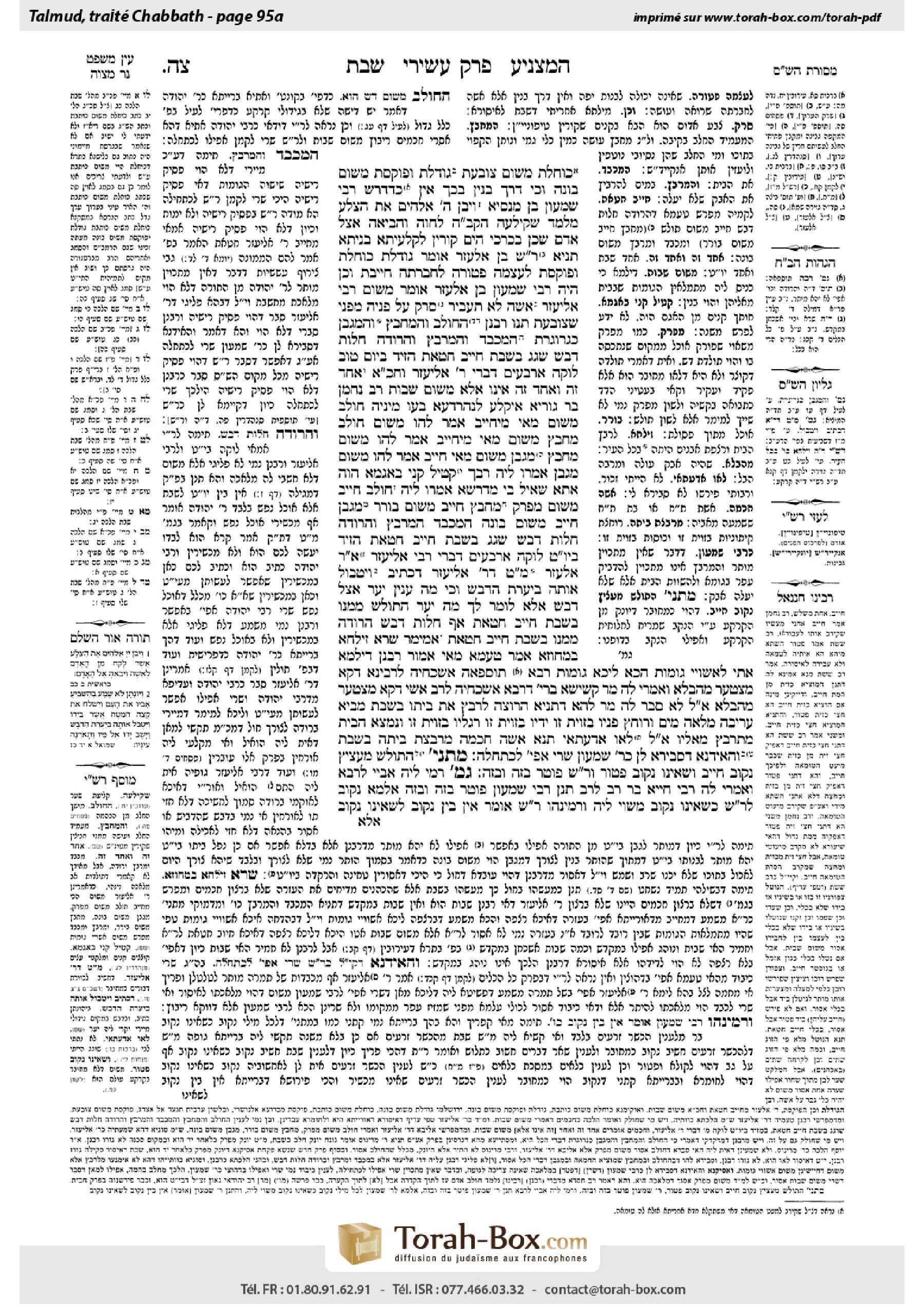
Shabbat 95a: Talmud study for Daf Yomi
Daf Yomi is the daily study of one Talmud folio. Explore 37 tractates with scans, Hebrew text, Sefaria English and AI-generated French translations where annotated.
Passage selection and English or AI-generated French translation are available where the scan has annotations. Daf Study is independent of Torah-Box and Sefaria.
Browse Shabbat · שבת · All tractatesShabbat 95a text and translations
This page of Shabbat includes the Aramaic text, an English translation and an AI-generated French translation, alongside the scan above.
שבת צ״ה א · Aramaic and Hebrew text
כּוֹחֶלֶת — מִשּׁוּם צוֹבַעַת, גּוֹדֶלֶת וּפוֹקֶסֶת — מִשּׁוּם בּוֹנָה. וְכִי דֶרֶךְ בִּנְיָן בְּכָךְ? אִין, כִּדְדָרֵשׁ רַבִּי שִׁמְעוֹן בֶּן מְנַסְיָא: ״וַיִּבֶן ה׳ אֱלֹהִים אֶת הַצֵּלָע״, מְלַמֵּד שֶׁקִּילְּעָהּ הַקָּדוֹשׁ בָּרוּךְ הוּא לְחַוָּה וֶהֱבִיאָהּ אֵצֶל אָדָם — שֶׁכֵּן בִּכְרַכֵּי הַיָּם קוֹרִין לְקַלָּעִיתָא ״בַּנָּיְתָא״. תַּנְיָא, רַבִּי שִׁמְעוֹן בֶּן אֶלְעָזָר אוֹמֵר: גּוֹדֶלֶת כּוֹחֶלֶת וּפוֹקֶסֶת, לְעַצְמָהּ — פְּטוּרָה, לַחֲבֶרְתָּהּ — חַיֶּיבֶת. וְכֵן הָיָה רַבִּי שִׁמְעוֹן בֶּן אֶלְעָזָר אוֹמֵר מִשּׁוּם רַבִּי אֱלִיעֶזֶר: אִשָּׁה לֹא תַּעֲבִיר סְרָק עַל פָּנֶיהָ מִפְּנֵי שֶׁצּוֹבַעַת.
תָּנוּ רַבָּנַן: הַחוֹלֵב וְהַמְחַבֵּץ וְהַמְגַבֵּן — כִּגְרוֹגֶרֶת. הַמְכַבֵּד, וְהַמְרַבֵּץ, וְהָרוֹדֶה חַלּוֹת דְּבַשׁ, שָׁגַג בְּשַׁבָּת — חַיָּיב חַטָּאת, הֵזִיד בְּיוֹם טוֹב — לוֹקֶה אַרְבָּעִים, דִּבְרֵי רַבִּי אֱלִיעֶזֶר. וַחֲכָמִים אוֹמְרִים: אֶחָד זֶה וְאֶחָד זֶה אֵינוֹ אֶלָּא מִשּׁוּם שְׁבוּת.
רַב נַחְמָן בַּר גּוּרְיָא אִיקְּלַע לִנְהַרְדָּעָא. בְּעוֹ מִינֵּיהּ: חוֹלֵב, מִשּׁוּם מַאי מִיחַיַּיב? אֲמַר לְהוּ: מִשּׁוּם חוֹלֵב. מְחַבֵּץ, מִשּׁוּם מַאי מִיחַיַּיב? אֲמַר לְהוּ: מִשּׁוּם מְחַבֵּץ. מְגַבֵּן, מִשּׁוּם מַאי חַיָּיב? אֲמַר לְהוּ: מִשּׁוּם מְגַבֵּן. אֲמַרוּ לֵיהּ: רַבָּךְ קָטֵיל קְנֵי בְּאַגְמָא הֲוָה. אֲתָא שְׁאֵיל בֵּי מִדְרְשָׁא. אֲמַרוּ לֵיהּ: חוֹלֵב חַיָּיב — מִשּׁוּם מְפָרֵק. מְחַבֵּץ חַיָּיב — מִשּׁוּם בּוֹרֵר, מְגַבֵּן חַיָּיב — מִשּׁוּם בּוֹנֶה.
הַמְכַבֵּד, הַמְרַבֵּץ, וְהָרוֹדֶה חַלּוֹת דְּבַשׁ, שָׁגַג בְּשַׁבָּת — חַיָּיב חַטָּאת, הֵזִיד בְּיוֹם טוֹב — לוֹקֶה אַרְבָּעִים, דִּבְרֵי רַבִּי אֱלִיעֶזֶר. אָמַר רַבִּי אֶלְעָזָר: מַאי טַעְמָא דְּרַבִּי אֱלִיעֶזֶר — דִּכְתִיב: ״וַיִּטְבֹּל אוֹתָהּ בְּיַעְרַת הַדְּבָשׁ״, וְכִי מָה עִנְיַן יַעַר אֵצֶל דְּבַשׁ? אֶלָּא לוֹמַר לָךְ: מָה יַעַר, הַתּוֹלֵשׁ מִמֶּנּוּ בְּשַׁבָּת — חַיָּיב חַטָּאת, אַף חַלּוֹת דְּבַשׁ, הָרוֹדֶה מִמֶּנּוּ בְּשַׁבָּת — חַיָּיב חַטָּאת.
אַמֵּימָר שְׁרָא זִילְחָא בְּמָחוֹזָא. אָמַר: טַעְמָא מַאי אֲמוּר רַבָּנַן — דִּילְמָא אָתֵי לְאַשְׁוֹיֵי גּוּמּוֹת, הָכָא לֵיכָּא גּוּמּוֹת. רָבָא תּוֹסְפָאָה אַשְׁכְּחֵיהּ לְרָבִינָא דְּקָא מִצְטַעַר מֵהַבְלָא, וְאָמְרִי לַהּ מָר קַשִּׁישָׁא בְּרֵיהּ דְּרָבָא אַשְׁכְּחֵיהּ לָרַב אָשֵׁי דְּקָא מִצְטַעַר מֵהַבְלָא, אֲמַר לֵיהּ: לָא סָבַר לַהּ מָר לְהָא דְּתַנְיָא: הָרוֹצֶה לְרַבֵּץ אֶת בֵּיתוֹ בְּשַׁבָּת, מֵבִיא עֲרֵיבָה מְלֵאָה מַיִם וְרוֹחֵץ פָּנָיו בְּזָוִית זוֹ, יָדָיו בְּזָוִית זוֹ, רַגְלָיו בְּזָוִית זוֹ, וְנִמְצָא הַבַּיִת מִתְרַבֵּץ מֵאֵלָיו? אֲמַר לֵיהּ: לָאו אַדַּעְתַּאי.
תָּנָא: אִשָּׁה חֲכָמָה מְרַבֶּצֶת בֵּיתָהּ בְּשַׁבָּת. וְהָאִידָּנָא דִּסְבִירָא לַן כְּרַבִּי שִׁמְעוֹן, שְׁרֵי אֲפִילּוּ לְכַתְּחִלָּה.
מַתְנִי׳ הַתּוֹלֵשׁ מֵעָצִיץ נָקוּב — חַיָּיב, וְשֶׁאֵינוֹ נָקוּב — פָּטוּר. וְרַבִּי שִׁמְעוֹן פּוֹטֵר בָּזֶה וּבָזֶה.
גְּמָ׳ רָמֵי לֵיהּ אַבָּיֵי לְרָבָא, וְאָמְרִי לַהּ רַבִּי חִיָּיא בַּר רַב לְרַב: תְּנַן רַבִּי שִׁמְעוֹן פּוֹטֵר בָּזֶה וּבָזֶה. אַלְמָא נָקוּב לְרַבִּי שִׁמְעוֹן — כְּשֶׁאֵינוֹ נָקוּב מְשַׁוֵּי לֵיהּ. וּרְמִינְהוּ, רַבִּי שִׁמְעוֹן אוֹמֵר: אֵין בֵּין נָקוּב לְשֶׁאֵינוֹ נָקוּב
Shabbat 95a · English translation
A woman who applies eye shadow is liable due to dyeing; one who braids her hair and applies blush is liable due to the prohibition against building. The Gemara asks about this: And is that the typical manner of building? The Gemara answers: Yes, braiding one’s hair is considered building, as Rabbi Shimon ben Menasya taught that the verse states: “And the Lord God built the side that He took from Adam into a woman” (Genesis 2:22), which teaches that the Holy One, Blessed be He, braided Eve’s hair and brought her to Adam. From where is it derived that this is the meaning of built? It is because in the islands of the sea they call braiding building. It was taught in a baraita that Rabbi Shimon ben Elazar says: With regard to a woman who braids her hair and who applies eye shadow or blush on Shabbat, if she did it for herself, she is exempt; if she did it for another, she is liable. This is because a woman cannot perform these actions for herself in as complete a fashion as she can for someone else. And, so too, Rabbi Shimon ben Elazar would say in the name of Rabbi Eliezer: A woman may not apply rouge to her face on Shabbat because by doing so she is dyeing, which is one of the prohibited labors on Shabbat.
The Sages taught in a baraita: One who milks an animal, and one who sets milk to curdle, and one who makes cheese, in the measure of a dried fig-bulk, and one who sweeps the house, and one who sprinkles water on the floor, and one who removes honeycombs, if he did so unwittingly on Shabbat, he is liable to bring a sin-offering. If he did so intentionally on a Festival, he receives forty lashes; this is the statement of Rabbi Eliezer. And the Rabbis say: Both this, on Shabbat and that, on a Festival, these actions are only prohibited due to a rabbinic decree, not by Torah law. Therefore, one is neither liable to bring a sin-offering nor to receive lashes for performing those actions.
The Gemara relates: Rav Naḥman bar Gurya happened to come to Neharde’a. The students asked him: For what prohibited labor is one who milks liable? He said to them: For milking. For what prohibited labor is one who sets milk to curdle liable? He said to them: For setting milk to curdle. For what is a person who makes cheese liable? He said to them: For making cheese. They said to him: Your teacher was a reed cutter in a swamp who did not know how to explain the mishna to his students. He came and asked those questions in the study hall. They said to him: One who milks is liable for performing the prohibited labor of extracting, which is a subcategory of threshing, on Shabbat. This is because when one extracts milk from a cow it is similar to the act of threshing, where one removes the desired content from its covering. One who sets milk is liable for the prohibited labor of selecting because part of the milk is separated and made into congealed milk. And one who makes cheese is liable for building because the cheese within the milk assumes a solid form, which is similar to the process of building.
The baraita cited above taught: With regard to one who sweeps the house, and one who sprinkles water on the floor, and one who removes honeycombs, if he did so unwittingly on Shabbat, he is liable to bring a sin-offering. If he did so intentionally on a Festival, he receives forty lashes; this is the statement of Rabbi Eliezer. Rabbi Elazar said: What is the rationale for the statement of Rabbi Eliezer? His rationale is as it is written: “And he put forth the end of the rod that was in his hand and dipped it in the honeycomb [yarat hadevash]” (i Samuel 14:27). The Gemara wonders: What does a forest [ya’ar] have to do with honey [devash]? Rather, it comes to tell you: Just as with regard to a forest, one who picks from a tree on Shabbat is liable to bring a sin-offering, so too, with regard to a honeycomb, one who removes honey from it on Shabbat is liable to bring a sin-offering.
The Gemara relates: Ameimar permitted sprinkling water in the city of Meḥoza. He said: What is the reason that the Rabbis said it is prohibited to sprinkle water? It was due to concern lest one come to smooth out holes in an unpaved floor. Here, in Meḥoza, there are no holes in the floor because all the houses have stone floors. The Gemara also relates: Rava Tosfa’a, an expert on the Tosefta, found that Ravina was suffering on Shabbat from the dusty hot air in the house. And some say that Mar Kashisha, son of Rava, found that Rav Ashi was suffering from the dusty hot air. Mar Kashisha said to Rav Ashi: And does my Master not hold in accordance with this halakha that was taught in a baraita: One who wishes to sprinkle water on the floor of his house on Shabbat, where it is otherwise prohibited, brings a large basin full of water, and washes his face in this corner, then moves the basin and washes his hands in this corner, his feet in this corner, and it will eventuate that the floor of the entire house is sprinkled by itself from the water that splashed in a backhanded manner? Rav Ashi said to him: It did not enter my mind to employ that method.
One of the Sages taught: A wise woman sprinkles water on the floor of her house on Shabbat by washing different vessels in different parts of the house. And now that we hold in accordance with the opinion of Rabbi Shimon, who maintains that it is permitted to perform an unintentional act on Shabbat, it is permitted to sweep and sprinkle water on the floor of a house on Shabbat even ab initio, because one’s intention is not to smooth the holes in the floor.
MISHNA: One who severs a leaf or a fruit from a plant growing in a perforated flowerpot on Shabbat is liable, as a plant in a flowerpot with holes in it has the legal status of a plant connected to the ground. Picking from it is prohibited due to reaping. And one who picks from an imperforated pot is exempt, but it is prohibited to do so ab initio. And Rabbi Shimon deems one who does so exempt in both this, the case of the perforated flowerpot, and that, the case of the imperforated flowerpot.
GEMARA: Abaye raised a contradiction before Rava, and some say it was Rabbi Ḥiyya bar Rav who raised the contradiction before Rav: On the one hand, we learned in the mishna that Rabbi Shimon deems one exempt in both this case and that case. Apparently, Rabbi Shimon equates a perforated pot with an imperforated pot. And they raised a contradiction: Rabbi Shimon says: The only difference between a perforated pot and an imperforated pot
Shabbat 95a · Traduction française (IA)
Une femme qui se met du fard sur les yeux est passible pour teindre ; celle qui se tresse les cheveux et se met du rouge est passible pour construire. La Guemara pose la question à ce sujet : est-ce là une manière habituelle de construire ? La Guemara répond : oui, tresser les cheveux est considéré comme construire, comme l’enseigna Rabbi Shimon ben Menasya : le verset dit : « Et le Seigneur Dieu construisit le côté qu’il avait pris de l’homme en une femme » (Genèse 2,22), ce qui enseigne que le Saint, béni soit-Il, tressa les cheveux d’Ève et la conduisit auprès d’Adam. D’où déduit-on que « construisit » a ce sens ? Du fait que, dans les îles de la mer, on appelle « construire » le fait de tresser. Il a été enseigné dans une baraïta que Rabbi Shimon ben Elazar dit : une femme qui se tresse les cheveux et se met du fard sur les yeux ou du rouge le Chabbat, si elle le fait pour elle-même, est exemptée ; si elle le fait pour une autre, elle est passible. En effet, une femme ne peut accomplir ces gestes pour elle-même aussi parfaitement qu’elle le peut pour une autre. De même, Rabbi Shimon ben Elazar disait au nom de Rabbi Eliezer : une femme ne peut pas se mettre du rouge sur le visage le Chabbat, car elle teint ainsi, ce qui constitue l’un des travaux interdits le Chabbat.
Les Sages enseignèrent dans une baraïta : celui qui trait un animal, celui qui fait cailler le lait, celui qui fabrique du fromage d’un volume d’une figue sèche, celui qui balaie la maison, celui qui répand de l’eau sur le sol et celui qui retire des rayons de miel, s’il l’a fait involontairement le Chabbat, est passible d’apporter un sacrifice expiatoire. S’il l’a fait intentionnellement un jour de fête, il reçoit quarante coups de fouet ; telle est la parole de Rabbi Eliezer. Les Rabbins disent : dans les deux cas, que ce soit le Chabbat ou un jour de fête, ces actes ne sont interdits qu’en vertu d’un décret rabbinique, et non par la Torah. Par conséquent, on n’est passible ni d’apporter un sacrifice expiatoire ni de recevoir des coups de fouet pour les avoir accomplis.
La Guemara rapporte : Rav Naḥman bar Gurya arriva par hasard à Nehardea. Les étudiants lui demandèrent : pour quel travail interdit celui qui trait est-il passible ? Il leur répondit : pour la traite. Pour quel travail interdit celui qui fait cailler le lait est-il passible ? Il leur répondit : pour le caillage. De quoi celui qui fabrique du fromage est-il passible ? Il leur répondit : pour la fabrication du fromage. Ils lui dirent : ton maître était un coupeur de roseaux dans un marécage, qui ne savait pas expliquer la Michna à ses élèves. Il alla poser ces questions à la maison d’étude. On lui répondit : celui qui trait est passible pour avoir accompli le travail interdit d’extraire, sous-catégorie du battage, le Chabbat. En effet, lorsqu’on extrait le lait d’une vache, cela ressemble au battage, où l’on sépare le contenu recherché de son enveloppe. Celui qui fait cailler le lait est passible pour le travail interdit de trier, car une partie du lait se sépare et se solidifie. Celui qui fabrique du fromage est passible pour construire, car le fromage contenu dans le lait prend une forme solide, ce qui ressemble au processus de construction.
La baraïta citée plus haut a enseigné : celui qui balaie la maison, celui qui répand de l’eau sur le sol et celui qui retire des rayons de miel, s’il l’a fait involontairement le Chabbat, est passible d’apporter un sacrifice expiatoire. S’il l’a fait intentionnellement un jour de fête, il reçoit quarante coups de fouet ; telle est la parole de Rabbi Eliezer. Rabbi Elazar dit : quelle est la raison de la parole de Rabbi Eliezer ? Sa raison se trouve dans ce qui est écrit : « Il tendit l’extrémité du bâton qu’il tenait à la main et la plongea dans le rayon de miel [yarat hadevash] » (I Samuel 14,27). La Guemara s’étonne : quel rapport y a-t-il entre une forêt [ya’ar] et du miel [devash] ? Cela vient plutôt t’apprendre que, de même que, dans une forêt, celui qui cueille sur un arbre le Chabbat est passible d’apporter un sacrifice expiatoire, de même, pour un rayon de miel, celui qui en retire du miel le Chabbat est passible d’apporter un sacrifice expiatoire.
La Guemara rapporte : Ameimar autorisa à répandre de l’eau dans la ville de Meḥoza. Il dit : pourquoi les Rabbins ont-ils dit qu’il est interdit de répandre de l’eau ? C’est par crainte que l’on ne vienne égaliser les trous d’un sol non pavé. Ici, à Meḥoza, il n’y a pas de trous dans le sol, car toutes les maisons ont un sol en pierre. La Guemara rapporte également : Rava Tosfa’a, spécialiste de la Tosefta, trouva Ravina souffrant le Chabbat de l’air chaud et poussiéreux de la maison. Certains disent que Mar Kashisha, fils de Rava, trouva Rav Ashi souffrant de l’air chaud et poussiéreux. Mar Kashisha dit à Rav Ashi : Mon maître ne suit-il donc pas cette halakha enseignée dans une baraïta : celui qui souhaite répandre de l’eau sur le sol de sa maison le Chabbat, alors que cela est par ailleurs interdit, prend un grand bassin rempli d’eau et se lave le visage dans un coin ; puis il déplace le bassin et se lave les mains dans un autre coin, les pieds dans un autre encore, et il se trouve que le sol de toute la maison est arrosé de lui-même par l’eau qui a éclaboussé de manière indirecte ? Rav Ashi lui répondit : Cette méthode ne m’était pas venue à l’esprit.
Un des Sages enseigna : une femme avisée répand de l’eau sur le sol de sa maison le Chabbat en lavant différents récipients dans différentes parties de la maison. Et maintenant que nous suivons l’opinion de Rabbi Shimon, qui soutient qu’il est permis d’accomplir involontairement un acte le Chabbat, il est permis de balayer et de répandre de l’eau sur le sol d’une maison le Chabbat, même a priori, car on n’a pas l’intention d’égaliser les trous du sol.
MICHNA : Celui qui détache une feuille ou un fruit d’une plante poussant dans un pot de fleurs percé le Chabbat est passible, car une plante dans un pot percé a le statut juridique d’une plante reliée au sol. La cueillir est interdite en raison de la moisson. Celui qui cueille dans un pot non percé est exempté, mais il est interdit de le faire a priori. Rabbi Shimon considère exempt celui qui le fait dans les deux cas, celui du pot de fleurs percé et celui du pot non percé.
GUEMARA : Abaye souleva une contradiction devant Rava ; certains disent que ce fut Rabbi Ḥiyya bar Rav qui souleva la contradiction devant Rav : d’une part, nous avons appris dans la Michna que Rabbi Shimon considère exempt celui qui agit dans les deux cas, celui-ci comme celui-là. Apparemment, Rabbi Shimon assimile un pot percé à un pot non percé. Or, ils soulevèrent une contradiction : Rabbi Shimon dit : la seule différence entre un pot percé et un pot non percé
Traduction française générée par IA à partir de l’édition anglaise de Sefaria. Vérifie toujours un passage avec le texte source.
Text from Sefaria: William Davidson Edition - Vocalized Aramaic (CC BY NC); William Davidson Edition - English (CC BY NC).