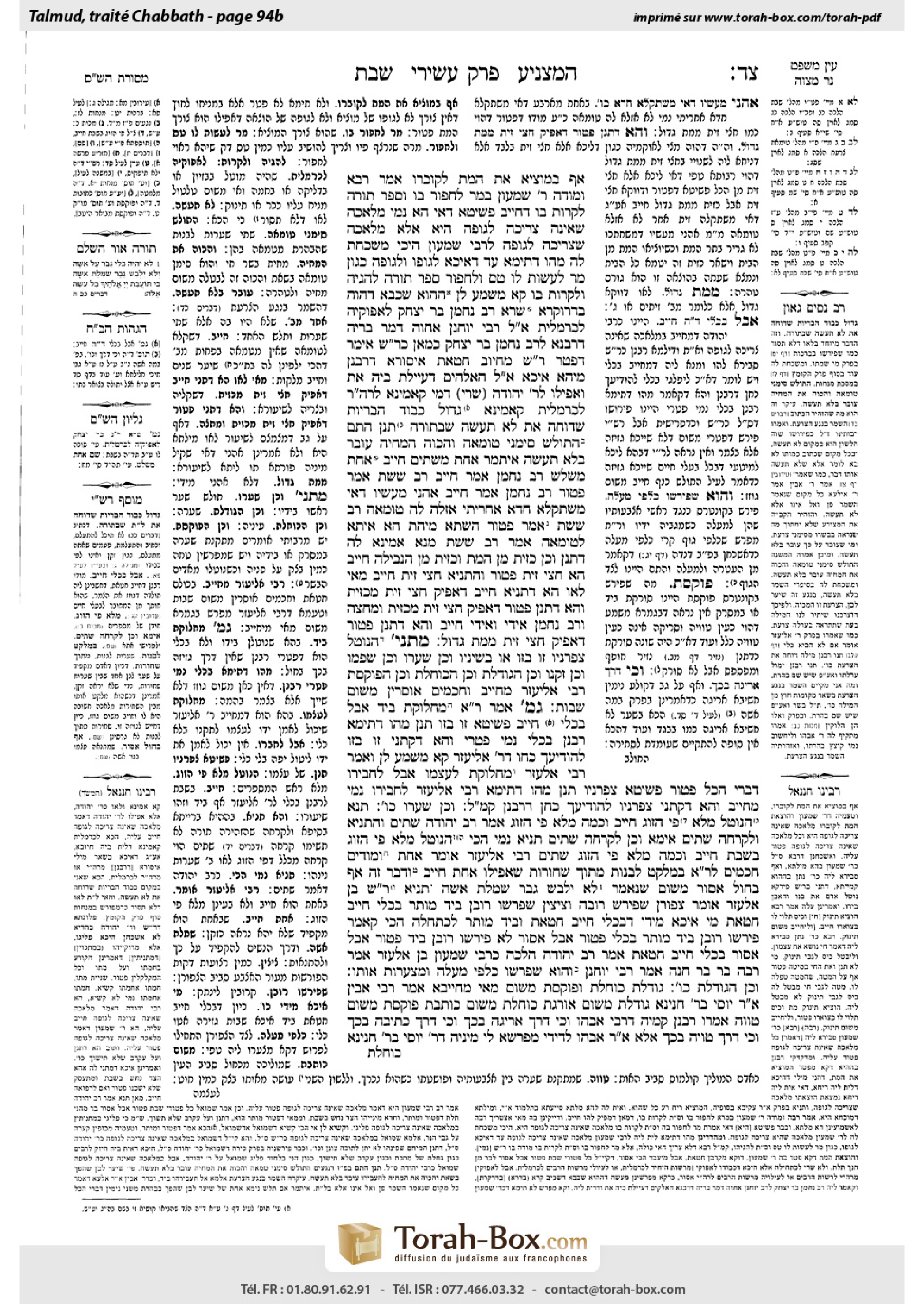
Shabbat 94b: Talmud study for Daf Yomi
Daf Yomi is the daily study of one Talmud folio. Explore 37 tractates with scans, Hebrew text, Sefaria English and AI-generated French translations where annotated.
Passage selection and English or AI-generated French translation are available where the scan has annotations. Daf Study is independent of Torah-Box and Sefaria.
Browse Shabbat · שבת · All tractatesShabbat 94b text and translations
This page of Shabbat includes the Aramaic text, an English translation and an AI-generated French translation, alongside the scan above.
שבת צ״ד ב · Aramaic and Hebrew text
אַף בְּמוֹצִיא אֶת הַמֵּת לְקוֹבְרוֹ. אָמַר רָבָא: וּמוֹדֶה רַבִּי שִׁמְעוֹן בְּמָר לַחְפּוֹר בּוֹ וְסֵפֶר תּוֹרָה לִקְרוֹת בּוֹ — דְּחַיָּיב. פְּשִׁיטָא, דְּאִי הָא נָמֵי מְלָאכָה שֶׁאֵינָהּ צְרִיכָה לְגוּפָהּ הִיא, אֶלָּא מְלָאכָה שֶׁצְּרִיכָה לְגוּפָהּ לְרַבִּי שִׁמְעוֹן הֵיכִי מַשְׁכַּחַתְּ לַהּ? מַהוּ דְתֵימָא, עַד דְּאִיכָּא לְגוּפוֹ וּלְגוּפָהּ, כְּגוֹן מָר לַעֲשׂוֹת לוֹ טַס וְלַחְפּוֹר, סֵפֶר תּוֹרָה לְהַגִּיהַּ וְלִקְרוֹת בּוֹ, קָא מַשְׁמַע לַן.
הָהוּא שָׁכְבָא דַּהֲוָה בִּדְרוֹקֶרֶת, שְׁרָא רַב נַחְמָן בַּר יִצְחָק לְאַפּוֹקֵיהּ לְכַרְמְלִית. אֲמַר לֵיהּ רַבִּי יוֹחָנָן אֲחוּהּ דְּמָר בְּרֵיהּ דְּרַבְנָא לָרַב נַחְמָן בַּר יִצְחָק: כְּמַאן, כְּרַבִּי שִׁמְעוֹן? אֵימַר דְּפָטַר רַבִּי שִׁמְעוֹן מֵחִיּוּב חַטָּאת, אִיסּוּרָא דְרַבָּנַן מִיהָא אִיכָּא! אֲמַר לֵיהּ: הָאֱלֹהִים, דְּעָיְילַתְּ בֵּיהּ אַתְּ? וַאֲפִילּוּ לְרַבִּי יְהוּדָה שְׁרֵי, דְּמִי קָאָמֵינָא לִרְשׁוּת הָרַבִּים? לְכַרְמְלִית קָאָמֵינָא, גָּדוֹל כְּבוֹד הַבְּרִיּוֹת שֶׁדּוֹחֶה אֶת ״לֹא תַעֲשֶׂה״ שֶׁבַּתּוֹרָה.
תְּנַן הָתָם: הַתּוֹלֵשׁ סִימָנֵי טוּמְאָה וְהַכֹּוֶה [אֶת] הַמִּחְיָה עוֹבֵר בְּ״לֹא תַעֲשֶׂה״. אִיתְּמַר: אַחַת מִשְּׁתַּיִם חַיָּיב, אַחַת מִשָּׁלֹשׁ — רַב נַחְמָן אָמַר חַיָּיב, רַב שֵׁשֶׁת אָמַר פָּטוּר. רַב נַחְמָן אָמַר חַיָּיב — אַהְנִי מַעֲשָׂיו, דְּאִי מִשְׁתַּקְלָא חֲדָא אַחֲרִיתִי אָזְלָה לַהּ טוּמְאָה. רַב שֵׁשֶׁת אָמַר פָּטוּר — הַשְׁתָּא מִיהַת הָא אִיתָא לְטוּמְאָה.
אָמַר רַב שֵׁשֶׁת: מְנָא אָמֵינָא לַהּ — דִּתְנַן: וְכֵן כְּזַיִת מִן הַמֵּת וּכְזַיִת מִן הַנְּבֵילָה — חַיָּיב, הָא חֲצִי זַיִת — פָּטוּר, וְהָתַנְיָא: ״חֲצִי זַיִת — חַיָּיב״! — מַאי לָאו, הָא דְּתַנְיָא ״חַיָּיב״ — דְּאַפֵּיק חֲצִי זַיִת מִכְּזַיִת, וְהָא דִּתְנַן ״פָּטוּר״ — דְּאַפֵּיק חֲצִי זַיִת מִכְּזַיִת וּמֶחֱצָה. וְרַב נַחְמָן: אִידֵּי וְאִידֵּי חַיָּיב, וְהָא דִּתְנַן ״פָּטוּר״, דְּאַפֵּיק חֲצִי זַיִת מִמֵּת גָּדוֹל.
מַתְנִי׳ הַנּוֹטֵל צִפׇּרְנָיו זוֹ בָּזוֹ, אוֹ בְּשִׁינָּיו, וְכֵן שְׂעָרוֹ, וְכֵן שְׂפָמוֹ, וְכֵן זְקָנוֹ, וְכֵן הַגּוֹדֶלֶת, וְכֵן הַכּוֹחֶלֶת, וְכֵן הַפּוֹקֶסֶת — רַבִּי אֱלִיעֶזֶר מְחַיֵּיב, וַחֲכָמִים אוֹסְרִין מִשּׁוּם שְׁבוּת.
גְּמָ׳ אָמַר רַבִּי אֶלְעָזָר: מַחֲלוֹקֶת בַּיָּד, אֲבָל בִּכְלִי — חַיָּיב. פְּשִׁיטָא, ״זוֹ בָּזוֹ״ תְּנַן! מַהוּ דְּתֵימָא: רַבָּנַן בִּכְלִי נָמֵי פָּטְרִי, וְהָא דְּקָתָנֵי ״זוֹ בָּזוֹ״ — לְהוֹדִיעֲךָ כֹּחוֹ דְּרַבִּי אֱלִיעֶזֶר, קָא מַשְׁמַע לַן.
וְאָמַר רַבִּי אֶלְעָזָר: מַחֲלוֹקֶת לְעַצְמוֹ, אֲבָל לַחֲבֵירוֹ — דִּבְרֵי הַכֹּל פָּטוּר. פְּשִׁיטָא, ״צִפׇּרְנָיו״, תְּנַן! מַהוּ דְתֵימָא רַבִּי אֱלִיעֶזֶר לַחֲבֵירוֹ נָמֵי מְחַיַּיב, וְהָא דְּקָתָנֵי ״צִפׇּרְנָיו״ לְהוֹדִיעֲךָ כֹּחָן דְּרַבָּנַן, קָא מַשְׁמַע לַן.
וְכֵן שְׂעָרוֹ כּוּ׳. תָּנָא: הַנּוֹטֵל מְלֹא פִי הַזּוּג — חַיָּיב. וְכַמָּה מְלֹא פִי הַזּוּג? אָמַר רַב יְהוּדָה: שְׁתַּיִם. וְהָתַנְיָא: וְלַקׇּרְחָה שְׁתַּיִם! אֵימָא: וְכֵן לַקׇּרְחָה שְׁתַּיִם.
תַּנְיָא נָמֵי הָכִי: הַנּוֹטֵל מְלֹא פִי הַזּוּג בְּשַׁבָּת — חַיָּיב. וְכַמָּה מְלֹא פִי הַזּוּג — שְׁתַּיִם. רַבִּי אֱלִיעֶזֶר אוֹמֵר: אַחַת, וּמוֹדִים חֲכָמִים לְרַבִּי אֱלִיעֶזֶר בִּמְלַקֵּט לְבָנוֹת מִתּוֹךְ שְׁחוֹרוֹת, שֶׁאֲפִילּוּ אַחַת חַיָּיב. וְדָבָר זֶה אַף בַּחוֹל אָסוּר, מִשּׁוּם שֶׁנֶּאֱמַר: ״לֹא יִלְבַּשׁ גֶּבֶר שִׂמְלַת אִשָּׁה״.
תַּנְיָא, רַבִּי שִׁמְעוֹן בֶּן אֶלְעָזָר אוֹמֵר: צִפּוֹרֶן שֶׁפֵּירֵשׁ רוּבָּהּ, וְצִיצִין שֶׁפֵּרְשׁוּ רוּבָּן, בַּיָּד — מוּתָּר, בִּכְלִי — חַיָּיב חַטָּאת. מִי אִיכָּא מִידֵּי דְּבִכְלִי חַיָּיב חַטָּאת, וּבַיָּד מוּתָּר לְכַתְּחִלָּה?! הָכִי קָאָמַר: פֵּירְשׁוּ רוּבָּן, בַּיָּד — מוּתָּר, בִּכְלִי — פָּטוּר אֲבָל אָסוּר. לֹא פֵּירְשׁוּ רוּבָּן, בַּיָּד — פָּטוּר אֲבָל אָסוּר, בִּכְלִי — חַיָּיב חַטָּאת. אָמַר רַב יְהוּדָה: הֲלָכָה כְּרַבִּי שִׁמְעוֹן בֶּן אֶלְעָזָר. אָמַר רַבָּה בַּר בַּר חָנָה אָמַר רַבִּי יוֹחָנָן: וְהוּא שֶׁפֵּרְשׁוּ כְּלַפֵּי מַעְלָה וּמְצַעֲרוֹת אוֹתוֹ.
וְכֵן הַגּוֹדֶלֶת כּוּ׳. גּוֹדֶלֶת, כּוֹחֶלֶת וּפוֹקֶסֶת מִשּׁוּם מַאי מְחַיְּיבָא? אָמַר רַבִּי אָבִין, אָמַר רַבִּי יוֹסֵי בְּרַבִּי חֲנִינָא: גּוֹדֶלֶת — מִשּׁוּם אוֹרֶגֶת, כּוֹחֶלֶת — מִשּׁוּם כּוֹתֶבֶת, פּוֹקֶסֶת — מִשּׁוּם טוֹוָה. אֲמַרוּ רַבָּנַן קַמֵּיהּ דְּרַבִּי אֲבָהוּ: וְכִי דֶרֶךְ אֲרִיגָה בְּכָךְ, וְכִי דֶרֶךְ כְּתִיבָה בְּכָךְ, וְכִי דֶרֶךְ טְוִיָּה בְּכָךְ?! אֶלָּא אָמַר רַבִּי אֲבָהוּ: לְדִידִי מִפָּרְשָׁא לִי מִינֵּיהּ דְּרַבִּי יוֹסֵי בְּרַבִּי חֲנִינָא,
Shabbat 94b · English translation
even one who carries out a corpse to bury it. Rava said: And Rabbi Shimon agrees that one who carries out a hoe on Shabbat with which to dig or a Torah scroll from which to read is liable. The Gemara asks: This is obvious, as if those acts of carrying out are also in the category of a prohibited labor not necessary for its own sake because the carrier’s intention is to dig or to read, if so, according to Rabbi Shimon, how can you find an act of carrying that would be considered a prohibited labor necessary for its own sake? The Gemara answers: Nevertheless, there is a novel element in Rava’s statement. Lest you say that Rabbi Shimon deems one liable only in a case where one carries out an object for the sake of the one carrying it, as well as for its own sake, for example, in a case where one carried out a hoe for its own sake, in order to sharpen its blade, and for the sake of the one carrying it, in order to dig with it, or one carried out a Torah scroll for its own sake, in order to emend it, and for the sake of the one carrying it, in order to read from it; therefore, Rava teaches us that Rabbi Shimon deems one liable for carrying out an object even when it is carried only for his own sake and not for the sake of the object.
The Gemara relates: There was a corpse in the city of Derokera and Rav Naḥman bar Yitzḥak permitted carrying it out into a karmelit on Shabbat because, for some reason, it could not remain where it was. Rabbi Yoḥanan, brother of Mar, son of Rabbana, said to Rav Naḥman bar Yitzḥak: In accordance with whose opinion did you permit moving the corpse to the karmelit? If it was in accordance with the opinion of Rabbi Shimon, say that in that case Rabbi Shimon exempted one from the obligation to bring a sin-offering. However, there remains a rabbinic prohibition. Rav Naḥman bar Yitzḥak said to him: By God, have you entered into an understanding of the matter? Even according to the opinion of Rabbi Yehuda it is permitted to carry out the corpse, as did I say they may carry it out to the public domain? I said that it may be carried out into a karmelit, which is only prohibited by rabbinic law. With regard to prohibitions by rabbinic law, the principle states: Great is human dignity, as it overrides a prohibition in the Torah: “You shall not deviate from that which they tell you to the right or to the left” (Deuteronomy 17:11).
We learned there in a mishna discussing the halakhot of leprosy: One who plucks white hairs that are signs of impurity, and similarly one who burned the unaffected skin in the midst of a leprous sore in an attempt to purify himself, violates a prohibition, as it is stated: “Take heed [hishamer] in the plague of leprosy” (Deuteronomy 24:8). This ruling is based on the principle that the term hishamer indicates a prohibition. On this topic, it was stated: With regard to one who plucks one of two white hairs, everyone agrees that he is liable because a single hair remains, which is less than the measure that determines impurity, i.e., two hairs. It is with regard to one who plucks one of three white hairs that there is a dispute between the amora’im. Rav Naḥman said: He is liable. Rav Sheshet said: He is exempt. The Gemara elaborates. Rav Naḥman said: He is liable because his actions were effective, as if another hair is removed, the impurity would cease. He thereby hastened his purification and is in violation of the prohibition. Rav Sheshet said: He is exempt because his actions were ineffective, as now, in any case, the impurity is intact even after he removed one hair. His act is ineffective, and therefore he does not violate the prohibition.
Rav Sheshet said: From where do I derive and state my opinion? I derive it as we learned in the mishna: And similarly, one who carries out an olive-bulk of a corpse and an olive-bulk of an animal carcass is liable. The Gemara elaborates: By inference, one who carries out half an olive-bulk is exempt. What, is it not taught in a baraita: One who carries out half an olive-bulk of a corpse is liable? Is it not that the contradiction is resolved as follows? That which was taught in the baraita: He is liable, is referring to a case where one carried out half an olive-bulk from an olive-bulk. Because less than an olive-bulk of the corpse remained, it is no longer a source of ritual impurity. And that which we learned in the mishna: He is exempt, is referring to a case where one carried out half an olive-bulk from an olive-bulk and a half. Since an entire olive-bulk remains, the source of impurity remains intact. And Rav Naḥman explains it differently. Both this, the one who carried out half an olive-bulk from an olive-bulk, and that, the one who carried out half an olive-bulk from an olive-bulk and a half, are liable. And that which we learned in the mishna: He is exempt, is referring to a case where one carried out half an olive-bulk from a large corpse. In that case, even Rav Naḥman agrees that his action was ineffective. Since he did not carry out a measure that determines liability, he is exempt.
MISHNA: With regard to one who removes his fingernails with one another on Shabbat without scissors, or with his teeth, and the same is true with regard to one who removes his hair with his hands, and the same is true with regard to his mustache, and the same is true with regard to his beard, and the same is true with regard to a woman who braids her hair, and the same is true with regard to one who applies blue eye shadow, and the same is true with regard to one who applies blush, Rabbi Eliezer deems them all liable, as they each performed a labor prohibited by Torah law. And the Rabbis prohibited performing all of these actions due to rabbinic decree. None of the actions constitute prohibited labors.
GEMARA: Rabbi Elazar said: The dispute is specifically with regard to a case where one removes his fingernails by hand; however, everyone agrees that one is liable if he removes them with a utensil. The Gemara asks: This is obvious. We explicitly learned the phrase: With one another, in the mishna. The Gemara answers: Lest you say that the Rabbis also exempt one who removes his fingernail with a utensil, i.e., because one is not interested in the removed nail, he did not perform the prohibited labor of shearing, and that which was taught in the mishna: With one another, is intended to convey the far-reaching nature of Rabbi Eliezer’s statement that one is liable even in a case where he removed his fingernails with one another; therefore, Rabbi Elazar teaches us that this is not so.
And Rabbi Elazar said: The dispute is specifically with regard to one who removes fingernails for himself; however, with regard to one removing fingernails for another, everyone agrees that he is exempt. The Gemara asks: That is obvious. We explicitly learned the phrase: His fingernails, in the mishna. The Gemara answers: Lest you say that Rabbi Eliezer deems one liable for cutting another’s fingernails as well, and that which was taught in the mishna: His fingernails, is intended to convey the far-reaching nature of the statement of the Rabbis that one is exempt even in a case where he removes his own nails, and all the more so in a case where he removes another’s; therefore, Rabbi Elazar teaches us that everyone agrees that he is exempt when removing another’s nails.
We learned in the mishna: And the same is true with regard to one who removes his hair with his hands; Rabbi Eliezer deems him liable and the Rabbis deem him exempt. One of the Sages taught in the Tosefta: One who removes enough of his hair to fill the opening of the scissors on Shabbat is liable. And how much is enough to fill the opening of the scissors? Rav Yehuda said: Two hairs. The Gemara asks: But was it not taught later in that baraita: And with regard to the Torah prohibition against removing one’s hair and causing baldness as an expression of mourning the dead: “Nor make any baldness between your eyes for the dead” (Deuteronomy 14:1), one who removes two hairs is liable? Apparently, enough to fill the opening of a scissors is a different amount of hairs. The Gemara answers: Say that these are not two different measures. The baraita is saying: And the same is true for baldness, two is the measure.
That was also taught in a baraita: One who removes enough of his hair to fill the opening of the scissors on Shabbat is liable. And how much is enough to fill the opening of the scissors? It is two hairs. Rabbi Eliezer says: One is liable for removing even one hair. And the Sages agree with Rabbi Eliezer that one who collects and plucks white hairs from among black ones is liable even if he removed a single hair. His actions indicate that one hair is significant for him. And this matter of plucking white hairs is prohibited for men even on weekdays, as it is stated: “A woman shall not don a man’s clothes, and a man shall not wear a woman’s garment” (Deuteronomy 22:5). The Sages derive that any action typically performed by women for beautification is prohibited for men.
It was taught in a baraita that Rabbi Shimon ben Elazar says: With regard to a fingernail, the majority of which has been severed, and it is only connected to the finger by a small piece; and with regard to shreds of skin, the majority of which have been severed from the body; by hand, one is permitted to completely remove them on Shabbat. If he removes them with a utensil, he is liable to bring a sin-offering. The Gemara wonders: Is there any matter where one who performs an action with a utensil is liable to bring a sin-offering, and if he performs that action by hand, it is permitted ab initio, and it is not even prohibited by rabbinic decree? The Gemara answers: This is what Rabbi Shimon ben Elazar meant to say: If the majority has been severed, removing the rest by hand is permitted. If he removes the rest with a utensil he is exempt, but it is prohibited to do so ab initio. And if the majority has not yet been severed, if he removes the rest by hand he is exempt, but it is prohibited to do so ab initio. If he did so with a utensil, he is liable to bring a sin-offering. Rav Yehuda said: The halakha is in accordance with the opinion of Rabbi Shimon ben Elazar in this matter. Rabba bar bar Ḥana said that Rabbi Yoḥanan said: And that is if the partially severed portions of the fingernail were severed facing upward near the nail and cause him pain; in that case one may remove them ab initio.
We learned in the mishna: And the same is true with regard to a woman who braids her hair, and one who applies blue eye shadow, and one who applies blush; Rabbi Eliezer deems them liable by Torah law. The Gemara asks: For performance of what prohibited labor is a woman who braids her hair, or who applies blue eye shadow, or who applies blush on Shabbat liable? Rabbi Avin said that Rabbi Yosei, son of Rabbi Ḥanina, said: A woman who braids her hair is liable due to weaving, as braiding and weaving are similar actions. A woman who applies blue eye shadow is liable due to writing. A woman who applies blush is liable due to spinning. Women would make a string from a doughy substance and pass it over their faces to redden their complexion. The Rabbis said before Rabbi Abbahu: And is that the typical manner of weaving, and is that the typical manner of writing, and is that the typical manner of spinning? Rabbi Eliezer would certainly agree that one who performs a prohibited labor in an atypical manner is exempt. Rather, Rabbi Abbahu said: This matter was explained to me by Rabbi Yosei, son of Rabbi Ḥanina, himself.
Shabbat 94b · Traduction française (IA)
même celui qui sort un mort pour l’enterrer. Rava dit : Rabbi Shimon convient que celui qui sort une houe pendant Chabbat pour creuser avec, ou un rouleau de la Torah pour y lire, est passible. La Guemara demande : Cela va de soi. En effet, si ces actes de sortie relèvent eux aussi d’un travail interdit qui n’est pas nécessaire en vue de son propre résultat, puisque l’intention de celui qui sort ces objets est de creuser ou de lire, comment pourrait-on alors, selon Rabbi Shimon, trouver un acte de sortie considéré comme un travail interdit nécessaire en vue de son propre résultat ? La Guemara répond : La déclaration de Rava comporte néanmoins un élément novateur. De peur que tu ne dises que Rabbi Shimon ne rend passible que dans un cas où l’on sort un objet à la fois pour le bénéfice de celui qui le porte et pour celui de l’objet lui-même, par exemple lorsqu’on sort une houe pour elle-même, afin d’en aiguiser la lame, et pour le bénéfice de celui qui la porte, afin de creuser avec, ou lorsqu’on sort un rouleau de la Torah pour lui-même, afin de le corriger, et pour le bénéfice de celui qui le porte, afin d’y lire, Rava nous enseigne que, selon Rabbi Shimon, on est passible même lorsqu’on porte un objet uniquement pour son propre bénéfice, et non pour celui de l’objet.
La Guemara rapporte : Il y avait un mort dans la ville de Derokera, et Rav Naḥman bar Yitzḥak autorisa à le transporter jusqu’à un karmelit pendant Chabbat, car, pour une raison quelconque, il ne pouvait pas rester là où il se trouvait. Rabbi Yoḥanan, frère de Mar, fils de Rabbana, dit à Rav Naḥman bar Yitzḥak : Selon l’opinion de qui as-tu autorisé à déplacer le mort jusqu’au karmelit ? Si c’est selon l’opinion de Rabbi Shimon, dis plutôt que, dans ce cas, Rabbi Shimon dispense de l’obligation d’apporter un sacrifice expiatoire. Il reste toutefois une interdiction rabbinique. Rav Naḥman bar Yitzḥak lui dit : Par Dieu, as-tu compris la question ? Même selon l’opinion de Rabbi Yehuda, il est permis de sortir le mort. Ai-je dit qu’on pouvait le sortir dans le domaine public ? J’ai dit qu’on pouvait le transporter jusqu’à un karmelit, ce qui n’est interdit que par décret rabbinique. En matière d’interdictions rabbiniques, le principe affirme : « Grande est la dignité humaine », car elle l’emporte sur une interdiction de la Torah : « Tu ne t’écarteras pas de ce qu’ils te diront, ni à droite ni à gauche » (Deutéronome 17:11).
Nous avons appris là-bas, dans une Michna traitant des halakhot de la lèpre : Celui qui arrache des poils blancs, signes d’impureté, et de même celui qui brûle la peau saine au milieu d’une plaie lépreuse afin de se purifier, transgresse une interdiction, comme il est dit : « Prends garde [hishamer] à la plaie de lèpre » (Deutéronome 24:8). Cette décision repose sur le principe selon lequel le terme hishamer indique une interdiction. À ce sujet, il a été dit : Celui qui arrache un des deux poils blancs est passible, de l’avis de tous, car il ne reste alors qu’un seul poil, quantité inférieure à la mesure qui détermine l’impureté, à savoir deux poils. Le désaccord entre les amoraïm porte sur celui qui arrache un des trois poils blancs. Rav Naḥman dit : Il est passible. Rav Sheshet dit : Il est exempté. La Guemara explique. Rav Naḥman dit : Il est passible, car son acte a été efficace : si un autre poil était arraché, l’impureté cesserait. Il a ainsi hâté sa purification et transgressé l’interdiction. Rav Sheshet dit : Il est exempté, car son acte n’a pas été efficace : même après qu’il a arraché un poil, l’impureté demeure de toute façon. Son acte étant inefficace, il ne transgresse donc pas l’interdiction.
Rav Sheshet dit : De quoi puis-je tirer mon opinion ? De ce que nous avons appris dans la Michna : De même, celui qui sort le volume d’une olive d’un mort et le volume d’une olive d’une carcasse animale est passible. La Guemara explique : On en déduit que celui qui sort un demi-volume d’olive est exempté. N’est-il pas enseigné dans une baraïta : Celui qui sort un demi-volume d’olive d’un mort est passible ? La contradiction ne se résout-elle pas ainsi ? La baraïta, qui enseigne qu’il est passible, parle du cas où il a sorti un demi-volume d’olive d’un volume d’olive. Comme il reste alors moins d’un volume d’olive du mort, celui-ci n’est plus une source d’impureté rituelle. Quant à ce que nous avons appris dans la Michna, à savoir qu’il est exempté, cela concerne le cas où il a sorti un demi-volume d’olive d’un volume et demi. Puisqu’il reste un volume entier d’olive, la source d’impureté reste intacte. Rav Naḥman l’explique autrement : dans les deux cas — celui où l’on sort un demi-volume d’olive d’un volume d’olive et celui où l’on sort un demi-volume d’olive d’un volume et demi —, on est passible. Quant à ce que nous avons appris dans la Michna, à savoir qu’il est exempté, cela concerne le cas où l’on sort un demi-volume d’olive d’un grand cadavre. Dans ce cas, même Rav Naḥman convient que son acte n’a pas été efficace. Puisqu’il n’a pas sorti une quantité suffisante pour engager sa responsabilité, il est exempté.
MICHNA : Celui qui se coupe les ongles pendant Chabbat avec ses propres ongles, sans ciseaux, ou avec ses dents ; de même, celui qui s’arrache les cheveux avec les mains, sa moustache ou sa barbe ; de même, une femme qui tresse ses cheveux, celui qui applique du fard bleu sur les paupières ou celui qui applique du fard à joues : Rabbi Eliezer les déclare tous passibles, car chacun a accompli un travail interdit par la Torah. Les Sages interdisent toutes ces actions par décret rabbinique. Aucune de ces actions ne constitue un travail interdit.
GUEMARA : Rabbi Elazar dit : Le désaccord porte précisément sur le cas où l’on s’arrache les ongles à la main ; toutefois, tous conviennent que l’on est passible si on les arrache avec un ustensile. La Guemara demande : Cela va de soi. Nous avons explicitement appris dans la Michna l’expression « avec ses propres ongles ». La Guemara répond : De peur que tu ne dises que les Sages exemptent également celui qui s’arrache un ongle avec un ustensile, parce qu’il ne souhaite pas conserver l’ongle arraché et n’a donc pas accompli le travail interdit de tondre, et que l’expression « avec ses propres ongles », enseignée dans la Michna, vise à souligner toute la portée de la déclaration de Rabbi Eliezer, selon laquelle on est passible même lorsqu’on s’arrache les ongles avec ses propres ongles, Rabbi Elazar nous enseigne qu’il n’en est pas ainsi.
Et Rabbi Elazar dit : Le désaccord porte précisément sur celui qui s’arrache les ongles pour lui-même ; toutefois, lorsqu’on arrache les ongles d’une autre personne, tous conviennent qu’on est exempté. La Guemara demande : Cela va de soi. Nous avons explicitement appris dans la Michna l’expression « ses ongles ». La Guemara répond : De peur que tu ne dises que Rabbi Eliezer rend également passible celui qui arrache les ongles d’autrui, et que l’expression « ses ongles », enseignée dans la Michna, vise à souligner toute la portée de la déclaration des Sages, selon laquelle on est exempté même lorsqu’on s’arrache ses propres ongles, et à plus forte raison lorsqu’on arrache ceux d’autrui, Rabbi Elazar nous enseigne que tous conviennent qu’on est exempté lorsqu’on arrache les ongles d’autrui.
Nous avons appris dans la Michna : De même, celui qui s’arrache les cheveux avec les mains ; Rabbi Eliezer le déclare passible et les Sages le déclarent exempté. Un des Sages enseigna dans la Tossefta : Celui qui arrache, pendant Chabbat, assez de cheveux pour remplir l’ouverture des ciseaux est passible. Et quelle quantité suffit pour remplir l’ouverture des ciseaux ? Rav Yehuda dit : Deux cheveux. La Guemara demande : Mais n’est-il pas enseigné plus loin dans cette baraïta, à propos de l’interdiction de la Torah de s’arracher les cheveux et de se faire une tonsure en signe de deuil pour les morts : « Vous ne vous ferez pas de tonsure entre les yeux pour un mort » (Deutéronome 14:1), que celui qui arrache deux cheveux est passible ? Apparemment, la quantité suffisante pour remplir l’ouverture des ciseaux correspond à un nombre différent de cheveux. La Guemara répond : Dis qu’il ne s’agit pas de deux mesures différentes. La baraïta veut dire : Il en va de même pour la tonsure ; la mesure est de deux cheveux.
Cela a également été enseigné dans une baraïta : Celui qui arrache, pendant Chabbat, assez de cheveux pour remplir l’ouverture des ciseaux est passible. Et quelle quantité suffit pour remplir l’ouverture des ciseaux ? Deux cheveux. Rabbi Eliezer dit : On est passible même pour avoir arraché un seul cheveu. Les Sages conviennent avec Rabbi Eliezer que celui qui recueille et arrache des cheveux blancs parmi les cheveux noirs est passible même s’il n’en a arraché qu’un seul. Ses actes montrent qu’un seul cheveu a de l’importance pour lui. L’épilation des cheveux blancs est interdite aux hommes même en semaine, comme il est dit : « Une femme ne portera pas un vêtement d’homme, et un homme ne portera pas un vêtement de femme » (Deutéronome 22:5). Les Sages en déduisent que tout acte habituellement accompli par les femmes pour s’embellir est interdit aux hommes.
Il a été enseigné dans une baraïta que Rabbi Shimon ben Elazar dit : Pour un ongle dont la majeure partie a été détachée et qui ne tient plus au doigt que par un petit morceau, ainsi que pour des lambeaux de peau dont la majeure partie a été détachée du corps, on peut les enlever complètement à la main pendant Chabbat. Si on les enlève avec un ustensile, on est passible d’apporter un sacrifice expiatoire. La Guemara s’étonne : Existe-t-il un cas où celui qui accomplit une action avec un ustensile est passible d’apporter un sacrifice expiatoire, tandis que s’il l’accomplit à la main, cela est permis d’emblée et n’est même pas interdit par décret rabbinique ? La Guemara répond : Voici ce que Rabbi Shimon ben Elazar voulait dire : si la majeure partie a été détachée, il est permis d’enlever le reste à la main. S’il enlève le reste avec un ustensile, il est exempté, mais il est interdit de le faire d’emblée. Si la majeure partie n’a pas encore été détachée, celui qui enlève le reste à la main est exempté, mais il lui est interdit de le faire d’emblée. S’il le fait avec un ustensile, il est passible d’apporter un sacrifice expiatoire. Rav Yehuda dit : La halakha suit l’opinion de Rabbi Shimon ben Elazar à ce sujet. Rabba bar bar Ḥana rapporte au nom de Rabbi Yoḥanan : cela s’applique lorsque les parties partiellement détachées de l’ongle se sont soulevées vers le haut, près de l’ongle, et lui font mal ; dans ce cas, on peut les enlever d’emblée.
Nous avons appris dans la Michna : De même, une femme qui tresse ses cheveux, celui qui applique du fard bleu sur les paupières et celui qui applique du fard à joues ; Rabbi Eliezer les déclare passibles selon la Torah. La Guemara demande : Pour l’accomplissement de quel travail interdit une femme qui tresse ses cheveux, applique du fard bleu sur les paupières ou applique du fard à joues pendant Chabbat est-elle passible ? Rav Avin rapporte au nom de Rabbi Yosei, fils de Rabbi Ḥanina : Une femme qui tresse ses cheveux est passible au titre du tissage, car tresser et tisser sont des actions semblables. Une femme qui applique du fard bleu sur les paupières est passible au titre de l’écriture. Une femme qui applique du fard à joues est passible au titre du filage. Les femmes fabriquaient un fil à partir d’une substance pâteuse et le passaient sur leur visage pour en rougir le teint. Les Sages dirent devant Rabbi Abbahu : Est-ce là la manière habituelle de tisser, d’écrire ou de filer ? Rabbi Eliezer conviendrait certainement que celui qui accomplit un travail interdit d’une manière inhabituelle est exempté. Rabbi Abbahu dit alors : C’est Rabbi Yosei, fils de Rabbi Ḥanina lui-même, qui m’a expliqué cette question.
Traduction française générée par IA à partir de l’édition anglaise de Sefaria. Vérifie toujours un passage avec le texte source.
Text from Sefaria: William Davidson Edition - Vocalized Aramaic (CC BY NC); William Davidson Edition - English (CC BY NC).