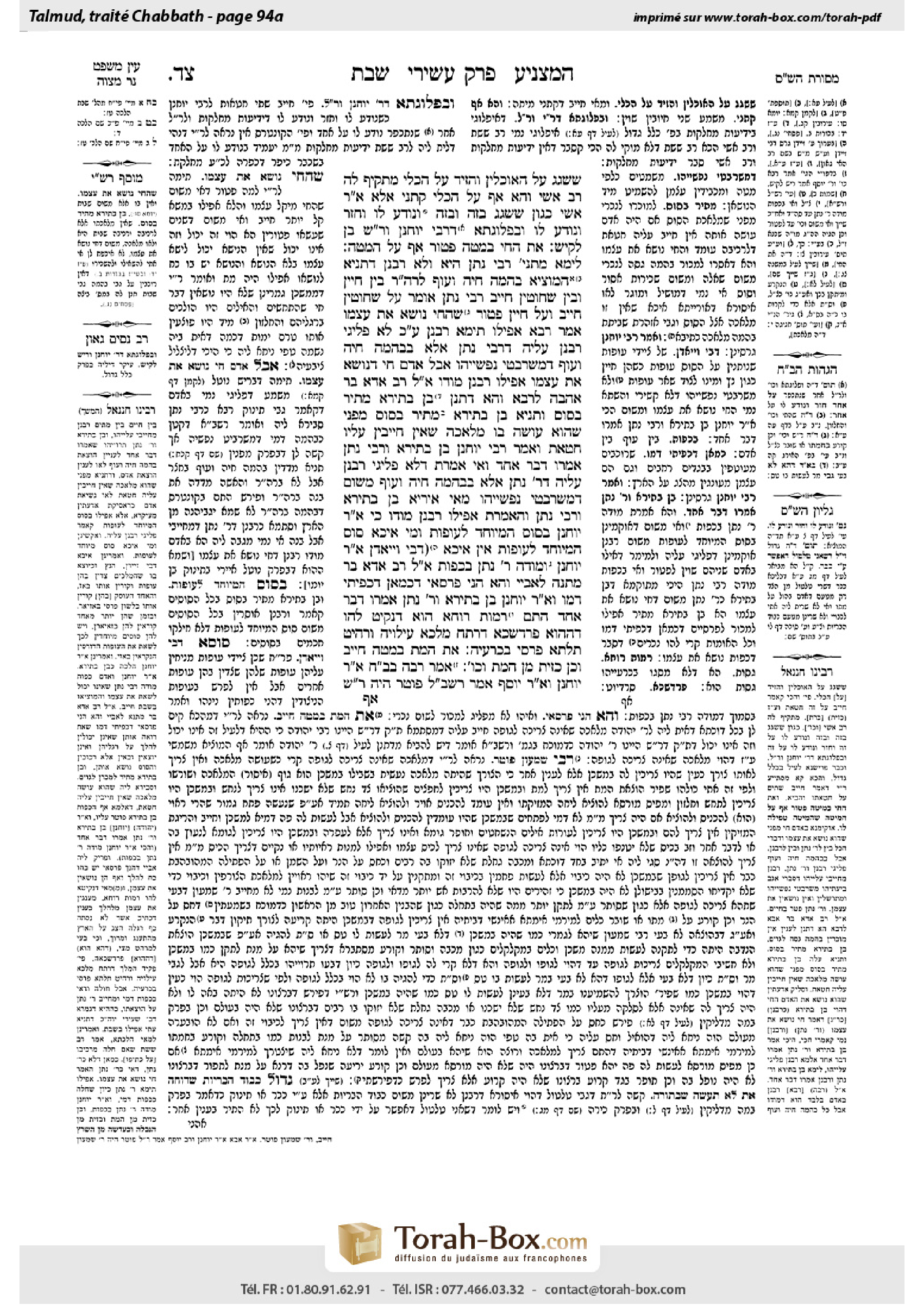
Shabbat 94a: Talmud study for Daf Yomi
Daf Yomi is the daily study of one Talmud folio. Explore 37 tractates with scans, Hebrew text, Sefaria English and AI-generated French translations where annotated.
Passage selection and English or AI-generated French translation are available where the scan has annotations. Daf Study is independent of Torah-Box and Sefaria.
Browse Shabbat · שבת · All tractatesShabbat 94a text and translations
This page of Shabbat includes the Aramaic text, an English translation and an AI-generated French translation, alongside the scan above.
שבת צ״ד א · Aramaic and Hebrew text
שֶׁשָּׁגַג עַל הָאוֹכָלִין וְהֵזִיד עַל הַכְּלִי. מַתְקֵיף לַהּ רַב אָשֵׁי: וְהָא ״אַף עַל הַכְּלִי״ קָתָנֵי! אֶלָּא אָמַר רַב אָשֵׁי: כְּגוֹן שֶׁשָּׁגַג בָּזֶה וּבָזֶה, וְנוֹדַע לוֹ, וְחָזַר וְנוֹדַע לוֹ, וּבִפְלוּגְתָּא דְּרַבִּי יוֹחָנָן וְרַבִּי שִׁמְעוֹן בֶּן לָקִישׁ.
אֶת הַחַי בַּמִּטָּה פָּטוּר אַף עַל הַמִּטָּה. לֵימָא מַתְנִיתִין רַבִּי נָתָן הִיא וְלָא רַבָּנַן, דְּתַנְיָא: הַמּוֹצִיא בְּהֵמָה חַיָּה וָעוֹף לִרְשׁוּת הָרַבִּים, בֵּין חַיִּין וּבֵין שְׁחוּטִין — חַיָּיב. רַבִּי נָתָן אוֹמֵר: עַל שְׁחוּטִין חַיָּיב וְעַל חַיִּין פָּטוּר, שֶׁהַחַי נוֹשֵׂא אֶת עַצְמוֹ. אָמַר רָבָא: אֲפִילּוּ תֵּימָא רַבָּנַן, עַד כָּאן לָא פְּלִיגִי רַבָּנַן עֲלֵיהּ דְּרַבִּי נָתָן אֶלָּא בִּבְהֵמָה חַיָּה וָעוֹף דִּמְשַׁרְבְּטִי נַפְשַׁיְיהוּ, אֲבָל אָדָם חַי דְּנוֹשֵׂא אֶת עַצְמוֹ — אֲפִילּוּ רַבָּנַן מוֹדוּ.
אֲמַר לֵיהּ רַב אַדָּא בַּר אַהֲבָה לְרָבָא, וְהָא דִּתְנַן: בֶּן בְּתִירָא מַתִּיר בַּסּוּס. וְתַנְיָא: בֶּן בְּתִירָא מַתִּיר בַּסּוּס מִפְּנֵי שֶׁהוּא עוֹשֶׂה בּוֹ מְלָאכָה שֶׁאֵין חַיָּיבִין עָלָיו חַטָּאת, וְאָמַר רַבִּי יוֹחָנָן: בֶּן בְּתִירָא וְרַבִּי נָתָן אָמְרוּ דָּבָר אֶחָד. וְאִי אָמְרַתְּ דְּלָא פְּלִיגִי רַבָּנַן עֲלֵיהּ דְּרַבִּי נָתָן אֶלָּא בִּבְהֵמָה חַיָּה וָעוֹף מִשּׁוּם דִּמְשַׁרְבְּטִי נַפְשַׁיְיהוּ, מַאי אִירְיָא בֶּן בְּתִירָא וְרַבִּי נָתָן? וְהָאָמְרַתְּ אֲפִילּוּ רַבָּנַן מוֹדוּ! כִּי אָמַר רַבִּי יוֹחָנָן, בְּסוּס הַמְיוּחָד לְעוֹפוֹת. וּמִי אִיכָּא סוּס הַמְיוּחָד לְעוֹפוֹת? אִין, אִיכָּא דְּבִי זְיָיארִן.
אָמַר רַבִּי יוֹחָנָן: וּמוֹדֶה רַבִּי נָתָן בְּכָפוּת. אֲמַר לֵיהּ רַב אַדָּא בַּר מַתְנָה לְאַבָּיֵי: וְהָא הָנֵי פָּרְסָאֵי דִּכְמַאן דִּכְפִיתִי דָּמוּ, וְאָמַר רַבִּי יוֹחָנָן: בֶּן בְּתִירָא וְרַבִּי נָתָן אָמְרוּ דָּבָר אֶחָד! הָתָם, רָמוּת רוּחָא הוּא דְּנָקֵיט לְהוּ. דְּהָהוּא פַּרְדַּשְׁכָא דִּרְתַח מַלְכָּא עִילָּוֵיהּ, וּרְהַט תְּלָתָא פַּרְסֵי בְּכַרְעֵיהּ.
אֶת הַמֵּת בַּמִּטָּה חַיָּיב וְכֵן כְּזַיִת מִן הַמֵּת וְכוּ׳. אָמַר רַבָּה בַּר בַּר חָנָה אָמַר רַבִּי יוֹחָנָן, וְאָמַר רַב יוֹסֵף אָמַר רַבִּי שִׁמְעוֹן בֶּן לָקִישׁ: פּוֹטֵר הָיָה רַבִּי שִׁמְעוֹן
Shabbat 94a · English translation
one acted unwittingly with regard to the food and intentionally with regard to the vessel. He is liable to bring a sin-offering for the food and to receive karet for the vessel. Rav Ashi strongly objects to this. Didn’t the baraita teach: He is liable even for the vessel? Apparently, the liability for the food and the liability for the vessel are identical. Rather, Rav Ashi said: This is referring to a case where one acted unwittingly both with regard to this, the food, and with regard to that, the vessel. And he became aware of one transgression, and then he became aware of the other transgression. And the ruling is dependent upon the dispute between Rabbi Yoḥanan and Rabbi Shimon ben Lakish cited above, with regard to the question whether or not one who unwittingly performed a single transgression twice and became aware of each separately is liable to bring two sin-offerings.
We learned in the mishna: One who carries out a living person on a bed is exempt even for carrying out the bed. The Gemara suggests: Let us say that the mishna is in accordance with the opinion of Rabbi Natan and not in accordance with the opinion of the Rabbis, as it was taught in a baraita: One who carries out a domesticated animal, an undomesticated animal, and fowl into the public domain on Shabbat is liable whether they are alive or whether they are slaughtered. Rabbi Natan says: For carrying out slaughtered animals, he is liable, and for carrying out live animals, he is exempt, because a living being carries itself. A living being attempts to lighten the load of the person carrying it and thereby participates in the act of carrying. Rava said: The mishna can be understood even if you say that it is in accordance with the opinion of the Rabbis. The Rabbis disagree with Rabbi Natan only as far as the case of a domesticated animal, an undomesticated animal, and fowl is concerned because they deaden their weight in an attempt to free themselves from the one carrying them. However, with regard to the fact that a live person carries himself, even the Rabbis agree. Therefore, one who carries a live person out is exempt.
Rav Adda bar Ahava said to Rava: And with regard to that which we learned in a mishna that it is prohibited to sell work animals to gentiles, to prevent a situation where animals still belonging to a Jew would be lent to a gentile who would perform labor with them on Shabbat, but ben Beteira permits selling a horse to a gentile. And it was taught in a baraita: Ben Beteira permits selling a horse for riding because the horse is performing an act for which one is not liable to bring a sin-offering, as riding a horse is not actually a prohibited labor. And Rabbi Yoḥanan said: Ben Beteira and Rabbi Natan said one, the same, thing. They both hold that an animal with a rider on its back is not considered to be bearing a burden. And if you say that the Rabbis only argue with Rabbi Natan with regard to a domesticated animal, an undomesticated animal, and fowl because they deaden their weight in an attempt to free themselves, why did Rabbi Yoḥanan say specifically that ben Beteira and Rabbi Natan agree? Didn’t you say that in the case of a person riding a horse even the Rabbis agree? The Gemara answers: When Rabbi Yoḥanan said that ben Beteira and Rabbi Natan said the same thing, he was referring to a horse designated specifically for carrying fowl. The Gemara asks: And is there a horse designated for carrying fowl? The Gemara answers: Yes, there is the horse for carrying a hunter’s falcons [devei vayadan].
Rabbi Yoḥanan said: And Rabbi Natan agrees in the case of a person who is bound because he is unable to lighten the load of the person carrying him. Rav Adda bar Mattana said to Abaye: And what of those Persians who are considered as if they were bound because they don heavy armor and always ride horses, and nevertheless Rabbi Yoḥanan said: Ben Beteira and Rabbi Natan said one thing and permitted selling horses even to Persians? The Gemara answers: There, with regard to the Persians, it is not that they are unable to dismount their horses. It is arrogance that keeps them from dismounting their horses. As proof, the Gemara relates: There was that Persian officer [pardashka] at whom the king was angry, and he ran three parasangs on foot. Apparently, even Persian horsemen are not considered bound and are capable of walking without their horses.
We learned in the mishna that according to the first tanna: One who carries out a corpse on a bed is liable. And similarly, one who carries out an olive-bulk of a corpse, or an olive-bulk of an animal carcass, or a lentil-bulk of a creeping animal is liable. Rabbi Shimon deems him exempt. Rabba bar bar Ḥana said that Rabbi Yoḥanan said, and Rav Yosef said that Rabbi Shimon ben Lakish said: Rabbi Shimon would deem exempt
Shabbat 94a · Traduction française (IA)
L’un a agi par inadvertance à l’égard de la nourriture et intentionnellement à l’égard du récipient. Il est tenu d’apporter un sacrifice expiatoire pour la nourriture et encourt le karèt pour le récipient. Rav Ashi objecte vivement : la baraïta n’a-t-elle pas enseigné qu’il est passible même pour le récipient ? Il semble donc que la responsabilité pour la nourriture et celle pour le récipient soient identiques. Rav Ashi dit plutôt : il s’agit d’un cas où l’on a agi par inadvertance à la fois à l’égard de ceci, la nourriture, et à l’égard de cela, le récipient. On a pris connaissance d’une transgression, puis de l’autre. La décision dépend de la controverse entre Rabbi Yoḥanan et Rabbi Shimon ben Lakish citée plus haut, sur la question de savoir si celui qui a commis par inadvertance deux fois une même transgression et en a pris connaissance séparément est tenu d’apporter deux sacrifices expiatoires.
Nous avons appris dans la Michna : Celui qui transporte une personne vivante sur un lit est exempt, même pour le transport du lit. La Guemara propose : disons que la Michna suit l’opinion de Rabbi Natan, et non celle des rabbins, car il a été enseigné dans une baraïta : Celui qui transporte un animal domestique, un animal sauvage et des volailles dans le domaine public pendant Chabbat est passible, qu’ils soient vivants ou abattus. Rabbi Natan dit : Pour le transport d’animaux abattus, il est passible ; pour celui d’animaux vivants, il est exempt, car un être vivant se porte lui-même. Un être vivant tente d’alléger la charge de celui qui le transporte et participe ainsi à l’acte de transport. Rava dit : On peut comprendre la Michna même si l’on affirme qu’elle suit l’opinion des rabbins. Ceux-ci ne sont en désaccord avec Rabbi Natan que dans le cas d’un animal domestique, d’un animal sauvage et de volailles, car ils raidissent leur corps pour tenter de se libérer de celui qui les transporte. Toutefois, même les rabbins conviennent qu’une personne vivante se porte elle-même. Par conséquent, celui qui transporte une personne vivante est exempt.
Rav Adda bar Ahava dit à Rava : Et qu’en est-il de ce que nous avons appris dans une Michna, à savoir qu’il est interdit de vendre des animaux de travail à des non-Juifs, afin d’éviter que des animaux appartenant encore à un Juif soient prêtés à un non-Juif qui les ferait travailler pendant Chabbat, tandis que ben Beteira autorise la vente d’un cheval à un non-Juif ? Il a été enseigné dans une baraïta que ben Beteira autorise la vente d’un cheval pour l’équitation, car le cheval accomplit alors un acte pour lequel on n’est pas tenu d’apporter un sacrifice expiatoire : monter à cheval n’est pas à proprement parler un travail interdit. Et Rabbi Yoḥanan a dit : ben Beteira et Rabbi Natan ont dit une seule et même chose. Tous deux estiment qu’un animal portant un cavalier sur son dos n’est pas considéré comme portant une charge. Et si tu dis que les rabbins ne sont en désaccord avec Rabbi Natan qu’à propos d’un animal domestique, d’un animal sauvage et de volailles, parce qu’ils raidissent leur corps pour tenter de se libérer, pourquoi Rabbi Yoḥanan a-t-il dit précisément que ben Beteira et Rabbi Natan sont d’accord ? N’as-tu pas dit que, dans le cas d’une personne montant un cheval, même les rabbins sont d’accord ? La Guemara répond : Lorsque Rabbi Yoḥanan a dit que ben Beteira et Rabbi Natan avaient dit une seule et même chose, il faisait référence à un cheval spécialement destiné au transport de volailles. La Guemara demande : Existe-t-il un cheval destiné au transport de volailles ? La Guemara répond : Oui, il y a le cheval destiné à transporter les faucons d’un chasseur [devei vayadan].
Rabbi Yoḥanan dit : Rabbi Natan est également d’accord dans le cas d’une personne ligotée, car elle ne peut pas alléger la charge de celui qui la transporte. Rav Adda bar Mattana dit à Abaye : Qu’en est-il de ces Perses, qui sont considérés comme ligotés parce qu’ils portent de lourdes armures et montent toujours à cheval, et pourtant Rabbi Yoḥanan a dit que ben Beteira et Rabbi Natan avaient dit une seule et même chose et a autorisé la vente de chevaux même aux Perses ? La Guemara répond : Dans leur cas, les Perses ne sont pas incapables de descendre de cheval. C’est leur arrogance qui les en empêche. À titre de preuve, la Guemara rapporte : Il y avait un officier perse [pardashka] contre lequel le roi s’était irrité ; il parcourut trois parasanges à pied. Il apparaît donc que même les cavaliers perses ne sont pas considérés comme ligotés et sont capables de marcher sans leurs chevaux.
Nous avons appris dans la Michna que, selon le premier tanna, celui qui transporte un cadavre sur un lit est passible. De même, celui qui transporte le volume d’une olive d’un cadavre, le volume d’une olive d’une carcasse animale ou le volume d’une lentille d’un animal rampant est passible. Rabbi Shimon le déclare exempt. Rabba bar bar Ḥana dit au nom de Rabbi Yoḥanan, et Rav Yosef dit au nom de Rabbi Shimon ben Lakish : Rabbi Shimon le déclarerait exempt
Traduction française générée par IA à partir de l’édition anglaise de Sefaria. Vérifie toujours un passage avec le texte source.
Text from Sefaria: William Davidson Edition - Vocalized Aramaic (CC BY NC); William Davidson Edition - English (CC BY NC).