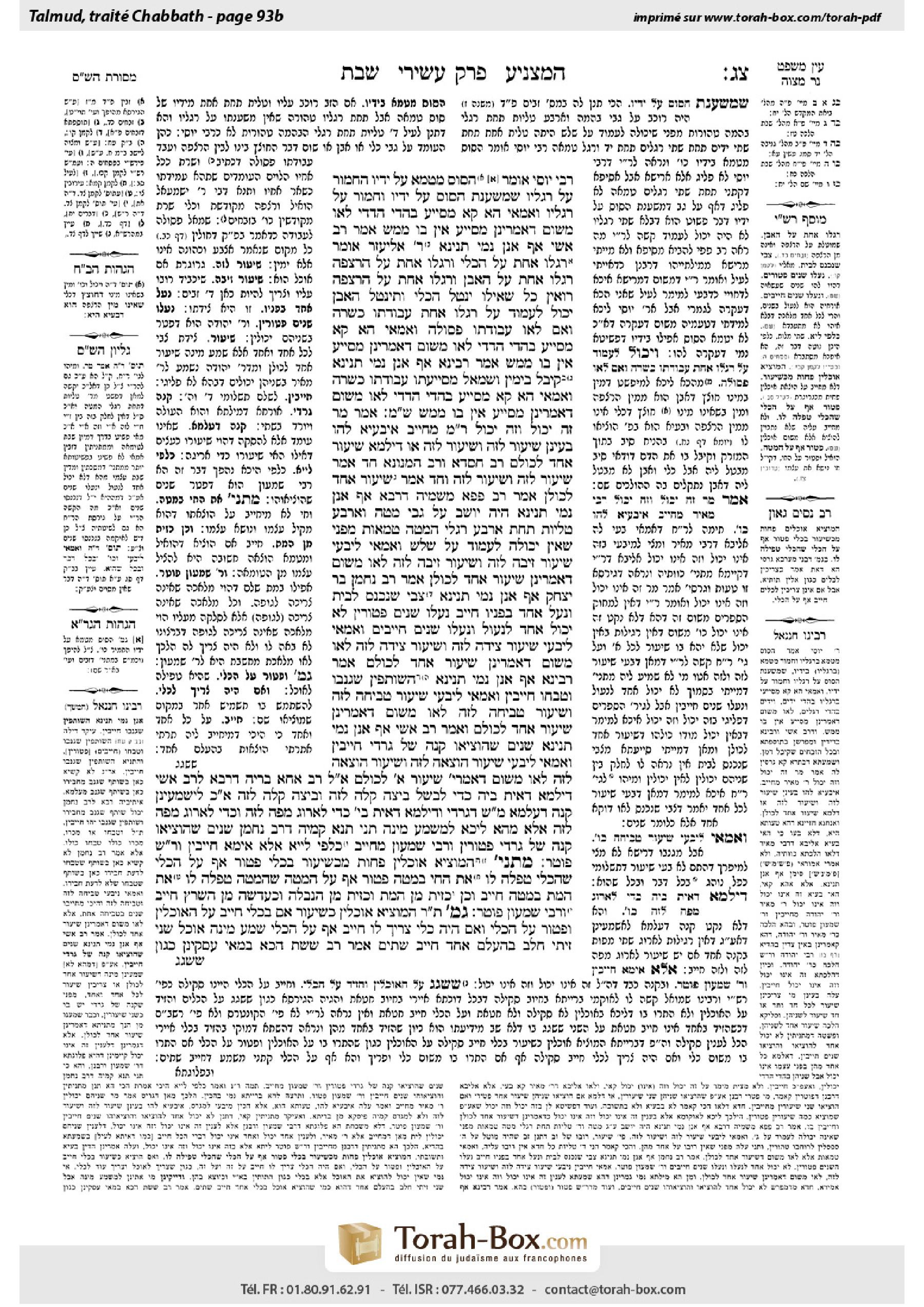
Shabbat 93b: Talmud study for Daf Yomi
Daf Yomi is the daily study of one Talmud folio. Explore 37 tractates with scans, Hebrew text, Sefaria English and AI-generated French translations where annotated.
Passage selection and English or AI-generated French translation are available where the scan has annotations. Daf Study is independent of Torah-Box and Sefaria.
Browse Shabbat · שבת · All tractatesShabbat 93b text and translations
This page of Shabbat includes the Aramaic text, an English translation and an AI-generated French translation, alongside the scan above.
שבת צ״ג ב · Aramaic and Hebrew text
רַבִּי יוֹסֵי אוֹמֵר: הַסּוּס מְטַמֵּא עַל יָדָיו, הַחֲמוֹר — עַל רַגְלָיו, שֶׁמִּשְׁעֶנֶת הַסּוּס עַל יָדָיו, וַחֲמוֹר עַל רַגְלָיו. וְאַמַּאי? הָא קָא מְסַיַּיע בַּהֲדֵי הֲדָדֵי! לָאו מִשּׁוּם דְּאָמְרִינַן מְסַיֵּיעַ אֵין בּוֹ מַמָּשׁ? אָמַר רַב אָשֵׁי: אַף אֲנַן נָמֵי תְּנֵינָא. רַבִּי אֱלִיעֶזֶר אוֹמֵר: רַגְלוֹ אַחַת עַל הַכְּלִי וְרַגְלוֹ אַחַת עַל הָרִצְפָּה, רַגְלוֹ אַחַת עַל הָאֶבֶן וְרַגְלוֹ אַחַת עַל הָרִצְפָּה — רוֹאִין כׇּל שֶׁאִילּוּ יִנָּטֵל הַכְּלִי וְתִינָּטֵל הָאֶבֶן יָכוֹל לַעֲמוֹד עַל רַגְלוֹ אַחַת — עֲבוֹדָתוֹ כְּשֵׁרָה, וְאִם לָאו — עֲבוֹדָתוֹ פְּסוּלָה.
וְאַמַּאי? הָא קָא מְסַיַּיע בַּהֲדֵי הֲדָדֵי! לָאו מִשּׁוּם דְּאָמְרִינַן מְסַיֵּיעַ אֵין בּוֹ מַמָּשׁ. אָמַר רָבִינָא: אַף אֲנַן נָמֵי תְּנֵינָא. קִיבֵּל בְּיָמִין, וּשְׂמֹאל מְסַיַּיעְתּוֹ — עֲבוֹדָתוֹ כְּשֵׁרָה. וְאַמַּאי, הָא קָא מְסַיַּיע בַּהֲדֵי הֲדָדֵי! לָאו מִשּׁוּם דְּאָמְרִינַן מְסַיֵּיעַ אֵין בּוֹ מַמָּשׁ? שְׁמַע מִינַּהּ.
אָמַר מָר: זֶה יָכוֹל וְזֶה יָכוֹל, רַבִּי מֵאִיר מְחַיַּיב. אִיבַּעְיָא לְהוּ: בָּעֵינַן שִׁיעוּר לָזֶה וְשִׁיעוּר לָזֶה, אוֹ דִילְמָא שִׁיעוּר אֶחָד לְכוּלָּם. רַב חִסְדָּא וְרַב הַמְנוּנָא, חַד אָמַר שִׁיעוּר לָזֶה וְשִׁיעוּר לָזֶה, וְחַד אָמַר שִׁיעוּר אֶחָד לְכוּלָּן. אָמַר רַב פָּפָּא מִשְּׁמֵיהּ דְּרָבָא: אַף אֲנַן נָמֵי תְּנֵינָא: הָיָה יוֹשֵׁב עַל גַּבֵּי מִטָּה וְאַרְבַּע טַלִּיּוֹת תַּחַת אַרְבַּע רַגְלֵי הַמִּטָּה — טְמֵאוֹת, מִפְּנֵי שֶׁאֵין יְכוֹלָה לַעֲמוֹד עַל שָׁלֹשׁ. וְאַמַּאי? לִיבְעֵי שִׁיעוּר זִיבָה לָזֶה וְשִׁיעוּר זִיבָה לָזֶה! לָאו מִשּׁוּם דְּאָמְרִינַן שִׁיעוּר אֶחָד לְכוּלָּן.
אָמַר רַב נַחְמָן בַּר יִצְחָק: אַף אֲנַן נָמֵי תְּנֵינָא: צְבִי שֶׁנִּכְנַס לַבַּיִת, וְנָעַל אֶחָד בְּפָנָיו — חַיָּיב. נָעֲלוּ שְׁנַיִם — פְּטוּרִין. לֹא יָכוֹל אֶחָד לִנְעוֹל, וְנָעֲלוּ שְׁנַיִם — חַיָּיבִים. וְאַמַּאי? לִיבְעֵי שִׁיעוּר צֵידָה לָזֶה וְשִׁיעוּר צֵידָה לָזֶה! לָאו מִשּׁוּם דְּאָמְרִינַן שִׁיעוּר אֶחָד לְכוּלָּם? אָמַר רָבִינָא: אַף אֲנַן נָמֵי תְּנֵינָא: הַשּׁוּתָּפִין שֶׁגָּנְבוּ וְטָבְחוּ — חַיָּיבִין. וְאַמַּאי? לִיבְעֵי שִׁיעוּר טְבִיחָה לָזֶה וְשִׁיעוּר טְבִיחָה לָזֶה! לָאו מִשּׁוּם דְּאָמְרִינַן שִׁיעוּר אֶחָד לְכוּלָּם?
וְאָמַר רַב אָשֵׁי: אַף אֲנַן נָמֵי תְּנֵינָא: שְׁנַיִם שֶׁהוֹצִיאוּ קָנֶה שֶׁל גַּרְדִּי — חַיָּיבִין. וְאַמַּאי? לִיבְעֵי שִׁיעוּר הוֹצָאָה לָזֶה וְשִׁיעוּר הוֹצָאָה לָזֶה! לָאו מִשּׁוּם דְּאָמְרִינַן שִׁיעוּר אֶחָד לְכוּלָּם? אֲמַר לֵיהּ רַב אַחָא בְּרֵיהּ דְּרָבָא לְרַב אָשֵׁי: דִילְמָא דְּאִית בֵּיהּ כְּדֵי לְבַשֵּׁל בֵּיצָה קַלָּה לָזֶה וּבֵיצָה קַלָּה לָזֶה! אִם כֵּן, לַישְׁמְעִינַן קָנֶה דְעָלְמָא, מַאי שְׁנָא דְּגַרְדִּי? וְדִילְמָא דְּאִית בֵּיהּ כְּדֵי לֶאֱרוֹג מַפָּה לָזֶה וּכְדֵי לֶאֱרוֹג מַפָּה לָזֶה, אֶלָּא מֵהָא לֵיכָּא לְמִשְׁמַע מִינַּהּ.
תָּנֵי תַּנָּא קַמֵּיהּ דְּרַב נַחְמָן: שְׁנַיִם שֶׁהוֹצִיאוּ קָנֶה שֶׁל גַּרְדִּי — פְּטוּרִין, וְרַבִּי שִׁמְעוֹן מְחַיֵּיב. כְּלַפֵּי לְיָיא?! אֶלָּא אֵימָא: חַיָּיבִין, וְרַבִּי שִׁמְעוֹן פּוֹטֵר.
מַתְנִי׳ הַמּוֹצִיא אוֹכָלִין פָּחוֹת מִכְּשִׁיעוּר בִּכְלִי — פָּטוּר אַף עַל הַכְּלִי, שֶׁהַכְּלִי טְפֵלָה לוֹ, אֶת הַחַי בַּמִּטָּה — פָּטוּר אַף עַל הַמִּטָּה, שֶׁהַמִּטָּה טְפֵלָה לוֹ. אֶת הַמֵּת בַּמִּטָּה — חַיָּיב, וְכֵן כְּזַיִת מִן הַמֵּת וּכְזַיִת מִן הַנְּבֵלָה וְכַעֲדָשָׁה מִן הַשֶּׁרֶץ — חַיָּיב, וְרַבִּי שִׁמְעוֹן פּוֹטֵר.
גְּמָ׳ תָּנוּ רַבָּנַן: הַמּוֹצִיא אוֹכָלִין כְּשִׁיעוּר, אִם בִּכְלִי — חַיָּיב עַל הָאוֹכָלִין וּפָטוּר עַל הַכְּלִי. וְאִם הָיָה כְּלִי צָרִיךְ לוֹ — חַיָּיב אַף עַל הַכְּלִי. שְׁמַע מִינַּהּ, אוֹכֵל שְׁנֵי זֵיתֵי חֵלֶב בְּהֶעְלֵם אֶחָד חַיָּיב שְׁתַּיִם! אָמַר רַב שֵׁשֶׁת: הָכָא בְּמַאי עָסְקִינַן — כְּגוֹן
Shabbat 93b · English translation
as we learned in a mishna, Rabbi Yosei says: If a zav was riding on an animal, and there was a garment beneath it, if he was riding the horse, he renders the garment impure by means of the horse’s front legs. Only then is it impure; if it was beneath the horse’s hind legs it is not. And if he was riding the donkey, he renders the garment impure by means of the donkey’s hind legs. Only then is it impure; if it was beneath the donkey’s front legs it is not. The reason for this distinction is that a horse rests primarily on its front legs, and a donkey rests primarily on its hind legs. But why should a garment beneath the hind legs of a horse or the front legs of a donkey remain ritually pure? Don’t the legs assist each other? Is the reason not because we say that one who assists is insubstantial? Rav Ashi said: We, too, also learned support for this halakha in a different mishna. Rabbi Eliezer says: With regard to a priest that stood in the Temple, and one of his feet was on a vessel, and one of his feet was on the floor, or one of his feet was on a stone, and one of his feet was on the floor, while performing priestly Temple rites; we see, if the vessel was removed or the stone was removed, whether he would still be capable of standing on one foot on the ground. If so, his service is valid. And if he could not stand on one foot, his service is invalid. Is he considered to be standing on the floor, in which case the service is valid, or is he not considered to be standing on the floor, in which case the service is invalid?
The Gemara asks: And why, if he would still be capable of standing on one foot, should it be valid? Don’t his legs assist each other? Isn’t the reason because we say: One who assists is insubstantial? Ravina said: We, too, also learned support for this in a different mishna. All service performed in the Temple must be performed with the right hand. If he received the blood in his right hand, and his left hand assisted his right hand, his service is valid. And why is his service valid? Aren’t his hands assisting each other? Isn’t the reason because we say: One who assists is insubstantial? The Gemara concludes: Indeed, learn from this that it is so.
The Master said in a baraita cited above: With regard to an action performed by two people, when this person is capable of performing it alone and that person is capable of performing it alone, Rabbi Meir deems them liable. A dilemma was raised before the students: Do we require a measure that determines liability for this person and a measure that determines liability for that one; or perhaps one measure that determines liability is sufficient for them all? Rav Ḥisda and Rav Hamnuna disagreed. One said: There must be a measure that determines liability for this person and a measure that determines liability for that one. And one said: One measure of liability is sufficient for them all. Rav Pappa said in the name of Rava: We, too, also learned a mishna in support of the opinion that one measure is sufficient. It states in the mishna in tractate Zavim: If a zav was sitting on a bed, and there were four garments beneath the four legs of the bed, they are all ritually impure because the bed is incapable of standing on three legs. And why should they be ritually impure? Let them require a measure of the weight of a zav for this garment and a measure of the weight of a zav for that garment. All the garments should only become impure if there was one zav on the bed for each garment. Is it not because we say that in order to make the garments impure one measure of impurity is sufficient for them all? Therefore, both parties are liable for one measure that determines liability.
Rav Naḥman bar Yitzḥak said: We, too, also learned an additional support from a different source. With regard to a deer that entered the house, and one person locked the door before it on Shabbat and prevented it from exiting, one is liable for performing the prohibited labor of trapping on Shabbat. If two people locked the door, they are exempt. If one is incapable of locking the door alone, and two people locked it, they are liable. And why are they liable? Let them require a measure of trapping for this person and a measure of trapping for that person. Is it not because we say that one measure of trapping is sufficient for them all? Ravina said: We, too, also learned an additional support from a different source. With regard to partners who stole an animal and slaughtered it, they are obligated to pay four or five times its value, as stated in the Torah. And why are they liable? Let them require a measure of slaughtering for this one and a measure of slaughtering for that one. Is it not because we say that one measure of slaughtering is sufficient for them all?
And Rav Ashi said: We, too, also learned an additional support from a similar source. Two people who carried out a weaver’s reed on Shabbat are liable. And why are they liable? Let them require a measure of carrying for this one and a measure of carrying for that one. Is it not because we say that one measure of carrying is sufficient for them all? Rav Aḥa, son of Rava, said to Rav Ashi: This cannot serve as a proof, for perhaps the rod has a measure equivalent to that which is used to cook an easily-cooked egg for this one and an easily-cooked egg for that one. That is the measure that determines liability for carrying out wood on Shabbat. He answered him: If so, let the baraita teach us the halakha with regard to an ordinary reed. What is different here that led the baraita to teach the halakha specifically about a weaver’s reed? Rather, the baraita is certainly referring to a reed that is a single unit. Again Rav Aḥa rejects the proof: And perhaps it has a measure equivalent to that which is used to weave a cloth for this one and to weave a cloth for that one. That is the measure that determines liability. Rather, proof cannot be learned from this baraita.
The tanna who recited mishnayot in the study hall taught before Rav Naḥman: Two people who carried out a weaver’s reed on Shabbat are exempt, and Rabbi Shimon deems them liable. Rav Naḥman was surprised at this. He asked: Toward where are you facing? This is the diametric opposite of their opinions. Rather, say an emended baraita: They are liable, and Rabbi Shimon deems them exempt.
MISHNA: One who carries out foods less than the measure that determines liability for carrying out food in a vessel on Shabbat is exempt, even for carrying out the vessel, because the vessel is secondary to the food inside it. Since one is not liable for carrying out the food, he is not liable for carrying out the vessel either. Similarly, one who carries out a living person on a bed is exempt, even for carrying out the bed, because the bed is secondary to the person. One who carries out a corpse on a bed is liable. And similarly, one who carries out an olive-bulk of a corpse, or an olive-bulk of an animal carcass, or a lentil-bulk of a creeping animal, which are the minimal measures of these items that transmit ritual impurity, is liable. And Rabbi Shimon deems him exempt. He holds that one is only liable for performing a prohibited labor for its own sake. One who carries out an object in order to bring it to its destination is liable. However, people carry out a corpse or an animal carcass only to be rid of them.
GEMARA: The Sages taught in a baraita: One who carries out the measure that determines liability for carrying out foods in a vessel on Shabbat is liable for carrying out the food and exempt for carrying out the vessel. And if that vessel was needed by him for another purpose, he is liable even for carrying out the vessel. The Gemara wonders with regard to the second halakha: Can we conclude from it that one who eats two olive-bulks of forbidden fat in the course of one lapse of awareness is liable to bring two sin-offerings? In that case, one who carries out a vessel with food inside it has performed two actions that fall under the rubric of one prohibited labor. Why should he be liable to bring two sin-offerings? Rav Sheshet said: With what are we dealing here? We are dealing with a case where
Shabbat 93b · Traduction française (IA)
Comme nous l’avons appris dans une Michna, Rabbi Yosei dit : Si un zav était monté sur un animal et qu’un vêtement se trouvait dessous, s’il montait un cheval, il rendait le vêtement impur par l’intermédiaire des pattes avant du cheval. Le vêtement n’était impur que dans ce cas ; s’il se trouvait sous les pattes arrière du cheval, il ne l’était pas. Et s’il montait un âne, il rendait le vêtement impur par l’intermédiaire des pattes arrière de l’âne. Le vêtement n’était impur que dans ce cas ; s’il se trouvait sous les pattes avant de l’âne, il ne l’était pas. La raison de cette distinction est qu’un cheval repose principalement sur ses pattes avant, tandis qu’un âne repose principalement sur ses pattes arrière. Mais pourquoi un vêtement placé sous les pattes arrière d’un cheval ou sous les pattes avant d’un âne resterait-il rituellement pur ? Les pattes ne se soutiennent-elles pas mutuellement ? N’est-ce pas parce que nous considérons que ce qui apporte son concours est négligeable ? Rav Ashi dit : Nous aussi, nous avons appris ailleurs, dans une autre Michna, un enseignement qui confirme cette halakha. Rabbi Eliezer dit : À propos d’un prêtre qui se tenait dans le Temple, un pied posé sur un ustensile et l’autre sur le sol, ou un pied posé sur une pierre et l’autre sur le sol, pendant qu’il accomplissait le service du Temple : on vérifie si, une fois l’ustensile ou la pierre retiré, il serait encore capable de se tenir debout sur un pied, au sol. Si oui, son service est valide ; s’il ne pouvait pas se tenir debout sur un pied, son service est invalide. Est-il considéré comme se tenant sur le sol, auquel cas son service est valide, ou n’est-il pas considéré comme se tenant sur le sol, auquel cas son service est invalide ?
La Guemara demande : Et pourquoi son service serait-il valide s’il était encore capable de se tenir debout sur un pied ? Ses jambes ne se soutiennent-elles pas mutuellement ? N’est-ce pas parce que nous considérons que ce qui apporte son concours est négligeable ? Ravina dit : Nous aussi, nous avons appris ailleurs, dans une autre Michna, un enseignement qui confirme cela. Tout service accompli dans le Temple doit l’être de la main droite. S’il a reçu le sang dans sa main droite et que sa main gauche a aidé sa main droite, son service est valide. Pourquoi son service est-il valide ? Ses mains ne s’aident-elles pas mutuellement ? N’est-ce pas parce que nous considérons que ce qui apporte son concours est négligeable ? La Guemara conclut : En effet, il faut en déduire que c’est bien le cas.
Le Maître a dit dans une baraïta citée précédemment : Lorsque deux personnes accomplissent une action, si l’une est capable de l’accomplir seule et que l’autre est également capable de l’accomplir seule, Rabbi Meïr les considère comme passibles. Les élèves soulevèrent une question : Faut-il une mesure entraînant la responsabilité pour cette personne et une autre pour celle-là, ou une seule mesure suffit-elle pour toutes deux ? Rav Ḥisda et Rav Hamnouna sont en désaccord. L’un dit : Il faut une mesure entraînant la responsabilité pour cette personne et une autre pour celle-là. L’autre dit : Une seule mesure suffit pour toutes deux. Rav Pappa dit au nom de Rava : Nous aussi, nous avons appris dans une Michna un enseignement qui confirme l’opinion selon laquelle une seule mesure suffit. La Michna du traité Zavim enseigne : Si un zav était assis sur un lit et que quatre vêtements se trouvaient sous ses quatre pieds, ils sont tous rituellement impurs, car le lit ne peut pas tenir sur trois pieds. Pourquoi devraient-ils être rituellement impurs ? Il faudrait qu’une mesure correspondant au poids d’un zav soit nécessaire pour ce vêtement et une autre mesure pour celui-là. Tous les vêtements ne devraient-ils devenir impurs que s’il y avait un zav sur le lit pour chaque vêtement ? N’est-ce pas parce que nous considérons qu’une seule mesure d’impureté suffit pour les rendre tous impurs ? Par conséquent, les deux personnes sont passibles pour une seule mesure entraînant la responsabilité.
Rav Naḥman bar Yitzḥak dit : Nous aussi, nous avons appris ailleurs un enseignement supplémentaire qui confirme cela. Si un cerf entre dans une maison et qu’une personne ferme la porte derrière lui pendant Chabbat, l’empêchant de sortir, elle est passible pour avoir accompli le travail interdit de piégeage pendant Chabbat. Si deux personnes ferment la porte, elles sont exemptes. Si une personne est incapable de fermer la porte seule et que deux personnes la ferment, elles sont passibles. Pourquoi sont-elles passibles ? Il faudrait qu’une mesure de piégeage soit nécessaire pour cette personne et une autre pour celle-là. N’est-ce pas parce que nous considérons qu’une seule mesure de piégeage suffit pour toutes deux ? Ravina dit : Nous aussi, nous avons appris ailleurs un enseignement supplémentaire qui confirme cela. Des associés qui ont volé un animal et l’ont abattu sont tenus de payer quatre ou cinq fois sa valeur, comme l’énonce la Torah. Pourquoi sont-ils passibles ? Il faudrait qu’une mesure d’abattage soit nécessaire pour l’un et une autre pour l’autre. N’est-ce pas parce que nous considérons qu’une seule mesure d’abattage suffit pour tous deux ?
Rav Ashi dit également : Nous aussi, nous avons appris ailleurs un enseignement supplémentaire qui confirme cela, à partir d’une source similaire. Deux personnes qui transportent une navette de tisserand pendant Chabbat sont passibles. Pourquoi sont-elles passibles ? Il faudrait qu’une mesure de transport soit nécessaire pour l’une et une autre pour l’autre. N’est-ce pas parce que nous considérons qu’une seule mesure de transport suffit pour toutes deux ? Rav Aḥa, fils de Rava, dit à Rav Ashi : Cela ne peut pas servir de preuve, car peut-être la baguette a-t-elle la taille requise pour cuire un œuf facile à cuire pour l’une et un autre œuf facile à cuire pour l’autre. C’est la mesure qui entraîne la responsabilité pour le transport de bois pendant Chabbat. Rav Ashi lui répondit : Dans ce cas, que la baraïta nous enseigne la halakha concernant une baguette ordinaire. Pourquoi la baraïta enseigne-t-elle ici spécifiquement la halakha concernant une navette de tisserand ? La baraïta parle donc certainement d’une navette constituant une seule unité. Rav Aḥa rejette de nouveau la preuve : Peut-être a-t-elle la taille requise pour tisser un tissu pour l’une et un autre tissu pour l’autre. C’est la mesure qui entraîne la responsabilité. On ne peut donc pas tirer de preuve de cette baraïta.
Le tanna qui récitait les Michnayot à la maison d’étude enseigna devant Rav Naḥman : Deux personnes qui transportent une navette de tisserand pendant Chabbat sont exemptes, et Rabbi Shimon les considère comme passibles. Rav Naḥman en fut surpris. Il demanda : Dans quelle direction regardes-tu ? C’est exactement l’inverse de leurs opinions. Il faut plutôt corriger la baraïta ainsi : elles sont passibles, et Rabbi Shimon les considère comme exemptes.
MICHNA : Celui qui transporte des aliments en quantité inférieure à la mesure entraînant la responsabilité pour le transport d’aliments pendant Chabbat est exempt, même pour le transport du récipient, car celui-ci est secondaire par rapport aux aliments qu’il contient. Puisqu’on n’est pas passible pour le transport des aliments, on ne l’est pas non plus pour celui du récipient. De même, celui qui transporte une personne vivante sur un lit est exempt, même pour le transport du lit, car le lit est secondaire par rapport à la personne. Celui qui transporte un cadavre sur un lit est passible. De même, celui qui transporte le volume d’une olive d’un cadavre, le volume d’une olive d’une carcasse animale ou le volume d’une lentille d’un animal rampant — les quantités minimales de ces éléments qui transmettent l’impureté rituelle — est passible. Rabbi Shimon le considère comme exempt. Selon lui, on n’est passible d’avoir accompli un travail interdit que si on l’a fait dans un but déterminé. Celui qui transporte un objet afin de le conduire à destination est passible. En revanche, on ne transporte un cadavre ou une carcasse animale que pour s’en débarrasser.
GUEMARA : Les Sages ont enseigné dans une baraïta : Celui qui transporte, dans un récipient, la quantité d’aliments entraînant la responsabilité pour le transport d’aliments pendant Chabbat est passible pour le transport des aliments et exempt pour celui du récipient. Mais si ce récipient lui était nécessaire pour un autre usage, il est également passible pour son transport. La Guemara s’interroge sur cette seconde halakha : Peut-on en déduire que celui qui mange deux volumes d’une olive de graisse interdite au cours d’une seule inadvertance est passible d’apporter deux sacrifices expiatoires ? Dans ce cas, celui qui transporte un récipient contenant des aliments a accompli deux actes relevant d’un même travail interdit. Pourquoi serait-il passible d’apporter deux sacrifices expiatoires ? Rav Sheshet dit : De quoi s’agit-il ici ? Il s’agit d’un cas où
Traduction française générée par IA à partir de l’édition anglaise de Sefaria. Vérifie toujours un passage avec le texte source.
Text from Sefaria: William Davidson Edition - Vocalized Aramaic (CC BY NC); William Davidson Edition - English (CC BY NC).