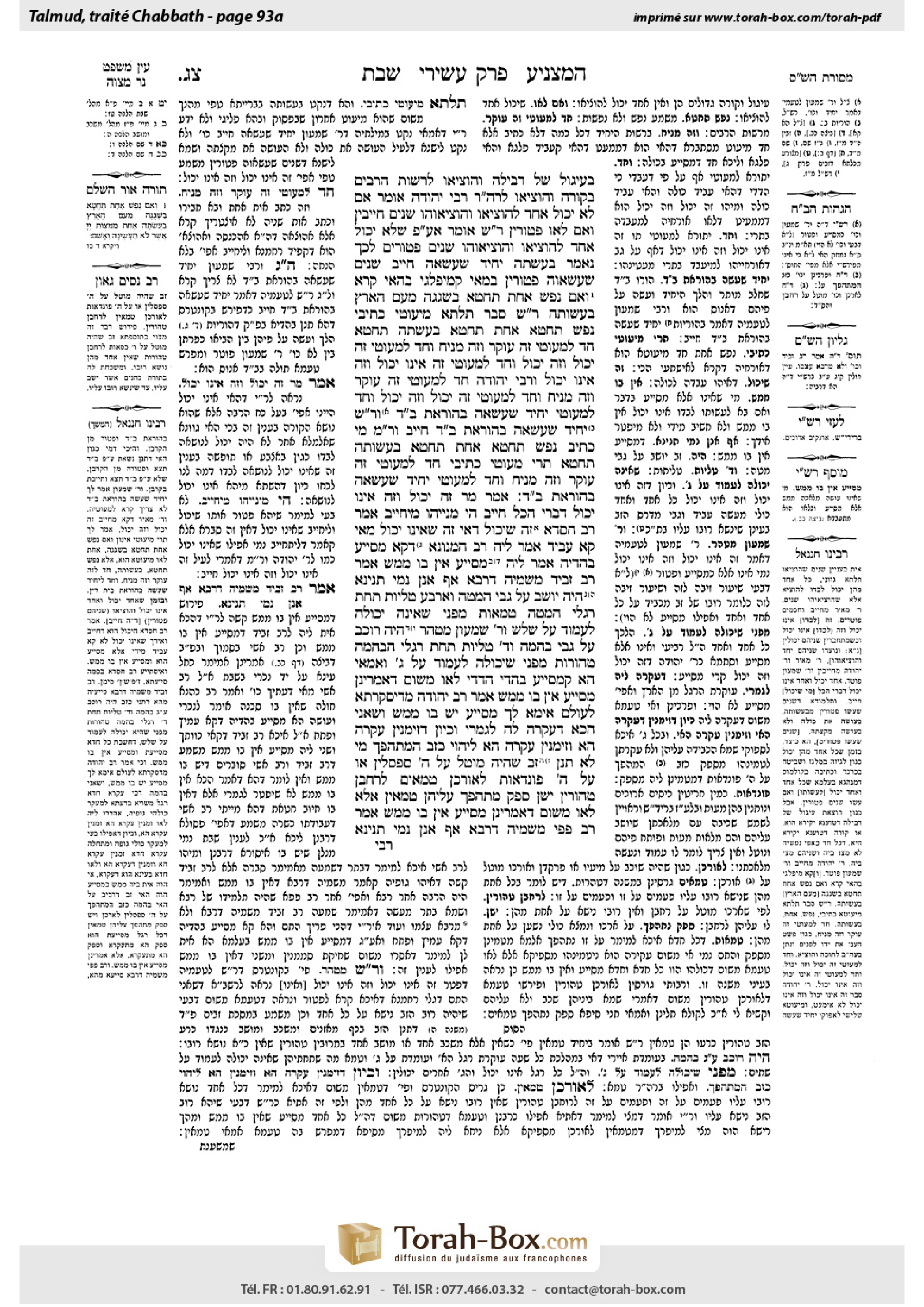
Shabbat 93a: Talmud study for Daf Yomi
Daf Yomi is the daily study of one Talmud folio. Explore 37 tractates with scans, Hebrew text, Sefaria English and AI-generated French translations where annotated.
Passage selection and English or AI-generated French translation are available where the scan has annotations. Daf Study is independent of Torah-Box and Sefaria.
Browse Shabbat · שבת · All tractatesShabbat 93a text and translations
This page of Shabbat includes the Aramaic text, an English translation and an AI-generated French translation, alongside the scan above.
שבת צ״ג א · Aramaic and Hebrew text
בְּעִיגּוּל שֶׁל דְּבֵילָה וְהוֹצִיאוּהוּ לִרְשׁוּת הָרַבִּים, בְּקוֹרָה וְהוֹצִיאוּהָ לִרְשׁוּת הָרַבִּים, רַבִּי יְהוּדָה אוֹמֵר: אִם לֹא יָכוֹל אֶחָד לְהוֹצִיאוֹ וְהוֹצִיאוּהוּ שְׁנַיִם — חַיָּיבִין, וְאִם לָאו — פְּטוּרִין. רַבִּי שִׁמְעוֹן אוֹמֵר: אַף עַל פִּי שֶׁלֹּא יָכוֹל אֶחָד לְהוֹצִיאוֹ וְהוֹצִיאוּהוּ שְׁנַיִם — פְּטוּרִים, לְכָךְ נֶאֱמַר ״בַּעֲשֹׂתָהּ״ — יָחִיד שֶׁעֲשָׂאָהּ חַיָּיב, שְׁנַיִם שֶׁעֲשָׂאוּהָ — פְּטוּרִין.
בְּמַאי קָמִיפַּלְגִי? בְּהַאי קְרָא: ״וְאִם נֶפֶשׁ אַחַת תֶּחֱטָא בִשְׁגָגָה מֵעַם הָאָרֶץ בַּעֲשֹׂתָהּ״. רַבִּי שִׁמְעוֹן סָבַר: תְּלָתָא מִיעוּטֵי כְּתִיבִי, ״נֶפֶשׁ תֶּחְטָא״, ״אַחַת תֶּחְטָא״, ״בַּעֲשֹׂתָהּ תֶּחְטָא״ — חַד לְמַעוֹטֵי זֶה עוֹקֵר וְזֶה מַנִּיחַ, וְחַד לְמַעוֹטֵי זֶה יָכוֹל וְזֶה יָכוֹל, וְחַד לְמַעוֹטֵי זֶה אֵינוֹ יָכוֹל וְזֶה אֵינוֹ יָכוֹל.
וְרַבִּי יְהוּדָה: חַד לְמַעוֹטֵי זֶה עוֹקֵר וְזֶה מַנִּיחַ, וְחַד לְמַעוֹטֵי זֶה יָכוֹל וְזֶה יָכוֹל, וְחַד לְמַעוֹטֵי יָחִיד שֶׁעֲשָׂאָהּ בְּהוֹרָאַת בֵּית דִּין. וְרַבִּי שִׁמְעוֹן: יָחִיד שֶׁעֲשָׂאָהּ בְּהוֹרָאַת בֵּית דִּין — חַיָּיב.
וְרַבִּי מֵאִיר — מִי כְּתִיב ״נֶפֶשׁ תֶּחְטָא״ ״אַחַת תֶּחְטָא״ ״בַּעֲשֹׂתָהּ תֶּחְטָא״? תְּרֵי מִעוּטֵי כְּתִיבִי, חַד לְמַעוֹטֵי זֶה עוֹקֵר וְזֶה מַנִּיחַ, וְחַד לְמַעוֹטֵי יָחִיד שֶׁעֲשָׂאָהּ בְּהוֹרָאַת בֵּית דִּין.
אָמַר מָר: זֶה יָכוֹל וְזֶה אֵינוֹ יָכוֹל — דִּבְרֵי הַכֹּל חַיָּיב. הֵי מִנַּיְיהוּ מִיחַיַּיב? אָמַר רַב חִסְדָּא: זֶה שֶׁיָּכוֹל, דְּאִי זֶה שֶׁאֵינוֹ יָכוֹל — מַאי קָא עָבֵיד! אֲמַר לֵיהּ רַב הַמְנוּנָא: דְּקָא מְסַיַּיע בַּהֲדֵיהּ! אֲמַר לֵיהּ: מְסַיֵּיעַ אֵין בּוֹ מַמָּשׁ.
אָמַר רַב זְבִיד מִשְּׁמֵיהּ דְּרָבָא, אַף אֲנַן נָמֵי תְּנֵינָא: הָיָה יוֹשֵׁב עַל גַּבֵּי הַמִּטָּה, וְאַרְבַּע טַלִּיּוֹת תַּחַת רַגְלֵי הַמִּטָּה — טְמֵאוֹת, מִפְּנֵי שֶׁאֵינָהּ יְכוֹלָה לַעֲמוֹד עַל שָׁלֹשׁ, וְרַבִּי שִׁמְעוֹן מְטַהֵר. הָיָה רוֹכֵב עַל גַּבֵּי בְּהֵמָה וְאַרְבַּע טַלִּיּוֹת תַּחַת רַגְלֵי הַבְּהֵמָה — טְהוֹרוֹת, מִפְּנֵי שֶׁיְּכוֹלָה לַעֲמוֹד עַל שָׁלֹשׁ. וְאַמַּאי? הָא קָמְסַיַּיעַ בַּהֲדֵי הֲדָדֵי! לָאו מִשּׁוּם דְּאָמְרִינַן מְסַיֵּיעַ אֵין בּוֹ מַמָּשׁ?
אָמַר רַב יְהוּדָה מִדִּיסְקַרְתָּא: לְעוֹלָם אֵימָא לָךְ מְסַיֵּיעַ יֵשׁ בּוֹ מַמָּשׁ, וְשָׁאנֵי הָכָא דְּעָקְרָה לַהּ לִגְמָרֵי. וְכֵיוָן דְּזִימְנִין עָקְרָה הָא, וְזִימְנִין עָקְרָה הָא, לֶיהֱוֵי כְּזָב הַמִּתְהַפֵּךְ! מִי לָא תְּנַן: זָב שֶׁהָיָה מוּטָּל עַל חֲמִשָּׁה סַפְסָלִין אוֹ עַל חָמֵשׁ פּוּנְדָּאוֹת, לְאוֹרְכָּן — טְמֵאִים, לְרׇחְבָּן — טְהוֹרִין. יָשֵׁן, סָפֵק מִתְהַפֵּךְ עֲלֵיהֶן — טְמֵאִין.
אֶלָּא לָאו, מִשּׁוּם דְּאָמְרִינַן מְסַיֵּיעַ אֵין בּוֹ מַמָּשׁ. אָמַר רַב פַּפִּי מִשְּׁמֵיהּ דְּרָבָא: אַף אֲנַן נָמֵי תְּנֵינָא,
Shabbat 93a · English translation
In contrast, if two people held a round cake of figs, which is too heavy for one person to carry, and they carried it out to the public domain, or if they held a beam and carried it out to the public domain, Rabbi Yehuda says: If one person is incapable of carrying it out alone, and two people carried it out, they are liable. And if not, if one person is capable of carrying it out alone, they are exempt. Rabbi Shimon says: Even if one person is incapable of carrying it out alone, and two people carried it out, they are exempt. It is with regard to that case that it is stated: “By performing it” (Leviticus 4:27), to establish a principle: An individual who performs a transgression is liable, two people who perform a transgression are exempt.
The Gemara asks: With regard to what do they disagree? The Gemara answers: They disagree over the interpretation of this verse: “And if one person among the common people sins unwittingly by performing it, any one of God’s commandments not to be done, and be guilty” (Leviticus 4:27). Rabbi Shimon holds: Three exclusionary statements are written in this verse. It is as if it were written: A person who sins, one who sins, and by performing it he sins. The Torah could have conveyed the same meaning by saying simply: And if one of the common people. Apparently, the superfluous words in the verse are exclusionary and the verse should be understood as follows: A person, and not many people; one, and not two; by performing it, and not by two performing it. One of the terms comes to exclude from liability a case where each of the two people performs a part of the transgression, i.e., this person lifts an object from one domain, and that person places it in another domain. And one of the terms comes to exclude a case where this person is capable of performing the action alone, and that person is also capable, and the two of them perform the action together. And one of the terms comes to exclude even a case where this person is incapable of performing the action alone, and that person is incapable of performing the action alone. Since the two of them violated this prohibition together, they are both exempt.
And Rabbi Yehuda holds: One of the terms comes to exclude a case where this person lifts an object, and that person places it, as he agrees that they are exempt in this case. And one of the terms comes to exclude a case where this person is capable of performing the action alone, and that person is also capable. And one of the terms comes to exclude the case of an individual who performed a transgression in accordance with the ruling of a court. If a court issued a mistaken ruling that a prohibited action is permitted, and an individual performed that action based on that ruling, he is exempt from bringing a sin-offering and is considered to have sinned due to circumstances beyond his control. And Rabbi Shimon holds that an individual who performed a transgression in accordance with the ruling of a court is liable to bring a sin-offering for his mistake. His action is not considered intentional, but falls into the category of an unwitting act.
The Gemara asks: And how does Rabbi Meir, who deems them liable in a case where each was capable of performing the act alone, interpret the third exclusionary term? The Gemara answers: Is it written in the verse: A person who sins, one who sins, and by performing it he sins? There are not three exclusionary terms in the verse. Only two exclusionary terms are written, as the words: “One person who sins,” constitutes a single phrase. Therefore, one term comes to exclude from liability a case where this person lifts an object, and that one places it; and one term comes to exclude an individual who performed a transgression in accordance with the ruling of a court.
We learned earlier that the Master said: In a case where this person is capable, and this person is incapable, and they performed it together, everyone agrees that he is liable. The Gemara seeks to clarify: Which of them is liable? Rav Ḥisda said: The one who is capable of performing the act alone is liable, as if it was the one who is incapable of performing the act alone that was liable, what is he doing that would render him liable? His efforts are inadequate to perform the task. Rav Hamnuna said to Rav Ḥisda: He is doing quite a bit, as he is assisting him. He said to him: The assistance provided by one who assists another to perform a task that the other could have performed himself is insubstantial.
Rav Zevid said in the name of Rava: We, too, also learned that halakha in a mishna, with regard to vessels upon which a zav lies or rides. By Torah law, any vessel designated for lying and riding, upon which a zav lies or rides, becomes impure even if the zav did not come into direct contact with it. If a zav was sitting on a bed, and there were four garments beneath the four legs of the bed, they are all ritually impure. The weight of the zav is considered to have rested on each of the garments because the bed is incapable of standing on three legs. And Rabbi Shimon deems the garments ritually pure, since only a portion of his weight rested on each garment. However, if he was riding on an animal, and there were four garments beneath the legs of the animal, they are all ritually pure because the animal is capable of standing on three legs. And why are the garments ritually pure? Aren’t the animal’s legs assisting each other in supporting the weight of the zav? Is it not because we say: An object that assists is insubstantial?
Rav Yehuda of Diskarta said: Actually, I will say to you that a person or an object that assists is substantial. However, it is different here, in this case, as the animal lifted its foot completely. The mishna is not discussing the case of an animal that could theoretically stand on three legs, but an actual situation where it completely lifted one of its feet and the fourth foot did not even assist in supporting the animal’s weight. The Gemara rejects the suggestion of Rav Yehuda of Diskarta. And since it sometimes lifts this foot and sometimes lifts that foot, it should have the legal status of a zav who turns over. Didn’t we learn in a mishna: With regard to a zav who was lying on five benches or on five money belts, if he was lying along their length, they are impure. At different times, his entire body was lying on each of the benches or on each of the money belts. If he was lying across their width, they are ritually pure because at no point was his entire weight supported by one of the benches or the money belts. However, if he slept across their width, there is uncertainty whether or not, while sleeping, he turned over on them. This raises the possibility that, at some point, he lay along their length, and his entire weight was supported by one of the benches. Therefore, all of the benches are impure. A zav who moves his weight from one place to another renders all of those places ritually impure. Similarly, the fact that the animal lifts different legs is not sufficient for each to be considered as not assisting to support the weight of the zav.
Rather, is it not that the garments beneath the legs of the animal remain ritually pure because we say: An object that assists is insubstantial? Each foot merely assists in supporting the weight of the zav. Similarly, Rav Pappi said in the name of Rava: We, too, also learned support for this halakha,
Shabbat 93a · Traduction française (IA)
En revanche, si deux personnes tiennent une galette ronde de figues, trop lourde pour qu’une seule personne puisse la porter, et la transportent dans le domaine public, ou si elles tiennent une poutre et la transportent dans le domaine public, Rabbi Yehuda dit : Si une seule personne ne peut pas la transporter, mais que deux personnes l’ont transportée, elles sont passibles. Sinon, si une seule personne peut la transporter, elles sont exemptes. Rabbi Shimon dit : Même si une seule personne ne peut pas la transporter, mais que deux personnes l’ont transportée, elles sont exemptes. C’est à propos de ce cas qu’il est dit : « En l’accomplissant » (Lévitique 4,27), afin d’établir un principe : un individu qui commet une transgression est passible ; deux personnes qui commettent une transgression sont exemptes.
La Guemara demande : Sur quoi porte leur désaccord ? La Guemara répond : Ils sont en désaccord sur l’interprétation du verset : « Si une personne du peuple commet involontairement une faute en accomplissant l’une des mitsvot de l’Éternel qu’il est interdit d’accomplir, et se rend ainsi coupable » (Lévitique 4,27). Rabbi Shimon considère que trois expressions d’exclusion figurent dans ce verset. C’est comme si le verset disait : une personne qui commet une faute, une personne, et elle commet une faute en l’accomplissant. La Torah aurait pu transmettre le même sens en disant simplement : « Si une personne du peuple ». Il semble donc que les mots superflus du verset servent à exclure, et que le verset doit être compris ainsi : une personne, et non plusieurs personnes ; une, et non deux ; en l’accomplissant, et non en l’accomplissant à deux. L’une de ces expressions vient exclure de la responsabilité le cas où chacune des deux personnes accomplit une partie de la transgression, c’est-à-dire que cette personne soulève un objet d’un domaine et que l’autre le dépose dans un autre domaine. Une autre expression vient exclure le cas où cette personne peut accomplir seule l’action et où l’autre le peut aussi, mais où elles l’accomplissent ensemble. Une autre encore vient exclure même le cas où cette personne ne peut pas accomplir seule l’action et où l’autre ne le peut pas non plus. Puisqu’elles ont enfreint ensemble cette interdiction, elles sont toutes deux exemptes.
Rabbi Yehuda considère, quant à lui, qu’une expression vient exclure le cas où cette personne soulève un objet et où l’autre le dépose, car il reconnaît qu’elles sont exemptes dans ce cas. Une autre expression vient exclure le cas où cette personne peut accomplir seule l’action et où l’autre le peut aussi. Une autre encore vient exclure le cas d’un individu qui a commis une transgression conformément à la décision d’un tribunal. Si un tribunal a rendu une décision erronée selon laquelle une action interdite est permise, et qu’un individu a accompli cette action en se fondant sur cette décision, il est exempt d’apporter un sacrifice expiatoire et est considéré comme ayant péché sous la contrainte. Rabbi Shimon considère, lui, qu’un individu qui a commis une transgression conformément à la décision d’un tribunal est tenu d’apporter un sacrifice expiatoire pour son erreur. Son acte n’est pas considéré comme intentionnel, mais relève de la catégorie d’un acte involontaire.
La Guemara demande : Comment Rabbi Meir, qui les déclare passibles lorsque chacun pouvait accomplir l’acte seul, interprète-t-il la troisième expression d’exclusion ? La Guemara répond : Le verset dit-il : « Une personne qui commet une faute, une personne, et elle commet une faute en l’accomplissant » ? Le verset ne comporte pas trois expressions d’exclusion. Il n’en comporte que deux, car les mots « une personne qui commet une faute » forment une seule expression. Par conséquent, une expression vient exclure de la responsabilité le cas où cette personne soulève un objet et où l’autre le dépose ; l’autre vient exclure le cas d’un individu qui a commis une transgression conformément à la décision d’un tribunal.
Nous avons appris précédemment que le Maître a dit : dans le cas où cette personne est capable et l’autre incapable, et où elles accomplissent l’acte ensemble, tous reconnaissent qu’il est passible. La Guemara cherche à préciser : Lequel des deux est passible ? Rav Ḥisda dit : Celui qui est capable d’accomplir seul l’acte est passible. En effet, si celui qui ne peut pas accomplir seul l’acte était passible, qu’aurait-il fait qui puisse le rendre passible ? Ses efforts ne suffisent pas à accomplir la tâche. Rav Hamnuna dit à Rav Ḥisda : Il en fait beaucoup, puisqu’il l’aide. Il lui répondit : L’aide apportée par quelqu’un à une personne pour accomplir une tâche que cette dernière aurait pu accomplir seule est négligeable.
Rav Zevid dit au nom de Rava : Nous aussi, nous avons appris cette halakha dans une Michna, à propos des récipients sur lesquels un zav est couché ou qu’il enfourche. Selon la Torah, tout récipient destiné à servir de couche ou de monture, sur lequel un zav est couché ou qu’il enfourche, devient impur, même si le zav n’est pas entré en contact direct avec lui. Si un zav était assis sur un lit et que quatre vêtements se trouvaient sous les quatre pieds du lit, ils sont tous rituellement impurs. Le poids du zav est considéré comme ayant reposé sur chacun des vêtements, car le lit ne peut pas tenir sur trois pieds. Rabbi Shimon déclare les vêtements rituellement purs, car seule une partie de son poids reposait sur chacun d’eux. Cependant, s’il enfourchait un animal et que quatre vêtements se trouvaient sous les pattes de l’animal, ils sont tous rituellement purs, car l’animal peut tenir sur trois pattes. Et pourquoi les vêtements sont-ils rituellement purs ? Les pattes de l’animal ne s’aident-elles pas les unes les autres à supporter le poids du zav ? N’est-ce pas parce que nous disons : ce qui apporte une aide est négligeable ?
Rav Yehuda de Diskarta dit : En réalité, je te dirai qu’une personne ou un objet qui apporte une aide est considéré comme substantiel. Cependant, le cas présent est différent, car l’animal a entièrement levé sa patte. La Michna ne traite pas du cas d’un animal qui pourrait théoriquement tenir sur trois pattes, mais d’une situation réelle où il a complètement levé l’une de ses pattes, et où la quatrième patte n’a même pas contribué à soutenir son poids. La Guemara rejette la proposition de Rav Yehuda de Diskarta. Puisqu’il lui arrive de lever cette patte et parfois l’autre, ne devrait-il pas avoir le statut d’un zav qui se retourne ? N’avons-nous pas appris dans une Michna : à propos d’un zav couché sur cinq bancs ou sur cinq ceintures porte-monnaie, s’il était couché dans le sens de leur longueur, ils sont impurs. À différents moments, tout son corps reposait sur chacun des bancs ou chacune des ceintures porte-monnaie. S’il était couché en travers, ils sont rituellement purs, car à aucun moment tout son poids ne reposait sur un seul des bancs ou une seule des ceintures porte-monnaie. Cependant, s’il dormait en travers, il est incertain qu’il se soit ou non retourné sur eux pendant son sommeil. Il est donc possible qu’à un moment donné il se soit couché dans le sens de leur longueur, son poids entier reposant alors sur un seul banc. Tous les bancs sont donc impurs. Un zav qui déplace son poids d’un endroit à un autre rend tous ces endroits rituellement impurs. De même, le fait que l’animal lève différentes pattes ne suffit pas à considérer que chacune ne contribue pas à soutenir le poids du zav.
Au contraire, n’est-ce pas parce que les vêtements placés sous les pattes de l’animal restent rituellement purs que nous disons : ce qui apporte une aide est négligeable ? Chaque patte ne fait qu’aider à soutenir le poids du zav. De même, Rav Pappi dit au nom de Rava : Nous aussi, nous avons appris un appui à cette halakha,
Traduction française générée par IA à partir de l’édition anglaise de Sefaria. Vérifie toujours un passage avec le texte source.
Text from Sefaria: William Davidson Edition - Vocalized Aramaic (CC BY NC); William Davidson Edition - English (CC BY NC).