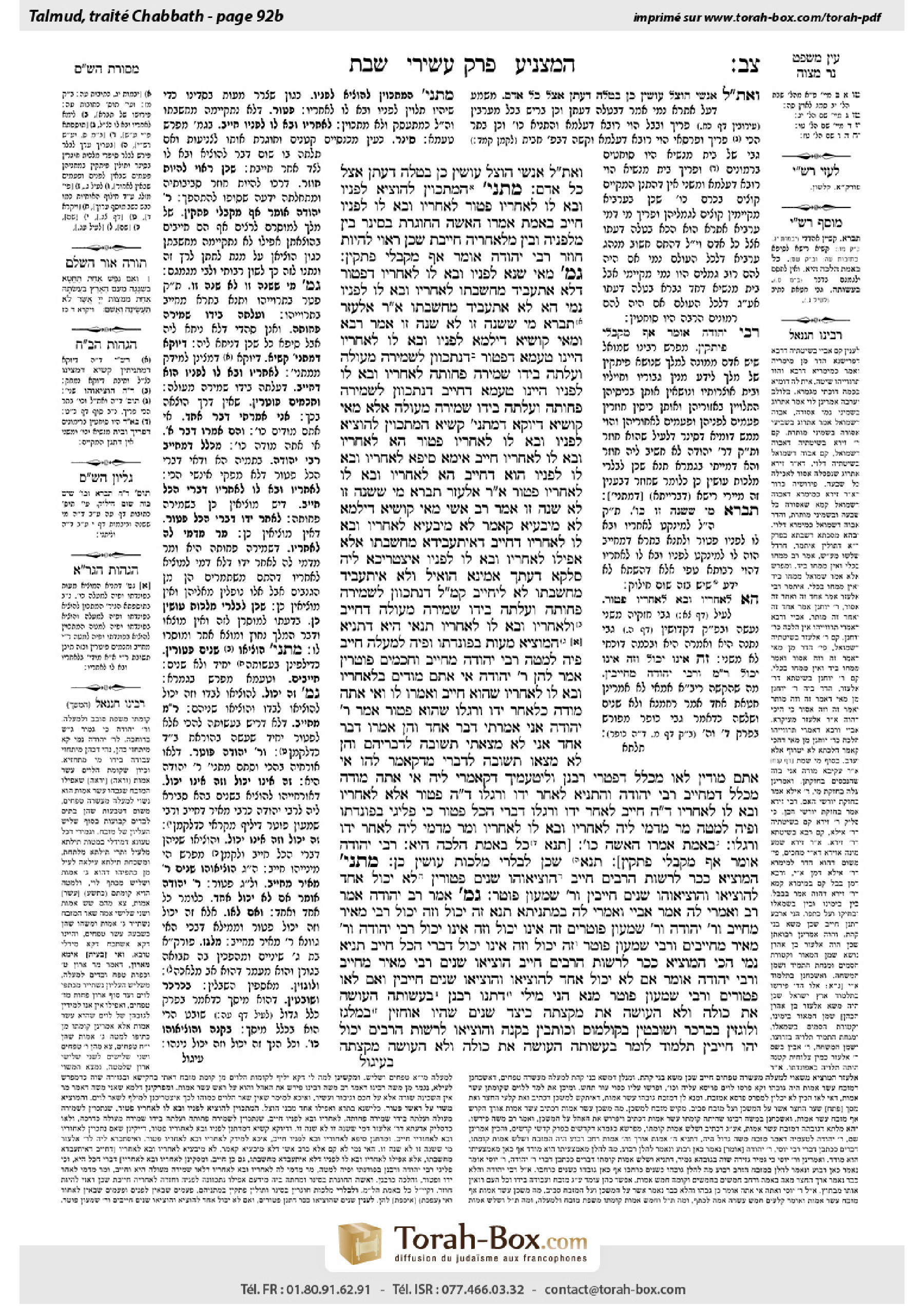
Shabbat 92b: Talmud study for Daf Yomi
Daf Yomi is the daily study of one Talmud folio. Explore 37 tractates with scans, Hebrew text, Sefaria English and AI-generated French translations where annotated.
Passage selection and English or AI-generated French translation are available where the scan has annotations. Daf Study is independent of Torah-Box and Sefaria.
Browse Shabbat · שבת · All tractatesShabbat 92b text and translations
This page of Shabbat includes the Aramaic text, an English translation and an AI-generated French translation, alongside the scan above.
שבת צ״ב ב · Aramaic and Hebrew text
וְאִם תִּמְצָא לוֹמַר אַנְשֵׁי הוּצָל עוֹשִׂין כֵּן — בָּטְלָה דַּעְתָּן אֵצֶל כׇּל אָדָם.
מַתְנִי׳ הַמִּתְכַּוֵּין לְהוֹצִיא לְפָנָיו, וּבָא לוֹ לְאַחֲרָיו — פָּטוּר. לְאַחֲרָיו וּבָא לוֹ לְפָנָיו — חַיָּיב. בֶּאֱמֶת אָמְרוּ: הָאִשָּׁה הַחוֹגֶרֶת בְּסִינָר, בֵּין מִלְּפָנֶיהָ וּבֵין מִלְּאַחֲרֶיהָ — חַיֶּיבֶת, שֶׁכֵּן רָאוּי לִהְיוֹת חוֹזֵר. רַבִּי יְהוּדָה אוֹמֵר: אַף מְקַבְּלֵי פִתְקִין.
גְּמָ׳ מַאי שְׁנָא לְפָנָיו וּבָא לוֹ לְאַחֲרָיו דְּפָטוּר — דְּלָא אִתְעֲבִידָא מַחְשַׁבְתּוֹ, לְאַחֲרָיו וּבָא לוֹ לְפָנָיו נָמֵי, הָא לָא אִתְעֲבִידָא מַחְשַׁבְתּוֹ! אָמַר רַבִּי אֶלְעָזָר: תַּבְרַהּ, מִי שֶׁשָּׁנָה זוֹ לֹא שָׁנָה זוֹ. אָמַר רָבָא: וּמַאי קוּשְׁיָא? דִילְמָא: לְפָנָיו וּבָא לוֹ לְאַחֲרָיו הַיְינוּ טַעְמָא דְּפָטוּר — דְּנִתְכַּוֵּון לִשְׁמִירָה מְעוּלָּה וְעָלְתָה בְּיָדוֹ שְׁמִירָה פְּחוּתָה, לְאַחֲרָיו וּבָא לוֹ לְפָנָיו הַיְינוּ טַעְמָא דְּחַיָּיב — דְּנִתְכַּוֵּון לִשְׁמִירָה פְּחוּתָה וְעָלְתָה בְּיָדוֹ שְׁמִירָה מְעוּלָּה.
אֶלָּא מַאי קוּשְׁיָא — דִּיּוּקָא דְמַתְנִיתִין קַשְׁיָא: הַמִּתְכַּוֵּין לְהוֹצִיא לְפָנָיו וּבָא לוֹ לְאַחֲרָיו — פָּטוּר, הָא לְאַחֲרָיו וּבָא לוֹ לְאַחֲרָיו — חַיָּיב. אֵימָא סֵיפָא: לְאַחֲרָיו וּבָא לוֹ לְפָנָיו הוּא דְּחַיָּיב, הָא לְאַחֲרָיו וּבָא לוֹ לְאַחֲרָיו פָּטוּר! אָמַר רַבִּי אֶלְעָזָר: תַּבְרַהּ, מִי שֶׁשָּׁנָה זוֹ לֹא שָׁנָה זוֹ.
אָמַר רַב אָשֵׁי: מַאי קוּשְׁיָא? דִּילְמָא לָא מִיבַּעְיָא קָאָמַר: לָא מִיבַּעְיָא לְאַחֲרָיו וּבָא לוֹ לְאַחֲרָיו דְּחַיָּיב — דְּאִיתְעֲבִידָא מַחְשַׁבְתּוֹ, אֶלָּא אֲפִילּוּ לְאַחֲרָיו וּבָא לוֹ לְפָנָיו אִיצְטְרִיכָא לֵיהּ. סָלְקָא דַּעְתָּךְ אָמֵינָא, הוֹאִיל וְלָא אִיתְעֲבִידָא מַחְשַׁבְתּוֹ לָא לִיחַיַּיב — קָא מַשְׁמַע לַן דְּנִתְכַּוֵּון לִשְׁמִירָה פְּחוּתָה וְעָלְתָה בְּיָדוֹ שְׁמִירָה מְעוּלָּה דְּחַיָּיב.
וּלְאַחֲרָיו וּבָא לוֹ לְאַחֲרָיו תַּנָּאֵי הִיא. דְּתַנְיָא: הַמּוֹצִיא מָעוֹת בְּפוּנְדָּתוֹ וּפִיהָ לְמַעְלָה — חַיָּיב. פִּיהָ לְמַטָּה — רַבִּי יְהוּדָה מְחַיֵּיב, וַחֲכָמִים פּוֹטְרִין. אָמַר לָהֶן רַבִּי יְהוּדָה: אִי אַתֶּם מוֹדִים בִּלְאַחֲרָיו וּבָא לוֹ לְאַחֲרָיו שֶׁהוּא חַיָּיב? וְאָמְרוּ לוֹ: וְאִי אַתָּה מוֹדֶה כִּלְאַחַר יָדוֹ וְרַגְלוֹ שֶׁהוּא פָּטוּר?
אָמַר רַבִּי יְהוּדָה: אֲנִי אָמַרְתִּי דָּבָר אֶחָד וְהֵן אָמְרוּ דָּבָר אֶחָד. אֲנִי לֹא מָצָאתִי תְּשׁוּבָה לְדִבְרֵיהֶם וְהֵן לֹא מָצְאוּ תְּשׁוּבָה לִדְבָרַי. מִדְּקָאֲמַר לְהוּ ״אִי אַתֶּם מוֹדִין״ — לָאו מִכְּלָל דְּפָטְרִי רַבָּנַן? וְלִיטַעְמָיךְ, דְּקָאָמְרִי לֵיהּ ״אִי אַתָּה מוֹדֶה״ — מִכְּלָל דִּמְחַיֵּיב רַבִּי יְהוּדָה? וְהָתַנְיָא: לְאַחַר יָדוֹ וְרַגְלוֹ דִּבְרֵי הַכֹּל פָּטוּר!
אֶלָּא: לְאַחֲרָיו וּבָא לוֹ לְאַחֲרָיו, דִּבְרֵי הַכֹּל חַיָּיב. לְאַחַר יָדוֹ וְרַגְלוֹ, דִּבְרֵי הַכֹּל פָּטוּר. כִּי פְּלִיגִי, בְּפוּנְדָּתוֹ וּפִיהָ לְמַטָּה: מָר מְדַמֵּי לֵיהּ לְאַחֲרָיו וּבָא לוֹ לְאַחֲרָיו, וּמָר מְדַמֵּי לֵיהּ לְאַחַר יָדוֹ וְרַגְלוֹ.
בֶּאֱמֶת אָמְרוּ הָאִשָּׁה כּוּ׳. [תָּנָא כׇּל ״בֶּאֱמֶת״ — הֲלָכָה הִיא. רַבִּי יְהוּדָה אוֹמֵר אַף מְקַבְּלֵי פִתְקִין.] תָּנָא: שֶׁכֵּן לַבְלָרֵי מַלְכוּת עוֹשִׂין כֵּן.
מַתְנִי׳ הַמּוֹצִיא כִּכָּר לִרְשׁוּת הָרַבִּים — חַיָּיב. הוֹצִיאוּהוּ שְׁנַיִם — פְּטוּרִין. לֹא יָכוֹל אֶחָד לְהוֹצִיאוֹ וְהוֹצִיאוּהוּ שְׁנַיִם — חַיָּיבִין. וְרַבִּי שִׁמְעוֹן פּוֹטֵר.
גְּמָ׳ אָמַר רַב יְהוּדָה אָמַר רַב, וְאָמְרִי לַהּ אָמַר אַבָּיֵי, וְאָמְרִי לַהּ בְּמַתְנִיתָא תָּנָא: זֶה יָכוֹל וְזֶה יָכוֹל — רַבִּי מֵאִיר מְחַיֵּיב, וְרַבִּי יְהוּדָה וְרַבִּי שִׁמְעוֹן פּוֹטְרִים. זֶה אֵינוֹ יָכוֹל וְזֶה אֵינוֹ יָכוֹל — רַבִּי יְהוּדָה וְרַבִּי מֵאִיר מְחַיְּיבִים וְרַבִּי שִׁמְעוֹן פּוֹטֵר. זֶה יָכוֹל וְזֶה אֵינוֹ יָכוֹל — דִּבְרֵי הַכֹּל חַיָּיב.
תַּנְיָא נָמֵי הָכִי: הַמּוֹצִיא כִּכָּר לִרְשׁוּת הָרַבִּים — חַיָּיב. הוֹצִיאוּהוּ שְׁנַיִם — רַבִּי מֵאִיר מְחַיֵּיב, וְרַבִּי יְהוּדָה אוֹמֵר: אִם לֹא יָכוֹל אֶחָד לְהוֹצִיאוֹ וְהוֹצִיאוּהוּ שְׁנַיִם — חַיָּיבִין, וְאִם לָאו — פְּטוּרִים, וְרַבִּי שִׁמְעוֹן פּוֹטֵר. מְנָא הָנֵי מִילֵּי? דְּתָנוּ רַבָּנַן: ״בַּעֲשֹׂתָהּ״ — הָעוֹשֶׂה אֶת כּוּלָּהּ וְלֹא הָעוֹשֶׂה אֶת מִקְצָתָהּ, כֵּיצַד? שְׁנַיִם שֶׁהָיוּ אוֹחֲזִין בְּמַלְגֵּז וְלוֹגְזִין, בְּכַרְכֵּר וְשׁוֹבְטִין, בְּקוּלְמוֹס וְכוֹתְבִין, בְּקָנֶה וְהוֹצִיאוּהוּ לִרְשׁוּת הָרַבִּים, יָכוֹל יְהוּ חַיָּיבִין — תַּלְמוּד לוֹמַר: ״בַּעֲשֹׂתָהּ״ — הָעוֹשֶׂה אֶת כּוּלָּהּ וְלֹא הָעוֹשֶׂה מִקְצָתָהּ.
Shabbat 92b · English translation
And if you say that the people of Hotzal do so and therefore they should be liable, their intention is rendered irrelevant by the opinions of all other people.
MISHNA: One who intends to carry out an object with the object before him, and as he was walking the object came to be carried behind him, is exempt. However, if he intended to carry it out behind him and it came to be carried before him, he is liable. In truth they said: A woman who girded herself in a pants-like sinar worn beneath the outer garments, whether she placed an object before her or behind her, and it came to be carried on the other side, she is liable, as it is common for the sinar to be reversed. Rabbi Yehuda says: Even those royal couriers, who receive notes [pittakin], carry those notes in their belts, and are not particular where on their belt they carry the notes (Rav Hai Gaon), are liable for carrying out the notes whether they carried them before them or behind them.
GEMARA: The Gemara asks: What is different about the case of one who intended to carry an object before him and it came to be carried behind him that he is exempt? The reason is that his intention was not realized. Since he did not perform the act that he intended to perform, he is exempt. If so, then even in the case of one who intended to carry an object behind him, and it came to be carried before him, he should also be exempt because his intention was not realized. Rabbi Elazar said: This mishna is disjointed, in the sense that it cites the opinions of two different Sages. He who taught this halakha did not teach that halakha. Rava said: And what difficulty is there here? Perhaps it can be explained as follows. With regard to one who intended to carry an object before him, and it came to be carried behind him, this is the reason that he is exempt: He intended to provide the object with outstanding protection, seeing it at all times, and ultimately he managed to provide the object with reduced protection. Since that was not his intention, it is not considered a prohibited labor and he is exempt. Whereas one who intended to carry an object behind him, and it came to be carried before him, this is the reason he is liable: He intended to provide the object with reduced protection, and ultimately he managed to provide the object with outstanding protection.
Rather, what is the difficulty here? It is the inference inferred from the mishna that is difficult. One who intends to carry out an object before him, and the object came to be carried behind him, is exempt. By inference: One who intends to carry out an object behind him, and indeed, the object came to be carried behind him, is liable. Say the latter clause of the mishna: One who intends to carry out an object behind him, and it came to be carried before him, is the case where he is liable. By inference: One who intends to carry out an object behind him, and indeed, the object came to be carried behind him, is exempt. The inference from the first clause contradicts the inference from the latter clause. Rabbi Elazar said: This mishna is disjointed. He who taught this halakha did not teach that halakha.
Rav Ashi said: What difficulty is there here? Perhaps the mishna is stating the halakha utilizing the following didactic style: It was not necessary, and it should be understood as follows. It was not necessary to teach that a person who intended to carry the object behind him, and it came to be carried behind him, is liable. That is obvious because his intention was realized. However, it was necessary for the mishna to teach that even in a case where he intended to carry the object behind him, and it came to be carried before him, he is liable. It would have entered your mind to say: Since his intention was not realized, he should not be liable. Therefore, the mishna teaches us: Since he intended to provide the object with reduced protection, and ultimately he managed to provide the object with outstanding protection, he is liable.
And the case where one intended to carry out the object behind him, and it came to be carried behind him, is the subject of a dispute between the tanna’im, as it was taught in a baraita: One who carried out coins in his money belt, and its opening was facing up, is liable because this is the typical method of carrying coins. However, if one carried it out with its opening facing down, Rabbi Yehuda deems him liable, and the Rabbis deem him exempt. Rabbi Yehuda said to the Rabbis: Do you not agree that in a case where one intends to carry the object behind him, and it came to be carried behind him, that he is liable? Apparently, one who intended to provide his object with reduced protection and realized that intention is liable. And they said to him: And do you not agree that one who carries out an object in a backhanded manner or with his foot is exempt? Apparently, carrying out an object in an atypical manner is not considered carrying.
Rabbi Yehuda said: I said one thing to the Rabbis in support of my opinion, and they said one thing to me. I did not find a response to their statement, and they did not find a response to my statement. From the fact that he said to them: Do you not agree that in a case where one intends to carry the object behind him, and it came to be carried behind him, he is liable? Can it not be inferred that the Sages deem one exempt in that case? Apparently, Rabbi Yehuda and the Rabbis dispute this matter. The Gemara asks: And according to your reasoning, from the fact that the Rabbis said to Rabbi Yehuda: Do you not agree that one who carries out an object in a backhanded manner is exempt, can it not be inferred that Rabbi Yehuda deems one liable, even for carrying out in a backhanded manner? Wasn’t it taught explicitly in a baraita: With regard to one who carries an object out in a backhanded manner or with his foot, everyone agrees that he is exempt?
Rather, the baraita should be understood as follows. With regard to one who intended to carry an object behind him, and the object came to be carried out behind him, everyone agrees that he is liable. With regard to one who carried out an object in a backhanded manner or with his foot, everyone agrees that he is exempt. Where they disagree is in a case where one carried coins in his money belt with its opening facing down. This Master, Rabbi Yehuda, likens it to the case of one who intended to carry an object behind him and the object came to be carried out behind him, and deems him liable; and this Master, the Rabbis, liken it to the case of one who carried out an object in a backhanded manner or with his foot, and deems him exempt.
We learned in the mishna: In truth they said: A woman who girded herself in a pants-like sinar, whether she placed an object before her or behind her, and it came to be carried on the other side, she is liable. It was taught in the Tosefta: In every instance that the mishna employs the phrase: In truth, that is the undisputed halakha. And we learned in the mishna: Rabbi Yehuda says that even those who receive notes, i.e., royal couriers who transmit messages, place notes in their belts, and are not particular about which side the note is on (Rav Hai Gaon), are liable for carrying out notes, whether they carry the notes out in front of them or behind them. We learned a different explanation: Because the royal scribes do this, they place their notes on all sides of their belts.
MISHNA: One who carries a large mass out to the public domain on Shabbat is liable. If two carried it out together, they are exempt because neither performed a complete prohibited labor. However, if one person is unable to carry it out alone, and therefore two people carried it out, they are liable. And Rabbi Shimon deems them exempt even in that case.
GEMARA: Rav Yehuda said that Rav said, and some say that Abaye said this, and some say that it was taught in a baraita: With regard to an action performed by two people, when this person is capable of performing it alone, and that person is capable of performing it alone, Rabbi Meir deems them liable, and Rabbi Yehuda and Rabbi Shimon deem them exempt. If both this person is incapable and that person is incapable of performing the action alone, and therefore they performed it together, Rabbi Yehuda and Rabbi Meir deem them liable, and Rabbi Shimon deems them exempt. If this person is capable, and that person is incapable, and they performed it together, everyone agrees that he is liable.
That was also taught in a baraita: One who carries a large mass out to the public domain on Shabbat is liable. If two carried it out together, Rabbi Meir deems them liable, and Rabbi Yehuda says: If one is incapable of carrying it out, and two carried it out, they are liable. And if not, if each person is capable of carrying it out himself, and nevertheless they carried it out together, they are exempt. And Rabbi Shimon deems them exempt even if neither was capable of performing the action alone. The Gemara asks: From where are these matters derived? What is the biblical source of these halakhot? The Gemara answers that the source is as our Sages taught in Torat Kohanim, the halakhic midrash on Leviticus. It is written: “And if one person among the common people sins unwittingly by performing it, any one of God’s commandments not to be done, and be guilty” (Leviticus 4:27). The Gemara interpreted: “By performing it,” means that one who performs a transgression in its entirety is liable, and not one who performs part of it. How so? If two people were holding a pitchfork and gathering the stalks, or holding a shuttle and weaving the threads of the warp, or holding a quill and writing, or holding a reed and carrying it out to the public domain, I might have thought they are liable, therefore the verse states: “By performing it.” One who performs a transgression in its entirety is liable, and not one who performs only part of it.
Shabbat 92b · Traduction française (IA)
Et si tu dis que les habitants de Hotzal agissent ainsi et qu’ils devraient donc être passibles, leur intention est annulée par l’avis de tous les autres.
MICHNA : Celui qui a l’intention de transporter un objet devant lui, mais qui, en marchant, le porte derrière lui, est exempt. En revanche, s’il a l’intention de le transporter derrière lui et qu’il le porte devant lui, il est passible. En vérité, on a dit : une femme qui s’est ceinte d’un sinar, vêtement semblable à un pantalon porté sous les vêtements extérieurs, est passible, qu’elle ait placé un objet devant elle ou derrière elle et qu’il ait été transporté de l’autre côté, car il est courant que le sinar se retourne. Rabbi Yehouda dit : même les courriers royaux, qui reçoivent des lettres [pittakin] et les portent dans leur ceinture sans se soucier de l’endroit où elles s’y trouvent (Rav Hai Gaon), sont passibles d’avoir transporté ces lettres, qu’ils les aient portées devant eux ou derrière eux.
GUEMARA : La Guemara demande : En quoi le cas de celui qui avait l’intention de transporter un objet devant lui, mais qui l’a porté derrière lui, diffère-t-il pour qu’il soit exempt ? C’est parce que son intention ne s’est pas réalisée. Puisqu’il n’a pas accompli l’acte qu’il avait l’intention d’accomplir, il est exempt. Si tel est le cas, même celui qui avait l’intention de transporter un objet derrière lui, mais qui l’a porté devant lui, devrait être exempt, puisque son intention ne s’est pas réalisée. Rabbi Elazar dit : Cette Michna est disjointe, en ce sens qu’elle rapporte les avis de deux Sages différents. Celui qui a enseigné cette halakha n’a pas enseigné l’autre. Rava dit : Où est donc la difficulté ? Peut-être peut-on l’expliquer ainsi : celui qui avait l’intention de transporter un objet devant lui, mais qui l’a porté derrière lui, est exempt pour la raison suivante : il avait l’intention d’assurer à l’objet une protection optimale, en le voyant à tout moment, mais il ne lui a finalement assuré qu’une protection moindre. Puisque ce n’était pas son intention, cela n’est pas considéré comme un travail interdit et il est exempt. En revanche, celui qui avait l’intention de transporter un objet derrière lui, mais qui l’a porté devant lui, est passible pour la raison suivante : il avait l’intention d’assurer à l’objet une protection moindre, mais il lui a finalement assuré une protection optimale.
Mais alors, quelle est la difficulté ? C’est l’inférence tirée de la Michna qui pose problème. Celui qui a l’intention de transporter un objet devant lui, mais qui le porte derrière lui, est exempt. On en déduit que celui qui a l’intention de transporter un objet derrière lui et qui le porte effectivement derrière lui est passible. Considérons la dernière clause de la Michna : celui qui a l’intention de transporter un objet derrière lui, mais qui le porte devant lui, est passible. On en déduit que celui qui a l’intention de transporter un objet derrière lui et qui le porte effectivement derrière lui est exempt. L’inférence tirée de la première clause contredit celle tirée de la dernière clause. Rabbi Elazar dit : Cette Michna est disjointe. Celui qui a enseigné cette halakha n’a pas enseigné l’autre.
Rav Achi dit : Où est la difficulté ? Peut-être la Michna énonce-t-elle la halakha selon le procédé didactique suivant : il n’était pas nécessaire d’enseigner un cas, et il faut comprendre ainsi. Il n’était pas nécessaire d’enseigner que celui qui avait l’intention de transporter l’objet derrière lui et qui l’a porté derrière lui est passible. C’est évident, puisque son intention s’est réalisée. En revanche, il fallait enseigner que même dans le cas où il avait l’intention de transporter l’objet derrière lui, mais qu’il l’a porté devant lui, il est passible. On aurait pu penser que, puisque son intention ne s’est pas réalisée, il ne devrait pas être passible. La Michna nous enseigne donc que, puisqu’il avait l’intention d’assurer à l’objet une protection moindre, mais qu’il lui a finalement assuré une protection optimale, il est passible.
Le cas de celui qui avait l’intention de transporter l’objet derrière lui et qui l’a porté derrière lui fait l’objet d’un désaccord entre les tannaïm, comme cela a été enseigné dans une baraïta : celui qui transporte des pièces dans sa bourse-ceinture, l’ouverture tournée vers le haut, est passible, car c’est la manière habituelle de transporter des pièces. Mais si quelqu’un la porte avec l’ouverture tournée vers le bas, Rabbi Yehouda le déclare passible, tandis que les Sages le déclarent exempt. Rabbi Yehouda dit aux Sages : Ne convenez-vous pas que celui qui a l’intention de transporter l’objet derrière lui et qui le porte derrière lui est passible ? Il apparaît donc que celui qui avait l’intention d’assurer une protection moindre à son objet et qui a réalisé cette intention est passible. Ils lui répondirent : Et ne convenez-vous pas que celui qui transporte un objet à rebours ou avec le pied est exempt ? Il apparaît donc que transporter un objet d’une manière inhabituelle n’est pas considéré comme un transport.
Rabbi Yehouda dit : J’ai avancé un argument aux Sages à l’appui de mon avis, et ils m’en ont opposé un autre. Je n’ai pas trouvé de réponse à leur argument, et ils n’ont pas trouvé de réponse au mien. Puisqu’il leur a dit : « Ne convenez-vous pas que celui qui a l’intention de transporter l’objet derrière lui et qui le porte derrière lui est passible ? », ne peut-on pas en déduire que les Sages le déclarent exempt dans ce cas ? Il apparaît donc que Rabbi Yehouda et les Sages sont en désaccord sur ce point. La Guemara demande : Mais selon ton raisonnement, puisque les Sages ont dit à Rabbi Yehouda : « Ne convenez-vous pas que celui qui transporte un objet à rebours est exempt ? », ne peut-on pas en déduire que Rabbi Yehouda le déclare passible, même lorsqu’il le transporte à rebours ? Pourtant, il a été explicitement enseigné dans une baraïta : celui qui transporte un objet à rebours ou avec le pied, tous conviennent qu’il est exempt.
Il faut plutôt comprendre la baraïta ainsi : celui qui avait l’intention de transporter un objet derrière lui et qui l’a porté derrière lui, tous conviennent qu’il est passible. Celui qui transporte un objet à rebours ou avec le pied, tous conviennent qu’il est exempt. Leur désaccord porte sur le cas de celui qui transporte des pièces dans sa bourse-ceinture, l’ouverture tournée vers le bas. Rabbi Yehouda assimile ce cas à celui de l’homme qui avait l’intention de transporter un objet derrière lui et qui l’a porté derrière lui, et le déclare passible ; les Sages, eux, l’assimilent au cas de celui qui a transporté un objet à rebours ou avec le pied, et le déclarent exempt.
Nous avons appris dans la Michna : « En vérité, on a dit : une femme qui s’est ceinte d’un sinar est passible, qu’elle ait placé un objet devant elle ou derrière elle et qu’il ait été transporté de l’autre côté. » Il a été enseigné dans la Tosefta que chaque fois que la Michna emploie l’expression « en vérité », il s’agit d’une halakha incontestée. Nous avons aussi appris dans la Michna que Rabbi Yehouda dit que même ceux qui reçoivent des lettres, c’est-à-dire les courriers royaux qui transmettent des messages, placent les lettres dans leur ceinture sans se soucier du côté où elles se trouvent (Rav Hai Gaon), sont passibles d’avoir transporté ces lettres, qu’ils les portent devant eux ou derrière eux. Nous avons appris une autre explication : les scribes royaux agissent ainsi et placent leurs lettres de tous les côtés de leur ceinture.
MICHNA : Celui qui transporte un lourd fardeau dans le domaine public pendant Chabbat est passible. Si deux personnes le transportent ensemble, elles sont exemptes, car aucune n’a accompli à elle seule un travail interdit complet. Toutefois, si une personne est incapable de le transporter seule et que deux personnes le transportent ensemble, elles sont passibles. Rabbi Chimon les déclare exemptes même dans ce cas.
GUEMARA : Rav Yehouda a dit au nom de Rav — et certains disent qu’Abayé l’a dit, tandis que d’autres disent que cela a été enseigné dans une baraïta — : lorsqu’un acte est accompli par deux personnes, si chacune est capable de l’accomplir seule, Rabbi Meïr les déclare passibles, tandis que Rabbi Yehouda et Rabbi Chimon les déclarent exemptes. Si ni l’une ni l’autre n’est capable d’accomplir l’acte seule, et qu’elles l’accomplissent donc ensemble, Rabbi Yehouda et Rabbi Meïr les déclarent passibles, tandis que Rabbi Chimon les déclare exemptes. Si l’une en est capable et que l’autre en est incapable, mais qu’elles accomplissent l’acte ensemble, tous conviennent que celui qui en est capable est passible.
Cela a également été enseigné dans une baraïta : celui qui transporte un lourd fardeau dans le domaine public pendant Chabbat est passible. Si deux personnes le transportent ensemble, Rabbi Meïr les déclare passibles, tandis que Rabbi Yehouda dit : si une personne est incapable de le transporter seule et que deux personnes le transportent ensemble, elles sont passibles. Sinon, si chacune est capable de le transporter seule et qu’elles le transportent néanmoins ensemble, elles sont exemptes. Rabbi Chimon les déclare exemptes même si aucune des deux n’était capable d’accomplir l’acte seule. La Guemara demande : D’où tire-t-on ces règles ? Quelle est la source biblique de ces halakhot ? La Guemara répond que la source est celle qu’enseignent nos Sages dans Torat Kohanim, le midrach halakhique sur le Lévitique. Il est écrit : « Si quelqu’un du peuple commet involontairement un péché en accomplissant l’un des commandements de l’Éternel qu’il est interdit d’accomplir, et se rend ainsi coupable » (Lévitique 4,27). La Guemara interprète les mots « en accomplissant » : celui qui commet une transgression dans son intégralité est passible, mais non celui qui n’en accomplit qu’une partie. Comment cela ? Si deux personnes tenaient une fourche et rassemblaient des épis, tenaient une navette et tissaient les fils de chaîne, tenaient une plume et écrivaient, ou tenaient un roseau et le transportaient dans le domaine public, j’aurais pu penser qu’elles sont passibles. C’est pourquoi le verset dit : « en accomplissant ». Celui qui commet une transgression dans son intégralité est passible, mais non celui qui n’en accomplit qu’une partie.
Traduction française générée par IA à partir de l’édition anglaise de Sefaria. Vérifie toujours un passage avec le texte source.
Text from Sefaria: William Davidson Edition - Vocalized Aramaic (CC BY NC); William Davidson Edition - English (CC BY NC).