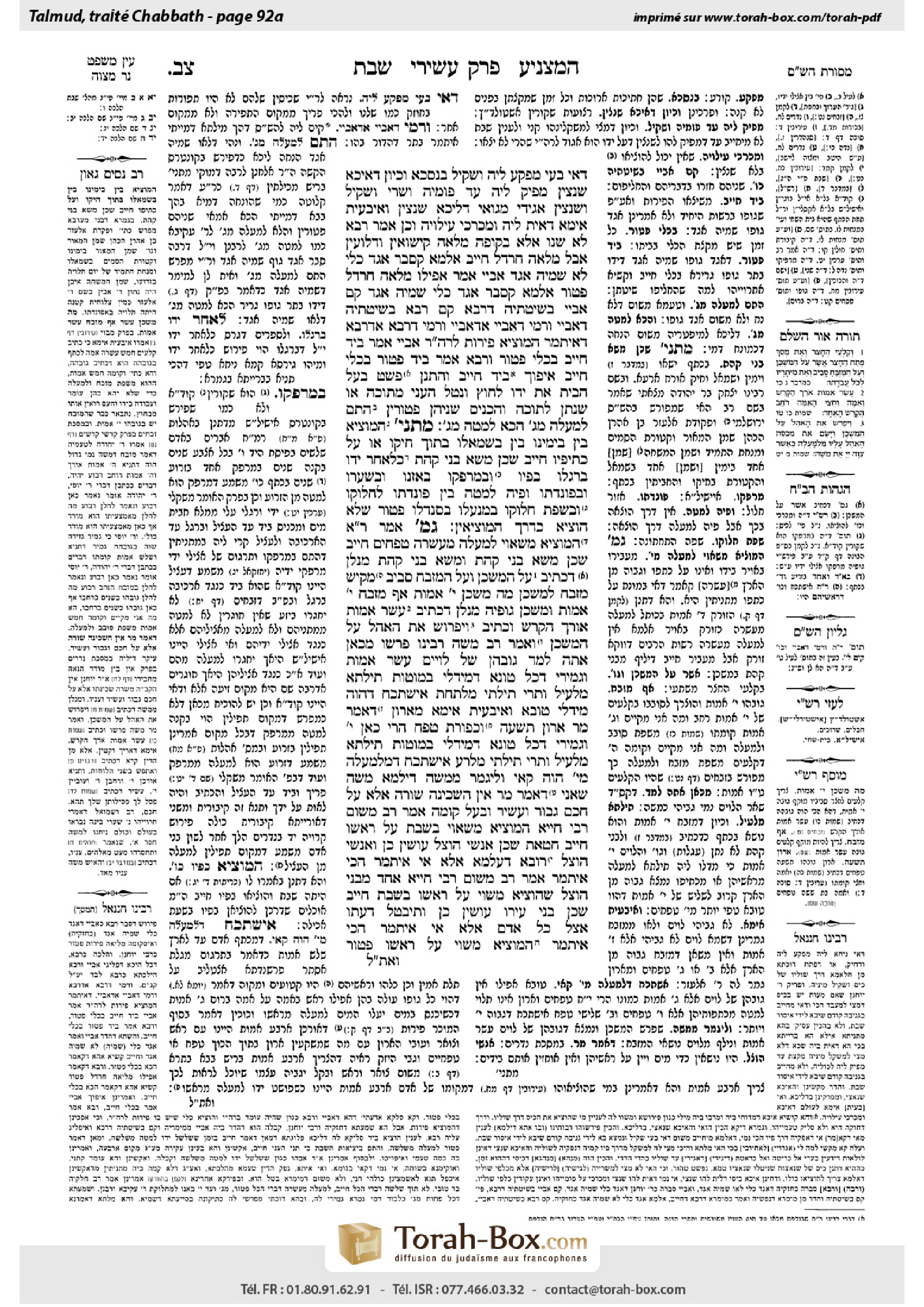
Shabbat 92a: Talmud study for Daf Yomi
Daf Yomi is the daily study of one Talmud folio. Explore 37 tractates with scans, Hebrew text, Sefaria English and AI-generated French translations where annotated.
Passage selection and English or AI-generated French translation are available where the scan has annotations. Daf Study is independent of Torah-Box and Sefaria.
Browse Shabbat · שבת · All tractatesShabbat 92a text and translations
This page of Shabbat includes the Aramaic text, an English translation and an AI-generated French translation, alongside the scan above.
שבת צ״ב א · Aramaic and Hebrew text
דְּאִי בָּעֵי מְפַקַּע לֵיהּ וְשָׁקֵיל! בְּנִסְכָּא. וְכֵיוָן דְּאִיכָּא שְׁנָצִין, מַפֵּיק לֵיהּ עַד פּוּמֵּיהּ וְשָׁרֵי וְשָׁקֵיל, וּשְׁנָצִין אֲגִידִי מִגַּוַּאי! דְּלֵיכָּא שְׁנָצִין. וְאִיבָּעֵית אֵימָא דְּאִית לֵיהּ, וּמְכָרְכִי עִילָּוֵיהּ.
וְכֵן אָמַר רָבָא: לֹא שָׁנוּ אֶלָּא בְּקוּפָּה מְלֵאָה קִישּׁוּאִין וְדִלּוּעִין, אֲבָל מְלֵאָה חַרְדָּל — חַיָּיב. אַלְמָא קָסָבַר אֶגֶד כְּלִי לָא שְׁמֵיהּ אֶגֶד. אַבָּיֵי אֲמַר: אֲפִילּוּ מְלֵאָה חַרְדָּל — פָּטוּר, אַלְמָא קָסָבַר אֶגֶד כְּלִי שְׁמֵיהּ אֶגֶד. קָם אַבָּיֵי בְּשִׁיטְתֵיהּ דְּרָבָא, קָם רָבָא בְּשִׁיטְתֵיהּ דְּאַבָּיֵי, וְרָמֵי דְּאַבָּיֵי אַדְּאַבָּיֵי, וְרָמֵי דְּרָבָא אַדְּרָבָא.
דְּאִיתְּמַר: הַמּוֹצִיא פֵּירוֹת לִרְשׁוּת הָרַבִּים, אַבָּיֵי אָמַר: בַּיָּד — חַיָּיב, בִּכְלִי — פָּטוּר. וְרָבָא אָמַר: בַּיָּד — פָּטוּר, בִּכְלִי — חַיָּיב!
אֵיפוֹךְ: בַּיָּד — חַיָּיב. וְהָתְנַן: פָּשַׁט בַּעַל הַבַּיִת אֶת יָדוֹ לַחוּץ, וְנָטַל הֶעָנִי מִתּוֹכָהּ אוֹ שֶׁנָּתַן לְתוֹכָהּ וְהִכְנִיס — שְׁנֵיהֶן פְּטוּרִין. הָתָם — לְמַעְלָה מִשְּׁלֹשָׁה, הָכָא — לְמַטָּה מִשְּׁלֹשָׁה.
מַתְנִי׳ הַמּוֹצִיא, בֵּין בִּימִינוֹ בֵּין בִּשְׂמֹאלוֹ, בְּתוֹךְ חֵיקוֹ אוֹ עַל כְּתֵיפָיו — חַיָּיב, שֶׁכֵּן מַשָּׂא בְּנֵי קְהָת. כִּלְאַחַר יָדוֹ, בְּרַגְלוֹ, בְּפִיו וּבְמַרְפְּקוֹ, בְּאׇזְנוֹ וּבִשְׂעָרוֹ, וּבְפוּנְדָּתוֹ וּפִיהָ לְמַטָּה, בֵּין פּוּנְדָּתוֹ לַחֲלוּקוֹ, וּבִשְׂפַת חֲלוּקוֹ, בְּמִנְעָלוֹ, בְּסַנְדָּלוֹ — פָּטוּר, שֶׁלֹּא הוֹצִיא כְּדֶרֶךְ הַמּוֹצִיאִין.
גְּמָ׳ אָמַר רַבִּי אֶלְעָזָר: הַמּוֹצִיא מַשּׂאוֹי לְמַעְלָה מֵעֲשָׂרָה טְפָחִים — חַיָּיב, שֶׁכֵּן מַשָּׂא בְּנֵי קְהָת. וּמַשָּׂא בְּנֵי קְהָת מְנָלַן? דִּכְתִיב: ״עַל הַמִּשְׁכָּן וְעַל הַמִּזְבֵּחַ סָבִיב״ — מַקִּישׁ מִזְבֵּחַ לְמִשְׁכָּן: מָה מִשְׁכָּן עֶשֶׂר אַמּוֹת, אַף מִזְבֵּחַ עֶשֶׂר אַמּוֹת.
וּמִשְׁכָּן גּוּפֵיהּ מְנָלַן? דִּכְתִיב: ״עֶשֶׂר אַמּוֹת אֹרֶךְ הַקָּרֶשׁ״, וּכְתִיב: ״וַיִּפְרֹשׂ אֶת הָאֹהֶל עַל הַמִּשְׁכָּן״, וְאָמַר רַב: מֹשֶׁה רַבֵּינוּ פְּרָשׂוֹ. מִכָּאן אַתָּה לָמֵד גּוֹבְהָן שֶׁל לְוִיִּים עֶשֶׂר אַמּוֹת. וּגְמִירִי דְּכֹל טוּנָא דְּמִידְּלֵי בְּמוֹטוֹת — תִּילְתָּא מִלְּעֵיל וּתְרֵי תִּילְתֵי מִלְּתַחַת, אִישְׁתְּכַח דַּהֲוָה מִידְּלֵי טוּבָא.
וְאִיבָּעֵית אֵימָא: מֵאָרוֹן. דְּאָמַר מָר: אָרוֹן תִּשְׁעָה וְכַפּוֹרֶת טֶפַח. הֲרֵי כָּאן עֲשָׂרָה, וּגְמִירִי דְּכֹל טוּנָא דְּמִידְּלֵי בְּמוֹטוֹת — תִּילְתָּא מִלְּעֵיל וּתְרֵי תִּילְתֵי מִלְּרַע, אִישְׁתְּכַח דְּמִלְּמַעְלָה מֵעֲשָׂרָה הֲוָה קָאֵי. וְלִיגְמַר מִמֹּשֶׁה? דִּילְמָא מֹשֶׁה שָׁאנֵי, דְּאָמַר מָר: אֵין הַשְּׁכִינָה שׁוֹרָה אֶלָּא עַל חָכָם גִּבּוֹר וְעָשִׁיר וּבַעַל קוֹמָה.
אָמַר רַב מִשּׁוּם רַבִּי חִיָּיא: הַמּוֹצִיא מַשּׂאוֹי בְּשַׁבָּת עַל רֹאשׁוֹ — חַיָּיב חַטָּאת, שֶׁכֵּן אַנְשֵׁי הוּצָל עוֹשִׂין כֵּן. וְאַנְשֵׁי הוּצָל רוּבָּא דְעָלְמָא?! אֶלָּא, אִי אִיתְּמַר הָכִי אִיתְּמַר: אָמַר רַב מִשּׁוּם רַבִּי חִיָּיא: אֶחָד מִבְּנֵי הוּצָל שֶׁהוֹצִיא מַשּׂוֹי עַל רֹאשׁוֹ בְּשַׁבָּת — חַיָּיב, שֶׁכֵּן בְּנֵי עִירוֹ עוֹשִׂין כֵּן. וְתִיבְטַל דַּעְתּוֹ אֵצֶל כׇּל אָדָם! אֶלָּא, אִי אִיתְּמַר הָכִי אִיתְּמַר: הַמּוֹצִיא מַשּׂוֹי עַל רֹאשׁוֹ — פָּטוּר,
Shabbat 92a · English translation
for if he wishes, he can tear the seam and take the money. The Gemara answers: Here, it is referring to long metal strips. As long as the entire purse is not in the public domain, he did not acquire any of the long strips, and he is not liable for theft. The Gemara asks: And since the purse has laces to close its opening, to be liable for theft it is sufficient that he carry it out so that its mouth is in the public domain, as he can untie the straps and remove the contents of the purse. And since the laces remain bound inside the private domain, he is not yet liable for violating the prohibition of Shabbat. The Gemara answers: This is referring to a case where the purse does not have laces. And if you wish, say instead that it is referring to a case where it has laces, and the laces are wound around the purse.
There is a dispute between Abaye and Rava that parallels the dispute between Ḥizkiya and Rabbi Yoḥanan. And, so too, Rava said: They only taught in the mishna that one is exempt with regard to carrying out a basket full of cucumbers and gourds. However, for carrying out a basket full of mustard seeds, he is liable. Apparently, Rava holds: fusion of several objects in a single vessel is not considered fusion. Abaye said: Even if the basket is full of mustard seeds, he is exempt. Apparently, Abaye holds: Fusion of several objects in a single vessel is considered fusion. The Gemara comments: Abaye later assumed the opinion of Rava, and Rava assumed the opinion of Abaye. And a contradiction is raised between one statement of Abaye and another statement of Abaye; and a contradiction is raised between one statement of Rava and another statement of Rava.
As it was stated that they disputed the matter of one who carries out fruit into the public domain. Abaye said: If he carried them out in his hand, he is liable even if the rest of his body remained in the private domain because fusion of several objects in his hand is not considered fusion. However, if he carried them out in a vessel, and part of the vessel remained in the private domain, he is exempt. And Rava said: If he carried them out in his hand, he is exempt because the legal status of his hand is determined by the status of the rest of the body. However, if he carried them out in a vessel, he is liable.
These are contrary to their opinions stated above. The Gemara answers: Reverse the opinions, and say that Rava was the one who said: If he carried it out in his hand, he is liable. The Gemara raises an objection. Didn’t we learn in the mishna: In a case where the homeowner extended his hand into the public domain, and either the poor person took an object from the homeowner’s hand and placed it in the public domain, or the poor person placed an object into the homeowner’s hand and the homeowner carried the object into the private domain, both are exempt. Apparently, one is not liable if he merely moved an object in his hand into the public domain. The Gemara answers: There, in the mishna, it is referring to a case where his hand was above three handbreadths from the ground. The object in his hand, therefore, does not have the legal status of having been placed on the ground, and he is exempt. Here, it is referring to a case where his hand was below three handbreadths off the ground. Anything that is within three handbreadths off the ground has the legal status of having been placed on the ground.
MISHNA: One who carries out an object into the public domain on Shabbat, whether he carried it out in his right hand or in his left hand, whether he carried it in his lap or on his shoulders, he is liable. All of these are typical methods of carrying out an object, as this was the method of carrying the sacred vessels of the Tabernacle employed by the sons of Kehat in the desert. All labors prohibited on Shabbat are derived from the Tabernacle, including the prohibited labor of carrying out from domain to domain. But one who carries an object out in an unusual, backhanded manner, or with his foot, or with his mouth, or with his elbow, with his ear, or with his hair, or with his belt [punda] whose opening faced downward, or between his belt and his cloak, or with the hem of his cloak, or with his shoe, or with his sandal, he is exempt because he did not carry it out in a manner typical of those who carry.
GEMARA: Rabbi Elazar said: One who carries out a load from the private domain to the public domain, even if he does so at a height above ten handbreadths, which is beyond the parameters of the public domain, he is liable, as this was the method of carrying utilized by the sons of Kehat. The Gemara asks: And from where do we derive that the method of carrying utilized by the sons of Kehat was above ten handbreadths? The Gemara answers: For it is written about the Levites’ carrying: “And the hangings of the courtyard, and the screen for the courtyard entrance which surrounds the Tabernacle, and the altar, and its cords for all of its service” (Numbers 3:26). This verse juxtaposes the altar to the Tabernacle. It is derived that just as the Tabernacle was ten cubits high, so too, the altar was ten cubits high. The verse that indicates otherwise: “And you shall make the altar…and its height should be three cubits” (Exodus 27:1), must be understood differently.
The Gemara asks: And from where do we derive that the Tabernacle itself was carried above ten handbreadths? The Gemara answers: As it is written: “And you shall make the boards for the Tabernacle out of acacia wood standing upright, the length of a board shall be ten cubits” (Exodus 26:15–16). And it is written with regard to the construction of the Tabernacle: “And he spread the tent over the Tabernacle, and he placed the cover for the tent on top of it as God commanded Moses” (Exodus 40:19). And Rav said: Moses, our teacher, spread it himself. From here you can derive that the height of the Levites was ten cubits. If Moses was capable of standing and spreading the cover over the tent by himself, he must have been at least ten cubits tall. Presumably, that was the height of the rest of the Levites as well. And they learned through tradition that every burden that is carried with poles, one-third of the burden is above the porter’s height, and two-thirds are below his height. It is found, then, that the altar was very high, as if they carried the altar on poles, the bottom of the altar was at least one-third of ten cubits, twenty handbreadths, off the ground.
And if you wish, say instead that the Levites were not extraordinarily tall, and this can be derived from the Ark of the Covenant, as the Master said: The Ark itself was nine handbreadths tall as stated in the Torah, and the Ark-cover was one handbreadth, for a total of ten. And they learned through tradition that every burden that is carried with poles, one-third of the burden is above the porter’s height and two-thirds are below his height. It is found, then, that the bottom of the Ark stood ten handbreadths above the ground. The Gemara asks: And let us derive it from Moses, and why was the first proof insufficient? The Gemara answers: Perhaps Moses was different from the other Levites and taller than they were, as the Master said: The Divine Presence only rests upon a person who is wise, mighty, wealthy, and tall. Since the Divine Presence rested on Moses, he had to be tall.
Rav said in the name of Rabbi Ḥiyya: One who carries out a burden on his head on Shabbat is liable to bring a sin-offering, as the people of Hotzal do so. They would typically carry burdens on their heads. The Gemara asks: And do the people of Hotzal constitute the majority of the world? Even if in one place it is a typical method of carrying a burden, it remains an atypical method of carrying in the rest of the world. Rather, if this ruling was stated, it was stated as follows. Rav said in the name of Rabbi Ḥiyya: If a resident of Hotzal carried out a burden on his head on Shabbat he is liable, as the people of his city do so. The Gemara asks again: Even if the inhabitants of his city do this, let his intention be rendered irrelevant by the opinions of all other people. If an individual or small group of people conduct themselves in an atypical manner, their conduct is not rendered typical. Typical conduct is determined by the majority of people. Rather, if this was stated, it was stated as follows. One who carries out a burden on his head is exempt.
Shabbat 92a · Traduction française (IA)
car s’il le souhaite, il peut défaire la couture et prendre l’argent. La Guemara répond : Ici, il s’agit de longues bandes de métal. Tant que la bourse entière ne se trouve pas dans le domaine public, il n’a acquis aucune des longues bandes et n’est pas passible de vol. La Guemara demande : Puisque la bourse est munie de cordons qui en ferment l’ouverture, il suffit, pour être passible de vol, qu’il la transporte de sorte que son ouverture se trouve dans le domaine public, car il peut dénouer les cordons et en retirer le contenu. Et puisque les cordons restent dans le domaine privé, il n’est pas encore passible d’avoir enfreint l’interdit du Chabbat. La Guemara répond : Il s’agit d’un cas où la bourse n’a pas de cordons. Ou bien, si tu préfères, il s’agit d’un cas où elle en a, mais où les cordons sont enroulés autour de la bourse.
Il existe entre Abayé et Rava un désaccord parallèle à celui qui oppose Ḥizkiya et Rabbi Yoḥanan. De même, Rava a dit : Dans la Michna, on a enseigné qu’il est quitte lorsqu’il transporte un panier plein de concombres et de courges. En revanche, s’il transporte un panier plein de graines de moutarde, il est passible. Il apparaît donc que, selon Rava, la réunion de plusieurs objets dans un même récipient n’est pas considérée comme une réunion. Abayé a dit : Même si le panier est plein de graines de moutarde, il est quitte. Il apparaît donc que, selon Abayé, la réunion de plusieurs objets dans un même récipient est considérée comme une réunion. La Guemara commente : Par la suite, Abayé a adopté l’avis de Rava, et Rava a adopté celui d’Abayé. Une contradiction est soulevée entre une déclaration d’Abayé et une autre déclaration d’Abayé, et une contradiction est soulevée entre une déclaration de Rava et une autre déclaration de Rava.
En effet, il a été enseigné qu’ils sont en désaccord au sujet de celui qui transporte des fruits dans le domaine public. Abayé a dit : S’il les a transportés dans sa main, il est passible, même si le reste de son corps est resté dans le domaine privé, car la réunion de plusieurs objets dans sa main n’est pas considérée comme une réunion. En revanche, s’il les a transportés dans un récipient et qu’une partie de celui-ci est restée dans le domaine privé, il est quitte. Rava a dit : S’il les a transportés dans sa main, il est quitte, car le statut de sa main est déterminé par celui du reste de son corps. En revanche, s’il les a transportés dans un récipient, il est passible.
Ces avis sont contraires à ceux qu’ils ont exprimés plus haut. La Guemara répond : Inverse les avis et dis que c’est Rava qui a dit : « S’il l’a transporté dans sa main, il est passible. » La Guemara soulève une objection : N’avons-nous pas appris dans la Michna : « Si le maître de maison a tendu la main dans le domaine public, et que le pauvre a pris un objet de la main du maître de maison et l’a posé dans le domaine public, ou que le pauvre a placé un objet dans la main du maître de maison et que celui-ci l’a transporté dans le domaine privé, les deux sont quittes » ? Il apparaît donc qu’on n’est pas passible lorsqu’on a seulement déplacé un objet dans sa main vers le domaine public. La Guemara répond : Là, dans la Michna, il s’agit d’un cas où sa main se trouvait à plus de trois largeurs de paume au-dessus du sol. L’objet qu’il tient n’a donc pas le statut d’un objet posé à terre, et il est quitte. Ici, il s’agit d’un cas où sa main se trouvait à moins de trois largeurs de paume au-dessus du sol. Tout ce qui se trouve à moins de trois largeurs de paume au-dessus du sol a le statut d’un objet posé à terre.
MICHNA : Celui qui transporte un objet dans le domaine public pendant Chabbat est passible, qu’il l’ait porté dans sa main droite ou dans sa main gauche, sur ses genoux ou sur ses épaules. Ce sont là des façons habituelles de transporter un objet, car c’est ainsi que les fils de Kehat transportaient les ustensiles sacrés du Michkan dans le désert. Tous les travaux interdits le Chabbat sont déduits du Michkan, y compris le travail interdit consistant à transporter d’un domaine à un autre. Mais celui qui transporte un objet d’une manière inhabituelle, à rebours, avec son pied, sa bouche, son coude, son oreille ou ses cheveux, avec sa ceinture [punda] dont l’ouverture était tournée vers le bas, entre sa ceinture et son manteau, avec l’ourlet de son manteau, avec sa chaussure ou sa sandale, est quitte, car il ne l’a pas transporté d’une manière habituelle.
GUEMARA : Rabbi Elazar a dit : Celui qui transporte une charge du domaine privé au domaine public est passible, même s’il le fait à une hauteur supérieure à dix largeurs de paume, au-delà des limites du domaine public, car c’est ainsi que les fils de Kehat transportaient les objets. La Guemara demande : D’où déduisons-nous que les fils de Kehat transportaient les objets à plus de dix largeurs de paume de hauteur ? La Guemara répond : Car il est écrit au sujet du transport effectué par les Lévites : « Les tentures de la cour, le rideau de l’entrée de la cour qui entoure le Michkan et l’autel, ainsi que ses cordages pour tout son service » (Nombres 3,26). Ce verset rapproche l’autel du Michkan. On en déduit que, de même que le Michkan avait une hauteur de dix coudées, l’autel avait lui aussi une hauteur de dix coudées. Le verset qui semble indiquer le contraire — « Tu feras l’autel… et sa hauteur sera de trois coudées » (Exode 27,1) — doit être compris autrement.
La Guemara demande : D’où déduisons-nous que le Michkan lui-même était transporté à plus de dix largeurs de paume du sol ? La Guemara répond : Car il est écrit : « Tu feras les planches du Michkan en bois d’acacia, dressées debout ; la longueur d’une planche sera de dix coudées » (Exode 26,15-16). Et il est écrit au sujet de la construction du Michkan : « Il étendit la tente sur le Michkan et posa la couverture de la tente par-dessus, comme Dieu l’avait ordonné à Moïse » (Exode 40,19). Rav a dit : Moïse, notre maître, l’étendit lui-même. On peut en déduire que les Lévites mesuraient dix coudées. Si Moïse était capable de se tenir debout et d’étendre lui-même la couverture sur la tente, il devait mesurer au moins dix coudées. On peut supposer que les autres Lévites avaient la même taille. Ils ont appris par tradition que, pour toute charge portée à l’aide de barres, un tiers de la charge se trouve au-dessus de la taille du porteur et deux tiers au-dessous. Il s’ensuit que l’autel était très haut : s’ils le portaient sur des barres, le bas de l’autel se trouvait à au moins un tiers de dix coudées, soit vingt largeurs de paume, au-dessus du sol.
Ou bien, si tu préfères, dis que les Lévites n’étaient pas d’une taille extraordinaire et qu’on peut le déduire de l’Arche de l’Alliance. En effet, le Maître a dit : L’Arche elle-même mesurait neuf largeurs de paume de haut, comme l’indique la Torah, et son couvercle en mesurait une, soit dix au total. Ils ont appris par tradition que, pour toute charge portée à l’aide de barres, un tiers de la charge se trouve au-dessus de la taille du porteur et deux tiers au-dessous. Il s’ensuit que le bas de l’Arche se trouvait à dix largeurs de paume au-dessus du sol. La Guemara demande : Pourquoi ne pas le déduire de Moïse ? Pourquoi la première preuve ne suffisait-elle pas ? La Guemara répond : Peut-être Moïse était-il différent des autres Lévites et plus grand qu’eux, car le Maître a dit : « La Présence divine ne repose que sur une personne sage, puissante, riche et grande. » Puisque la Présence divine reposait sur Moïse, il devait être grand.
Rav a dit au nom de Rabbi Ḥiyya : Celui qui transporte une charge sur sa tête pendant Chabbat est passible d’un sacrifice expiatoire, car les habitants de Hotzal transportent habituellement les charges sur leur tête. La Guemara demande : Les habitants de Hotzal représentent-ils la majorité du monde ? Même si, dans un endroit, c’est une façon habituelle de transporter une charge, cela reste une façon inhabituelle de la transporter dans le reste du monde. Mais si cet enseignement a été transmis, il l’a été ainsi : Rav a dit au nom de Rabbi Ḥiyya : Si un habitant de Hotzal transporte une charge sur sa tête pendant Chabbat, il est passible, car les gens de sa ville procèdent ainsi. La Guemara demande encore : Même si les habitants de sa ville procèdent ainsi, son intention ne devrait-elle pas être rendue sans effet par l’avis de tous les autres ? Si un individu ou un petit groupe se comporte de manière inhabituelle, cela ne rend pas cette conduite habituelle. La conduite habituelle est déterminée par la majorité des gens. Mais si cet enseignement a été transmis, il l’a été ainsi : Celui qui transporte une charge sur sa tête est quitte.
Traduction française générée par IA à partir de l’édition anglaise de Sefaria. Vérifie toujours un passage avec le texte source.
Text from Sefaria: William Davidson Edition - Vocalized Aramaic (CC BY NC); William Davidson Edition - English (CC BY NC).