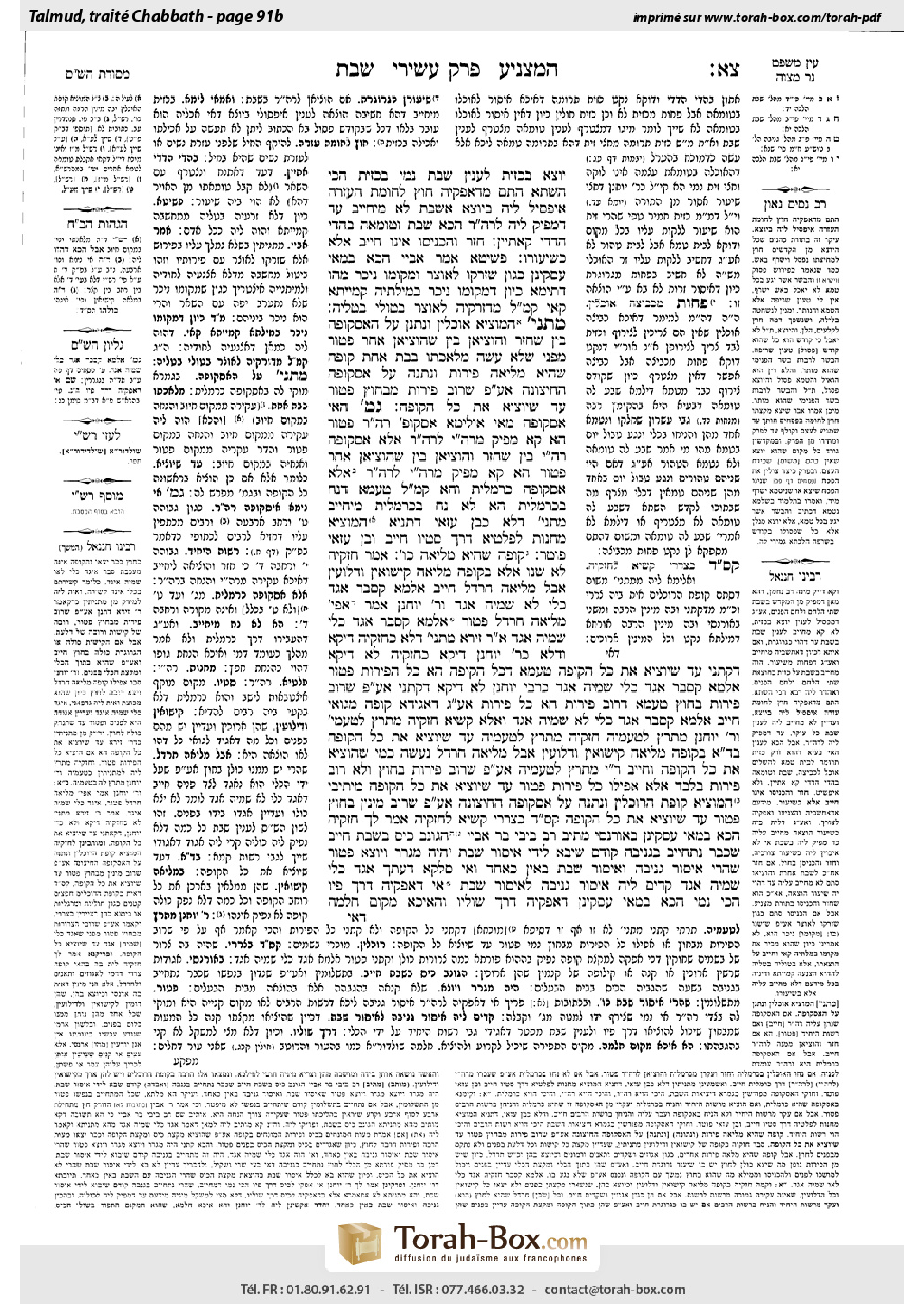
Shabbat 91b: Talmud study for Daf Yomi
Daf Yomi is the daily study of one Talmud folio. Explore 37 tractates with scans, Hebrew text, Sefaria English and AI-generated French translations where annotated.
Passage selection and English or AI-generated French translation are available where the scan has annotations. Daf Study is independent of Torah-Box and Sefaria.
Browse Shabbat · שבת · All tractatesShabbat 91b text and translations
This page of Shabbat includes the Aramaic text, an English translation and an AI-generated French translation, alongside the scan above.
שבת צ״א ב · Aramaic and Hebrew text
יוֹצֵא — בִּכְזַיִת, לְעִנְיַן שַׁבָּת נָמֵי — בִּכְזַיִת! הָכִי הַשְׁתָּא?! הָתָם — מִדְּאַפְּקֵיהּ חוּץ לְחוֹמַת הָעֲזָרָה אִיפְּסִיל לֵיהּ בְּיוֹצֵא, אַשַּׁבָּת לָא מִיחַיַּיב עַד דְּמַפֵּיק לֵיהּ לִרְשׁוּת הָרַבִּים, הָכָא — שַׁבָּת וְטוּמְאָה בַּהֲדֵי הֲדָדֵי קָאָתְיָין.
חָזַר וְהִכְנִיסוֹ אֵינוֹ חַיָּיב אֶלָּא כְּשִׁיעוּרוֹ. פְּשִׁיטָא! אָמַר אַבָּיֵי: הָכָא בְּמַאי עָסְקִינַן — כְּגוֹן שֶׁזְּרָקוֹ לְאוֹצָר וּמְקוֹמוֹ נִיכָּר. מַהוּ דְּתֵימָא: כֵּיוָן דִּמְקוֹמוֹ נִיכָּר בְּמִילְּתֵיהּ קַמָּיְיתָא קָאֵי, קָא מַשְׁמַע לַן — מִדְּזַרְקֵיהּ לְאוֹצָר, בַּטּוֹלֵי בַּטְּלֵיהּ.
מַתְנִי׳ הַמּוֹצִיא אוֹכָלִין וּנְתָנָן עַל הָאַסְקוּפָּה, בֵּין שֶׁחָזַר וְהוֹצִיאָן, בֵּין שֶׁהוֹצִיאָן אַחֵר — פָּטוּר, מִפְּנֵי שֶׁלֹּא עָשָׂה מְלַאכְתּוֹ בְּבַת אַחַת. קוּפָּה שֶׁהִיא מְלֵיאָה פֵּירוֹת וּנְתָנָהּ עַל אַסְקוּפָּה הַחִיצוֹנָה, אַף עַל פִּי שֶׁרוֹב פֵּירוֹת מִבַּחוּץ — פָּטוּר, עַד שֶׁיּוֹצִיא אֶת כָּל הַקּוּפָּה.
גְּמָ׳ הַאי אַסְקוּפָּה, מַאי? אִילֵימָא אַסְקוּפָּה רְשׁוּת הָרַבִּים — פָּטוּר? הָא קָא מַפֵּיק מֵרְשׁוּת הַיָּחִיד לִרְשׁוּת הָרַבִּים! אֶלָּא אַסְקוּפָּה רְשׁוּת הַיָּחִיד. בֵּין שֶׁחָזַר וְהוֹצִיאָן, בֵּין שֶׁהוֹצִיאָן אַחֵר — פָּטוּר? הָא קָא מַפֵּיק מֵרְשׁוּת הַיָּחִיד לִרְשׁוּת הָרַבִּים!
אֶלָּא אַסְקוּפָּה כַּרְמְלִית, וְהָא קָא מַשְׁמַע לַן: טַעְמָא דְּנָח בְּכַרְמְלִית, הָא לָא נָח בְּכַרְמְלִית — מִיחַיַּיב. מַתְנִיתִין דְּלָא כְּבֶן עַזַּאי. דְּתַנְיָא: הַמּוֹצִיא מֵחֲנוּת לִפְלַטְיָא דֶּרֶךְ סְטָיו — חַיָּיב, וּבֶן עַזַּאי פּוֹטֵר.
קוּפָּה שֶׁהִיא מְלֵיאָה כּוּ׳. אָמַר חִזְקִיָּה: לֹא שָׁנוּ אֶלָּא בְּקוּפָּה מְלֵיאָה קִישּׁוּאִין וְדִלּוּעִין, אֲבָל מְלֵיאָה חַרְדָּל — חַיָּיב. אַלְמָא קָסָבַר אֶגֶד כְּלִי — לָא שְׁמֵיהּ אֶגֶד. וְרַבִּי יוֹחָנָן אָמַר: אֲפִילּוּ מְלֵיאָה חַרְדָּל — פָּטוּר. אַלְמָא קָסָבַר אֶגֶד כְּלִי — שְׁמֵיהּ אֶגֶד.
אָמַר רַבִּי זֵירָא: מַתְנִיתִין דְּלָא כְּחִזְקִיָּה דַּיְקָא, וּדְלָא כְּרַבִּי יוֹחָנָן דַּיְקָא: כְּחִזְקִיָּה לָא דַּיְקָא — דְּקָתָנֵי: ״עַד שֶׁיּוֹצִיא אֶת כָּל הַקּוּפָּה״ — טַעְמָא דְּכׇל הַקּוּפָּה, הָא כׇּל הַפֵּירוֹת — פָּטוּר, אַלְמָא קָסָבַר אֶגֶד כְּלִי שְׁמֵיהּ אֶגֶד. כְּרַבִּי יוֹחָנָן לָא דַּיְקָא — דְּקָתָנֵי: ״אַף עַל פִּי שֶׁרוֹב פֵּירוֹת בַּחוּץ״ — טַעְמָא דְּרוֹב פֵּירוֹת, הָא כׇּל פֵּירוֹת, אַף עַל גַּב דַּאֲגִידָא קוּפָּה מִגַּוַּאי — חַיָּיב, אַלְמָא קָסָבַר אֶגֶד כְּלִי לָא שְׁמֵיהּ אֶגֶד.
וְאֶלָּא קַשְׁיָא! חִזְקִיָּה מְתָרֵץ לְטַעְמֵיהּ, וְרַבִּי יוֹחָנָן מְתָרֵץ לְטַעְמֵיהּ. חִזְקִיָּה מְתָרֵץ לְטַעְמֵיהּ: ״עַד שֶׁיּוֹצִיא אֶת כָּל הַקּוּפָּה״, בַּמֶּה דְּבָרִים אֲמוּרִים — בְּקוּפָּה מְלֵיאָה קִישּׁוּאִין וְדִלּוּעִין, אֲבָל מְלֵיאָה חַרְדָּל — נַעֲשֶׂה כְּמִי שֶׁהוֹצִיא אֶת כָּל הַקּוּפָּה, וְחַיָּיב. רַבִּי יוֹחָנָן מְתָרֵץ לְטַעְמֵיהּ, ״אַף עַל פִּי שֶׁרוֹב פֵּירוֹת בַּחוּץ״, וְלֹא רוֹב פֵּירוֹת בִּלְבַד, אֶלָּא אֲפִילּוּ כׇּל פֵּירוֹת — פָּטוּר, עַד שֶׁיּוֹצִיא אֶת כָּל הַקּוּפָּה.
מֵיתִיבִי: הַמּוֹצִיא קוּפַּת הָרוֹכְלִין וּנְתָנָהּ עַל אַסְקוּפָּה הַחִיצוֹנָה, אַף עַל פִּי שֶׁרוֹב מִינִין בַּחוּץ — פָּטוּר, עַד שֶׁיּוֹצִיא אֶת כָּל הַקּוּפָּה. קָא סָלְקָא דַּעְתָּךְ בִּצְרָרֵי, קַשְׁיָא לְחִזְקִיָּה! אָמַר לָךְ חִזְקִיָּה: הָכָא בְּמַאי עָסְקִינַן — בְּאוּרְנָסֵי.
מֵתִיב רַב בִּיבִי בַּר אַבָּיֵי: הַגּוֹנֵב כִּיס בְּשַׁבָּת — חַיָּיב, שֶׁכְּבָר נִתְחַיֵּיב בִּגְנֵיבָה קוֹדֶם שֶׁיָּבֹא לִידֵי אִיסּוּר שַׁבָּת. הָיָה מְגָרֵר וְיוֹצֵא — פָּטוּר, שֶׁהֲרֵי אִיסּוּר גְּנֵיבָה וְאִיסּוּר שַׁבָּת בָּאִין כְּאֶחָד. וְאִי סָלְקָא דַעְתָּךְ אֶגֶד כְּלִי — שְׁמֵיהּ אֶגֶד, קָדֵים לֵיהּ אִיסּוּר גְּנֵיבָה לְאִיסּוּר שַׁבָּת!
אִי דְּאַפְּקֵיהּ דֶּרֶךְ פִּיו — הָכִי נָמֵי. הָכָא בְּמַאי עָסְקִינַן? — דְּאַפְּקֵיהּ דֶּרֶךְ שׁוּלָיו. וְהָאִיכָּא מְקוֹם חֲלָמָה,
Shabbat 91b · English translation
disqualification of consecrated items due to leaving the Temple courtyard, the significant measure is an olive-bulk, as one who eats that measure of disqualified consecrated items is liable; with regard to Shabbat, its measure for liability should also be an olive-bulk. The Gemara rejects this: How can you make that comparison? There, in the case of the consecrated items, from the moment that he took it beyond the courtyard wall it was disqualified due to the prohibition of leaving. However, with regard to Shabbat, he is only liable when he takes it into the public domain, which is far beyond the courtyard walls. Here, in the case where one threw teruma into the house on Shabbat, the prohibition of Shabbat and the impurity of the teruma come simultaneously. Since the olive-bulk is significant in terms of impurity, it is similarly significant with regard to Shabbat.
We learned in the mishna: If one stored the seed, carried it out, and then brought it back in, he is only liable if he brought in its measure for liability. The Gemara asks: This is obvious. By bringing it back into the house he indicates that he no longer considers it significant, and the object then assumes the legal status of an object belonging to anyone else. Abaye said: With what are we dealing here? We are dealing with a case where he threw it into the storehouse and its place is clearly discernible to the one who threw it, in that he knows where it landed. Lest you say that because its location is discernible it maintains its original status, the mishna teaches us that from the fact that he threw it into the storehouse, he indicated that he nullified the object’s previous significance.
MISHNA: One who carries out food from his house on Shabbat and placed it on the threshold of the door, whether he then carried it out from the threshold into the public domain or another person carried it out, he is exempt because he did not perform his prohibited labor of carrying from domain to domain all at once. Similarly, if one placed a basket that is full of fruit on the outer threshold, which is in the public domain, and part of the basket remained inside, even though most of the fruit is outside in the public domain, he is exempt until he carries out the entire basket.
GEMARA: The Gemara begins by asking: What is the nature of this threshold in terms of Shabbat? If you say that it is a threshold that has the legal status of the public domain, in that it does not extend above nine handbreadths, and its area is four by four handbreadths, and it is suitable for use by the multitudes, why is he exempt? Didn’t he carry out food from the private domain to the public domain? Rather, say that it is a threshold that has the legal status of the private domain, in that it extends above ten handbreadths, and its area is four by four handbreadths. In that case, why does the mishna say: Whether he then carried it out from the threshold into the public domain or another person carried it out, he is exempt? Why should he be exempt? Didn’t he carry out food from the private domain to the public domain?
Rather, the mishna is referring to a threshold that is a karmelit. And it teaches us the following: The reason that he is exempt is due to the fact that the object came to rest in a karmelit. However, if the object did not come to rest in a karmelit, he is liable even if it passed through a karmelit. This comes to teach that the mishna is not in accordance with the opinion of ben Azzai, as it was taught in a baraita: One who carries out an object from a store, which is a private domain, to a plaza, which is a public domain, via a colonnade, which is a karmelit, is liable because he lifted the object in a private domain and placed it in a public domain. And ben Azzai deems him exempt because, in his opinion, an exempt domain separates between the private and public domains.
We learned in the mishna: If one placed a basket that is full of fruit on the outer threshold, he is only liable if he carries out the entire basket. Ḥizkiya said: They only taught this halakha with regard to a basket full of cucumbers and gourds, both of which are long. Part of each fruit remains inside even when most of the basket is in the public domain. However, if the basket was full of mustard seeds, he is liable for carrying out a measure of individual mustard seeds to the public domain. The Gemara concludes: Apparently, he holds that the fusion of several objects in a single vessel is not considered fusion. Even though several objects are in a single basket, they do not have the legal status of a single unit. And Rabbi Yoḥanan said: Even if the basket were full of mustard seeds, he is exempt. Apparently, he holds that the fusion of several objects in a single vessel is considered fusion.
Rabbi Zeira said: The language of the mishna does not precisely correspond with the opinion of Ḥizkiya, and it does not precisely correspond with the opinion of Rabbi Yoḥanan. The Gemara explains: It does not precisely correspond with the opinion of Ḥizkiya, as the mishna taught: Until he carries out the entire basket. The Gemara infers: The reason that he is liable is because he carried out the entire basket. However, if part of the basket remained inside, even if he carried out all the fruit, he is exempt. Apparently, the mishna holds that fusion of several objects in a single vessel is considered fusion. Since the vessel fuses the fruit into one entity, when part of the basket remains inside, by extension its fruit is also considered to have remained inside. And it does not precisely correspond with the opinion of Rabbi Yoḥanan, as the mishna taught: Even though most of the fruit is outside. The Gemara infers: The reason that he is exempt is because only most of the fruit is outside. However, if all the fruit were outside, then even though part of the basket remains bound inside, he is liable. Apparently, the mishna holds that the fusion of several objects in a single vessel is not considered fusion.
The Gemara asks: However, that is difficult. The inferences of the mishna are contradictory. The Gemara explains: Ḥizkiya resolves the contradiction in accordance with his reasoning, and Rabbi Yoḥanan resolves the contradiction in accordance with his reasoning. The Gemara elaborates: According to both of the Sages, the mishna is referring to two distinct cases. Ḥizkiya resolves the contradiction according to his reasoning. The phrase: Until he carries out the entire basket; in what case is this statement said? It is said in the case of a basket full of cucumbers and gourds. However, in the case of a basket full of mustard seeds, he becomes as one who carried out the entire basket, and he is liable for carrying out the mustard seeds. And Rabbi Yoḥanan resolves the contradiction according to his reasoning: When we learned: Even though most of the fruit is outside, he is exempt; and that ruling is true not only if he carried out most of the fruit, but even if he carried out all the fruit he is also exempt, until he carries out the entire basket.
The Gemara raises an objection from that which was taught in a baraita: One who carries out the merchant’s basket on Shabbat that contains different items, primarily spices, and placed it on the outer threshold of the house, even though most of the types of items in the basket are outside, he is exempt until he carries out the entire basket. It might enter your mind to say that this is referring to a basket full of bundles of different spices. That is difficult according to the opinion of Ḥizkiya, as even though most of the bundles entered the public domain, he is exempt. The Gemara answers: Ḥizkiya could have said to you: With what are we dealing here? With stalks [urnasei]. The spices are in the form of stalks that fill the entire length of the basket. As long as part of the basket remains inside, part of each stalk remains inside as well.
And Rav Beivai bar Abaye also raised an objection from that which we learned: One who steals a purse on Shabbat is liable for the theft. Based on the principle that one who is liable to receive two punishments receives the greater of the two, in this case one should be exempt from payment for the theft, since performing a prohibited labor on Shabbat is punishable by stoning. However, this case is different because he was already liable for theft as soon as he lifted the purse. This took place before he came to violate the prohibition of performing prohibited labor on Shabbat by carrying it into the public domain. However, if he did not lift the purse, but was dragging it on the ground and exiting the private domain, he is exempt from paying for the theft, as in that case, he is only liable for the theft when he drags the purse out of the owner’s property into the public domain. The prohibition of theft and the prohibition of Shabbat are violated all at once. For the purposes of this discussion: And if it enters your mind to say that fusion of several objects within a single vessel is considered fusion, in this case the prohibition of theft precedes the prohibition of Shabbat. At the moment that the mouth of the purse enters the public domain, he is liable for theft because it is as if the money inside had been carried out. With regard to Shabbat, he would not be liable until the entire purse entered the public domain.
The Gemara explains: If this is referring to a case where he carried it out by way of its mouth, indeed that is so, he would be liable for theft. However, with what are we dealing here? We are dealing with a case where he carried it out by the underside of the purse. Since none of the money is accessible until the entire purse is in the public domain, he violated the prohibitions simultaneously. The Gemara asks: Isn’t there the area of the seam? He could gain access to the money even if he dragged out the purse by way of its underside,
Shabbat 91b · Traduction française (IA)
En ce qui concerne l’invalidation des objets consacrés parce qu’ils ont quitté l’enceinte du Temple, la mesure déterminante est le volume d’une olive, car celui qui consomme cette quantité d’objets consacrés invalidés est passible. Pour Chabbat également, la mesure entraînant la responsabilité devrait donc être le volume d’une olive. La Guemara rejette cette comparaison : comment peut-on comparer les deux cas ? Dans le cas des objets consacrés, ils sont invalidés par l’interdiction de sortir dès qu’ils franchissent le mur de l’enceinte. En revanche, pour Chabbat, il n’est passible que lorsqu’il les fait entrer dans le domaine public, bien au-delà des murs de l’enceinte. Ici, dans le cas de celui qui jette de la terouma dans la maison pendant Chabbat, l’interdiction de Chabbat et l’impureté de la terouma surviennent simultanément. Puisque le volume d’une olive est déterminant pour l’impureté, il l’est également pour Chabbat.
Nous avons appris dans la Michna : si quelqu’un a mis la graine en réserve, l’a transportée à l’extérieur, puis l’a rapportée à l’intérieur, il n’est passible que s’il en a rapporté la quantité requise pour entraîner sa responsabilité. La Guemara demande : n’est-ce pas évident ? En la rapportant dans la maison, il montre qu’il ne la considère plus comme importante ; l’objet prend alors le statut juridique d’un objet appartenant à n’importe qui. Abayé dit : de quel cas s’agit-il ici ? D’un cas où il l’a jetée dans le magasin et où son emplacement est clairement repérable par celui qui l’a jetée, puisqu’il sait où elle est tombée. On pourrait penser que, parce que son emplacement est repérable, elle conserve son statut initial. La Michna nous enseigne donc que, du fait qu’il l’a jetée dans le magasin, il a indiqué qu’il renonçait à l’importance qu’il lui accordait auparavant.
MICHNA : Celui qui sort de chez lui de la nourriture pendant Chabbat et la dépose sur le seuil de la porte est exempt, qu’il la sorte ensuite du seuil vers le domaine public ou qu’une autre personne la sorte, car il n’a pas accompli d’un seul coup le travail interdit consistant à transporter d’un domaine à un autre. De même, si quelqu’un dépose sur le seuil extérieur, qui se trouve dans le domaine public, un panier rempli de fruits, alors qu’une partie du panier reste à l’intérieur, il est exempt jusqu’à ce qu’il sorte le panier entier, même si la majeure partie des fruits se trouve à l’extérieur, dans le domaine public.
GUEMARA : La Guemara commence par demander : quel est le statut de ce seuil au regard de Chabbat ? Si l’on dit qu’il a le statut de domaine public, c’est-à-dire qu’il ne s’élève pas à plus de neuf palmes, que sa superficie est de quatre palmes sur quatre et qu’il convient à l’usage du public, pourquoi est-il exempt ? N’a-t-il pas sorti de la nourriture du domaine privé vers le domaine public ? Il faut plutôt dire qu’il s’agit d’un seuil ayant le statut de domaine privé, c’est-à-dire qu’il s’élève à plus de dix palmes et que sa superficie est de quatre palmes sur quatre. Dans ce cas, pourquoi la Michna dit-elle : qu’il la sorte ensuite du seuil vers le domaine public ou qu’une autre personne la sorte, il est exempt ? Pourquoi serait-il exempt ? N’a-t-il pas sorti de la nourriture du domaine privé vers le domaine public ?
Il faut plutôt dire que la Michna parle d’un seuil qui est une karmelit. Elle nous enseigne ceci : il est exempt parce que l’objet s’est immobilisé dans une karmelit. En revanche, si l’objet ne s’y est pas immobilisé, il est passible même s’il est passé par une karmelit. Cela vient enseigner que la Michna ne suit pas l’opinion de ben Azaï, comme il a été enseigné dans une baraïta : celui qui sort un objet d’un magasin, qui est un domaine privé, vers une place, qui est un domaine public, en passant par une galerie à colonnades, qui est une karmelit, est passible, car il a soulevé l’objet dans un domaine privé et l’a déposé dans un domaine public. Ben Azaï le déclare exempt, car, selon lui, un domaine exempt sépare le domaine privé du domaine public.
Nous avons appris dans la Michna : si quelqu’un dépose un panier rempli de fruits sur le seuil extérieur, il n’est passible que s’il sort le panier entier. Hizkiya dit : cette halakha n’a été enseignée qu’à propos d’un panier rempli de concombres et de courges, qui sont tous deux longs. Même lorsque la majeure partie du panier se trouve dans le domaine public, une partie de chaque fruit reste à l’intérieur. En revanche, si le panier était rempli de graines de moutarde, il serait passible d’avoir sorti une quantité de graines de moutarde dans le domaine public. La Guemara conclut : apparemment, il soutient que la réunion de plusieurs objets dans un même récipient n’est pas considérée comme une fusion. Même si plusieurs objets se trouvent dans un seul panier, ils n’ont pas le statut juridique d’une seule unité. Rabbi Yoḥanan dit : même si le panier était rempli de graines de moutarde, il serait exempt. Apparemment, il soutient que la réunion de plusieurs objets dans un même récipient est considérée comme une fusion.
Rabbi Zeïra dit : la formulation de la Michna ne correspond exactement ni à l’opinion de Hizkiya ni à celle de Rabbi Yoḥanan. La Guemara explique : elle ne correspond pas exactement à l’opinion de Hizkiya, car la Michna a enseigné : « jusqu’à ce qu’il sorte le panier entier ». On en déduit qu’il est passible parce qu’il a sorti le panier entier. En revanche, si une partie du panier est restée à l’intérieur, il est exempt, même s’il a sorti tous les fruits. Apparemment, la Michna considère que la réunion de plusieurs objets dans un même récipient constitue une fusion. Puisque le récipient rassemble les fruits en une seule entité, si une partie du panier reste à l’intérieur, ses fruits sont, par extension, eux aussi considérés comme étant restés à l’intérieur. La formulation ne correspond pas non plus exactement à l’opinion de Rabbi Yoḥanan, car la Michna a enseigné : « même si la majeure partie des fruits se trouve à l’extérieur ». On en déduit qu’il est exempt parce que seule la majeure partie des fruits se trouve à l’extérieur. En revanche, si tous les fruits se trouvaient à l’extérieur, il serait passible, même si une partie du panier restait attachée à ce qui est à l’intérieur. Apparemment, la Michna considère que la réunion de plusieurs objets dans un même récipient ne constitue pas une fusion.
La Guemara demande : mais cela pose une difficulté. Les déductions tirées de la Michna se contredisent. La Guemara explique : Hizkiya résout la contradiction selon son raisonnement, et Rabbi Yoḥanan la résout selon le sien. Elle développe : selon les deux sages, la Michna parle de deux cas distincts. Hizkiya résout la contradiction selon son raisonnement : la formule « jusqu’à ce qu’il sorte le panier entier », dans quel cas s’applique-t-elle ? Elle s’applique à un panier rempli de concombres et de courges. En revanche, dans le cas d’un panier rempli de graines de moutarde, il est considéré comme ayant sorti le panier entier et il est passible d’avoir sorti les graines de moutarde. Rabbi Yoḥanan résout la contradiction selon son raisonnement : lorsqu’il est enseigné qu’il est exempt « même si la majeure partie des fruits se trouve à l’extérieur », cette règle vaut non seulement s’il a sorti la majeure partie des fruits, mais aussi s’il les a tous sortis : il reste exempt jusqu’à ce qu’il sorte le panier entier.
La Guemara soulève une objection à partir de ce qui a été enseigné dans une baraïta : celui qui sort pendant Chabbat le panier du marchand, qui contient différents produits, principalement des épices, et le dépose sur le seuil extérieur de la maison, est exempt jusqu’à ce qu’il sorte le panier entier, même si la plupart des sortes de produits contenues dans le panier se trouvent à l’extérieur. On pourrait penser qu’il s’agit d’un panier rempli de bottes de différentes épices. Cela pose une difficulté selon l’opinion de Hizkiya, car il est exempt même si la plupart des bottes sont entrées dans le domaine public. La Guemara répond : Hizkiya aurait pu vous dire : de quel cas s’agit-il ici ? De tiges [urnasei]. Les épices se présentent sous forme de tiges qui remplissent toute la longueur du panier. Tant qu’une partie du panier reste à l’intérieur, une partie de chaque tige reste également à l’intérieur.
Rav Beivaï bar Abayé soulève lui aussi une objection à partir de ce que nous avons appris : celui qui vole une bourse pendant Chabbat est passible pour le vol. Selon le principe voulant que celui qui encourt deux peines reçoive la plus lourde des deux, il devrait être exempt de payer pour le vol, puisque l’accomplissement d’un travail interdit pendant Chabbat est passible de lapidation. Toutefois, ce cas est différent, car il est déjà passible pour le vol dès qu’il a soulevé la bourse. Cela a lieu avant qu’il ne transgresse l’interdiction de transporter un objet pendant Chabbat en le faisant entrer dans le domaine public. En revanche, s’il n’a pas soulevé la bourse, mais l’a traînée au sol en sortant du domaine privé, il est exempt de payer pour le vol, car, dans ce cas, il n’est passible pour le vol que lorsqu’il traîne la bourse hors de la propriété de son propriétaire pour la faire entrer dans le domaine public. L’interdiction du vol et l’interdiction de Chabbat sont alors transgressées au même instant. Pour les besoins de cette discussion, si l’on pense que la réunion de plusieurs objets dans un même récipient constitue une fusion, dans ce cas, l’interdiction du vol précède celle de Chabbat. Au moment où l’ouverture de la bourse entre dans le domaine public, il est passible pour le vol, car c’est comme si l’argent qu’elle contient avait été sorti. En ce qui concerne Chabbat, il ne serait passible que lorsque la bourse entière serait entrée dans le domaine public.
La Guemara explique : si cela concerne un cas où il l’a sortie par son ouverture, en effet, il serait passible pour le vol. Mais de quel cas s’agit-il ici ? D’un cas où il l’a sortie par le fond de la bourse. Puisque l’argent n’est accessible qu’une fois que la bourse entière se trouve dans le domaine public, il a transgressé les interdictions simultanément. La Guemara demande : mais qu’en est-il de la zone de la couture ? Il pourrait accéder à l’argent même s’il a traîné la bourse en la sortant par le fond.
Traduction française générée par IA à partir de l’édition anglaise de Sefaria. Vérifie toujours un passage avec le texte source.
Text from Sefaria: William Davidson Edition - Vocalized Aramaic (CC BY NC); William Davidson Edition - English (CC BY NC).