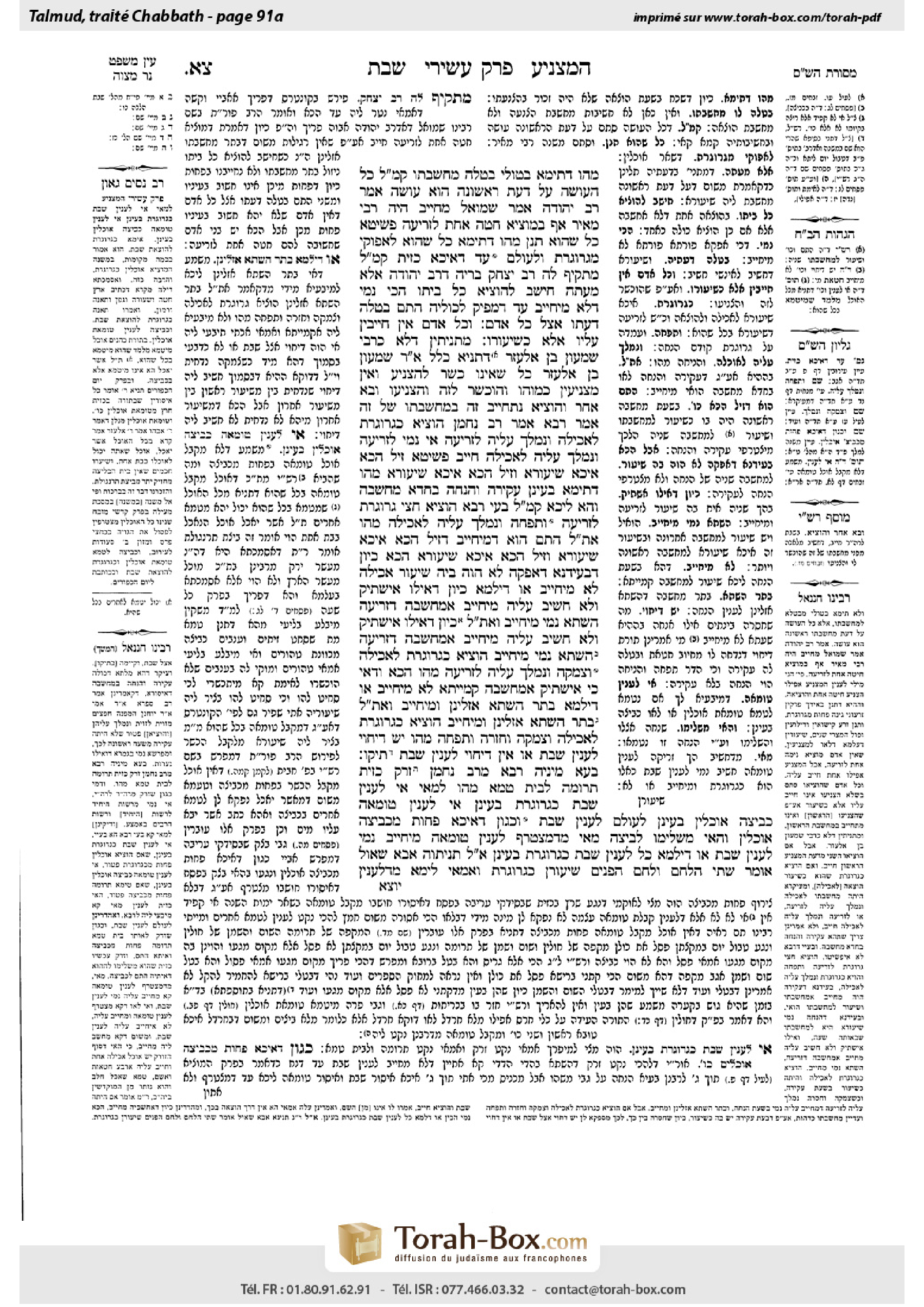
Shabbat 91a: Talmud study for Daf Yomi
Daf Yomi is the daily study of one Talmud folio. Explore 37 tractates with scans, Hebrew text, Sefaria English and AI-generated French translations where annotated.
Passage selection and English or AI-generated French translation are available where the scan has annotations. Daf Study is independent of Torah-Box and Sefaria.
Browse Shabbat · שבת · All tractatesShabbat 91a text and translations
This page of Shabbat includes the Aramaic text, an English translation and an AI-generated French translation, alongside the scan above.
שבת צ״א א · Aramaic and Hebrew text
מַהוּ דְּתֵימָא, בַּטּוֹלֵי בַּטְּלַהּ לְמַחְשַׁבְתּוֹ — קָא מַשְׁמַע לַן: כׇּל הָעוֹשֶׂה, עַל דַּעַת רִאשׁוֹנָה הוּא עוֹשֶׂה.
אָמַר רַב יְהוּדָה אָמַר שְׁמוּאֵל: מְחַיֵּיב הָיָה רַבִּי מֵאִיר אַף בְּמוֹצִיא חִטָּה אַחַת לִזְרִיעָה. פְּשִׁיטָא, ״כׇּל שֶׁהוּא״ תְּנַן! מַהוּ דְּתֵימָא: ״כׇּל שֶׁהוּא״ — לְאַפּוֹקֵי מִגְּרוֹגֶרֶת, וּלְעוֹלָם עַד דְּאִיכָּא כְּזַיִת, קָא מַשְׁמַע לַן. מַתְקִיף לַהּ רַב יִצְחָק בְּרֵיהּ דְּרַב יְהוּדָה: אֶלָּא מֵעַתָּה, חִישֵּׁב לְהוֹצִיא כׇּל בֵּיתוֹ, הָכִי נָמֵי דְּלָא מִיחַיַּיב עַד דְּמַפֵּיק לְכוּלֵּיהּ?! הָתָם — בָּטְלָה דַּעְתּוֹ אֵצֶל כׇּל אָדָם.
וְכׇל אָדָם אֵין חַיָּיבִין עָלָיו אֶלָּא כְּשִׁיעוּרוֹ. מַתְנִיתִין דְּלָא כְּרַבִּי שִׁמְעוֹן בֶּן אֶלְעָזָר, דְּתַנְיָא: כְּלָל אָמַר רַבִּי שִׁמְעוֹן בֶּן אֶלְעָזָר, כׇּל שֶׁאֵינוֹ כָּשֵׁר לְהַצְנִיעַ, וְאֵין מַצְנִיעִין כָּמוֹהוּ, וְהוּכְשַׁר לָזֶה וְהִצְנִיעוֹ, וּבָא אַחֵר וְהוֹצִיאוֹ — נִתְחַיֵּיב זֶה בְּמַחְשַׁבְתּוֹ שֶׁל זֶה.
אָמַר רָבָא אָמַר רַב נַחְמָן: הוֹצִיא כִּגְרוֹגֶרֶת לַאֲכִילָה, וְנִמְלַךְ עָלֶיהָ לִזְרִיעָה, אִי נָמֵי לִזְרִיעָה, וְנִמְלַךְ עָלֶיהָ לַאֲכִילָה — חַיָּיב. פְּשִׁיטָא, זִיל הָכָא — אִיכָּא שִׁיעוּרָא, וְזִיל הָכָא — אִיכָּא שִׁיעוּרָא! מַהוּ דְּתֵימָא בָּעֵינַן עֲקִירָה וְהַנָּחָה בַּחֲדָא מַחְשָׁבָה וְהָא לֵיכָּא — קָא מַשְׁמַע לַן.
בָּעֵי רָבָא: הוֹצִיא חֲצִי גְרוֹגֶרֶת לִזְרִיעָה וְתָפְחָה, וְנִמְלַךְ עָלֶיהָ לַאֲכִילָה, מַהוּ? אִם תִּמְצֵי לוֹמַר: הָתָם הוּא דְּמִיחַיַּיב — דְּזִיל הָכָא אִיכָּא שִׁיעוּרָא וְזִיל הָכָא אִיכָּא שִׁיעוּרָא, הָכָא, כֵּיוָן דִּבְעִידָּנָא דְּאַפְּקֵהּ לָא הֲוָה בֵּיהּ שִׁיעוּר אֲכִילָה — לָא מִיחַיַּיב, אוֹ דִילְמָא: כֵּיוָן דְּאִילּוּ אִישְׁתִּיק וְלָא חַשֵּׁיב עֲלֵיהּ מִיחַיַּיב אַמַּחְשָׁבָה דִזְרִיעָה — הַשְׁתָּא נָמֵי מִיחַיַּיב.
וְאִם תִּמְצֵי לוֹמַר: כֵּיוָן דְּאִילּוּ אִישְׁתִּיק וְלָא חַשֵּׁיב עֲלֵיהּ מִיחַיַּיב אַמַּחְשָׁבָה דִזְרִיעָה, הַשְׁתָּא נָמֵי מִיחַיַּיב — הוֹצִיא כִּגְרוֹגֶרֶת לַאֲכִילָה וְצָמְקָה וְנִמְלַךְ עָלֶיהָ לִזְרִיעָה, מַהוּ? הָכָא וַדַּאי כִּי אִישְׁתִּיק — אַמַּחְשָׁבָה קַמַּיְיתָא לָא מִיחַיַּיב, אוֹ דִילְמָא בָּתַר הַשְׁתָּא אָזְלִינַן, וּמִיחַיַּיב. וְאִם תִּמְצֵי לוֹמַר: בָּתַר הַשְׁתָּא אָזְלִינַן, וּמִיחַיַּיב — הוֹצִיא כִּגְרוֹגֶרֶת לַאֲכִילָה וְצָמְקָה וְחָזְרָה וְתָפְחָה, מַהוּ? יֵשׁ דִּיחוּי לְעִנְיַן שַׁבָּת, אוֹ אֵין דִּיחוּי לְעִנְיַן שַׁבָּת? תֵּיקוּ.
בְּעָא מִינֵּיהּ רָבָא מֵרַב נַחְמָן: זָרַק כְּזַיִת תְּרוּמָה לְבַיִת טָמֵא מַהוּ? לְמַאי: אִי לְעִנְיַן שַׁבָּת — כִּגְרוֹגֶרֶת בָּעֵינַן, אִי לְעִנְיַן טוּמְאָה — כְּבֵיצָה אוֹכָלִין בָּעֵינַן! לְעוֹלָם לְעִנְיַן שַׁבָּת, וּכְגוֹן דְּאִיכָּא פָּחוֹת מִכְּבֵיצָה אוֹכָלִין, וְהַאי מַשְׁלִימוֹ לִכְבֵיצָה. מַאי: מִדְּמִצְטָרֵף לְעִנְיַן טוּמְאָה — מִיחַיַּיב נָמֵי לְעִנְיַן שַׁבָּת, אוֹ דִילְמָא: כׇּל לְעִנְיַן שַׁבָּת כִּגְרוֹגֶרֶת בָּעֵינַן? אֲמַר לֵיהּ: תְּנֵיתוּהָ. אַבָּא שָׁאוּל אוֹמֵר: שְׁתֵּי הַלֶּחֶם וְלֶחֶם הַפָּנִים שִׁיעוּרָן כִּגְרוֹגֶרֶת, וְאַמַּאי? לֵימָא: מִדִּלְעִנְיַן
Shabbat 91a · English translation
Lest you say that in doing so his original intention is completely nullified, since when he carries it out he is no longer conscious of the reason that he stored it, the tanna of the mishna teaches us that anyone who performs an action with an object with which he had dealings in the past, performs the action with the original intention in mind.
Rav Yehuda said that Shmuel said: Rabbi Meir deemed liable one who carried out even a single wheat seed for sowing on Shabbat. The Gemara asks: This is obvious. We learned in the mishna that the measure that determines liability for one who carries out seeds for sowing on Shabbat is any amount. Since the principle is that an unattributed mishna is in accordance with the opinion of Rabbi Meir, clearly Rabbi Meir would deem him liable for carrying out one seed. He would even deem him liable for carrying out less than one seed. The Gemara answers that Shmuel’s statement was necessary. Lest you say that when the mishna employs the term any amount it is to exclude the standard measure for carrying out food on Shabbat, a dried fig-bulk; and actually one is only liable if there is at least an olive-bulk of whatever he is carrying out. Therefore, Shmuel teaches us that any amount refers to even a single seed. Rav Yitzḥak the son of Rav Yehuda strongly objects to this: But now, based on the approach that the measure of liability depends solely on the intention of the person carrying out the object and not on objective measures, one who planned to carry out the contents of his entire house at once, so too, is he only liable when he carries it out at once? The Gemara answers: There is no comparison. There, with regard to a person who plans to carry out the contents of his entire house, his intention is rendered irrelevant by the opinions of all other people, as most people do not conduct themselves in that manner.
We also learned in the mishna: And any other person is only liable for carrying it out on Shabbat if he carries out its measure for liability. The Gemara comments: The mishna is not in accordance with the opinion of Rabbi Shimon ben Elazar, as it was taught in a baraita that Rabbi Shimon ben Elazar stated a principle: Anything that is not fit to be stored, and therefore people do not typically store items like it, but it was deemed fit for storage by this person and he stored it, and another person came and carried out the object that was stored, that person, who carried it out, is rendered liable by the thought of this person, who stored it.
Rava said that Rav Naḥman said: If one carried out on Shabbat a dried fig-bulk of seeds for eating, and along the way he reconsidered and decided to use them for sowing; or, alternatively, if one intended to carry them out for sowing and reconsidered and decided to use them for eating, he is liable. The Gemara wonders: This is obvious. Whichever way you view this case, he is clearly liable. Go here and examine his initial intention, there is a measure that determines liability; and go here and examine his ultimate intention, there is a measure that determines liability. The Gemara replies that Rav Naḥman’s statement teaches a novel concept. Lest you say that in order to be deemed liable for carrying out an object on Shabbat, we require that the lifting and placing of the object be performed with a single, identical, intention, and that is not the situation here, i.e., that the change in his intention transforms his action into two separate half-labors, therefore Rav Naḥman teaches us that it is considered a single prohibited act, and the person who performed it is liable.
On the basis of this halakha, Rava raised a dilemma: With regard to one who carried out half a dried fig-bulk of seeds for the purpose of sowing, which is less than the measure that determines liability, and in the meantime the seeds became moist and expanded to a dried fig-bulk, and he reconsidered his plans for the dried fig-bulk of seeds and decided to use it for eating, what is the halakha? The two sides of the dilemma are: If you say that there, in the first case, he is liable because go here and examine his initial intention, there is a measure that determines liability; and go here and examine his ultimate intention, there is a measure that determines liability; but here, in this case, since at the time that he carried it out there was not a measure that determines liability for one who carries out seeds for the purpose of eating, then he is not liable. Or, perhaps, since had he been silent and had no intention with regard to the seeds at all, he would be liable for the intention of carrying it out for the purpose of sowing, then now too, he is liable because, even based on his reconsidered intention, he completed the prohibited labor of carrying out.
And if you say that since had he been silent and had no intention with regard to the seeds at all, he would be liable for the intention of carrying it out for the purpose of sowing, now too, he is liable, if he carried out seeds in the measure of a dried fig-bulk for the purpose of eating, and they shriveled until there was less than that measure, and he reconsidered and decided to use them for the purpose of sowing, then what is the halakha? Here, certainly had he been silent and had no intention with regard to the seeds at all, for the original intention he is not liable because there remains less than the measure for liability; or perhaps we follow his intention at present and he is liable. And if you say that we follow his intention at present, and he is liable, the dilemma arises: If one carried out a dried fig-bulk of seeds for the purpose of eating, and it shriveled until there was less than that measure, and then it expanded to a fig-bulk, what is the halakha? Is there disqualification with regard to the halakhot of Shabbat? Since at a certain point there was less than the measure that determines liability, he can no longer be held liable for carrying it out even if it expands. Or, perhaps there is no disqualification with regard to the halakhot of Shabbat. The crucial moments that determine liability for carrying an object are the moment that it is lifted and the moment that it is placed. At both of those junctures, the measure for liability was whole. No resolution was found to any of these dilemmas. Therefore, let them stand unresolved.
Rava raised a dilemma before Rav Naḥman: If one threw an olive-bulk of teruma into an impure house, what is the halakha? The Gemara attempts to clarify the question. With regard to what matter was this dilemma raised? If it was raised with regard to Shabbat, the measure that we require to determine liability for carrying out is a dried fig-bulk, and an olive-bulk is smaller than that. And if it was raised with regard to ritual impurity, the measure that we require to determine impurity for food is at least an egg-bulk, and an olive-bulk is smaller than that as well. The Gemara answers: Actually, this dilemma was raised with regard to Shabbat. And it is referring to a case where there is less than an egg-bulk of food in the house, and this olive-bulk that was thrown into the house completes the measure of the food in the house to an egg-bulk. The dilemma is: What is the halakha in that case? Is it from the fact that the olive-bulk joins together with the food in the house with regard to ritual impurity that he is also liable with regard to Shabbat? Or perhaps, all matters concerning carrying out on Shabbat require a dried fig-bulk in order to be liable. Rav Naḥman said to him: We already learned the resolution to that dilemma in a baraita: Abba Shaul says: The measure that determines liability for carrying out the wave-offering of the two loaves of bread and the showbread that were in the Temple is a dried fig-bulk. The Gemara asks: And why is that their measure? Let us say: From the fact that with regard to the matter of
Shabbat 91a · Traduction française (IA)
De peur que tu ne dises qu’en agissant ainsi, son intention initiale est entièrement annulée, puisqu’au moment où il le transporte, il ne se souvient plus de la raison pour laquelle il l’avait mis de côté, le tanna de la Michna nous enseigne que quiconque accomplit une action avec un objet avec lequel il a déjà eu affaire l’accomplit en gardant à l’esprit son intention initiale.
Rav Yehouda a dit au nom de Shmouel : Rabbi Meïr rend passible celui qui transporte le Chabbat même un seul grain de blé destiné aux semailles. La Guemara demande : Cela va de soi. Nous avons appris dans la Michna que la mesure qui rend passible celui qui transporte le Chabbat des graines destinées aux semailles est la moindre quantité. Puisque le principe veut qu’une Michna anonyme soit conforme à l’opinion de Rabbi Meïr, il est évident que Rabbi Meïr le rendrait passible pour avoir transporté une seule graine. Il le rendrait même passible pour en avoir transporté moins d’une. La Guemara répond que la déclaration de Shmouel était nécessaire. De peur que tu ne dises que, lorsque la Michna emploie l’expression « la moindre quantité », elle entend exclure la mesure habituelle pour transporter de la nourriture le Chabbat, à savoir le volume d’une figue sèche, et qu’en réalité, on n’est passible que si ce que l’on transporte atteint au moins le volume d’une olive. Shmouel nous enseigne donc que « la moindre quantité » désigne même une seule graine. Rav Yitsḥak, fils de Rav Yehouda, s’y oppose vivement : Mais alors, selon l’approche d’après laquelle la mesure de responsabilité dépend uniquement de l’intention de celui qui transporte l’objet, et non de mesures objectives, celui qui avait l’intention de transporter en une seule fois le contenu de toute sa maison ne serait-il, lui aussi, passible que s’il le transporte en une seule fois ? La Guemara répond : Il n’y a pas de comparaison. Dans le cas de celui qui prévoit de transporter le contenu de toute sa maison, son intention est rendue sans effet par l’opinion de tous les autres, car la plupart des gens ne se comportent pas ainsi.
Nous avons également appris dans la Michna : Toute autre personne n’est passible d’avoir transporté l’objet le Chabbat que si elle en transporte la mesure requise pour être passible. La Guemara fait remarquer : La Michna n’est pas conforme à l’opinion de Rabbi Shimon ben Elazar, car il a été enseigné dans une baraïta que Rabbi Shimon ben Elazar énonce un principe : Tout objet qui ne se prête pas à être conservé, et que les gens n’ont donc pas coutume de conserver, mais que cette personne a jugé bon de conserver et a effectivement conservé, puis qu’une autre personne est venue transporter, rend cette dernière passible en vertu de l’intention de la personne qui l’avait conservé.
Rava a dit au nom de Rav Naḥman : Si quelqu’un transporte le Chabbat un volume d’une figue sèche de graines destinées à la consommation et qu’en chemin il change d’avis et décide de les utiliser pour les semailles, ou, à l’inverse, s’il avait l’intention de les transporter pour les semailles, puis change d’avis et décide de les utiliser pour la consommation, il est passible. La Guemara s’étonne : Cela va de soi. Quelle que soit la manière dont on examine ce cas, il est clairement passible. Considère son intention initiale : la mesure requise pour être passible est atteinte ; considère ensuite son intention finale : la mesure requise pour être passible est atteinte. La Guemara répond que la déclaration de Rav Naḥman enseigne un principe nouveau. De peur que tu ne dises que, pour être rendu passible d’avoir transporté un objet le Chabbat, il faut que le soulèvement et le dépôt de l’objet soient effectués avec une seule et même intention, ce qui n’est pas le cas ici, car le changement d’intention transformerait son acte en deux demi-travaux distincts, Rav Naḥman nous enseigne que l’acte est considéré comme une seule transgression et que celui qui l’a accompli est passible.
Sur la base de cette halakha, Rava souleva un dilemme : Quel est le statut de celui qui transporte une demi-mesure d’une figue sèche de graines destinées aux semailles, quantité inférieure à la mesure qui rend passible, puis dont les graines s’humidifient et gonflent entre-temps jusqu’à atteindre le volume d’une figue sèche, et qui change alors d’avis au sujet de ces graines et décide de les utiliser pour la consommation ? Les deux branches du dilemme sont les suivantes : Si tu dis que, dans le cas précédent, il est passible parce que, si l’on considère son intention initiale, la mesure requise est atteinte, et que, si l’on considère son intention finale, la mesure requise est atteinte, mais qu’ici, comme au moment où il les a transportées il n’y avait pas la mesure requise pour rendre passible celui qui transporte des graines destinées à la consommation, il n’est pas passible. Ou peut-être que, s’il était resté silencieux et n’avait eu aucune intention concernant les graines, il aurait été passible pour les avoir transportées en vue des semailles ; il est donc passible aussi maintenant, car, même compte tenu de son intention modifiée, il a achevé le travail interdit de transport.
Et si tu dis que, s’il était resté silencieux et n’avait eu aucune intention concernant les graines, il aurait été passible pour les avoir transportées en vue des semailles, et qu’il est donc passible aussi maintenant, quel est le statut de celui qui transporte une mesure d’une figue sèche de graines destinées à la consommation, qui se dessèchent jusqu’à ce qu’il en reste moins que cette mesure, puis change d’avis et décide de les utiliser pour les semailles ? Dans ce cas, s’il était resté silencieux et n’avait eu aucune intention concernant les graines, il ne serait certainement pas passible en vertu de son intention initiale, puisqu’il en reste moins que la mesure requise ; ou peut-être suit-on son intention actuelle et est-il passible. Et si tu dis que l’on suit son intention actuelle et qu’il est passible, un autre dilemme se pose : Quel est le statut de celui qui transporte une mesure d’une figue sèche de graines destinées à la consommation, qui se dessèchent jusqu’à ce qu’il en reste moins que cette mesure, puis gonflent de nouveau jusqu’à atteindre le volume d’une figue sèche ? Y a-t-il une disqualification dans les lois du Chabbat ? Puisqu’à un certain moment la quantité était inférieure à la mesure qui rend passible, il ne peut plus être tenu pour passible de l’avoir transportée, même si elle gonfle de nouveau. Ou peut-être n’y a-t-il pas de disqualification dans les lois du Chabbat. Les moments décisifs pour établir la responsabilité liée au transport d’un objet sont celui où on le soulève et celui où on le dépose. À ces deux moments, la quantité atteignait la mesure requise pour être passible. Aucun de ces dilemmes n’a été tranché. Ils restent donc sans réponse.
Rava souleva un dilemme devant Rav Naḥman : Quel est le statut de celui qui jette un volume d’une olive de terouma dans une maison impure ? La Guemara cherche à préciser la question. À propos de quoi ce dilemme a-t-il été soulevé ? S’il concerne le Chabbat, la mesure exigée pour être passible d’avoir transporté un objet est le volume d’une figue sèche, et un volume d’une olive est inférieur à cela. Et s’il concerne l’impureté rituelle, la mesure exigée pour qu’un aliment soit susceptible de transmettre l’impureté est au moins le volume d’un œuf, et un volume d’une olive est également inférieur à cela. La Guemara répond : En réalité, ce dilemme concerne le Chabbat. Il s’agit d’un cas où la maison contient moins que le volume d’un œuf de nourriture, et où le volume d’une olive jeté dans la maison complète la quantité de nourriture qui s’y trouve pour atteindre le volume d’un œuf. Le dilemme est le suivant : Le fait que le volume d’une olive s’ajoute à la nourriture qui se trouve dans la maison pour ce qui est de l’impureté rituelle rend-il également celui qui l’a jeté passible au regard du Chabbat ? Ou peut-être faut-il, dans tous les cas de transport le Chabbat, un volume d’une figue sèche pour être passible. Rav Naḥman lui dit : Nous avons déjà appris la réponse à ce dilemme dans une baraïta : Abba Shaoul dit que la mesure qui rend passible celui qui transporte l’oblation ondulée des deux pains et le pain de proposition qui se trouvaient dans le Temple est le volume d’une figue sèche. La Guemara demande : Pourquoi cette mesure ? Pourquoi ne pas dire que, du fait que, pour ce qui est de
Traduction française générée par IA à partir de l’édition anglaise de Sefaria. Vérifie toujours un passage avec le texte source.
Text from Sefaria: William Davidson Edition - Vocalized Aramaic (CC BY NC); William Davidson Edition - English (CC BY NC).