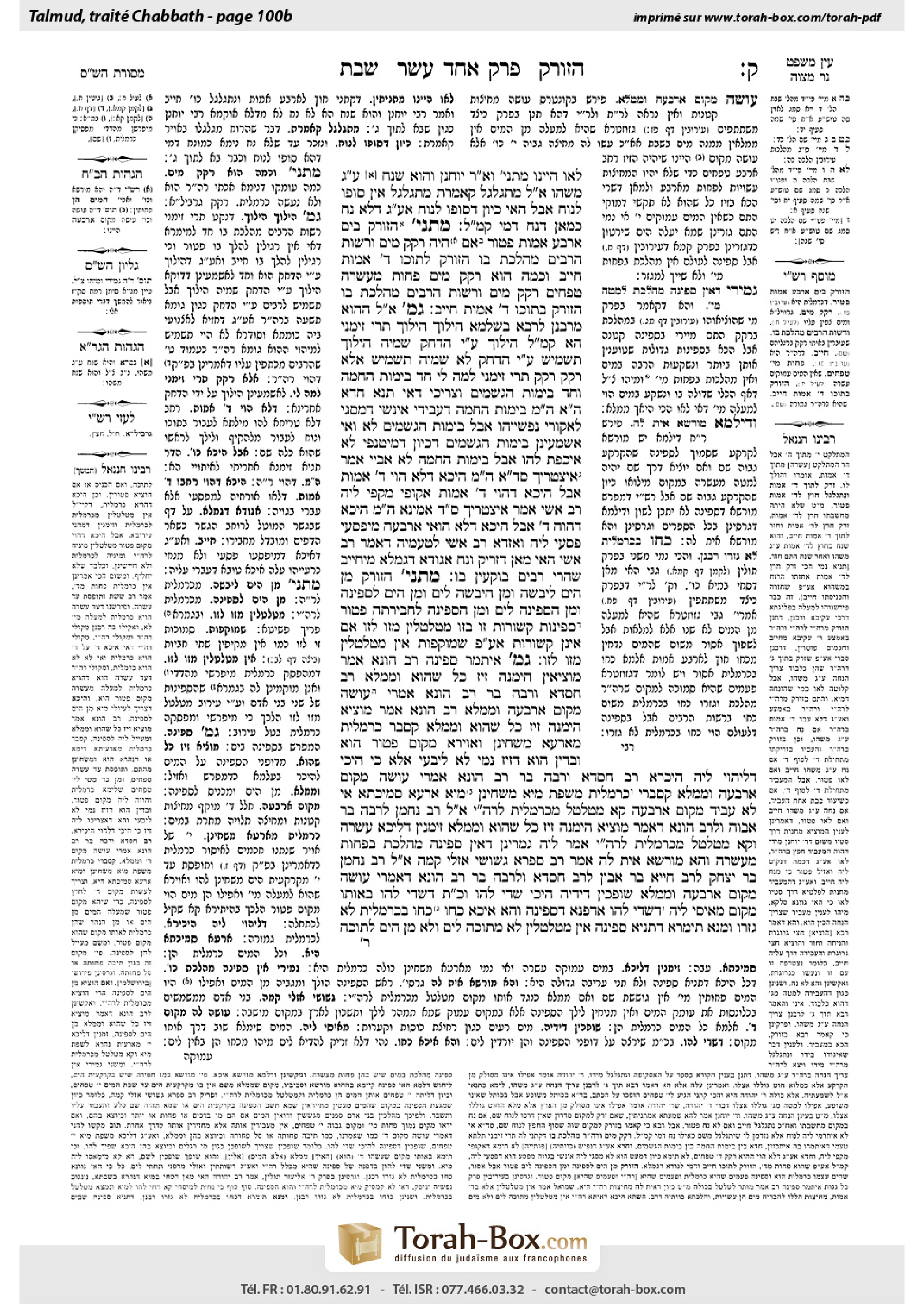
Shabbat 100b: Talmud study for Daf Yomi
Daf Yomi is the daily study of one Talmud folio. Explore 37 tractates with scans, Hebrew text, Sefaria English and AI-generated French translations where annotated.
Passage selection and English or AI-generated French translation are available where the scan has annotations. Daf Study is independent of Torah-Box and Sefaria.
Browse Shabbat · שבת · All tractatesShabbat 100b text and translations
This page of Shabbat includes the Aramaic text, an English translation and an AI-generated French translation, alongside the scan above.
שבת ק׳ ב · Aramaic and Hebrew text
לָאו הַיְינוּ מַתְנִיתִין, וְאָמַר רַבִּי יוֹחָנָן: וְהוּא שֶׁנָּח עַל גַּבֵּי מַשֶּׁהוּ. אֲמַר לֵיהּ: מִתְגַּלְגֵּל קָאָמְרַתְּ — מִתְגַּלְגֵּל אֵין סוֹפוֹ לָנוּחַ, אֲבָל הַאי כֵּיוָן דְּסוֹפוֹ לָנוּחַ, אַף עַל גַּב דְּלָא נָח — כְּמַאן דְּנָח דָּמֵי, קָא מַשְׁמַע לַן.
מַתְנִי׳ הַזּוֹרֵק בַּיָּם אַרְבַּע אַמּוֹת — פָּטוּר. אִם הָיָה רְקַק מַיִם, וּרְשׁוּת הָרַבִּים מְהַלֶּכֶת בּוֹ, הַזּוֹרֵק לְתוֹכוֹ אַרְבַּע אַמּוֹת — חַיָּיב. וְכַמָּה הוּא רְקַק מַיִם — פָּחוֹת מֵעֲשָׂרָה טְפָחִים. רְקַק מַיִם וּרְשׁוּת הָרַבִּים מְהַלֶּכֶת בּוֹ, הַזּוֹרֵק בְּתוֹכוֹ אַרְבַּע אַמּוֹת — חַיָּיב.
גְּמָ׳ אֲמַר לֵיהּ הָהוּא מֵרַבָּנַן לְרָבָא: בִּשְׁלָמָא ״הִילּוּךְ״ ״הִילּוּךְ״ תְּרֵי זִימְנֵי, הָא קָא מַשְׁמַע לַן: הִילּוּךְ עַל יְדֵי הַדְּחָק — שְׁמֵיהּ הִילּוּךְ, תַּשְׁמִישׁ עַל יְדֵי הַדְּחָק — לָא שְׁמֵיהּ תַּשְׁמִישׁ. אֶלָּא ״רְקָק״ ״רְקָק״ תְּרֵי זִימְנֵי לְמָה לִי? חַד בִּימוֹת הַחַמָּה וְחַד בִּימוֹת הַגְּשָׁמִים. וּצְרִיכִי. דְּאִי תְּנָא חֲדָא, הֲוָה אָמֵינָא הָנֵי מִילֵּי בִּימוֹת הַחַמָּה, דַּעֲבִידִי אִינָשֵׁי דִּמְסַגִּי לְאֹקוֹרֵי נַפְשַׁיְיהוּ, אֲבָל בִּימוֹת הַגְּשָׁמִים — לָא. וְאִי אַשְׁמְעִינַן בִּימוֹת הַגְּשָׁמִים, דְּכֵיוָן דְּמִיטַּנְּפִי לָא אִיכְפַּת לְהוּ, אֲבָל בִּימוֹת הַחַמָּה — לָא.
אַבָּיֵי אֲמַר: אִיצְטְרִיךְ, סָלְקָא דַּעְתָּךְ אָמֵינָא הָנֵי מִילֵּי הֵיכָא דְּלָא הָוֵי אַרְבַּע אַמּוֹת, אֲבָל הֵיכָא דְּהָוֵי אַרְבַּע אַמּוֹת — אַקּוֹפֵי מַקְּפִי לֵיהּ.
רַב אָשֵׁי אָמַר: אִיצְטְרִיךְ, סָלְקָא דַּעְתָּךְ אָמֵינָא הָנֵי מִילֵּי הֵיכָא דַּהֲוַאי אַרְבָּעָה, אֲבָל הֵיכָא דְּלָא הֲוַאי אַרְבָּעָה — מִיפְסָע פָּסְעִי לֵיהּ. וְאַזְדָּא רַב אָשֵׁי לְטַעְמֵיהּ, דְּאָמַר רַב אָשֵׁי: הַאי מַאן דְּזָרֵיק וְנָח אַגּוּדָּא דְגַמְלָא — מִיחַיַּיב, שֶׁהֲרֵי רַבִּים בּוֹקְעִין בּוֹ.
מַתְנִי׳ הַזּוֹרֵק מִן הַיָּם לַיַּבָּשָׁה, וּמִן הַיַּבָּשָׁה לַיָּם, וּמִן הַיָּם לַסְּפִינָה, וּמִן הַסְּפִינָה לַיָּם, וּמִן הַסְּפִינָה לַחֲבֶירְתָּהּ — פָּטוּר. סְפִינוֹת קְשׁוּרוֹת זוֹ בָּזוֹ — מְטַלְטְלִין מִזּוֹ לָזוֹ. אִם אֵינָן קְשׁוּרוֹת, אַף עַל פִּי שֶׁמּוּקָּפוֹת — אֵין מְטַלְטְלִין מִזּוֹ לָזוֹ.
גְּמָ׳ אִיתְּמַר: סְפִינָה, רַב הוּנָא אָמַר: מוֹצִיאִין הֵימֶנָּה זִיז כׇּל שֶׁהוּא וּמְמַלֵּא. רַב חִסְדָּא וְרַבָּה בַּר רַב הוּנָא אָמְרִי: עוֹשֶׂה מְקוֹם אַרְבָּעָה וּמְמַלֵּא.
רַב הוּנָא אָמַר מוֹצִיא הֵימֶנָּה זִיז כׇּל שֶׁהוּא וּמְמַלֵּא, קָסָבַר כַּרְמְלִית מֵאַרְעָא מָשְׁחִינַן וְאַוֵּירָא מְקוֹם פְּטוּר הוּא, וּבְדִין הוּא דְּזִיז נָמֵי לָא לִיבְעֵי, אֶלָּא — כִּי הֵיכִי דְּלֶיהְוֵי לֵיהּ הֶיכֵּרָא.
רַב חִסְדָּא וְרַבָּה בַּר רַב הוּנָא אָמְרִי עוֹשֶׂה מְקוֹם אַרְבָּעָה וּמְמַלֵּא, קָסָבְרִי כַּרְמְלִית מִשְּׂפַת מַיָּא מָשְׁחִינַן — מַיָּא אַרְעָא סְמִיכְתָּא, אִי לָא עָבֵיד מְקוֹם אַרְבָּעָה — קָא מְטַלְטֵל מִכַּרְמְלִית לִרְשׁוּת הַיָּחִיד.
אֲמַר לֵיהּ רַב נַחְמָן לְרַבָּה בַּר אֲבוּהּ: וּלְרַב הוּנָא דְּאָמַר מוֹצִיא הֵימֶנָּה זִיז כׇּל שֶׁהוּא וּמְמַלֵּא, זִימְנִין דְּלֵיכָּא עֲשָׂרָה, וְקָא מְטַלְטֵל מִכַּרְמְלִית לִרְשׁוּת הַיָּחִיד! אֲמַר לֵיהּ: גָּמְרִינַן דְּאֵין סְפִינָה מְהַלֶּכֶת בְּפָחוֹת מֵעֲשָׂרָה. וְהָא מוּרְשָׁא אִית לַהּ! אָמַר רַב סָפְרָא: גָּשׁוֹשֵׁי אָזְלִי קַמַּהּ.
אֲמַר לֵיהּ רַב נַחְמָן בַּר יִצְחָק לְרַב חִיָּיא בַּר אָבִין: לְרַב חִסְדָּא וּלְרַבָּה בַּר רַב הוּנָא דְּאָמְרִי עוֹשֶׂה מְקוֹם אַרְבָּעָה וּמְמַלֵּא, שׁוֹפְכִין דִּידֵיהּ הֵיכִי שָׁדֵי לְהוּ? וְכִי תֵּימָא דְּשָׁדֵי לְהוּ בְּאוֹתוֹ מָקוֹם — מְאִיסִי לֵיהּ. דְּשָׁדֵי לְהוּ אַדֻּפְנָא דִסְפִינָה. וְהָא אִיכָּא כֹּחוֹ! כֹּחוֹ בְּכַרְמְלִית לָא גְזַרוּ. וּמְנָא תֵּימְרָא? דְּתַנְיָא: סְפִינָה אֵין מְטַלְטְלִין לֹא מִתּוֹכָהּ לַיָּם וְלֹא מִן הַיָּם לְתוֹכָהּ,
Shabbat 100b · English translation
Isn’t that what we learned in the mishna, with regard to which Rabbi Yoḥanan said: That liability is when it came to rest atop something, which means that the object must actually land in order for the one who threw it to be liable. Mareimar said to Ravina: Are you saying it is a case of rolling? One cannot cite proof from a rolling object because a rolling object will not ultimately come to rest. However, with regard to this object, which passed within three handbreadths of the ground, I would say: Since it will ultimately come to rest, even though it has not yet come to rest, it is considered as an object that came to rest. Therefore, Rava teaches us that even in that case one is not liable until it actually comes to rest upon something.
MISHNA: One who throws an object four cubits into the sea is exempt. If there was a swamp and the public domain passes through it, one who throws an object four cubits into it is liable like one who carried four cubits in the public domain. And how deep is this swamp? It is less than ten handbreadths deep. In the case of a swamp that the public domain passes through, one who throws an object four cubits into the swamp is liable.
GEMARA: One of the Sages said to Rava: Granted, passing passing is mentioned twice in the mishna; this teaches us that passage under duress is considered passage, but usage under duress is not considered usage. But why do I need it to mention swamp swamp twice? Rava answered him: One case is referring to the summer, and one case is referring to the winter. And both cases are necessary, as had the mishna taught only one mention of swamp, I would have said that these matters, i.e., cases indicating that passage under duress is considered passage, apply only in the summer because people commonly pass through the swamp to cool themselves; however, in the winter I would have thought that it would not be so. And had the mishna taught us only the case of winter, I would have said that since they are filthy from mud anyway, they do not mind walking through the swamp, but in the summer it would not be so.
Abaye said: It is possible to explain this other way. It was necessary for the mishna to state swamp twice because it would have entered your mind to say that these matters apply specifically where the swamp is not four cubits wide because then people walk through the swamp and do not circumvent it, but where the swamp is four cubits wide, people circumvent it. Therefore, it was necessary to teach that people walk through swamps that are both narrow and wide.
Rav Ashi said another explanation: It was necessary for the mishna to state swamp twice because it would have entered your mind to say that these matters apply specifically where the swamp is at least four handbreadths wide, but where the swamp is not four handbreadths wide, people step over it and do not walk through it. The Gemara comments: And Rav Ashi follows his own reasoning, as Rav Ashi said: One who threw an object and it came to rest on one of the beams of a bridge is liable. Even though the width of each beam is less than four handbreadths, it joins together with the other beams to form a single surface of the public domain because even though many people step over the beams, still many people step on it.
MISHNA: One who throws an object from the sea to dry land, or from dry land to the sea, or from the sea onto a boat, or from a boat into the sea, or from one boat to another is exempt because the sea has the legal status of a karmelit. If boats are tied together, one may carry an object from one to the other on Shabbat. However, if they are not tied, even though they are adjacent, one may not carry from one to the other.
GEMARA: It was stated that the Sages disagreed with regard to the manner in which one may draw seawater onto a boat on Shabbat. Rav Huna said: One extends a projection of any size from the side of the boat as a distinctive sign, and fills a receptacle with water from the sea. Rav Ḥisda and Rabba bar Rav Huna say: One creates an area, a frame of four by four handbreadths, and fills the water from inside it.
The Gemara explains: Rav Huna, who said that one extends a projection of any size and fills a receptacle with water, maintains that we measure the karmelit from the sea floor. Since the sea itself is deeper than ten handbreadths, the boat is considered to be floating in the air, and the air is an exempt domain, as it is above ten handbreadths from the ground of the karmelit. And by law one should not require a projection because he is drawing water from an exempt domain into a private domain, which is permitted ab initio. Rather, the reason a projection is required is so that he will have a distinctive sign and not come to draw water from a karmelit into a private domain.
Rav Ḥisda and Rabba bar Rav Huna say: One creates an area, a frame of four by four handbreadths, and fills a receptacle with water. They maintain that we measure the karmelit from the surface of the water, and the water in the sea has a legal status like that of solid land. Therefore, if one does not create an area of four by four, he will carry from a karmelit to the private domain.
Rav Naḥman said to Rabba bar Avuh: And according to Rav Huna, who said that one extends a projection of any size from the side of the boat and fills a receptacle with water, isn’t there room for concern that at times when the water is not ten handbreadths deep, he will carry from a karmelit into the private domain? He said to him: We learned through tradition that a boat does not travel in water that is less than ten handbreadths deep. He asks: Although a boat has a protrusion at its bow is more than ten handbreadths above the sea floor, the entire length of the boat is not necessarily that far above the bottom. Rav Safra said: Those people who measure the depth of the water with long poles proceed before the ship and ensure that that the water is at least ten handbreadths deep.
Rav Naḥman bar Yitzḥak said to Rav Ḥiyya bar Avin: According to Rav Ḥisda and Rabba bar Rav Huna, who say that in order to draw water onto a boat on Shabbat one creates an area of four by four handbreadths and fills a receptacle, how does he throw out his waste water? And if you say he pours it out in the same area from which he draws water, the water that he subsequently draws from there will be disgusting to him. Rav Ḥiyya bar Avin answered him: He pours it onto the side of the boat from which it runs into the sea, and he does not pour it directly into the sea. The Gemara asks: Even so, it is accomplished by means of his power. Although he did not pour it directly, he caused the waste water to enter the sea. The Gemara answers: The Sages did not issue a decree to prohibit an action performed by one’s power in a karmelit. They only prohibited throwing an object directly. And from where do you say that this is so? As it was taught in a baraita: With regard to a ship, one may neither carry from it into the sea, nor from the sea into it.
Shabbat 100b · Traduction française (IA)
N’est-ce pas ce que nous avons appris dans la Michna, au sujet de laquelle Rabbi Yoḥanan a dit : « Cette responsabilité ne s’applique que si l’objet s’est immobilisé sur quelque chose », ce qui signifie que l’objet doit effectivement se poser pour que celui qui l’a lancé soit responsable ? Mareimar dit à Ravina : « Parles-tu d’un cas où l’objet roule ? » On ne peut pas tirer de preuve d’un objet qui roule, car un objet qui roule ne finira pas par s’immobiliser. Mais, concernant cet objet, qui est passé à moins de trois empans du sol, je dirais : puisqu’il finira par s’immobiliser, même s’il ne s’est pas encore immobilisé, il est considéré comme un objet qui s’est immobilisé. Rava nous enseigne donc que, même dans ce cas, on n’est pas responsable tant que l’objet ne s’est pas effectivement immobilisé sur quelque chose.
MICHNA : Celui qui lance un objet à quatre coudées dans la mer est exempt. S’il y a un marécage que traverse le domaine public, celui qui y lance un objet à quatre coudées est responsable, comme celui qui transporte un objet sur quatre coudées dans le domaine public. Quelle est la profondeur de ce marécage ? Elle est inférieure à dix empans. Dans le cas d’un marécage que traverse le domaine public, celui qui y lance un objet à quatre coudées est responsable.
GUEMARA : L’un des Sages dit à Rava : Certes, le mot « traverse » est mentionné deux fois dans la Michna ; cela nous enseigne que le passage sous la contrainte est considéré comme un passage, mais que l’usage sous la contrainte n’est pas considéré comme un usage. Mais pourquoi la Michna mentionne-t-elle deux fois le marécage ? Rava lui répondit : Un cas concerne l’été et l’autre l’hiver. Les deux cas sont nécessaires, car si la Michna n’avait mentionné le marécage qu’une seule fois, j’aurais dit que ces principes, c’est-à-dire les cas indiquant que le passage sous la contrainte est considéré comme un passage, ne s’appliquent qu’en été, car les gens traversent couramment le marécage pour se rafraîchir ; mais j’aurais pensé qu’il n’en va pas ainsi en hiver. Et si la Michna ne nous avait enseigné que le cas de l’hiver, j’aurais dit que, puisqu’ils sont de toute façon couverts de boue, cela ne les dérange pas de traverser le marécage, mais qu’il n’en va pas ainsi en été.
Abaye dit : On peut expliquer cela autrement. Il était nécessaire que la Michna mentionne deux fois le marécage, car tu aurais pu penser que ces principes s’appliquent spécifiquement lorsque le marécage fait moins de quatre coudées de large : dans ce cas, les gens le traversent au lieu de le contourner. Mais lorsque le marécage fait quatre coudées de large, les gens le contournent. Il était donc nécessaire d’enseigner que les gens traversent les marécages, qu’ils soient étroits ou larges.
Rav Ashi donne une autre explication : Il était nécessaire que la Michna mentionne deux fois le marécage, car tu aurais pu penser que ces principes s’appliquent spécifiquement lorsque le marécage fait au moins quatre empans de large, mais que, s’il fait moins de quatre empans de large, les gens l’enjambent au lieu de le traverser. La Guemara commente : Rav Ashi suit son propre raisonnement, car Rav Ashi a dit : Celui qui lance un objet et que celui-ci s’immobilise sur l’une des poutres d’un pont est responsable. Même si chacune des poutres fait moins de quatre empans de large, elles s’unissent aux autres pour former une seule surface du domaine public, car, même si beaucoup de gens enjambent les poutres, beaucoup d’autres marchent dessus.
MICHNA : Celui qui lance un objet de la mer sur la terre ferme, ou de la terre ferme dans la mer, ou de la mer sur un bateau, ou d’un bateau dans la mer, ou d’un bateau à un autre, est exempt, car la mer a le statut juridique de karmelit. Si des bateaux sont attachés les uns aux autres, on peut transporter un objet de l’un à l’autre pendant Chabbat. En revanche, s’ils ne sont pas attachés, on ne peut pas transporter d’un bateau à l’autre, même s’ils sont côte à côte.
GUEMARA : Il a été rapporté que les Sages sont en désaccord sur la manière dont on peut puiser de l’eau de mer à bord d’un bateau pendant Chabbat. Rav Houna dit : On fixe sur le côté du bateau une saillie de n’importe quelle dimension, à titre de signe distinctif, puis on puise de l’eau de mer dans un récipient. Rav Ḥisda et Rabba bar Rav Houna disent : On délimite une surface de quatre empans sur quatre et on puise l’eau à l’intérieur.
La Guemara explique : Rav Houna, qui dit qu’on fixe une saillie de n’importe quelle dimension et qu’on puise de l’eau dans un récipient, soutient que l’on mesure la karmelit à partir du fond de la mer. Comme la mer elle-même a une profondeur supérieure à dix empans, le bateau est considéré comme flottant dans les airs, et cet espace est un domaine exempt, puisqu’il se trouve à plus de dix empans au-dessus du fond de la karmelit. Selon la loi, on ne devrait donc pas exiger de saillie, puisqu’il puise de l’eau d’un domaine exempt vers un domaine privé, ce qui est permis a priori. Si une saillie est requise, c’est plutôt pour lui fournir un signe distinctif et éviter qu’il ne vienne à puiser de l’eau d’une karmelit vers un domaine privé.
Rav Ḥisda et Rabba bar Rav Houna disent : On délimite une surface de quatre empans sur quatre et on puise l’eau dans un récipient. Ils soutiennent que l’on mesure la karmelit à partir de la surface de l’eau et que l’eau de mer a le statut juridique d’un sol solide. Par conséquent, si l’on ne délimite pas une surface de quatre empans sur quatre, on transportera de l’eau d’une karmelit vers le domaine privé.
Rav Naḥman dit à Rabba bar Avouha : Selon Rav Houna, qui dit que l’on fixe une saillie de n’importe quelle dimension sur le côté du bateau et que l’on puise de l’eau dans un récipient, ne faut-il pas craindre qu’à certains moments, lorsque l’eau n’a pas dix empans de profondeur, il transporte de l’eau d’une karmelit vers le domaine privé ? Il lui répondit : Nous avons appris par tradition qu’un bateau ne navigue pas dans une eau de moins de dix empans de profondeur. Il objecte : Même si la proue du bateau se trouve à plus de dix empans au-dessus du fond de la mer, toute la longueur du bateau ne se trouve pas nécessairement à cette hauteur au-dessus du fond. Rav Safra dit : Les hommes qui mesurent la profondeur de l’eau à l’aide de longues perches avancent devant le bateau et s’assurent que l’eau a au moins dix empans de profondeur.
Rav Naḥman bar Yitsḥak dit à Rav Ḥiyya bar Avin : Selon Rav Ḥisda et Rabba bar Rav Houna, qui disent que, pour puiser de l’eau à bord d’un bateau pendant Chabbat, on délimite une surface de quatre empans sur quatre et on puise l’eau dans un récipient, comment se débarrasse-t-on des eaux usées ? Si tu dis qu’on les verse dans la même surface que celle où l’on puise l’eau, l’eau qu’on y puisera ensuite sera répugnante. Rav Ḥiyya bar Avin lui répondit : On les verse sur le côté du bateau, d’où elles s’écoulent dans la mer ; on ne les verse pas directement dans la mer. La Guemara demande : Même ainsi, cela se fait par son action. Bien qu’il ne les ait pas versées directement, il a provoqué l’écoulement des eaux usées dans la mer. La Guemara répond : Les Sages n’ont pas décrété d’interdire une action accomplie par son intermédiaire dans une karmelit. Ils ont seulement interdit de lancer un objet directement. Et d’où sait-on qu’il en est ainsi ? De ce qui a été enseigné dans une baraïta : En ce qui concerne un bateau, on ne peut transporter ni de celui-ci vers la mer, ni de la mer vers celui-ci.
Traduction française générée par IA à partir de l’édition anglaise de Sefaria. Vérifie toujours un passage avec le texte source.
Text from Sefaria: William Davidson Edition - Vocalized Aramaic (CC BY NC); William Davidson Edition - English (CC BY NC).