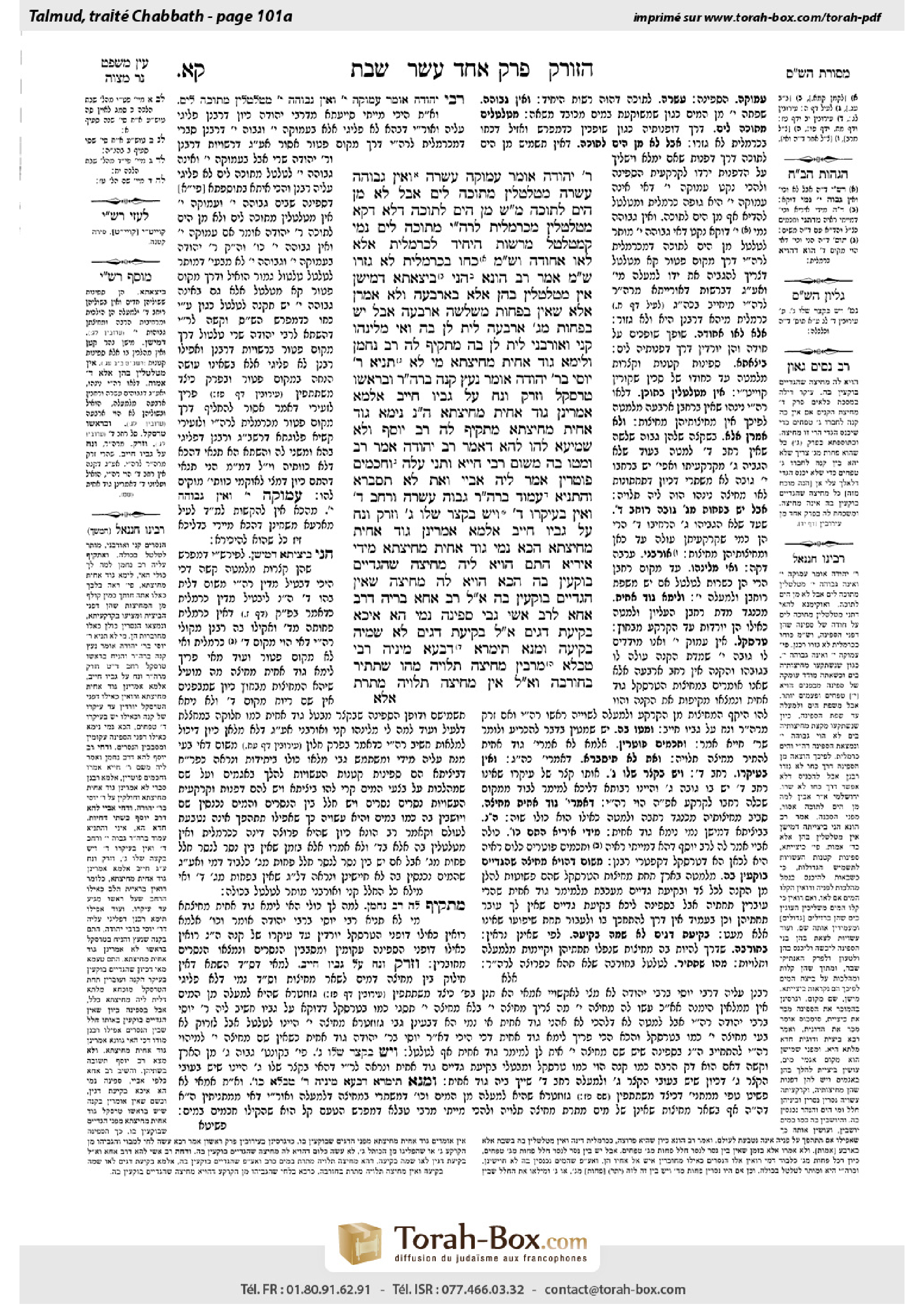
Shabbat 101a: Talmud study for Daf Yomi
Daf Yomi is the daily study of one Talmud folio. Explore 37 tractates with scans, Hebrew text, Sefaria English and AI-generated French translations where annotated.
Passage selection and English or AI-generated French translation are available where the scan has annotations. Daf Study is independent of Torah-Box and Sefaria.
Browse Shabbat · שבת · All tractatesShabbat 101a text and translations
This page of Shabbat includes the Aramaic text, an English translation and an AI-generated French translation, alongside the scan above.
שבת ק״א א · Aramaic and Hebrew text
רַבִּי יְהוּדָה אוֹמֵר: עֲמוּקָּה עֲשָׂרָה, וְאֵין גְּבוֹהָה עֲשָׂרָה — מִטַּלְטְלִין מִתּוֹכָהּ לַיָּם, אֲבָל לֹא מִן הַיָּם לְתוֹכָהּ. מַאי שְׁנָא מִן הַיָּם לְתוֹכָהּ דְּלָא — דְּקָא מְטַלְטְלִין מִכַּרְמְלִית לִרְשׁוּת הַיָּחִיד, מִתּוֹכָהּ לַיָּם — נָמֵי קָמְטַלְטֵל מֵרְשׁוּת הַיָּחִיד לְכַרְמְלִית! אֶלָּא לָאו אַחוּדָּהּ. וּשְׁמַע מִינַּהּ כֹּחוֹ בְּכַרְמְלִית לָא גְּזַרוּ. שְׁמַע מִינַּהּ.
אָמַר רַב הוּנָא: הָנֵי בִּיצִיָּאתָא דְמֵישָׁן אֵין מְטַלְטְלִין בָּהֶן אֶלָּא בְּאַרְבַּע [אַמּוֹת]. וְלָא אֲמַרַן אֶלָּא שֶׁאֵין בְּפָחוֹת מִשְּׁלֹשָׁה אַרְבָּעָה, אֲבָל יֵשׁ בְּפָחוֹת מִשְּׁלֹשָׁה אַרְבָּעָה — לֵית לַן בַּהּ. וְאִי מְלָנְהוּ קְנֵי וְאוּרְבָּנֵי — לֵית לַן בַּהּ.
מַתְקֵיף לַהּ רַב נַחְמָן, וְלֵימָא גּוּד אַחֵית מְחִיצָתָא! מִי לָא תַּנְיָא, רַבִּי יוֹסֵי בְּרַבִּי יְהוּדָה אוֹמֵר: נָעַץ קָנֶה בִּרְשׁוּת הָרַבִּים וּבְרֹאשׁוֹ טְרַסְקָל, וְזָרַק וְנָח עַל גַּבָּיו — חַיָּיב. אַלְמָא אָמְרִינַן גּוּד אַחֵית מְחִיצָתָא. הָכָא נָמֵי נֵימָא גּוּד אַחֵית מְחִיצָתָא!
מַתְקֵיף לַהּ רַב יוֹסֵף: וְלָא שְׁמִיעָא לְהוּ לְהָא דְּאָמַר רַב יְהוּדָה אָמַר רַב, וּמָטוּ בָּהּ מִשּׁוּם רַבִּי חִיָּיא, וְתָנֵי עֲלַהּ: וַחֲכָמִים פּוֹטְרִין. אֲמַר לֵיהּ אַבָּיֵי: וְאַתְּ לָא תִּסְבְּרָא? וְהָתַנְיָא: עַמּוּד בִּרְשׁוּת הָרַבִּים גָּבוֹהַּ עֲשָׂרָה וְרָחָב אַרְבָּעָה, וְאֵין בְּעִיקָּרוֹ אַרְבָּעָה, וְיֵשׁ בַּקָּצָר שֶׁלּוֹ שְׁלֹשָׁה, וְזָרַק וְנָח עַל גַּבָּיו — חַיָּיב. אַלְמָא אָמְרִינַן: גּוּד אַחֵית מְחִיצָתָא. הָכָא נָמֵי: גּוּד אַחֵית מְחִיצָתָא.
מִידֵּי אִירְיָא?! הָתָם הָוְיָא לַהּ מְחִיצָה שֶׁהַגְּדָיִים בּוֹקְעִין בָּהּ. הָכָא הָוְיָא לַהּ מְחִיצָה שֶׁאֵין הַגְּדָיִים בּוֹקְעִין בָּהּ. אֲמַר לֵיהּ רַב אַחָא בְּרֵיהּ דְּרַב אַחָא לְרַב אָשֵׁי: גַּבֵּי סְפִינָה נָמֵי, הָא אִיכָּא בְּקִיעַת דָּגִים! אֲמַר לֵיהּ: בְּקִיעַת דָּגִים לֹא שְׁמָהּ בְּקִיעָה. וּמְנָא תֵּימְרָא? — דִּבְעָא מִינֵּיהּ רַבִּי טַבְלָא מֵרַב: מְחִיצָה תְּלוּיָה מַהוּ שֶׁתַּתִּיר בְּחוּרְבָּה? וַאֲמַר לֵיהּ: אֵין מְחִיצָה תְּלוּיָה מַתֶּרֶת
Shabbat 101a · English translation
Rabbi Yehuda says: If the interior of the boat is ten handbreadths deep and it is not ten handbreadths above the surface of the water, one may carry from it into the sea, but not from the sea into it. The Gemara asks: What is different about carrying from the sea into the ship that one may not do so? Is it because in doing so one is carrying from a karmelit into the private domain? In carrying from the ship into the sea, one is also carrying from the private domain into a karmelit. Rather, is it not that from the ship to the sea is permitted because one throws the object onto the edge of the boat and it falls into the sea on its own, and learn from it that the Sages did not issue a decree prohibiting an action caused indirectly by one’s power in a karmelit? The Gemara summarizes: Indeed, learn from it that this is so.
Rav Huna said: With regard to those small boats of Meishan, which are wide on top and narrow at the bottom, one may carry in them only within four cubits. Because they are less than four handbreadths wide at the bottom, they are not a private domain. And we only said this halakha in a case where the width of the boat does not reach four handbreadths less than three handbreadths from the bottom of the boat. However, if the width of the boat reaches four handbreadths less than three handbreadths from the bottom, we do not have this halakha, as those are considered full-fledged partitions which create a private domain. And, similarly, if one fills the bottom of the boat with reeds and thin willow branches up to the point where the boat reaches four handbreadths, we do not have this halakha. If there are ten handbreadths above the point where the boat reaches four handbreadths, it is a private domain.
Rav Naḥman strongly objects to this: And let us say: Lower the partition. The upper part of the raft is sufficiently wide and its partitions are sufficiently high; why not consider it as if the partitions of the boat descend from the top of the raft in a straight line to the bottom? Was it not taught in a baraita that Rabbi Yosei, son of Rabbi Yehuda, says: One who stuck a stick into the ground in the public domain, and hung a basket atop it that is four by four handbreadths wide, and threw an object from the public domain and it landed upon it, he is liable, like one who carried an object into a private domain? Apparently, we say: Lower the partition of the basket and treat it as if it reaches the ground, creating a column that is considered a private domain. Here, too, let us say: Lower the partition.
Rav Yosef strongly objects to this statement of Rav Naḥman: And did they not hear that which Rav Yehuda said that Rav said, and there are those who determined that this halakha was stated in the name of Rabbi Ḥiyya: And it was taught in a baraita: And the Rabbis deem one exempt in the case of a reed stuck in the ground of a public domain? Apparently, the opinion of Rabbi Yosei, son of Rabbi Yehuda, is an individual opinion and was not accepted as halakha. Abaye said to him: And do you not hold the principle of extending partitions? Was it not taught in a baraita: With regard to a column in the public domain that is ten handbreadths high and four handbreadths wide, and its base is not four handbreadths wide, and its narrowest point is more than three handbreadths high; and if one threw an object from the public domain and it came to rest atop the column, he is liable? Apparently, we say: Lower the partition. Since the column’s uppermost section is sufficiently wide, its partitions are considered as if they extend to the ground. Here, too, say: Lower the partition.
The Gemara asks: Are the case of the basket and the case of the boat comparable? There, in the case of the basket, it is a partition that goats pass through. A partition that does not serve as a barrier is not considered a partition. Here, it is a partition that goats do not pass through. It is considered a partition. Rav Aḥa, son of Rav Aḥa, said to Rav Ashi: In the case of a boat, too, there is the passage of fish, as they can swim through the lowered partitions of the boat. He said to him: Passage of fish is not considered passage because it is not visible. And from where do you say that this is so? As Rabbi Tavla raised a dilemma before Ravin: With regard to a hanging partition, what is the ruling in terms of it permitting one to carry in a ruin when part of the building’s walls are still intact, and they are still considered partitions? Ravin said to him: A hanging partition only permits one to carry
Shabbat 101a · Traduction française (IA)
Rabbi Yehuda dit : Si l’intérieur du bateau a une profondeur de dix téfa’him et qu’il ne se trouve pas à dix téfa’him au-dessus de la surface de l’eau, on peut transporter des objets du bateau vers la mer, mais pas de la mer vers le bateau. La Guemara demande : En quoi le transport de la mer vers le bateau diffère-t-il pour être interdit ? Est-ce parce qu’on transporte ainsi d’une karmelit vers un domaine privé ? En transportant du bateau vers la mer, on transporte également d’un domaine privé vers une karmelit. Ne faut-il pas plutôt dire que le transport du bateau vers la mer est permis parce qu’on jette l’objet sur le bord du bateau et qu’il tombe ensuite de lui-même dans la mer ? On peut en déduire que les Sages n’ont pas décrété l’interdiction d’une action provoquée indirectement par sa force dans une karmelit. La Guemara conclut : En effet, on peut en déduire qu’il en est ainsi.
Rav Huna dit : Dans ces petits bateaux de Meishan, larges en haut et étroits en bas, on ne peut transporter des objets que dans un rayon de quatre coudées. Comme leur largeur à la base est inférieure à quatre téfa’him, ils ne constituent pas un domaine privé. Cette halakha ne s’applique que lorsque le bateau n’atteint pas une largeur de quatre téfa’him à moins de trois téfa’him du fond. En revanche, si le bateau atteint une largeur de quatre téfa’him à moins de trois téfa’him du fond, cette halakha ne s’applique pas, car ces parois sont considérées comme des cloisons à part entière qui créent un domaine privé. De même, si l’on remplit le fond du bateau de roseaux et de fines branches de saule jusqu’au point où le bateau atteint une largeur de quatre téfa’him, cette halakha ne s’applique pas. S’il y a dix téfa’him au-dessus du point où le bateau atteint une largeur de quatre téfa’him, il s’agit d’un domaine privé.
Rav Naḥman objecte vigoureusement : Pourquoi ne pas dire : « Abaisse la cloison » ? La partie supérieure du radeau est suffisamment large et ses cloisons suffisamment hautes ; pourquoi ne pas considérer que les cloisons du bateau descendent en ligne droite depuis le haut du radeau jusqu’au fond ? N’a-t-on pas enseigné dans une baraïta que Rabbi Yosei, fils de Rabbi Yehuda, dit : Celui qui enfonce un bâton dans le sol du domaine public et y suspend un panier de quatre téfa’him sur quatre, puis lance un objet depuis le domaine public et que celui-ci atterrit sur le panier, est passible, comme celui qui a transporté un objet dans un domaine privé ? Apparemment, nous disons : « Abaisse la cloison du panier » et considérons-la comme si elle atteignait le sol, formant ainsi une colonne considérée comme un domaine privé. Ici aussi, disons : « Abaisse la cloison. »
Rav Yosef objecte vigoureusement à cette déclaration de Rav Naḥman : N’ont-ils donc pas entendu ce que Rav Yehuda a dit au nom de Rav — certains attribuent cette halakha à Rabbi Ḥiyya — et ce qui a été enseigné dans une baraïta : Les Rabbins exemptent dans le cas d’un roseau enfoncé dans le sol du domaine public ? Apparemment, l’avis de Rabbi Yosei, fils de Rabbi Yehuda, est une opinion individuelle et n’a pas été retenu comme halakha. Abaye lui dit : Ne tiens-tu pas le principe de l’extension des cloisons ? N’a-t-on pas enseigné dans une baraïta : À propos d’une colonne située dans le domaine public, haute de dix téfa’him et large de quatre téfa’him, dont la base n’a pas quatre téfa’him de largeur et dont le point le plus étroit se trouve à plus de trois téfa’him de hauteur : si quelqu’un lance un objet depuis le domaine public et que celui-ci se pose au sommet de la colonne, il est passible. Apparemment, nous disons : « Abaisse la cloison. » Puisque la partie supérieure de la colonne est suffisamment large, ses cloisons sont considérées comme si elles se prolongeaient jusqu’au sol. Ici aussi, dis : « Abaisse la cloison. »
La Guemara demande : Le cas du panier est-il comparable à celui du bateau ? Dans le cas du panier, il s’agit d’une cloison que les chèvres traversent. Une cloison qui ne fait pas obstacle n’est pas considérée comme une cloison. Ici, il s’agit d’une cloison que les chèvres ne traversent pas ; elle est donc considérée comme une cloison. Rav Aḥa, fils de Rav Aḥa, dit à Rav Ashi : Dans le cas du bateau aussi, il y a le passage des poissons, puisqu’ils peuvent nager sous les cloisons abaissées du bateau. Il lui répondit : Le passage des poissons n’est pas considéré comme un passage, car il n’est pas visible. Et d’où savons-nous qu’il en est ainsi ? Rabbi Tavla posa cette question à Ravin : Quel est le statut d’une cloison suspendue quant à la permission de transporter des objets dans un bâtiment en ruine, lorsque certaines des parois du bâtiment sont encore intactes et toujours considérées comme des cloisons ? Ravin lui répondit : Une cloison suspendue ne permet de transporter des objets que
Traduction française générée par IA à partir de l’édition anglaise de Sefaria. Vérifie toujours un passage avec le texte source.
Text from Sefaria: William Davidson Edition - Vocalized Aramaic (CC BY NC); William Davidson Edition - English (CC BY NC).