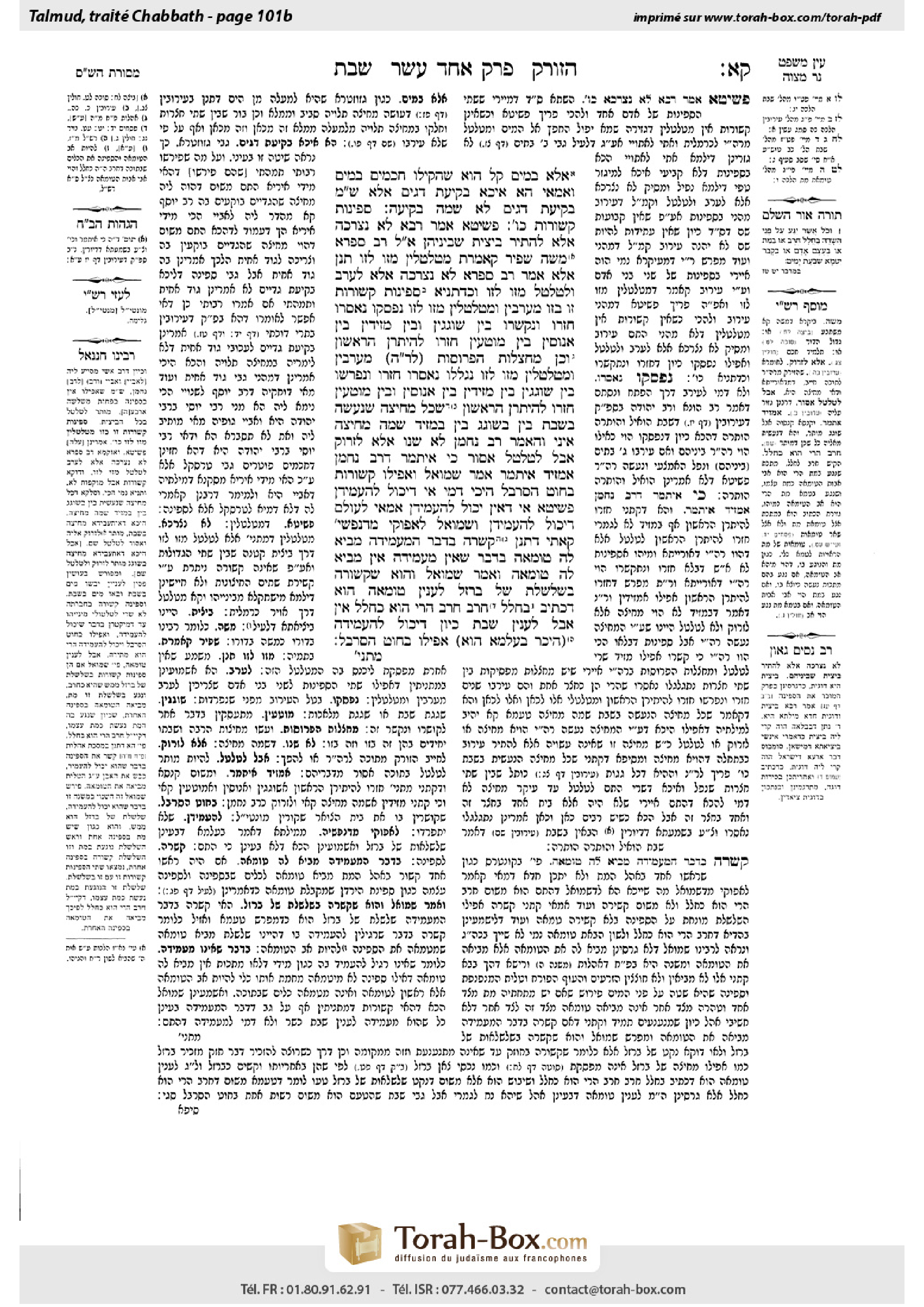
Shabbat 101b: Talmud study for Daf Yomi
Daf Yomi is the daily study of one Talmud folio. Explore 37 tractates with scans, Hebrew text, Sefaria English and AI-generated French translations where annotated.
Passage selection and English or AI-generated French translation are available where the scan has annotations. Daf Study is independent of Torah-Box and Sefaria.
Browse Shabbat · שבת · All tractatesShabbat 101b text and translations
This page of Shabbat includes the Aramaic text, an English translation and an AI-generated French translation, alongside the scan above.
שבת ק״א ב · Aramaic and Hebrew text
אֶלָּא בְּמַיִם, קַל הוּא שֶׁהֵקֵילּוּ חֲכָמִים בְּמַיִם. וְאַמַּאי, הָא אִיכָּא בְּקִיעַת דָּגִים? אֶלָּא שְׁמַע מִינַּהּ — בְּקִיעַת דָּגִים לֹא שְׁמָהּ בְּקִיעָה.
סְפִינוֹת קְשׁוּרוֹת כּוּ׳. פְּשִׁיטָא! אָמַר רָבָא: לֹא נִצְרְכָה אֶלָּא לְהַתִּיר בִּיצִּית שֶׁבֵּינֵיהֶן.
אֲמַר לֵיהּ רַב סָפְרָא: מֹשֶׁה, שַׁפִּיר קָאָמְרַתְּ?! ״מְטַלְטְלִין מִזּוֹ לָזוֹ״ תְּנַן! אֶלָּא אָמַר רַב סָפְרָא: לֹא נִצְרְכָה אֶלָּא לְעָרֵב וּלְטַלְטֵל מִזּוֹ לָזוֹ, וְכִדְתַנְיָא: סְפִינוֹת קְשׁוּרוֹת זוֹ בָּזוֹ — מְעָרְבִין וּמְטַלְטְלִין מִזּוֹ לָזוֹ. נִפְסְקוּ — נֶאֶסְרוּ. חָזְרוּ וְנִקְשְׁרוּ, בֵּין שׁוֹגְגִין וּבֵין מְזִידִין בֵּין אֲנוּסִין בֵּין מוּטְעִין — חָזְרוּ לְהֶיתֵּרָן הָרִאשׁוֹן.
וְכֵן מַחְצָלוֹת הַפְּרוּסוֹת לִרְשׁוּת הָרַבִּים — מְעָרְבִין וּמְטַלְטְלִין מִזּוֹ לָזוֹ. נִגְלְלוּ — נֶאְסְרוּ. חָזְרוּ וְנִפְרְשׂוּ, בֵּין שׁוֹגְגִין בֵּין מְזִידִין בֵּין אֲנוּסִין וּבֵין מוּטְעִין — חָזְרוּ לְהֶיתֵּרָן הָרִאשׁוֹן, שֶׁכׇּל מְחִיצָה שֶׁנַּעֲשֵׂת בַּשַּׁבָּת, בֵּין בְּשׁוֹגֵג בֵּין בְּמֵזִיד — שְׁמָהּ מְחִיצָה.
אִינִי?! וְהָאָמַר רַב נַחְמָן: לֹא שָׁנוּ אֶלָּא לִזְרוֹק, אֲבָל לְטַלְטֵל אָסוּר! כִּי אִיתְּמַר דְּרַב נַחְמָן — אַמֵּזִיד אִיתְּמַר.
אָמַר שְׁמוּאֵל: וַאֲפִילּוּ קְשׁוּרוֹת בְּחוּט הַסַּרְבָּל. הֵיכִי דָמֵי? אִי דְּיָכוֹל לְהַעֲמִידָן — פְּשִׁיטָא. אִי דְּאֵין יָכוֹל לְהַעֲמִידָן — אַמַּאי?
לְעוֹלָם דְּיָכוֹל לְהַעֲמִידָן. וּשְׁמוּאֵל לְאַפּוֹקֵי מִדְּנַפְשֵׁיהּ קָאָתֵי. דִּתְנַן: קְשָׁרָהּ בְּדָבָר הַמַּעֲמִידָהּ — מֵבִיא לָהּ טוּמְאָה. בְּדָבָר שֶׁאֵין מַעֲמִידָהּ — אֵין מֵבִיא לָהּ טוּמְאָה. וְאָמַר שְׁמוּאֵל: וְהוּא שֶׁקְּשׁוּרָה בְּשַׁלְשֶׁלֶת שֶׁל בַּרְזֶל.
לְעִנְיַן טוּמְאָה הוּא, דִּכְתִיב: ״בַּחֲלַל חֶרֶב״ — חֶרֶב הֲרֵי הוּא כְּחָלָל. (אִין) אֲבָל לְעִנְיַן שַׁבָּת, כֵּיוָן דְּיָכוֹל לְהַעֲמִידָהּ, הֶיכֵּר בְּעָלְמָא הוּא — אֲפִילּוּ בְּחוּט הַסַּרְבָּל.
Shabbat 101b · English translation
in water. It is a leniency the Sages instituted in water but not in other circumstances. And why were they lenient with regard to a hanging partition in water? Isn’t there the passage of fish? Rather, learn from this that the passage of fish is not considered passage.
We learned in the mishna: If boats are tied together, one may carry an object from one to the other on Shabbat. The Gemara asks: That is obvious, since these boats are like a single domain. Rava said: This mishna was necessary only to permit carrying from one boat to another via a small boat that is between them.
Rav Safra said to him: You, who are as great in this generation as Moses, did you speak well? We learned in the mishna that one may carry only from one to the other, not via a small boat. Rather, Rav Safra said: The mishna was only necessary to obligate one to place an eiruv, a joining of courtyards, between the two boats. Since the boats belong to different people, they must be joined to form a single domain in order to permit carrying from one to the other, as it was taught in a baraita: With regard to boats tied to one another, one places an eiruv and carries from one to the other. If the ties between them were severed, the people on the boats are prohibited to carry from one to the other. If they were then retied, whether unwittingly, i.e., the one who retied them forgot that it was Shabbat, whether intentionally, whether due to circumstances beyond one’s control, whether mistakenly, the boats are restored to their original permitted status.
And similarly, in the case of mats that are unfurled to create a partition between two people and the public domain, one places an eiruv and carries from one to the other. If the mats were furled, the people on the boats are prohibited to carry from one to the other. If the mats were then unfurled again, whether unwittingly, whether intentionally, whether due to circumstances beyond one’s control, whether mistakenly, they are restored to their original permitted status. That is because any partition that is established on Shabbat, whether unwittingly, whether intentionally, is considered a partition.
The Gemara asks: Is that so? Didn’t Rav Naḥman say: They only taught the principle that a partition established on Shabbat is considered a partition with regard to throwing. In that case, a partition creates a domain unto itself, and one who throws an object into it from another domain is liable. However, with regard to carrying within that domain, it is certainly prohibited. The Gemara answers: When that statement of Rav Naḥman was stated, it was stated with regard to an act performed intentionally. One who intentionally establishes a partition is penalized and is not permitted to benefit from it. In principle, though, that partition is considered a full-fledged partition.
Shmuel said: The halakha that one may carry from one ship to another if they are tied together applies even if they were tied with a string used to close the neckline of a cloak. The Gemara asks: What are the circumstances? If the string is capable of holding the ships together, it is obvious that carrying between the ships is permitted as they are tied together. However, if the string is incapable of holding them, why is it permitted?
The Gemara explains: Actually, it refers to a string that can hold them, and Shmuel said this to exclude this case from his own statement. As we learned in a mishna: If one tied a ship with an item capable of holding it and the end of that item was in a tent with a corpse, it transmits impurity to the ship. And if one tied it with something that is incapable of holding it, it does not transmit impurity to the ship. And Shmuel said: When the mishna refers to an item capable of holding it, it is referring to a case where it is tied with an iron chain. It was necessary for Shmuel to establish that although with regard to ritual impurity the halakha applies only to an iron chain, with regard to Shabbat the halakha applies to any item capable of holding the ships together.
The reason that the halakha is different with regard to impurity is as it is written: “And whoever touches in the open field one slain by sword, or one who dies by himself, or a bone of a man, or a grave, shall be unclean seven days” (Numbers 19:16). The Sages derived from the phrase: One slain by sword that a sword is like one slain, i.e., a corpse. A metal instrument that comes into contact with a corpse assumes the same level of ritual impurity as the corpse itself, the ultimate primary source of ritual impurity. Therefore, it is only an iron chain in a tent with a corpse in it that can render a boat tied to the other end a primary source of ritual impurity. A string made of other materials cannot. However, with regard to Shabbat, since it is capable of holding it and it is a mere distinctive sign that is necessary, even the string of a cloak is sufficient.
Shabbat 101b · Traduction française (IA)
dans l’eau. C’est une indulgence que les Sages ont instituée dans l’eau, mais pas dans d’autres situations. Et pourquoi ont-ils été indulgents au sujet d’une cloison suspendue dans l’eau ? N’y a-t-il pas le passage des poissons ? Il faut plutôt en déduire que le passage des poissons n’est pas considéré comme un passage.
Nous avons appris dans la Michna : si des bateaux sont attachés les uns aux autres, on peut transporter un objet de l’un à l’autre pendant Chabbat. La Guemara demande : cela va de soi, puisque ces bateaux forment un seul domaine. Rava dit : cette Michna était nécessaire uniquement pour autoriser le transport d’un bateau à l’autre en passant par une petite embarcation située entre eux.
Rav Safra lui dit : « Toi qui es aussi grand que Moïse en cette génération, as-tu bien parlé ? » Nous avons appris dans la Michna qu’on peut transporter uniquement de l’un à l’autre, et non en passant par une petite embarcation. Rav Safra dit plutôt : la Michna était nécessaire uniquement pour imposer de placer un érouv, une association de cours, entre les deux bateaux. Puisque les bateaux appartiennent à des personnes différentes, ils doivent être réunis pour former un seul domaine afin d’autoriser le transport de l’un à l’autre, comme cela a été enseigné dans une baraïta : lorsque des bateaux sont attachés les uns aux autres, on place un érouv et l’on transporte de l’un à l’autre. Si les liens qui les unissent sont rompus, les personnes à bord n’ont pas le droit de transporter de l’un à l’autre. S’ils sont ensuite rattachés, que ce soit sans le savoir — c’est-à-dire que la personne qui les a rattachés avait oublié que c’était Chabbat —, intentionnellement, à la suite de circonstances indépendantes de sa volonté ou par erreur, les bateaux retrouvent leur statut initial, qui permet le transport.
De même, dans le cas de nattes déployées pour créer une cloison entre deux personnes et le domaine public, on place un érouv et l’on transporte de l’une à l’autre. Si les nattes sont repliées, les personnes à bord des bateaux n’ont pas le droit de transporter de l’une à l’autre. Si les nattes sont ensuite déployées de nouveau, que ce soit sans le savoir, intentionnellement, à la suite de circonstances indépendantes de leur volonté ou par erreur, elles retrouvent leur statut initial, qui permet le transport. En effet, toute cloison érigée pendant Chabbat, que ce soit sans le savoir ou intentionnellement, est considérée comme une cloison.
La Guemara demande : en est-il ainsi ? Rav Naḥman n’a-t-il pas dit : ils n’ont enseigné le principe selon lequel une cloison érigée pendant Chabbat est considérée comme une cloison qu’en ce qui concerne le fait de lancer ? Dans ce cas, la cloison crée un domaine à part entière, et celui qui y lance un objet depuis un autre domaine est passible. Cependant, transporter à l’intérieur de ce domaine est certainement interdit. La Guemara répond : lorsque cette déclaration de Rav Naḥman a été formulée, elle concernait un acte accompli intentionnellement. Celui qui érige intentionnellement une cloison est sanctionné et n’est pas autorisé à en tirer profit. En principe, toutefois, cette cloison est considérée comme une véritable cloison.
Chmouel dit : la halakha autorisant le transport d’un bateau à un autre lorsqu’ils sont attachés l’un à l’autre s’applique même s’ils sont attachés par un cordon servant à fermer l’encolure d’un manteau. La Guemara demande : dans quelles circonstances ? Si le cordon est capable de maintenir les bateaux attachés l’un à l’autre, il va de soi que le transport entre les bateaux est autorisé, puisqu’ils sont attachés. Mais si le cordon n’est pas capable de les maintenir, pourquoi est-ce autorisé ?
La Guemara explique : en réalité, il s’agit d’un cordon capable de les maintenir, et Chmouel a dit cela pour exclure ce cas de sa propre déclaration. En effet, nous avons appris dans une Michna : si quelqu’un a attaché un bateau avec un objet capable de le maintenir et que l’extrémité de cet objet se trouvait dans une tente contenant un cadavre, l’impureté se transmet au bateau. Mais s’il l’a attaché avec quelque chose qui n’est pas capable de le maintenir, l’impureté ne se transmet pas au bateau. Et Chmouel a dit : lorsque la Michna parle d’un objet capable de le maintenir, elle désigne un cas où le bateau est attaché par une chaîne de fer. Chmouel devait préciser que, même si, en matière d’impureté rituelle, la halakha ne s’applique qu’à une chaîne de fer, en matière de Chabbat, elle s’applique à tout objet capable de maintenir les bateaux attachés les uns aux autres.
La raison pour laquelle la halakha diffère en matière d’impureté est qu’il est écrit : « Quiconque touche, en plein champ, un homme tué par l’épée, un homme mort de mort naturelle, un os humain ou une tombe sera impur pendant sept jours » (Nombres 19:16). Les Sages ont déduit de l’expression « tué par l’épée » qu’une épée est comme un homme tué, c’est-à-dire comme un cadavre. Un instrument métallique qui entre en contact avec un cadavre acquiert le même degré d’impureté rituelle que le cadavre lui-même, la source primaire ultime d’impureté rituelle. Par conséquent, seule une chaîne de fer placée dans une tente contenant un cadavre peut conférer le statut de source primaire d’impureté rituelle à un bateau attaché à son autre extrémité. Un cordon fait d’autres matériaux ne le peut pas. En revanche, en matière de Chabbat, puisqu’il est capable de maintenir les bateaux et qu’il ne faut qu’un signe distinctif, même le cordon d’un manteau suffit.
Traduction française générée par IA à partir de l’édition anglaise de Sefaria. Vérifie toujours un passage avec le texte source.
Text from Sefaria: William Davidson Edition - Vocalized Aramaic (CC BY NC); William Davidson Edition - English (CC BY NC).