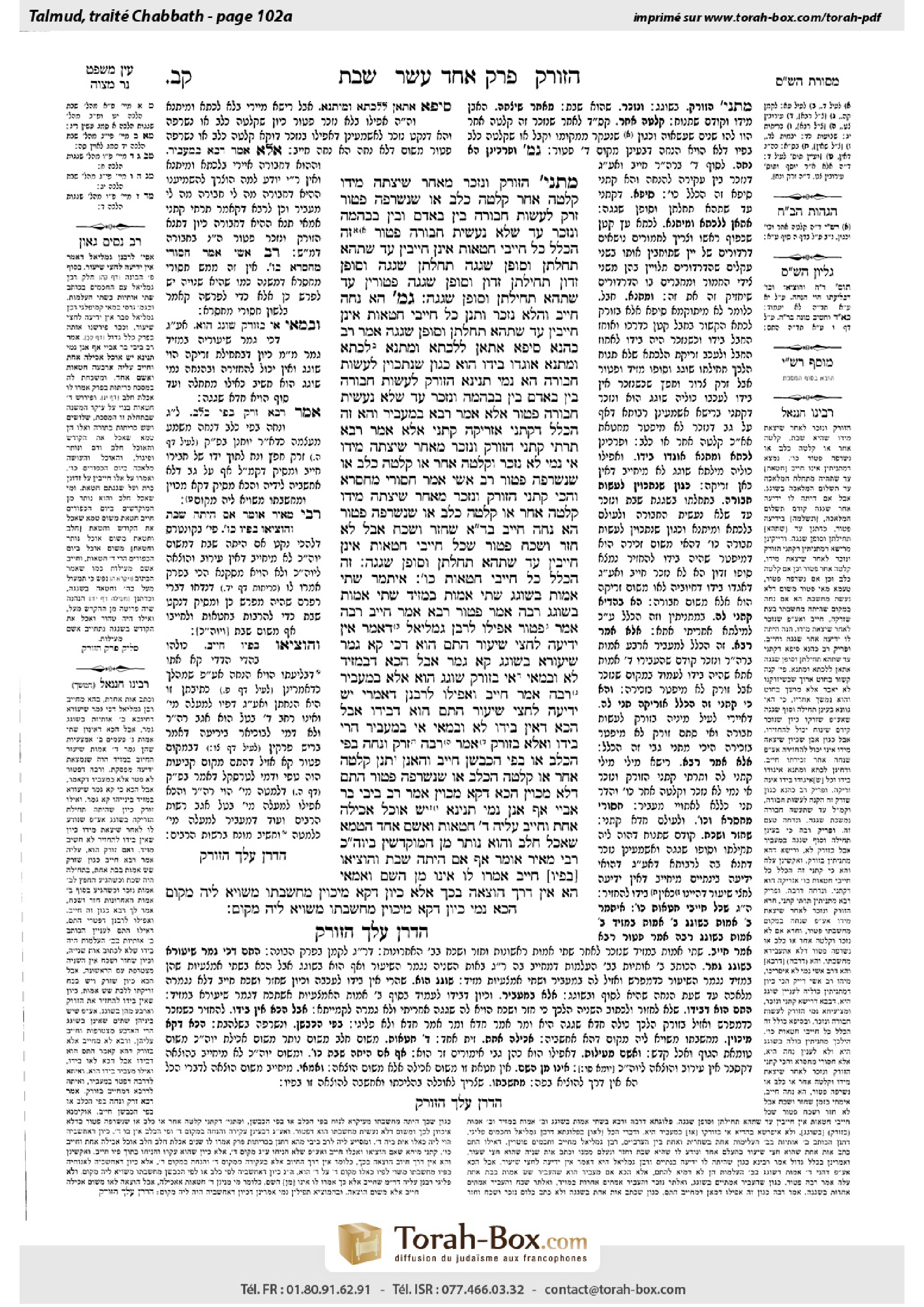
Shabbat 102a: Talmud study for Daf Yomi
Daf Yomi is the daily study of one Talmud folio. Explore 37 tractates with scans, Hebrew text, Sefaria English and AI-generated French translations where annotated.
Passage selection and English or AI-generated French translation are available where the scan has annotations. Daf Study is independent of Torah-Box and Sefaria.
Browse Shabbat · שבת · All tractatesShabbat 102a text and translations
This page of Shabbat includes the Aramaic text, an English translation and an AI-generated French translation, alongside the scan above.
שבת ק״ב א · Aramaic and Hebrew text
מַתְנִי׳ הַזּוֹרֵק, וְנִזְכַּר מֵאַחַר שֶׁיָּצְתָה מִיָּדוֹ, קְלָטָהּ אַחֵר, קְלָטָהּ כֶּלֶב אוֹ שֶׁנִּשְׂרְפָה — פָּטוּר. זָרַק לַעֲשׂוֹת חַבּוּרָה, בֵּין בְּאָדָם וּבֵין בַּבְּהֵמָה, וְנִזְכַּר עַד שֶׁלֹּא נַעֲשֵׂית חַבּוּרָה — פָּטוּר. זֶה הַכְּלָל: כׇּל חַיָּיבֵי חַטָּאוֹת — אֵינָן חַיָּיבִין עַד שֶׁתְּהֵא תְּחִלָּתָן וְסוֹפָן שְׁגָגָה. תְּחִלָּתָן שְׁגָגָה וְסוֹפָן זָדוֹן, תְּחִילָּתָן זָדוֹן וְסוֹפָן שְׁגָגָה — פְּטוּרִין, עַד שֶׁתְּהֵא תְּחִילָּתָן וְסוֹפָן שְׁגָגָה.
גְּמָ׳ הָא נָחָה — חַיָּיב? וַהֲלֹא נִזְכָּר, וּתְנַן: כׇּל חַיָּיבֵי חַטָּאוֹת אֵינָן חַיָּיבִין עַד שֶׁתְּהֵא תְּחִלָּתָן וְסוֹפָן שְׁגָגָה?! אָמַר רַב כָּהֲנָא: סֵיפָא אֲתָאן לְלַכְתָּא וּמִתְנָא.
לַכְתָּא וּמִתְנָא אוֹגְדוֹ בְּיָדוֹ הוּא! כְּגוֹן שֶׁנִּתְכַּוֵּין לַעֲשׂוֹת חַבּוּרָה. הָא נָמֵי תְּנֵינָא: הַזּוֹרֵק לַעֲשׂוֹת חַבּוּרָה, בֵּין בָּאָדָם בֵּין בַּבְּהֵמָה, וְנִזְכַּר עַד שֶׁלֹּא נַעֲשֵׂית חַבּוּרָה — פָּטוּר! אֶלָּא אָמַר רָבָא: בְּמַעֲבִיר.
וְהָא ״זֶה הַכְּלָל״ דְּקָתָנֵי, אַזְּרִיקָה קָתָנֵי. אֶלָּא אָמַר רָבָא, תַּרְתֵּי קָתָנֵי: הַזּוֹרֵק וְנִזְכַּר מֵאַחַר שֶׁיָּצְתָה מִיָּדוֹ, אִי נָמֵי לֹא נִזְכַּר וּקְלָטָהּ אַחֵר אוֹ קְלָטָהּ כֶּלֶב אוֹ שֶׁנִּשְׂרְפָה — פָּטוּר.
רַב אָשֵׁי אָמַר: חַסּוֹרֵי מְחַסְּרָא, וְהָכִי קָתָנֵי: הַזּוֹרֵק וְנִזְכַּר מֵאַחַר שֶׁיָּצְתָה מִיָּדוֹ, קְלָטָהּ אַחֵר אוֹ קְלָטָהּ כֶּלֶב אוֹ שֶׁנִּשְׂרְפָה — פָּטוּר. הָא נָחָה — חַיָּיב. בַּמֶּה דְּבָרִים אֲמוּרִים — שֶׁחָזַר וְשָׁכַח, אֲבָל לֹא חָזַר וְשָׁכַח — פָּטוּר, שֶׁכׇּל חַיָּיבֵי חַטָּאוֹת אֵינָן חַיָּיבִין עַד שֶׁתְּהֵא תְּחִלָּתָן וְסוֹפָן שְׁגָגָה.
זֶה הַכְּלָל: כׇּל חַיָּיבֵי חַטָּאוֹת כּוּ׳. אִיתְּמַר: שְׁתֵּי אַמּוֹת בְּשׁוֹגֵג, שְׁתֵּי אַמּוֹת בְּמֵזִיד, שְׁתֵּי אַמּוֹת בְּשׁוֹגֵג — רַבָּה אָמַר: פָּטוּר. רָבָא אָמַר: חַיָּיב.
רַבָּה אָמַר פָּטוּר, אֲפִילּוּ לְרַבָּן גַּמְלִיאֵל דְּאָמַר אֵין יְדִיעָה לַחֲצִי שִׁיעוּר, הָתָם הוּא דְּכִי קָא גָמַר שִׁיעוּרָא — בְּשׁוֹגֵג קָא גָמַר, אֲבָל הָכָא דִּבְמֵזִיד — לָא.
וּבְמַאי? אִי בְּזוֹרֵק — שׁוֹגֵג הוּא! אֶלָּא בְּמַעֲבִיר.
רָבָא אָמַר חַיָּיב, וַאֲפִילּוּ לְרַבָּנַן דְאָמְרִי יֵשׁ יְדִיעָה לַחֲצִי שִׁיעוּר, הָתָם הוּא דִּבְיָדוֹ, אֲבָל הָכָא דְּאֵין בְּיָדוֹ — לָא. וּבְמַאי? אִי בְּמַעֲבִיר — הֲרֵי בְּיָדוֹ! וְאֶלָּא בְּזוֹרֵק.
אָמַר רַבָּה: זָרַק וְנָחָה בְּפִי הַכֶּלֶב אוֹ בְּפִי הַכִּבְשָׁן — חַיָּיב. וְהָאֲנַן תְּנַן: קְלָטָהּ אַחֵר אוֹ קְלָטָהּ הַכֶּלֶב אוֹ שֶׁנִּשְׂרְפָה — פָּטוּר! הָתָם דְּלָא מְכַוֵּין, הָכָא דְּקָא מְכַוֵּין.
אָמַר רַב בִּיבִי בַּר אַבָּיֵי, אַף אֲנַן נָמֵי תְּנֵינָא: יֵשׁ אוֹכֵל אֲכִילָה אַחַת וְחַיָּיב עָלֶיהָ אַרְבַּע חַטָּאוֹת וְאָשָׁם אֶחָד. הַטָּמֵא שֶׁאָכַל חֵלֶב, וְהוּא נוֹתָר מִן הַמּוּקְדָּשִׁין, בְּיוֹם הַכִּפּוּרִים.
רַבִּי מֵאִיר אוֹמֵר: אַף אִם הָיְתָה שַׁבָּת וְהוֹצִיאוֹ [בְּפִיו] — חַיָּיב. אָמְרוּ לוֹ: אֵינוֹ מִן הַשֵּׁם. וְאַמַּאי? הָא אֵין דֶּרֶךְ הוֹצָאָה בְּכָךְ! אֶלָּא: כֵּיוָן דְּקָא מִיכַּוֵּין — מַחְשַׁבְתּוֹ מְשַׁוְּיָא לֵיהּ מָקוֹם. הָכָא נָמֵי, כֵּיוָן דְּקָא מִיכַּוֵּין — מַחְשַׁבְתּוֹ מְשַׁוְּיָא לֵיהּ מָקוֹם.
הדרן עלך הזורק
Shabbat 102a · English translation
MISHNA: One who unwittingly throws an object from one domain to another or one who throws an object four cubits within the public domain, and after the object left his hand he remembered that he is in violation of a prohibition, if another caught it, or if a dog caught it, or if it was burned, he is exempt. Similarly, if one threw a rock on Shabbat to inflict a wound on a person or on an animal, for which one is liable to bring a sin-offering, and he remembered that he was in violation of a prohibition before the wound was inflicted, he is exempt. This is the principle: All who are liable to bring sin-offerings are only liable if the beginning of their action and the conclusion of their action are unwitting. However, if the beginning of one’s action was unwitting and the conclusion was intentional, as he became aware that he was in violation of a prohibition, or if the beginning of one’s action was intentional and the conclusion was unwitting, the individuals in both of these cases are exempt until both the beginning and the conclusion are unwitting.
GEMARA: We learned in the mishna that if one throws an object unwittingly and then remembers that he was in violation of a prohibition, he is exempt if the object did not come to rest on the ground. The Gemara infers: If the object comes to rest, he is liable. The Gemara asks: Why is he liable? Didn’t he remember the prohibition before it landed, and we learned in the mishna: All who are liable to bring sin-offerings are only liable if the beginning of their action and the conclusion of their action will be unwitting? If one remembered before the act was complete, he should be exempt. Rav Kahana said: With regard to the latter clause of the mishna, we have come to a special case of a bolt and a cord. The bolt is connected to a cord that one holds in his hand, which renders him capable of retrieving the bolt before it lands. Therefore, in a case where the beginning was unwitting and the conclusion was intentional, one is exempt because he is still capable of changing the outcome of the action. However, in the first clause of the mishna, once the object left his hand the action is irreversible, and therefore it is an action whose beginning and conclusion are unwitting.
The Gemara asks: The case of the bolt and the cord is one where one holds it in his hand. Therefore, no act of throwing actually took place, and there is no liability to bring a sin-offering. The Gemara answers: The case of the bolt and the cord was not stated with regard to Shabbat. Rather, it was stated with regard to one who intended to inflict a wound by throwing an object tied to a rope. The Gemara asks: This was also taught explicitly in the mishna: If one threw a rock on Shabbat to inflict a wound on a person or on an animal, and he remembered before the wound was inflicted, he is exempt. Rather, Rava said: This principle was stated with regard to a case of carrying, not throwing an object. Since one is holding the object the entire time while violating the prohibition, and is capable of letting it go at any time, this is a case whose beginning and conclusion are intentional.
The Gemara asks: Wasn’t this principle that was taught, taught with regard to throwing because that is the topic of the mishna? Rather, Rava said: Two separate matters were taught in the mishna. The first case is: One who unwittingly throws an object, and after the object left his hand he remembered that he was in violation of a prohibition. Alternatively, another case where one is exempt is: A case where one did not remember and another caught it, or a dog caught it, or if it was burned, he is exempt.
Rav Ashi said: The mishna is incomplete, and it teaches the following: One who throws a rock and remembers the violation after it left his hand, if another caught it, or if a dog caught it, or if it was burned, he is exempt. By inference, if the object comes to rest, he is liable. Rav Ashi adds: In what case are these matters stated? In a case where one then forgot again before the object came to rest. However, if one did not then forget again, he is exempt because all who are liable to bring sin-offerings are liable only if the beginning of their action and the conclusion of their action are unwitting.
We learned in the mishna that this is the principle: All who are liable to bring sin-offerings are only liable if the beginning of their action and the conclusion of their action are unwitting. It was stated that amora’im disputed this point. With regard to a case where one carried an object in the public domain two cubits unwittingly, and then became aware and carried it two more cubits intentionally, and then carried it two additional cubits unwittingly, and then placed the object, can this be characterized as a case in which the beginning of the action and the conclusion of the action are unwitting? Rabba said: One is exempt. Rava said: One is liable.
The Gemara clarifies the two positions. Rabba said: One is exempt. This is the halakha even according to Rabban Gamliel, who said: There is no awareness for half a measure, and therefore he is liable. Since one is not liable to bring a sacrifice for a half-measure, the fact that he became aware between consumption of the two halves of an olive-bulk is of no significance. One’s awareness does not demarcate between the two half-measures of two cubits with regard to liability to bring a sin-offering. He only said so there, when the measure that determines liability was completed, it was completed unwittingly. However, here, when the measure is completed, it is completed intentionally. In that case, he would say no, he is not liable. The measure that determines liability for carrying in the public domain on Shabbat is four cubits. When the object reached four cubits, he was carrying the object intentionally.
The Gemara explains: And in what case was this stated? If it was stated with regard to a case of throwing, the entire act was unwitting because when he became aware, there was nothing he could do to prevent the object from landing. Rather, it must have been with regard to a case of carrying.
Rava said: One is liable. Even according to the Rabbis, who said: There is awareness for half a measure, and therefore he is exempt, they only said so there, where it is still in his control to complete or terminate the action. But here, where it is not in his control to affect the outcome, they would not say so and would deem him liable. And in what case was this stated? If it was stated with regard to a case of carrying, the outcome is still in his control. Rather, it must have been with regard to a case of throwing. Apparently, Rabba and Rava do not disagree. They are discussing separate cases.
Rabba said: If one unwittingly threw an object from one domain to another or unwittingly threw an object four cubits in a public domain on Shabbat, and it came to rest in the mouth of a dog or in a furnace, he is liable. The Gemara asks: Didn’t we learn in the mishna: If another caught it, or if a dog caught it, or if it was burned, he is exempt? The Gemara answers: There, the case of the mishna where one is exempt, one did not intend to throw it into the dog’s mouth. A dog came and snatched the object, preventing it from landing at its intended destination. Since the intention of the thrower was not realized, he is exempt. However, here, where Rabba said that the thrower is liable, he intended to throw the object into the dog’s mouth. He is liable because his intention was realized.
Rav Beivai bar Abaye said: We also learned support for that distinction in a mishna: There is a person who performs a single act of eating an olive-bulk of food, and he is liable to bring four sin-offerings and one guilt-offering. How so? This halakha applies to one who is ritually impure who ate forbidden fat that was notar from a consecrated offering, i.e., it remained after the time when it may have been eaten expired, and this happened on Yom Kippur. The person who did this is liable to bring one sin-offering for eating consecrated food while impure, one for eating forbidden fat, one for eating notar, and one for eating on Yom Kippur. He is also liable to bring a guilt-offering for misuse of consecrated items.
Rabbi Meir says: There is one more sin-offering for which he may be liable. In addition, if it was Shabbat and he carried this olive-bulk of food from one domain to another in his mouth, he is liable for carrying out on Shabbat. The Rabbis said to Rabbi Meir: Liability for the sin-offering that you added is not incurred from violation of the same type of prohibition. He is liable for carrying out the food, not for eating it. However, fundamentally, the Rabbis agree that one would be liable for carrying out in that case. The Gemara asks: And why would one be liable? That carrying, which was done in one’s mouth, is not the typical manner of carrying out. Rather, it must be that since he intended to carry out the object in that manner, his thought renders his mouth a suitable place for placement of an object. Here, too, since he intends to throw the object into the dog’s mouth, his thought renders the dog’s mouth a suitable place for placement of an object, and he is liable for throwing it there.
Shabbat 102a · Traduction française (IA)
MICHNA : Celui qui lance par inadvertance un objet d’un domaine à un autre, ou qui lance un objet à quatre coudées dans le domaine public, puis se souvient, après que l’objet a quitté sa main, qu’il transgresse une interdiction, est quitte si quelqu’un d’autre l’attrape, si un chien l’attrape ou si l’objet est brûlé. De même, si quelqu’un lance un caillou pendant Chabbat pour blesser une personne ou un animal — acte qui l’oblige à apporter un sacrifice expiatoire — et qu’il se souvient qu’il transgresse une interdiction avant que la blessure ne soit infligée, il est quitte. Voici le principe : ceux qui sont tenus d’apporter un sacrifice expiatoire ne le sont que si le début et la fin de leur action sont tous deux accomplis par inadvertance. En revanche, si le début de l’action a été accompli par inadvertance et la fin intentionnellement, parce que la personne a pris conscience qu’elle transgressait une interdiction, ou si le début de l’action a été intentionnel et la fin accomplie par inadvertance, les personnes concernées par ces deux cas sont quittes, jusqu’à ce que le début et la fin soient tous deux accomplis par inadvertance.
GUEMARA : Nous avons appris dans la Michna que si quelqu’un lance un objet par inadvertance, puis se souvient qu’il transgresse une interdiction, il est quitte si l’objet ne se pose pas à terre. La Guemara en déduit que s’il se pose, il est tenu responsable. La Guemara demande : Pourquoi est-il tenu responsable ? Ne s’est-il pas souvenu de l’interdiction avant que l’objet n’atterrisse ? Or, nous avons appris dans la Michna : ceux qui sont tenus d’apporter un sacrifice expiatoire ne le sont que si le début et la fin de leur action sont tous deux accomplis par inadvertance. S’il s’en est souvenu avant que l’acte ne soit achevé, il devrait être quitte. Rav Kahana dit : Dans le dernier membre de phrase de la Michna, il s’agit du cas particulier d’un verrou et d’une corde. Le verrou est attaché à une corde que l’on tient à la main, ce qui permet de le retenir avant qu’il ne tombe. Par conséquent, lorsque le début de l’action a été accompli par inadvertance et la fin intentionnellement, on est quitte, car on peut encore modifier l’issue de l’action. Toutefois, dans le premier membre de phrase de la Michna, dès que l’objet a quitté sa main, l’action est irréversible ; le début et la fin de l’action sont donc accomplis par inadvertance.
La Guemara demande : Dans le cas du verrou et de la corde, on tient la corde à la main. Ainsi, aucun acte de lancer n’a réellement eu lieu et il n’y a pas lieu d’apporter un sacrifice expiatoire. La Guemara répond : Le cas du verrou et de la corde n’a pas été mentionné à propos de Chabbat. Il concerne plutôt quelqu’un qui voulait infliger une blessure en lançant un objet attaché à une corde. La Guemara demande : Ce cas n’a-t-il pas également été enseigné explicitement dans la Michna : si quelqu’un lance un caillou pendant Chabbat pour blesser une personne ou un animal et qu’il se souvient avant que la blessure ne soit infligée, il est quitte ? Rava dit plutôt : Ce principe a été énoncé à propos d’un cas de transport, et non du lancer d’un objet. Puisqu’on tient l’objet tout le temps pendant qu’on transgresse l’interdiction et qu’on peut le lâcher à tout moment, le début et la fin de l’action sont intentionnels.
La Guemara demande : Ce principe n’a-t-il pas été enseigné à propos du lancer, puisque c’est le sujet de la Michna ? Rava dit plutôt : Deux cas distincts ont été enseignés dans la Michna. Le premier est celui de quelqu’un qui lance un objet par inadvertance et qui, après que l’objet a quitté sa main, se souvient qu’il transgresse une interdiction. L’autre cas où l’on est quitte est celui où la personne ne s’en souvient pas, mais que quelqu’un d’autre attrape l’objet, qu’un chien l’attrape ou que l’objet soit brûlé.
Rav Ashi dit : La Michna est incomplète et enseigne ce qui suit : celui qui lance un caillou et se souvient de la transgression après que le caillou a quitté sa main est quitte si quelqu’un d’autre l’attrape, si un chien l’attrape ou si le caillou est brûlé. On en déduit que si l’objet se pose, il est tenu responsable. Rav Ashi ajoute : Dans quel cas ces propos ont-ils été énoncés ? Dans le cas où la personne a de nouveau oublié avant que l’objet ne se pose. En revanche, si elle n’a pas oublié de nouveau, elle est quitte, car ceux qui sont tenus d’apporter un sacrifice expiatoire ne le sont que si le début et la fin de leur action sont tous deux accomplis par inadvertance.
Nous avons appris dans la Michna que voici le principe : ceux qui sont tenus d’apporter un sacrifice expiatoire ne le sont que si le début et la fin de leur action sont tous deux accomplis par inadvertance. Les amoraïm sont en désaccord sur ce point. Si quelqu’un transporte un objet sur deux coudées dans le domaine public par inadvertance, puis prend conscience de son acte et le transporte encore sur deux coudées intentionnellement, puis le transporte sur deux coudées supplémentaires par inadvertance et enfin le dépose, peut-on considérer que le début et la fin de l’action ont été accomplis par inadvertance ? Rabba dit : Il est quitte. Rava dit : Il est tenu responsable.
La Guemara précise les deux positions. Rabba dit : Il est quitte. C’est la halakha même selon Rabban Gamliel, qui dit qu’il n’y a pas de prise de conscience pour une demi-mesure ; l’homme est donc tenu responsable. Puisqu’on n’est pas tenu d’apporter un sacrifice pour une demi-mesure, le fait qu’il ait pris conscience de son acte entre la consommation des deux moitiés d’un volume d’olive n’a aucune importance. Sa prise de conscience ne sépare pas les deux demi-mesures de deux coudées en ce qui concerne l’obligation d’apporter un sacrifice expiatoire. Rabban Gamliel n’a dit cela que dans le cas où la mesure déterminant l’obligation a été atteinte par inadvertance. Ici, en revanche, lorsque la mesure est atteinte, elle l’est intentionnellement. Dans ce cas, il dirait que l’homme n’est pas tenu responsable. La mesure qui détermine l’obligation pour le transport dans le domaine public pendant Chabbat est de quatre coudées. Lorsque l’objet a parcouru quatre coudées, il le transportait intentionnellement.
La Guemara explique : Dans quel cas cela a-t-il été dit ? Si cela concernait un cas de lancer, toute l’action aurait été accomplie par inadvertance, car, lorsqu’il a pris conscience de son acte, il ne pouvait rien faire pour empêcher l’objet d’atterrir. Il faut donc que cela concerne un cas de transport.
Rava dit : Il est tenu responsable. Même les Rabbins, qui disent qu’il y a prise de conscience pour une demi-mesure et qu’il est donc quitte, ne l’ont dit que dans le cas où la personne peut encore décider d’achever ou d’interrompre l’action. Ici, en revanche, puisqu’elle ne peut pas influer sur l’issue de l’action, ils ne diraient pas cela et la considéreraient comme tenue responsable. Dans quel cas cela a-t-il été dit ? Si cela concernait un cas de transport, l’issue serait encore sous son contrôle. Il faut donc que cela concerne un cas de lancer. Apparemment, Rabba et Rava ne sont pas en désaccord : ils parlent de cas distincts.
Rabba dit : Si quelqu’un lance par inadvertance un objet d’un domaine à un autre, ou lance par inadvertance un objet à quatre coudées dans le domaine public pendant Chabbat, et que l’objet se pose dans la gueule d’un chien ou dans un four, il est tenu responsable. La Guemara demande : N’avons-nous pas appris dans la Michna que si quelqu’un d’autre attrape l’objet, si un chien l’attrape ou si l’objet est brûlé, il est quitte ? La Guemara répond : Dans le cas de la Michna où la personne est quitte, elle n’avait pas l’intention de lancer l’objet dans la gueule du chien. Un chien est venu et l’a happé, l’empêchant d’atterrir à la destination prévue. Puisque l’intention de celui qui a lancé l’objet ne s’est pas réalisée, il est quitte. Ici, en revanche, dans le cas où Rabba dit que celui qui a lancé l’objet est tenu responsable, il avait l’intention de le lancer dans la gueule du chien. Il est tenu responsable parce que son intention s’est réalisée.
Rav Beivai bar Abaye dit : Nous avons également trouvé dans une Michna un appui à cette distinction : quelqu’un peut manger une quantité équivalant à un volume d’olive en un seul acte et être tenu d’apporter quatre sacrifices expiatoires et un sacrifice de culpabilité. Comment cela ? Cette halakha s’applique à une personne rituellement impure qui a mangé du suif interdit provenant d’une offrande consacrée et devenu notar, c’est-à-dire qu’il en restait après l’expiration du délai pendant lequel il pouvait être consommé ; de plus, cela a eu lieu pendant Yom Kippour. Cette personne est tenue d’apporter un sacrifice expiatoire pour avoir mangé de la nourriture consacrée alors qu’elle était impure, un pour avoir mangé du suif interdit, un pour avoir mangé du notar et un pour avoir mangé pendant Yom Kippour. Elle est également tenue d’apporter un sacrifice de culpabilité pour avoir fait un usage profane d’objets consacrés.
Rabbi Meïr dit : Il y a encore un sacrifice expiatoire supplémentaire dont cette personne peut être redevable. De plus, si c’était Chabbat et qu’elle a transporté ce volume d’olive de nourriture d’un domaine à un autre dans sa bouche, elle est tenue responsable d’avoir transporté un objet pendant Chabbat. Les Rabbins dirent à Rabbi Meïr : l’obligation relative au sacrifice expiatoire que tu as ajouté ne résulte pas de la transgression d’une interdiction du même type. La personne est tenue responsable d’avoir transporté la nourriture, et non de l’avoir mangée. Toutefois, sur le fond, les Rabbins reconnaissent que, dans ce cas, elle serait tenue responsable du transport. La Guemara demande : Pourquoi serait-elle tenue responsable ? Transporter ainsi dans la bouche n’est pas une manière habituelle de transporter. Il faut plutôt dire que, puisqu’elle avait l’intention de transporter l’objet de cette manière, sa pensée fait de sa bouche un lieu approprié pour y déposer un objet. Ici aussi, puisqu’il a l’intention de lancer l’objet dans la gueule du chien, sa pensée fait de la gueule du chien un lieu approprié pour y déposer un objet ; il est donc tenu responsable de l’y avoir lancé.
Traduction française générée par IA à partir de l’édition anglaise de Sefaria. Vérifie toujours un passage avec le texte source.
Text from Sefaria: William Davidson Edition - Vocalized Aramaic (CC BY NC); William Davidson Edition - English (CC BY NC).