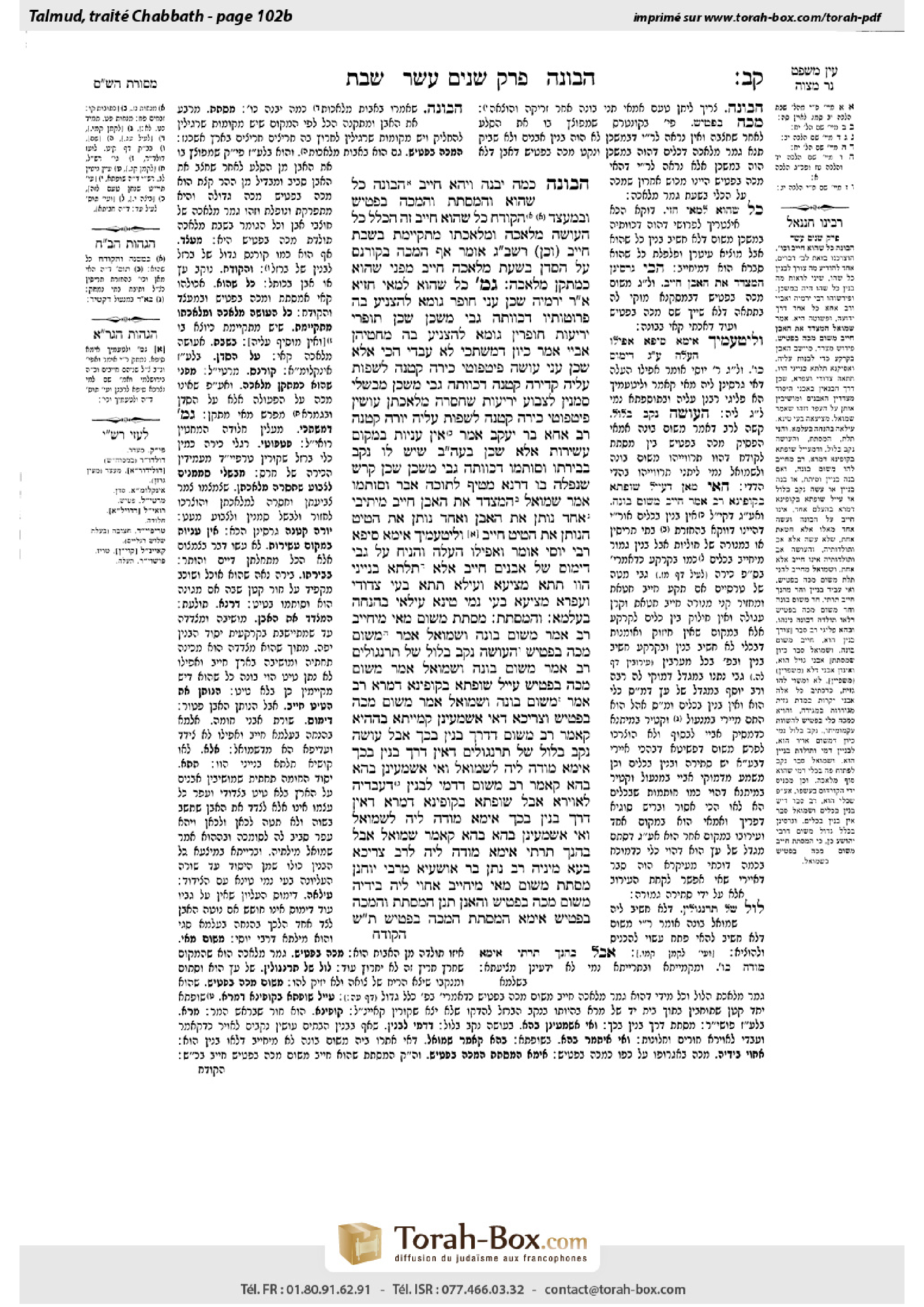
Shabbat 102b: Talmud study for Daf Yomi
Daf Yomi is the daily study of one Talmud folio. Explore 37 tractates with scans, Hebrew text, Sefaria English and AI-generated French translations where annotated.
Passage selection and English or AI-generated French translation are available where the scan has annotations. Daf Study is independent of Torah-Box and Sefaria.
Browse Shabbat · שבת · All tractatesShabbat 102b text and translations
This page of Shabbat includes the Aramaic text, an English translation and an AI-generated French translation, alongside the scan above.
שבת ק״ב ב · Aramaic and Hebrew text
מַתְנִי׳ הַבּוֹנֶה, כַּמָּה יִבְנֶה וִיהֵא חַיָּיב? הַבּוֹנֶה כׇּל שֶׁהוּא, וְהַמְסַתֵּת וְהַמַּכֶּה בַּפַּטִּישׁ וּבְמַעֲצָד, הַקּוֹדֵחַ כׇּל שֶׁהוּא — חַיָּיב. זֶה הַכְּלָל: כׇּל הָעוֹשֶׂה מְלָאכָה, וּמְלַאכְתּוֹ מִתְקַיֶּימֶת בַּשַּׁבָּת — חַיָּיב. וְכֵן רַבָּן שִׁמְעוֹן בֶּן גַּמְלִיאֵל אוֹמֵר: אַף הַמַּכֶּה בְּקוּרְנָס עַל הַסַּדָּן בִּשְׁעַת מְלָאכָה — חַיָּיב, מִפְּנֵי שֶׁהוּא כִּמְתַקֵּן מְלָאכָה.
גְּמָ׳ כׇּל שֶׁהוּא לְמַאי חַזְיָא? אָמַר רַבִּי יִרְמְיָה: שֶׁכֵּן עָנִי חוֹפֵר גּוּמָּא לְהַצְנִיעַ בָּהּ פְּרוּטוֹתָיו. דִּכְווֹתַהּ גַּבֵּי מִשְׁכָּן, שֶׁכֵּן תּוֹפְרֵי יְרִיעוֹת חוֹפְרִין גּוּמָּא לְהַצְנִיעַ בָּהּ מַחֲטֵיהֶן. אַבָּיֵי אָמַר: כֵּיוָן דְּמִשַּׁתְּכִי לָא עָבְדִי הָכִי. אֶלָּא, שֶׁכֵּן עָנִי עוֹשֶׂה פִּיטְפּוּטֵי כִּירָה קְטַנָּה לִשְׁפּוֹת עָלֶיהָ קְדֵירָה קְטַנָּה. דִּכְווֹתַהּ גַּבֵּי מִשְׁכָּן, מְבַשְּׁלֵי סַמָּנִין לִצְבּוֹעַ יְרִיעוֹת שֶׁחָסְרָה מְלַאכְתָּן, עוֹשִׂין פִּיטְפּוּטֵי כִּירָה קְטַנָּה לִשְׁפּוֹת עָלֶיהָ יוֹרָה קְטַנָּה.
רַב אַחָא בַּר יַעֲקֹב אָמַר: אֵין עֲנִיּוּת בִּמְקוֹם עֲשִׁירוּת. אֶלָּא, שֶׁכֵּן בַּעַל הַבַּיִת שֶׁיֵּשׁ לוֹ נֶקֶב בְּבִירָתוֹ וְסוֹתְמוֹ, דִּכְווֹתַהּ גַּבֵּי מִשְׁכָּן, שֶׁכֵּן קֶרֶשׁ שֶׁנָּפְלָה בּוֹ דַּרְנָא — מַטִּיף לְתוֹכָהּ אֲבָר וְסוֹתְמוֹ.
אָמַר שְׁמוּאֵל: הַמְצַדֵּד אֶת הָאֶבֶן — חַיָּיב. מֵיתִיבִי, אֶחָד נוֹתֵן אֶת הָאֶבֶן וְאֶחָד נוֹתֵן אֶת הַטִּיט — הַנּוֹתֵן אֶת הַטִּיט חַיָּיב!
וְלִיטַעְמָיךְ, אֵימָא סֵיפָא, רַבִּי יוֹסֵי אוֹמֵר: וַאֲפִילּוּ הֶעֱלָה וְהִנִּיחַ עַל גַּבֵּי דִּימוֹס שֶׁל אֲבָנִים — חַיָּיב! אֶלָּא תְּלָתָא בִּנְיָינֵי הָווּ: תַּתָּא, מְצִיעָאָה, וְעִילָּאָה. תַּתָּא בָּעֵי צַדּוֹדֵי וְעַפְרָא. מְצִיעָא בָּעֵי נָמֵי טִינָא. עִילָּאָה בְּהַנָּחָה בְּעָלְמָא.
וְהַמְסַתֵּת. מְסַתֵּת מִשּׁוּם מַאי מִיחַיַּיב? רַב אָמַר: מִשּׁוּם בּוֹנֶה, וּשְׁמוּאֵל אָמַר: מִשּׁוּם מַכֶּה בַּפַּטִּישׁ. הָעוֹשֶׂה נֶקֶב בְּלוּל שֶׁל תַּרְנְגוֹלִים, רַב אָמַר: מִשּׁוּם בּוֹנֶה, וּשְׁמוּאֵל אָמַר: מִשּׁוּם מַכֶּה בַּפַּטִּישׁ. עַיֵּיל שׁוּפְתָּא בְּקוֹפִינָא דְמָרָא, רַב אָמַר: מִשּׁוּם בּוֹנֶה, וּשְׁמוּאֵל אָמַר: מִשּׁוּם מַכֶּה בַּפַּטִּישׁ.
וּצְרִיכָא, דְּאִי אַשְׁמְעִינַן קַמַּיְיתָא — בְּהַהִיא קָאָמַר רַב, מִשּׁוּם דְּדֶרֶךְ בִּנְיָן בְּכָךְ. אֲבָל עוֹשֶׂה נֶקֶב בְּלוּל שֶׁל תַּרְנְגוֹלִים, דְּאֵין דֶּרֶךְ בִּנְיָן בְּכָךְ — אֵימָא מוֹדֶה לֵיהּ לִשְׁמוּאֵל. וְאִי אַשְׁמְעִינַן בְּהָא — בְּהָא קָאָמַר רַב, מִשּׁוּם דְּדָמֵי לְבִנְיָן, דְּעַבְדֵיהּ לְאַוֵּירָא,
אֲבָל שׁוּפְתָּא בְּקוֹפִינָא דְמָרָא דְּאֵין דֶּרֶךְ בִּנְיָן בְּכָךְ — אֵימָא מוֹדֶה לֵיהּ לִשְׁמוּאֵל. וְאִי אַשְׁמְעִינַן בְּהָא, בְּהָא קָאָמַר שְׁמוּאֵל, אֲבָל בְּהָנָךְ תַּרְתֵּי — אֵימָא מוֹדֶה לֵיהּ לְרַב, צְרִיכָא.
בְּעָא מִינֵּיהּ רַב נָתָן בַּר אוֹשַׁעְיָא מֵרַבִּי יוֹחָנָן: מְסַתֵּת מִשּׁוּם מַאי מִיחַיַּיב? אַחְוִי לֵיהּ בִּידֵיהּ מִשּׁוּם מַכֶּה בַּפַּטִּישׁ. וְהָאֲנַן תְּנַן: הַמְסַתֵּת וְהַמַּכֶּה בַּפַּטִּישׁ! אֵימָא: הַמְסַתֵּת הַמַּכֶּה בַּפַּטִּישׁ.
תָּא שְׁמַע:
Shabbat 102b · English translation
MISHNA: With regard to one who builds on Shabbat, thereby violating a prohibition in a primary category of prohibited labor, how much must he build to be liable to bring a sin-offering? The Sages said: One who builds is liable for building any amount. And one who chisels, or strikes with a hammer or with an adze, or one who drills a hole of any size on Shabbat, is liable. This is the principle: Anyone who performs a prohibited labor and his labor endures on Shabbat is liable. And so too, Rabban Shimon ben Gamliel says: Even one who strikes an anvil with a sledgehammer during his labor has performed a constructive act and is liable, because he is as one who improves the labor that he is performing.
GEMARA: The Gemara asks: With regard to any small amount of building, for what use is it suited? Rabbi Yirmeya said: As a poor person digs a hole in the floor of his house in which to hide his coins. Digging a hole in the floor of a house is an act of building. The corresponding situation in the Tabernacle was as those who sewed curtains in the Tabernacle dug holes in which to hide their needles. Abaye said: Since needles rust in the ground, they did not do so. The Gemara seeks a different example of small-scale building that is significant. Rather, an example is that a poor person makes legs for a small stove to place a small pot on it. The corresponding situation in the Tabernacle was with regard to those who cooked herbs used to dye curtains, whose dyeing process was lacking a small amount for completion. At that point, it was not worth the effort to cook a large quantity of dye, and so they would make legs for a small stove upon which to place a small cauldron to cook a small bit of dye to finish the job.
Rav Aḥa bar Ya’akov said: There is no poverty in a place of wealth. In the Tabernacle, as in any public project, actions are not performed on a small scale or in parsimonious quantities; they were performed generously. Those who cooked dyes in the Tabernacle had no use for small crucibles. Rather, an example of significant small-scale building is a homeowner who has a small hole in his house and seals it. The corresponding situation in the Tabernacle was with regard to a beam that was set upon by a worm that bore a hole into it; one pours lead into the hole and seals it.
Shmuel said: If one sets a stone in place on Shabbat, i.e., he takes a building stone and fixes it in place on the ground on Shabbat, he is liable for performing the prohibited labor of building. The Gemara raises an objection to this from that which the Sages taught with regard to building on Shabbat. In a case where one puts down a stone and another one places the mortar, the one who places the mortar is liable for building. Apparently, the prohibition of building is only violated when mortar is added. Merely setting a stone in place is not enough to establish liability.
The Gemara answers: And according to your line of reasoning, say the latter clause of that mishna where we learn that Rabbi Yosei says: And even if one lifted the stone and placed it on a top row of stones [dimos], he is liable even without securing it with mortar. Rather, apparently, there are three different kinds of building: Bottom row, middle row, and upper row. The bottom row requires setting the stones in place and dirt to hold it in place. The middle row requires mortar as well. The upper row suffices with mere placement.
We learned in the mishna: One who chisels any amount is liable. The Gemara asks: With regard to one who chisels, for which primary category of prohibited labor is he liable? Rav said: He is liable due to the prohibited labor of building. And Shmuel said: He is liable due to the prohibited labor of striking a blow with a hammer to complete the production process of a vessel. They similarly disagreed with regard to one who makes a hole in a chicken coop. Rav said: He is liable due to the prohibited labor of building. And Shmuel said: He is liable due to the prohibited labor of striking a blow with a hammer. And similarly, with regard to one who inserts a pin into the handle of a hoe in order to secure the handle, Rav said: He is liable due to the prohibited labor of building. And Shmuel said: He is liable due to the prohibited labor of striking a blow with a hammer.
The Gemara comments: It is necessary for the Gemara to teach us that Rav and Shmuel disagreed in each of these cases because one could not be inferred from the other. As, had the Gemara told us only the first case of chiseling, I would have said that it is specifically in that case that Rav said one is liable for building because it is a typical manner of building; however, with regard to one who makes a hole in a chicken coop, which is not a typical manner of building, say that Rav agrees with Shmuel that this is not subsumed under the rubric of the prohibited labor of building. And had the Gemara told us only about this case of making a hole in a chicken coop, I would have said that it is specifically in that case that Rav said one is liable for building, because it is similar to building, as people do so for ventilation in a chicken coop, just as they place windows in buildings.
However, inserting a pin into the handle of a hoe, which is not a typical manner of building, say that Rav agrees with Shmuel that it is not subsumed under the rubric of the prohibited labor of building. Conversely, had the Gemara told us only about this case of inserting a pin into the handle of a hoe, I would have said that it is only in that case that Shmuel said that the action is not subsumed under the rubric of the prohibited labor of building; however, with regard to these other two cases of chiseling and making a hole in the coop, say that Shmuel agrees with Rav that they are subsumed under the rubric of the prohibited labor of building. Therefore, it was necessary to cite all three disputes.
Rav Natan bar Oshaya raised a dilemma before Rabbi Yoḥanan: With regard to one who chisels, for which primary category of prohibited labor is he liable? He indicated with his hand that he is liable for striking a blow with a hammer. The Gemara asks: Didn’t we learn in the mishna: One who chisels and one who strikes a blow with a hammer, indicating that they are two different prohibitions? The Gemara answers: Emend this and say: One who chisels is liable due to the prohibition of striking a blow with a hammer.
Come and hear a proof that will resolve this dilemma from that which we learned:
Shabbat 102b · Traduction française (IA)
MICHNA : Celui qui construit pendant Chabbat, transgressant ainsi une interdiction relevant d’une catégorie principale de travaux interdits, doit construire quelle quantité pour être tenu d’apporter un sacrifice expiatoire ? Les Sages ont dit : celui qui construit est passible même pour une quantité quelconque. Celui qui taille, frappe avec un marteau ou une herminette, ou perce un trou, quelle qu’en soit la taille, pendant Chabbat, est passible. Voici le principe : quiconque accomplit un travail interdit dont le résultat subsiste pendant Chabbat est passible. Rabban Chimon ben Gamliel dit lui aussi : même celui qui frappe une enclume avec une masse au cours de son travail a accompli un acte constructif et est passible, car il améliore ainsi le travail qu’il effectue.
GUEMARA : La Guemara demande : À quoi peut servir une construction d’aussi petite dimension ? Rabbi Yirmeya dit : à creuser un trou dans le sol de sa maison pour y cacher ses pièces, comme le fait un pauvre. Creuser un trou dans le sol d’une maison est un acte de construction. Dans le Michkan, la situation correspondante était celle des personnes qui cousaient les tentures et creusaient des trous pour y cacher leurs aiguilles. Abayé dit : les aiguilles rouillent dans la terre, donc ils ne faisaient pas cela. La Guemara cherche un autre exemple de construction à petite échelle qui soit significatif. Elle propose plutôt le cas d’un pauvre qui fabrique des pieds pour un petit fourneau afin d’y poser une petite marmite. Dans le Michkan, la situation correspondante était celle des personnes qui faisaient cuire les herbes servant à teindre les tentures, alors qu’il ne manquait qu’une petite quantité de teinture pour achever le processus. À ce stade, cela ne valait pas la peine de faire cuire une grande quantité de teinture ; elles fabriquaient donc des pieds pour un petit fourneau, sur lequel elles posaient un petit chaudron afin d’y faire cuire une petite quantité de teinture et de terminer le travail.
Rav Aḥa bar Ya’akov dit : il n’y a pas de pauvreté dans un lieu de richesse. Dans le Michkan, comme dans tout projet public, on n’accomplissait pas les travaux à petite échelle ni en quantités parcimonieuses ; on procédait généreusement. Ceux qui faisaient cuire les teintures dans le Michkan n’avaient pas besoin de petits creusets. Il faut plutôt prendre l’exemple d’un propriétaire qui a un petit trou dans sa maison et le colmate. Dans le Michkan, la situation correspondante était celle d’une poutre attaquée par un ver qui y avait creusé un trou ; on versait du plomb dans le trou pour le boucher.
Chmouel dit : si quelqu’un met une pierre en place pendant Chabbat, c’est-à-dire s’il prend une pierre de construction et la fixe au sol pendant Chabbat, il est passible pour avoir accompli le travail interdit de construire. La Guemara soulève une objection à partir de ce que les Sages ont enseigné au sujet de la construction pendant Chabbat : si l’un pose une pierre et un autre applique le mortier, celui qui applique le mortier est passible pour avoir construit. Il semble donc que l’interdiction de construire ne soit transgressée que lorsqu’on ajoute du mortier. Le simple fait de mettre une pierre en place ne suffit pas à rendre passible.
La Guemara répond : selon ton raisonnement, examine la dernière clause de cette Michna, où nous apprenons que Rabbi Yossé dit : même si quelqu’un soulève la pierre et la pose sur une rangée supérieure de pierres [dimos], il est passible, même sans la fixer avec du mortier. Il semble donc qu’il y ait trois sortes de construction : la rangée inférieure, la rangée intermédiaire et la rangée supérieure. Pour la rangée inférieure, il faut mettre les pierres en place et ajouter de la terre pour les maintenir. Pour la rangée intermédiaire, il faut aussi du mortier. Pour la rangée supérieure, il suffit de les poser.
Nous avons appris dans la Michna : celui qui taille, quelle que soit la quantité, est passible. La Guemara demande : celui qui taille est passible au titre de quelle catégorie principale de travaux interdits ? Rav dit : il est passible au titre du travail interdit de construire. Chmouel dit : il est passible au titre du travail interdit consistant à donner un coup de marteau pour achever la fabrication d’un ustensile. Ils sont pareillement en désaccord au sujet de celui qui perce un trou dans un poulailler. Rav dit : il est passible au titre du travail interdit de construire. Chmouel dit : il est passible au titre du travail interdit consistant à donner un coup de marteau. De même, au sujet de celui qui introduit une cheville dans le manche d’une houe afin de le fixer, Rav dit qu’il est passible au titre du travail interdit de construire, tandis que Chmouel dit qu’il est passible au titre du travail interdit consistant à donner un coup de marteau.
La Guemara fait remarquer qu’il était nécessaire de nous enseigner le désaccord de Rav et Chmouel dans chacun de ces cas, car on ne pouvait pas déduire l’un des autres. En effet, si la Guemara nous avait rapporté uniquement le premier cas, celui de la taille, j’aurais dit que Rav affirme qu’on est passible pour avoir construit précisément dans ce cas, car il s’agit d’une manière habituelle de construire ; mais, au sujet de celui qui perce un trou dans un poulailler, ce qui n’est pas une manière habituelle de construire, j’aurais dit que Rav est d’accord avec Chmouel : cela ne relève pas de la catégorie du travail interdit de construire. Et si la Guemara nous avait rapporté uniquement le cas où l’on perce un trou dans un poulailler, j’aurais dit que Rav affirme qu’on est passible pour avoir construit précisément dans ce cas, car cela ressemble à un acte de construction : on perce un trou pour aérer un poulailler, tout comme on place des fenêtres dans les bâtiments.
En revanche, au sujet de celui qui introduit une cheville dans le manche d’une houe, ce qui n’est pas une manière habituelle de construire, j’aurais dit que Rav est d’accord avec Chmouel : cela ne relève pas de la catégorie du travail interdit de construire. À l’inverse, si la Guemara nous avait rapporté uniquement le cas où l’on introduit une cheville dans le manche d’une houe, j’aurais dit que Chmouel affirme que l’acte ne relève pas de la catégorie du travail interdit de construire uniquement dans ce cas ; mais, au sujet des deux autres cas, celui de la taille et celui où l’on perce un trou dans le poulailler, j’aurais dit que Chmouel est d’accord avec Rav : ils relèvent de la catégorie du travail interdit de construire. Il fallait donc citer les trois désaccords.
Rav Natan bar Oshaya posa cette question à Rabbi Yoḥanan : celui qui taille est passible au titre de quelle catégorie principale de travaux interdits ? Rabbi Yoḥanan indiqua de la main qu’il est passible au titre du travail interdit consistant à donner un coup de marteau. La Guemara demande : n’avons-nous pas appris dans la Michna : « Celui qui taille et celui qui frappe avec un marteau », ce qui indique qu’il s’agit de deux interdictions différentes ? La Guemara répond : corrige le texte et dis : « Celui qui taille est passible au titre de l’interdiction de frapper avec un marteau. »
Viens et écoute une preuve qui permettra de trancher cette question, tirée de ce que nous avons appris :
Traduction française générée par IA à partir de l’édition anglaise de Sefaria. Vérifie toujours un passage avec le texte source.
Text from Sefaria: William Davidson Edition - Vocalized Aramaic (CC BY NC); William Davidson Edition - English (CC BY NC).