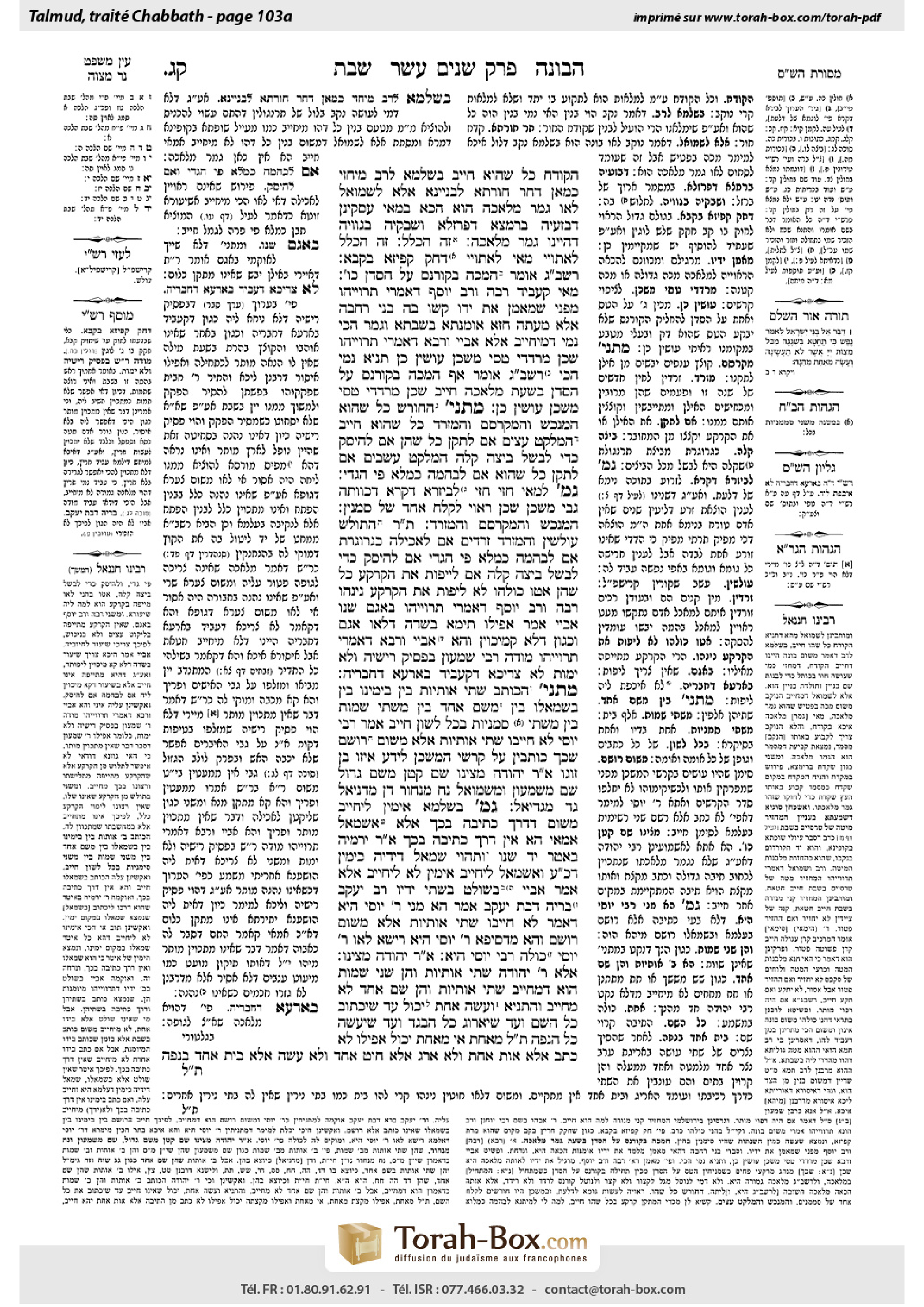
Shabbat 103a: Talmud study for Daf Yomi
Daf Yomi is the daily study of one Talmud folio. Explore 37 tractates with scans, Hebrew text, Sefaria English and AI-generated French translations where annotated.
Passage selection and English or AI-generated French translation are available where the scan has annotations. Daf Study is independent of Torah-Box and Sefaria.
Browse Shabbat · שבת · All tractatesShabbat 103a text and translations
This page of Shabbat includes the Aramaic text, an English translation and an AI-generated French translation, alongside the scan above.
שבת ק״ג א · Aramaic and Hebrew text
הַקּוֹדֵחַ כׇּל שֶׁהוּא — חַיָּיב. בִּשְׁלָמָא לְרַב — מֶיחְזֵי כְּמַאן דְּחַר חוֹרְתָא לְבִנְיָינָא, אֶלָּא לִשְׁמוּאֵל — לָאו גְּמַר מְלָאכָה הוּא! הָכָא בְּמַאי עָסְקִינַן — דְּבַזְעֵיהּ בְּרַמְצָא דְפַרְזְלָא וְשַׁבְקֵיהּ בְּגַוֵּויהּ, דְּהַיְינוּ גְּמַר מְלָאכָה.
זֶה הַכְּלָל. ״זֶה הַכְּלָל״ לְאֵתוּיֵי מַאי? לְאֵתוּיֵי דְּחַק קְפִיזָא בְּקַבָּא.
רַבָּן שִׁמְעוֹן בֶּן גַּמְלִיאֵל אוֹמֵר: הַמַּכֶּה בְּקוּרְנָס עַל הַסַּדָּן כּוּ׳. מַאי קָעָבֵיד? רַבָּה וְרַב יוֹסֵף דְּאָמְרִי תַּרְוַיְיהוּ: מִפְּנֵי שֶׁמְאַמֵּן אֶת יָדוֹ. קָשׁוּ בָּהּ בְּנֵי רַחֲבָה: אֶלָּא מֵעַתָּה, חֲזָא אוּמָּנוּתָא בְּשַׁבְּתָא וּגְמַר, הָכִי נָמֵי דְּמִיחַיַּיב? אֶלָּא אַבָּיֵי וְרָבָא דְּאָמְרִי תַּרְוַיְיהוּ: שֶׁכֵּן מְרַדְּדֵי טַסֵּי מִשְׁכָּן עוֹשִׂין כֵּן. תַּנְיָא נָמֵי הָכִי, רַבָּן שִׁמְעוֹן בֶּן גַּמְלִיאֵל אוֹמֵר: אַף הַמַּכֶּה בְּקוּרְנָס עַל הַסַּדָּן בִּשְׁעַת מְלָאכָה — חַיָּיב, שֶׁכֵּן מְרַדְּדֵי טַסֵּי מִשְׁכָּן עוֹשִׂין כֵּן.
מַתְנִי׳ הַחוֹרֵשׁ כׇּל שֶׁהוּא, הַמְנַכֵּשׁ וְהַמְקַרְסֵם וְהַמְזָרֵד כׇּל שֶׁהוּא — חַיָּיב. הַמְלַקֵּט עֵצִים, אִם לְתַקֵּן — כׇּל שֶׁהֵן, אִם לְהֶיסֵּק — כְּדֵי לְבַשֵּׁל בֵּיצָה קַלָּה. הַמְלַקֵּט עֲשָׂבִים, אִם לְתַקֵּן — כׇּל שֶׁהוּא, אִם לִבְהֵמָה — כִּמְלֹא פִי הַגְּדִי.
גְּמָ׳ לְמַאי חֲזֵי? חֲזֵי לְבִיזְרָא דְקַרָא. דִּכְווֹתַהּ גַּבֵּי מִשְׁכָּן, שֶׁכֵּן רָאוּי לְקֶלַח אֶחָד שֶׁל סַמָּנִין.
הַמְנַכֵּשׁ וְהַמְקַרְסֵם וְהַמְזָרֵד. תָּנוּ רַבָּנַן: הַתּוֹלֵשׁ עוּלְשִׁין וְהַמְזָרֵד זְרָדִים, אִם לַאֲכִילָה — כִּגְרוֹגֶרֶת. אִם לִבְהֵמָה — כִּמְלֹא פִי הַגְּדִי. אִם לְהֶיסֵּק — כְּדֵי לְבַשֵּׁל בֵּיצָה קַלָּה. אִם לְיַיפּוֹת אֶת הַקַּרְקַע — כׇּל שֶׁהֵן.
אַטּוּ כּוּלְּהוּ לָא לְיַפּוֹת אֶת הַקַּרְקַע נִינְהוּ? רַבָּה וְרַב יוֹסֵף דְּאָמְרִי תַּרְוַיְיהוּ: בַּאֲגַם שָׁנוּ. אַבָּיֵי אָמַר: אֲפִילּוּ תֵּימָא בְּשָׂדֶה דְּלָאו אֲגַם, וּכְגוֹן דְּלָא קָמִיכַּוֵּין. וְהָא אַבָּיֵי וְרָבָא דְּאָמְרִי תַּרְוַיְיהוּ: מוֹדֶה רַבִּי שִׁמְעוֹן, בִּ״פְסִיק רֵישֵׁיהּ וְלָא יְמוּת״! לָא צְרִיכָא, דְּקָעָבֵיד בְּאַרְעָא דְחַבְרֵיהּ.
מַתְנִי׳ הַכּוֹתֵב שְׁתֵּי אוֹתִיּוֹת, בֵּין בִּימִינוֹ בֵּין בִּשְׂמֹאלוֹ, בֵּין מִשֵּׁם אֶחָד בֵּין מִשְּׁנֵי שֵׁמוֹת בֵּין מִשְׁתֵּי סַמָּנִיּוֹת, בְּכׇל לָשׁוֹן — חַיָּיב. אָמַר רַבִּי יוֹסֵי: לֹא חִיְּיבוּ שְׁתֵּי אוֹתִיּוֹת אֶלָּא מִשּׁוּם רוֹשֵׁם, שֶׁכָּךְ כּוֹתְבִין עַל קַרְשֵׁי הַמִּשְׁכָּן לֵידַע אֵיזוֹ בֶּן זוּגוֹ. אָמַר רַבִּי יְהוּדָה: מָצִינוּ שֵׁם קָטָן מִשֵּׁם גָּדוֹל — ״שֵׁם״ מִשִּׁמְעוֹן וּמִשְּׁמוּאֵל, ״נֹחַ״ מִנָּחוֹר, ״דָּן״ מִדָּנִיאֵל, ״גָּד״ מִגַּדִּיאֵל.
גְּמָ׳ בִּשְׁלָמָא אַיָּמִין לִיחַיַּיב מִשּׁוּם דְּדֶרֶךְ כְּתִיבָה בְּכָךְ, אֶלָּא אַשְּׂמֹאל אַמַּאי? הָא אֵין דֶּרֶךְ כְּתִיבָה בְּכָךְ! אָמַר רַבִּי יִרְמְיָה: בְּאִטֵּר יָד שָׁנוּ. וְתֶהֱוֵי שְׂמֹאל דִּידֵיהּ כְּיָמִין דְּכוּלֵּי עָלְמָא, וְאַשְּׂמֹאל לִיחַיַּיב, אַיָּמִין לָא לִיחַיַּיב! אֶלָּא אָמַר אַבָּיֵי: בְּשׁוֹלֵט בִּשְׁתֵּי יָדָיו.
רַב יַעֲקֹב בְּרֵהּ דְּבַת יַעֲקֹב אָמַר: הָא מַנִּי — רַבִּי יוֹסֵי הִיא, דַּאֲמַר לֹא חִיְּיבוּ שְׁתֵּי אוֹתִיּוֹת אֶלָּא מִשּׁוּם רוֹשֵׁם. וְהָא מִדְּסֵיפָא רַבִּי יוֹסֵי הִיא, רֵישָׁא לָאו רַבִּי יוֹסֵי! כּוּלָּהּ רַבִּי יוֹסֵי הִיא.
אָמַר רַבִּי יְהוּדָה, מָצִינוּ. אֶלָּא רַבִּי יְהוּדָה שְׁתֵּי אוֹתִיּוֹת וְהֵן שְׁנֵי שֵׁמוֹת הוּא דִּמְחַיֵּיב, שְׁתֵּי אוֹתִיּוֹת וְהֵן שֵׁם אֶחָד — לָא מְחַיֵּיב?
וְהָתַנְיָא: ״וְעָשָׂה״ — אַחַת. יָכוֹל עַד שֶׁיִּכְתּוֹב כׇּל הַשֵּׁם, וְעַד שֶׁיֶּאֱרוֹג כׇּל הַבֶּגֶד, וְעַד שֶׁיַּעֲשֶׂה כָּל הַנָּפָה — תַּלְמוּד לוֹמַר: ״מֵאַחַת״.
אִי ״מֵאַחַת״, יָכוֹל אֲפִילּוּ לֹא כָּתַב אֶלָּא אוֹת אַחַת, וְלֹא אָרַג אֶלָּא חוּט אֶחָד, וְלֹא עָשָׂה אֶלָּא בַּיִת אֶחָד בַּנָּפָה,
Shabbat 103a · English translation
One who drills a hole of any size is liable. Granted, according to Rav, who said that one who makes a hole is liable due to the prohibited labor of building, here too, he should be liable because he appears as one who is making a hole for the purpose of building. However, according to Shmuel, drilling a hole is not a completion of the labor. The labor will be complete only when a stake or pin is inserted into the hole. Until he does so, he cannot be liable for completing the labor. The Gemara answers: With what we are dealing here? With a case where one drilled a hole with an iron nail and left it inside the surface in which he drilled the hole. That is considered a completion of labor because there is no intention to remove the nail from its hole.
We learned in the mishna that this is the principle: Anyone who performs a prohibited labor and his labor endures on Shabbat is liable. The Gemara asks: What does the phrase: This is the principle, come to include? The Gemara explains: It comes to include a case where one carved out a vessel with a capacity of half a kav [kefiza] into a piece of wood in which it was possible to chisel a vessel with a capacity of a whole kav. Since this labor endures on Shabbat and it can be used, it is considered a complete labor and he is liable.
We also learned in the mishna that Rabban Shimon ben Gamliel says: Even one who strikes an anvil with a sledgehammer is liable. The Gemara wonders: What has he done by striking the anvil that would render him liable? It was Rabba and Rav Yosef who both said in explanation: He is liable because he trains his hand for his work by striking the anvil. The sons of a man named Raḥava found this answer difficult: If so, one who observed a craft being performed on Shabbat and learned to perform that craft through observation, would he also be liable? Only one who performs an actual labor on Shabbat is liable. Rather, it was Abaye and Rava who both said in explanation: He is liable, as those who flatten plates of metal for the Tabernacle do so. They would strike the anvil with the sledgehammer in order to straighten the sledgehammer’s handle, which became crooked. That was also taught in a baraita. Rabban Shimon ben Gamliel says: Even one who strikes an anvil with a sledgehammer during his labor is liable, as those who flatten plates of metal for the Tabernacle do so.
MISHNA: One who plows is liable for plowing any amount of land on Shabbat. One who weeds and removes grass on Shabbat, and one who removes dry branches and who prunes any amount is liable. With regard to one who gathers wood, if he did so to enhance the tree or the land, he is liable for any amount; if he did so for fuel, he is liable for collecting a measure equivalent to that which is used to cook an easily cooked egg. With regard to one who gathers grass, if he did so to enhance the plants or the land, he is liable for any amount; if he did so to feed an animal, he is liable for collecting a measure equivalent to a goat’s mouthful.
GEMARA: The Gemara asks: For what use is plowing any amount of land suited? The Gemara answers: It is suited for a single pumpkin seed. The corresponding situation in the Tabernacle was as it is suitable for planting a single stalk of herbs to make dyes.
We also learned in the mishna: One who weeds, and one who removes dry branches, and who prunes any amount is liable. The Sages taught that in a baraita: With regard to one who severs endives that grow like weeds, or who prunes reeds [zeradim]; if he did so for human consumption, he is liable in the measure of a fig-bulk; if he did so for animal consumption, he is liable in a measure equivalent to a goat’s mouthful. If he did so for fuel, he is liable for severing a measure equivalent to that which is used to cook an easily cooked egg. If he did so to enhance the land, he is liable for any amount.
The Gemara asks: Aren’t all these done to enhance the land? Each stalk that a person uproots enhances the land. It was Rabba and Rav Yosef who both said in explanation: They taught this baraita with regard to swampland, where grass is not uprooted to enhance the land. Abaye said: Even if you say that the baraita is referring to a field that is not a swampland, it can be referring to a case where one did not intend to enhance the land. The Gemara asks: However, is it not Abaye and Rava who both say that Rabbi Shimon, who holds that one is liable only for performing an intentional action, concedes that one is liable in a case of cut off its head, will it not die? In any case where the outcome is inevitable, as in this case where the land will be enhanced, one’s lack of intention does not exempt him. The Gemara answers: Abaye’s statement was only necessary in a case where one did so on another’s land. Since he did not intend for that outcome to eventuate and he derives no benefit from enhancing the land, he is not liable in that case.
MISHNA: One who writes two letters on Shabbat, whether he did so with his right hand or his left, whether they were the same letter or two different letters, whether he did so using two different types of ink, in any language, he is liable. Rabbi Yosei said: One is deemed liable for writing two letters only due to marking, as they would write symbols on adjacent beams of the Tabernacle to know which beam was another beam’s counterpart. Rabbi Yehuda said: We found that one is liable for writing even if he did not complete what he was writing, so that he wrote a small name that constituted part of a longer name, e.g., Shem [shin mem] from the name Shimon or from Shmuel; Noaḥ [nun ḥet] from Naḥor; Dan [dalet nun] from Daniel; Gad [gimmel dalet] from Gaddiel. In all of these cases, the first two letters of the longer name constitute the shorter name.
GEMARA: The Gemara questions the beginning of the mishna: Granted, for writing with the right hand let one be liable, as that is the typical manner of writing. However, for writing with the left hand, why is one liable? That is not the typical manner of writing. Rabbi Yirmeya said: When the mishna taught that one who writes with his left hand is liable, they taught it with regard to one who is left-handed. The Gemara asks: And if so, let his left hand have the same legal status as everyone’s right hand; for writing with his left hand, let him be liable, for writing with his right hand, let him not be liable. Rather, Abaye said: This mishna refers to an ambidextrous person, who is liable for writing with either hand.
Rav Ya’akov, son of the daughter of Ya’akov, said: In accordance with whose opinion is this mishna? It is in accordance with the opinion of Rabbi Yosei, who said: One is deemed liable for writing two letters only due to marking. As such, one is liable for writing a letter even if he writes it imprecisely with his left hand. The Gemara asks: From the fact that the latter clause of the mishna is in accordance with the opinion of Rabbi Yosei, the first clause of the mishna is not in accordance with the opinion of Rabbi Yosei. The Gemara answers: That is not necessarily the case. The entire mishna is in accordance with the opinion of Rabbi Yosei, and the attribution of his second statement was for emphasis alone.
We learned in the mishna that Rabbi Yehuda said: We found that one is liable for writing even if he did not complete what he was writing, so that he wrote a small name that constituted part of a longer name. The Gemara asks: Rather, is that to say that according to Rabbi Yehuda, it is one who writes two letters that are two different types of letters who is liable; however, one who writes two letters that are one type of letter is not liable?
Wasn’t it taught in a baraita that it is written: “When a leader sinned, and he unwittingly performed one of any of the commandments which the Lord his God commanded not to do, and is guilty” (Leviticus 4:22)? The Sages taught: I might have thought that one is not guilty until he performs a complete labor, e.g., until he writes the entire name that he intended to write, or until he weaves the entire garment, or until he crafts the entire sieve made from the reeds of the warp and the woof; therefore, the verse states: “A soul who sins unintentionally in any of the Lord’s commandments which one shall not perform, and did an action from one of these” (Leviticus 4:2).
The emphasis on the phrase “from one” teaches that in order for one to be liable, it is sufficient that he perform only part of the prohibited labor. However, if that is derived from the use of the phrase “from one,” I might have thought that one is liable even if he wrote only a single letter, or even if he wove only a single thread, or even if he crafted only a single eye of the sieve, i.e., arranging the reeds to create a warp, and then interweaving a single reed as a woof;
Shabbat 103a · Traduction française (IA)
Celui qui perce un trou, quelle qu’en soit la taille, est passible. Certes, selon Rav, qui a dit que celui qui fait un trou est passible au titre du travail interdit de construire, ici aussi, il devrait être passible, car il donne l’impression de faire un trou en vue de construire. Toutefois, selon Shmuel, percer un trou ne constitue pas l’achèvement du travail. Celui-ci ne sera achevé que lorsqu’on insérera un pieu ou une cheville dans le trou. Tant qu’il ne l’a pas fait, il ne peut être passible d’avoir achevé le travail. La Guemara répond : De quel cas s’agit-il ici ? D’un cas où il a percé un trou avec un clou de fer et l’a laissé dans la surface percée. Cela est considéré comme l’achèvement du travail, car il n’a pas l’intention de retirer le clou du trou.
Nous avons appris dans la Michna ce principe : quiconque accomplit un travail interdit dont le résultat perdure pendant Chabbat est passible. La Guemara demande : Qu’est-ce que l’expression « ce principe » vient inclure ? La Guemara explique : Elle vient inclure le cas où quelqu’un a creusé un récipient d’une capacité d’un demi-kav [kefiza] dans une pièce de bois où il était possible de creuser un récipient d’une capacité d’un kav entier. Puisque le travail perdure pendant Chabbat et que le récipient peut être utilisé, il est considéré comme un travail achevé, et il est passible.
Nous avons également appris dans la Michna que Rabban Shimon ben Gamliel dit : même celui qui frappe une enclume avec une masse est passible. La Guemara s’étonne : Qu’a-t-il fait en frappant l’enclume qui le rendrait passible ? Rabba et Rav Yosef ont tous deux expliqué : il est passible parce qu’il exerce sa main pour son travail en frappant l’enclume. Les fils d’un homme nommé Raḥava ont contesté cette réponse : Si tel est le cas, celui qui observe un artisan travailler pendant Chabbat et apprend à exercer ce métier en le regardant serait-il lui aussi passible ? Seul celui qui accomplit réellement un travail pendant Chabbat est passible. Abaye et Rava ont plutôt expliqué tous deux : il est passible, car ceux qui aplatissaient les plaques de métal pour le Tabernacle procédaient ainsi. Ils frappaient l’enclume avec la masse afin de redresser le manche de la masse, qui s’était tordu. Cela a également été enseigné dans une baraïta : Rabban Shimon ben Gamliel dit : même celui qui frappe une enclume avec une masse pendant son travail est passible, car ceux qui aplatissaient les plaques de métal pour le Tabernacle procédaient ainsi.
MICHNA : Celui qui laboure est passible même pour avoir labouré la moindre surface de terre pendant Chabbat. Celui qui sarcle et enlève de l’herbe pendant Chabbat, ainsi que celui qui retire des branches sèches ou élague, est passible quelle qu’en soit la quantité. Pour celui qui ramasse du bois, s’il le fait pour améliorer l’arbre ou le sol, il est passible quelle qu’en soit la quantité ; s’il le fait comme combustible, il est passible à partir de la quantité nécessaire pour cuire un œuf à cuisson facile. Pour celui qui ramasse de l’herbe, s’il le fait pour améliorer les plantes ou le sol, il est passible quelle qu’en soit la quantité ; s’il le fait pour nourrir un animal, il est passible à partir de la quantité correspondant à une bouchée de chèvre.
GUEMARA : La Guemara demande : À quoi peut servir une si petite surface de terre labourée ? La Guemara répond : Elle peut servir à planter une seule graine de courge. Le cas correspondant dans le Tabernacle était celui d’une surface convenant à la plantation d’une seule tige d’herbe destinée à fabriquer des teintures.
Nous avons également appris dans la Michna : Celui qui sarcle, celui qui retire des branches sèches et celui qui élague est passible quelle qu’en soit la quantité. Les Sages ont enseigné dans une baraïta : Celui qui coupe des endives poussant comme des mauvaises herbes, ou qui élague des roseaux [zeradim] : s’il le fait pour la consommation humaine, il est passible à partir d’un volume de figue ; s’il le fait pour la consommation animale, il est passible à partir de la quantité correspondant à une bouchée de chèvre. S’il le fait comme combustible, il est passible à partir de la quantité nécessaire pour cuire un œuf à cuisson facile. S’il le fait pour améliorer le sol, il est passible quelle qu’en soit la quantité.
La Guemara demande : Ne fait-on pas tout cela pour améliorer le sol ? Chaque tige qu’une personne déracine améliore le sol. Rabba et Rav Yosef ont tous deux expliqué : Cette baraïta a été enseignée à propos d’un terrain marécageux, où l’on ne déracine pas l’herbe pour améliorer le sol. Abaye a dit : Même si l’on considère que la baraïta parle d’un champ qui n’est pas marécageux, elle peut désigner un cas où la personne n’avait pas l’intention d’améliorer le sol. La Guemara demande : Pourtant, Abaye et Rava ne disent-ils pas tous deux que Rabbi Shimon, qui considère qu’on n’est passible que si l’on agit intentionnellement, reconnaît qu’on est passible dans le cas de « coupe-lui la tête, ne va-t-il pas mourir ? » Dans tout cas où le résultat est inévitable, comme ici, où le sol sera amélioré, l’absence d’intention ne l’exempte pas. La Guemara répond : La déclaration d’Abaye était nécessaire uniquement dans un cas où la personne a agi sur le terrain d’autrui. Puisqu’elle ne voulait pas que ce résultat se produise et ne tire aucun bénéfice de l’amélioration du sol, elle n’est pas passible dans ce cas.
MICHNA : Celui qui écrit deux lettres pendant Chabbat est passible, qu’il les ait écrites de la main droite ou de la main gauche, qu’il s’agisse de la même lettre ou de deux lettres différentes, qu’il ait utilisé deux sortes d’encre différentes, et quelle que soit la langue. Rabbi Yosei a dit : On n’est passible d’avoir écrit deux lettres qu’en raison de leur fonction de marque ; en effet, on inscrivait des symboles sur des poutres adjacentes du Tabernacle afin de savoir quelle poutre correspondait à une autre. Rabbi Yehuda a dit : Nous avons établi qu’on est passible d’écrire même sans avoir achevé ce qu’on écrivait, par exemple en écrivant un petit nom qui constitue une partie d’un nom plus long : Shem [shin mem], extrait du nom Shimon ou de Shmuel ; Noaḥ [nun ḥet], extrait de Naḥor ; Dan [dalet nun], extrait de Daniel ; Gad [gimmel dalet], extrait de Gaddiel. Dans tous ces cas, les deux premières lettres du nom plus long forment le nom plus court.
GUEMARA : La Guemara s’interroge sur le début de la Michna : Certes, celui qui écrit de la main droite est passible, puisque c’est la manière habituelle d’écrire. Mais pourquoi celui qui écrit de la main gauche serait-il passible ? Ce n’est pas la manière habituelle d’écrire. Rabbi Yirmeya a dit : Quand la Michna enseigne que celui qui écrit de la main gauche est passible, elle parle d’un gaucher. La Guemara demande : Dans ce cas, sa main gauche devrait avoir le même statut que la main droite de tout le monde : qu’il soit passible s’il écrit de la main gauche, mais non s’il écrit de la main droite. Abaye a plutôt dit : Cette Michna parle d’une personne ambidextre, qui est passible qu’elle écrive de l’une ou l’autre main.
Rav Ya’akov, fils de la fille de Ya’akov, a dit : Selon l’opinion de qui cette Michna a-t-elle été formulée ? Selon celle de Rabbi Yosei, qui a dit : On n’est passible d’avoir écrit deux lettres qu’en raison de leur fonction de marque. Ainsi, on est passible d’écrire une lettre même si on l’écrit de manière imprécise de la main gauche. La Guemara demande : Puisque la dernière partie de la Michna est conforme à l’opinion de Rabbi Yosei, faut-il en conclure que la première partie ne l’est pas ? La Guemara répond : Ce n’est pas nécessairement le cas. Toute la Michna est conforme à l’opinion de Rabbi Yosei, et l’attribution de sa seconde déclaration n’a été faite que pour insister sur ce point.
Nous avons appris dans la Michna que Rabbi Yehuda a dit : Nous avons établi qu’on est passible d’écrire même sans avoir achevé ce qu’on écrivait, par exemple en écrivant un petit nom qui constitue une partie d’un nom plus long. La Guemara demande : Faut-il donc en conclure que, selon Rabbi Yehuda, on est passible lorsqu’on écrit deux lettres différentes, mais qu’on ne l’est pas lorsqu’on écrit deux lettres identiques ?
N’a-t-il pas été enseigné dans une baraïta, où il est écrit : « Lorsqu’un chef a péché et a accompli par inadvertance l’un des commandements que le Seigneur son Dieu a ordonné de ne pas accomplir, et qu’il s’est rendu coupable » (Lévitique 4:22) ? Les Sages ont enseigné : J’aurais pu penser qu’on n’est coupable qu’après avoir accompli un travail entier, par exemple après avoir écrit le nom entier qu’on avait l’intention d’écrire, ou après avoir tissé le vêtement entier, ou après avoir fabriqué le tamis entier formé par les roseaux de la chaîne et de la trame ; c’est pourquoi le verset dit : « Une personne qui pèche involontairement contre l’un des commandements du Seigneur, en accomplissant ce qu’on ne doit pas faire, et qui accomplit un acte parmi ceux-ci » (Lévitique 4:2).
L’accent mis sur l’expression « parmi ceux-ci » enseigne qu’il suffit, pour être passible, d’accomplir seulement une partie du travail interdit. Toutefois, si l’on déduit cela de l’emploi de l’expression « parmi ceux-ci », j’aurais pu penser qu’on est passible même si l’on n’a écrit qu’une seule lettre, ou tissé un seul fil, ou fabriqué un seul œil du tamis, c’est-à-dire disposé les roseaux pour former la chaîne, puis entrecroisé un seul roseau comme trame ;
Traduction française générée par IA à partir de l’édition anglaise de Sefaria. Vérifie toujours un passage avec le texte source.
Text from Sefaria: William Davidson Edition - Vocalized Aramaic (CC BY NC); William Davidson Edition - English (CC BY NC).