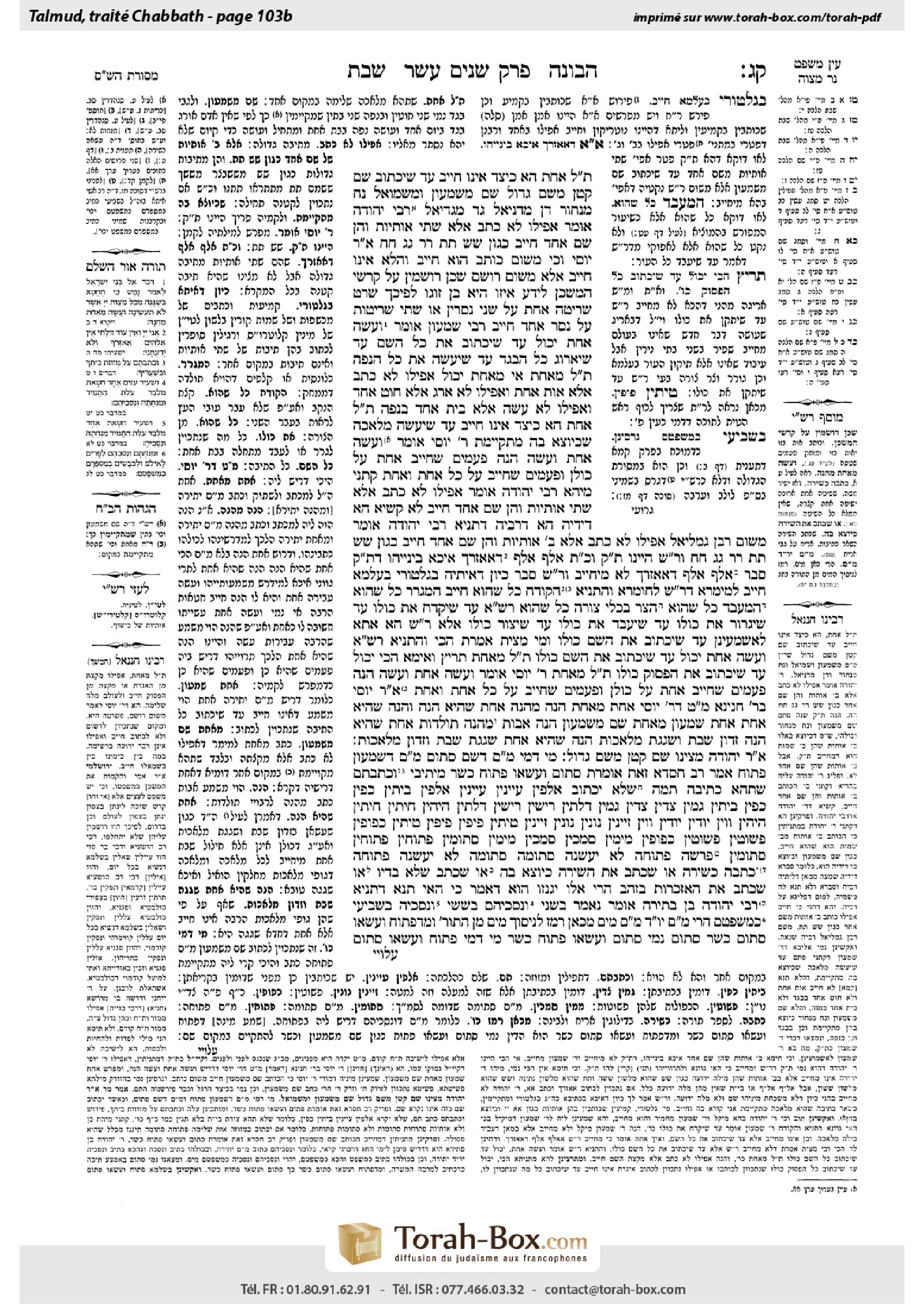
Shabbat 103b: Talmud study for Daf Yomi
Daf Yomi is the daily study of one Talmud folio. Explore 37 tractates with scans, Hebrew text, Sefaria English and AI-generated French translations where annotated.
Passage selection and English or AI-generated French translation are available where the scan has annotations. Daf Study is independent of Torah-Box and Sefaria.
Browse Shabbat · שבת · All tractatesShabbat 103b text and translations
This page of Shabbat includes the Aramaic text, an English translation and an AI-generated French translation, alongside the scan above.
שבת ק״ג ב · Aramaic and Hebrew text
תַּלְמוּד לוֹמַר: ״אַחַת״. הָא כֵּיצַד, אֵינוֹ חַיָּיב עַד שֶׁיִּכְתּוֹב שֵׁם קָטָן מִשֵּׁם גָּדוֹל — ״שֵׁם״ מִשִּׁמְעוֹן וּמִשְּׁמוּאֵל, ״נֹחַ״ מִנָּחוֹר, ״דָּן״ מִדָּנִיאֵל, ״גָּד״ מִגַּדִּיאֵל. רַבִּי יְהוּדָה אוֹמֵר: אֲפִילּוּ לֹא כָּתַב אֶלָּא שְׁתֵּי אוֹתִיּוֹת וְהֵן שֵׁם אֶחָד — חַיָּיב, כְּגוֹן: ״שֵׁשׁ״ ״תֵּת״, ״רָר״, ״גַּג״, ״חָח״.
אָמַר רַבִּי יוֹסֵי: וְכִי מִשּׁוּם כּוֹתֵב הוּא חַיָּיב?! וַהֲלֹא אֵינוֹ חַיָּיב אֶלָּא מִשּׁוּם רוֹשֵׁם, שֶׁכֵּן רוֹשְׁמִין עַל קַרְשֵׁי הַמִּשְׁכָּן לֵידַע אֵיזוֹ הִיא בֶּן זוּגוֹ. לְפִיכָךְ, שָׂרַט שְׂרִיטָה אַחַת עַל שְׁנֵי נְסָרִין, אוֹ שְׁתֵּי שְׂרִיטוֹת עַל נֶסֶר אֶחָד — חַיָּיב.
רַבִּי שִׁמְעוֹן אוֹמֵר: ״וְעָשָׂה אַחַת״, יָכוֹל עַד שֶׁיִּכְתּוֹב אֶת כָּל הַשֵּׁם, עַד שֶׁיֶּאֱרוֹג כׇּל הַבֶּגֶד, עַד שֶׁיַּעֲשֶׂה אֶת כָּל הַנָּפָה — תַּלְמוּד לוֹמַר: ״מֵאַחַת״. אִי ״מֵאַחַת״, יָכוֹל אֲפִילּוּ לֹא כָּתַב אֶלָּא אוֹת אַחַת, וַאֲפִילּוּ לֹא אָרַג אֶלָּא חוּט אֶחָד, וַאֲפִילּוּ לֹא עָשָׂה אֶלָּא בַּיִת אֶחָד בַּנָּפָה — תַּלְמוּד לוֹמַר: ״אַחַת״. הָא כֵּיצַד? אֵינוֹ חַיָּיב עַד שֶׁיַּעֲשֶׂה מְלָאכָה שֶׁכַּיּוֹצֵא בָּהּ מִתְקַיֶּימֶת.
רַבִּי יוֹסֵי אוֹמֵר: ״וְעָשָׂה אַחַת״ ״וְעָשָׂה הֵנָּה״, פְּעָמִים שֶׁחַיָּיב אַחַת עַל כּוּלָּן, וּפְעָמִים שֶׁחַיָּיב עַל כׇּל אַחַת וְאַחַת.
קָתָנֵי מִיהָא: רַבִּי יְהוּדָה אוֹמֵר אֲפִילּוּ לֹא כָּתַב אֶלָּא שְׁתֵּי אוֹתִיּוֹת וְהֵן שֵׁם אֶחָד — חַיָּיב. לָא קַשְׁיָא: הָא דִּידֵיהּ, הָא דְרַבֵּיהּ. דְּתַנְיָא, רַבִּי יְהוּדָה אוֹמֵר מִשּׁוּם רַבָּן גַּמְלִיאֵל: אֲפִילּוּ לֹא כָּתַב אֶלָּא שְׁתֵּי אוֹתִיּוֹת וְהֵן שֵׁם אֶחָד — חַיָּיב, כְּגוֹן ״שֵׁשׁ״, ״תֵּת״, ״רָר״, ״גַּג״, ״חָח״.
רַבִּי שִׁמְעוֹן הַיְינוּ תַּנָּא קַמָּא? וְכִי תֵּימָא אָלֶ״ף אָלֶ״ף דַּ״אֲאַזֶּרְךָ״ אִיכָּא בֵּינַיְיהוּ, דְּתַנָּא קַמָּא סָבַר אָלֶ״ף אָלֶ״ף דַּ״אֲאַזֶּרְךָ״ לָא מִיחַיַּיב, וְרַבִּי שִׁמְעוֹן סָבַר כֵּיוָן דְּאִיתֵיהּ בִּגְלָטוֹרֵי בְּעָלְמָא — חַיָּיב, לְמֵימְרָא דְּרַבִּי שִׁמְעוֹן לְחוּמְרָא?
וְהָתַנְיָא: הַקּוֹדֵחַ כׇּל שֶׁהוּא חַיָּיב, הַמְגָרֵר כׇּל שֶׁהוּא, הַמְעַבֵּד כׇּל שֶׁהוּא, הַצָּר בִּכְלִי צוּרָה כׇּל שֶׁהוּא. רַבִּי שִׁמְעוֹן אוֹמֵר: עַד שֶׁיִּקְדַּח אֶת כּוּלּוֹ, עַד שֶׁיִּגְרוֹר אֶת כּוּלּוֹ, עַד שֶׁיְּעַבֵּד אֶת כּוּלּוֹ, עַד שֶׁיָּצוּר כּוּלּוֹ.
אֶלָּא, רַבִּי שִׁמְעוֹן הָא אֲתָא לְאַשְׁמוֹעִינַן, עַד שֶׁיִּכְתּוֹב אֶת הַשֵּׁם כּוּלּוֹ. וּמִי מָצֵית אָמְרַתְּ הָכִי? וְהָתַנְיָא, רַבִּי שִׁמְעוֹן אוֹמֵר: ״וְעָשָׂה אַחַת״, יָכוֹל עַד שֶׁיִּכְתּוֹב אֶת הַשֵּׁם כּוּלּוֹ — תַּלְמוּד לוֹמַר: ״מֵאַחַת״! תָּרֵיץ וְאֵימָא הָכִי: יָכוֹל עַד שֶׁיִּכְתּוֹב אֶת הַפָּסוּק כּוּלּוֹ — תַּלְמוּד לוֹמַר: ״מֵאַחַת״.
רַבִּי יוֹסֵי אוֹמֵר: ״וְעָשָׂה אַחַת״ ״וְעָשָׂה הֵנָּה״ — פְּעָמִים שֶׁחַיָּיב אַחַת עַל כּוּלָּן, וּפְעָמִים שֶׁחַיָּיב עַל כׇּל אַחַת וְאַחַת.
אָמַר רַבִּי יוֹסֵי בְּרַבִּי חֲנִינָא: מַאי טַעְמָא דְּרַבִּי יוֹסֵי ״אַחַת״ ״מֵאַחַת״, ״הֵנָּה״ ״מֵהֵנָּה״, אַחַת שֶׁהִיא ״הֵנָּה״, וְ״הֵנָּה״ שֶׁהִיא אַחַת.
״אַחַת״ — ״שִׁמְעוֹן״, ״מֵאַחַת״ — ״שֵׁם״ מִ״שִּׁמְעוֹן״. ״הֵנָּה״ — אָבוֹת, ״מֵהֵנָּה״ — תּוֹלָדוֹת. אַחַת שֶׁהִיא הֵנָּה — זְדוֹן שַׁבָּת וְשִׁגְגַת מְלָאכוֹת. הֵנָּה שֶׁהִיא אַחַת — שִׁגְגַת שַׁבָּת וּזְדוֹן מְלָאכוֹת.
אָמַר רַבִּי יְהוּדָה: מָצִינוּ שֵׁם קָטָן מִשֵּׁם גָּדוֹל. מִי דָּמֵי? מֵ״ם דְּ״שֵׁם״ סָתוּם, מֵ״ם דְּ״שִׁמְעוֹן״ פָּתוּחַ! אָמַר רַב חִסְדָּא: זֹאת אוֹמֶרֶת סָתוּם וַעֲשָׂאוֹ פָּתוּחַ — כָּשֵׁר.
מֵיתִיבִי: ״וּכְתַבְתָּם״ — שֶׁתְּהֵא כְּתִיבָה תַּמָּה, שֶׁלֹּא יִכְתּוֹב אַלְפִין עַיְינִין, עַיְינִין אַלְפִין. בֵּיתִין כָּפִין, כָּפִין בֵּיתִין. גַּמִּין צָדִין, צָדִין גַּמִּין. דַּלְתִין רֵישִׁין, רֵישִׁין דַּלְתִין. הֵיהִין חֵיתִין, חֵיתִין הֵיהִין. וָוִין יוֹדִין, יוֹדִין וָוִין. זַיְינִין נוּנִין, נוּנִין זַיְינִין. טֵיתִין פֵּיפִין, פֵּיפִין טֵיתִין.
כְּפוּפִין פְּשׁוּטִין, פְּשׁוּטִין כְּפוּפִין. מֵימִין סָמְכִין, סָמְכִין מֵימִין. סְתוּמִין פְּתוּחִין, פְּתוּחִין סְתוּמִין. פָּרָשָׁה פְּתוּחָה לֹא יַעֲשֶׂנָּה סְתוּמָה, סְתוּמָה לֹא יַעֲשֶׂנָּה פְּתוּחָה. כְּתָבָהּ כְּשִׁירָה, אוֹ שֶׁכָּתַב אֶת הַשִּׁירָה כַּיּוֹצֵא בָהּ, אוֹ שֶׁכָּתַב שֶׁלֹּא בִּדְיוֹ, אוֹ שֶׁכָּתַב אֶת הָאַזְכָּרוֹת בְּזָהָב — הֲרֵי אֵלּוּ יִגָּנְזוּ.
הוּא דְּאָמַר כִּי הַאי תַּנָּא, דְּתַנְיָא, רַבִּי יְהוּדָה בֶּן בְּתִירָה אוֹמֵר: נֶאֱמַר בַּשֵּׁנִי ״וְנִסְכֵּיהֶם״. בַּשִּׁשִּׁי ״וּנְסָכֶיהָ״, בַּשְּׁבִיעִי ״כְּמִשְׁפָּטָם״, הֲרֵי מֵ״ם יוֹ״ד מֵ״ם — ״מַיִם״, מִכָּאן רֶמֶז לְנִיסּוּךְ מַיִם מִן הַתּוֹרָה.
וּמִדְּפָתוּחַ וַעֲשָׂאוֹ סָתוּם — כָּשֵׁר, סָתוּם נָמֵי סָתוּם וַעֲשָׂאוֹ פָּתוּחַ — כָּשֵׁר.
מִי דָּמֵי? פָּתוּחַ וַעֲשָׂאוֹ סָתוּם —
Shabbat 103b · English translation
therefore, the verse states “one,” which means one complete labor. How can the two phrases be reconciled? Rather it must be explained that one is liable only if he writes a small name that constitutes part of a longer name, e.g., Shem from the name Shimon or from Shmuel, Noaḥ from Naḥor, Dan from Daniel, Gad from Gaddiel. Rabbi Yehuda says: One is liable even if he wrote only two letters that are one type of letter, e.g., shesh [shin shin], tet [tav tav], rar [reish reish], gag [gimmel gimmel], ḥaḥ [ḥet ḥet].
Rabbi Yosei said: And is one liable due to the labor of writing? Isn’t one liable only due to the prohibition of marking, as they would write symbols on adjacent beams of the Tabernacle to know which beam was another beam’s counterpart? Therefore, one who made a single scratch on two boards, or two scratches on a single board, is liable.
Rabbi Shimon says: The verse states, “When a leader sinned, and he unwittingly performed one of any of the commandments which the Lord his God commanded not to do, and is guilty” (Leviticus 4:22), and from the word one, I might have thought that one is not guilty until he performs a complete labor, e.g., until he writes the entire name that he intended to write, or until he weaves the entire garment, or until he crafts the entire sieve made from the reeds of the warp and the woof; therefore, the verse states “from one.” However, if that is derived from the use of the phrase “from one,” I might have thought that one is liable even if he wrote only a single letter, or even if he wove only a single thread, or even if he crafted only a single eye of the sieve. Therefore, the verse states “one.” But how can we reconcile the two phrases? One is only liable for performing a labor that is of the type that endures. In that case it is considered a complete labor.
Rabbi Yosei says that the verse states: “And did an action from one of these” (Leviticus 4:2). This unusual expression indicates repetition: And he performed one, and he performed these. From here it is derived that at times one is liable to bring one sin-offering for them all, and at times one is liable to bring several offerings, one for each and every one.
The Gemara returns to the matter of the baraita: In any event, it was taught that Rabbi Yehuda says: One is liable even if he only wrote two letters that are one type of letter; he does not insist that one is liable only if he writes two different letters. The Gemara answers: This is not difficult. This opinion is his own, and that other opinion is that of his teacher, as it was taught in a baraita: Rabbi Yehuda says in the name of Rabban Gamliel: Even if one only wrote two identical letters, forming words such as shesh, tet, rar, gag, or ḥaḥ, he is liable. That is Rabban Gamliel’s opinion, but Rabbi Yehuda himself holds that one is only liable for writing two different letters.
The Gemara asks: The opinion of Rabbi Shimon in the baraita is identical to the opinion of the first tanna. And if you say that there is a practical difference between their opinions in the case of the letters alef alef in a word such as a’azerkha (Isaiah 45:5), in that the first tanna holds that if one wrote the letters alef alef of the word a’azerkha he is not liable because the two letters do not spell a complete word, and Rabbi Shimon holds that since that combination of letters appears in standard amulets [gelatorei] he is liable because this writing is considered to be enduring; is that to say that the opinion of Rabbi Shimon tends to stringency in this matter?
Wasn’t it taught in a baraita: One who drills a hole of any size on Shabbat is liable, one who scrapes and smooths posts or parchments in any amount is liable, one who tans any amount of an animal hide is liable, one who draws any size form on a vessel is liable? Rabbi Shimon says: One is liable only if he drills the entire hole that he intended to drill, or if he scrapes the entire post or parchment that he intended to scrape, or if he tans the entire hide that he intended to tan, or if he draws the entire form that he intended to draw. Clearly, Rabbi Shimon’s opinion is the lenient one.
Rather, Rabbi Shimon comes to teach us this: It is considered writing that endures only if he writes the entire name. The Gemara asks: And how can you say this? Wasn’t it taught in a baraita that Rabbi Shimon says: From the phrase “and he performed one” I might have thought that one is liable only if he writes the entire name; therefore, the verse states “from one.” Apparently, he does not require that the entire word be written in order to be liable. The Gemara answers: Resolve the contradiction between these statements and say this: I might have thought that one is liable only if he writes the entire verse that he intended to write; therefore, the verse states “from one.” One is liable for writing less than that. However, one is certainly not liable for writing less than a complete word.
The baraita cites that Rabbi Yosei says that the verse states: “And did an action from one of these.” This unusual expression indicates repetition and it is as if it says: And he did one, and he did these. From here it is derived that at times one is liable to bring one sin-offering for them all, and at times one is liable to bring several offerings, one for each and every one.
And Rabbi Yosei, son of Rabbi Ḥanina, said: What is the reason for Rabbi Yosei’s opinion? Since the verse says “from one” and “of these,” Rabbi Yosei detects both a restriction, i.e., “from” and “of,” an amplification based on superfluous expressions, as it would have been sufficient for the verse to say “one” and not “from one,” and it would have been sufficient to say “these” instead of “of these.” The repetitive language teaches that there are cases of one that is these and cases of these that are one.
Similarly, Rabbi Yosei explained that had the verse said “one,” the conclusion would have been that one is only liable for performing a complete transgression, e.g., writing the name Shimon on Shabbat. “From one” teaches that one is liable even if he does not complete the intended action, e.g., writing Shem from Shimon. “These” refers to the transgressions themselves, e.g., the primary categories of labor prohibited on Shabbat. The words “from these” teach that even subcategories are included. The Gemara illustrates the case of one that is these. One was aware that he was in violation of the prohibition of Shabbat but not aware that the individual labors were prohibited. In that case, if he performed several prohibited labors during this lapse of awareness, he is liable to bring a sin-offering for each violation. These that are one refers to a case where one was unaware that he was in violation of the prohibition of Shabbat but he was aware that the individual labors were prohibited. In that case, he is liable to bring only one sin-offering for all of the prohibited labors.
We learned in the mishna that Rabbi Yehuda said: We found that one is liable for writing even if he did not complete what he was writing and wrote a small name that constituted part of a longer name, e.g., Shem from Shimon. The Gemara asks: Is it similar? The mem in Shem is closed and the mem in Shimon is open. Rav Ḥisda said: That is to say that a closed letter that one rendered open is valid even in writing a Torah scroll, and it is not considered an irregularity in the writing. Therefore, one is liable for writing an open letter instead of a closed one.
The Gemara raised an objection from a baraita that interprets the verse: “And you shall write them on the doorposts of your house and on your gates” (Deuteronomy 6:9). “And you shall write them [ukhtavtam]” means that it should be perfect writing [ketiva tamma] with no mistakes, and clear writing. This means that one should not write an alef as an ayin, an ayin as an alef, a beit as a kaf, a kaf as a beit, a gimmel as a tzadi, a tzadi as a gimmel, a dalet as a reish, a reish as a dalet, a heh as a ḥet, a ḥet as a heh, a vav as a yod, a yod as a vav, a zayin as a nun, a nun as a zayin, a tet as a peh, a peh as a tet.
Similarly, one should not write bent letters like kaf and nun found in the middle of a word as straight letters like kaf and nun found at the end of a word, nor should one write straight letters as bent letters. A final mem should not be written like a samekh, and a samekh should not be written like a mem. A closed mem should not be written open, and an open one should not be written closed. Similarly, if there is an open paragraph in the Torah one may not render it closed, and one may not render a closed paragraph open. If one wrote a mezuza or a Torah scroll following the Torah’s format for poetry or if one wrote poetry like regular text, as a mezuza is typically written, or if one wrote without ink but with another material, or if one wrote the mentions of God’s names in gold, all of these must be suppressed. Apparently, one may not write closed letters as open letters, contrary to the statement of Rav Ḥisda.
The Gemara answers: Rav Ḥisda stated his opinion in accordance with the opinion of this tanna, as it was taught in a baraita that Rabbi Yehuda ben Beteira says: While on the rest of the days of Sukkot the verse employs the phrase: “And its libation [veniska],” on the second day it is stated: “And their libations [veniskeihem]” (Numbers 29:19) with an extra letter mem; on the sixth day, it is stated: “And its libations [unsakhe’ah]” (Numbers 29:31) with an extra letter yod. On the seventh day, instead of “according to the law [kamishpat]” employed on the other days, it is stated: “According to their laws [kemishpatam]” (Numbers 29:33) with an extra letter mem. Together these additional letters, mem, yod, and mem, form the word mayim, which means water. This is an allusion to the water libation from the Torah. On Sukkot, a water libation was poured onto the altar in addition to the wine libation that accompanied sacrifices throughout the year. However, here, the closed mem at the end of the word veniskeihem is interpreted as if it were an open mem and used as the first mem in mayim.
And from the fact that an open letter that one rendered closed is valid, in the case of a closed letter, too, a closed letter that one rendered open is valid. This homiletic interpretation supports Rav Ḥisda’s opinion.
The Gemara rejects this comparison: Is it similar? If one rendered an open letter closed,
Shabbat 103b · Traduction française (IA)
C’est pourquoi le verset dit « une », ce qui signifie un travail complet. Comment concilier les deux expressions ? Il faut plutôt expliquer qu’on n’est passible que si l’on écrit un nom court qui constitue une partie d’un nom plus long, par exemple Shem, tiré du nom Shimon ou de Shmuel, Noaḥ, tiré de Naḥor, Dan, tiré de Daniel, ou Gad, tiré de Gaddiel. Rabbi Yehuda dit : On est passible même si l’on n’a écrit que deux lettres identiques, par exemple shesh [shin shin], tet [tav tav], rar [reish reish], gag [gimmel gimmel] ou ḥaḥ [ḥet ḥet].
Rabbi Yosei dit : Est-on passible en raison du travail d’écriture ? N’est-on pas passible uniquement en raison de l’interdiction de marquer ? En effet, on inscrivait des signes sur les poutres adjacentes du Tabernacle afin de savoir quelle poutre correspondait à quelle autre. Par conséquent, celui qui fait une seule entaille sur deux planches, ou deux entailles sur une seule planche, est passible.
Rabbi Shimon dit : Le verset énonce : « Lorsqu’un chef aura péché et aura commis par inadvertance l’une des mitsvot que l’Éternel, son Dieu, a ordonné de ne pas faire, et qu’il sera coupable » (Lévitique 4:22). Du mot « une », j’aurais pu conclure qu’on n’est coupable qu’après avoir accompli un travail complet, par exemple après avoir écrit le nom entier que l’on voulait écrire, après avoir tissé tout le vêtement, ou après avoir fabriqué tout le tamis constitué de roseaux de chaîne et de trame. C’est pourquoi le verset dit « l’une ». Toutefois, si l’on déduit cela de l’expression « l’une des », j’aurais pu conclure qu’on est passible même si l’on n’a écrit qu’une seule lettre, tissé un seul fil ou fabriqué un seul œil du tamis. C’est pourquoi le verset dit « une ». Comment concilier les deux expressions ? On n’est passible que pour un travail du type de ceux qui subsistent ; dans ce cas, il est considéré comme un travail complet.
Rabbi Yosei dit que le verset énonce : « et qu’il ait accompli une action parmi l’une de celles-ci » (Lévitique 4:2). Cette expression inhabituelle indique une répétition : il en a accompli une, et il a accompli celles-ci. On en déduit que, parfois, on est passible d’apporter un seul sacrifice expiatoire pour l’ensemble, et parfois, on est passible d’apporter plusieurs sacrifices, un pour chacune.
La Guemara revient à la baraïta : en tout état de cause, il y était enseigné que Rabbi Yehuda dit : On est passible même si l’on n’a écrit que deux lettres identiques ; il ne soutient pas qu’on n’est passible que si l’on écrit deux lettres différentes. La Guemara répond : Il n’y a pas de difficulté. Une opinion est la sienne, et l’autre est celle de son maître, car il a été enseigné dans une baraïta : Rabbi Yehuda dit au nom de Rabban Gamliel : Même si l’on n’a écrit que deux lettres identiques, formant des mots tels que shesh, tet, rar, gag ou ḥaḥ, on est passible. C’est l’opinion de Rabban Gamliel ; mais Rabbi Yehuda lui-même estime qu’on n’est passible que si l’on écrit deux lettres différentes.
La Guemara demande : L’opinion de Rabbi Shimon dans la baraïta est identique à celle du premier tanna. Et si tu dis qu’il existe une différence pratique entre leurs opinions dans le cas des lettres alef alef du mot a’azerkha (Isaïe 45:5) — le premier tanna estime que si l’on écrit les lettres alef alef du mot a’azerkha, on n’est pas passible, car ces deux lettres ne forment pas un mot complet, tandis que Rabbi Shimon estime que, puisque cette combinaison de lettres apparaît dans des amulettes usuelles [gelatorei], on est passible, car cette écriture est considérée comme durable — faut-il en conclure que l’opinion de Rabbi Shimon tend à la rigueur sur ce point ?
N’a-t-il pas été enseigné dans une baraïta : Celui qui perce un trou, quelle qu’en soit la taille, pendant Chabbat est passible ; celui qui gratte et lisse des poteaux ou des parchemins, quelle qu’en soit la quantité, est passible ; celui qui tanne une partie, quelle qu’en soit la quantité, d’une peau d’animal est passible ; celui qui trace une forme de n’importe quelle taille sur un récipient est passible. Rabbi Shimon dit : On n’est passible que si l’on perce le trou entier que l’on avait l’intention de percer, si l’on gratte le poteau ou le parchemin entier que l’on avait l’intention de gratter, si l’on tanne la peau entière que l’on avait l’intention de tanner, ou si l’on trace la forme entière que l’on avait l’intention de tracer. Il est donc clair que l’opinion de Rabbi Shimon est la plus clémente.
Rabbi Shimon vient plutôt nous enseigner ceci : une écriture n’est considérée comme durable que si l’on écrit le nom entier. La Guemara demande : Comment peux-tu dire cela ? N’a-t-il pas été enseigné dans une baraïta que Rabbi Shimon dit : De l’expression « et il en a accompli une », j’aurais pu conclure qu’on n’est passible que si l’on écrit le nom entier ; c’est pourquoi le verset dit « l’une des ». Apparemment, il n’exige pas que le mot entier soit écrit pour qu’on soit passible. La Guemara répond : Résous la contradiction entre ces enseignements ainsi : J’aurais pu conclure qu’on n’est passible que si l’on écrit le verset entier que l’on avait l’intention d’écrire ; c’est pourquoi le verset dit « l’une des ». On est passible pour en avoir écrit moins. Toutefois, on n’est certainement pas passible pour avoir écrit moins qu’un mot complet.
La baraïta rapporte que Rabbi Yosei dit que le verset énonce : « et qu’il ait accompli une action parmi l’une de celles-ci ». Cette expression inhabituelle indique une répétition, comme s’il était dit : il en a accompli une, et il a accompli celles-ci. On en déduit que, parfois, on est passible d’apporter un seul sacrifice expiatoire pour l’ensemble, et parfois, on est passible d’apporter plusieurs sacrifices, un pour chacune.
Et Rabbi Yosei, fils de Rabbi Ḥanina, dit : Quelle est la raison de l’opinion de Rabbi Yosei ? Puisque le verset dit « l’une des » et « parmi celles-ci », Rabbi Yosei y décèle à la fois une restriction — « des » et « parmi » — et une amplification fondée sur des expressions superflues. En effet, il aurait suffi que le verset dise « une », et non « l’une des », et il aurait suffi de dire « celles-ci », au lieu de « parmi celles-ci ». Cette formulation répétitive enseigne qu’il existe des cas où une correspond à celles-ci, et des cas où celles-ci correspondent à une.
De même, Rabbi Yosei explique que si le verset avait dit « une », on en aurait conclu qu’on n’est passible que pour avoir commis une transgression complète, par exemple écrire le nom Shimon pendant Chabbat. « L’une des » enseigne qu’on est passible même si l’on n’achève pas l’action que l’on avait l’intention d’accomplir, par exemple en écrivant Shem à partir de Shimon. « Celles-ci » désigne les transgressions elles-mêmes, par exemple les catégories principales de travaux interdits pendant Chabbat. Les mots « parmi celles-ci » enseignent que les sous-catégories sont également incluses. La Guemara illustre le cas où une correspond à celles-ci : la personne savait qu’elle enfreignait l’interdiction de Chabbat, mais ignorait que les différents travaux étaient interdits. Dans ce cas, si elle a accompli plusieurs travaux interdits pendant cette période d’ignorance, elle est passible d’apporter un sacrifice expiatoire pour chaque transgression. « Celles-ci correspondent à une » désigne le cas où la personne ignorait qu’elle enfreignait l’interdiction de Chabbat, mais savait que les différents travaux étaient interdits. Dans ce cas, elle est passible d’apporter un seul sacrifice expiatoire pour l’ensemble des travaux interdits.
Nous avons appris dans la Michna que Rabbi Yehuda a dit : Nous avons constaté qu’on est passible pour avoir écrit même sans achever ce que l’on écrivait, en écrivant un nom court qui constitue une partie d’un nom plus long, par exemple Shem à partir de Shimon. La Guemara demande : Les deux cas sont-ils comparables ? Le mem de Shem est fermé, tandis que celui de Shimon est ouvert. Rav Ḥisda a dit : Cela signifie qu’une lettre fermée que l’on a rendue ouverte est valide même dans l’écriture d’un rouleau de la Torah, et n’est pas considérée comme une irrégularité d’écriture. Par conséquent, on est passible pour avoir écrit une lettre ouverte au lieu d’une lettre fermée.
La Guemara soulève une objection à partir d’une baraïta qui interprète le verset : « Tu les écriras sur les poteaux de ta maison et sur tes portes » (Deutéronome 6:9). « Tu les écriras [ukhtavtam] » signifie que l’écriture doit être parfaite [ketiva tamma], sans erreurs, et claire. Cela signifie qu’on ne doit pas écrire un alef à la place d’un ayin, un ayin à la place d’un alef, un beit à la place d’un kaf, un kaf à la place d’un beit, un gimmel à la place d’un tzadi, un tzadi à la place d’un gimmel, un dalet à la place d’un reish, un reish à la place d’un dalet, un heh à la place d’un ḥet, un ḥet à la place d’un heh, un vav à la place d’un yod, un yod à la place d’un vav, un zayin à la place d’un nun, un nun à la place d’un zayin, un tet à la place d’un peh, ni un peh à la place d’un tet.
De même, on ne doit pas écrire les lettres courbes, comme le kaf et le nun qui se trouvent au milieu d’un mot, sous leur forme droite, comme le kaf et le nun qui se trouvent à la fin d’un mot ; on ne doit pas non plus écrire les lettres droites sous leur forme courbe. Un mem final ne doit pas être écrit comme un samekh, ni un samekh comme un mem. Un mem fermé ne doit pas être écrit ouvert, et un mem ouvert ne doit pas être écrit fermé. De même, si un paragraphe de la Torah est ouvert, on ne peut pas le rendre fermé, et on ne peut pas rendre ouvert un paragraphe fermé. Si l’on a écrit une mezouza ou un rouleau de la Torah selon la disposition poétique de la Torah, ou si l’on a écrit un poème comme un texte ordinaire, à la manière dont une mezouza est généralement écrite, ou si l’on a écrit sans encre, mais avec une autre matière, ou si l’on a écrit les noms de Dieu en or, tous ces textes doivent être supprimés. Apparemment, on ne peut pas écrire des lettres fermées sous forme de lettres ouvertes, contrairement à l’affirmation de Rav Ḥisda.
La Guemara répond : Rav Ḥisda a formulé son opinion conformément à celle de ce tanna, car il a été enseigné dans une baraïta que Rabbi Yehuda ben Beteira dit : Alors que, pour les autres jours de Soukkot, le verset emploie l’expression « et sa libation [veniska] », le deuxième jour, il est dit : « et leurs libations [veniskeihem] » (Nombres 29:19), avec un mem supplémentaire ; le sixième jour, il est dit : « et ses libations [unsakhe’ah] » (Nombres 29:31), avec un yod supplémentaire. Le septième jour, au lieu de « selon la règle [kamishpat] », expression employée pour les autres jours, il est dit : « selon leurs règles [kemishpatam] » (Nombres 29:33), avec un mem supplémentaire. Ensemble, ces lettres supplémentaires — mem, yod et mem — forment le mot mayim, qui signifie « eau ». Il s’agit d’une allusion à la libation d’eau mentionnée dans la Torah. Pendant Soukkot, une libation d’eau était versée sur l’autel, en plus de la libation de vin qui accompagnait les sacrifices tout au long de l’année. Toutefois, ici, le mem fermé à la fin du mot veniskeihem est interprété comme s’il s’agissait d’un mem ouvert et sert de premier mem dans mayim.
Et puisque la validité d’une lettre ouverte que l’on a rendue fermée est reconnue, il en va de même pour une lettre fermée : une lettre fermée que l’on a rendue ouverte est valide. Cette interprétation homilétique étaye l’opinion de Rav Ḥisda.
La Guemara rejette cette comparaison : Les deux cas sont-ils comparables ? Si l’on a rendu fermée une lettre ouverte,
Traduction française générée par IA à partir de l’édition anglaise de Sefaria. Vérifie toujours un passage avec le texte source.
Text from Sefaria: William Davidson Edition - Vocalized Aramaic (CC BY NC); William Davidson Edition - English (CC BY NC).