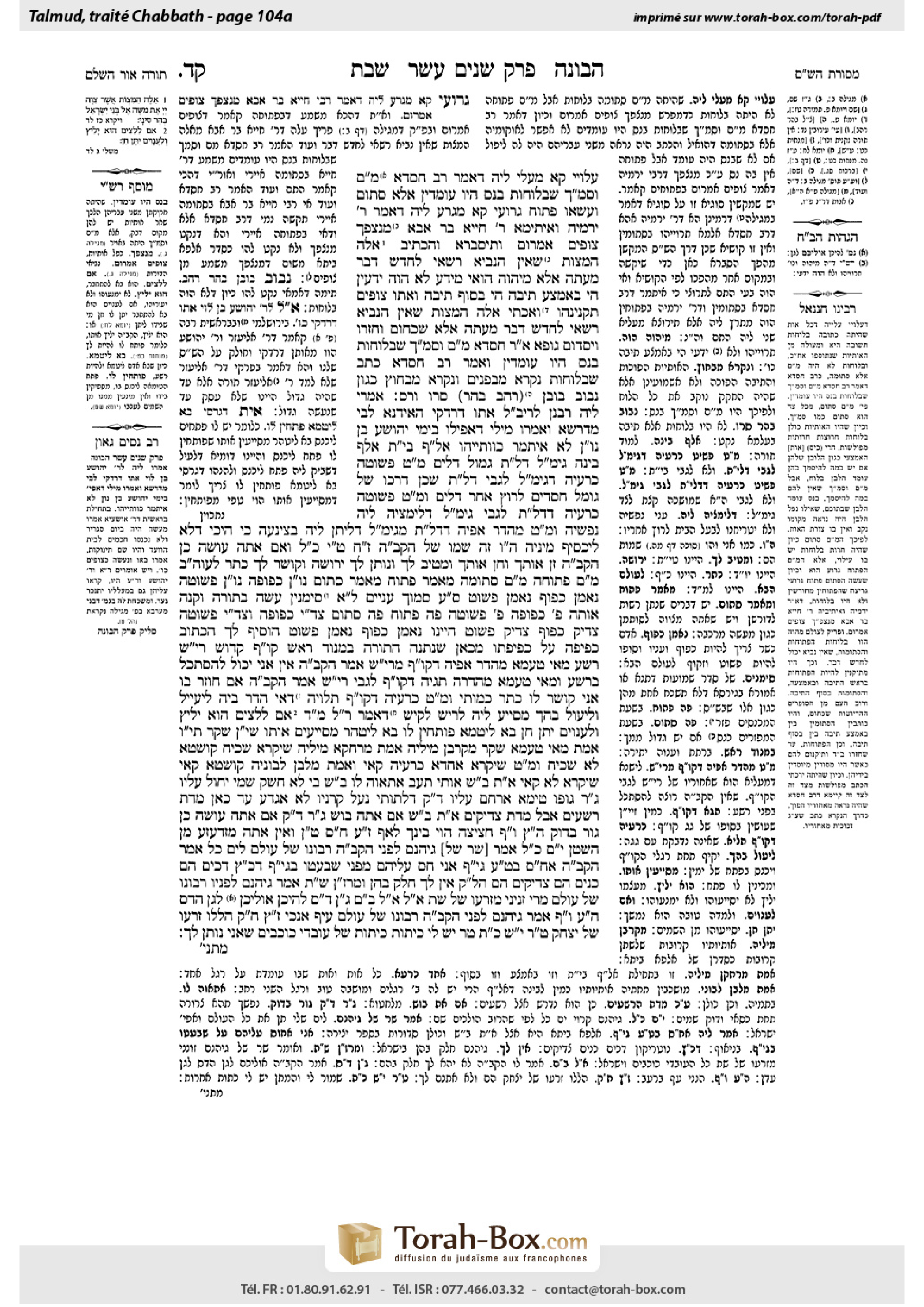
Shabbat 104a: Talmud study for Daf Yomi
Daf Yomi is the daily study of one Talmud folio. Explore 37 tractates with scans, Hebrew text, Sefaria English and AI-generated French translations where annotated.
Passage selection and English or AI-generated French translation are available where the scan has annotations. Daf Study is independent of Torah-Box and Sefaria.
Browse Shabbat · שבת · All tractatesShabbat 104a text and translations
This page of Shabbat includes the Aramaic text, an English translation and an AI-generated French translation, alongside the scan above.
שבת ק״ד א · Aramaic and Hebrew text
עַלּוֹיֵי קָא מְעַלֵּי לֵיהּ, דְּאָמַר רַב חִסְדָּא: מֵ״ם וְסָמֶ״ךְ שֶׁבַּלּוּחוֹת בְּנֵס הָיוּ עוֹמְדִין. אֶלָּא סָתוּם וַעֲשָׂאוֹ פָּתוּחַ — גָּרוֹעֵי קָא מְגָרַע לֵיהּ, דְּאָמַר רַבִּי יִרְמְיָה, וְאִיתֵּימָא רַבִּי חִיָּיא בַּר אַבָּא: מַנְצְפַךְ צוֹפִים אֲמָרוּם.
וְתִיסְבְּרָא?! וְהָכְתִיב: ״אֵלֶּה הַמִּצְוֹת״ — שֶׁאֵין הַנָּבִיא רַשַּׁאי לְחַדֵּשׁ דָּבָר מֵעַתָּה! אֶלָּא מִיהְוָה הֲוַאי, מִידָּע לָא הֲוָה יָדְעִין הֵי בְּאֶמְצַע תֵּיבָה הֵי בְּסוֹף תֵּיבָה, וַאֲתוֹ צוֹפִים תַּקְּנִינְהוּ. וְאַכַּתִּי ״אֵלֶּה הַמִּצְוֹת״ — שֶׁאֵין הַנָּבִיא רַשַּׁאי לְחַדֵּשׁ דָּבָר מֵעַתָּה! אֶלָּא, שְׁכָחוּם וְחָזְרוּ וְיִסְּדוּם.
גּוּפָא, אָמַר רַב חִסְדָּא: מֵ״ם וְסָמֶ״ךְ שֶׁבַּלּוּחוֹת בְּנֵס הָיוּ עוֹמְדִין. וְאָמַר רַב חִסְדָּא: כְּתָב שֶׁבַּלּוּחוֹת נִקְרָא מִבִּפְנִים וְנִקְרָא מִבַּחוּץ, כְּגוֹן: ״נְבוּב״ — ״בובן״, ״רַהַב״ — ״בָּהָר״, ״סָרוּ״ — ״ורס״.
אָמְרִי לֵיהּ רַבָּנַן לְרַבִּי יְהוֹשֻׁעַ בֶּן לֵוִי: אֲתוֹ דַּרְדְּקֵי הָאִידָּנָא לְבֵי מִדְרְשָׁא וַאֲמַרוּ מִילֵּי דַּאֲפִילּוּ בִּימֵי יְהוֹשֻׁעַ בִּן נוּן לָא אִיתְּמַר כְּווֹתַיְיהוּ: אָלֶ״ף בֵּי״ת — אֲלַף בִּינָה. גִּימֶ״ל דָּלֶ״ת — גְּמוֹל דַּלִּים. מַאי טַעְמָא פְּשׁוּטָה כַּרְעֵיהּ דְּגִימֶ״ל לְגַבֵּי דָּלֶ״ת — שֶׁכֵּן דַּרְכּוֹ שֶׁל גּוֹמֵל חֲסָדִים לָרוּץ אַחַר דַּלִּים. וּמַאי טַעְמָא פְּשׁוּטָה כַּרְעֵיהּ דְּדָלֶ״ת לְגַבַּי גִּימֶ״ל — דְּלַימְצְיַהּ לֵיהּ נַפְשֵׁיהּ. וּמַאי טַעְמָא מְהַדַּר אַפֵּיהּ דְּדָלֶ״ת מִגִּימֶ״ל — דְּלִיתֵּן לֵיהּ בְּצִינְעָה, כִּי הֵיכִי דְּלָא לִיכְּסִיף מִינֵּיהּ.
ה״ו — זֶה שְׁמוֹ שֶׁל הַקָּדוֹשׁ בָּרוּךְ הוּא. ז״ח ט״י כ״ל — וְאִם אַתָּה עוֹשֶׂה כֵּן, הַקָּדוֹשׁ בָּרוּךְ הוּא זָן אוֹתְךָ, וְחָן אוֹתְךָ, וּמֵטִיב לְךָ, וְנוֹתֵן לְךָ יְרוּשָּׁה, וְקוֹשֵׁר לְךָ כֶּתֶר לָעוֹלָם הַבָּא. מֵ״ם פְּתוּחָה, מֵ״ם סְתוּמָה — מַאֲמָר פָּתוּחַ, מַאֲמָר סָתוּם. נוּ״ן כְּפוּפָה, נוּ״ן פְּשׁוּטָה — נֶאֱמָן כָּפוּף, נֶאֱמָן פָּשׁוּט.
ס״ע — סְמוֹךְ עֲנִיִּים. לִישָּׁנָא אַחֲרִינָא: סִימָנִין עֲשֵׂה בַּתּוֹרָה וּקְנֵה אוֹתָהּ. פ׳ כְּפוּפָה, פ׳ פְּשׁוּטָה — פֶּה פָּתוּחַ, פֶּה סָתוּם. צָדִ״י כְּפוּפָה וְצָדִ״י פְּשׁוּטָה — צַדִּיק כָּפוּף, צַדִּיק פָּשׁוּט. הַיְינוּ: נֶאֱמָן כָּפוּף, נֶאֱמָן פָּשׁוּט! הוֹסִיף לְךָ הַכָּתוּב כְּפִיפָה עַל כְּפִיפָתוֹ, מִכָּאן שֶׁנִּתְּנָה הַתּוֹרָה בִּמְנוֹד רֹאשׁ.
קוּ״ף — קָדוֹשׁ. רֵי״שׁ — רָשָׁע. מַאי טַעְמָא מְהַדַּר אַפֵּיהּ דְּקוּ״ף מֵרֵי״שׁ — אָמַר הַקָּדוֹשׁ בָּרוּךְ הוּא: אֵין אֲנִי יָכוֹל לְהִסְתַּכֵּל בָּרָשָׁע. וּמַאי טַעְמָא מְהַדַּר תָּגֵיהּ דְּקוּ״ף לְגַבֵּי רֵי״שׁ — אָמַר הַקָּדוֹשׁ בָּרוּךְ הוּא: אִם חוֹזֵר בּוֹ אֲנִי קוֹשֵׁר לוֹ כֶּתֶר כְּמוֹתִי. וּמַאי טַעְמָא כַּרְעֵיהּ דְּקוּ״ף תַּלְיָא — דְּאִי הָדַר בֵּיהּ, לִיעַיֵּיל.
וְלֵיעוּל בְּהָךְ! מְסַיַּיע לֵיהּ לְרֵישׁ לָקִישׁ, דְּאָמַר רֵישׁ לָקִישׁ: מַאי דִּכְתִיב ״אִם לַלֵּצִים הוּא יָלִיץ וְלַעֲנָוִים יִתֶּן חֵן״? בָּא לִיטַמֵּא — פּוֹתְחִין לוֹ, בָּא לִיטָּהֵר — מְסַיְּיעִים אוֹתוֹ.
שִׁי״ן — שֶׁקֶר. תָּי״ו — אֱמֶת. מַאי טַעְמָא שֶׁקֶר מְקָרְבָן מִילֵּיהּ, אֱמֶת מְרַחֲקָא מִילֵּיהּ? — שִׁיקְרָא שְׁכִיחַ, קוּשְׁטָא לָא שְׁכִיחַ. וּמַאי טַעְמָא שִׁיקְרָא אַחֲדָא כַּרְעֵיהּ קָאֵי, וֶאֱמֶת מְלַבַּן לַבּוֹנֵי — קוּשְׁטָא קָאֵי, שִׁיקְרָא לָא קָאֵי.
א״ת ב״ש: — אוֹתִי תִּעֵב אֶתְאַוֶּה לוֹ ב״ש בִּי לֹא חָשַׁק, שְׁמִי יָחוּל עָלָיו? ג״ר — גּוּפוֹ טִימֵּא, אֲרַחֵם עָלָיו ד״ק דַּלְתוֹתַי נָעַל, קַרְנָיו לֹא אֲגַדֵּעַ? עַד כָּאן מִדַּת רְשָׁעִים,
אֲבָל מִדַּת צַדִּיקִים: א״ת ב״ש — אִם אַתָּה בּוֹשׁ. ג״ר ד״ק — אִם אַתָּה עוֹשֶׂה כֵּן, גּוּר בְּדוֹק. ה״ץ ו״ף — חֲצִיצָה הָוֵי בֵּינְךָ לָאַף. ז״ע ח״ס ט״ן — וְאֵין אַתָּה מִזְדַּעְזֵעַ מִן הַשָּׂטָן. י״ם כ״ל — אָמַר [שַׂר שֶׁל] גֵּיהִנָּם לִפְנֵי הַקָּדוֹשׁ בָּרוּךְ הוּא: רִבּוֹנוֹ שֶׁל עוֹלָם, לַיָּם כֹּל.
אָמַר הַקָּדוֹשׁ בָּרוּךְ הוּא: אח״ס בט״ע גי״ף — אֲנִי חָס עֲלֵיהֶם מִפְּנֵי שֶׁבָּעֲטוּ בְּגִיף: דכ״ץ — דַּכִּים הֵם, כֵּנִים הֵם, צַדִּיקִים הֵם. הל״ק — אֵין לְךָ חֵלֶק בָּהֶן. ומרז״ן ש״ת — אָמַר גֵּיהִנָּם לְפָנָיו: רִבּוֹנוֹ שֶׁל עוֹלָם, מָרִי, זֻנֵינִי מִזַּרְעוֹ שֶׁל שֵׁת.
אָמַר לוֹ: א״ל ב״ם ג״ן ד״ס — לְהֵיכָן אוֹלִיכֵן, לְגַן הֲדַס. ה״ע ו״ף — אָמַר גֵּיהִנָּם לִפְנֵי הַקָּדוֹשׁ בָּרוּךְ הוּא: רִבּוֹנוֹ שֶׁל עוֹלָם, עָיֵף אָנֹכִי. ז״ץ ח״ק — הַלָּלוּ זַרְעוֹ שֶׁל יִצְחָק. ט״ר י״ש כ״ת — טֹר יֵשׁ לִי כִּיתּוֹת כִּיתּוֹת שֶׁל אוּמּוֹת הָעוֹלָם שֶׁאֲנִי נוֹתֵן לְךָ.
Shabbat 104a · English translation
he elevates its status, as Rav Ḥisda said: The letters mem and samekh that were in the tablets were standing miraculously. Each letter was chiseled all the way through the tablets. In that case, the segment of the tablets at the center of the samekh and final mem, letters that are completely closed, should have fallen. Miraculously, they remained in place. Consequently, rendering an open mem closed elevates its status. However, if one rendered a closed letter open, he diminishes its status, as Rabbi Yirmeya said, and some say that it was Rabbi Ḥiyya bar Abba who said: The prophets instituted the difference between the open and closed forms of the letters mem, nun, tzadi, peh, kaf. Since the closed letters date back to the Ten Commandments, apparently the prophets introduced the open versions of the letters, which are therefore less significant.
The Gemara rejects this: And is that reasonable? Isn’t it written: “These are the commandments that the Lord commanded Moses to tell the children of Israel at Mount Sinai” (Leviticus 27:34). The word “these” underscores that a prophet is not permitted to introduce any new element related to the Torah and its mitzvot from here on. Rather, the prophets did not innovate these forms. Both the open and closed versions existed before then. However, people did not know which form appeared in the middle of a word and which form at the end of a word. And the prophets came and instituted their set positions. The Gemara asks: And still the question remains: Didn’t the Sages derive from the verse: “These are the commandments,” that a prophet is not permitted to introduce any new element from here on? How could they institute the position of the letters? Rather, over the course of time, the people forgot their positions in the words and the prophets then reestablished their positions. Apparently, closed letters are no more significant than the open ones.
The Gemara returns to discuss the matter itself. Rav Ḥisda said: The letters mem and samekh that were in the tablets were standing miraculously. And furthermore, Rav Ḥisda said: The writing on the tablets was read from the inside, from one side of the tablets, and read from the outside, the other side of the tablets, in reverse order. The Gemara cites words that appear elsewhere in the Bible: Nevuv was read as bet, vav, bet, nun; rahav as beit, heh, reish; and saru as vav, reish, samekh.
The Sages said to Rabbi Yehoshua ben Levi: Young students came today to the study hall and said things the likes of which were not said even in the days of Joshua bin Nun. These children who only knew the Hebrew alphabet interpreted the letters homiletically.
Alef beit means learn [elaf] the wisdom [bina] of the Torah.
Gimmel dalet means give to the poor [gemol dalim]. Why is the leg of the gimmel extended toward the dalet? Because it is the manner of one who bestows loving-kindness to pursue the poor. And why is the leg of the dalet extended toward the gimmel? It is so that a poor person will make himself available to him who wants to give him charity. And why does the dalet face away from the gimmel? It is to teach that one should give charity discreetly so that the poor person will not be embarrassed by him.
The children continued to interpret the letters.
Heh vav: That is the principal name of the Holy One, Blessed be He.
Zayin ḥet, tet yod, kaf lamed: And if you do so, the Holy One, Blessed be He, feeds [zan] you, and shows you favor [ḥan], and bestows goodness [meitiv] upon you, and gives you an inheritance [yerusha], and ties a crown [keter] for you in the World to Come [la’olam haba].
The open mem and closed mem indicate that the Torah contains an open statement, understood by all, and an esoteric statement.
The bent nun and the straight nun at the end of a word refer to a faithful person who is bent [ne’eman kafuf] and is modest now, who will ultimately become a well-known faithful person [ne’eman pashut].
Samekh ayin: Support the poor [semokh aniyyim] to prevent them from falling further. Another version: Make mnemonic signs [simanim aseh] to remember the Torah and acquire it.
The bent peh and the straight peh: Sometimes one needs to have an open mouth [peh patuaḥ] and speak, and sometimes one needs to have a closed mouth [peh satum].
The bent tzadi and the straight tzadi indicate that a righteous person who is bent and humble [tzaddik kafuf] now will ultimately become a well-known righteous person [tzaddik pashut] whose righteousness is apparent to all. The Gemara asks: That is identical to the interpretation of the bent and straight nun: Ne’eman kafuf, ne’eman pashut. The Gemara explains: The verse added the bending of the righteous person to the bending of the faithful person. From here it is derived that the Torah was given in an atmosphere of gravity. One must receive the Torah with a sense of awe and extreme humility.
The children continued:
Kuf: Holy [kadosh], referring to God.
Reish: A wicked person [rasha]. Why is the kuf facing away from the reish? This question was phrased euphemistically, as it is the reish that is facing away from the kuf. The Holy One, Blessed be He, said: I am unable look at a wicked person, i.e., the wicked person does not want to look toward God. And why is the crown of the letter kuf turned toward the reish? The Holy One, Blessed be He, said: If the wicked person repents his evil ways I will tie a crown for him like My own. And why is the leg of the kuf suspended and not connected to the roof of the letter? Because if the wicked person repents he can enter through this opening if he so desires.
The Gemara asks: Let him enter through that opening, as the kuf is open on both sides at the bottom. The Gemara answers: This supports the statement of Reish Lakish, as Reish Lakish said: What is the meaning of that which is written: “If it concerns the scorners, He scorns them, and unto the humble He gives grace” (Proverbs 3:34)? One who comes in order to become impure, i.e., to sin, they, in Heaven, provide him with an opening to do so, and he is not prevented from sinning. However, if he comes in order to become purified, not only is he allowed to do so, but they, in Heaven, assist him.
They further taught:
Shin: Falsehood [sheker]. Tav: Truth [emet].
Why are the letters of the word sheker adjacent to one another in the alphabet, while the letters of emet are distant from one another? That is because while falsehood is easily found, truth is found only with great difficulty. And why do the letters that comprise the word sheker all stand on one foot, and the letters that comprise the word emet stand on bases that are wide like bricks? Because the truth stands eternal and falsehood does not stand eternal.
The Gemara cites another midrash that also deals with the letters of the alphabet. This one uses a code in which the first letter is paired with the last letter, the second letter with the penultimate one, and so on [alef tav, beit shin]. Alef tav, God said: If he despised Me [oti ti’ev] would I desire [etaveh] him? Beit shin: If he does not desire to worship Me [bi], shall My name [shemi] rest upon him? Gimmel reish: He defiled his body [gufo]; shall I have mercy [araḥem] on him? The word comprised of the letters gimmel and reish in Aramaic means licentiousness. Dalet kuf: He locked My doors [daltotai], shall I not cut off his horns [karnav]? To this point, the Gemara interpreted the letters as referring to the attribute of the wicked.
However, with regard to the attribute of the righteous it is taught differently. Alef tav, beit shin: If you have shame [ata bosh], gimmel reish, dalet kuf: If you do so, you will reside [gur] in the heavens [bedok], as the verse says: “Who stretches out the Heavens like a curtain [dok]” (Isaiah 40:22). Heh tzadi, vav peh: There is a partition [ḥatzitza havei] between you and anger [af]. Zayin ayin, ḥet samekh, tet nun: And you will not be shaken [mizdaze’a] by the Satan. Yod mem, kaf lamed: The minister of Gehenna said before the Holy One, Blessed be He: Master of the Universe, send the righteous as well into the sea to which all go [yam kol], Gehenna.
The interpretation of the alphabet continues with other combinations of letters. The Holy One, Blessed be He, said: Alef ḥet samekh, bet tet ayin, gimmel yod peh: I have mercy on them [Ani ḥas aleihem] because they spurned [ba’atu] adultery [gif]. The Gemara continues with this combination of the letters: Dalet kaf tzadi: They are pure [dakkim], they are honest [kenim], they are righteous [tzaddikim]. Heh lamed kuf: You have no portion [ḥelek] with them, based on the interchange of the letters ḥet and heh. Vav mem reish zayin nun, shin tav: The minister of Gehenna said [amar], based on vav mem reish, before Him: Master of the Universe, my Master [Mari], sustain me [zaneini] with the seed of Seth [Shet], which refers to all humankind, including the Jewish people.
The Holy One, Blessed be He, said to him using another configuration of the alphabet: Alef lamed, beit mem: Not with them [al bam], i.e., you will have no portion of them. Gimmel nun, dalet samekh: To where will I lead them? I will lead them to the garden of myrtle [gan hadas], i.e., the Garden of Eden. Heh ayin, vav peh: The minister of Gehenna said before the Holy One, Blessed be He: Master of the Universe, I am tired [ayef anokhi] and thirsty and need people to care for me. The Holy One, Blessed be He, responded: Zayin tzadi, ḥet kuf: These are the descendants [zaro] of Isaac [Yitzḥak]. Tet reish, yod shin, kaf tav: Wait [tar], I have groups upon groups [yesh li kittot kittot] of other nations that I will give you instead.
Shabbat 104a · Traduction française (IA)
Il élève son statut, comme l’a dit Rav Ḥisda : Les lettres mem et samekh qui se trouvaient sur les Tables tenaient miraculeusement. Chaque lettre était gravée de part en part des Tables. Dans ce cas, le segment des Tables situé au centre du samekh et du mem final, des lettres entièrement fermées, aurait dû tomber. Miraculeusement, il resta en place. Par conséquent, transformer un mem ouvert en mem fermé élève son statut. En revanche, transformer une lettre fermée en lettre ouverte en diminue le statut, comme l’a dit Rabbi Yirmeya — et certains disent que c’est Rabbi Ḥiyya bar Abba qui l’a dit : Les prophètes ont institué la distinction entre les formes ouverte et fermée des lettres mem, nun, tzadi, peh et kaf. Puisque les lettres fermées remontent aux Dix Commandements, il semble que les prophètes aient introduit les formes ouvertes des lettres, qui sont donc moins importantes.
La Guemara rejette cette explication : Est-ce raisonnable ? N’est-il pas écrit : « Tels sont les commandements que l’Éternel a ordonné à Moïse de transmettre aux enfants d’Israël, au mont Sinaï » (Lévitique 27:34) ? Le mot « tels » souligne qu’un prophète n’est désormais autorisé à introduire aucun élément nouveau concernant la Torah et ses mitsvot. Les prophètes n’ont donc pas innové ces formes. Les formes ouverte et fermée existaient toutes deux auparavant. Cependant, les gens ne savaient pas quelle forme apparaissait au milieu d’un mot et laquelle apparaissait à la fin. Les prophètes vinrent alors et en fixèrent les positions respectives. La Guemara demande : Mais la question demeure : Les Sages n’ont-ils pas déduit du verset « Tels sont les commandements » qu’un prophète n’est désormais autorisé à introduire aucun élément nouveau ? Comment ont-ils pu fixer la position des lettres ? En réalité, au fil du temps, le peuple avait oublié leur position dans les mots, et les prophètes les rétablirent. Il semble donc que les lettres fermées ne soient pas plus importantes que les lettres ouvertes.
La Guemara revient à la question elle-même. Rav Ḥisda a dit : Les lettres mem et samekh qui se trouvaient sur les Tables tenaient miraculeusement. Rav Ḥisda a également dit : L’écriture des Tables se lisait de l’intérieur, depuis une face des Tables, et de l’extérieur, depuis l’autre face, en sens inverse. La Guemara cite des mots qui apparaissent ailleurs dans la Bible : Nevuv se lisait bet, vav, bet, nun ; rahav, beit, heh, reish ; et saru, vav, reish, samekh.
Les Sages dirent à Rabbi Yehoshua ben Levi : De jeunes élèves sont venus aujourd’hui à la maison d’étude et ont prononcé des paroles telles qu’on n’en avait même pas entendues du temps de Josué, fils de Noun. Ces enfants, qui ne connaissaient que l’alphabet hébreu, interprétèrent les lettres par homélie. Alef beit signifie : Apprends [elaf] la sagesse [bina] de la Torah. Gimmel dalet signifie : Donne aux pauvres [gemol dalim]. Pourquoi la jambe du gimmel est-elle tendue vers le dalet ? Parce que celui qui pratique la bonté a pour habitude de poursuivre les pauvres pour leur venir en aide. Et pourquoi la jambe du dalet est-elle tendue vers le gimmel ? Pour que le pauvre se rende accessible à celui qui veut lui donner la tsedaka. Et pourquoi le dalet tourne-t-il le dos au gimmel ? Pour enseigner qu’il faut donner la tsedaka discrètement, afin que le pauvre n’en soit pas humilié.
Les enfants continuèrent d’interpréter les lettres. Heh vav : C’est le Nom principal du Saint, béni soit-Il. Zayin ḥet, tet yod, kaf lamed : Si tu agis ainsi, le Saint, béni soit-Il, te nourrit [zan], te témoigne de la faveur [ḥan], te comble de bonté [meitiv], te donne un héritage [yerusha] et t’attache une couronne [keter] dans le Monde à venir [la’olam haba]. Le mem ouvert et le mem fermé indiquent que la Torah comporte un enseignement ouvert, compris de tous, et un enseignement ésotérique. Le nun courbé et le nun droit en fin de mot désignent une personne fidèle, courbée [ne’eman kafuf] et modeste à présent, qui finira par devenir une personne fidèle bien connue [ne’eman pashut].
Samekh ayin : Soutiens les pauvres [semokh aniyyim] pour les empêcher de tomber davantage. Autre version : Fais des signes mnémotechniques [simanim aseh] pour te souvenir de la Torah et l’acquérir. Le peh courbé et le peh droit : Parfois, il faut avoir la bouche ouverte [peh patuaḥ] et parler ; parfois, il faut garder la bouche fermée [peh satum]. Le tzadi courbé et le tzadi droit indiquent qu’un juste courbé et humble [tzaddik kafuf] à présent finira par devenir un juste bien connu [tzaddik pashut], dont la justice sera manifeste à tous. La Guemara demande : Cela revient au même que l’interprétation du nun courbé et du nun droit : Ne’eman kafuf, ne’eman pashut. La Guemara explique : Le verset a ajouté le fait que le juste soit courbé à celui que le fidèle soit courbé. On en déduit que la Torah a été donnée dans une atmosphère de gravité. Il faut recevoir la Torah avec un sentiment de crainte et une extrême humilité.
Les enfants continuèrent : Kuf : Saint [kadosh], en référence à Dieu. Reish : Un méchant [rasha]. Pourquoi le kuf tourne-t-il le dos au reish ? Cette question est formulée par euphémisme, car c’est le reish qui tourne le dos au kuf. Le Saint, béni soit-Il, dit : Je ne peux pas regarder un méchant ; autrement dit, le méchant ne veut pas se tourner vers Dieu. Et pourquoi la couronne de la lettre kuf est-elle tournée vers le reish ? Le Saint, béni soit-Il, dit : Si le méchant se repent de ses mauvaises voies, je lui attacherai une couronne semblable à la mienne. Et pourquoi la jambe du kuf est-elle suspendue et non reliée au toit de la lettre ? Parce que, si le méchant se repent, il peut entrer par cette ouverture s’il le souhaite.
La Guemara demande : Qu’il entre par cette ouverture, puisque le kuf est ouvert des deux côtés en bas. La Guemara répond : Cela appuie la déclaration de Reish Lakish, car Reish Lakish a dit : Quel est le sens de ce qui est écrit : « S’il s’agit des moqueurs, Il se moque d’eux, mais aux humbles Il accorde Sa grâce » (Proverbes 3:34) ? À celui qui vient pour se rendre impur, c’est-à-dire pour pécher, on ménage, là-haut, une ouverture qui lui permette de le faire, et on ne l’empêche pas de pécher. En revanche, s’il vient pour se purifier, non seulement on le laisse faire, mais on l’aide, là-haut.
Ils enseignèrent encore : Shin : Le mensonge [sheker]. Tav : La vérité [emet]. Pourquoi les lettres du mot sheker sont-elles adjacentes dans l’alphabet, alors que celles du mot emet en sont éloignées ? Parce que le mensonge se trouve facilement, tandis que la vérité ne se trouve qu’avec beaucoup de difficulté. Et pourquoi les lettres qui composent le mot sheker tiennent-elles toutes sur un seul pied, tandis que celles qui composent le mot emet reposent sur des bases larges comme des briques ? Parce que la vérité demeure éternellement, tandis que le mensonge ne demeure pas éternellement.
La Guemara cite un autre midrach qui traite lui aussi des lettres de l’alphabet. Celui-ci utilise un code où la première lettre est associée à la dernière, la deuxième à l’avant-dernière, et ainsi de suite [alef tav, beit shin]. Alef tav : Dieu dit : S’il M’a méprisé [oti ti’ev], le désirerais-je [etaveh] ? Beit shin : S’il ne désire pas Me servir [bi], Mon nom [shemi] reposera-t-il sur lui ? Gimmel reish : Il a souillé son corps [gufo] ; aurais-je pitié [araḥem] de lui ? Le mot formé par les lettres gimmel et reish signifie en araméen la débauche. Dalet kuf : Il a fermé Mes portes [daltotai] ; ne lui couperais-je pas les cornes [karnav] ? Jusqu’ici, la Guemara a interprété les lettres comme renvoyant à la conduite des méchants.
Cependant, l’enseignement concernant la conduite des justes est différent. Alef tav, beit shin : Si tu as honte [ata bosh], gimmel reish, dalet kuf : si tu agis ainsi, tu résideras [gur] dans les cieux [bedok], comme le dit le verset : « Lui qui étend les cieux comme un rideau [dok] » (Isaïe 40:22). Heh tzadi, vav peh : Une cloison [ḥatzitza havei] te sépare de la colère [af]. Zayin ayin, ḥet samekh, tet nun : Tu ne seras pas ébranlé [mizdaze’a] par le Satan. Yod mem, kaf lamed : Le ministre de la Géhenne dit au Saint, béni soit-Il : Maître de l’Univers, envoie aussi les justes dans la mer où tous vont [yam kol], la Géhenne.
L’interprétation de l’alphabet se poursuit avec d’autres combinaisons de lettres. Le Saint, béni soit-Il, dit : Alef ḥet samekh, bet tet ayin, gimmel yod peh : J’ai pitié d’eux [Ani ḥas aleihem], parce qu’ils ont rejeté [ba’atu] l’adultère [gif]. La Guemara poursuit avec cette combinaison de lettres : Dalet kaf tzadi : Ils sont purs [dakkim], honnêtes [kenim] et justes [tzaddikim]. Heh lamed kuf : Tu n’as aucune part [ḥelek] avec eux, selon l’interversion des lettres ḥet et heh. Vav mem reish zayin nun, shin tav : Le ministre de la Géhenne dit [amar], d’après vav mem reish, devant Lui : Maître de l’Univers, mon Maître [Mari], nourris-moi [zaneini] de la descendance de Seth [Shet], qui désigne toute l’humanité, y compris le peuple juif.
Le Saint, béni soit-Il, lui répondit au moyen d’une autre configuration de l’alphabet : Alef lamed, beit mem : Pas avec eux [al bam], c’est-à-dire que tu n’auras aucune part en eux. Gimmel nun, dalet samekh : Où les conduirai-je ? Je les conduirai dans le jardin de myrtes [gan hadas], c’est-à-dire le Jardin d’Éden. Heh ayin, vav peh : Le ministre de la Géhenne dit au Saint, béni soit-Il : Maître de l’Univers, je suis fatigué [ayef anokhi] et j’ai soif ; j’ai besoin de gens pour prendre soin de moi. Le Saint, béni soit-Il, répondit : Zayin tzadi, ḥet kuf : Ce sont les descendants [zaro] d’Isaac [Yitzḥak]. Tet reish, yod shin, kaf tav : Attends [tar], j’ai des groupes et encore des groupes [yesh li kittot kittot] d’autres nations que je te donnerai à la place.
Traduction française générée par IA à partir de l’édition anglaise de Sefaria. Vérifie toujours un passage avec le texte source.
Text from Sefaria: William Davidson Edition - Vocalized Aramaic (CC BY NC); William Davidson Edition - English (CC BY NC).